Deborah Middleton (2024). Integrating space syntax methods in building environmental simulations and urban studies to enhance designer's critical reflective practice. In: Human Interaction and Emerging Technologies (IHIET 2024). AHFE Open Access, vol. 157, pp. 497–507. https://doi.org/10.54941/ahfe1005509
The aim of the study assesses how architecture students reflectively evolve their procedural (tacit) knowledge, iterate innovative design strategies and logically link simulation modeling outcomes to develop synoptic synthesis with architectural understanding. A model of Reflective Synthesis Design Cognition (RSDC) is developed that extends Donald Schön’s seeing-moving-seeing model of reflection in action with material of a design situation. Two design pedagogy approaches were developed to test the validity of the RSDC model through the prototyping of student application of simulation modeling tools commonly used in building environmental performance and urban studies. The first trial required young designers to adapt a variety of design simulation modeling approaches to discover and transform the environmental performance of their architecture studio project, with a second trial required students to investigate the urban spatial morphology surrounding their project site. The two trials integrated an unfamiliar methodology, space syntax undertaking modeling with a variety of depthmapX tools. Research methods use in this study include, content analysis of the simulation modeling outcomes in order to classify the formative application of simulation modeling to test design strategy, with an investigative on-line survey questionnaire exploring user experience and self-identification of psychometric processes. Findings highlight the need for descriptive studies examining referential reflection, qualitative assessment reflection, and summative versus synthesis constructivist knowledge formation.
Design simulations result from the interaction of variables, from spatial form, configuration and orientation, to tactile materials, and variables that provide contextual framing such as environmental, temporal, behavioural, social organization. In contemporary design practice, digital simulations combine and form interactive relationships from single to multiple parameters, that are
descriptive as 2D and 3D digital models, that may also contain information as output relational data (i.e. quantity of solar irradiance exposure on a building façade). Using computer aided simulation techniques, designers engage in mental processes that frame design tasks to solve a design problem, establish logical sequences of design moves - as steps in interactive informational processing with a simulation.
To advance the simulation phase into concrete design phase, designers must engage in reference and reflection with the designed object, in order to achieve understanding. This process engages enhancing students ability to distinguish and isolates variables through their per-formative interaction and apply reflective qualitative judgment to link simulation outcomes to design goals.
This paper provides evidence of how designers engage in relational and reflective conversations with new design visualizations to generate a summative synthesis, as knowledge and understanding. In order to gain an understanding of different cognitive process, research trials introduced students to a previously unknown design simulation methodology, that generates new visual representation. This study illustrates how designers define design problems, and apply a combination of simulation types to model and adjust a design strategy and proposal.
In the next section, I presents a brief literature review on previous insights into design cognition and iteration. Donald Schön’s model of seeing-moving- seeing is then adapted as a new cognitive schema, that engages constructs of reference, analysis, and reflection. The research approach and design output samples from two different trials is presented in Section discusses the results and presents highlights of the interaction between information processing and design strategy formulation.
Insights from an on-line survey deepen understanding of the cognitive processes related to reflection, reference and summative synthesis. The conclusion poses new questions for design cognition research and possible ways to investigate these further.
LITERATURE REVIEW
Design Cognition Research Early research into design cognition focused on the structure of the design task from the perspective of protocol analysis, to examine problem-solving behaviour and mental information processing (Ericson & Simon, 1984). Design task analysis has also categorized cognitive behaviour as seeking patterns, encoding meaning and developing classification and ordering systems (Atkins, 1978; Eastman, 1969). Studies of design work flow have identified the inherent challenge facing a designer to scope the design context, characterize an ill-defined design problem, define a strategic approach, and concept, and apply the designers experience and tacit knowledge, to organize different sub-tasks (Goel et al., 1996). Dorst (1997) found that designers rely heavily on the external representations involved in order to develop an awareness of what the designer is doing. Schön’s model of knowing-in-action with materials of a design situation, suggests that a designers’ process is
Integrating Space Syntax Methods in Building Environmental Simulations 499
revealed in and by doing actual designing, when they are in transaction with a design situation which in turn they create (Schön, 1992). Schön further suggests that through engagement with design processes, a designer interacts with intermediate design representations, that may change their view of the current design as a result of them generating and interpreting representations of the design (Schön, 1992). This research seeks to gain further insights into the design psychometric process.
The Role of Iteration in Design Cognitive Processes The design learning process is also iterative. Designers reflectively study design outcomes, engage in constructing referential systems of meaning, respond, react, plan to modify, and adjust, a designed object or its spatial relationships, in a cyclical way. Iteration may occur at multiple phases in the design process, from innovative concept development, to the framing and decomposition of complex problems, or in the need to integrate design processes (Eppinger et al., 1994). Feedback loops, as a stage-based design development process, are used by designers to drive innovation within a project, and also generate learning across consecutive or concurrent projects (Pahl & Beitz, 1996; Kline, 1985; Eppinger et al., 1994). Exploration and convergence processes, also apply iteration, to enable alternatives to be repeatedly generated, analysed, and evaluated (Wynn & Clarkson, 2005). Schön & Wiggins (1992) viewed this to involve a form of sequential development interplay in design problem and concept formation. The co- evolution of the problem and solution spaces (Dorst and Cross, 2001) may be defined in relation to time duration, scale, context and scope of the design problem, and aspects of value-added versus corrective action, (Wynn and Clarkson, 2016) align to the reframing of the design problem (Kolodner and Wills, 1996). In these cases, qualitative reference and reflective processes may be engaged by the designer.
Design Appropriate Learning Models and Theories Piaget’s cognitive development model, and Kolb’s learning styles, are two learning theories suited to the pedagogy of architecture and design in their consideration of learning as an internal mental process. Teaching from this perspective engages students to develop cognitive abilities to problem- solve, organize information, and develop purposeful self-directed learning practices. Students apply their knowledge and focus on their internal learning as cognitive process. Using reflective observation learners transition their experiential learning into knowledge, which then can be flexibly applied to a range of new situations (Kolb, 1984). Piaget in his theory of cognitive development posits that ‘through the construction, expansion, and integration of mental structures, the individual not only acts (mentally and behaviorally) following the principles of logic, but also becomes more and more able to accurately predict future events (Piaget, 1971 in Kazi & Galanaki, 2020).
500 Middleton
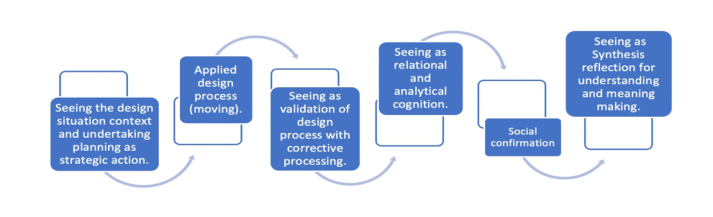
REFLECTIVE SYTHESIS DESIGN COGNTION MODEL In this paper I draw attention to the above processes, and present a new model with a focus on information processing, reflection, reference and synthesis. The RSDC framework, expands on Schön’s reflection in action model, by placing emphasis on psychometric processes that aid the development of design strategies. Additionally the approach taken in this study, integrates many of the above constructs to examine how student designers engage in experimental prototyping, order and classification in information processing, and engage in iterative and variable processes of analytical reasoning, reflection and reference.
Specifying the sequential process steps and linkage between cognitive phases is not addressed in this study, rather the research focus is on classifying user reference and reflection psychometric processes.
Figure 1: Design cognitive reflective synthesis learning model adapted from Schön seeing-moving-seeing (1992) framework of design cognition.
METHOD APPROACH In order to examine the appropriateness of this model to understand design cognition and learning processes, two undergraduate architecture modules, ARC201 Environmental Performance of Buildings, and ARC206 Urban Studies, were selected for an intervention that introduces new analytical simulation modeling approaches. The pedagogy applied in the two trials, places emphasis on reflection with simulation data representations, in order to test and develop sustainable design strategies for the site and building.
To minimize the influence of previous knowledge feedback loops in the cognitive process, a new previously unknown digital simulation tool depthmapX and Space Syntax analytical methods were used to augment environmental and urban studies analytical approaches. Students did not have prior experience,or knowledge of how to use space syntax theory or depthmapX, and were challenged to find an appropriate way to integrate this methodology into their workflow to pilot a design problem and environmental performance simulation strategy. The assignment structure sought to integrate psychometric processes from contextual assessment (seeing) strategy formation, memory, (moving) information processing sequencing of steps (moving), analytical and qualitative reasoning to modify simulation output and methodology (seeing), generate new, or engage in
Integrating Space Syntax Methods in Building Environmental Simulations 501
iterative testing of design strategy (moving), and engage in reflection (seeing) with aspects of qualitative value judgment.
Reflection in action in the context of the two trials was framed to be holistic in nature, distinguished as summative - presented as a type of analogue structuring of transactions, or synthesis - illustrated through a back and forth formation of knowing, as goal, methodology, strategy validation, for design implementation.
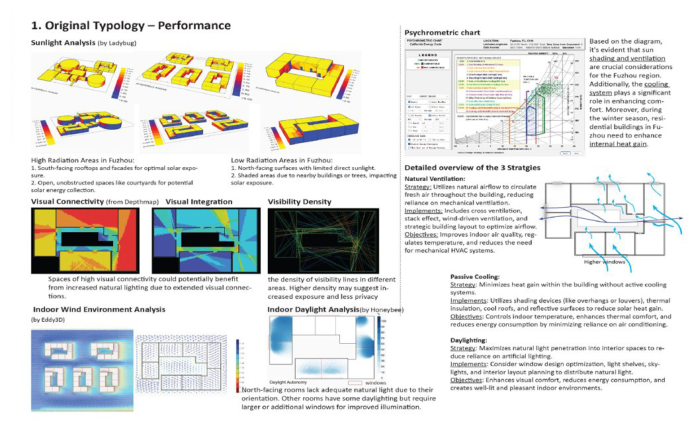
In trial one, student were tasked to devise a quantitative methodology for building and site environmental performance simulation to solve a design problem. The assignment required students to produce a summative understanding of environmental performance simulation approaches, aligned to a comprehensive design strategy that would address one or more problems that the student was to define. Simulation tools included depthmapX, ladybug & honeybee environmental plug-ins for Rhino, computational fluid dynamic modeling to achieve thermal comfort through, mean wind speed ratio (MWSR), and comfort wind zone ratio (CWZR) analysis. Within each type of simulation software there are a number of tools for focused analysis. It was anticipated that students would address design problems such as mitigating urban heat island, site building orientation paired to timed solar irradiance exposure, site design relationships to climate data with site wind dynamics, and spatial configuration that would enhance user comfort through daylighting, ventilation flows and visual experience.
The research approach in this trial undertook content analysis of student individual synoptic submissions to categorize the design problem, applied simulation methodology, applied design strategy, summative or synthesis format, partial or comprehensive design approach.
Figure 2: Trial one sample examining interior courtyard environmental performance simulations applying space syntax approach.
502 Middleton
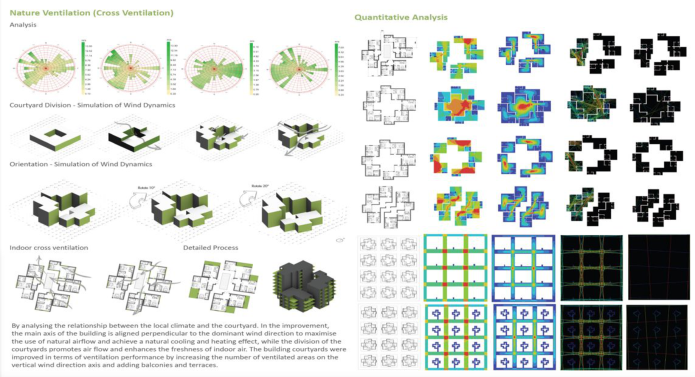
Figure 3: Trial one sample of iterative testing of design variations of spatial configuration applying space syntax approach and environmental performance simulations for ventilation.
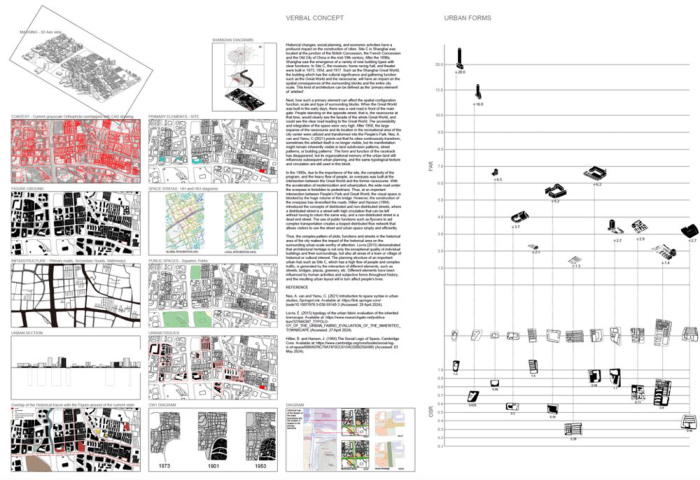
In Trial two, the urban area surrounding the site of the architecture project was analyzed to understand spatial morphology transformation over time. Students were required to examine the impact of additional variables on qualitative aspects of the site. Information approaches used by students include, physical site surveys, content mapping of spatial function location, user behavior in the urban environment, figure-ground diagramming with space syntax depthmapX to be integrated into the student course work. Students generated coded representations of variables at different resolutions and scales and selectively formatted the presentation as 2D and 3D maps. The assignment required a formative synthesis to demonstrate the students ability to engage in qualitative value judgment, and present summative or synthesize insight regarding the urban spatial structures transformations over time.
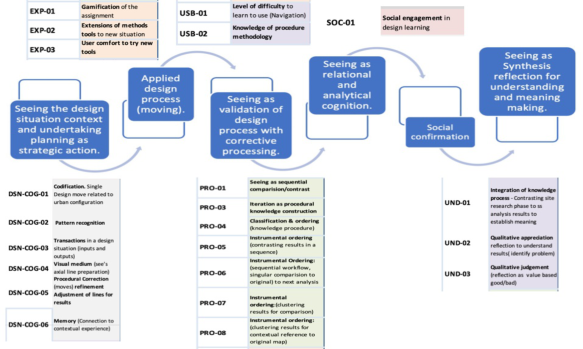
Figure 4: Framework for the questionnaire survey for Trial two aligned to the RSDC model.
Integrating Space Syntax Methods in Building Environmental Simulations 503
The research method applied in this trial presented students with an online survey requiring them to reflectively identify their applied mental process. The aim of the survey was to distinguish dominant cognitive processes, framed as gamification and exploration, information processing, pattern recognition, instrumental ordering and analysis typologies, memory, social validation, qualitative appreciation and qualitative judgement (see Figure 4). A content analysis of the course work submission was not undertaken in trial 2.
Figure 5: Trial two, sample synopsis panel with syntax analysis of street configuration contrasted to building typology and urban spatial morphology.
FINDINGS Information Processing, Simulations and Strategy Formation
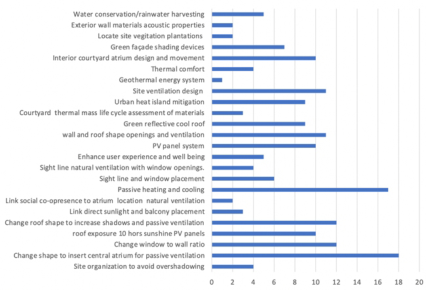
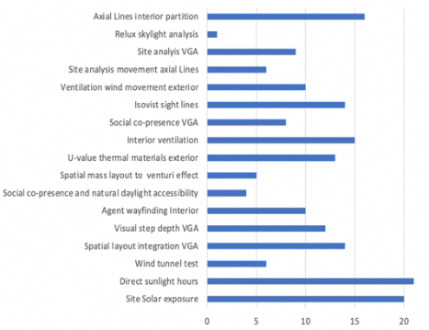
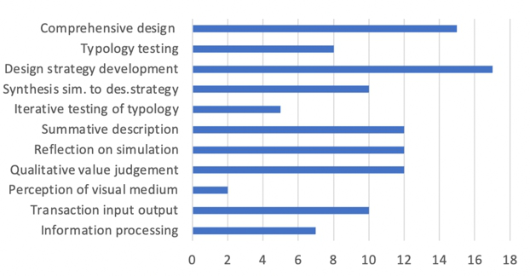
In Trial one, 26 course work submissions directly applied the space syntax methodology out of 141 total submissions. Results of the content analysis of submitted synoptic presentations, reveal that mean number of applied simulations to be 4.8, with minimum of 2 and maximum of 12 simulations applied. The mean number of design strategies applied was 7, with minimum of 2 and maximum of 12.
Ranking of applied typology of methods and strategies is shown in Figure 6 and 7. The design strategy developed required a robust number of design approaches be applied to solve sustainable problems and develop a comprehensive design proposal. To this end the majority of student submissions developed fine grain strategies that were surprisingly creative in applying space syntax approaches, and aligned to environmental simulation modeling data outputs. This was an unexpected outcome for the trial, requiring further investigation.
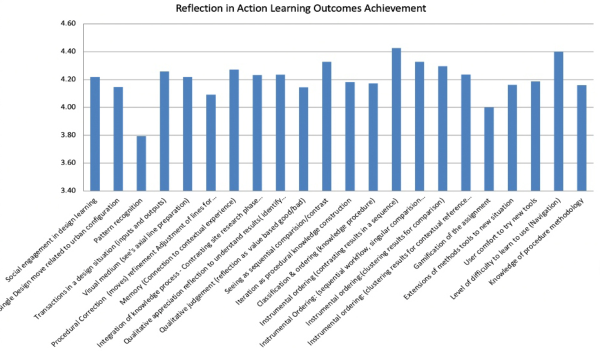
Reflection Synthesis Psychometric Processes The cognitive processes listed below reach levels of significance of 4.20 and above, to best illustrate student agreement to typologies of psychometric activity (see Figure 8). The survey results highlight a number of interesting findings regarding reference and reflective mental processes for students working with analogue and digital modelling. Pattern recognition processes received the lowest agreement response with instrumental ordering, contrasting results in a sequence receiving the highest agreement.
Significant processes distinguished in the survey relate to seeing as a sequential comparison or contrast activity, instrumental ordering as contrasting results in a sequence, followed by instrumental ordering of sequential workflow with singular comparison, and instrumental orderingclustering results for comparison with instrumental ordering, clustering results for contextual reference. Mental tasks of memory (connection to contextual experience) and transactions in a design situation (inputs - outputs), are also seen to play a role in formative understanding.
Integrating Space Syntax Methods in Building Environmental Simulations 505
Figure 8: Survey results on designers reflective awareness of mental processes Trial 2.
In Trial two, formative understanding is distinguished by mental processes such as ‘integrate knowledge process - contrasting site research phase’ and ‘qualitative appreciative reflection to understand results’. This is contrasted to Trial one, where design strategy and comprehensive design reach highest agreement as the significant pedagogical outcome. Student samples highlight summative description, reflection on simulation, and qualitative value judgment to be significant, followed by mental processes that primarily engage transactions of input output and synthesis linking simulation methods to design strategy.
Figure 9: Types of psychometric processes used by students in Trial 1.
CONCLUSION
This paper reports on findings from two trials framed by a model of reflection synthesis design cognition (RSDC) that extends Schön’s seeing-movingseeing model, applied as reflection in action with material of a design situation. It is noted that further clarification mapping into reference vs. reflection in
506 Middleton
action with materials from simulation modelling is required, to identify sub- classification types of design cognition. Further investigation into formative knowledge construction is also needed to fine tune the distinction between summative and synthesis processes in reflection, in order to advance cognitive learning models for design pedagogy. A second interesting outcome of this study is the experimentation richness that has resulted from introducing space syntax into environmental performance simulations. With limited guidance, students were successful in the formative construction of simulation models that informed unique, creative and comprehensive design proposals. While abstract thinking processes are often highlighted in conceptual design generation, more concrete outcome oriented simulations are required now to advance sustainability to the comprehensive design stage in architectural study at the junior pedagogy level.
REFERENCES
Atkin O How do architects design? An Artificial Intelligence and Pattern Recognition in Computer-Aided Design, Latombe J. C. Ed. North Holland Press,. 1978. New York, pp. 65–104. Baya V. and Leifer, L. 1996. Understanding Information Management in Conceptual
Design, in Cross N., Christians H., Dorst K., Eds. Analysing Design Activity, John Wiley and Sons, Chichester. pp. 151–168. Dorst K. 1997. Describing Design: A comparison of paradigms, Ph. D. thesis, TU Delft. Dorst & Cross. 1998. Co-Evolution of problem and solution spaces in creative
design; observations from an empirical study, Computational models of creative design, IV J. Gero and M. L Maher (ed) University of Sydney USW Australia. Eastman, C. 1969 Cognitive processes and ill-defined problems: A case study from design. Proceedings Joint International Conference on Artificial Intelligence. Walker, D., and Norton L., eds. ACM, Washington D. C. Ericson K. and Simon H. 1984. Protocol Analysis: Verbal reports as data. MIT Press,
Cambridge MA. Eppinger S. D. 1999. Model-based approaches to managing concurrent engineering.
Journal of Engineering Design. 2(4): 283–290. Goel G. A., Grue N., Murdock W., Recher M., Govindaraj T. 1996. Design explanations in interactive design environments, in Gero J. Eds. Proceedings Fourth International Conference on AI in Design, Palo Alto. Kazi S., Galanaki E. 2020. Piagetian theory of cognitive development. Entry in the
Encyclopedia of Child and Adolescent Development. Hupp S. & Jewell J. D. Eds. Wiley Publishers, New York. Kline, S. J. 1985. Innovation is not a linear process. Re. Mang 28(4):36–45.
Kolb D. A. 1984. Experiential learning: Experience as the source of learning and development (Vol. 1) Englewood cliffs, NJ. Prentice-Hall. Kolodner J. L. & Wills L. M.1996. Powers of observation in creative design. Design Studies 17(4): 385–416. Middleton D. A. 2024. Integrating Space Syntax into the architecture design studio:
Assessing adoption of new software tools to enhance critical reflective practice. Unpublished report EDU PGCERT 402 Xi’an Jiaotong-Liverpool University une 12, 2024. Pahl, G. & Beitz, W. 1996. Engineering Design: A systematic approach, 2nd Edition Springer.
Integrating Space Syntax Methods in Building Environmental Simulations 507
Schon D., 1992. Designing as Reflective Conversation with the Materials of a Design Situation, Research in Engineering Design, 3. pp. 131–147. Schon D. & Wiggins, G. 1992. Kinds of seeing and their function in designing. Design
Studies, 13:2, pp. 135–156. Wynn, D. & Eckert, C. M. 2016. Perspectives on iteration in design and development.
In Res. Eng. Design. Springer-Verlag, London.
LISTED IN THE AHFE DIGITAL BOOKSTORE CATALOGUE
Explore the complete digital volume
Human Interaction and Emerging Technologies (IHIET 2024)
Read this individual research paper free through the original publisher, or explore the full digital proceedings book.
ISBN 978-1-964867-33-5
Explore this ISBN in the AHFE Bookstore ↗Listed in the July 2026 bookstore catalogue; search by ISBN to confirm current availability · Digital book purchase optional