Deborah Middleton (2022). Advancing Spatial Ability in the Design of Discrete and Aggregated 3D Green Roof Modules. In: Human Interaction & Emerging Technologies (IHIET-AI 2022): Artificial Intelligence & Future Applications. AHFE Open Access, vol. 23. https://doi.org/10.54941/ahfe100927
This research paper examines how spatial relations and 3D visualization align to spatial ability in design practice. It highlights an integrated model supporting the development of spatial ability encompassing discrete, and continuous assemblage design processes, and scientific and interpretive realms seen in a project by junior female design students tasked to conceptually develop and test a 3D spatial module with capability to generate solar shading. Evidence of spatial relations and design principles and the spatial forms’ performance in conditions of orientation and aggregation are identified in design solution (3D visualizations) seen to reflect spatial relations.
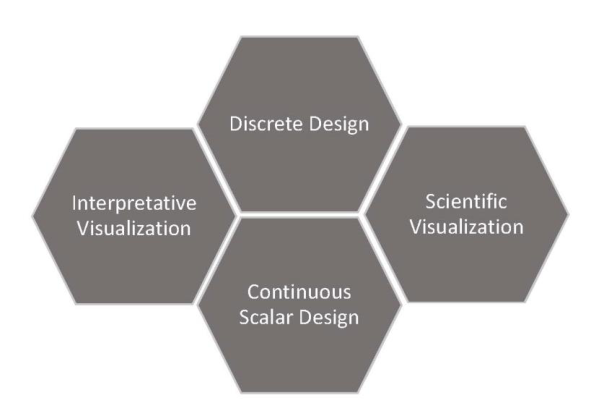
This paper outlines an integrated model to form an understanding of the interaction of spatial relations, spatial ability and modes of interpretive and scientific visualization. In order to assess cognitive processes of spatial ability, a project to design spatial modular system for a green roof that incorporates solar shading in relation to solar path and spatial scaling variables. The project was assigned to 20 junior female design students working in teams of 2-3 students in a sustainable design course at Effat University in 2019. The interpretive and scientific reflective cognitive process engages the seeing – moving – seeing model proposed by Schön (1984) and is activated by discrete and continuous design processes and 3D modes of visualization. An integrated design model encompassing spatial formation (relations) and visualization types (interpretive and scientific) to characterize a modular unit and aggregated system that has the ability to generate shading on one or more planes under variable orientations of a light source.
Figure 1. Integrated design model (spatial ability, spatial relations, visualization)
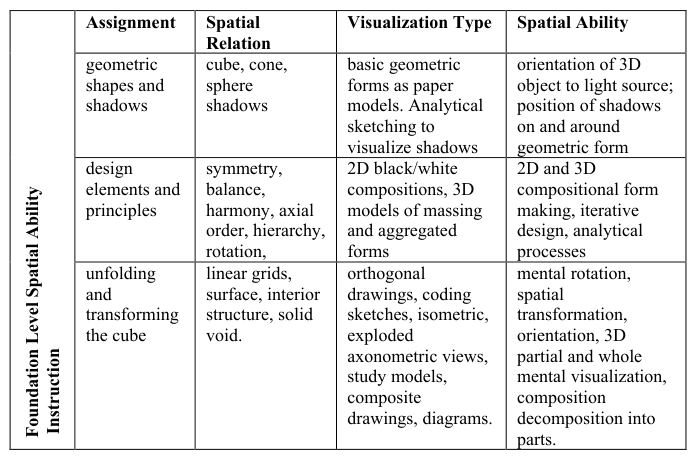
Developing Spatial Ability in Foundation Level Design Studio Spatial ability is both innate and a learned, defined by the ability to mentally manipulate, rotate, twist, or invert a pictorially presented stimuli (McGee, 1979) or engage in 2D and 3D object manipulation and orientation awareness. (Cho, 2019) Coordinating two or more elements in a shared form of visualization and aligning 3D objects from different or new vantage points is characteristic of spatial ability. (Strong & Smith, 2002, Buckley, 2018) In foundation level design studies knowledge of
Human Interaction & Emerging Technologies (IHIET-AI 2022) Artificial Intelligence & Future Applications https://openaccess.cms-conferences.org/#/publications/book/978-1-7923-8989-4 design visualization techniques develops in tandem with spatial ability and spatial relations (understood through design principles and phenomenology). In order to advance our understanding of how spatial relations and types of 3D visualization may be integrated with spatial ability, a complex design problem that foregrounded spatial ability and spatial relations was assigned to junior design students for this research study.
Table 1: Scaffold sequence of exercises to develop spatial ability in foundation design programs.
Figure 2 The Cube is a commonly used exercise to develop spatial ability in foundation design studio.
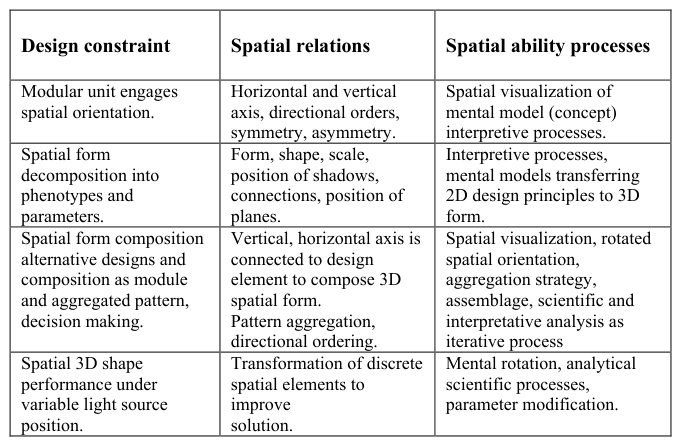
Research Methodology The purpose of this study was to examine how spatial relations intersect with visualization and cognitive processes involving spatial ability. Previous research inquires have identified numerous gaps in our understanding of how spatial ability is connected to 3D spatial forms and visualizations (unfolded 2D diagrams, isometric, orthographic views) as schematic and procedural knowledge. (Duffy, Sorby and Bowe, 2020) In this study junior students demonstrate their spatial ability in a design problem that negotiates two challenges, 1) define the arrangement of vertical and horizontal planes to form a discrete module interior space with the ability to generate shade on one or more planes in relation to changing positions of a light source, and 2) aggregate the discrete model as a spatial pattern to increase shadow spatial coverage in relation to the changing position of a light source. The following research questions are addressed. RQ 1 What are the spatial relations seen in the design solution that align to spatial ability cognitive processes? RQ 2 How are interpretive or scientific cognitive processes evident in 3D visualization? RQ 3 How is spatial ability related to spatial relations in 3D visualizations?
Table 2: Design problem constraint, spatial relations and spatial ability Design constraint Modular unit engages spatial orientation.
Analysis Cognitive process phases engaging spatial ability and spatial formation
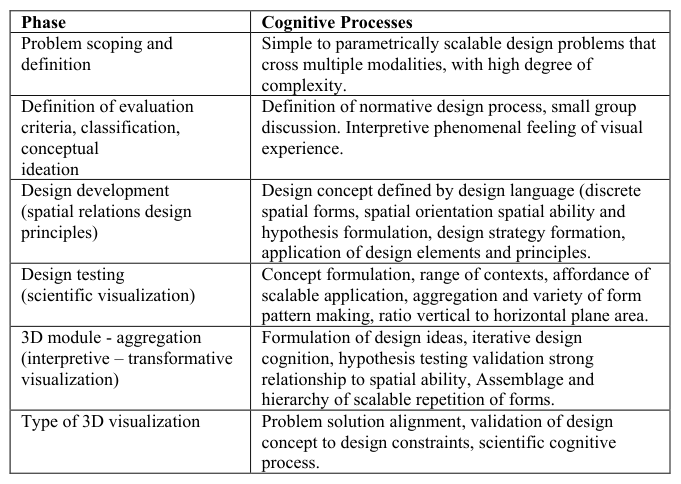
The design problem involved combined mental rotation, a cognitive process that combines visualization and manipulation of holistic spatial relations with analytical rotated sequential processing of 3D forms and images (shadows on spatial forms). The sequence of conceptual thinking required students to manipulate and represent a spatial form to unite different parameter values seen in the grouping of modules to form a system or pattern field, and engage in analysis of the 3D modular form to assess its ability to generate information and data (shadows on a planar surface).
Table 3: Cognitive process phases engaging spatial ability and spatial formation
Formulation of design ideas, iterative design cognition, hypothesis testing validation strong relationship to spatial ability, Assemblage and hierarchy of scalable repetition of forms. Type of 3D visualization Problem solution alignment, validation of design concept to design constraints, scientific cognitive process. Spatial Ability Aligned to Spatial Relations and 3D Visualizations Design solutions for the module and an aggregated pattern are outcomes from a process that engages discrete and continuous scalar form making using design principles, and supported by 3D models that enable to interpretive and analytical scientific reflection. The integrated model introduced in this paper further advances the reflective model of Sch|n (1984) and engages W\nn and Clarkson¶s (2018) concept of time duration, scale and scope of the design problem, by aligning design constraints to cognitive processes of spatial relations in different temporal/spatial
Human Interaction & Emerging Technologies (IHIET-AI 2022) Artificial Intelligence & Future Applications https://openaccess.cms-conferences.org/#/publications/book/978-1-7923-8989-4 orientations of a light source (ie. solar path), a feature problem of spatial ability. The integrated design model outlined above, was validated by students design engagement with visualization modes and interpretive and scientific analysis in order to identify problems, formulate a conceptual design (spatial relations process), test design strategies under solar path constraints (spatial relations interaction with spatial ability process), aggregate (scalar -spatial relations and spatial ability - and gyroscopic orientations) towards the light source stimuli.
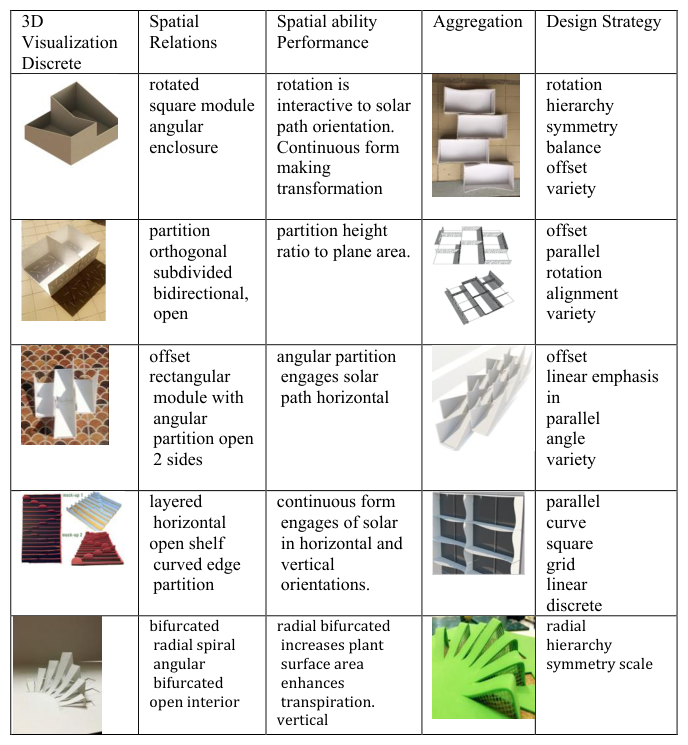
Table 3: Typology of design solutions for the module system.
Design solutions for the module and an aggregated pattern are outcomes from a process that engages discrete and continuous scalar form making using design principles, and supported by 3D models that enable to interpretive and analytical
Human Interaction & Emerging Technologies (IHIET-AI 2022) Artificial Intelligence & Future Applications https://openaccess.cms-conferences.org/#/publications/book/978-1-7923-8989-4 scientific reflection. The integrated model introduced in this paper further advances the reflective model of Sch|n (1984) and engages W\nn and Clarkson¶s (2018) concept of time duration, scale and scope of the design problem, by aligning design constraints to cognitive processes of spatial relations in different temporal/spatial orientations of a light source (ie. solar path), a feature problem of spatial ability. The integrated design model outlined above, was validated by students design engagement with visualization modes and interpretive and scientific analysis in order to identify problems, formulate a conceptual design (spatial relations process), test design strategies under solar path constraints (spatial relations interaction with spatial ability process), aggregate (scalar -spatial relations and spatial ability - and gyroscopic orientations) towards the light source stimuli.
CONCLUSIONS
This research study characterizes spatial ability, spatial relations and design processes as seen in visualizations for design solutions with the ability to generate solar shading. Student cognitive process seen in this study follow the seeing – moving – seeing cognitive model (Schön, 1984). In Schöns¶ model design cognition engages a reflective communication structure that involves sequential development interplay between design problem and concept formation, that may occur as a toggling contextual informed conversation. (Schön and Wiggins, 1992) Reflective processes also reference design transactions, and specify how a designer responds to the demands and possibility of a design situation as a reflective conversation. The aspect of spatial relations and design composition is seen to be the main task that students iteratively focused on in their design process rather than interpretive and analytical visualization formation. 2D sketches and 3D digital and prototype models were used by students to design a hierarchy of patterns.
The integrated design model as identified in this paper reflects tacit visualization for scientifically analysis as a dominant vector related to iterative design transitions. Visualization forms for the temporal phasing of shading throughout the solar day was captured by photographs and ordered to demonstrate sequence, yet did not exhaustively inquire into spatial relations and performance outcome in the design solution. The scientific process to visualize the solution may have required more emphasis in the project introduction phase. The weakness of visualization formats to describe geometric spatial formation performance may be due to the ability or inability of students to work with solar irradiance modeling tools that are integrated in different 3D digital modeling software.
This was the first time that this design project was undertaken by junior students. The variables will need to be tested in future projects to see a discursive impact of specific design forms engage spatial ability outcomes. The resulting concepts and design approaches are promising and require further exploration with variation to the scaffolding of the assignment as sequential design cognitive process. Further inquiry into the meaning and use of interpretive and scientific visualizations in the work of
Human Interaction & Emerging Technologies (IHIET-AI 2022) Artificial Intelligence & Future Applications https://openaccess.cms-conferences.org/#/publications/book/978-1-7923-8989-4 design could establish stronger alignments to design pedagogy involving spatial ability.
ACKNOWLEDGMENTS
The authors would like to acknowledge WKH *HQHUDO 6XSHUYLVRU RI $ODVDOD 8QLYHUVLW\ IRU KLVJHQHURVLW\ LQ SURYLGLQJ IXQGLQJ WR DWWHQG WKH FRQIHUHQFH LQ DGGLWLRQ WR Effat University for the 5&, JUDQW WR XQGHUWDNH WKH UHVHDUFK SURMHFW # UC#7/28.Feb.2018/10.2-45c
REFERENCES
Buckley J. A (2018) Heuristic Framework of Spatial Ability: A Review and Synthesis of Spatial Factor Literature to Support its Translation into STEM Education. Educational Psychology Review, 30, 947-972.
Cho J. Y., Suh J. (2019) Understanding Spatial Ability in Interior Design Education: 2D-to-3D visualization proficiency as a predictor of design performance, Journal of Interior Design 44 (3) 141-159 Duffy, D. Sorby, S.A. Bowe B. (2020) An Investigation of the Role of Spatial AbiliW\ in RepresenWing and SolYing Word Problems Among Engineering SWXdenWs¶ Journal of Engineering Education, 109(3)
McGee, M. G. (1979) Human spatial abilities: Source of Sex differences. New York Praeger Publishers.
Schön D. (1984) The architectural studio as an exemplar of education for reflection in-action, Journal of Architectural Education, 38(1), 2-9 Schön D., Wiggins G. (1992) Kinds of seeing and their function in designing. Design Studies 13(2):135-156
Strong, S., Smith R. (2002) Spatial Visualization: Fundamentals and Trends in Engineering Graphics. Journal of Industrial Technology. Vol. 18. N.1 Nov. 2001- Jan. 2002 National Association of Industrial Technology.
Wynn D. C. & Clarkson P. J., (2018) Process models in design and development Res. Eng. Design, 29: 161-202 Wynn D.C. Eckert, C. Clarkson, P.J., (2019) Research into the design and development process: Some themes and an overview of the special issue. Research in Engineering and Design Springer Verlag London. 30: 157-160
Read this individual research paper free through the original publisher, or explore the full digital proceedings book.
ISBN 978-1-7923-8989-4
Explore this ISBN in the AHFE Bookstore ↗Listed in the July 2026 bookstore catalogue; search by ISBN to confirm current availability · Digital book purchase optional