Tamami Satoh, Nobuhiko Yamaguchi, Soraki Shiromoto, Yuki Matsunaga, Koki Nakano, Mitsuhiro Takasaki (2025). AI-Based Mobile Application for Biomechanical Assessment and Visualization of Infant Carrying Posture. In: Human Factors in Design, Engineering, and Computing. AHFE Open Access, vol. 199, pp. 1628–1637. https://doi.org/10.54941/ahfe1006973
Postpartum mothers are especially vulnerable to musculoskeletal disorders due to the physical demands of childcare. Inappropriate infant carrying posture frequently leads to wrist tenosynovitis, lower back pain, or pelvic strain. If unaddressed, these problems may become chronic, hinder daily caregiving, and reduce overall maternal well-being. Early intervention is therefore essential. However, until now, mothers have lacked a simple and objective tool to identify problems in their own carrying posture and to receive timely guidance.To address this gap, we developed a mobile application that provides AI-based biomechanical assessment and visualization of infant carrying posture. The application was designed with simplicity and usability in mind, requiring only a few taps to capture an image and generate immediate feedback. Five evidence-based ergonomic indicators form the evaluation framework: (1) carrying height relative to the torso, (2) closeness of caregiver–infant body contact, (3) degree of arm abduction, (4) shoulder balance, and (5) spinal alignment. Unlike conventional assessments that rely on expert observation or specialized equipment, this system offers visual feedback that compares the user’s posture with an ideal model, enabling mothers to recognize specific differences and take corrective action without requiring professional expertise.Validation was conducted by comparing system output with expert evaluations. Results demonstrated moderate to substantial agreement: Kendall’s posture (Accuracy 0.667, κ = 0.333), Infant closeness (Accuracy 0.750, κ = 0.500), Infant’s vertical position (Accuracy 0.821, κ = 0.643), and Armpit openness (Accuracy 0.857, κ = 0.714), with a macro-average of Accuracy 0.774 and κ = 0.548. These results indicate that the application reliably approximates expert judgment across multiple aspects of infant carrying posture.Equally important, user testing highlighted the impact of the design approach. Mothers reported that the app was intuitive and efficient, with assessments completed in seconds. The visualization of differences between actual and ideal posture was rated as highly useful for self-correction and for raising awareness of ergonomic carrying habits. Participants also noted the potential value of using the app jointly with professionals such as midwives and public health nurses, enhancing consultations with objective posture data and visual explanations.This study contributes to mobile health and ergonomics by translating clinical knowledge into an accessible everyday tool. It demonstrates how AI-driven posture recognition can support early intervention, helping postpartum mothers prevent musculoskeletal problems while ensuring infant safety. By combining biomechanical assessment with intuitive visualization, the application empowers caregivers with actionable feedback for healthier childcare practices.
Musculoskeletal disorders are among the most frequent health complaints for postpartum women, including wrist, shoulder, and back pain. Hand and wrist problems such as de Quervain’s disease are common and can affect daily life (Anderson et al., 2004; Sit et al., 2017; Satoh et al., 2017; Satoh et al., 2022). Nearly half of postpartum women report musculoskeletal pain within two months after delivery, with pain locations including the back, shoulders, and knees (Li et al., 2024).
Improper posture is a known risk factor, not only during infant carrying but also during breastfeeding. In Jordan, nursing mothers reported
AI-Based Mobile Application for Biomechanical Assessment 1629
musculoskeletal pain related to poor posture, often without receiving professional education about optimal positioning (Aburub et al., 2022). These findings highlight the importance of posture guidance as part of maternal care.
Carrying infants also changes maternal biomechanics. Studies using motion analysis have shown that carrying or wearing infants alters gait, spinal curvature, and trunk inclination, increasing physical load (Havens et al., 2020; Junqueira et al., 2015). Such biomechanical adaptations resemble pregnancy-related postural changes and may contribute to musculoskeletal strain.
Meanwhile, advances in computer vision, particularly BlazePose, enable on-device pose estimation from ordinary smartphone cameras (Bazarevsky and Grishchenko, 2020). Yamaguchi et al. (2025) demonstrated that BlazePose can be used to determine infant carrying posture with substantial agreement compared to expert evaluation. Further developments have applied BlazePose in occupational ergonomics, combining it with transfer learning to achieve high accuracy in dynamic posture assessment (Chidambaram et al., 2024).
Building on this foundation, this study focuses on practical implementation: we developed a smartphone application for everyday use by mothers and public health professionals. The app evaluates five ergonomic indicators and visualizes them using radar charts, providing feedback that is both technically valid and intuitively understandable. In addition to enabling basic self-checks by caregivers, the application is primarily designed as a counseling aid for public health nurses and midwives: by overlaying an ideal reference posture onto the caregiver’s own photograph and summarizing the five indicators, it supports concrete, photo-based guidance during consultations. To examine feasibility and acceptability in community settings, we conducted a pilot during group health checkups; the quantitative questionnaire findings and observed short-term improvements are reported in the Results and discussed in relation to professional use.
RELATED WORK
Clinical Background Musculoskeletal pain in postpartum women is prevalent worldwide. In Japan, Satoh et al. (2017; 2022) reported frequent hand and wrist pain affecting quality of life, while Sit et al. (2017) described similar findings in urban Chinese populations. International evidence also highlights education gaps; Aburub et al. (2022) showed that mothers often lack advice on breastfeeding posture despite reporting pain.
Biomechanical Studies Carrying infants imposes measurable biomechanical changes. Junqueira et al. (2015) and Havens et al. (2020) found that infant carrying alters gait patterns, spinal alignment, and center of gravity management. These findings
support the inclusion of spinal alignment and shoulder balance in ergonomic evaluation.
Pose Estimation and Ergonomics BlazePose (Bazarevsky and Grishchenko, 2020) has become a standard for lightweight, on-device pose estimation. Applications include infant-carrying posture determination (Yamaguchi et al., 2025), hug posture classification (Matsunaga et al., 2023; Nakano et al., 2023), and occupational posture evaluation with RULA indices (Chidambaram et al., 2024). These studies establish the technical foundation for our app. Distinct from prior work that emphasized algorithmic performance or lab-based evaluation, our contribution is a field-deployable smartphone system and evidence of its use by midwives in real-time posture counseling, leveraging photo-based visualization to support tailored guidance.
METHODS
System Architecture The developed application consists of four main layers (Matsunaga et al., 2023; Yamaguchi et al., 2025), as illustrated in Figure 1.
Figure 1: System architecture consisting of four layers: user interface, pose estimation, evaluation, and visualization.
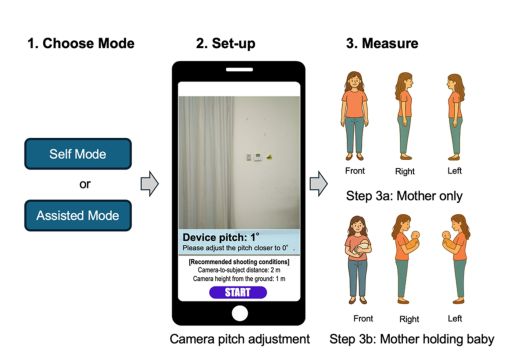
1. User interface layer – A smartphone camera is used to capture a full-body photo of the caregiver holding an infant. The interface requires only a few simple taps to operate. The workflow of image capture, analysis, and result display is shown in Figure 2. 2. Pose estimation layer – Using Google’s BlazePose, 33 keypoints of the body (such as shoulders, elbows, hips, and knees) are extracted directly on the device without sending data to an external server (Bazarevsky et al., 2020). 3. Evaluation layer – The app calculates five ergonomic indicators derived from prior research in maternal health and ergonomics (Satoh et al., 2017; Satoh et al., 2022; Yamaguchi et al., 2025):
Carrying height: whether the infant is held at an appropriate level relative to the caregiver’s torso.
Body contact: closeness between caregiver and infant.
Arm angle: degree of arm abduction, reflecting shoulder strain.
AI-Based Mobile Application for Biomechanical Assessment 1631
Shoulder balance: symmetry between left and right shoulders.
Spinal alignment: whether the back is upright rather than hunched or leaning.
4. Visualization layer – Results are displayed in two formats:
A color overlay on the caregiver’s photo, with the ideal posture shown in orange and the actual posture in green.
A radar chart summarizing the five indicators for easy interpretation.
This structure allows real-time, private analysis on a smartphone without external data transfer.
Figure 2: Measurement procedure consisting of three steps: mode selection (self or assisted), camera pitch adjustment, and image capture of the mother alone (step 3a) and while holding the baby (step 3b) from three directions (front, right, and left).
Pilot Testing During Group Health Checkups To examine feasibility in a real-world context, the app was tested during group health checkups. Midwives introduced the app to participating parents (mothers and fathers) and used it as a posture guidance tool. Each participant’s posture was captured, analyzed, and displayed on screen. After viewing the evaluation, parents were encouraged to ask questions and attempt posture corrections. The app was then used again to re-assess the corrected posture. This immediate feedback loop helped participants recognize errors and observe visible improvements.
In total, five parents participated. For one participant, ankle landmarks were obscured by clothing and re-assessment was not possible. In the remaining four participants, overall scores improved by 14–20 points after correction. Indicator-specific results varied: carrying height often improved, whereas other items showed mixed changes. These observations suggested that individualized guidance is necessary. Midwives also noted that recognition errors due to clothing could be reduced by simple adjustments,
such as lifting sleeves or hems to expose the wrist or ankle joints, or wrapping a scarf around the waist to make the pelvis more identifiable.
Questionnaire Survey To complement observational findings, participants completed a short questionnaire after using the app. Items addressed feasibility (time required), ease of use, clarity of results, reliability, usefulness for posture improvement, satisfaction, and willingness to recommend the system. Free-text responses were also collected to capture impressions in participants’ own words. This dual approach allowed evaluation of both quantitative ratings and qualitative feedback on the application’s utility in practice.
RESULTS
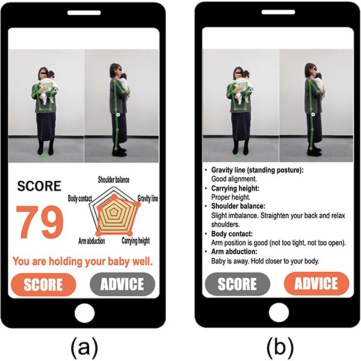
Visualization of Posture Evaluation The application successfully provided clear visual feedback on infant- carrying posture. As shown in Figure 3, two result views can be alternately displayed. The initial screen (a) shows the overall score and a radar chart summarizing the five ergonomic indicators. By tapping the “ADVICE” button, the screen switches to (b), which provides detailed comments and corrective suggestions for each indicator. Users can return to the score screen at any time by pressing the “SCORE” button, since both buttons are always visible on the interface.
Figure 3: Example of the application’s feedback screen: (a) posture evaluation score and radar chart summarizing five ergonomic indicators; (b) detailed advice with visual overlay of actual (green) and reference (orange) posture.
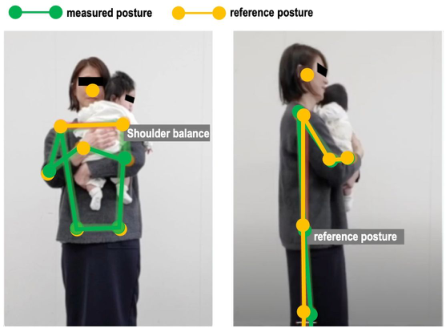
In addition, as illustrated in Figure 4, both result views display the caregiver’s actual posture (green skeleton) overlaid against the reference ideal posture (orange skeleton). This overlay enabled participants to easily identify specific differences, such as shoulder height or spinal curvature, and served as an intuitive visual aid for posture correction.
AI-Based Mobile Application for Biomechanical Assessment 1633
Figure 4: Posture visualization by overlaying the caregiver’s actual posture (green skeleton) on the reference ideal posture (orange skeleton). Circles represent joint landmarks and lines represent skeletal edges. This display highlights differences such as shoulder balance and spinal alignment.
Application in Group Health Checkups The app was applied during group health checkups, where midwives used it to guide parents in posture correction. After viewing their evaluation results, participants were encouraged to ask questions and adjust their carrying technique. Re-assessment was then performed immediately. Of the five parents, one could not be re-assessed due to ankle landmarks being obscured by clothing, but procedural adjustments were identified to resolve this issue in future use. In the remaining four participants, overall scores improved by 14–20 points, demonstrating visible short-term effects of guided correction.
Quantitative Questionnaire Results Structured questionnaires were completed by all five participants after using the app. Key findings were as follows:
Feasibility: All participants rated the required time as appropriate.
Ease of use: Four reported the procedure was “very easy,” and one “easy.”
Clarity of results: All participants found the results easy to understand (three “very easy,” two “easy”). Reasons included: “multiple indicators were clear” and “good to see posture visually.”
Reliability: Two rated the results as “very reliable,” and three as “reliable,” citing the numerical outputs and AI-based judgment.
Usefulness for posture improvement: All participants considered the app useful (three “useful,” two “somewhat useful”).
Satisfaction: All were satisfied (one “very satisfied,” four “satisfied”).
Recommendation: All indicated they would recommend the app (one “strongly,” four “moderately”), particularly to expectant mothers, first- time parents, friends, family, and childcare professionals.
Qualitative Feedback Free-text comments were obtained from five participants. Overall, the responses were positive:
“It was good to see my posture in a photo.”
“The evaluation was easy to understand.”
“It made me more aware of my posture.”
“It helped me think objectively rather than relying on my own way.”
“The numerical results and multiple indicators made it clear what to focus on.”
These qualitative findings were consistent with the questionnaire results. They suggest that the application not only increased awareness of carrying posture but also enhanced motivation to practice corrections. Participants reported greater satisfaction after observing improvements in their second evaluation.
DISCUSSION
This study demonstrated the feasibility of a smartphone-based application for evaluating and visualizing infant-carrying posture. The system provided real-time feedback using BlazePose pose estimation and five ergonomic indicators, and was tested in group health checkups where midwives used it for guidance. Visible improvements in posture, together with consistently positive questionnaire ratings, suggest the potential of this tool to support both mothers and health professionals.
Development From Previous Research Earlier studies by Satoh and colleagues (2017, 2022) clarified the high prevalence and impact of musculoskeletal pain in postpartum mothers, especially hand and wrist pain. Similar findings were reported in China (Sit et al., 2017), and a large-scale study confirmed that nearly half of postpartum women experience pain in multiple body regions (Li et al., 2024). Evidence from Jordan also shows that mothers often lack education on posture despite discomfort during breastfeeding (Aburub et al., 2022). These findings highlight the need for preventive approaches addressing daily childcare posture.
Technical studies developed prototype systems for automatic posture evaluation. Yamaguchi et al. (2025) showed that AI-based assessment approximates expert judgment with substantial accuracy, while related work applied pose estimation and machine learning for hug classification (Matsunaga et al., 2023; Nakano et al., 2023). BlazePose has also been used in occupational ergonomics with transfer learning for dynamic posture assessment (Chidambaram et al., 2024). The present study extends this line of research by implementing a smartphone application and demonstrating its use in maternal health guidance.
AI-Based Mobile Application for Biomechanical Assessment 1635
Implications for Midwifery and Health Guidance The questionnaire results strengthen the evidence that the app is practical and well accepted. All participants rated the process as feasible, easy, and reliable, and unanimously reported satisfaction and willingness to recommend it. Importantly, the visual overlay of the caregiver’s actual posture against the ideal reference made it possible for midwives to explain posture problems concretely during consultations. This shared, photo-based feedback fostered immediate understanding and motivated participants to attempt corrections, as reflected in score improvements of 14–20 points.
Thus, the application offers dual benefits. While caregivers themselves can perform basic self-checks at home, its greatest advantage lies in supporting professional intervention. By providing objective and visual feedback, the app enhances traditional verbal advice, making posture education more effective and personalized. In this way, the system bridges professional guidance and daily practice, contributing to healthier caregiving routines.
Biomechanical studies confirm that infant carrying alters gait, spinal curvature, and trunk inclination (Junqueira et al., 2015; Havens et al., 2020). These findings support the inclusion of spinal alignment and shoulder balance in our indicators. By integrating such evidence into an intuitive, widely accessible tool, the app translates biomechanical knowledge into practical maternal care.
This study contributes to mobile health and ergonomics by providing an accessible everyday tool. AI-driven posture recognition can support early intervention, helping mothers prevent musculoskeletal problems while ensuring infant safety.
Strengths and Limitations A major strength is the demonstration of real-world feasibility in group health checkups, where both quantitative questionnaires and qualitative feedback confirmed usability and satisfaction. Another strength is the clear visualization that enabled midwives to provide tailored guidance in real time. Limitations include the small sample size, the absence of long-term follow-up, and evaluation in a controlled setting with midwife support. Broader testing in home environments and diverse populations will be required to establish generalizability.
Future Directions Future work should expand participant numbers to assess generalizability and long-term effects on musculoskeletal health. Integration with continuous monitoring, such as video-based feedback or data storage, could enhance utility. Collaboration with midwives and public health professionals will be essential to optimize usability and align the tool with maternal care needs. Further refinement of the self-checking function will also be necessary to ensure accuracy in unsupervised use.
In summary, this study highlights the potential of combining AI-based posture estimation with maternal health education. The application may contribute to early detection and prevention of musculoskeletal problems, supporting parents and healthcare providers in promoting maternal well- being.
CONCLUSION
This study developed and tested a smartphone application for real-time evaluation of infant-carrying posture. By combining AI-based biomechanical assessment with intuitive visualization, the app enabled caregivers to perform basic self-checks and, more importantly, allowed midwives to provide objective, photo-based guidance during group health checkups.
The pilot results showed measurable improvements in posture scores and uniformly positive evaluations from parents, confirming feasibility, usability, and satisfaction. These findings suggest that the application can support early intervention, enhance professional counseling, and help prevent musculoskeletal problems in postpartum mothers. While the initial results are promising, further studies with larger populations, diverse settings, and long-term follow-up are needed to validate effectiveness and broaden implementation.
ACKNOWLEDGMENT
This research was supported by JSPS KAKENHI Grant Numbers 22K11064, 25K13988 (Grant-in-Aid for Scientific Research (C)). The authors would like to thank all participating mothers and public health nurses for their valuable contributions to this study.
REFERENCES
Aburub, A., et al. (2022) ‘Nursing Mothers’ Experiences of Musculoskeletal Pain Attributed to Poor Posture During Breastfeeding: A Mixed Methods Study’, Breastfeeding Medicine, 17(11), pp. 926–931. https://doi.org/10.1089/ bfm.2022.010. Anderson, S. E., et al. (2004) “‘Baby wrist”: MRI of an overuse syndrome in
mothers’, American Journal of Roentgenology, 182(3), pp. 719–724. Bazarevsky, V. and Grishchenko, I. (2020) ‘On-device, real-time body pose tracking with MediaPipe BlazePose’, Google AI Blog. Available at: https:// ai.googleblog.com/2020/08/on-device-real-time-body-pose-tracking.html. Chidambaram, V., et al. (2024) ‘Ergonomic investigations on novel dynamic postural estimator using BlazePose and transfer learning’, Ergonomics, 67(2), pp. 240–256. https://doi.org/10.1080/00140139.2023.2221411. Havens, K. L., et al. (2020) ‘Baby carrying method impacts caregiver posture and
loading during gait and item retrieval’, Gait & Posture, 80, pp. 65–71. https:// doi.org/10.1016/j.gaitpost.2020.05.013. Junqueira, L. D., et al. (2015) ‘Effects of transporting an infant on the posture of women during walking and standing still’, Gait & Posture, 41(3), pp. 841–846. https://doi.org/10.1016/j.gaitpost.2015.02.014.
AI-Based Mobile Application for Biomechanical Assessment 1637
Li, M., et al. (2024) ‘Examining the factors influencing postpartum musculoskeletal pain: A thorough analysis of risk factors and pain assessment indices’, European Spine Journal, 33(2), pp. 517–524. https://doi.org/10.1007/ s00586–023-08008–5. Matsunaga, Y., et al. (2023) ‘Baby-Holding Posture Determination System using Pose
Estimation’, International Workshop on Networking, Computing, Systems, and Software (NCSS), November 2023. Matsunaga, Y., et al. (2023) ‘Poor posture detection system of hug using pose estimation’, The 39th Fuzzy Systems Symposium (FSS), September 2023, Paper 1P1-O03. Nakano, K., et al. (2023) ‘Poor posture determination system of hug using K-nearest
neighbors’, The 39th Fuzzy Systems Symposium (FSS), September 2023, Paper 3F1–2. Satoh, T., et al. (2017) ‘Hand and wrist pain and its related factors in postpartum women’, Journal of Japan Academy of Midwifery, 31(1), pp. 63–70. Satoh, T., et al. (2022) ‘Self-assessed hand and wrist pain and quality of life for
postpartum mothers in Japan’, British Journal of Midwifery, 30(8), pp. 467–475. Sit, R. W. S., et al. (2017) ‘A pilot cross-sectional study of postpartum wrist pain in an urban Chinese population: Prevalence and risk factors’, Pain Physician, 20(5), E711–E719. World Health Organization (2022) ‘Breastfeeding’, Fact sheets. Available at: https://
www.who.int/news-room/fact-sheets/detail/breastfeeding. Yamaguchi, N., et al. (2025) ‘Infant-carrying posture determination using RGB camera and BlazePose’, Journal of Advanced Computational Intelligence and Intelligent Informatics, 29(2), pp. 231–240.
LISTED IN THE AHFE DIGITAL BOOKSTORE CATALOGUE
Explore the complete digital volume
Human Factors in Design, Engineering, and Computing
Read this individual research paper free through the original publisher, or explore the full digital proceedings book.
ISBN 978-1-964867-75-5
Explore this ISBN in the AHFE Bookstore ↗Listed in the July 2026 bookstore catalogue; search by ISBN to confirm current availability · Digital book purchase optional