Rachael Boyle, Ruslana Pledger, Hans-frederick Brown (2024). AdTech’s AI Appetite: A Case Study in Advertisers’ Perceptions and Concerns of AI Integration. In: Human Interaction and Emerging Technologies (IHIET 2024). AHFE Open Access, vol. 157, pp. 508–518. https://doi.org/10.54941/ahfe1005510
As artificial intelligence (AI) technologies continue to advance, the integration of AI into business operations, particularly into business-to-business software-as-a-solution (B2B SaaS) organizations, presents both opportunities and challenges. This paper addresses the critical need for understanding the potential benefits and risks of adopting AI, focusing on the perspectives of both B2B customers and employees. The study is particularly relevant in the context of advertising, where AI plays a significant role in shaping business strategies and consumer experiences but can also introduce financial, legal, and reputation risks. While existing research highlights potential consumer concerns and potential benefits, there is a notable gap in understanding the adoption phase from the perspective of B2B businesses, particularly within regulated industries like advertising. Our study brings in the perspectives of the marketers using the AI tools and the advertising technology employees that create, adopt, and implement the AI tools. We argue that these perspectives are vital since marketers, as the customer of the advertising technology tool, determine the success of the tool and employees, as the experts of the product, influence what ultimately gets built. As UX researchers at LiveRamp, a B2B SaaS company operating in the ad tech space undergoing this AI adoption phase, we conducted a comprehensive survey study with 469 customers and 166 employees to inform our own AI strategy. With this survey, we investigate various aspects of AI adoption, including perceptions, awareness, utility, concerns, barriers, and preferred levels of automation/transparency. We also capture these perspectives specifically along the various steps of the actual advertising user journey to better understand where we should invest in AI first and where we should not introduce it. Some preliminary findings showed that while customers are legitimately concerned about privacy, this concern is only the top priority in theory rather than in practice. For actual implementation, privacy concerns are overshadowed by technical limitations and concerns over accuracy. In contrast, employees are much more concerned about privacy and ethical data use. Some of the most passionate concerns were voiced by employee AI-advocates concerned over failing to adopt AI quickly enough and AI-averse customers who worry about the accuracy of the AI. While there is a general inclination towards seeing AI's benefits as outweighing its risks, there is also a notable level of uncertainty or neutrality among respondents too, especially among our customers. We plan on furthering these insights by performing a correlation analysis, using Spearman’s Rank-Correlation Coefficient, on the survey results to test whether there is a significant correlation between prior AI experience or technical proficiency and concerns/willingness to adopt AI. We believe this study serves as a valuable case study for other B2B SaaS businesses navigating the complexities of AI adoption in the advertising sector. Furthermore, the study contributes to the broader Human-Computer Interaction (HCI) community by shedding light on the top concerns, barriers, and perceptions associated with AI integration, emphasizing the necessity of considering both customer and employee perspectives in the evolving landscape of AI adoption.
Over the past decade, there has been unprecedented advancement and commercialization of artificial intelligence (AI) technologies. These technologies have far exceeded computational expectations, transforming the experience between the user and the machine while prompting pressing questions about ethics, privacy, and security. With the creation of embeddable AI tools, it is theoretically easier than ever for companies to integrate AI into their products. But balancing consumer demands while navigating an undefined regulatory landscape can be incredibly challenging. How does an organization determine when and how to take the leap of investing in AI over other competing priorities?
Answering these questions is difficult, but especially so for B2B SaaS organizations given their distance from the ultimate end-user who would best guide these decisions, and especially so if they exist within highly regulated industries like advertising. AI has been used in this space, prior to this most recent AI boom, for actions like predictive modeling, targeting, and ad personalization. These capabilities led to a level of precision and
A Case Study in Advertisers’ Perceptions and Concerns of AI Integration 509
persuasiveness that, for better or worse, had not been seen before. Thus the question is, what does this new era of AI mean for advertising?
As researchers at LiveRamp, a B2B SaaS company that operates in this space, we sought to find these answers and inform our company’s own AI strategy through the perspective of our customers and employees. We found these two perspectives (i.e. employees as the adopters and integrators of AI, B2B customers as the users of the AI tools) to be missing in existing literature today since much of it focuses on the end-consumer (i.e. the ones seeing or engaging with the output of these AI tools). While these insights are invaluable, it is just one piece of the puzzle for B2B companies whose customers are not individuals but rather businesses. How our customers think about AI should inform AI strategies because their experience in our products determines the success of our business. Meaning, they are experts and the ultimate influencers of what our company should and should not pursue. How our employees think about AI should inform AI strategies because they are the most knowledgeable in our offerings, technical resources, and privacy / data ethics restrictions. Meaning, they are the influencers and ultimate experts of what we can and can not do.
With this in mind, we constructed a 23 question survey and captured responses from 469 of our customers and 166 of our employees at our company, LiveRamp, to help understand the perceptions, hesitations, risks, barriers, and ideas that surround implementing AI into our product suite. Through the insights uncovered in this survey, we help guide and ground our company’s AI strategy with the opinions of those most important to enabling and ensuring its success. Through sharing our insights with other B2B SaaS businesses, we hope to serve as a launchpad for their own AI strategization. Through sharing our insights with the broader HCI community, we hope to add key perspectives to the discussion of AI adoption in highly regulated industries like advertising, unveil key barriers / issues to this adoption, and start to create the connective tissue for this AI conversation between various stakeholders (i.e. for advertising, between consumers, marketers, ad technology providers).
LITERATURE REVIEW
While we are entering a new age of AI, it is by no means a new concept in the field of advertising. AI has been discussed in this industry as early as the 1950s (Huh et al., 2023), with the discussions evolving as the technology evolved, the use cases and wealth of data growing increasingly complex in turn. It grew clear that this complexity could be aided through the use of AI to derive better consumer insights (Kietzmann et al., 2018). Many papers dive into potential use cases which, prior to large-language models (LLMs), included things like consumer insight discovery (Li, 2019), ad creation and impact evaluation (Li, 2019), predictive analysis modeling (Enache, 2020), media planning and buying (Chen et al., 2019), personalization (Rafeian & Yoganarasimhan, 2023), and even synthetic ad creation (Campbell et al., 2021).
With the most recent advancements, AI tools will undoubtedly introduce “dramatic changes in how advertisements are conceived, produced, edited, and targeted” (Colin et al., 2022). While AI can allow for better advertising control (Shah et al., 2020), research claims the new challenge marketers face is ensuring the use of these tools does not elicit negative reactions from their end-consumers, like feelings of eeriness (Wu & Wen, 2021) or concerns over their data privacy. While unlocking these use cases could help businesses be more effective or gain a competitive advantage, the potential harms are plentiful as well. These include: job security risks; revenue model impact; organizational structure changes; lack of transparency, deemed “critical to developing ethical and socially responsible AI technology” given the trend towards technological opaqueness and “consumers’ limited ability to understand AI technology” (Huh, Jisu et al., 2023); and reputational or legal risks.
Much of the existing literature is focused on these marketer benefits or consumer concerns. Little to no research focuses on businesses, specifically B2B businesses, and the adoption phase such a business must undergo before deciding to implement AI. “While AI holds many possibilities for marketers, achieving its potential is not easy” (Campbell et al., 2019). While some are successfully considering or embedding AI in their business strategy decisions (Baker, 2017; Wolska, 2017), many businesses “are struggling to see the forest for the trees” and “navigate AI adoption” (Campbell et al., 2019). Businesses within heavily regulated industries especially need this sort of guidance. Beyond a complicated regulatory landscape, there is a steep learning curve, unclear return on investment, and large reputational risks if anything goes wrong (Rodgers, 2021).
However, AI commercialization and market demands ensure that more and more businesses will need to go through this adoption and strategizing phase in order to stay competitive (Enache, 2020). As Campbell et al. (2019) states, “AI should be a consideration for all marketing managers as it represents the highest growth of any technology in marketing (Salesforce, 2017), is expected to increase in use (Columbus, 2018), and is predicted to have a $40 billion effect on marketing by 2025 (Reavie, 2018).” We argue that B2B companies’ AI adoption journey (from AI consideration, “AI Foundation”, to “AI Orientation”) is an important area of study since it produces many downstream effects that warrant its own research (i.e. effects on the consumer, societal impact).
To guide our own company’s adoption journey, we surveyed our employees and our customers (i.e. marketers) to understand their perceptions and concerns of integrating AI into our product offering as well as pinpoint where in our customers’ journey we should or should not be introducing it. While existing research focuses on the consumer or the marketer, this case study highlights the businesses that connect the two together. These businesses typically (though not solely) implement the AI technologies that marketers leverage and whose output consumers engage with. Thus, they are important to include in the framework of perspectives we evaluate. We hope our work begins to answer some of the calls to action made in existing literature to introduce frameworks that guide “the future of AI advertising”
A Case Study in Advertisers’ Perceptions and Concerns of AI Integration 511
(Huh et al., 2023) and investigate the use / impact of AI as it is integrated into existing advertising processing (Li, 2019).
METHODOLOGY
Survey Design To ensure our questions would be tactically impactful to our company’s roadmap, we gathered the key user tasks within our products, or “Jobs To Be Done” (JTBD), and framed questions from the context of those jobs (Christensen & Raynor, 2003). The survey went through multiple rounds of review with relevant stakeholders (i.e. product management, engineering, data ethics). Our final survey had a total of 23 questions with a variety of matrix, multiple choice, multi-select, and free-response questions. We only made pivotal questions mandatory to provide optionality for our respondents and to ensure data quality. Our questions can mainly be grouped into one of the following categories:
Background (4 questions) to compare cross-sections of our responses by respondent type (i.e. employee vs customer, product usage, job function)
AI in the Customer Journey (6 questions) to understand what tasks or jobs-to-be-done (JTBD) users are already leveraging AI for, would like to leverage AI for but aren’t, or have no intentions of using AI for
AI Concerns and Barriers to Use (9 questions) to understand concerns barriers that prevent users from already leveraging existing AI solutions
AI Tradeoffs (6 questions) to understand viewpoints on tradeoffs between risks vs. opportunities and transparency vs. automation for AI integration
Importance of AI (2 questions) to understand how important incorporating AI is and what information is most critical for it to succeed
AI Suggestions Questions (2 questions) to understand users free-form thoughts on AI and how LiveRamp should incorporate it Data Collection
The survey, created on Qualtrics, was distributed internally and externally via email to gather feedback from both employees and customers. Customers were incentivized with a raffle drawing, while employees received no incentive. A total of 7471 customers and 1755 employees were contacted, resulting in 635 responses. Data analysis utilized techniques such as data visualization, cross tabulation, and correlation analysis. The questionnaire, analysis, and data (anonymized for privacy) are accessible on GitHub for future scholarly reference.
Hypothesis Testing Before conducting our survey, we formulated hypotheses regarding the potential relationship between AI experience, technical proficiency, and employee status on AI perceptions. We established a null hypothesis (H0) stating that there is no significant correlation between these factors, and
alternative hypotheses positing correlations between AI experience (H1), technical proficiency (H2), employee status (H3), and AI perception. To test these hypotheses, we used survey questions on job function, product usage, and AI tool usage as proxies for these variables. The categorical responses were then converted into numerical scores based on our expertise. Additionally, survey responses to questions about AI perception were used as variables and already measured on a numerical scale.
RESULTS
Out of 9226 individuals surveyed, we received 635 responses, yielding a response rate of 6.88%. Among the 7471 customers surveyed, we obtained 469 responses (6.27%), while out of the 1755 employees surveyed, we received 166 responses (9.46%).
Background
The majority (74%) of respondents were external customers, with 26% being employees. The most common job function among respondents was Marketing (27%), followed by Operations (13%) and Data Science (10%). Majority (66%) of our customer respondents use one or more of our flagship products which are typically more UI-based, requiring less technical knowledge. Among customer respondents, a large majority had prior experience with AI tools, with ChatGPT being the most popular (82%). Other notable tools included DALL-E (21%), Bard (16%), and Midjourney (11%).
User Journey
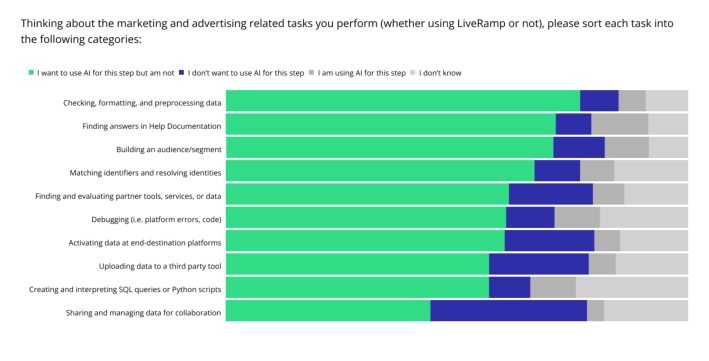
Figure 1: AI use preference for 325 of our customer respondents across all JTBD. The JTBD are sorted in order of highest number of “want to use” selections (in green) to least.
The survey included user journey matrix questions focusing on customers’ main Jobs To Be Done (JTBD) regarding product usage. The responses
A Case Study in Advertisers’ Perceptions and Concerns of AI Integration 513
indicated a strong desire to use AI for various tasks, with the majority expressing interest in leveraging AI but currently not doing so. Notably, JTBDs like checking formatting and preprocessing, building an audience, and finding answers in help documentation stood out as areas where customers expressed a desire to use AI but were not currently doing so. On the other hand, customers reported using AI for tasks such as finding answers in help documentation, debugging, and creating/interpreting SQL queries. Majority (64%) of those already using AI for certain JTBD were satisfied with their experience. Those dissatisfied listed scalability, lagging adoption, unreliability / unexpected behaviors, rate limits, accuracy, and the addition of manual steps as reasons for their dissatisfaction. While there is a strong desire to use AI for various tasks, some JTBD customers showed reluctance to use AI for, such as data sharing, uploading data, activating data, and evaluating partner tools.
The survey also assessed attitudes towards the level of automation or human oversight if AI was implemented across JTBD. The responses generally leaned towards wanting some oversight on AI outcomes, indicating a preference for semi-automated processes. Tasks like building segments and finding/evaluating partner tools were highlighted as areas where respondents wanted complete oversight on AI. However, there were differences between employee and customer responses in terms of desired oversight, suggesting nuanced perspectives based on user roles. Additionally, the JTBD of managing data with partners for collaboration and analysis received a notably higher number of responses advocating against AI use, indicating a wariness of AI being involved in data collaboration and a higher scrutiny of the type of role it plays.
Concerns and Barriers When surveyed about their concerns regarding the use of AI in LiveRamp’s products, respondents showed a higher level of concern when asked specifically about potential biases in AI algorithms compared to their overall concerns about AI usage. Specifically, 48% expressed concern about bias, while 23% were concerned about AI usage overall. The top overall AI concerns included privacy and data security (79%), accuracy of AI-driven insights (66%), transparency in how an AI decision was reached (55%), ethical data usage (53%), control/configurability over AI process (36%), and the inability of AI system to capture human complexity (36%). While the top two concerns were consistent across employees and customers, there were some notable differences.
Moreover, customers’ concerns regarding AI varied depending on whether they were asked tactically or theoretically about it. When asked tactically, accuracy was the top concern, followed by privacy. However, when asked theoretically, privacy emerged as the primary concern. Barriers to leveraging AI for desired tasks included technical resource limitations, potential inaccuracies, privacy/security concerns, work prioritization, lack of AI options at work, lack of transparency/explainability, inability of AI systems to capture human complexity, lack of configurability/control, ethical data usage concerns, and cost. Interestingly, privacy concerns seemed to be
overshadowed by other technical constraints when respondents were asked in a tactical manner.
AI Tradeoffs A majority of customers (56%) agreed that the potential benefits of AI outweigh the risks, with 30% remaining neutral and 14% disagreeing. To validate these findings, a reversed question was posed later in the survey, yielding similar trends: 20% agreed, 27% were neutral, and 52% disagreed. This suggests a general inclination towards favoring AI’s benefits over risks, alongside a notable level of uncertainty or neutrality among respondents. Regarding comfort levels, most respondents were comfortable (68%) with AI providing suggestions. However more were neutral (19%), with a slight skew towards discomfort (46%), with AI making decisions for them. This indicates a greater uncertainty among respondents regarding AI decision-making compared to AI offering suggestions.
AI Importance Respondents were divided on the importance of AI integration into LiveRamp’s products, with 37% being neutral, 42% considering it important (17% very important), and 21% deeming it relatively unimportant (8% not important). While there’s a slight skew towards importance, a significant portion remains undecided. Subsequently, respondents ranked the importance of AI details, with information on how privacy is maintained topping the list (mean ranking: 2.29), followed by understanding how data powers AI (mean ranking: 2.45), how AI features work (mean ranking: 2.54), and knowing what data is used to power AI (mean ranking: 2.72). While the order was consistent across employee and customer respondents, slight differences in alignment and average rank were observed.
Suggestions and Ideas From free response questions, the following themes emerged on the use cases AI might be most helpful with: data recommendation / augmentation, training and customer support (i.e. “if LiveRamp has 24/7 technical support, that would be great”), natural language searches and queries (i.e. “provide python [and] sql template scripts for jumpstart”), data onboarding (i.e. “if an uploaded file isn’t formatted correctly, AI could be used to automatically correct the uploaded file”), data analysis (i.e. “having AI to apply filters, create visualization or [give] information on how to interpret numbers would help a lot”), and enhanced identity resolution and/or backend automation.
Employees also had ideas on how AI could help internal processes within LiveRamp, specifically seeing it useful for: onboarding new hires, engineering processes (i.e. LLMs for code base), customer support via internal and external chatbots (i.e. “tying together historical support case threads with slack messages, email threads, and conversations related to times where similar issues were resolved or similar questions were asked by clients”), sales processes, and competitive analysis. Staunch AI proponents highlighted concerns around taking an “excessively cautious” stance on AI given the
A Case Study in Advertisers’ Perceptions and Concerns of AI Integration 515
concrete ways “we could meaningfully enhance our processes and products today.” While some proponents concede that the state of AI does not seem “super useful” quite yet, they still call for LiveRamp to closely examine how it can make us a “better company.”
While the majority of comments were generally positive about integrating AI into our products, there was also a passionate minority concerned with this path. These comments ranged from mild to serious concern, specifically around themes of data reliability (i.e. “if AI had any malfunction and provided the wrong data to an important client that could hinder future business and budget costs”), bias and regulatory risk (i.e. “it’s clearly important that AI doesn’t end up accidentally causing a whole set of biases that create risk for marketers, given the complex regulations in place that govern how and why marketers can use data to make advertising decisions”), and broader AI cynicism (i.e. “there’s nothing you can do to convince me AI will work in this type of application”).
Differences in AI Perception Customer respondents were mostly from marketing backgrounds, while engineering was predominant among employee respondents, indicating a difference in technical proficiency that could influence response nuances. There was also variation in AI tool usage, with Bard being notably more popular among employees compared to customers. In terms of AI stance, customers appeared more conflicted and neutral compared to employees. Customer responses showed more neutrality regarding the importance of integrating AI into LiveRamp’s platform and the balance between AI benefits and risks. Similarly, customers were more undecided about their comfort level with AI making decisions within products. Conversely, employees showed clearer opinions, with a majority considering AI integration important and expressing greater comfort or greater concern with AI decision-making. Differences also emerged in preferences for oversight in the user journey with AI introduction. Customers prioritized tasks related to audience building and partner tool evaluation, while employees focused more on SQL queries and data management, reflecting concerns about privacy. Moreover, top concerns differed between employees and customers, with employees emphasizing privacy and ethical considerations more than customers, who were more concerned about accuracy. These differences likely stem from each group’s role, responsibilities, and relationship to LiveRamp.
Table 1. Statistically significant correlation between variables of AI perception and variables for prior AI experience, technical expertise, and employee status.
Table available in the original PDF paper.
Variables Spearman’s ρ p-value AI_EXPERIENCE and AI_CONCERN 0.1072 0.0273 AI_EXPERIENCE and AI_BENEFIT 0.2076 < 0.001 TECH_PROFICIENCY and AI_BENEFIT 0.1119 0.0288 EMPLOYEE and AI_RISK 0.1731 0.0085 EMPLOYEE and AI_BENEFIT 0.1339 0.0062
Correlation Analysis To test our hypotheses, we first created our variables by identifying relevant questions from the survey and properly transforming the data. For AI perception, we took questions on the user’s level of AI concern, on whether AI’s benefits outweigh AI risks, on whether AI’s risks outweigh AI benefits, and comfortability with AI making decisions. These questions were each on a 5-point agreement scale and re-coded to 1–5 representing increasing acceptance of AI. For technical proficiency, questions on job function and LiveRamp product usage were used as proxies and mapped to a technical proficiency score ranging from 0 (less technical) to 2 (highly technical) based on the technical requirements of the role or product. The same was done for prior AI experience where 0 represented no experience and 2 denoted more experience with AI tools. Responses indicating the use of the most mainstream AI tool, ChatGPT, were given a score of 1, while use of less popular tools were scored as 2.
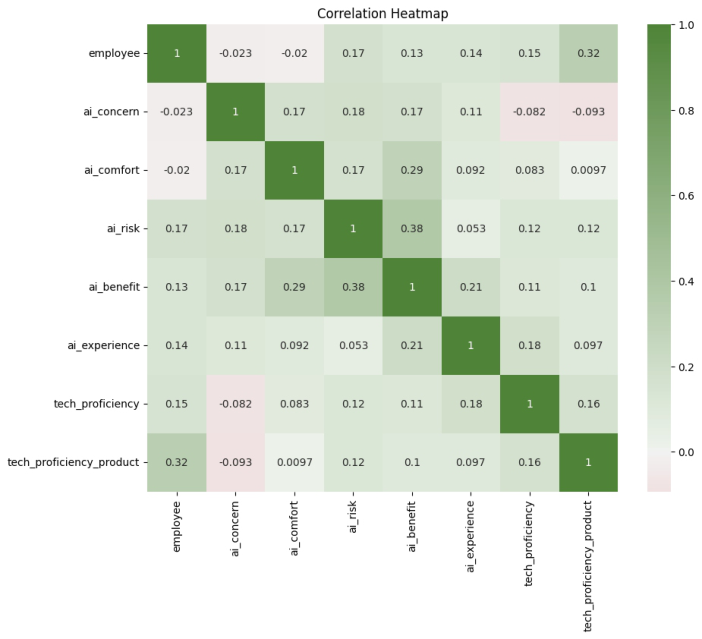
Figure 2: A heatmap of the calculated Spearman’s rank correlation Coefficients between all variables, regardless of statistical significance. A dark green indicates a strong, positive coefficient equal to 1. A dark red indicates a strong, negative coefficient equal to –1.
A Case Study in Advertisers’ Perceptions and Concerns of AI Integration 517
We then employed Spearman’s rank correlation coefficient to assess the strength and direction of monotonic relationships between AI attitude variables and the variables we hypothesized might influence that attitude. We used Spearman’s correlation since it is robust to non-normality and works better with ordinal data. The results of this analysis allowed us to reject the null hypothesis and showed support of H1, H2, and H3. However, all statistically significant correlations between variables show only a weak or very weak correlation. The strongest correlation (Spearman’s ρ = 0.2076) was shown to be between prior AI experience and the belief that AI’s benefits outweigh its risks (i.e. those with more experience using AI are more likely to have a positive perception of AI).
LIMITATIONS AND RECOMMENDATIONS The study acknowledges several limitations despite providing insights into AI adoption dynamics. Firstly, there’s an uneven distribution of employee and customer respondents, potentially introducing bias. Survey limitations include the inability to provide context or probe deeper into responses, as well as the challenge of conditional questions affecting response rates. The study’s abstract nature due to our early AI adoption stage also limits specificity in questions, possibly leading to ambiguity or confusion for respondents filling out the survey. For our analysis, the assignment of AI experience and technical expertise scores is subjective and may lack reliability. Suggestions for future research include conducting similar studies across different contexts and industries to compare AI appetites, executing longitudinal studies to track perception changes over time, and investigating factors influencing AI implementation success or failure.
CONCLUSION
This study explores the challenges and considerations of AI adoption for B2B SaaS companies within regulated industries through surveying 469 customers and 166 employees at LiveRamp, a B2B SaaS company in advertising. Results showed overall positive attitudes towards AI adoption but revealed nuanced insights. We hope these findings provide guidance for refining AI strategies in this space and contribute to the discourse on AI adoption within businesses.
REFERENCES
Campbell, C., Plangger, K., Sands, S., and Kietzmann, J. (2021). Preparing for an Era of Deepfakes and AI-Generated Ads: A Framework for Understanding Responses to Manipulated Advertising. Journal of Advertising, 51(1), pp. 22–38. Campbell, C., Plangger, K., Sands, S., Kietzmann, J., and Bates, K. (2022). How
Deepfakes and Artificial Intelligence Could Reshape the Advertising Industry: The Coming Reality of AI Fakes and Their Potential Impact on Consumer Behavior. Journal of Advertising Research, 62(3), pp. 241–251. Campbell, C., Sands, S., Ferraro, C., Tsao, H. Y., and Mavrommatis, A. (2020).
From data to action: How marketers can leverage AI. Business Horizons, 63, pp. 227–243.
Chen, G., Xie, P., Dong, J., and Wang, T. (2019). Understanding Programmatic Creative: The Role of AI. Journal of Advertising, 48(4), pp. 347–355. Christensen, C., and Raynor, M. (2013). The innovator’s solution: Creating and
sustaining successful growth. Harvard Business Review Press. Enache, M. C. (2020). AI for Advertising. Annals of Dunarea de Jos University of Galati. Fascicle I. Economics and Applied Informatics, 26(1), pp. 28–32. Ford, J., Jain, V., Wadhwani, K., and Gupta, D. (2023). AI advertising: An overview
and guidelines. Journal of Business Research, 166, p. 114124. Horzyk, A. (2023). Data Protection and Privacy: Risks and Solutions in the Contentious Era of AI-Driven Ad Tech. International Conference on Neural Information Processing (pp. 352–363). Huh, J., Nelson, M., and Russell, C. (2023). ChatGPT, AI Advertising, and
Advertising Research and Education. Journal of Advertising, 52(4), pp. 477–482. Kietzmann, J., Paschen, J., and Treen, E. (2018). Artificial Intelligence in Advertising: How Marketers Can Leverage Artificial Intelligence Along the Consumer Journey. Journal of Advertising Research, 58(3), pp. 263–267. Li, H. (2019). Special Section Introduction: Artificial Intelligence and Advertising.
Journal of Advertising, 48(4), pp. 333–337. Rodgers, S. (2021). Themed Issue Introduction: Promises and Perils of Artificial Intelligence and Advertising. Journal of Advertising, 50(1), pp. 1–10. Shah, N., Engineer, S., Bhagat, N., Chauhan, H., and Shah, M. (2020). Research Trends on the Usage of Machine Learning and Artificial Intelligence in Advertising. Augmented Human Research, 5(1). Wu, L., and Wen, T. (2021). Understanding AI Advertising From the Consumer
Perspective: What Factors Determine Consumer Appreciation of AI-Created Advertisements? Journal of Advertising Research, 61(2), pp. 133–146.
LISTED IN THE AHFE DIGITAL BOOKSTORE CATALOGUE
Explore the complete digital volume
Human Interaction and Emerging Technologies (IHIET 2024)
Read this individual research paper free through the original publisher, or explore the full digital proceedings book.
ISBN 978-1-964867-33-5
Explore this ISBN in the AHFE Bookstore ↗Listed in the July 2026 bookstore catalogue; search by ISBN to confirm current availability · Digital book purchase optional