Juan Jimenez Garcia, Niyousha Saeidi, Onita Basu (2024). Culturally Sensitive Mobile App for Female Sanitation and Hygiene in Low-income Countries. In: Human Systems Engineering and Design (IHSED2024): Future Trends and Applications. AHFE Open Access, vol. 158, pp. 72–82. https://doi.org/10.54941/ahfe1005530
In recent years, numerous discussions on Water, Sanitation, and Hygiene (WASH) have taken place, with a particular focus on developing countries. As many of them lack access to basic tools and education, a notable impact is observed specifically on the health and well-being of the adolescent female population. Although several initiatives have been implemented regarding infrastructure and policies, they have not provided a straightforward solution to this problem. The key challenges faced by this community include limited access to information, insufficient WASH infrastructure tailored to the female population, and the impact of early marriages and teen pregnancies that lead to educational obstacles. These circumstances have heightened the need for a tool to support female sanitation and hygiene practices in Mozambique. This paper describes the design process and development of a mobile application solution to support female students of Mozambique in enhancing their sanitation and hygiene practices.WASH, female sanitation and hygiene, and design for localized needs are the central topics of this research. While embracing technology, we also acknowledge several challenges that co-exist within the Global South regarding the limitations in technological infrastructure, digital literacy, and cultural restrictions that prevent potential solutions from bringing practical benefits. Our motivation stemmed from the lack of educational resources specifically addressing the WASH topic for the target female population. However, the development of a digital solution for this target population is challenging from a technological and design perspective in terms of understanding and identifying the complexity of female sanitation and hygiene practices and needs. Participatory Design (PD) was applied to encourage participant engagement and inform the design of the prototype. The HCD approach was used for the mobile application design to ensure proper product development for a sensitive population considering their way of life, surroundings, environment, culture, and traditions.To further inform the application design, this work is composed of three main design phases that involve various stakeholders, such as end users, to allow iterative design refinement. Firstly, we conducted a baseline questionnaire with young female students in Mozambique, followed by two focus group interviews with design researchers and experts in the fields related to WASH. Our findings identify the opportunity to serve this population by developing a mobile application. We describe that designing for sensitive, Global South communities requires accounting for deeper factors, such as individual motivations and or cultural norms, highlighting the importance of applying contextualized methods that consider the full range of constraints and resources in communities. Building upon these insights, we aim to stimulate discourse on the importance of considering context-related factors that inform the design of a culturally sensitive mobile application and how these insights can inform action points for Human-Centered Design practice for Low-Income countries.
Personal and community sanitation and hygiene practices for females in numerous countries within the Global South face significant challenges related to sufficient support for the target population (United Nations Children’s Fund & World Health Organization, 2023). At an individual level, females require more specific personal hygiene practices due to menstrual cycle, pregnancy, etc., requiring more knowledge on the subject and learning the best practices. Design and participatory practices play an important role in looking for solutions to this issue. The focal point of this project is to
address the lack of sanitation and hygiene practices among female adolescents between 12 and 15 years old in Mozambique, Africa.
Water, Sanitation, Hygiene (WASH), and gender-related inequality are critical issues in many low-income countries. Girls and women are primarily responsible for collecting and carrying water, sharing sanitation facilities in unsafe environments, managing household chores and childcare, as well as dealing with insufficient WASH facilities for menstruation. These challenges are particularly severe for females due to a lack of privacy and education for managing menstruation, as highlighted by the United Nations Children’s Fund and the World Health Organization (2023). According to their report, “awareness of menstruation before menarche varied widely in the two countries having data. Girls who were unaware were much more likely to have negative experiences”(United Nations Children’s Fund & World Health Organization, 2023).
Complex issues like child marriages are also a big part of the problem. Although the legal age for marriage is 18, 57 percent of girls in Mozambique are married by 18, and 21 percent by 15 years old (World, 2010). This forces many to drop out of school to care for their families and may thus have a negative effect on their health and education (Thelwell, 2021). Continuing education allows girls to gain knowledge in various fields, including sanitation and hygiene, but early marriage and childbirth often lead to school dropouts, affecting their health due to a lack of knowledge. Providing timely delivery of crucial information related to health will increase awareness, which is a key factor in improving female sanitation and hygiene.
Most of the existing digital solutions are primarily focused on specific aspects, (iRainbow, 2021; Halilou, 2022) rather providing a comprehensive approach to educating the female population on better WASH practices. They lack in informing and assisting them with improving sanitation and hygiene practices and building a knowledge base. To address a gap in knowledge and resources within low-income countries, more specifically Mozambique, the focus should be on delivering tailored information to the target audience, so that they are empowered to build the knowledge base for the individuals and within the community. Although there have been discussions in the fields of Human-Centered Design (HCD), Women-Centered Design (WCD), and Participatory Design (PD) about better personal and community sanitation and hygiene practices, providing social, urban, and policy insights (Botha, 2018; Bennett, Cassim & van der Merwe, 2017; Salvi, 2018) these solutions are not specific to this unattended user and gaps still exist within this field of study. There are still more suitable ways to help improve WASH for young females, their needs, and daily practices.
Understanding their everyday practices and cultural conditions provides better insight into how a solution could be integrated into their daily lives. Waterlution, a federally registered Canadian non-profit water-focused organization (Waterlution.com, 2021) that collaborated on this project, provided in-the-field data from Nampula and Mozambique. They offered baseline information on the cultural characteristics of the young population in this region, which enhanced our insights toward a context-sensitive solution for this demographic. We state that key factors in female
sanitation and hygiene solutions revolve around awareness and information dissemination. Based on the data collected in situ with the target population, we found that many young females use smartphones to watch content and gain information. This, along with the increase in technological use in African regions in the number of internet and social media users (Kemp, 2021), showed that a mobile application has the potential to deliver the needed information to the target audience promptly and fit better with their daily life practices. The application of HCD and PD principles with the intended users and stakeholders led to the development of a design rationale for the smartphone application that was later validated by experts in the field.
In this paper, we share our experiences in designing a smartphone application for a cultural-sensitive context for the Global South and we discuss the importance of tailoring content to the cultural context to increase relevance and acceptance, local collaboration to overcome logistical challenges and meeting the real needs of users, and to underscore the importance of Human-Centered Design to address health-related solutions for sensitive populations. Our findings are grounded on qualitative data collected in the field and with experts related to WASH in developing countries, informing the design features of the smartphone application.
ITERATIVE DESIGN PROCESS, PHASES AND METHODS The design of a smartphone application for this target population presents challenges from both technological and design perspectives, particularly in terms of understanding the context and difficulties related to female sanitation and hygiene practices and needs. Two overarching design approaches were employed to provide tools and strategies for application development. Firstly, Participatory Design (PD) was utilized to engage with stakeholders, including end users, to inform the prototype design. Secondly, Human-Centered Design (HCD) was used in designing the mobile application to consider the sensitive population, their way of life, surroundings, environment, culture, and traditions.
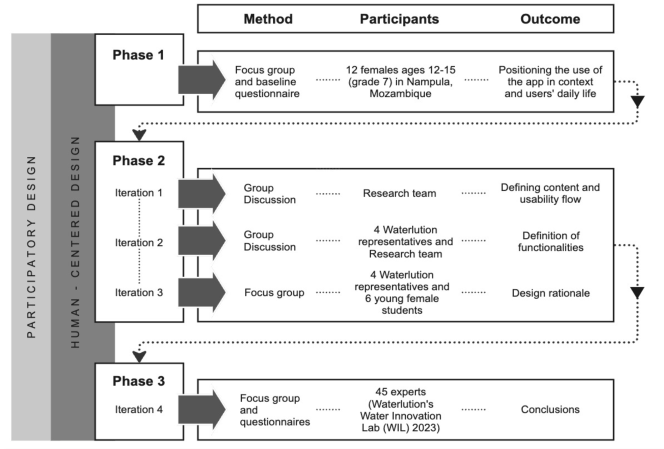
This research was conducted in three main design phases, allowing us to iterate and refine the design for the target user (Table 1). In the first phase, we engaged with young female participants in situ, using a baseline questionnaire to gather initial data on their daily practices, contexts, and main concerns. We recruited twelve females, ages 12–15 (grade 7), in Nampula, Mozambique. All collected data and individual information were anonymized. These insights provided fundamental information to build the structure of the first iteration, which was later evaluated by the main research team, including 4 Waterlution representatives.
In the second phase, three prototype iterations were developed for understanding, ideating, and defining. Multiple iterations were essential for validation and improvement. Iteration 1 started with hand-made mock-ups based on literature research and baseline data from Waterlution. Iteration 2 provided a more realistic graphical view and was validated with Waterlution representatives and the research team. Iteration 3 created the first functional prototype and tested its usability and functionality in a focus group session with 6 young female students in Mozambique. This phase included two
Culturally Sensitive Mobile Application 75
non-functional prototypes and a functional APK prototype on participants’ Android phones.
In the third phase, we aimed to optimize the solution and enhance it in terms of aesthetics and functionality. This was achieved by introducing a more robust functional prototype based on a design rationale that framed aesthetics and visuals. This phase included Iteration 4, the second functional prototype, which was validated through an in-person discussion focus group with 45 people, predominantly women who work in diverse areas related to water and WASH to gain feedback on the proposed solution of this study.
Figure 1: Iterative design process of the smartphone application, detailing phases of participatory design and human-centered design methods involving focus groups, questionnaires, and group discussions.
RESULTS
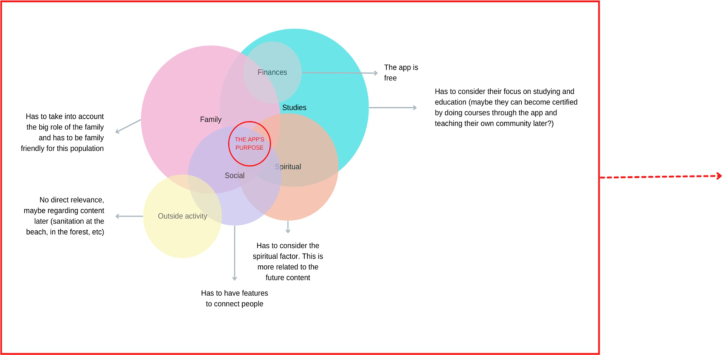
Phase 1 As mentioned, Phase 1 builds on the literature review exploring how sensitive cultural aspects, such as habits, future goals regarding education, family-oriented life, and socializing, influence young female students in Mozambique’s attitudes towards the use of a smartphone application. It was found that the use of smartphone devices is increasingly being used for multiple purposes. Based on our insights collected in the field, Figure 2 illustrates the key domains influencing the use of the smartphone application focused on female sanitation and hygiene, which later became the cornerstones of the application’s design. The size and overlap of circles represent the importance and interrelation of these factors based on participants’ responses. Key factors include family, which is crucial in shaping experiences and requires the app to be family-friendly, and studies, highlighted by most participants, emphasizing the app’s role in education, and offering certification opportunities. The spiritual aspect is important for
tailoring content to cultural and traditions sensitivities, while the social factor encourages virtual interactions to create a supportive community. Finances indicate the requirement for the app to be free, considering the financial constraints of users. Although outside activity is less significant, it can be incorporated into content development. Overall, the app design aims to be context-sensitive, integrating educational, social, and cultural elements to support female hygiene practices in low-income countries.
Figure 2: Interrelated domains influencing the position of the application in users’ daily life.
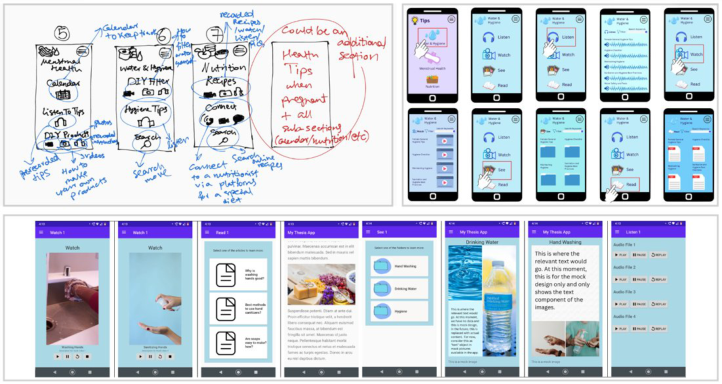
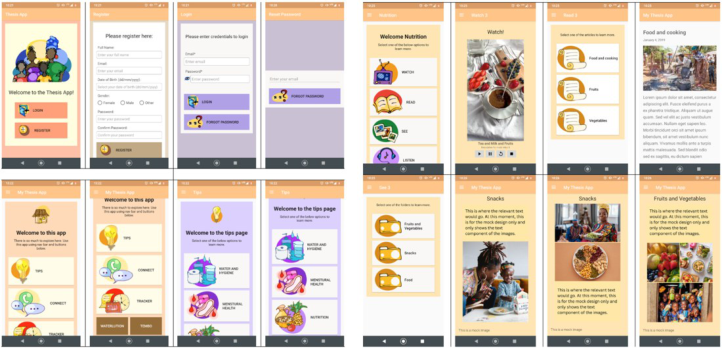
Phase 2 In an iterative process (Figure 3), the main design structure and components were defined. The application prioritizes privacy and engagement at its core, starting with a registration page requiring a username and password to ensure user privacy. The welcome page offers features like main tips, peer connectivity, a menstrual cycle calendar, and a personal journal. The tips section covers three main topics: water and hygiene, menstrual health, and nutrition, providing informative content through a multimedia gallery with audio, video, images, and text tailored to individual learning preferences. The connectivity functionality facilitates collaborative learning and support through chat, audio, and video calls. The calendar helps users track their menstrual cycles, while the journal allows for detailed entries that can be organized by year, month, or day, and includes a search function for easy access to past entries. The design ensures users access essential information and support in a user-friendly, interactive format, with iterative design improvements enhancing functionality.
Iteration 1 The initial mock-up feedback revealed that participants found it difficult to understand how the mobile application would work without a more functional prototype. The biggest challenges were related to navigation, page transitions, and user interaction with the content. To better understand the
Culturally Sensitive Mobile Application 77
flow without implementing a functional product, a more comprehensive set of graphics was required, leading to the next iteration.
Iteration 2 A more realistic graphical view of what the potential mobile application might look like was developed. Wireframes with key features, actions and steps were introduced to collect more detailed feedback. Although this was not a functional prototype, the insights collected provided information to define a more comprehensive graphic representation of various parts of the mobile application.
Iteration 3 This iteration focused on defining the visual look and enhancing the flow of the product, laying out the first functional prototype. From the graphic iterations, the application was developed using Android Studio, written in Java, and the UI was developed using .XML files. Functionality took priority in this first functional version of the application. Discussions with Waterlution representatives and young female students in Mozambique provided insights on what could be altered and improved. These suggestions included enhancing the community chat function, reordering the tips section, including a multi-language option, and improving the journal entry process. This iteration highlighted the need to incorporate visual attributes fitting the culture and traditions, consider the target user’s age, and create a sense of familiarity. The outcome of this iteration led to the creation of a design rationale, introducing visual attributes that enhance engagement for the target audience, as well as minor changes regarding functionality, such as connectivity methods.
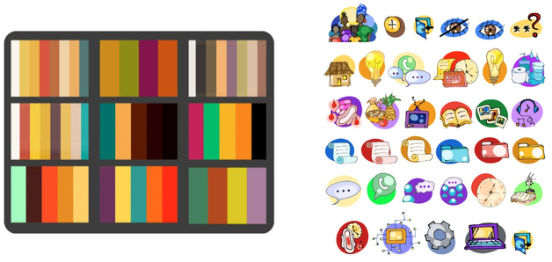
Phase 3 Design Rationale Based on the collaboration with Waterlution and the findings collected in the field with the target user residing in Mozambique and other African Countries, their culture and traditions, their gender and age play a crucial role in defining visual attributes of this smartphone application, such as colours, iconography (Figure 4) and content.
Colour: Once the functionality and the user flow were improved, the design rationale aimed to introduce aesthetics and visuals to appeal to the target audience. We were interested in applying a colour palette that is relevant and has meaning in the African Culture, as well as applying primary principles of colour theory. We have investigated main colors that can be used in the application to understand their meaning and associated imagery. According to Sika’a, (2021), purple symbolizes the beauty and the strong nature, the heart of femininity; gold and yellow symbolize fertility; and green represents growth as a colour often seen in nature.
Iconography: Based on the findings collected in Phase 1 from the target user, implementing icons as doodles and sketches remains relevant. The iconography developed in this application is free-handed with the use of bright colours. The goal was to create a comfortable, trustworthy feeling for those using the application by using color-oriented visual attributes to make it more familiar and personal to the target user.
Content: The imagery required in the “tips section”, which provides the main information about hygiene and sanitation practices, needs to be more contextualized, depicting the real conditions of the target user. For example, we found out that presenting an image depicting someone cleaning their hands with a modern kitchen design in the background would appear too unfamiliar and unattached to their real conditions. This may discourage users and lead to misunderstanding of the content. Therefore, isolated images that depict the activity with a neutral background need to be considered in this section. This will help avoid bias and judgment, not only about how unfamiliar it is, but to avoid distraction to the topic at hand, in this case “how to wash your hands.”
Figure 4: left: African tribal patterns; Right: custom iconography designed for the application.
Culturally Sensitive Mobile Application 79
Iteration 4 In Phase 3, a group of experts in WASH, ranging from policymakers, entrepreneurs, and innovators, was gathered to evaluate the content for the mobile application. We aimed to create up-to-date, trustworthy, understandable information that would appeal and fit to the target audience of the application: some of the considerations included the language to be used, the colour and iconography, and the level of detail and the length of the text excerpts provided to girls on each page, emphasizing the importance of integrating multimedia resources to enhance accessibility and engagement (Figure 5).
Figure 5: Main sections in Iteration 4: homepage, tips, content, connect, Q&A, settings.
DISCUSSION: ACTION POINTS FOR HUMAN-CENTERED DESIGN The Potential of a Higher Prevalence of Smartphone Usage and Multimedia Integration
Our findings indicate that the increasing use of smartphones among young females in Mozambique makes mobile technology a promising platform for delivering educational content on sanitation and hygiene. This observation aligns with the growing penetration of mobile technology in African regions, which has been documented to significantly impact health education and information dissemination (Kemp, 2021). This opens an opportunity for the incorporation of multimedia resources—audio, video, images, and text— to diverse learning preferences, improving accessibility and engagement of the application. This strategy is supported by existing literature, which underscores the importance of leveraging mobile technology to facilitate the dissemination of health information and education with the use of multimedia materials (International Telecommunication Union, 2021). Integrating multimedia content helps overcome poor health services and literacy barriers in low-income countries. Visual and auditory aids enhance
understanding and retention of health information among populations with limited literacy skills (Peipert et al., 2021).
Contextualizing Content for Better Relevance Our work highlights the importance of tailoring content that fits real-life conditions and cultural nuances of the target users, considering daily life practices and needs to ensure that the application’s design and content were relatable. This approach not only enhances relevance and relatability but also ensures that the educational material is perceived as practical. Research has shown that culturally appropriate design elements can significantly impact user acceptance and engagement (Rogers et al., 2019). By integrating colors, iconography, and imagery that resonate with the cultural context of the users, the application aims to build a sense of familiarity and trust. Such culturally sensitive design strategies are crucial for the success of health interventions in diverse and resource-constrained settings (Garcia et al., 2022).
Importance of Iterative Testing and Stakeholder Involvement The iterative design process, involving multiple prototypes and stakeholder engagements, was critical in refining the application’s usability and functionality. Engaging local stakeholders, including young female students and representatives from Waterlution, provided valuable insights that informed the design adjustments. Studies have highlighted the importance of stakeholder involvement in the design and implementation of health interventions, as it enhances the effectiveness and sustainability of the solutions (Hudson et al., 2020). This participatory approach is essential for ensuring that the solution addresses the real needs and preferences of the target population (Udoewa, 2022). The challenges faced in gathering data and testing prototypes in Mozambique show the importance of local collaboration. The involvement of Waterlution representatives, who were familiar with the local context, was instrumental in overcoming logistical barriers and ensuring that the data collected was relevant and accurate. This highlights the necessity of having local partners in global health projects to navigate cultural and logistical complexities that otherwise could be overlooked or assumed wrongly.
Limitations Despite the progress made, the study faced limitations, including a small sample size and the lack of quantitative data to validate the level of engagement and usability with final users. Future research should aim to expand the participant pool and incorporate longitudinal studies to assess the long-term impact of the application on educating users, and how this solution ultimately impacts sanitation and hygiene practices.
CONCLUSION
This paper details the design of a culturally sensitive mobile application to improve female sanitation and hygiene in low-income countries like Mozambique. Using Human-Centered and Participatory Design
Culturally Sensitive Mobile Application 81
methodologies, the prototype was developed to meet the unique needs and contexts of young female students. The iterative design process, guided by stakeholder feedback and contextual research, aimed to ensure the application was user-friendly, relevant, and effective. The findings demonstrate the potential of mobile technology as a powerful health education tool in resource-constrained settings, offering valuable insights for future educational programs and promoting sustainable improvements in female sanitation and hygiene practices.
ACKNOWLEDGMENT
We thank Waterlution for their support and the students at the school in Nampula, Mozambique, for their valuable participation.
REFERENCES
Bennett, A., Cassim, F. and Van der Merwe, M. (2017). How Design Education Can Use Generative Play to Innovate for Social Change: A Case Study on the Design of South African Children’s Health Education Toolkits. [online] International Journal of Dsign. Available at: http://www.ijdesign.org/index.php/IJDesign/articl e/view/2588/777. Botha, N. (2018). The Portable Flush Toilet: From Camping Accessory to Protest
Totem. Design and Culture, 10(1), pp. 17–31. doi: https://doi.org/10.1080/ 17547075.2018.1430985. Halilou, I. (2022). 10 e-learning platforms transforming education in Africa. [online] TRUE Africa. Available at: https://trueafrica.co/lists/e-learning-platforms-africa- tutor-ng-mest-school-education-startups/ Hudson, J. L. et al. (2020) ‘Engagement of Stakeholders in the Design, Evaluation,
and Implementation of Complex Interventions’, in M. S. Hagger et al. (eds.) The Handbook of Behavior Change. Cambridge: Cambridge University Press (Cambridge Handbooks in Psychology), pp. 349–360. International Telecommunication Union (ITU) 2021, Digital trends in Africa 2021, ITU. Available at: https://www.itu.int/en/ITU-D/Statistics/Documents/facts/ICTF actsFigures2021.pdf iRainbow. (2023). E-learning Software Solutions In South Africa | iRainbow. [online]
Available at: https://irainbow.co.za/educational-software-options-in-south-africa/ Jimenez Garcia, J., Castilla, C., Aguirre, J., Martinez, J. P. & Liu, W. 2022, ‘Experiences in the Design of Localized eHealth Tools for Users Facing Inequality of Access to Healthcare’, in Soares, M. M., Rosenzweig, E. & Marcus, A. (eds), Design, User Experience, and Usability: Design for Emotion, Well-being and Health, Learning, and Culture, HCII 2022, Lecture Notes in Computer Science, vol. 13322, Springer, Cham. Available at: https://doi.org/10.1007/978-3-031- 05900-1_8 Kemp, S. (2021). Digital in Mozambique: All the Statistics You Need in 2021.
[online] DataReportal – Global Digital Insights. Available at: https://datareport al.com/reports/digital-2021-mozambique. Peipert, J. D., Lad, T., Khosla, P. G., Garcia, S. F. & Hahn, E. A. 2021, ‘A low literacy, multimedia health information technology intervention to enhance patient-centered cancer care in safety net settings increased cancer knowledge in a randomized controlled trial’, Cancer Control, vol. 28, p. 10732748211036783. Available at: https://pubmed.ncbi.nlm.nih.gov/34565193/
Rogers, Y., Sharp, H. & Preece, J. 2019, ‘Culturally Appropriate Design of Mobile Learning Applications in the Malaysian Context’, Journal of Educational Technology & Society, vol. 22, no. 4, pp. 67–79. Salvi, F. (2016a). In the making: constructing in-school pregnancy in Mozambique.
Gender and Education, 30(4), pp. 494–512. doi: https://doi.org/10.1080/ 09540253.2016.1219700. Sika’a (2021). The meaning behind the colours in African Culture. [online] Sika’a.
Available at: https://www.sikaa.com/blogs/blog/the-meaning-behind-the-colour. Thelwell, K. (2019). Top 10 Facts About Girls’ Education in Mozambique. [online] The Borgen Project. Available at: https://borgenproject.org/top-10-facts-about-gi rls-education-in-mozambique/. Udoewa, V. (2022) ‘An introduction to radical participatory design: decolonising participatory design processes’, Design Science, 8, p. e31. doi: 10.1017/dsj.2022.24. United Nations (2023). WHO/UNICEF Joint Monitoring Program for Water Supply,
Sanitation and Hygiene (JMP) – Progress on household drinking water, sanitation and hygiene 2000-2022: Special focus on gender. [online] UN-Water. Available at: https://www.unwater.org/publications/who/unicef-joint-monitoring-program -update-report-2023. Waterlution.com. (2021a). About Us | Waterlution.org. [online] Available at: https: //waterlution.org/about-us/. World, T. P. (2010). Mozambique society & culture complete report: An all-inclusive
profile combining all of our society and culture reports. World Trade Press.
LISTED IN THE AHFE DIGITAL BOOKSTORE CATALOGUE
Explore the complete digital volume
Human Systems Engineering and Design (IHSED2024): Future Trends and Applications
Read this individual research paper free through the original publisher, or explore the full digital proceedings book.
ISBN 978-1-964867-34-2
Explore this ISBN in the AHFE Bookstore ↗Listed in the July 2026 bookstore catalogue; search by ISBN to confirm current availability · Digital book purchase optional