Xuanhui Yan, Xin Hu (2024). Voice function operation in hospital intelligent registration systems. In: Human Factors in Design, Engineering, and Computing. AHFE Open Access, vol. 159, pp. 149–157. https://doi.org/10.54941/ahfe1005577
Based on the technological development trend of modern society, hospitals use intelligent registration machines to provide support to human workers. At present, the self-service registration machine presents the following interactive problems: due to the inconsistency of department names across various hospitals, the operator struggles to accurately find the target option that meets the needs of their illness on the machine, instead they have to seek manual consultation at the triage desk. However, under normal circumstances, the triage table is often understaffed with no clear queuing rules. In such environments, this is more likely to increase anxiety and other stressful emotions that can result in contradictions and disputes between patients and staff. Moreover, the system used by the self-service registration machine may not be suitable for the elderly and similar patients who are not familiar with technology use, and not as accessible for the visually impaired. Therefore, in order to facilitate the improvement of intelligent registration machines, field research was conducted in three different hospitals currently using said self-service machines. To investigate the interaction process, the researcher observed the use of the equipment in the hospital environment and patients were briefly interviewed on how the machines may be inaccessible. Patient responses were then sorted into key points, coded, and grouped into specific problems. Field research can effectively gather information of the significant problems in the environment the equipment is used such as the user's emotions, grasp the common problems of use by the public, and propose targeted solutions. Finally, this study is aimed to optimize the device interaction by adding the voice recognition function and make a targeted voice dialogue registration system design to the self-service machine. Upon returning to the research site to ask the patients whether the addition of the voice system could improve the efficiency of operation, the consensus was unanimously affirmed. The addition of the new voice functions in intelligent registration equipment can effectively improve the registration efficiency, reduce the error rate of department selection and reduce the probability of hospital disputes, and also can relive the pressure of triage desk manual service, and form a better general hospital environment. The specialised voice registration can reduce the difficulty of operation for the elderly, the visually impaired, and those whose disabilities make it inconvenient to use such machines, and broadens the scope of use.
With the rapid development of intelligent technology, intelligent machines and programs are increasingly being used in various social scenarios. Alongside the maturation of information technology and the establishment of personal information networks, hospitals, as an important part of the public service system, are gradually introducing intelligent devices to enhance service efficiency and quality. The intelligent self-registration machine was thus born to alleviate the workload of manual registration staff, optimize the allocation of human resources, improve registration and payment efficiency, and reduce patient waiting times. However, existing intelligent products need to be continuously tracked for usage and development optimization after deployment. Interaction problems that gradually emerge during the use of hospital self-service registration systems and the derived new issues urgently need improvement. Through on-site research and interviews, this study collected and organized the actual and potential operation difficulties encountered by patients in using self-registration machines, conducted relevant analyses at the audience level, and finally proposed optimizing self-service registration machines in hospitals by adding voice recognition, broadcast functions, and conversational interactions.
RESEARCH BACKGROUND Hospitals, as an important part of the public service system, have begun to gradually introduce intelligent devices to enhance service efficiency and quality. As an intelligent front-end service device, self-registration machines aim to alleviate the workload of traditional window staff by providing functions such as registration and payment to provide more convenient service experiences for patients. Self-service machines should facilitate quick registration, payment, and report inquiries, focusing on the convenience and efficiency of medical services, which requires devices to have clear functional categories and efficient operating procedures. However, the current reality of intelligent self-service terminals in hospitals reveals that many patients still experience clear operation difficulties and inconvenience due to unsatisfactory interaction design, affecting not only the efficiency of patient visits but also reducing service quality and user satisfaction.
Research Methods and Problem Description In the daily operation of hospitals, registration as the first link of medical treatment directly relates to the overall service level of hospitals. This study comprehensively explores the interaction problems of self-registration machines through various research methods such as on-site investigations and semi-structured interviews. The researcher visited hospitals equipped with self-registration machines from a first-person perspective to experience the process, record patient operations, and conduct simple interviews with different groups to collect specific difficulties and needs encountered during the operation of self-registration machines, thereby proposing effective optimization solutions.
Voice Function Operation in Hospital Intelligent Registration Systems 151
According to the observation in the overall hospital environment, the main categories of users involved in the use of intelligent self-service terminals are:
1. Patients: most direct contact, largest number 2. Triage desk staff: indirect contact, usually only one person 3. Self-registration machine volunteers: direct contact with patients and intelligent terminals, but some hospitals do not set up volunteer positions based on different human resource management practices, with usually one or two volunteers.
The research conducted semi-structured interviews with these three categories of people. However, due to the specific hospital environment, constraints of on-site emotions and availability, the study only asked direct questions during the interviews, obtaining the most direct responses from participants, and used their emotional expressions as one of the evaluation criteria for the importance placed on the issue. The research experience was divided into two stages based on the sequence in which major problems were revealed. The first stage is the department selection stage. Due to the independent procedures within different hospitals and their distinct department naming conventions, patients seeking treatment for the same illness may not find the department name chosen in another hospital’s registration system at their current hospital, which can increase anxiety. Furthermore, when seeking treatment for a particular condition for the first time, patients are usually only aware of the affected body part and not the specific cause, leading to confusion or selecting the wrong department during the department selection process, increasing steps in the medical visit, decreasing overall medical efficiency, and causing anxiety. Many patients expressed during the interviews that the touch feedback of the intelligent registration terminal is poor, often lagging in response, reducing operational speed, especially evident during steps like inputting numbers, leading to errors and triggering negative emotions. Unclear selection of the target department leads to patient behavior seeking human help to clarify their department, resulting in these “problematic patients” approaching the guidance desk to ask medical staff for assistance in determining the appropriate department, transitioning to the second stage—guidance desk inquiry.
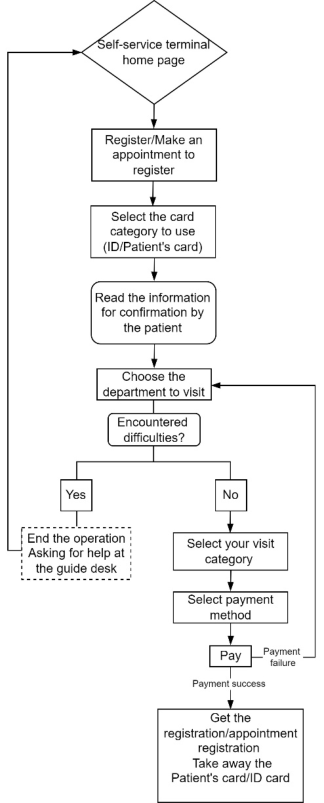
The guidance desk serves for patient inquiries to staff and is usually set up in an open layout without clear queuing restrictions. This causes a rush of patients asking about department directions during peak hours, putting pressure on guidance desk staff. Due to the lack of queue rules, the staff’s responses to inquiries are random, leading to dissatisfaction among patients who ask too many questions, resulting in negative emotions being projected onto the guidance desk staff and other patients, easily leading to disputes and more serious consequences. Finally, the current usage process of the intelligent registration terminal is presented in a flowchart (see Figure 1).
152 Yan and Xin
Figure 1: Current usage process of the intelligent registration terminal (made by author).
In terms of the user scope, the research observed that the composition of patients is complex. Besides ordinary patients, the hospital environment dictates the presence of a significant number of patients with physical limitations, such as the elderly, visually impaired patients, patients with hand injuries or disabilities, and wheelchair users, who cannot independently use the intelligent registration terminal. Issues mainly encountered by the elderly and visually impaired patients include difficulties in reading the self- service machine’s screen, while patients with hand injuries or disabilities and wheelchair users face challenges in touch operation. Many elderly people are not familiar with modern intelligent devices, posing interaction challenges for these special patient groups. As a result, some hospitals have set up volunteer positions and related staff near the self-service machines to assist patients with operational difficulties. On one hand,
Voice Function Operation in Hospital Intelligent Registration Systems 153
this alleviates some of the guidance desk’s workload and, on the other hand, assists patients with interaction issues during operation. However, one of the fundamental purposes of intelligent automation is to reduce manual workload. Transforming manual work content into machine-usable or upgradable functionality becomes the aim of this study.
In summary, the existing interaction issues with self-service registration machines in hospitals are as follows:
1. Different department names in hospital registration systems lead to difficulty or error in selecting the department for patients. 2. Insensitive touchscreens and slow responses lower registration speed. 3. A single visual interaction mode is not conducive to the use of elderly, visually impaired, hand-injured or disabled, and wheelchair-bound patient groups.
The current methods adopted by hospitals to alleviate these issues mainly involve:
1. Setting up guidance desks to answer patient queries. 2. Installing volunteers near the intelligent registration machines to assist with operations.
However, the problems arising from these approaches include:
1. Additional staffing and the original purpose of deploying intelligent registration terminals may conflict. 2. Guidance desks lack clear queuing rules, leading to random question responses and potential conflicts. 3. Limited number of volunteers unable to assist all patients, thus interaction issues persist.
To address the above problems, considering patient needs and the primary objectives of hospitals’ existing mitigations, a design strategy is proposed.
Design of Hospital Intelligent Self-Service Registration Terminal Interaction Optimization Solution In terms of the user scope, the research observed that the composition of patients is complex. Besides ordinary patients, to address the mentioned issues, and taking into account patient needs and the primary objectives of the hospital’s current alleviation measures, it is recommended to add the following functionalities to intelligent registration terminals:
1. Assist patients in clearly identifying symptoms and selecting the correct department. 2. Expand the scope of intelligent registration terminal users by providing operating methods beyond touch and visual information retrieval.
Based on the optimization requirements identified, the study proposes adding voice broadcast and prompting features to intelligent registration terminals, as well as an independent conversational operating system.
154 Yan and Xin
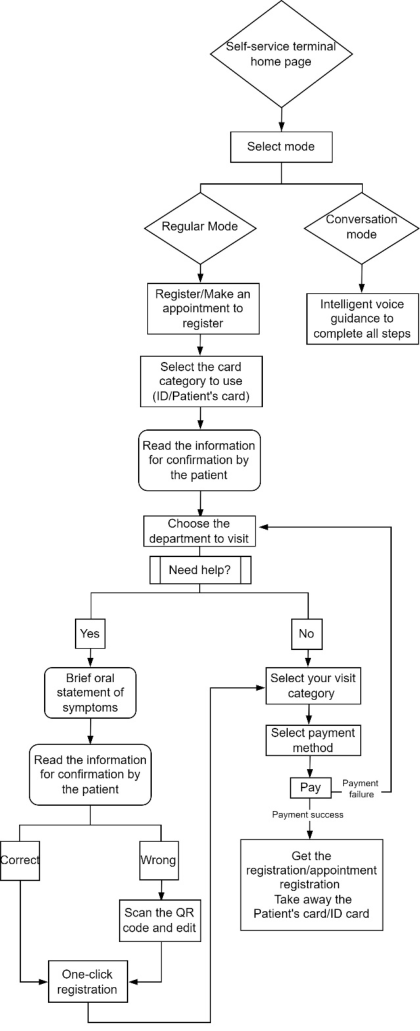
In the department selection step, a special procedure is introduced for patients to use the “guidance assistance” function on the interface if they are unsure about the department selection. This function allows patients to describe their symptoms briefly, such as “seeing black spots,” or “having pain in a specific area,” for the system to recommend the appropriate department. As inaccuracies in content recognition remain a consideration in modern speech technology, an intermediate step is inserted for verbal confirmation by displaying the recognized content as text on the interface and prompting patients to confirm its accuracy. In cases of content error, considering the insensitivity and delayed response of the intelligent terminal’s touchscreen, to reduce direct touchscreen operations, a QR code can be provided on the page for patients to scan, connecting them directly to their personal smart device, displaying an input box and existing content for patient amendment and submission to validate for registration. To simplify the operation flow and reduce errors due to memory deviation, after confirming the department, patients can directly register with one click, without the need to repeat the process on the homepage.
Another significant optimization involves the design of a conversational intelligent registration system to facilitate a dialogue-based interaction for special patient groups to complete the registration process. This functionality entails the intelligent registration terminal asking questions, patients responding, the terminal reinstating patient requirements for confirmation, and automatically performing the required operations in the system. The design of this conversational mode primarily serves patients with physical limitations, and the intelligent dialogue can be designed based on existing artificial intelligence conversation products.
To ensure that the design solution is well-received by users, after finalizing the basic design strategy, the study randomly introduced the design solution to a group of individuals who have used hospital intelligent self-registration machines and inquired about whether the proposed voice function could enhance the user experience. The responses were consistently affirmative, with most participants indicating that connecting to personal devices for text correction could eliminate negative emotions resulting from insensitive touch operations and effectively improve user confidence. Finally, a flowchart illustrates the steps after integrating the voice function (see Figure 2).
CONCLUSION
The design of hospital self-service machines should involve a comprehensive experience optimization process to meet the evolving demands of hospitals and patients through service-oriented design, human-centered design, intelligent interaction, and continuous improvement in user experience. Such self-service machines not only enhance the operational efficiency of hospitals but also improve the medical experiences of patients, achieving a perfect integration of medical services and technological innovation. When designing solutions for hospital self-service machines, considerations should include service-oriented design, elements of human-centered design, basic needs of intelligent interaction, and continuous improvement in user experience.
Voice Function Operation in Hospital Intelligent Registration Systems 155
Figure 2: Steps after the introduction of voice functionality (made by author).
The voice assistance feature and dialogue-based registration operation mode proposed in this study combine considerations across these problem realms with the aim of providing efficient, convenient, and friendly user experiences with hospital self-service machines.
156 Yan and Xin
In the actual design and deployment of hospital self-service machines, close attention should be paid to the specific requirements of hospitals and user feedback for continuous optimization. Intelligent self-service terminals should not only meet functional requirements but also consider the psychological and social needs of users. Voice tones, speech pacing, and visual design should be warm and friendly, avoiding an industrial feel to alleviate patients’ potential anxiety. Screen interface design should cater to users of different ages and cultural backgrounds, with font sizes, color contrasts, language choices, among others, being easily readable and understandable. The system should integrate hospital information to ensure synchronous updates and accuracy while prioritizing the security of personal data, complying with relevant legal requirements. Emotional design can include displaying and speaking warm wishes or health tips on the interface after user completion of all operations to enhance user satisfaction and engagement.
REFERENCES
Abhishek, S., Sathish, H., Kumar, A., & Anjali, T. (2022, September). Aiding the visually impaired using artificial intelligence and speech recognition technology. In 2022 4th International Conference on Inventive Research in Computing Applications (ICIRCA) (pp. 1356–1362). IEEE. Ali A, Mohamed., Brandon, Lucke-Wold. (2024). Apple Intelligence in neurosurgery.
Neurosurg Rev, 47(1), 0. Buhalis, D., & Moldavska, I. (2022). Voice assistants in hospitality: using artificial intelligence for customer service. Journal of Hospitality and Tourism Technology, 13(3), 386–403. Dinesh, R. S., Surendran, R., Kathirvelan, D., & Logesh, V. (2022, March). Artificial Intelligence based Vision and Voice Assistant. In 2022 International Conference on Electronics and Renewable Systems (ICEARS) (pp. 1478–1483). IEEE. C. Ramos, J. C. Augusto and D. Shapiro, “Ambient Intelligence—the Next Step for
Artificial Intelligence,” in IEEE Intelligent Systems, vol. 23, no. 2, pp. 15–18, March-April 2008. Chapanis, A. (1996). Human factors in systems engineering. Wiley Series in Systems Engineering and Management. Andrew Sage, series editor. Hoboken, NJ: Wiley. Choudhary, A. and Kshirsagar, R. (2012) Process Speech Recognition System Using
Artificial Intelligence Technique. International Journal of Soft Computing and Engineering (IJSCE), 2. El Kariema, I. H., Siyoto, S., & Wardani, R. (2021). Evaluation and Implementation Registration of Outpatient with Online Systems at Health Services Center. Journal for Quality in Public Health, 4(2), 106–112. Fabry, D. A., & Bhowmik, A. K. (2021, August). Improving speech understanding
and monitoring health with hearing aids using artificial intelligence and embedded sensors. In Seminars in Hearing (Vol. 42, No. 03, pp. 295–308). Thieme Medical Publishers, Inc. Faraz Bagwan, Rashmi Phalnikar, Sharmista Desai, “Artificially Intelligent Health Chatbot Using Deep Learning”, 2021 2nd International Conference for Emerging Technology (INCET), pp. 1–5, 2021. G. Sun, F. Yu, X. Lei, Y. Wang and H. Hu, “Research on Mobile Intelligent Medical
Information System Based on the Internet of Things Technology,” 2016 8th International Conference on Information Technology in Medicine and Education (ITME), Fuzhou, China, 2016, pp. 260–266, DOI: 10.1109/ITME.2016.0066.
Voice Function Operation in Hospital Intelligent Registration Systems 157
Luger, G. and Stubblefield, W. (2004) Artificial Intelligence: Structures and Strategies for Complex Problem Solving. 5th Edition, The Benjamin/Cummings Publishing Company, Inc. M. Zhang, Z. Wu, J. Li and J. Zhu, “The promotion Effect of Artificial Intelligence
Guidance System on the Optimization of Stomatological Hospital Appointment Registration in China,” 2020 International Conference on Public Health and Data Science (ICPHDS), Guangzhou, China, 2020, pp. 297–301, DOI: 10.1109/ICPHDS51617.2020.00064. N. Xian and W. Wang, “Research on Intelligent Facility Design of Medical Indoor Space Based on Barrier-free Design,” 2021 2nd International Conference on Intelligent Design (ICID), Xi’an, China, 2021, pp. 451–457, DOI: 10.1109/ICID54526.2021.00095. Suwandari, I., & Wardani, R. (2021). An Analysis of the Online Registration System
at Caruban Hospital in 2020. Journal for Quality in Public Health, 4(2), 15–20. Yan, G. L., Chiu, Y. H., Hu, L. J., & Tsai, M. S. (2008, August). A hospital registration system using syndromes’ descriptions analysis and information retrieval technology. In 2008 30th Annual International Conference of the IEEE Engineering in Medicine and Biology Society (pp. 5113–5116). IEEE. Yu, W., Yu, X., Hu, H., Duan, G., Liu, Z., & Wang, Y. (2013). Use of hospital
appointment registration systems in China: a survey study. Global Journal of Health Science, 5(5), 193.
LISTED IN THE AHFE DIGITAL BOOKSTORE CATALOGUE
Explore the complete digital volume
Human Factors in Design, Engineering, and Computing
Read this individual research paper free through the original publisher, or explore the full digital proceedings book.
ISBN 978-1-964867-35-9
Explore this ISBN in the AHFE Bookstore ↗Listed in the July 2026 bookstore catalogue; search by ISBN to confirm current availability · Digital book purchase optional