Yijing Wang, Xin Hu (2025). Exploring the impact of AI-generated content on branded IP character design and user experience. In: Human-Computer Interaction & Emerging Technologies. AHFE Open Access, vol. 195, pp. 25–34. https://doi.org/10.54941/ahfe1006220
This paper aims to explore the practical application and potential value of AIGC technology in brand IP character design, and study its specific role in improving design efficiency, enhancing brand recognition and user emotional connection. Through literature review, the core theory of AIGC technology and its development trend in brand design are sorted out, and combined with case analysis and comparative analysis, the advantages and disadvantages of traditional design methods and AIGC technology are compared in depth. The study found that AIGC technology is significantly superior to traditional methods in terms of design efficiency, cost control and creative expression, especially showing strong appeal in the young audience market. In addition, through in-depth analysis of multiple typical cases, this article summarizes the key application scenarios of AIGC technology in the character design process, such as the generation of virtual idols, rapid iteration of brand IP images, and support for cross-platform communication. However, the study also revealed the limitations of AIGC technology applications, including insufficient emotional expression, low fit with brand tone, and data privacy and ethical issues. Based on the research results, this paper proposes suggestions for optimizing the application of AIGC technology, such as enhancing the emotional computing ability of the model, deepening the integration of brand research data, and promoting the hybrid design model of human-machine collaboration. This study shows that AIGC technology not only plays an important role in the current brand IP role design, but also provides a new direction for the sustainable development of the future brand communication ecology.
In the 21st century, we have fully entered the digital age. The rapid development of AI technology is profoundly changing our lifestyle, work style, and all aspects of cultural entertainment. In this era of innovation and exploration, artificial intelligence is not only a technology, but also a force that leads the future. At the same time, brand IP (intellectual property) character design, as part of cultural creativity, is building a unique and unforgettable experience for people through unique images and stories.
At present, artificial intelligence and brand IP character design have found an organic combination. Artificial intelligence is no longer just cold
computer code. It has creativity and artistry, and can generate amazing content, as if it has a soul. This interaction with artificial intelligence is not only reflected in technological applications, but also integrated into all aspects of cultural creativity. Brand IP character design has become one of the bridges connecting artificial intelligence and designer emotions. Through deep storylines and vivid images, brand IP character design not only resonates in the business field, but also inspires people’s curiosity and enthusiasm in entertainment culture. The content generated by artificial intelligence provides more inspiration and possibilities for brand IP character design, making the creativity in this field more colorful.
AIGC TECHNOLOGY AND BRAND IP CHARACTER DESIGN Development of AIGC Technology
AIGC (Artificial Intelligence Generated Content) is understood by domestic industry, academia and research circles as a new production method that uses artificial intelligence technology to automatically generate content after professional generated content (PGC) and user generated content (UGC). The vigorous development of AIGC is injecting new vitality into design and artistic creation, and its application and technological evolution in many fields have attracted widespread attention. The uniqueness of AIGC technology lies in that it is not only an update of a creative tool, but also a profound change in the creative process and thinking mode of designers. Traditional design methods are usually completed independently by designers, while AIGC technology advocates the cooperation between designers and artificial intelligence. Designers provide AI with their own insights and needs, thereby building a two-way interactive creation mode. The application fields of AIGC technology span text, audio and image generation, providing creators with a wider range of expression space. This new design method is not only a technological innovation, but also an inspiration for creators’ creative methods. Through AIGC technology, designers can create literature, music, painting and drama in a more open and experimental way, promoting the diversification of artistic expression. With the continuous improvement of AIGC technology, designers have improved the quality and creativity of generated content through deep learning and pre- training. AIGC technology has also played a key role in brand IP character design, injecting new perspectives and creativity into the creation of brand IP, making the brand image more personalized and unique. AIGC technology has also promoted the transformation of the creative industry, allowing traditional design methods to gradually evolve into a more open and diverse creation model.
Development of Brand IP Character Design IP is the abbreviation of “Intellectual Property” in English, which literally means “intellectual property”. In a broad sense, IP exists in various fields based on content, including literature, film and television, games, animation, etc. It can be summarized as a work with independent intellectual property
Exploring the Impact of AI-Generated Content 27
rights, wide popularity and strong derivatives. For enterprises and brands, building IP needs to start with the design of IP image. The result of the creation is to create an IP image that is popular with the public and has long-term vitality and commercial value. IP characters play a key role in brand strategy. The evolution of brand IP character design shows a development trend from simple logos to multi-dimensional media interaction. However, there are still risks of over-commercialization, short-termism and homogenization in the development of brand IP character design. Some brands may only stay on the surface of social responsibility. Lack of cultural sensitivity also affects global adaptability. Brand design needs to balance commercial interests and long-term construction, truly pay attention to social responsibility, and enhance cultural sensitivity to ensure a sustainable and in-depth brand image. With the advancement of AIGC technology, brand IP character design will develop in a more intelligent, personalized and interactive direction. Through two-way collaboration with AI, designers will create more diverse IP characters, which will make brand IP character design more up-to-date and meet the needs of users in the digital age.
APPLICATION OF AIGC TECHNOLOGY IN BRAND IP CHARACTER DESIGN Brand Market Research and Positioning
Brand positioning refers to the commercial decision of an enterprise on the cultural orientation and personality differences of a specific brand based on market positioning and product positioning. It is the process and result of establishing a brand image related to the target market. AIGC technology plays a great role in brand market research and positioning, providing brands with more accurate, real-time, convenient and personalized market insights and decision-making support. First, by analyzing big data, AI reveals consumers’ preferences, behaviors and emotional tendencies for IP characters, and then through personalized recommendations and user interactions, it improves user engagement, collects real-time feedback data, and provides brands with deep consumer insights. These insights help brands understand users’ emotional needs and then adjust the image of IP characters. Secondly, AI can also analyze market trends, predict future trends, monitor and analyze competitors in real time, and provide data support for optimizing market positioning, so that brand IP characters are more in line with user expectations. Finally, AI technology also enables brands to adjust and optimize IP characters in real time to ensure that they are consistent with user expectations and market changes. These comprehensive applications make brands more competitive and market adaptable, and promote the success of brand IP character design in the market.
Brand Values and Story Construction In the design of brand IP characters, the intervention of AIGC has played a profound role in shaping values and story construction. A good brand story can make a brand stand out from a crowd of marketing promotions, promote
28 Yijing and xin
corporate values to consumers, and potentially establish a connection between consumers and companies. First, through in-depth data analysis, AI can accurately grasp user emotions, attitudes and values, and build accurate user portraits for brands. This not only helps IP characters get closer to the emotional resonance of users, but also ensures that brand values are closely aligned with the audience. Secondly, personalized story recommendations based on big data analysis enable brands to understand users’ interests and preferences more accurately, providing the possibility for IP characters to create more personalized and profound brand stories. This personalized story construction not only enhances the emotional connection between brands and users, but also makes IP characters more in-depth and attractive in brand stories. The third key contribution of AI technology is the analysis of market trends and social hot spots. By grasping the spirit of the times, brands can make the stories of IP characters more leading and in line with users’ life scenes. Finally, we have to mention again that AI’s real-time feedback and adjustment capabilities provide flexibility for brand IP character design. Brands can adjust the story expression of IP characters based on real-time feedback from users, which not only keeps the brand story consistent with user expectations, but also maintains the user’s sense of freshness. In general, AIGC plays a key role in brand IP character design through in-depth understanding of users, personalized recommendations, forward-looking analysis, and real-time adjustments. It provides all-round support for the value and construction of brand stories, and helps brands create popular IP character images in the market.
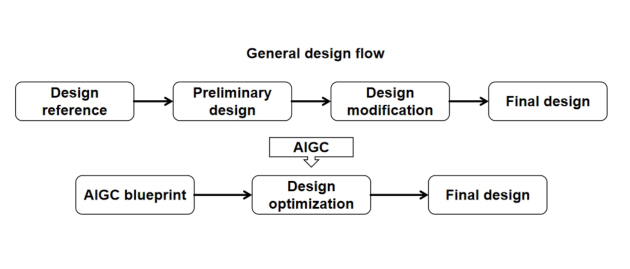
Creative Concept and Sketch In today’s IP design field, AIGC is gradually becoming a powerful assistant in the creative concept and sketch stage of character design, opening a new door to the creative world for designers. First of all, generative AI (such as Mid Journey, GPT, etc.) can continuously absorb various design elements and trends through deep learning and data mining, injecting new inspiration into creativity. This characteristic of keeping up with the times makes character design more innovative and refreshing. Secondly, the style guidance function of AIGC also plays a vital role in the design process. It can provide designers with style references based on the designer’s early insights and different IPs or themes to ensure that the new design is consistent with the overall brand. This intelligent guidance provides designers with more possibilities, making the character design more personalized and unique. Finally, AI’s rapid prototyping in the sketch stage greatly improves the efficiency of design. Designers can preview and modify designs more quickly, and get rich inspiration support when creating the final IP character image. With the help of AIGC in the creative concept and sketch stage, the cost of design can be reduced to a certain extent, especially in large-scale IP character design projects.
However, AI at this stage serves more as a design tool and assistant. A good design work still requires the designer to do it personally. The final
Exploring the Impact of AI-Generated Content 29
design direction still requires the designer to use his or her own creativity, aesthetics and unique human emotional intelligence to make decisions.
Figure 1: AIGC assists in designing flow chart.
Final Refinement of IP Characters With the technical cooperation of AIGC, the final optimization of IP characters has become more convenient and faster. For example, the three- view plane, 3D modeling and rendering of IP characters can be quickly completed with the assistance of AIGC, which also includes the later IP character updates, replacing the details of clothing, hairstyle, and accessories on the basis of retaining the original IP character characteristics, and ensuring that the final design is consistent with the brand image. In addition, the importance of interactive design in the current brand IP is becoming increasingly prominent, including emotional expression, sound and voice design, virtual reality (VR) and augmented reality (AR), which can also be realized by AIGC. For example, the chat AI assistant Replika (Xiaobing) developed by OpenAI allows users to create personalized virtual characters by talking to Replika. Replika will gradually learn the user’s preferences, interests and emotions, and create a virtual partner with deep interaction with the user based on this. This personalized interactive experience enables users to establish a unique emotional connection with the brand.
Online and On-Site Release After the above procedures are carried out, it means that the basic creation of the brand IP has been successful, but whether it can be turned into an IP in the end depends on the subsequent operations. The key to operation is content creation and customer interaction. Create content closely around the IP personality and image, spread it, attract fans to interact, create content with fans, play together, and form a closed loop of marketing and promotion. According to the continuous IP operation, fans will continue to accumulate and fission, and the brand property will continue to appreciate, and finally evolve into a super IP. In terms of subsequent derivatives, after
30 Yijing and xin
the successful operation of the brand IP, it is also necessary to consider cross- border marketing, derivative peripheral products and services to maximize the use value of IP. In the process of online release and landing of brand IP characters, AIGC brings the advantages of digitalization, personalization and high interaction to the brand. Brands can use AI to analyze user data, deeply understand user interests and interaction capabilities, and enable brand IP characters to interact with users more personalized and in-depth on social platforms. This interactivity helps to establish a close brand-user relationship and improve user loyalty. Using the characteristics of AIGC technology to support personalized content generation, brand IP characters can create more interesting and unique online content. From text to pictures to videos, they can be customized through AIGC to better meet user needs and brand image. This helps brand IP characters stay fresh on online platforms and attract more users’ attention. Virtual events and live broadcasts also benefit from AIGC’s support. For example, brand IP characters can interact with users in real time through AIGC-designed virtual concerts, online press conferences, and the currently popular AI real-life unmanned live broadcast interactions, thereby increasing user participation and strengthening brand influence. The intelligent customer service system, which is superior to the traditional choice question system, further improves the convenience of online services. Users can obtain information and solve problems by talking to brand IP characters, achieving services that are closer to user needs.
APPLICATION PROSPECTS OF AIGC TECHNOLOGY IN BRAND IP CHARACTER DESIGN Innovative Impact
Accelerate Pre-Design Research AI provides designers with comprehensive and convenient support in the pre-design research of brand IP characters. Through big data analysis, AI can gain a deep understanding of consumers’ interests and behaviors, and sentiment analysis technology enables designers to more keenly capture users’ emotional needs, adjust character images based on user feedback, provide accurate user insights, improve user resonance, and provide designers with more targeted creative directions. At the same time, the use of machine learning algorithms makes trend forecasting and market analysis more accurate, provides designers with clearer industry dynamics, and helps ensure that the design of brand IP characters is timely and forward-looking. In terms of brand consistency, AI’s automatic monitoring and analysis capabilities ensure the consistency of brand image across different channels, providing strong support for designers to maintain the unity of brand style in character design. Finally, we have to mention its most representative 24/7 availability. The AIGC system is not restricted by the time and location of traditional market research, and can run around the clock to provide designers with continuous support and resources. Without being affected by time differences or working day restrictions. This is significantly convenient for urgent
Exploring the Impact of AI-Generated Content 31
projects, creative ideas that need to be adjusted in a timely manner, and cross-time zone teamwork.
Design Inspiration and Diversity The application of AIGC has inspired a lot of design inspiration and provided a variety of reference elements for designers in brand IP character design. Its ability to learn a large number of artworks and images enables it to generate innovative art elements, providing designers with a wider range of art style choices, allowing designers to draw elements from a variety of styles, bringing designers unprecedented visual inspiration, and thus creating more personalized and innovative designs. By integrating multiple art styles, AIGC can create novel and unique designs, and also provide designers with the possibility of creative synthesis. In addition, AIGC’s rapid prototyping function can quickly verify designers’ concepts and ideas, thereby stimulating more creative exploration. It can introduce non-traditional design elements to challenge traditional aesthetic concepts and provide designers with the opportunity to break through traditional boundaries.
Human-Computer Collaborative Creativity Human-computer collaborative creativity is another important aspect. Compared with traditional design software that is operated by designers throughout the process, AIGC can provide designers with creative suggestions and prototype design, while designers can still use their own aesthetics and judgment to achieve a more comprehensive creative process. AGCI has brought new vitality to brand IP character design, from data analysis to creative generation, to emotional understanding and collaborative creativity, providing designers with a wider creative space. Human-machine collaborative creativity provides designers with new tools and resources, accelerates the design process, expands the creative space, and improves design efficiency. It is a key step for the brand IP character design field to move towards a more innovative and influential future. However, in this process, it is crucial to maintain the dominant position of designers, because the creativity and humanistic insights of designers are still irreplaceable. AI, as an auxiliary tool, works with designers to ensure that the design is in line with both technical support and the core values of the brand and the expectations of the target audience, so as to jointly promote innovation and development in the field of brand IP character design.
Personalized and Customized Brand IP Character Design AIGC technology also plays a vital role in the personalization and customization of brand IP character design. Through data analysis, deep learning algorithms and sentiment analysis technology, brands can collect, organize and analyze a large amount of consumer data, including social media activities, online behaviors and purchase history, and can identify and understand consumers’ emotions and reactions when interacting with IP characters, providing designers with deeper insights, thereby providing brands with targeted personalized elements, creating more
32 Yijing and xin
resonant and emotionally connected IP characters, and enhancing brand loyalty. In addition, real-time interaction and customized experience are also possible. Brands can achieve real-time interaction with users through virtual assistants or chatbots, adjust the performance and characteristics of IP characters based on user feedback, enable consumers to participate more deeply in the creation process of IP characters, or create brand IP characters that are unique to the user but have brand consistency, providing consumers with a more personalized and customized brand experience.
Challenges and Limitations Privacy and Copyright Issues When using AI to assist in brand IP character design, designers need to focus on privacy and copyright issues, be responsible for our final design work, and ensure compliance with regulations. In terms of privacy, it is necessary to ensure that the data used by the brand is obtained legally and has been fully agreed by the user. Anonymization and de-identification are also very critical steps, which help minimize potential privacy risks and improve transparency and controllability. Clearly explaining to users how data is used and allowing users to selectively participate in the design process will help build user trust. In terms of copyright, designers should ensure that all materials and data used are obtained legally to avoid infringing on the intellectual property rights of others. Implementing an effective generated content review mechanism, including professional copyright detection tools and manual review, will help ensure that the generated IP characters do not infringe on the copyrights of others. When working with other creators or partners, clearly stipulate the copyright ownership of the generated content to avoid future legal disputes. Designers should also be careful to avoid creating characters that are too similar to existing works to prevent being mistaken for infringement. Taking all these factors into consideration, designers should pay attention to ethical guidelines, compliance standards, and legal advice to ensure that when using AIGC to assist in brand IP character design, they not only create unique and interesting character images, but also protect user privacy and the intellectual property rights of others.
Challenges of Humanization and Creativity In the field of brand IP character design, the application of generative AI has brought innovation and efficiency, but also faces challenges in humanization, creativity, emotional expression, and aesthetic judgment. At this stage, designers still dominate AIGC applications. AIGC is only an auxiliary application to help designers deeply understand human culture, social interaction, and user emotions to create brand IP characters that better meet user expectations. In terms of creativity, AIGC’s various artistic styles are also refined based on the creations of existing artists, and AI is often limited by existing models and data in generative design. Therefore, designers need to inject more originality and creativity on the basis of AI generation to ensure that the brand IP is unique and outstanding in
Exploring the Impact of AI-Generated Content 33
the market. Among them, emotional expression is also the key to the success of brand IP. AIGC has certain limitations in emotional simulation, and real emotional experience is difficult to express completely through algorithms. At this time, designers need to add their own design language and emotional element insights on the basis of AIGC, so that the works created can establish a deep emotional connection between users and brands. In terms of aesthetic judgment, AIGC is constrained by inherent patterns. Designers need to make aesthetic adjustments to the content generated by AI to ensure that the design meets the aesthetic standards of different cultures and markets. Although AIGC still has room for further development in these aspects, it also brings new opportunities for brand IP design. In- depth cooperation between designers and AIGC may become a solution, using AIGC as a creative assistant to give full play to its advantages of automation and generation while retaining the judgment and aesthetic sense of human designers. AIGC can accelerate the design process, automate some established processes and provide more creative inspiration, making design more efficient and providing designers with more possibilities. The in-depth cooperation between designers and AI technology is expected to create more fascinating brand IP characters with deep emotional resonance, further promoting innovation and development in the field of brand design.
CONCLUSION
In the era of rapid development of artificial intelligence, we have witnessed a new era of IP character design. AIGC technology has injected unprecedented vitality into this creative field and opened the door to unlimited possibilities for designers. However, we cannot ignore the strong creative ability and inspiration of our designers themselves, so the intervention of AIGC at this stage only brings a more efficient creative process to brand IP character design. It can quickly analyze market trends and user feedback, provide a strong reference for design, and enable designers to grasp the needs of the audience more accurately. At the same time, AIGC can also provide creative inspiration in the early stage of design, expand the boundaries of designers’ thinking, and promote the emergence of more creative works.
Although AIGC plays an increasingly important role in design, the creativity and unique visual perception of designers are still the irreplaceable core. The future direction of designers will focus more on exploring human emotions, cultural heritage and unique understanding of beauty, making brand IP more profound and resonant.
In the future, we look forward to seeing more integration of AI and human creativity, and jointly promote brand IP character design into a richer, more diverse and more dynamic realm. In this era of co-creation, AI is not only a design tool, but also a good companion for designers to pursue innovation, opening a new chapter for brand IP character design. Let us join hands to explore the unknown, witness together the miracles that AIGC brings to brand IP character design, and lead the future development of design.
34 Yijing and xin
ACKNOWLEDGMENT
We would like to extend our heartfelt gratitude to all the experts and students who participated in this study. Their valuable opinions and feedback were indispensable in completing this research. Special thanks to the School of Innovation and Design at the University of Macau for their continuous support and resources. Additionally, we are grateful to the anonymous reviewers and colleagues whose insightful suggestions significantly enhanced the quality of this paper. Lastly, we would like to thank our families and friends for their unwavering support and encouragement throughout the research process.
REFERENCES
(2023). AIGC empowers all industries and helps industry upgrade and iteration.
Big Data Era (08), 6–29. doi: CNKI: SUN: DSJD.0.2023–08-002. Chen Yansong. (2023). Research on the application strategy of AIGC technology in artificial intelligence film creation. Modern Film Technology (09), 39–45. doi: CNKI: SUN: YSJZ.0.2023–09-007. Fu Xuanze. (2023). Breakthroughs, controversies and reflections of artificial
intelligence painting in the context of the first year of AIGC. New Beauty Domain (09), 25–28. doi: CNKI: SUN: XMCH.0.2023–09-009. Huang Huizhong. (2023). AI and animation discipline construction: History, current situation and future. Journal of Beijing Institute of Graphic Communication (11), 31–34+38. doi: 10.19461/j.cnki.1004–8626.2023.11.008. Lei Li. (2023). From human creativity to AIGC: Philosophical thinking on
future advertising. Journal of Cultural Studies (08), 58–63. doi: CNKI: SUN: WHXU.0.2023–08-013. Li Shiqin. (2023). How should we respond to the development trend of AIGC technology? Printing Manager (06), 57–58. doi: CNKI: SUN: YSJL.0.2023–06- 019. Su Jie (2023-11-21). A rational view of the rise of AIGC. China Banking and
Insurance News, 008. Wang Jun & Su Lijun. AIGC, technological alienation and workers’ employment anxiety: An analysis based on the perspective of Marxist political economy. Changbai Journal. Wang Yubo & Li Tairan. (2023). Film and television content production and
innovation based on AIGC technology. East China Science and Technology (09), 43-45. doi: CNKI: SUN: HDKJ.0.2023–09-009. Wu Tingting. (2023). Technical domain and cultural configuration: an analysis of the prospects of AIGC film production under the wave of artificial intelligence. Film Literature (18), 39–42. doi: CNKI: SUN: DYLX.0.2023–18-008. Wu Wei. (2023). Industry opportunities of AIGC content marketing. Shanghai State-
owned Assets (10), 17. doi: CNKI: SUN: GZSH.0.2023–10-011. Xia Er. (2023). Brand marketing practice under AIGC empowerment. International Brand Observation (19), 21–23. doi: CNKI: SUN: GJPC.0.2023–19-005. Yuan Lin. (2023). Research on the application of AIGC technology in the design
of museum cultural and creative products. Shoe Crafts and Design (19), 42–44. doi: CNKI: SUN: ZWXE.0.2023–19-015. Zhang Jian, Wang Yuxin & Yuan Zhe. (2023). AIGC empowers traditional cultural heritage design methods and practices - taking the design of the digital display center of Yongle Palace in Shanxi Province as an example. Design (17), 30–33. doi: 10.20055/j.cnki.1003–0069.001157.
Read this individual research paper free through the original publisher, or explore the full digital proceedings book.
ISBN 978-1-964867-71-7
Explore this ISBN in the AHFE Bookstore ↗Listed in the July 2026 bookstore catalogue; search by ISBN to confirm current availability · Digital book purchase optional