Jianhong Wang, Xin Hu (2024). Through the Lens of ZMET Technique: Unveiling the Emotional Value and Innovative Integration of Campus Cultural and Creative Products. In: Intelligent Human Systems Integration (IHSI 2024): Integrating People and Intelligent Systems. AHFE Open Access, vol. 119, pp. 793–803. https://doi.org/10.54941/ahfe1004544
In recent years, the campus cultural and creative industry has attracted significant attention, yet its innovation and development still face multifaceted challenges. One of the most prominent challenges is the difficulty of fully incorporating consumers' deep-seated thoughts into the design elements of cultural and creative products. To gain a deeper understanding of consumers' sentiments towards the campus and to precisely meet their needs, this study aims to drive the innovative development of campus cultural and creative products.Through an analysis of the innovative diffusion process of cultural and creative products at the City University of Macau, the study reveals the challenges encountered by the campus cultural and creative industry in its innovation and development. The study utilizes the Zaltman Metaphor Elicitation Technique (ZMET), combining on-site investigations, questionnaire surveys, and semi-structured interviews to explore the metaphorical elements of campus culture and transform them into specific design elements for cultural and creative products.Additionally, the study applies models from innovation diffusion theory to explain and predict the market penetration process of campus cultural and creative products. The in-depth analysis of metaphorical elements in campus culture successfully disrupts traditional design patterns, injecting new vitality into campus cultural innovation.The application of the innovation diffusion theory model indicates that the innovative development of campus cultural and creative products is influenced by various factors, including product characteristics, market environment, and consumer behavior. The findings of this study provide new theoretical and practical guidance for the development of the campus cultural and creative industry. The application of the innovation diffusion theory model improves understanding of the market penetration process of campus cultural and creative products, offering fresh insights and directions for product innovation design. By gaining a deeper understanding of consumers' inner needs, we can more accurately anticipate the development trends of campus cultural and creative products, thereby enhancing the market adaptability of the products and user satisfaction.
Current Development Status of Campus Cultural and Creative Industries Campus cultural industry is a refinement and manifestation at the level of spiritual and cultural construction on campuses. It is a creative realization form with material as a carrier, embodying the entity operation and dissemi- nation of the spiritual culture containing the school’s educational philosophy and professional characteristics. In the research on campus creativity, various research methods related to creative design have been identified in the liter- ature. For instance, Yan Tingmin, Chen Zihe, and others conducted research on campus creative design based on a narrative model. They analyzed the feasibility of introducing narrative concepts into campus creativity, deeply examined cultural resources in universities, and explored the narrative design process for campus creativity (Yan Tingmin and Chen Zihe, 2023). Xu Ting and Chen Zhengkai conducted emotional campus creative design research using the Analytic Hierarchy Process (AHP). They analyzed from the instinct level, behavioral level, and reflective level, constructing a list of elements for emotional campus creative design (Xu Ting and Chen Zhengkai, 2022). Zhu Xi, Zhu Honghong, and Jiang Qian conducted research on campus cre- ative product design from the perspective of regional culture, organically combining Nanjing regional culture with the campus culture of Jinling Uni- versity of Science and Technology (Zhu Xi and Zhu Honghong, 2021). There are various approaches in campus creative research, driven by innovative development in campus creative design, leading to the innovative diffusion of campus creative industries. However, many schools are still in the early stages of developing campus creativity. At the same time, whether the inno- vation in campus creative product design can truly lead to the innovative diffusion and development of campus creative products is a question worthy of research. Through a search on the China National Knowledge Infrastruc- ture (CNKI) platform for literature on creative design in various fields, it was found that the quantity of research on creative product design in univer- sities is relatively low, with only 64 articles. While the cultural and creative industry is an important branch of cultural creativity, many universities have not yet fully realized the cultural status and role of campus creative prod- ucts, which also proves the promising development prospects of university cultural and creative industries from another perspective (He Ping, 2022). In the theoretical framework, it is necessary to further develop conceptual models and theoretical systems applicable to campus creative research to promote in-depth research and development (Zou Lan and Yang Liping, 2021). The research on campus creativity also needs better integration of practice and theory. This article will take the development of innovative dif- fusion of campus creative products at the City University of Macau as an example and use ZMET (Zaltman Metaphor Elicitation Technique) tech- nology to explore the development prospects of campus creativity at our university.
Through the Lens of ZMET Technique: Unveiling the Emotional Value 795
Existing Research on Innovation Diffusion Theory The pioneer in laying the foundation for innovation theory, Joseph Schum- peter (1990), first introduced diffusion into the study of innovation, propos- ing that widespread imitation behavior among enterprises is the “diffusion of innovation.” Everett M. Rogers, through extensive research on cases of innovation diffusion, defined “innovation” as a process in which methods or practices are perceived as novel by individuals or groups and are even- tually internalized and accepted by individuals (Chen Mingyu and Sun Jilei, 2023). Subsequently, scholars at home and abroad have defined the concept of innovation diffusion from multiple perspectives such as channel dissem- ination, selection and adoption, and technology application and formation (He Qi and Ai Wei, 2022). The differences in innovation adoption rates can be combined with the five stages of innovation, starting from the cognitive stage, decision stage, persuasion stage, implementation stage, and confirma- tion stage. It is believed that the higher the fit between an innovation and the attributes of the five stages, the easier the innovation is to diffuse. The the- ory of innovation diffusion explains the fundamental laws of the five basic processes of perception, interest, evaluation, implementation, and accep- tance that a new innovative thing undergoes before being widely accepted by society (Xiao Yan, 2021). This basic law aligns with the development of inno- vation in campus creative product development. Campus creative products refer to a series of comprehensive products with artistic, practical, and cul- tural value, innovatively designed by symbolizing campus cultural resources, combining unique historical and cultural elements of universities, and visual symbols, human landscapes, etc. (Yan Tingmin and Chen Zihe, 2023). While the innovation diffusion theory is mostly applied in disciplines such as com- munication and psychology, there is currently no relevant research on the combination of innovation diffusion theory and the innovation and develop- ment of campus creative products. Nevertheless, its inherent characteristics play a positive role in promoting the innovative development of products. The design innovation of campus creative products influences the diffusion of products in the campus cultural industry. The application of innovation diffusion theory to the innovation of campus creative products serves as a validation.
The Zaltman Metaphor Elicitation Technique (ZMET) is a qualitative research method designed to reveal individuals’ deep psychological structures and implicit concepts. Proposed by Professor Gerald Zaltman of Harvard Business School in 1995, this method explores individuals’ views and per- ceptions of specific topics or concepts using metaphors (Fang Qing and Li Benqian, 2019). Through non-verbal expressions, individuals can intu- itively express their inner feelings and concepts, bypassing the limitations of traditional language. The goal is to reveal the deep psychological struc- tures within individuals. By conducting in-depth interviews and discussions with individuals through multiple stages, researchers can gradually uncover and understand individuals’ feelings, emotions, and perceptions of specific topics.ZMET is currently widely used in various fields such as tourism, edu- cation, market research, and consumer behavior. Research on the ZMET
796 Wang and Hu
method is in a developing stage, with an increasing number of papers apply- ing ZMET for academic research and practical purposes in recent years (Tan Lelin, 2020). However, there is scarce application in product design, and espe- cially in campus creative design, it has not been utilized. The characteristics of ZMET technology suggest its practical basis for university creative design; it can help designers understand the inner thoughts of the audience, summariz- ing methods and principles for university campus creative design. Exploring implicit knowledge in user experience for campus creative design, extracting user demand features and product design features from implicit knowledge that align with the product theme (Zheng Dehong, 2019). Applying Zalt- man’s metaphor extraction technology design process, extracting implicit knowledge from participants’ experiences or objects related to the theme through in-depth interview techniques, classifying implicit knowledge into three conceptual types: product attributes, usage results, and values. Then, using a feature classification framework, organizing concepts into hierarchi- cal needs, demand characteristics, and design features, and finally linking design features with design elements. Based on participants’ metaphors and symbolic meanings, ZMET provides valuable inspiration and guidance for campus creative design, creating more creative and resonant cultural works. By deeply understanding participants’ psychological experiences and the essence of campus culture, it can better capture and convey the essence of campus culture to meet the needs and expectations of the campus community. By achieving these goals, this study provides a novel and effective method for the field of campus creative design, promoting the integration of creative design practice and research, contributing new ideas and empirical research to the innovation and dissemination of campus culture.
RESEARCH PROCESS DESIGN Viewed from the perspective of constructing the innovation diffusion the- ory framework, the work of Rogers (1962) in “Diffusion of Innovations” is widely acknowledged for defining and researching the concepts, elements, and processes of innovation diffusion, laying the theoretical foundation for modern research in innovation diffusion. However, these two studies at the time only considered one aspect, either market strategy or interpersonal influ- ence. Bass (1969) integrated these two models and proposed the influential Bass model, marking the foundation of the innovation diffusion model (He Qi and Ai Wei, 2022). Since the 1970s, subsequent research on innovation mod- els has built upon the Bass model and its clusters, introducing various flexible variables for improvement. In more complex fields and technological condi- tions, new and more precise predictive models have been explored. Research on the innovation diffusion process and innovation decision-making has also begun to emerge. Based on the stage theory of innovation decision-making proposed by Ryan et al. (1943), Rogers (1962) further suggested that the innovation diffusion process resembles an S-curve.
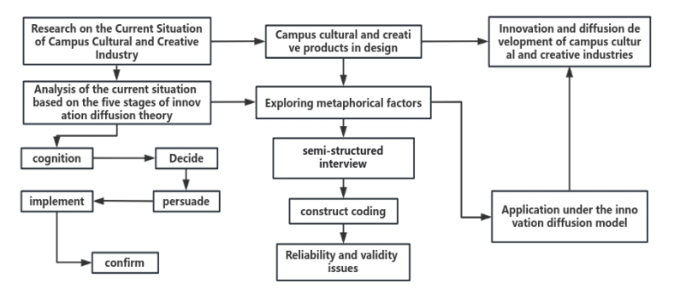
Building upon this renewed foundation, this study will take the campus cultural and creative products of the City University of Macau as a case. Combining it with Rogers’ innovation diffusion theory, the analysis will
Through the Lens of ZMET Technique: Unveiling the Emotional Value 797
be conducted from five aspects: the cognitive stage, decision-making stage, persuasion stage, implementation stage, and confirmation stage. The City University of Macau’s cultural and creative products will be assessed to iden- tify the challenges facing their development. At the innovation level, the ZMET technique will be applied to unearth hidden cultural elements on campus, providing new perspectives for redesign and exploring new paths in campus cultural and creative design.
Figure 1: Innovation diffusion theory research framework (author’s own).
ANALYSIS OF THE INNOVATION DIFFUSION THEORY STAGES MODEL Based on the five stages of the Innovation Diffusion Theory, an on-site inves- tigation was conducted on the brand awareness, communication channels, and product sales of the current cultural and creative products at the City University of Macau. The study aimed to examine the brand’s current com- munication status, explore more effective brand communication models to enhance brand awareness, and provide insights for the communication of cultural and creative products in other university brands. The City Univer- sity of Macau’s cultural and creative products are currently only sold at the university’s small convenience store, which is small in size and has a limited variety. In summary, the communication establishment of the City Univer- sity of Macau’s cultural and creative products has gone through the five stages of awareness, persuasion, decision, implementation, and confirmation, aligning with the development stages of the Innovation Diffusion Theory. This lays a solid foundation for further promotion and development in the market.
Awareness Stage: Single Channel, Limited Audience This section will demonstrate the feasibility of promoting campus cul- tural and creative products based on the investigation and analysis of the awareness of the City University of Macau’s cultural and creative prod- ucts. Promotion is a crucial process in fostering consumer awareness of a
798 Wang and Hu
brand. According to the questionnaire, it was found that, after conducting a small-scale survey on 148 consumers, 51.4% of the respondents had never heard of the City University of Macau’s cultural and creative products. Addi- tionally, 14.9% were aware of the products but did not know where they were sold. Those who had purchased but had little interest accounted for 27.1% of the total consumers. Long-term purchasers were a very small percentage, making up only 14.8%. These data indicate that the market acceptance of the City University of Macau’s cultural and creative prod- ucts is still at a low level, with a very limited audience, and the proportion of consumers consistently purchasing campus cultural and creative prod- ucts is low. The understanding of the City University of Macau’s cultural and creative products is still in the early stages. The reasons for this can be attributed to several factors: the brand’s communication channels are single, marketing methods are outdated, mainly relying on in-store sales, resulting in low marketing efficiency; the organizational level is low, with scattered management; the brand lacks a systematic promotion model. Addi- tionally, the cultural and creative products themselves face severe issues of homogeneity.
Table 1. Market awareness questionnaire of cultural and creative products of City University of Macau.
Table available in the original PDF paper.
Didn’t hear
Total number
Research location
long purchase
Bought but with little interest
Heard of it but don’t know how to buy it
6 0 14 8 28
Sell cultural and creative stores school library 4 7 17 15 43 Other areas 0 15 9 53 77 summation 10 22 40 76 148
Persuasion: Intense Competition, Low Distinctiveness To make a brand highly persuasive, it is crucial to reinforce brand advan- tages, enhance brand attractiveness, and diversify the types of brand products to stimulate consumers’ willingness to purchase. After building awareness, how to persuade consumers becomes a crucial aspect. Currently, the cul- tural and creative products of the City University of Macau mainly include “notebooks,” “pens,” “canvas bags,” “water bottles,” and more. How- ever, according to the survey, these products are not well-known among consumers. Among 148 randomly surveyed participants, over 72 (approx- imately 48.7%) expressed a keen interest in cultural and creative products and expressed a desire to purchase more campus products representing the school. The lack of recognition led them to resort to purchasing products from supermarkets. Consequently, the brand’s recognition is quite limited, and the variety of campus cultural and creative products is insufficient. The products face challenges in standing out and expanding their market presence.
Through the Lens of ZMET Technique: Unveiling the Emotional Value 799
Table 2. Questionnaire of correlation between factors of consumers buying campus cultural and creative products.
Table available in the original PDF paper.
The factor of consumers buying campus cultural and creative products Research location novelty typical practicability jointly Campus emotion Total number
Decision: Lack of Innovation, Limited Variety In the decision-making stage, convenient purchase channels, transparent product information, and the characteristics of the product itself are cru- cial. A random survey of 387 people was conducted to study the correlation of factors influencing consumers’ purchases of campus cultural and creative products. The results, as shown in Table 2, indicate that various factors influ- ence consumers’ decisions to purchase campus cultural and creative products. Campus emotions constitute the largest proportion, accounting for 29.5% of the total respondents. Simultaneously, innovation, representativeness, and practicality account for 19.1%, 21.2%, and 19.4%, respectively. However, the cultural and creative products of the City University of Macau still have shortcomings in these factors.
Therefore, even if consumers go through the awareness and persuasion stages, when they reach the decision-making stage, they may abandon their purchase due to a lack of innovation, representativeness, practicality, and a sense of campus emotions. Hence, there is still significant untapped potential in the market for campus cultural and creative products.
Implementation and Confirmation: Few Repeat Customers, Low Re-transmission Rate The survey reveals that after purchasing campus cultural and creative prod- ucts, some consumers lose interest due to poor in-store services or incon- venient purchases and may not make a repeat purchase. Another group of consumers expresses a neutral view of the brand, deciding whether to make a repeat purchase based on the situation. It can be observed that, based on the current analysis of the innovation diffusion theory stages for the City University of Macau’s campus cultural and creative products, there are issues such as a single distribution channel, limited audience, low recognition, lack of innovation in products, limited variety, few repeat customers, and a low re-transmission rate.
Taking the perspective of the innovation attributes of the innovation diffu- sion theory, this study attempts to derive strategies that align with the needs of the users of the City University of Macau’s campus cultural and creative products. Next, this paper employs Zaltman Metaphor Elicitation Technique (ZMET) for innovative design points exploration. ZMET is essentially a con- tent research method that, through the design of interview techniques such as the Kelly grid method, laddering technique, and the setup of specific question
800 Wang and Hu
groups, extracts users’ conceptual impressions from typical images or visuals. The stimulation and formation of concepts rely on the divergence of users’ implicit knowledge, revealing inner thoughts through recall and association, characterized by conceptual generalization.
EXTRACTION OF INNOVATION ATTRIBUTES BASED ON ZMET Throughout this study, the research approach “interview-collect-code- classify-induce-analyze” has been followed. ZMET only requires a reason- able interpretation of specific phenomena and does not impose external validity requirements. Therefore, a general small sample and purposive sam- pling were employed. According to practical verification, ZMET can collect the ideas of about 90% of the respondents with only 4–5 interviewees, and the concepts tend to saturat. Considering the current environment of the City University of Macau, the survey targeted students and teachers at the City University of Macau. The total number of interviewees was 8, consisting of both teachers and students. Specific details of the interviewees are as follows.
In-Depth Interviews To meet the requirements of the metaphor extraction technique, respondents need to provide 8–10 pictures before the formal interview (Lei, C., & Liu, M., 2023). These pictures are autonomously selected by the respondents based on their understanding of the research topic. The researcher does not par- ticipate in the picture selection process, nor does they intervene or guide the respondents. The sources of the pictures can be from the internet, books, mag- azines, personal photography, or even hand-drawn images. This approach aims to unearth the authentic thoughts of the interviewees. During the inter- view, respondents are required to interpret and describe each selected picture individually. They should explain the feelings these pictures evoke and the associations they trigger.
Concept Extraction and Categorization The content of the interviews was documented, and a respondent story chart was created to illustrate the respondents’ feelings about the pictures. Subse- quently, a primary coding was conducted based on the descriptions provided by the interviewees, and key terms were extracted (Fan, M., 2023). After completing the primary coding, concepts with similar content and consistent attributes were merged. For example, “innovative” and “novel”were merged into “novelty,” and “interesting” and “fun” were merged into “distinctive.” This process resulted in 47 concepts, and a secondary coding was performed. To explore the consistency and representativeness of the mentioned con- cepts, a trend chart of concept consistency was generated. It can be observed that, with the increase in the number of participants, the number of newly introduced concepts gradually decreased. The first respondent proposed 22 concepts, the second respondent introduced 18 new concepts, and by the fifth respondent, the addition of new concepts had significantly reduced. Although there are minor fluctuations, the overall trend is declining. The
Through the Lens of ZMET Technique: Unveiling the Emotional Value 801
research results indicate that the concepts provided by the eight respondents exhibit inherent consistency.
An analysis and synthesis of the concepts provided by the interviewees were conducted, extracting high-frequency concepts based on the majority of people, the majority of the time, and the majority of ideas and principles. A consensus map was constructed. Drawing on previous experiences, concepts mentioned by over one-third of the respondents and relationships between concepts mentioned by over one-fourth of the respondents were included in the consensus map.
ANALYSIS OF RESEARCH RESULTS Through the application of ZMET technology in the research, it was dis- covered that there is significant untapped potential for the development of cultural and creative products at the City University of Macau. Based on the research findings, this study identified five concepts: green, practical, envi- ronmentally friendly, innovative, and emotional. During the survey, terms such as cross-border, commuting, and overseas were notably emphasized by respondents. Additionally, consumers expressed a desire for campus cul- tural and creative products to be practical and innovative. Many respondents indicated that the City University of Macau’s cultural and creative prod- ucts lack distinctiveness, insufficient novelty in design, and a lack of cultural connotation.
Association and Integration of Results In the analysis of innovation diffusion, we extensively dissected the mar- ket penetration process of campus cultural and creative products using the innovation diffusion theory. This not only confirmed the applicability of the innovation diffusion theory but also provided theoretical support for busi- nesses to formulate targeted promotion strategies. However, we also observed that the uncertainty of the market environment negatively affects innovation diffusion. This suggests that businesses need to be more cautious in mar- ket research and strategic planning to adapt to dynamic changes in market demand. Through the application of ZMET technology, we delved deeper into consumers’ underlying emotions and needs regarding campus cultural and creative products. The extraction of metaphorical elements revealed a profound emotional connection between consumers and campus culture, providing a new perspective for product design. This not only serves as inspiration for product design but also offers robust support for emotional communication in product marketing. The application of ZMET technol- ogy further revealed consumers’ deep-seated desires for emotional value in campus cultural and creative products. Consumer perceptions and expecta- tions of products exhibit diversity, emphasizing the necessity for personalized market promotion and product positioning.
CONCLUSION
Comparing the results of innovation diffusion analysis and ZMET technol- ogy with existing theoretical research, we identified both consistency and
802 Wang and Hu
uniqueness. The innovation diffusion theory offers a valuable theoretical framework for explaining the process of market penetration and influenc- ing factors, validating factors such as product characteristics and market environment emphasized in empirical analysis. However, ZMET technology provides a more delicate tool for understanding emotional needs, surpassing the superficial understanding of consumer emotions in traditional theo- ries. Simultaneously, we discovered some factors not covered in theoretical research that have a significant impact in the practical market. Factors such as implicit expression of consumer emotions and the deep-seated connection to campus culture offer new theoretical perspectives for market research and product design. This indicates the limitations of theoretical research in adapt- ing to the constantly changing market environment, emphasizing the need to focus more on consumer emotions and cultural identity.
In summary, the integrated application of innovation diffusion analysis and ZMET technology provides a comprehensive and in-depth understand- ing for the market promotion and product design of campus cultural and creative products. It offers robust support for future market strategies and R&D directions for businesses.
REFERENCES
Chen Mingyu, Sun Jilei, et al. (2023). “Optimization Path of Rural Resident Training from the Perspective of Innovation Diffusion Theory—Based on the Prac- tice Exploration of Village Z in City J.” Vocational Education Forum, 38(08), 100–107. Fan Minna (2023). “Research on Foshan Urban Image Based on ZMET.”Beauty and
Time, (12), 106–108. Fang Qing, Li Benqian (2019). “Research on Consensus Map of Values of Chinese Science and Technology Brands Based on Metaphor Extraction Method.” Contemporary Communication, (05), 30–35. He Ping (2022). “Research on Healing Product Design Based on ZMET Method,”
Xihua University. He Qi, Ai Wei, et al. (2022). “Innovation Diffusion in the Context of Digital Transformation: Theoretical Evolution, Research Hotspots, and Innovative Methods Research—Based on the Perspective of Knowledge Graph.” Science Studies and Science & Technology Management, 43(06), 17–50. Huang Jiayi (2022). “Research on the Promotion Mini Program Design of Yue Opera
Based on Innovation Diffusion Theory,” Jiangnan University. Huang Yuqi (2022). “Design and Research of Campus Cultural and Creative Products in Universities—A Case Study of Zhejiang Normal University,” Zhejiang Normal University. Jiang Junjie, Du Hemin (2023). “Research on Tourism Image Design Method Guided
by User Impression.” Packaging Engineering, 1–17. Lei Congying, Liu Min (2023). “Metaphor Extraction Technology and Its Application in Tourism Research.” Journal of Capital Normal University (Natural Science Edition), 1–9. Tan Lelin (2020). “Consensus Map Construction of Residents’ Perception of Tourism
Development in Historical and Cultural Blocks—Based on Metaphor Extraction Technology (ZMET).” Journal of Southwest Normal University (Natural Science Edition), 45(12), 93–101.
Through the Lens of ZMET Technique: Unveiling the Emotional Value 803
Tian Qi, Yan Zhiwu, et al. (2019). “Analysis of Perception Image of Guizhou Tourism Based on ZMET.” Hubei Agricultural Sciences, 58(21), 241–249. Xiao Yan (2021). “Diversified Development of Contemporary Wenmiao Innovation
Model—Interpretation Based on the Theory of ‘Innovation Diffusion’.” World Religious Research, (05), 25–33. Xu Ting, Chen Zhengkai (2022). “Research on Emotional Campus Cultural and Creative Design Based on AHP Hierarchical Analysis Method.” Journal of Jiamusi University (Natural Science Edition), 40(1), 147–150. Yan Tingmin, Chen Zihe, et al. (2023). “Research on Campus Cultural and Creative
Design Based on Narrative Model.” Packaging Engineering, 44(8), 368–374, 390. Zheng Dehong (2019). “Design Dialogue Framework Based on Zaltman Metaphor Extraction Technology.” Packaging Engineering, 40(20), 175–180. Zhu Li, Zhu Honghong, et al. (2021). “Research on Campus Cultural and Cre-
ative Product Design Based on Regional Cultural Perspective—A Case Study of ‘Shao Hua Jinling’ Campus Cultural and Creative Product Development.” Green Technology, 23(17), 217–219. Zou Lan, Yang Liping, et al. (2021). “Design and Practice of Agricultural University Cultural and Creative Souvenirs Based on the Transmission of Traditional Agricultural Culture.” Packaging Engineering, 42(18), 374–379, 422.
LISTED IN THE AHFE DIGITAL BOOKSTORE CATALOGUE
Explore the complete digital volume
Intelligent Human Systems Integration (IHSI 2024): Integrating People and Intelligent Systems
Read this individual research paper free through the original publisher, or explore the full digital proceedings book.
ISBN 978-1-958651-95-7
Explore this ISBN in the AHFE Bookstore ↗Listed in the July 2026 bookstore catalogue; search by ISBN to confirm current availability · Digital book purchase optional