Georgia Libera Finstad, Gabriele Giorgi, Matteo Curcuruto, Valentina Sommovigo (2024). The Emerging Technology-related Stressors Scale: assessing the impact of ICTs in the hybrid context. In: Human Factors in Design, Engineering, and Computing. AHFE Open Access, vol. 159, pp. 1809–1818. https://doi.org/10.54941/ahfe1005748
The spread of Information and Communication Technologies (ICTs) is fundamentally altering the nature of work, products, and processes, introducing potential psychosocial, organizational, and ergonomic risks and leading to what is referred to as “technostress”. For example, ICTs compel users to work faster and longer, exacerbating feeling overwhelmed and reducing their ability to manage techno-related demands successfully. The digitization of HR practices can lead to stringent control of productivity and performance, putting the worker under pressure, decreasing autonomy, and raising privacy issues. Professionally, employees may perceive their skills as inadequate in the face of technological advancements, as ICTs perpetuate a growing skills discrepancy. This can lead to feeling unable to relocate and a diminished sense of employability. Additionally, ICTs have abstracted organizational relationships, with workers increasingly communicating through email, phone calls, and virtual conferences. This shift reduces opportunities for face-to-face interactions, negatively affecting the socialization processes that build a sense of belonging and organizational identification. To accurately capture the nuanced experiences of both in-office and remote workers, the development of new, updated measurement tools for assessing the impact of ICTs is essential. Accurate measurement can enable organizations to identify specific techno-stressors and tailor interventions accordingly.This study aimed to develop and preliminarily validate the Emerging Technology-related Stressors Scale. Items were generated using both inductive and deductive approaches, resulting in a pool of 21 items administered to 3,374 Italian employees through an anonymous online survey. The factor structure of the scale was evaluated using exploratory factor analysis (EFA) and confirmatory factor analysis (CFA), with the latter conducted on a separate sample of 852 employees from a different firm. Reliability estimates and nomological validity were also assessed. The EFA identified a four-factor structure, including technology-related demands, privacy/monitoring, employability, and technology-mediated social interactions. This structure was confirmed by the CFA, which outperformed alternative models and demonstrated good reliability. Correlations showed that the total score of the scale and each dimension were positively associated with psycho-physical distress and negatively related to job satisfaction.Accurately measuring emerging technology-related stressors is crucial for identifying their impact and developing strategies to mitigate detrimental health outcomes (e.g., psycho-physical distress) and work-related issues (e.g., job dissatisfaction). This study introduces a reliable instrument for assessing employees’ perceptions of technology-related stressors, usable by both researchers and practitioners. The results can guide the effective implementation of ICTs by identifying potential sources of techno-stress and addressing them proactively. Additionally, properly evaluating techno-stressors can provide insights into how to promote healthy technology use, such as setting boundaries for after-hours online communication and offering resources for managing digital workloads. This can also encourage practices that enhance technology-mediated social interactions, including implementing collaborative platforms, promoting peer support networks, and facilitating social activities. The scale also provides valuable information for developing targeted training programs to help employees cope with techno-stressors, improving their technological skills and employability. By identifying and quantifying techno-stressors, organizations can raise awareness among employees about the potential stressors related to ICTs and educate them on effective coping strategies, thus maintaining a healthy and satisfied workforce.
In response to the need for new work arrangements, companies quickly adopted digital solutions to facilitate collaboration, communication, and task management. However, this reliance on ICTs presents challenges and potential adverse psychological, physical, and behavioral outcomes for employees, and counterproductive effects for businesses (La Torre et al., 2019; Sarabadani et al., 2018). Working with technologies can increase perceived workload (i.e., techno-overload) due to added complexity (Rasool et al., 2022), leading to issues like information overload (“data smog”), restrictive deadlines, errors, constant updates and workflow interruptions (Day et al., 2012; Ragu-Nathan et al., 2008). For instance, research shows that individuals spend significant time on email activities, which can reduce productive work time (Gupta & Sharda, 2008; Mark et al., 2016).
Additionally, handling various information streams at high speeds forces workers to multi tasks and switch tasks rapidly, creating cognitive congestion (Judd and Kennedy, 2011; Kamal and Dong, 2017). According to cognitive load theory and task-technology fit perspective, technologies should be task- specific to avoid negative outcomes from excessive complexity and overload (Karr-Wisniewski and Lu, 2010). Techno-overload is linked to increased strain, anxiety, exhaustion, lower satisfaction and productivity (Borle et al., 2021; La Torre et al., 2019). Digital tools and virtual environments also reduce opportunities for direct interaction (Vayre and Pignault, 2014), leading to a phenomenon called “being alone together” where employees communicate via ICTs even when physically close (Stich, 2020; Turkle, 2011). Computer-mediated communication (CMC) can negatively affect interactions, requiring more efforts to coordinate and build relationships (Liao, 2017), leading to workplace stress (Stich et al., 2018), lower trust and leader-member exchange quality, and reduced job satisfaction (Duarte and Dias, 2023; Golden et al., 2008). CMC lacks social cues (e.g., tone, inflection, proximity, eye contact) essential to process relational information, which can lead to misunderstandings, and feelings of isolation (Day et al., 2012). The spread of technology in the workplace has increased employee monitoring (Chang et al., 2015), with around 80% of companies using electronic performance monitoring (EPM) tools like keystroke logs, website tracking, conversation recording, and GPS data (Tomczak et al., 2018). While EPM can improve productivity and safety, it is often perceived negatively by employees, leading to feelings of violation. Evidence shows that constant supervision is a highly stressful experience associated with stress, anxiety, depression, anger and fatigue, decreased job satisfaction and organizational commitment (Ayyagari et al., 2011; Day et al., 2012; Wells et al., 2007). ICTs also disrupt entire market sectors and transform job skills (Frey and Osborne, 2017), leading to “skills discrepancy” that forces continuous learning and increases stress (Day et al., 2012; Wang et al., 2008). The threat of job replacement by technology can cause turnover intentions, cynicism, depression, reduced job satisfaction, and career satisfaction (Brougham and Haar, 2018; Lestari et al., 2023), and lower sense of employability. This perception is essential for workers’ well-being as “feeling unable to relocate can generate strong anxiety that can culminate in forms of maladaptive coping and stress” (Giorgi et al., 2012, p. 88). To address these issues, new measurement tools are needed to assess the impact of ICTs on both in-office and remote workers. Thus, this study aimed to develop and preliminarily validate the Emerging Technology-related Stressors Scale. It focused on identifying emerging factors that generate technostress, validating the measurement tool, and verifying associations with psychological distress and job satisfaction. This scale is intended to help organizations identify specific techno-stressors and tailor interventions to mitigate negative mental (e.g., anxiety) and work- related outcomes (i.e., job dissatisfaction), typically related to technostress (Borle et al., 2021; Kumar and Kumar, 2014; La Torre et al., 2019; Suh and Lee, 2017).
The Emerging Technology-Related Stressors Scale 1811
METHOD
Instrument Development Based on existing literature and prior scales (Ayyagari et al., 2011; Day et al., 2010; Ragu-Nathan et al., 2008), we created items to address emerging work-related challenges posed by ICTs using inductive and deductive approaches (MacKenzie et al., 2011). Team members independently generated items reflecting potential emerging techno-stressors. Using an investigator triangulation approach (Denzin, 1978), three authors independently categorized the items into techno-stressors categories and discussed discrepancies to achieve consensus. The items were assessed for redundancy and construct representativeness. The resulting pool of 23 items was reviewed by three subject matter experts (SMEs), all scholars in techno-stress, who assessed each item’s representativeness, relevance, and understandability. Based on their feedback, amendments were made. All SMEs agreed to retain all 23 items, which were included in the final set. The scale included positive and negative items, which were reverse-coded.
Participants and Procedure The data were collected from two Italian companies: one sample included 3,762 workers from an IT consultancy multinational, and the other comprised 910 employees from the banking sector. Data collection was conducted using SurveyMonkey during 2022 and 2023, with voluntary and anonymous participation. The research adhered to the Declaration of Helsinki, the General Data Protection Regulation, and Italian privacy law, with all participants providing consent. The factor structure of the scale was evaluated using exploratory factor analysis (EFA) on the first sample and confirmatory factor analysis (CFA) on the second sample. The EFA sample included 3,374 predominantly male employees (69.3%), with most aged 31–40 years (27.8%), followed by age groups 41–50 years (26.5%), 20–30 years (23.3%), and over 50 years (22.5%). The CFA sample consisted of 852 predominantly male employees (58%), with the largest age group being over 50 years (38.4%), followed by 41–50 years (37.4%), 31–40 years (17.4%), and 20–30 years (6.8%).
Measurements The Emerging Technology-related Stressors Scale1 consisted of 23 items divided into four expected dimensions: 1) technology-related demands (e.g., I am forced to neglect some tasks because new notifications always come in), 2) privacy/monitoring (e.g., The use of technologies could compromise my privacy), 3) employability (e.g., My job future is uncertain due to technology), and 4) technology-mediated social interactions (e.g., The use of technology reduces opportunities for interaction among colleagues). Participants rated their agreement with each statement on a 5-point Likert scale (1=strongly disagree, 5=strongly agree).
1Questionnaire available on request by contacting the first author
Psycho-somatic distress was evaluated using the 12-item Italian version of the General Health Questionnaire (GHQ-12; Fraccaroli et al., 1991), covering three dimensions: social dysfunction (six items, e.g., Have you felt unable to cope with your problems recently?), general dysphoria (four items, e.g., Have you felt confident in yourself recently?), and loss of confidence (two items, e.g., Have you been losing confidence in yourself recently?). Responses were given on a 4-point Likert scale (from 0 = better than usual/more so than usual to 3 = much less than usual, for positively worded items; and from 0 = not at all to 3 = much more than usual, for negatively worded items), with higher scores indicating greater psycho-physical discomfort.
Job satisfaction was measured using a single item that assessed overall satisfaction (“How satisfied have you been with your work?”; Giorgi et al., 2015), with higher scores indicating greater job satisfaction (from 0 = no satisfaction to 10 = complete satisfaction).
RESULTS
Exploratory Factor Analysis A total of 388 multivariate outliers were identified using p <.001 criterion for Mahalanobis distance and excluded. Skewness (from −0.83 to 0.99) and kurtosis (from −0.33 to 1.70) indices indicated a normal distribution of the items. Bartlett’s test of sphericity was significant (p <.001), and the Kaiser-Meyer-Olkin measure was satisfactory (i.e., 0.95). Parallel analysis suggested a 4-factor structure, as the original data’s factor had an eigenvalue of 1.17, exceeding the average expected eigenvalue of 1.10. An initial 4-factor EFA was conducted on the EFA group (n = 3374), utilizing maximum likelihood (ML) extraction with Geomin rotation. Two items did not meet all the criteria (i.e., factor loading below.40 on the primary factor; Howard, 2014) and were removed. The resulting four-factor solution in the EFA indicated a satisfactory fit (χ2= 1539.80, df = 132, p = .00; CFI = .96; TLI = .93; RMSEA = .06; SRMR = .02). All 21 item factor loadings met the cutoff criteria outlined by Howard (2016), supporting a four-factor structure comprising 21 items with factor loadings ranging from 0.43 to 0.83. The factors were: 1) technology-related demands (8 items), 2) privacy/monitoring (3 items), 3) employability (6 items), and 4) technology-mediated social interactions (5 items). All factors demonstrated satisfactory internal reliability (overload: α =.90; ω =.90; CR = .87; privacy: α =.70; ω =.70; CR = .64; employability: α =.75; ω =.76; CR = .68; support: α =.91; ω =.91; CR = .88). The inter-item correlation was 0.63, and McDonald’s omega coefficient for the 21 items was 0.93, indicating good internal consistency for the entire scale (α = 0.92). The item-total correlation averaged 0.58, and all items exhibited communalities ranging from 0.45 to 0.76. The factor solution accounted for 62.34% of the total variance
Confirmatory Factor Analysis A total of 58 multivariate outliers were identified using p <.001 criterion for Mahalanobis distance and removed. Skewness (from 0.25 to 0.82)
The Emerging Technology-Related Stressors Scale 1813
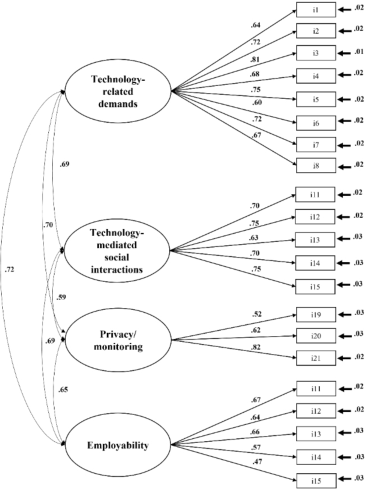
and kurtosis (from −0.76 to 1.61) values indicated a normal distribution for the items. Bartlett’s test of sphericity was significant (p <.001), and the Kaiser-Meyer-Olkin measure was satisfactory (i.e., 0.94). The 4-factor model selected in the EFA was tested on the CFA sample (n = 852) using the ML method. This model demonstrated good fit indices (χ2 = 718.97, df = 183, p = .00; CFI = .93; TLI = .92; RMSEA = .06; SRMR = .04; see Figure 1) and outperformed all alternative models (1-factor model: χ2 = 1626.59, df = 189, p = .00; CFI = .81; TLI = .78; RMSEA = .09; SRMR = .06; 2-factor model: χ2 = 1438.64, df = 188, p = .00; CFI = .83; TLI = .81; RMSEA = .09; SRMR = .06; 3-factor model: χ2 = 1272.30, df = 183, p = .00; CFI = .85; TLI = .83; RMSEA = .08; SRMR = .06). All factors exhibited satisfactory composite reliabilities (technology-related demands: α = .89; ω = .86; CR = .89; technology-mediated social interactions: α = .83; ω = .83; CR = .83; privacy/monitoring: α = .70; ω = .70; CR = .69; employability: α = .75; ω = .75; CR = .74). The total scale showed satisfactory composite reliabilities (α = .92; ω = .92; CR = .95). The average inter-item correlation was 0.62, the item-total correlation was 0.57, with all items exhibiting communalities from 0.44 to 0.73. The factor solution accounted for 58.54% of the variance.
Table 1. EFA (n = 3374): factor loadings and communalities of the selected items, explained variance and reliability of the factors.
Note. h2= item communality. Factor loadings > |.40| are in bold. Factor 1=
Figure 1: Standardized coefficients of the four-factor model. Note. p<.001 for all coefficients.
Nomological Validity The total and sub-dimensions scores of the scale were positively related to psycho-physical distress, while negatively linked to job satisfaction (see Table 2).
Table 2. Descriptive statistics and intercorrelations among the study’s variables in the CFA sample (N = 852).
7. Satisfaction 7.09 1.69 −1.06 1.62 −.39**a −.37**a −.31**a −.30**a −.29**a −.50**a − 15. Gender − − − − −.06 b −.05 b −.08* b −.04b .01 b −.04 b −.02 b − 16. Age − − − − .17**c .14**c .10**c .10**c .25**c .05c −.04c −.10**b − 17. Tenure − − − − .19**c .19**c .11**c .14**c .24**c .05c −.08**c −.03b .65**c Note. Boldfaced numbers on the diagonal represent Cronbach’s alpha; Demands = technology- related demands, Relations = Technology-mediated social interactions; Privacy = privacy/monitoring, Employab. = Employability; sex: 0 = male, 1 = female; Age: 1 = 20-30 years, 2 = 31–40 years, 3 = 41–50 years, 4 = <50 years; Tenure = job tenure: : 1 = <1 year, 2 = 1–5 years, 3 = 6–10 years, 4 = 11–20 years, 5 = > 20 years; M = means; SD = standard deviations; Skew. = skewness; Kurt. = kurtosis; *p<05; **p < .01. a = Pearson’s correlation coefficients; b = Spearman’s rho correlation coefficients; c = Kendall’s coefficients of rank correlation tau-subb.
The Emerging Technology-Related Stressors Scale 1815
DISCUSSION
This study advances our understanding of the main factors contributing to technostress and offers a novel and reliable assessment tool for their evaluation. Both the EFA and the CFA results confirmed a four- factor structure: 1) “technology-related demands” includes interruptions in activities due to ICTs, feelings of pressure and urgency, heavier workload, fatigue from ICT use, and increased deadlines due to excessive virtual engagement; 2) “privacy/monitoring” involves concerns about work monitoring through ICTs, privacy impairment due, and beliefs about excessive company monitoring through technology; 3) “employability” addresses uncertainty about job future due to technological advancements, concerns related to marketability of technological skills, and competitiveness of those skills; 4) “technology-mediated social interactions”, measures perceive limitations in face-to-face relationships and fewer interaction opportunities due to ICTs. The study confirmed items’ adequacy and the scale’s satisfactory internal consistency. The results supported the nomological validity of the scale, showing positive associations between the four sources of techno-stress and psycho-physical distress, and negative relationships with job satisfaction, which is consistent with the previous literature on technostress (Borle et al., 2021; Kumar et al., 2013; La Torre et al., 2019; Rasool et al., 2022; Sarabadani et al., 2018; Suh & Lee, 2017). Given its cross-sectional and self-reported nature, this study does not allow us to infer causal relationships. To alleviate participants’ evaluation apprehension and social desirability concerns, only minimal socio-demographic information was collected. Future studies should gather data from multiple sources on larger and more gender-balanced samples of employees from different countries and organizational sectors to validate our preliminary findings and adopt a longitudinal design to verify the test- retest reliability of the scale. The results of this study can guide the effective implementation of ICTs by identifying potential sources of techno-stress and addressing them proactively. This can also encourage practices that enhance technology-mediated social interactions, including implementing collaborative platforms, promoting peer support networks, and facilitating virtual social activities. The scale also provides valuable information for developing targeted training programs to help employees improving their technological skills and employability.
REFERENCES
Ayyagari, Grover, and Purvis. (2011), “Technostress: Technological Antecedents and Implications”, MIS Quarterly, Vol. 35, No. 4, p. 831, DOI : 10.2307/41409963. Borle, P., Reichel, K., Niebuhr, F. and Voelter-Mahlknecht, S. (2021), “How
Are Techno-Stressors Associated with Mental Health and Work Outcomes? A Systematic Review of Occupational Exposure to Information and Communication Technologies within the Technostress Model”, International Journal of Environmental Research and Public Health, Vol. 18, No. 16, p. 8673, DOI : 10.3390/ijerph18168673.
Brougham, D. and Haar, J. (2018), “Smart technology, artificial intelligence, robotics, and algorithms (STARA): Employees’ perceptions of our future workplace”, Journal of Management & Organization, Cambridge University Press, Vol. 24, No. 2, pp. 239–257. Chang, S. E., Liu, A. Y. and Lin, S. (2015), “Exploring privacy and trust for
employee monitoring”, Industrial Management & Data Systems, Vol. 115, No. 1, pp. 88–106, DOI : 10.1108/IMDS-07-2014-0197. Day, A., Paquet, S., Scott, N. and Hambley, L. (2012), “Perceived information and communication technology (ICT) demands on employee outcomes: The moderating effect of organizational ICT support.”, Journal of Occupational Health Psychology, Vol. 17, No. 4, pp. 473–491, DOI : 10.1037/a0029837. Day, A., Scott, N. and Kevin Kelloway, E. (2010), “Information and communication
technology: Implications for job stress and employee well-being”, in Perrewé, P. L. and Ganster, D. C. (Eds.), Research in Occupational Stress and Well-Being, Vol. 8, Emerald Group Publishing Limited, pp. 317–350. Duarte, A. and Dias, P. (2023), “Digital Wellbeing in the Workplace Environment: Definition, Dimensions, Strategies, and Best Practices”, in Duarte, A., Dias, P., Ruão, T. and Andrade, J. G. (Eds.), Advances in Human Resources Management and Organizational Development, IGI Global, pp. 1–15, DOI : 10.4018/978-1- 6684-7353-5.ch001. Fraccaroli, F., Depolo, M. and Sarchielli, G. (1991), “L’uso del General Health
Questionnaire di Goldberg in una ricerca su giovani disoccupati. [The use of Goldberg’s General Health Questionnaire in a study of unemployed young people. ]”, Giunti Organizzazioni Speciali, Vol. 197, pp. 13–19. Frey, C. B. and Osborne, M. A. (2017), “The future of employment: How susceptible are jobs to computerisation?”, Technological Forecasting and Social Change, Vol. 114, pp. 254–280, DOI : 10.1016/j.techfore.2016.08.019. Giorgi, G., Arcangeli, G. and Cupelli, V. (2012), Stress Lavoro Correlato. Leader e
Collaboratori a Confronto., Edises Napoli. Goldberg, D. P. and Williams, P. (1988), A User’s Guide to the General Health Questionnaire: GHQ., GL Assessment, London. Golden, T. D., Veiga, J. F. and Dino, R. N. (2008), “The impact of professional
isolation on teleworker job performance and turnover intentions: Does time spent teleworking, interacting face-to-face, or having access to communication- enhancing technology matter?”, Journal of Applied Psychology, Vol. 93 No. 6, pp. 1412–1421, DOI : 10.1037/a0012722. Gupta, A. and Sharda, R. (2008), “SIMONE: A Simulator for Interruptions and Message Overload in Network Environments”, International Journal of Simulation and Process Modelling, Vol. 4, No. 3/4, p. 237, DOI : 10.1504/IJSPM.2008.023685. Judd, T. and Kennedy, G. (2011), “Measurement and evidence of computer-
based task switching and multitasking by ‘Net generation’ students.”, Computers & Education, Elsevier Science, Netherlands, Vol. 56, No. 3, pp. 625–631, DOI : 10.1016/j.compedu.2010.10.004. Kamal, M. and Dong, Y. (2017), “A cross country analysis of multitasking with technology in academic settings”. Karr-Wisniewski, P. and Lu, Y. (2010), “When more is too much: Operationalizing
technology overload and exploring its impact on knowledge worker productivity”, Computers in Human Behavior, Vol. 26, No. 5, pp. 1061–1072, DOI : 10.1016/j.chb.2010.03.008.
The Emerging Technology-Related Stressors Scale 1817
Kumar, R., Lal, R., Bansal, Y. and Sharma, S. K. (2013), “Technostress in relation to job satisfaction and organisational commitment among IT professionals”, International Journal of Scientific and Research Publications, Vol. 3, No. 12, pp. 1–3. Kumar, V. and Kumar, S. (2014), “Workplace spirituality as a moderator in
relation between stress and health: An exploratory empirical assessment”, International Review of Psychiatry, Vol. 26, No. 3, pp. 344–351, DOI : 10.3109/09540261.2014.924909. La Torre, G., Esposito, A., Sciarra, I. and Chiappetta, M. (2019), “Definition, symptoms and risk of techno-stress: a systematic review”, International Archives of Occupational and Environmental Health, Vol. 92, No. 1, pp. 13–35, DOI : 10.1007/s00420-018-1352-1. Lestari, N. S., Rosman, D. and Millenia, E. (2023), “The Association Between
Smart Technology, Artificial Intelligence, Robotics, and Algorithms (STARA) Awareness, Job Stress, Job Insecurity, and Job Satisfaction Among Hotel Employees During COVID-19 Pandemic”, edited by Mursitama, T. N., Noerlina, Sitepu, E. and Basaria, F. T. E3S Web of Conferences, Vol. 388, p. 03021, DOI : 10.1051/e3sconf/202338803021. Liao, C. (2017), “Leadership in virtual teams: A multilevel perspective”, Human Resource Management Review, Vol. 27, No. 4, pp. 648–659, DOI : 10.1016/j.hrmr.2016.12.010. MacKenzie, Podsakoff, and Podsakoff. (2011), “Construct Measurement and Validation Procedures in MIS and Behavioral Research: Integrating New and Existing Techniques”, MIS Quarterly, Vol. 35, No. 2, p. 293, DOI : 10.2307/23044045. Ragu-Nathan, T. S., Tarafdar, M., Ragu-Nathan, B. S. and Tu, Q. (2008), “The
Consequences of Technostress for End Users in Organizations: Conceptual Development and Empirical Validation”, Information Systems Research, Vol. 19, No. 4, pp. 417–433, DOI : 10.1287/isre.1070.0165. Rasool, T., Warraich, N. F. and Sajid, M. (2022), “Examining the Impact of Technology Overload at the Workplace: A Systematic Review”, SAGE Open, Vol. 12, No. 3, p. 215824402211143, DOI : 10.1177/21582440221114320. Sarabadani, J., Carter, M. and Compeau, D. (2018), “10 years of research on
technostress creators and inhibitors: synthesis and critique”. Stich, J.-F. (2020), “A review of workplace stress in the virtual office”, Intelligent Buildings International, Vol. 12, No. 3, pp. 208–220, DOI : 10.1080/17508975.2020.1759023. Stich, J.-F., Tarafdar, M. and Cooper, C. L. (2018), “Electronic communication in the workplace: boon or bane?”, Journal of Organizational Effectiveness: People and Performance, Vol. 5, No. 1, pp. 98–106, DOI : 10.1108/JOEPP-05-2017-0046. Suh, A. and Lee, J. (2017), “Understanding teleworkers’ technostress and its
influence on job satisfaction”, Internet Research, Vol. 27, No. 1, pp. 140–159, DOI : 10.1108/IntR-06-2015-0181. Tomczak, D. L., Lanzo, L. A. and Aguinis, H. (2018), “Evidence-based recommendations for employee performance monitoring”, Business Horizons, Vol. 61, No. 2, pp. 251–259, DOI : 10.1016/j.bushor.2017.11.006. Turkle, S. (2011), Alone Together: Why We Expect More from Technology and Less from Each Other, Basic books, New York.
Vayre, E. and Pignault, A. (2014), “A systemic approach to interpersonal relationships and activities among French teleworkers: French teleworkers’ relationships and activities”, New Technology, Work and Employment, Vol. 29, No. 2, pp. 177–192, DOI : 10.1111/ntwe.12032. Wang, K., Shu, Q. and Tu, Q. (2008), “Technostress under different organizational environments: An empirical investigation”, Computers in Human Behavior, Vol. 24, No. 6, pp. 3002–3013, DOI : 10.1016/j.chb.2008.05.007. Wells, D. L., Moorman, R. H. and Werner, J. M. (2007), “The impact of
the perceived purpose of electronic performance monitoring on an array of attitudinal variables”, Human Resource Development Quarterly, Vol. 18, No. 1, pp. 121–138, DOI: 10.1002/hrdq.1194.
LISTED IN THE AHFE DIGITAL BOOKSTORE CATALOGUE
Explore the complete digital volume
Human Factors in Design, Engineering, and Computing
Read this individual research paper free through the original publisher, or explore the full digital proceedings book.
ISBN 978-1-964867-35-9
Explore this ISBN in the AHFE Bookstore ↗Listed in the July 2026 bookstore catalogue; search by ISBN to confirm current availability · Digital book purchase optional