Frauke Schuseil, Michael Hertwig, Joachim Lentes, Nikolas Zimmermann, Katharina Hölzle (2024). A semantic matchmaking approach to empower human decision-making in Manufacturing-as-a-Service scenarios. In: Human Factors in Design, Engineering, and Computing. AHFE Open Access, vol. 159, pp. 1838–1848. https://doi.org/10.54941/ahfe1005751
Fragile and unreliable supply chains, due to environmental disasters or other disruptions are a challenge for modern production companies. The concept of Manufacturing-as-a-Service (MaaS) marks a shift from traditional manufacturing, focusing on shared, networked infrastructures. In MaaS environments, effective management of demand for manufacturing capabilities and supply of production capacity is crucial, while final decisions remain with human operators. The EU project ACCURATE (Achieving Resilience through Manufacturing-as-a-Service, Digital Twins and Ecosystems) aims to create a distributed MaaS ecosystem that offers a collaborative, human-centered Decision Support System (DSS) for robust planning and resilient operations. A primary challenge is aligning services from suppliers with the demand for physical goods, which includes transportation, warehousing, and information, in addition to manufacturing. Semantic approaches and ontologies can describe these services comparably. This paper introduces a semantic matchmaking concept in MaaS networks to empower human decision makers in supply chain management. To support this, related concepts of service-oriented manufacturing concepts are analyzed and a working definition of MaaS is derived. Based on this, an approach is presented that matches supply and demand for manufacturing services while considering product process requirements. Importantly, this is not a standalone decision-making tool but a foundation for informed choices, enabling users, like order fulfilment managers, to receive tailored offers from suitable providers based on recommendations from the semantic matchmaking service.
In today’s global economy, the vulnerability of supply chains to environmental disasters and other unpredictabilities pose challenges for modern production companies. These organizations aim to build resilience and sustainability within their value chains. The objective of an ongoing research project is to ascertain methods for mitigating the impact of supply chain disruptions, with the aim of enhancing the resilience and sustainability of these supply chains. In the context of the rapid evolution of industrial
A Semantic Matchmaking Approach to Empower Human Decision-Making 1839
manufacturing, the concept of Manufacturing-as-a-Service (MaaS) represents a key innovation, with the potential to reshape the way in which companies can access and utilize manufacturing capabilities. MaaS is changing the way how companies access manufacturing capabilities, providing cost-effective solutions during disruptions and increasing equipment utilization. Despite digital advancements, finding suitable manufacturing services remains difficult. It is of great significance to match demand with the existing supply. Therefore, this paper proposes a matchmaking approach to facilitate the matching of supply and demand, aiming for an increase of diffusion of MaaS in the market. The presented matchmaking approach is based on the semantic representation of information as an ontology, which facilitates semantic features for matchmaking as well as the extension of the information model during its usage phase. The ontology is presented in a dedicated article as its description is beyond the scope of this paper.
The publication is structured as follows: the next section covers the State of the Art in service-oriented manufacturing and matchmaking concepts. Next, it presents the Ontology-Based Matchmaking concept for MaaS providers and customers, including the human decision maker’s role. Finally, it concludes and discusses further research directions.
ANALYSIS OF CURRENT CONCEPTS AND RELATED RESEARCH This chapter is aimed at establishing the necessary foundations for the subsequent work. Consequently, a comprehensive literature search was conducted. Initially, related service-oriented manufacturing concepts are presented, followed by the State of the Art of related matchmaking concepts.
Service-Oriented Manufacturing Concepts The term ‘Outsourcing’ is used to describe the practice of industrial and service companies contracting out certain products or services to external companies that are able to provide these products or services in a superior or more efficient manner (Klein-Schneider & Beutler, 2013). In the so-called Manufacturing Grid (MGrid), companies engage in collaborative activities through the coordinated (but not centralized) utilization, integration, and interoperability of a system of spatially distributed and heterogeneous manufacturing resources (including design, manufacturing, human, and application system resources using grid, information, computer and advanced management, and advanced manufacturing technologies (Tao & Qi, 2019; Tao et al., 2011; Tedaldi & Miragliotta, 2021).
Cloud manufacturing (CMfg) enables the transformation of the manufacturing industry from production-oriented manufacturing to service- oriented manufacturing (Ren et al., 2017). Henzel and Herzwurm (2018) conducted an extensive literature review on CMfg and identified the following seven characteristics: Networked environment and collaboration among users (I); Service and requirement orientation (II); Interoperability among systems (III); Effective realization of intelligence by Knowledge and Data (IV); Virtualization principle (V); Scalability/Pay-as-you-go (VI); Highly reliant on Trust and Security (VII). Often mistakenly considered as
a synonym for MaaS, MaaS is rather an integral part of CMfg (Bulut et al., 2021). The term ‘Production as a Service’ (PaaS) is also frequently used as a synonym for MaaS, for example in Balta et al. (2017) or Hermann et al. (2020). The focus is mainly on small-batch production, which, in our opinion, is not incompatible with the MaaS approach. From a terminological perspective, MaaS can be considered a subset of PaaS, given that manufacturing constitutes a sub-area of production (Groover, 2020; Heizer et al., 2017).
In the context of MaaS, CMfg has been described by Liu et al. (2019) as follows: “A model for enabling aggregation of distributed manufacturing resources (e.g. manufacturing software tools, manufacturing equipment, and manufacturing capabilities) and ubiquitous, convenient, on-demand network access to a shared pool of configurable manufacturing services that can be rapidly provisioned and released with minimal management effort or service operator and provider interaction”. The characteristics of CMfg (Tedaldi & Miragliotta, 2021) aimed at realizing MaaS can be summarized as follows: 1. centralized management of resources by the cloud operator (i.e. conversion of user requests into tasks, allocation and scheduling); 2. intensive exchange of information between resource provider, user and cloud operator; 3. on- demand availability of resources; 4. service orientation and flexibility (high adaptability for the user in terms of product, delivery date, volume, mix, fast response time, flexible contractual relationships); 5. resources are pooled and the user generally has no control or knowledge of the exact location of the resources provided; 6. services are available everywhere and accessible via standard devices (e.g. smartphone, laptop); 7. dynamic with uncertainty, rapid elasticity and scalability. For the remainder of this publication the following working definition for MaaS will be used: “MaaS represents a service-based manufacturing concept enabled by CMfg and thus managed via a centralized CMfg platform. A distinguishing characteristic of this concept is the capacity to disperse manufacturing services across both geographical and logical boundaries. Primarily demand-oriented, MaaS is characterized by short-term collaboration. MaaS provides both individual manufacturing services and combinations of such services (service bundles).” A detailed examination of the derivation of this definition and a comparison with the other manufacturing concepts will be presented in a subsequent publication, as this is beyond the scope of the present work.
Matchmaking of Manufacturing Services Jang et al. (2008) define manufacturing services as activities using physical equipment for material processing. The discovery of services involves matching orders with advertised services (Zhang et al., 2007). In their research, Yu’an et al. discover that keyword-based service discovery and matching in MGrids is not ideal, which is why semantic- based matching approaches emerged mid-2000s (Yu’an et al., 2009). Ameri and Dutta (2008) propose a matchmaking algorithm to connect buyers and sellers of manufacturing services based on their semantic similarities regarding manufacturing capabilities using Manufacturing
A Semantic Matchmaking Approach to Empower Human Decision-Making 1841
Service Description Language (MSDL) to compensate for the lack of a complete vocabulary for describing manufacturing services in other semantic description languages. They develop an optimization model to maximize similarity and minimize the number of suppliers in a supply chain. Yu’an et al. (2009) introduce a three-layer matching method, consisting of requirements of service function or methods (Method), constraints of object properties of the task (Objects), and requirements of Quality of Service (QoS), using Web Ontology Language for Services (OWL-S). Cai et al. (2011) develop ManuHub for modelling distributed manufacturing services with Web Ontology Language (OWL) and Semantic Web Rule Language (SWRL), proposing a simplified and efficient semantic matchmaking algorithm building upon the feature-based approach proposed by Ameri and Dutta. Other authors (Liu et al., 2012; Sun et al., 2008; Yu’an et al., 2009) use fuzzy approaches to describe semantic similarity matching. In a further development of the approach originally set forth by Cai et al. in 2011, Zhang et al. (2015) employ an OWL-based ontology for personalized manufacturing service recommendations using a collaborative filtering method to automate the semantic annotation of manufacturing service capabilities. Lartigau et al. (2015) present a CMfg approach based on QoS evaluation extending it with geo-perspective correlation from one cloud service to another for traffic impact analysis. Järvenpää et al. (2017, 2018; 2023) elaborate on an OWL-based capability matchmaking which supports rapid configuration and reconfiguration of production systems. As this is a fundamental prerequisite for a matchmaking to find suitable service providers for potential service consumers and vice versa at a meta level, our work will take this preliminary work as a basis. Zhao et al. (2017) propose multi-level matchmaking comprising feature matching based on semantic similarity, numerical matching based on rules, and feature matching based on task decomposition. Siltala et al. (2019) introduce a method to check the connectivity of manufacturing resources in addition to the capability-based matchmaking by Järvenpää et al. They focus on interface connectivity of resources and develop an interface ontology, which is queried with SPARQL for the interface matchmaking. Vennesland et al. (2019) develop a semantic matching algorithm for capacity exchange that, based on the formally described supply chain resources returns a ranked list of relevant suppliers given a customer query. The matching is based on various parameters to find suppliers whose offered resources match a consumer query: process, material, machine, certifications, capacity, and calendar availability. Delaram et al. (2021) model resource allocation as a matching game in a public cloud manufacturing environment, while Sparr et al. (2021) use a Multi-Agent System for auction-based service provider selection in CMfg.
CONCEPT FOR A MATCHMAKING APPROACH IN A MaaS SCENARIO The objective of this chapter is to advance the State of the Art by proposing a conceptual framework for a three-stage matchmaking approach. This framework is designed to facilitate the involvement of a human decision- maker in the evaluation process, thereby enabling the selection of a MaaS service or provider that meets the desired criteria.
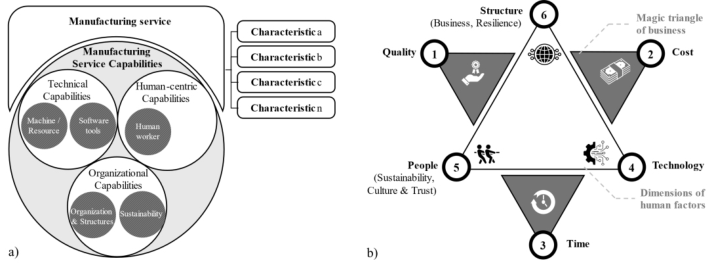
Involved Parties in Matchmaking To enable MaaS, two parties must be involved. These must be a service provider and a service customer, representing at least two contracting parties. A MaaS provider offers services that encompass one or more manufacturing steps, or even assume the role of a supplier. This can leverage existing capabilities, including infrastructure, machinery, software, and skilled personnel (Figure 1a). The establishment of organizational structures and measures, such as standards, certifications, and process descriptions, serves to further enhance these offerings. The motivation for becoming a MaaS provider is diverse and can be driven by a variety of factors, including the presence of excess capacity, underutilized machinery, or the identification of new business opportunities. Irrespective of the rationale, the services in question must be delineated in a manner that enables customers to evaluate their suitability. This can be realized by utilizing characteristics to describe manufacturing service capabilities (Figure 1a). The characteristics are employed to ensure compliance to the customers’ specification, which may be multifaceted. The aforementioned characteristics may be classified as technical, encompassing quality, performance, and process-related attributes. In the context of MaaS, customers may occasionally encounter temporal disruptions, underscoring the importance of timely delivery. This includes not only the time required for transport but also the scheduling of that transport. In addition, the organizational characteristics must be taken into account, as they may pertain to certification, the fulfillment of specific regulations, or the provision of relevant documentation.
Figure 1: (a) Characteristics describing manufacturing service capabilities required to provide a MaaS service, and (b) requirements describing manufacturing service demands.
A MaaS customer represents the demand side of the supply perspective. They require a service that can either be a part of an offering or the entirety of the offered service. The reason that service customers are looking for MaaS are various: Disruption of Internal Production Processes Unforeseen machine or production line breakdowns can reduce or eliminate manufacturing capacity. In addition, production capacities cannot be
A Semantic Matchmaking Approach to Empower Human Decision-Making 1843
achieved if quality and tolerance requirements cannot be met. Quick replacement of this capacity is essential to meet delivery agreements (Katsaliaki et al., 2022), which can be filled by a suitable MaaS offering.
Disruption in the Supply Chain The COVID-19 pandemic highlighted supply chain fragility (Shishodia et al., 2023). Analyzing risks allows for strategy development, but some interruptions are costly or difficult to address. Disruptions include supplier breakdowns or transport issues. MaaS can temporarily replace a supplier until reliable supply is restored (Herold & Marzantowicz, 2023).
Short-Term Increases in Demand for Capacity Volatile demand can lead to mismatches between capacity and customer needs, causing losses. When demand exceeds capacity, manufacturers can use MaaS to increase capacity.
A MaaS customer has specific demands from two perspectives (Figure 1b). The first is the magic triangle of business: balancing quality (form, volume, material, tolerances), cost, and time. The second perspective involves technology, people, and structure. Technology requirements are product- specific, people drive processes and impact organizational sustainability, and structure includes regulations, certifications, and external conditions.
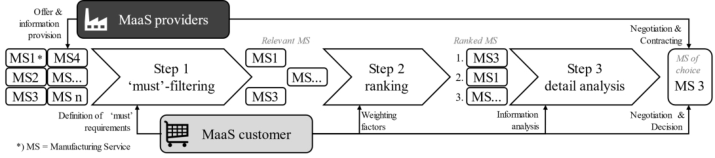
Human-Centered Ontology-Based Matchmaking Matchmaking should support the human decision maker by leveraging the beneficial performance aspects of both parties – machine and human (Wilson & Daugherty, 2018). To enable an accurate and efficient matchmaking of manufacturing capabilities with the demand perspective, semantic product requirements and process attributes are crucial, as the matchmaking process involves comparing the product requirements with the capabilities of available manufacturing services to ensure compatibility and optimal resource utilization. Based on a calculated pre-evaluation, the human decision maker can evaluate different constraints according to the current situation and strategic perspective (Ozkiziltan & Hassel, 2020). To support the matchmaking between products and manufacturing services, a related ontology class ProductServiceMatching, is developed using Ontology-Based Matchmaking (OBMm). The comparison of matching attributes is advanced by relating the customer perspective (service requirement) and offering perspective (characteristics), based on the conceptual ideas of Järvenpää et al. (2017). Both, requirements and characteristics may or may not be quantifiable, but they have reference values for the comparison. If they are quantifiable, they refer to a quantity, which at least has a value and a measurement unit and can be derived from the National Aeronautics and Space Administration (NASA) ontology for Quantities, Units, Dimension and Types (QUDT, 2019). If they are not quantifiable, they refer to an arbitrary instance of a class of the ontology. The OBMm procedure is designed to facilitate a significant role for the human operator, comprising two distinct steps, followed by a final human-inclusive decision (Figure 2).
Figure 2: Conceptual visualization of the OBMm procedure aiming to realize a MaaS scenario.
Firstly, the available services are filtered by the must requirements based on their characteristics, as the MaaS customer has the ability to classify must- requirements. All these requirements need to be fulfilled to be evaluated in the second step. For quantified comparisons, requirements can require equality but may be based on a minimum or maximum condition with included or excluded boundary values (so they can be closed or open as intervals). Thus, to define quantified requirements which are based on an interval, users must define two requirements, one for the minimum and one for the maximum condition. Non-quantifiable requirements are fulfilled, if the characteristic ‘has’ an arbitrary instance of the ontology class which is defined by the reference value of the requirement.
In a second step, the remaining services are ranked according to their fulfillment of the requirements to support the decision maker. Two measures are taken to take account of different scales. Firstly, the weightings of the requirements are defined on identical scales and normalized subsequently. Secondly, the normalized weightings are scaled to compensate the order of magnitude of the quantity of the characteristic. Possible product-service- matchings are then provided in a ranking based on their matching degree as the sum of the fulfillment degrees of the requirements fulfillments of the product-service-matching to the user, who may then select a service based on his preferences.
Finally, the decision maker can analyze details about the manufacturing service and the providing organization to evaluate the compliance to strategic objectives and organization conditions. This provides an additional lever for controllability of the matching results and the service provider.
CONCLUSION AND OUTLOOK This paper proposes an Ontology-Based Matchmaking concept for the realization of MaaS to overcome current difficulties in matching the demand of MaaS customers with the existing supply. To achieve this, it was necessary to derive a working definition of MaaS from a combination of literature analyses and comparisons of related service- oriented manufacturing concepts, which will be described in detail in a subsequent publication. The matchmaking approach was deliberately selected to afford a human user the greatest degree of decision-making and intervention power, thereby ensuring that the resulting recommendations are solely indicative.
A Semantic Matchmaking Approach to Empower Human Decision-Making 1845
Further research is required to provide a comprehensive description of the characteristics associated with both MaaS offerings and requirements for a MaaS service. It is essential to validate the approach by examining its functionality across a range of use cases and the technical implementation within a CMfg platform. It is intended to realize the matchmaking supporting MaaS applications as a service unit within a GAIA-X ecosystem. By doing so, the Ontology-Based Matchmaking must be technically further detailed.
ACKNOWLEDGMENT
This paper is supported by European Union’s Horizon Europe research and innovation programme under grant agreement No 101138269, project ACCURATE (Achieving Resilience through Manufacturing as a Service, Digital Twins and Ecosystems). The authors would like to thank the funding bodies and all project partners, without whom this publication could not have been realized. Funded by the European Union. However, the views and opinions expressed are those of the author(s) only and do not necessarily reflect those of the European Union or European Health and Digital Executive Agency (HADEA). Neither the European Union nor the granting authority can be held responsible for them.
REFERENCES
Ameri, F., & Dutta, D. (2008). A matchmaking methodology for supply chain deployment in distributed manufacturing environments. JOURNAL of COMPUTING and INFORMATION SCIENCE in ENGINEERING, 8(1). https://doi.org/10.1115/1.2830849 Balta, E. C., Jain, K., Lin, Y., Tilbury, D., Barton, K., & Mao, Z. M. (2017).
Production as a service: A centralized framework for small batch manufacturing. In 13th IEEE Conference on Automation Science and Engineering (pp. 382–389). https://doi.org/10.1109/COASE.2017.8256133 Bulut, S., Wende, M., Wagner, C., & Anderl, R. (2021). Impact of Manufacturing-asa-Service: Business Model Adaption for Enterprises. Procedia CIRP, 104, 1286– 1291. https://doi.org/10.1016/j.procir.2021.11.216 Cai, M., Zhang, W. Y., & Zhang, K. (2011). ManuHub: A semantic web system for
ontology-based service management in distributed manufacturing environments. IEEE Transactions on Systems, Man, and Cybernetics Part a: Systems and Humans, 41(3), 574–582. https://doi.org/10.1109/TSMCA.2010.2076395 Delaram, J., Houshamand, M., Ashtiani, F., & Valilai, O. F. (2021). A utilitybased matching mechanism for stable and optimal resource allocation in cloud manufacturing platforms using deferred acceptance algorithm. Journal of Manufacturing Systems, 60, 569–584. https://doi.org/10.1016/j.jmsy.2021.07. 012 Groover, M. P. (2020). Fundamentals of modern manufacturing: Materials, processes,
and systems (Seventh edition). John Wiley & Sons, Inc. Heizer, J. H., Render, B., & Munson, C. (2017). Operations management: Sustainability and supply chain management (Twelfth edition, global edition). Pearson. Henzel, R., & Herzwurm, G. (2018). Cloud Manufacturing: A state-of-the-art survey of current issues. Procedia CIRP, 72, 947–952. https://doi.org/10.1016/j.procir .2018.03.055
Hermann, J., Rübel, P., Wagner, A., & Ruskowski, M. (2020). A generic product and resource description to enable capability matchmaking for Production as a service. IFAC-PapersOnLine, 53. https://doi.org/10.1016/j.ifacol.2020.12.2826 Herold, D. M., & Marzantowicz, Ł. (2023). Supply chain responses to global
disruptions and its ripple effects: an institutional complexity perspective. Operations Management Research, 16(4), 2213–2224. https://doi.org/10.1007/ s12063-023-00404-w Jang, J., Jeong, B., Kulvatunyou, B., Chang, J., & Cho, H. (2008). Discovering and integrating distributed manufacturing services with semantic manufacturing capability profiles. International Journal of Computer Integrated Manufacturing, 21(6), 631–646. https://doi.org/10.1080/09511920701350920 Jarvenpaa, E., Siltala, N., Hylli, O., & Lanz, M. (2017). Capability matchmaking
procedure to support rapid configuration and re-configuration of production systems. In M. Pellicciari & M. Peruzzini (Chairs), 27th Internation Conference on Flexible Automation and Intelligent Manufacturing: FAIM2017. Jarvenpaa, E., Siltala, N., Hylli, O., & Lanz, M. (2018). Product Model ontology and its use in capability-based matchmaking. In Wang, Lihui (Chair), 51st CIRP Conference on Manufacturing Systems. Symposium conducted at the meeting of KTH Royal Inst Technol Int Acad Prod Engn. Jarvenpaa, E., Siltala, N., Hylli, O., Nylund, H., & Lanz, M. (2023). Semantic rules
for capability matchmaking in the context of manufacturing system design and reconfiguration. International Journal of Computer Integrated Manufacturing, 36(1), 128–154. https://doi.org/10.1080/0951192X.2022.2081361 Katsaliaki, K., Galetsi, P., & Kumar, S. (2022). Supply chain disruptions and resilience: A major review and future research agenda. Annals of Operations Research, 319(1), 965–1002. https://doi.org/10.1007/s10479-020-03912-1 Klein-Schneider, H., & Beutler, K. (2013). Werkvertragsunternehmen: Outsourcing
auf dem Betriebsgelände. WSI-Mitteilungen, 66(2), 144–148. https://doi.org/10. 5771/0342-300x-2013-2-144 Lartigau, J., Xu, X [Xiaofei], Nie, L., & Zhan, D. (2015). Cloud manufacturing service composition based on QoS with geo-perspective transportation using an improved Artificial Bee Colony optimisation algorithm. International Journal of Production Research, 53(14), 4380–4404. https://doi.org/10.1080/00207543. 2015.1005765 Liu, M., Shen, W., Hao, Q., Yan, J., & Bai, L. (2012). A fuzzy matchmaking approach
for Semantic Web Services with application to collaborative material selection. Computers in Industry, 63(3), 193–209. https://doi.org/10.1016/j.compind.2011. 10.001 Liu, Y., Wang, L [Lihui], Wang, X. V., Xu, X [Xun], & Jiang, P. (2019). Cloud manufacturing: Key issues and future perspectives. International Journal of Computer Integrated Manufacturing, 32(9), 858–874. https://doi.org/10.1080/ 0951192X.2019.1639217 Ozkiziltan, D., & Hassel, A. (2020). Humans versus Machines: An Overview of
Research on the Effects of Automation of Work. Hertie School of Governance. QUDT. (2019). QUDT Ontologies Overview. https://www.qudt.org/pages/QUDTo verviewPage.html Ren, L., Zhang, L [Lin], Wang, L [Lihui], Tao, F., & Chai, X. (2017). Cloud
manufacturing: key characteristics and applications. International Journal of Computer Integrated Manufacturing, 30(6), 501–515. https://doi.org/10.1080/ 0951192X.2014.902105
A Semantic Matchmaking Approach to Empower Human Decision-Making 1847
Shishodia, A., Sharma, R., Rajesh, R., & Munim, Z. H. (2023). Supply chain resilience: A review, conceptual framework and future research. The International Journal of Logistics Management, 34(4), 879–908. https://doi.org/10.1108/IJLM -03-2021-0169 Siltala, N., Jarvenpaa, E., & Lanza, M. (2019). A method to evaluate interface
compatibility during production system design and reconfiguration. In P. Butala, E. Govekar, & R. Vrabic (Chairs), 52nd CIRP Conference on Manufacturing Systems (CMS). Symposium conducted at the meeting of CIRP. Sparr, K., Drexel, D., & Hoch, R. (2021). Using an Auction-Based System in Cloud Manufacturing for Selecting Manufacturing-as-a-Service Providers. In A. Dolgui, A. Bernard, D. Lemoine, G. VonCieminski, & D. Romero (Eds.), IFIP Advances in Information and Communication Technology, Advances in Production Management Systems: Artificial Intelligence for Sustainable and Resilient Production Systems (pp. 445–454). PT V. https://doi.org/10.1007/978- 3-030-85914-5\_48 Sun, Z., Jing, W., Hong, J., & Huo, M. (2008). Matchmaking of network mold enterprise based on analytical hierarchy process. Hsi- an Chiao Tung Ta Hsueh/Journal of Xi’an Jiaotong University, 42(3), 291–294. https://www.scopus.com/inward/record.uri?eid=2-s2.0– 41949114309&partnerID=40&md5=cec1b033633cd0d50a38be7eadf64608 Tao, F., & Qi, Q. (2019). New IT Driven Service-Oriented Smart Manufacturing:
Framework and Characteristics. IEEE Transactions on Systems Man Cybernetics- System, 49(1), 81–91. https://doi.org/10.1109/TSMC.2017.2723764 Tao, F., Zhang, L [Lin], & Nee, A. (2011). A review of the application of grid technology in manufacturing. International Journal of Production Research, 49(13), 4119–4155. https://doi.org/10.1080/00207541003801234 Tedaldi, G., & Miragliotta, G. (2021). Manufacturing-as-a-Service (MaaS): state-
of-the-art of up and running solutions and a framework to assess the level of development of a Cloud Manufacturing platform. Summer School “Francesco Turco” – Industrial Systems Engineering, 26. Vennesland, A., Man, J. C.de, Haro, P. H., Arica, E., & Oliveira, M. (2019). Towards a semantic matchmaking algorithm for capacity exchange in manufacturing supply chains. IC3K 2019 - Proceedings of the 11th International Joint Conference on Knowledge Discovery, Knowledge Engineering and Knowledge Management, 2. https://doi.org/10.5220/0008364404660472 Wilson, H. J., & Daugherty, P. R. (2018). Collaborative Intelligence: Humans and
AI Are Joining Forces: Humans and machines can enhance each other’s strengths. Harvard Business Review (July-August), 114–123. https://hbr.org/2018/07/collab orative-intelligence-humans-and-ai-are-joining-forces (How Humans and AI Are Working Together in 1, 500 Companies). Yu’an, H., Dongqi, W., & Tao, Y. (2009). Research on Service Discovery and Matching Based on Ontology and Service Capabilities in Manufacturing Grid. In 2009 WRI World Congress on Computer Science and Information Engineering. IEEE. https://doi.org/10.1109/csie.2009.837
Zhang, L [Lei], Ma, J., & Zhang, S [Song] (2007). Automatic discovery of semantic manufacturing grid services. 3rd International Conference on Semantics, Knowledge, and Grid, SKG 2007. Advance online publication. https://doi.org/10. 1109/SKG.2007.101 Zhang, W., Guo, S., & Zhang, S [Shuai] (2015). Personalized manufacturing
service recommendation using semantics-based collaborative filtering. Concurrent Engineering-Research and Applications, 23(2), 166–179. https://doi.org/10.1177/ 1063293X15578034 Zhao, Y., Liu, Q., & Xu, W. (2017). Open Industrial Knowledge Graph Development for Intelligent Manufacturing Service Matchmaking. Proceedings - 2017 International Conference on Industrial Informatics - Computing Technology, Intelligent Technology, Industrial Information Integration, ICIICII 2017, 2017- December. https://doi.org/10.1109/ICIICII.2017.36
LISTED IN THE AHFE DIGITAL BOOKSTORE CATALOGUE
Explore the complete digital volume
Human Factors in Design, Engineering, and Computing
Read this individual research paper free through the original publisher, or explore the full digital proceedings book.
ISBN 978-1-964867-35-9
Explore this ISBN in the AHFE Bookstore ↗Listed in the July 2026 bookstore catalogue; search by ISBN to confirm current availability · Digital book purchase optional