Yi Fan Chen, Jiejun Dai (2024). Interface Design of Vehicle AR-HUD Based on User Needs. In: Human Factors in Design, Engineering, and Computing. AHFE Open Access, vol. 159, pp. 906–915. https://doi.org/10.54941/ahfe1005657
Focused on user needs, it aims to explore the design strategies for in-vehicle AR-HUD interfaces that effectively reduce cognitive load, improve driving safety, and elevate user experience and satisfaction across safety, experiential, and visual dimensions. Firstly, user needs were obtained through semi structured interviews, in-depth observations, etc., and classified using the KANO model. Secondly, the Analytic Hierarchy Process (AHP) is employed to calculate and prioritize the weights of user demands, thereby identifying core requirements. Lastly, the Quality Function Deployment (QFD) was employed to map ambiguous user needs into specific design elements, with weights calculated and ranked to provide execution strategies and practical guidance for implementing in-vehicle AR-HUD interfaces. Following the KANO-AHP-QFD research process, 11 user needs were objectively identified and extracted, leading to the identification of 15 design elements across safety, experience, and visual dimensions, culminating in innovative design proposals for the in-vehicle AR-HUD interface. Through the comprehensive application of the KANO-AHP-QFD model, both surface-level and latent user needs can be met, effectively guiding interface design, enhancing user satisfaction, and providing reference and insights for similar designs.
With the maturity of various technologies in the field of intelligent connected vehicles, cars are gradually transforming from a single means of transportation into an intelligent interactive space with intelligent driving systems and intelligent cockpits. Head-up displays (HUDs) can use holographic projection to provide users with multidimensional information about vehicle driving and road conditions directly on the road ahead, achieving “human-machine integration” and becoming the core interface for human-vehicle interaction (Riegler et al., 2019) Currently, there are three types of in-vehicle HUDs: C-HUD, W-HUD, and AR-HUD. The first two types of in-vehicle HUDs have a small imaging area, are close to the driver, and have limited display content, so they perform poorly in key evaluation indicators such as field of view and virtual image distance (Zhou et al., 2023). AR-HUD not only presents driving-related parameters and data on the windshield but also integrates the presented information with real traffic conditions, enhancing users’ situational awareness, improve driving safety and efficiency in both visual and psychological aspects, providing users with a new driving experience (Sun et al., 2024), and has become the mainstream application trend for future human-vehicle interaction.
Interface Design of Vehicle AR-HUD Based on User Needs 907
Currently, scholars have produced rich research results in the fields of vehicle AR-HUD interface usability design and cognitive load (Piegler et al., 2019), but few scholars have proposed AR-HUD interface design strategies based on user needs. User needs are an important guide for defining the direction of vehicle AR-HUD interface design and a key indicator for improving user experience. Therefore, this paper establishes a KANO-AHP- QFD research model by comprehensively considering the advantages and disadvantages of various models, focusing on user needs. The vehicle AR- HUD interface design is innovated from three dimensions: safety, experience, and visual aspects, to meet users’ needs and expectations for vehicle AR-HUD interfaces.
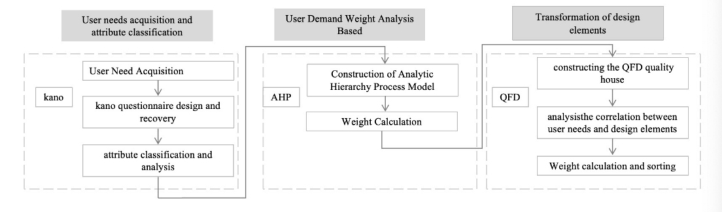
RESEARCH MODEL ANALYSIS AND DESIGN FRAMEWORK CONSTRUCTION User-driven design research methods mainly follow two major directions: qualitative and quantitative, including various models such as KANO, AHP (Analytic Hierarchy Process), TOPSIS (Technique for Order Preference by Similarity to Ideal Solution), AD (Axiomatic Design), and QFD (Quality Function Deployment) (Chen et al., 2024). KANO, proposed by Professor Noriaki Kano of Tokyo Institute of Technology, is a qualitative analysis model that primarily analyzes the non-linear relationship between users and performance through the acquisition, classification, and ranking of user needs, assessing user acceptance of new features. AHP, a model combining qualitative and quantitative analysis. It decomposes elements related to the overall decision into different levels such as goals, criteria, and schemes.This can identify key points for vehicle AR-HUD interface design (Qiu et al., 2023). QFD, a quantitative analysis model. Its key is to map user needs to design elements and other product definitions. The core is to build a “House of Quality” that visually displays the relationship between user needs and design elements, which can derive systematic and comprehensive decision points for vehicle AR-HUD interface design (Xiong et al., 2024). Through sorting, it can be concluded that each type of model has different emphasis: KANO is simple to operate but cannot provide precise ranking; AHP can perform weight ranking but cannot provide new solutions; QFD can “translate” user needs into quantifiable, specific design goals. Additionally, different models target different stages in the vehicle AR-HUD interface design process (Tang et al., 2023). Based on this, this paper fully utilizes the advantages of each model, integrating the KANO-AHP-QFD research model for vehicle AR-HUD interface design. In the vehicle AR-HUD interface design process, it achieves a full process construction including obtaining user needs, clarifying importance, and mapping design elements. The detailed process of the research approach (see Figure 1).
908 Yifan and Jiejun
Figure 1: The research process of interface design for car mounted AR-HUD (Yifan Chen, 2024).
DESIGN STRATEGY ANALYSIS INTEGRATING KANO-AHP-QFD User Need Acquisition and Classification Based on KANO
This study randomly selected 50 users at car exhibitions, 4S stores, and other locations as survey subjects. Through extraction and cross-analysis of basic information such as age, purchase intention, and level of understanding. To focus the survey, potential and explicit user needs were obtained through semi-structured interviews and in-depth observations. After integration and screening, a total of 14 user needs across 3 categories were identified: visual design, user experience, and safety assurance.
The Kano questionnaire was developed using the five-point Likert scale method, ranging from “very satisfied”, “just as I like it”, “neutral”, “acceptable” to “very dissatisfied” (Mao et al., 2024). Of the 120 collected questionnaires, 4 were eliminated due to contradictory answers between positive and negative questions, resulting in 116 valid questionnaires. The effective recovery rate of the questionnaires was 96.67%.
After integrating the questionnaire results, specific values for KM, KO, KA, KI, and KR of each user need were calculated using formulas. Based on the maximum value, the KANO attributes of user need indicators were determined (Tang et al., 2023) (see Table 1).
Ability to display information dynamically Error tolerance 20.00% 17.78% 8.89% 40.00% 6.67% 6.67%
User Demand Weight Analysis Based on AHP Construction of Analytic Hierarchy Process Model Based on the KANO questionnaire survey results, indifferent needs (I) are not considered in this study as they have no direct impact on improving user satisfaction and may occupy unnecessary attention from developers. The criterion layer of AHP consists of essential needs (M), expected needs (O), and attractive needs (A), while the indicator layer comprises 12 user sub-needs (see Table 2).
Table 2. Design features for automotive AR-HUD interface (Yifan Chen, 2024).
Table available in the original PDF paper.
Guideline Level User Requirements Design Elements Visual experience category
1. Simple and clear interface The main visual point is free from unnecessary obstructions, clearly presenting road information (DP1) Information of different levels is displayed in distinct zones, respecting driving priorities (DP2) 2. Scientifically designed and harmonious color scheme
3. Visually appealing icons and text
Colors used to convey information are consistent with common sense and should not exceed four types; contrasting colors with the current environment are preferred (DP3) Sensory experience category
Icons and fonts have no special effects, adhering to mainstream aesthetics (DP4) 4. Emotional and playful design elements
Emotional and caring expressions are displayed at the start of driving, during prolonged driving, and at the end of driving (DP5) 5. Multimodal interaction Includes multiple interactive operation methods such as voice, gesture, and touch screen (DP6) 6. Personalized display options Display content can be personalized; position can be adjusted based on user characteristics (DP7) 7. User-friendly interactive interface
Design includes a mascot; icons are designed with representational imagery (DP8) (Continued)
910 Yifan and Jiejun
Table 2. Continued Guideline Level User Requirements Design Elements
Table available in the original PDF paper.
Safety assurance category
8. Interface design aligned with human factors principles
Colors and shapes align with everyday cognition (DP10)
AR-HUD interface placement is determined based on the driver’s characteristics (DP9) 9. Information design in accordance with common sense
10. Low cognitive load Avoid information overload, and clearly define the priority order of information display (DP11) Minimize text usage, and use visual icons to convey information (DP12) Displayed information should be clear and easy to read, with animations that are intuitive and guiding (DP13) 11. Safety warning functionality
Focused alerts for pedestrians and vehicles that suddenly intrude (DP14) 12. Gradual warning design Safety warning information will not appear abruptly (DP15)
Weight Calculation To ensure the scientific and objective nature of user demand weight results, this study invited 6 designers, 2 graduate supervisors, 4 graduate students, and 3 experienced users in the field of in-vehicle AR-HUD interface design to conduct pairwise comparisons of the 3 criterion layers and the indicators within each criterion layer. Scoring was based on the nine-point scale’s indicator meanings, and the geometric mean method was used to calculate the user demand weight values for in-vehicle AR-HUD interface design. Consistency checks were also performed (see Table 3).
Table 3. Global weight and ranking of sub criterion layer indicators (Yifan Chen, 2024).
Table available in the original PDF paper.
Ranking
Guideline Level
Weight Indicator Level Weight Combined Weight M 0.5396 Simple and clear interface M1 0.14 0.08 5 Compliant with ergonomic principles M2 0.28 0.15 3 Information design aligns with common sense M3 0.24 0.13 4 Low cognitive load M4 0.34 0.18 1 O 0.2970 User-friendly interface interaction O1 0.14 0.04 9 Safety warning function O2 0.57 0.17 2 Emotional and entertaining design O3 0.06 0.02 12 Visually appealing icons and text O4 0.23 0.07 7 A 0.1634 Progressive warning design A1 0.42 0.07 6 Scientific and harmonious color scheme A2 0.12 0.02 11 Personalized display requirements A3 0.17 0.03 10 Multimodal interaction A4 0.29 0.05 8
To ensure the scientific validity of the results, a consistency check was performed on the calculation results. The criterion layer ICR = 0.0079 ≤0.1, and the sub-criterion layer ICR values are 0.0680, 0.0574, and 0.0607 respectively, all less than 0.1, indicating that the consistency check has passed.
Interface Design of Vehicle AR-HUD Based on User Needs 911
Analysis of In-Vehicle AR-HUD Interface Design Elements Based on QFD Mapping and Analysis of User Needs to Design Elements The most important function of QFD is to realize the mapping from user needs to design elements (Wu et al., 2015). To further map user needs to design elements, we first obtained preliminary elements required for in- vehicle AR-HUD interface design through data integration and literature research.
After organizing the literature results, the Delphi method was introduced, solicit opinions from experts in relevant fields. After organization and summarization, the in-vehicle AR-HUD interface design element was obtained.
Constructing the Quality House for In-Vehicle AR-HUD Interface Design The left wall represents user needs and their AHP weights, the roof represents various design elements, and the interior represents the correlation between the two, thus constructing the QFD quality house for in-vehicle AR-HUD interface design. Then, scoring is conducted on the correlation between user needs and design elements within the quality house. Strong correlation is assigned a weight of 5, denoted by “■”; moderate correlation is assigned a weight of 3, denoted by “□”; weak correlation is assigned a weight of 1, denoted by “△” ( Lu et al. 2021). The final weight value for each element is the sum of the products of all user needs under that function and their corresponding weights (see Table 4).
Table 4. In-vehicle AR-HUD interface design QFD house of quality (Yifan Chen, 2024).
Table available in the original PDF paper.
User Design Elements Weight DP1 DP2 DP3 DP4 DP5 DP6 DP7 DP8 DP9 DP10 DP11 DP12 DP13 DP14 DP15 User Needs
DESIGN STRATEGIES AND PRACTICES FOR IN-VEHICLE AR-HUD INTERFACES The study of in-vehicle AR-HUD interface design aims to help manufacturers meet users’ explicit needs and uncover their potential needs. Through interface designs with clear hierarchies, visual appeal, and strong interactivity, it helps users reduce cognitive burden during driving, enhance driving safety, and increase satisfaction. Based on an in-depth exploration of user needs, this paper uses weighted calculation values to screen, stratify, and rank their importance, and maps them to design requirements one by one. Founded on 12 user needs, corresponding solutions are proposed from three dimensions: safety, experience, and visual aspects.
Design Aimed at Improving Safety The in-vehicle AR-HUD interface design needs to fulfill the most basic and important function, which is to enhance driving safety. In terms of safety, the design should first meet users’ need for low cognitive load in the interface, which is crucial for maintaining the driver’s attention focus. Secondly, it should satisfy the need for compliance with ergonomic principles, which is related to whether users can clearly capture interface information. Lastly, it should meet user needs for information design that conforms to common sense, safety warning functions, and progressive warning design, which are connected to users’ response state to interface information (Patel et al., 2021).
Design Oriented Towards Improving Driving Experience Under the guidance of the “Third Space” concept, in-vehicle AR- HUD interface design is gradually shifting from basic safety needs to personalized needs. Through multimodal interaction, aesthetically pleasing and entertaining visual design, and prompts for points of interest in the driving environment, users’ emotional needs can be met, driving experience can be optimized, thereby enhancing user stickiness and satisfaction (Lu et al., 2021).
Visual Design Oriented Towards Simplicity and Aesthetics Visual aesthetics is an important user experience in in-vehicle AR-HUD interface design. Good visual design needs to ensure clear overall interface modules, reasonable quantity, simplicity and clarity, and scientific color schemes (Gabbard et al., 2020).
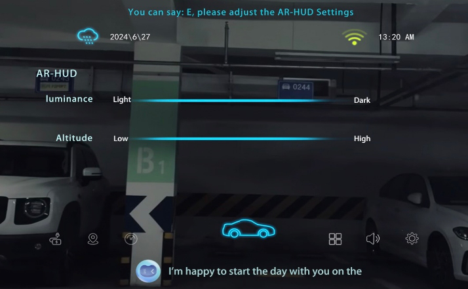
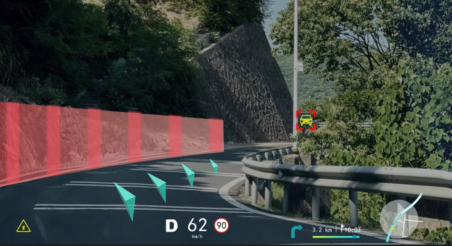
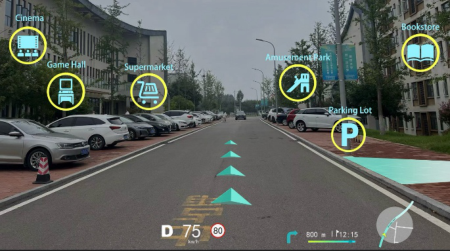
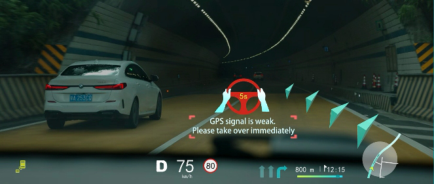
This not based on the integration of design strategies after sorting the design element table, focusing on expressing design elements with higher optimization weights, a set of in-vehicle AR-HUD interfaces that can improve user satisfaction has been designed. The specific design schemes are as follows (see Figure 2–5):
Interface Design of Vehicle AR-HUD Based on User Needs 913
Figure 2: Standard mode of vehicle AR-HUD interface (Yifan Chen, 2024).Figure 3: Snow weather mode of vehicle AR-HUD interface (Yifan Chen, 2024).Figure 4: Initial interface of vehicle AR-HUD interface (Yifan Chen, 2024).Figure 5: Takeover Aler of vehicle AR-HUD interface (Yifan Chen, 2024).
914 Yifan and Jiejun
CONCLUSION
The technological support for in-vehicle HUD has achieved transformation and upgrade, and users have new expectations and requirements for the interface design of in-vehicle AR-HUD. This paper, primarily oriented towards meeting current user needs for in-vehicle AR-HUD interface design, employs an integrated research method based on KANO-AHP-QFD. It integrates user needs, calculates weights, conducts hierarchical analysis, maps fuzzy requirements to specific designs, and recalculates weights to identify core design elements. Nine specific design schemes are derived from three aspects: safety, experience, and visuals. This approach precisely enhances the overall quality of interface design, targeting user needs for new experiences such as “non-driving,” “high-quality,” “contextualized,” and “immersive.” It effectively explores ways to reduce cognitive load, improve driving safety, optimize visual experience, enhance interactive feel, and emotional response in in-vehicle AR-HUD interfaces. This can practically address the current issues of complex driving scenarios and upgraded user driving needs.
REFERENCES
Chen, J. Xu, S. Sun, X et al. (2023). User Requirement-oriented Concept Design Integration Method for a Smart Cockpit Flexible Test Rig, in: Mechanical Design, Volume 41, No. 03. pp. 170–176. Gabbard, J. Smith, M. Merenda, C et al. (2020). A perceptual color-matching method
for examining color blending in augmented reality head-up display graphics, in: IEEE Transactions on Visualization and Computer Graphics, Volume 28, No.8. pp. 2834–2851. Lu, J. Ma, J. Gong, Z. (2021). Design of Human-machine Interaction Interface for Autonomous Vehicles Based on Multidimensional Perceptual Context, in: Scientific Programming. pp. 1–8. Lu, W. Zhao, Z. (2021). Design of a Pulp Paper Cup End Delivery Device Based
on QFD and TRIZ, in: Packaging and Food Machinery, Volume 39, No. 4. pp. 69–73. Mao, T. Liu, J. Zhao, Q. (2024). Research on the Prioritization of Aging-appropriate Modifications for Medical and Health Apps from a User needs Nerspective, in: Modern Information, Volume 44, NO. 4. pp. 87–97+113. Patel, S. Liu, Y. Zhao, R et al. (2022). Inspection of In-Vehicle Touchscreen
Infotainment Display for Different Screen Locations, Menu Types, and Positions, in: HCI in Mobility, Transport, and Automotive Systems (MOBITAS 2022). pp. 258–279 Piener, A. Holzmann, C. (2024). A Systematic Review of Augmented Reality Applications for Automated Driving, in: Presence: Virtual and Augmented Reality, No. 28. pp. 87–126. Qiu, Y. Zeng, X. Zou, X. (2024). Innovative Design of Kitchen Sterilizers Integrating
SET-Kano-AHP, in: Journal of Fujian University of Technology, Volume 2, No.1. pp. 90–96. Riener, A. Holzmann, C. (2019). A systematic review of augmented reality applications for automated driving, in: Presence: Virtual and Augmented Reality. pp. 87–126.
Interface Design of Vehicle AR-HUD Based on User Needs 915
Sun, L. Zhang, Y. Zhao, J et al. (2024). Research and Application of Driving Information Overload Under Bounded Rationality Decision Theory, in: Journal of Southwest University (Natural Science Edition), Volume 4, No. 63. pp. 168–177. Tang, R. Li, J. Luo, Q et al. (2023). Practice in Designing Pediatric Dental Chairs
Based on the KANO-AHP-AD Theoretical Model, in: Packaging Engineering, Volume 44, No. 22. pp. 169–180. Wu, X. Xiong, H. Yu, L. (2015). Research on the Method to Determine the Importance of Technical Characteristics for Electric Vehicles Based on QFD, in: Mechanical Design and Manufacturing, Volume 2015, NO. 7. PP. 131–134+138. Xiong, H. Zhan, X. Zheng, X. (2024). Research on Optimizing the Quality of
Health Website Information Services Using the KANO-QFD Integrated Method, in: Information Theory and Practice, Volume 2024, pp. 1–16. Zhou, T. Qiao, W. Hua, J Y et al. (2023). Current Status and Prospects of Augmented Reality Head-up Displays, in: Advances in Lasers and Optoelectronics, Volume 60, No. 8. pp. 149–162.
LISTED IN THE AHFE DIGITAL BOOKSTORE CATALOGUE
Explore the complete digital volume
Human Factors in Design, Engineering, and Computing
Read this individual research paper free through the original publisher, or explore the full digital proceedings book.
ISBN 978-1-964867-35-9
Explore this ISBN in the AHFE Bookstore ↗Listed in the July 2026 bookstore catalogue; search by ISBN to confirm current availability · Digital book purchase optional