Zhuoran Ma, Ruihong Ma, Xiaozhou Zhou (2025). Characterization of motion and warning light signals for flying robots. In: Intelligent Human Systems Integration (IHSI 2025): Integrating People and Intelligent Systems. AHFE Open Access, vol. 160, pp. 389–397. https://doi.org/10.54941/ahfe1005844
As the use of flying robots in various types of human-robot collaborative work continues to increase, but their interaction with humans remains somewhat deficient, it has become critical to ensure that flying robots are able to convey information to humans in a timely and accurate manner. Lightspeak is an effective means to achieve this goal by controlling the lights on flying robots to convey information in a specific pattern, color, or frequency. In the field of industrial robotics, specific light patterns can be used to indicate the robot's working status, production progress, or possible malfunctions. Such visual signals can help plant operators quickly recognize robot status and act accordingly, thereby increasing productivity and reducing potential errors or hazards. Although the application of light language in industrial robotics has achieved some success, the research on human-robot interaction for flying robots is still relatively limited. Especially in dynamic and complex environments, how to design efficient light language patterns to adapt to the multi-dimensional motion characteristics of flying robots and to ensure that humans can quickly interpret light language messages remains an urgent challenge. Using virtual reality (VR) technology, this study aims to develop a set of flying robot intention characterization methods based on light signals by simulating flying robot light changes, designing light language rules applicable to the multi-degree-of-freedom motion and warning states of flying robots, and optimizing their performance in user understanding and interaction through experiments. Based on the task analysis of the flying robot, this study identifies seven degrees of freedom of motion and three main warning modes by decomposing the motion and warning states of the flying robot in detail. Based on this, we designed three basic light modes including constant light, blinking, and surge, and optimized their colors, blinking frequencies, and timings. The experiment uses 73 motion state light languages and 8 alarm state light languages to test the characterization effect and user preference of different light languages in multiple contexts through animated video and randomized design. The experimental study shows that in the stationary state, the all-light constant light signal has the highest preference rate, while in the dynamic motion state and emergency alarm state, the flashing signal (e.g., double flashing, long and short flashing) exhibits higher saliency and information transfer efficiency. Users' choices of light language patterns are highly correlated with their visual saliency, clarity of signal meaning, and situational urgency. The red light signal has a significant advantage in the warning state, and the high-frequency flashing signal is the most effective in the “hardware failure” scenario, while the stable constant light signal is more suitable for the “active stop” scenario. In this study, we propose a light language design method that combines perceptual theory, color design, and light animation, which significantly improves the efficiency of the flying robot's message delivery in multi-degree-of-freedom motion and alarm states. Through experimental verification, this set of light language rules provides important support for the safety and human-robot interaction ability of flying robots in complex application scenarios, and lays a foundation for the expansion of the light language in the field of robotics.
“Light language” is a method of conveying information through the arrangement and control of light effects and is widely used in various devices and machines (Kunchay and Abdullah, 2021). Light language can convey complex information visually to users or other systems via changes in color, intensity, frequency, and light mode, especially in scenarios where the environment is complex, noise levels are high, or rapid information transfer is needed (Mutlu et al., 2008).
As the application of flying robots in human-machine collaboration scenarios grows, it becomes crucial for flying robots to communicate information to humans accurately and promptly (Song and Yamada, 2018). By controlling the lights on the flying robot, light language uses specific patterns, colors, or frequencies to convey information, effectively achieving this goal. In the industrial robotics field, specific light patterns are often used to indicate a robot’s working state, production progress, or potential faults. These visual signals help operators quickly identify the status of robots, enabling them to take appropriate actions, thus improving production efficiency and reducing potential errors or dangers.
The application of perception and color theory is particularly important in the color design of flying robot lights. The color design of light language needs to consider several key factors, including safety, functionality, visual effects, and user experience(Pörtner et al., 2018). First, colors must be chosen
to ensure that light signals convey information clearly and accurately under a variety of environmental conditions. For example, red color is usually associated with danger or emergencies, whereas green color is commonly used to indicate normal operation or safety status. Therefore, when designing a flying robot lighting system, the symbolism of these colors must be carefully considered and selected according to actual needs. Second, the colors and flashing patterns in the light language should not only effectively convey information but also consider the user’s visual perception and cognitive ability. In addition, the flash frequency and pattern of the lights must also be carefully designed to avoid visual fatigue caused by the strobe effect while ensuring the timeliness and accuracy of information transmission.
In the design of the motion direction representation, we drew inspiration from the theory of unit perception. According to this theory, during perceptual processing, the perceptual system integrates multiple similar stimuli occurring within a single working cycle into a unified whole. This phenomenon is particularly evident in visual perception (Hildreth, 1973).
RELATED WORK
In previous studies, Ginosar et al. proposed a four-stage model for human– flying robot interaction during flight and designed an expressive light system that enables flying robots to communicate effectively with humans through lights (Ginosar and Cauchard, 2023). This system not only enhances the operability of flying robots but also improves the communication efficiency between flying robots and humans. Additionally, Rea et al. introduced a robot communication system augmented by environmental factors, where the robot used multicolored light rings for information transfer (Rea et al., 2012). By changing the color of the lights, the robot can express its emotions and intentions, making its behavior more anthropomorphic and enhancing human-robot interaction experiences. Monajjemi et al. utilized LED light strips on flying robots to signal detected individuals, employing different light animations during the flying robot approach and interaction (Monajjemi et al., 2016). For example, during flying robot selfies, they designed a “timer” animation to convey operation timing and status. Baraka et al. further explored the use of lights as a continuous visualization method for robot states, arranging different light animation patterns, colors, and speeds to make the robot’s state more visible and easier to understand during task execution (Baraka et al., 2016).
Moreover, Alexandra et al. developed three new light combinations and five overall states, significantly improving the overall readability of robot state communication (Bacula et al., 2022). The development of these studies and technologies demonstrates the immense potential and wide application prospects of light language in human-robot interactions, particularly in scenarios requiring clear and rapid information transmission. Light language has become an indispensable tool in such contexts. Through continuous optimization and innovation, the application of light language in flying robots and other robots will further enhance its effectiveness and reliability in human-machine interactions (Avelino et al., 2021).
Characterization of Motion and Warning Light Signals for Flying Robots 391
METHODOLOGY
This section explains the strategy and implementation process used in the design of the basic flying robot light language. To minimize the dependency on the number and position of lights while maintaining generality, we select four corners on the same plane of the flying robot as the main light source. These four-point light sources can be precisely controlled to achieve various light changes, ensuring the accuracy and consistency of information transmission.
In the design process, we first clarified the types of light variations, which were set according to different operational scenarios and task requirements. For example, we considered how to represent the normal flight status, emergencies, and other specific operating states using different colors of lights and flashing frequencies. To ensure that these light variations can intuitively convey information, we designed a series of light animations that visually display information in an easily understandable manner while maintaining good visibility and recognizability in complex environments (Hernández et al., 2021).
We then provided a detailed description of the specific design and implementation of the light animations. The design of the animations included not only the choice of color and brightness but also the flashing pattern, switching frequency, and synchronization control of the light sources. Through comparative analysis of different animation effects, we selected the optimal scheme to effectively convey information while reducing visual fatigue. These animations not only serve as a visual effect display but also act as a medium for information transfer, establishing a quick and intuitive communication method between the operator and the flying robot.
FLYING ROBOT STATUS We systematically decompose the working states of the flying robot, identifying three main states: the motion state, the photography state, and the alert state. This study focuses on analyzing and discussing motion and alert states.
In motion states, a flying robot typically exhibits characteristics such as following a target, free movement, and manual control. During the flight, the flying robot constantly adjusts its posture while making corresponding adjustments on the basis of the operator’s position and direction (Wang et al., 2023). To better understand the motion behavior of the flying robot, we analyzed its position changes relative to the operator in the environment, ultimately breaking down the motion state into seven degrees of freedom: stationary, forward, upwards, right-turn, right-move, pitch-up, and roll. Specifically, the stationary state refers to the flying robot maintaining its position relative to the operator; the forward state refers to the flying robot moving towards the operator, reducing the distance between them; the upwards state refers to the flying robot moving upwards relative to the operator; the right-turn state indicates a turning motion to the right; the right- turn state refers to a lateral movement to the right; and the pitch-up state represents the flying robot tilting its nose upwards, whereas the pitch-down state represents the flying robot tilting its nose downwards.
In the analysis of alarm states, we ranked the frequency and severity of various faults that may occur. Among the operating states of the flying robot, hardware faults have the highest degree of severity despite their lower frequency and are therefore prioritized as the object of the warning light language design. Similarly, the operator’s initiative to call off the flying robot also belongs to the lower frequency but higher severity faults, which are also suitable for timely warning through the light language. Therefore, we choose hardware failures and active stopping as the focus of the warning light language study. In contrast, malfunctions such as trapped machines, loss of localization, and insufficient power, although occurring more frequently in flying robot operation, are of relatively low severity. To avoid unnecessary disturbances to users, we decided not to include these lower-level faults in the light language characterization for the time being.
Through systematic analysis, we aim to ensure that flying robots in different states can be prompted by effective light language to help operators make timely and appropriate responses. The light language design not only improves the safety of flying robot operation but also enhances its reliability in complex operating environments.
LIGHT LANGUAGE DESIGN To convey the flying robot’s behavior under different operating states, we first distinguished its motion and alert states using different light colors (Bacula et al., 2022). This design principle was based on the semantic application of safe colors, adhering to established safety standards for color selection. Specifically, blue light is often used to convey information, as blue light is easier for the human eye to capture under low-light conditions and can convey information without being easily confused with other colors. Red is commonly used to indicate emergencies or to signal stopping, as it can quickly attract attention, whereas green represents normal operation or clearance. Guided by color theory, we choose blue as the status indicator color during motion to convey movement signals and red as the status indicator color during alert states to indicate potential danger or abnormalities, prompting the operator to take necessary safety measures.
Concerning the flashing patterns, we designed different light variations to further refine the flying robot’s state representation at each stage. These light patterns not only convey state information visually but also enhance the visibility of flying robots in complex environments.
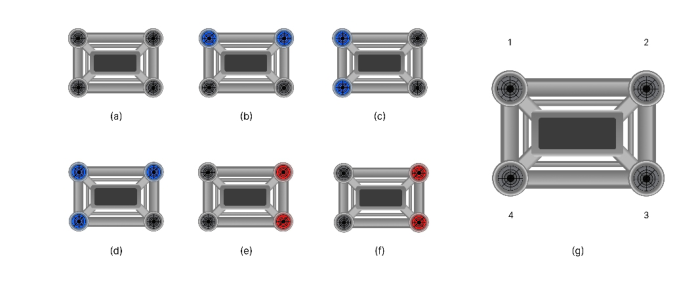
We designed three light modes: constant, flashing, and surge. The constant mode refers to lights that maintain a consistent brightness and color for a set period, providing stable visual information. The flashing mode conveys urgent information by rapidly changing the light’s brightness and includes single flash, double flash, and long–short flash patterns. Additionally, on the basis of Bloch’s law, we design a “surge” mode by controlling the time intervals between flashes, creating the effect of light moving in a specific direction. Ultimately, we derived suitable flashing parameters through animation software: a single flash cycle of 800 milliseconds, flashing once during the first 500 milliseconds and turning off for the remaining 300
Characterization of Motion and Warning Light Signals for Flying Robots 393
milliseconds; a double flash cycle of 1 second, flashing twice evenly during the first 600 milliseconds; and a long–short flash cycle of 850 milliseconds, with a long flash lasting 450 milliseconds and a short flash lasting 150 milliseconds (Figure 1. a-f). Furthermore, the design of the flashing mode also considers visual fatigue and information transmission efficiency. The single flash mode captures attention with brief, high-intensity light, whereas the double flash and long–short flash modes increase the flash frequency and duration to convey more complex information. This not only enriches the information but also allows operators to distinguish different alert signals and respond appropriately on the basis of varying urgency levels.
EXPERIMENTAL RESEARCH This section describes in detail the design process and implementation of the light language for a four-light flying robot. We design three major categories of light representation modes—constant, flashing, and surge—by manipulating these three variables to change the light’s behavior and derive suitable light language modes for different states, including motion or alert representations. By combining these representation methods, we designed 73 motion state light languages and 8 alert state light languages, coding the four lights on the front of the flying robot, starting with the light in the upper right corner and rotating clockwise, numbered lights 1, 2, 3, and 4 (Figure 1. g). Corresponding flying robot light animation videos were created for each light language. To ensure experimental consistency, these animation videos were trimmed to a similar length of 10 seconds. To avoid sound interference, all the audio tracks were removed, and a quiet environment was maintained throughout the experiment. To eliminate the effect of testing order, the animation presentation order was randomized.
Before starting the experiment, the participants received a brief introduction and training. The participants first learned about the basic shape and light distribution of the flying robot and were informed that the flying
robot had seven states: stationary, forward, upwards, right-move, roll, right- turn, and pitch-up. The participants needed to observe the light animations and determine the flying robot’s intended motion or alert state.
Different light representations were used as independent variables, including three light modes and 81 animations presented as video stimuli. During the experiment, the flying robot was always presented from a stationary front view. Since the flying robot’s movement state might affect participants’ judgment of light animations, the experiment did not consider the flying robot’s movement. For light representation under motion states, all lights used the same brightness and blue color; for alert states, all lights used the same brightness and red color. Before starting the experiment, the participants were informed of the procedure and precautions. The experiment was conducted with participants seated and facing a computer screen. Once the experiment began, the system recorded the data, and each participant received a monetary reward upon completion.
EXPERIMENTAL PROCEDURES At the beginning of the experiment, a red “+” symbol appeared on the computer screen as a fixation point, indicating the start of the experiment. When the participants were ready, they pressed the space bar to proceed. A 10-second flying robot light animation subsequently appeared in the center of the screen. The participants were asked to identify the motion or alert state represented by the animation from seven possible states. The experiment consisted of two modules, one for motion states and the other for alert states, totaling 81 animation videos. The participants could take a break by pressing the space bar at any point if they felt fatigued.
RESULTS
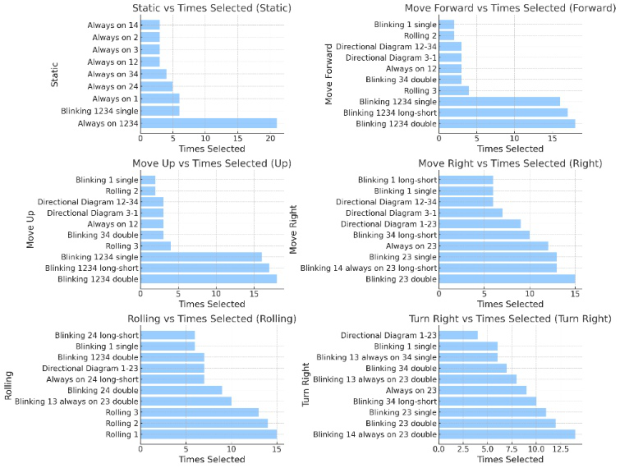
The experimental results of the motion states reflected the frequency of choosing different light signals under varying conditions, such as stationary, forward, upwards, right-move, roll, right-turn, and pitch-up. The results showed that, under stationary conditions, constant illumination of all lights was the most frequently chosen signal, indicating that constant illumination was preferred during stationary states. During forward and upwards states, four-light double flashes, long-short flashes, and single flashes were most commonly chosen, suggesting that flashing signals were preferable for dynamic states, possibly because of their higher visibility. For the right-move state, flashing signals had an apparent advantage, with the double flash mode for lights 2 and 3 being selected more often (Figure 2). However, for the right-turn state, constant illumination for lights 1 and 4, along with double flashing for lights 2 and 3, was preferred. The selection for pitch-up was more dispersed, but long–short flashes were frequently chosen.
Characterization of Motion and Warning Light Signals for Flying Robots 395
Figure 2: Participants’ preferences for different light signals in the motion state.
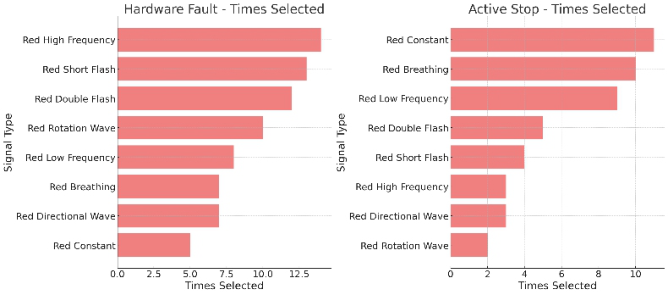
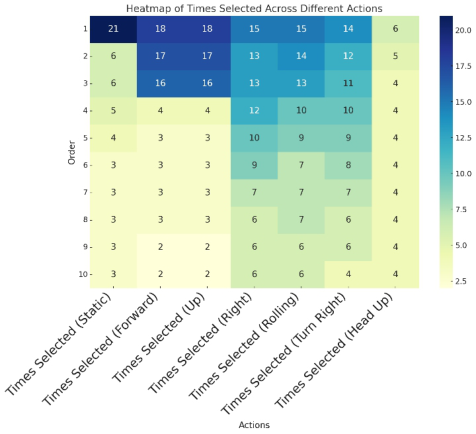
The results for alert states revealed significant differences in preferences for light signals under the “hardware failure” and “manual shutdown” scenarios (Figure 3). For “hardware failure,” the “red high-frequency” signal was chosen most frequently, followed by “red long–short flash” and “red double flash.” In contrast, for “manual shutdown,” the “red constant light” signal was preferred, followed by “red breathing” and “red low-frequency” signals. Overall, the results indicate that red light signals are highly recognizable in emergency and shutdown situations, whereas specific flashing patterns should be optimized on the basis of scenario requirements (Figure 4).
Figure 3: Participants’ preferences for different light signals in the alarm state.Figure 4: Heatmap for the light mode under different flying robot movements.
CONCLUSION
A conceptual design was begun with, and the lighting configuration and animation effects required for each light variation were clarified. Ultimately, a reliable visual signal is provided by the design for flying robots in various complex application scenarios, enhancing safety and operability.
The differences in choice frequency were due mainly to the visual salience of the signals, the urgency of the situation, the signal applicability, the clarity of meaning, and the users’ familiarity and psychological response. In “hardware failure” scenarios, high-frequency flashing signals are most commonly used because of their prominent visual effect and urgent warning function, whereas constant illumination is preferred for “manual shutdown” scenarios because of its persistent reminder function. Additionally, users tend to choose familiar signals commonly used in other fields, especially in emergencies, which explains the high frequency of high-frequency flashes and constant illumination signals. The complexity and unfamiliarity of signals also led to fewer choices, reflecting the different needs and preferences of users when dealing with different situations.
ACKNOWLEDGMENT
This work was supported by the National Natural Science Foundation of China [grant number 52275238].
REFERENCES
Avelino, J., Garcia-Marques, L., Ventura, R., and Bernardino, A. (2021). “Break the ice: a survey on socially aware engagement for human-robot first encounters”, International Journal of Social Robotics, pp. 1–27.
Characterization of Motion and Warning Light Signals for Flying Robots 397
Bacula, A., Mercer, J., Berger, J., Adams, J. A., and Knight, H. (2022). “Integrating robot manufacturer perspectives into legible factory robot light communications”, ACM Transactions on Human-Robot Interaction, 12, pp. 1–33. Baraka, K., Rosenthal, S., and Veloso, M. (2016). “Enhancing human understanding
of a mobile robot’s state and actions using expressive lights”, in: 2016 25th IEEE International Symposium on Robot and Human Interactive Communication (RO- MAN), New York, NY, USA: IEEE Press. Ginosar, E., and Cauchard, J. R. (2023). “At first light: expressive lights in support of drone-initiated communication”, in: Proceedings of the 2023 CHI Conference on Human Factors in Computing Systems, Hamburg, Germany: Association for Computing Machinery. Hernández, R. A., Xu, T., Huang, Y., and Zúñiga Zamalloa, M. A. (2021). “Firefly:
Supporting drone localization with visible light communication”, arXiv preprint, arXiv:2112.06677. Hildreth, J. D. (1973). “Bloch’s law and a temporal integration model for simple reaction time to light”, Attention Perception & Psychophysics, 14, pp. 421–432. Kunchay, S., and Abdullah, S. (2021). “Assessing the effectiveness and interpretability
of light behaviors in smart speakers”, in: Proceedings of the 3rd Conference on Conversational User Interfaces, Bilbao (online), Spain: Association for Computing Machinery. Monajjemi, M., Mohaimenianpour, S., and Vaughan, R. (2016). “UAV, come to me: end-to-end, multi-scale situated HRI with an uninstrumented human and a distant UAV”, in: 2016 IEEE/RSJ International Conference on Intelligent Robots and Systems (IROS), IEEE Press. Mutlu, B., Forlizzi, J., Nourbakhsh, I. R., and Hodgins, J. K. (2008). “The use of
abstraction and motion in the design of social interfaces”, in: Proceedings of the Conference on Designing Interactive Systems, University Park, PA, USA, June 26- 28, 2006. Pörtner, A., Schröder, L., Rasch, R., Sprute, D., Hoffmann, M., and König, M. (2018).
“The power of color: a study on the effective use of colored light in human-robot interaction”, in: 2018 IEEE/RSJ International Conference on Intelligent Robots and Systems (IROS), IEEE, pp. 3395–3402. Rea, D., Young, J. E., Irani, P., and Machinery, A. C. (2012). “The Roomba mood ring: an ambient-display robot”, in: 7th ACM/IEEE International Conference on Human-Robot Interaction (HRI), Boston, MA: Association for Computing Machinery, pp. 217–218. Song, S., and Yamada, S. (2018). “Effect of expressive lights on human perception
and interpretation of functional robot”, in: Extended Abstracts of the 2018 CHI Conference on Human Factors in Computing Systems, Montreal, QC, Canada: Association for Computing Machinery. Wang, S., Zhang, K., Zhu, B., Wang, W., and Zhang, Z. (2023). “Visible light communications for unmanned aerial vehicle: channel modeling and experimental validation”, IEEE Communications Letters, 27, pp. 1530-1534.
LISTED IN THE AHFE DIGITAL BOOKSTORE CATALOGUE
Explore the complete digital volume
Intelligent Human Systems Integration (IHSI 2025): Integrating People and Intelligent Systems
Read this individual research paper free through the original publisher, or explore the full digital proceedings book.
ISBN 978-1-964867-36-6
Explore this ISBN in the AHFE Bookstore ↗Listed in the July 2026 bookstore catalogue; search by ISBN to confirm current availability · Digital book purchase optional