Belén Carballo Leyenda, Pilar Sánchez Collado, Fabio García-heras, Jorge Gutiérrez Arroyo, Juan Rodríguez Medina, Jose A Rodríguez-marroyo (2025). Assessment of Flicker Fusion Threshold in Mountain Rescuers Following a Simulated Winter Rescue. In: Artificial Intelligence and Social Computing. AHFE Open Access, vol. 163, pp. 225–231. https://doi.org/10.54941/ahfe1006054
The aim of this study was to analyze central nervous system fatigue through the critical flicker fusion threshold (CFF) in mountain rescuers after a simulated winter rescue. Fifteen rescuers (13 men and 2 women; age: 32.1 ± 8.5 yr) participated in the study, which was conducted at the Bormio ski resort in Italy. The simulation included ascending to a simulated victim (~75 kg), victim packaging, and descending using rescue stretchers or sleds. The rescuers’ CFF was assessed before and after the simulation, and their effort during the task was monitored through heart rate measurements. Throughout the simulation, the rescuers maintained an average intensity of 79.4 ± 6.7% of their maximal heart rate, with no significant differences in effort between the ascent and descent phases (p > 0.05). The CFF, measured as an indicator of sensory and cognitive fatigue, showed baseline values of 42.9 ± 2.0 Hz and post-simulation values of 43.6 ± 2.5 Hz, with no significant changes (p > 0.05). This finding contrasts with previous hypotheses suggesting cognitive decline associated with fatigue following high-intensity tasks. The lack of significant changes could be attributed to the rescuers' experience, which allowed them to regulate their intensity and employ effective strategies to avoid excessive fatigue. Additionally, the moderate environmental conditions (~7°C) likely reduced thermal strain, contributing to the stability of the CFF results. In conclusion, no significant differences in CFF were observed following the rescue simulation, suggesting that the protocol conditions and the characteristics of the studied group mitigated cognitive fatigue. These findings emphasize the importance of specific training programs to optimize the performance of mountain rescuers in real-life conditions.
Mountain rescue operations involve a unique combination of physical, mental, and extreme environmental stressors, factors that significantly influence the operational performance of rescuers (Callender, Ellerton and MacDonald, 2012). Although several studies have extensively analyzed the physical and physiological demands in emergency teams such as
wildland firefighters or military units (Carballo-Leyenda et al., 2018; Rodríguez-Marroyo et al., 2012), only Callender, Ellerton and MacDonald (2012) specifically evaluated these aspects in mountain rescuers. To our knowledge, no studies have yet examined the impact of these demands during rescue operations under winter conditions involving snow.
On the other hand, recent research focusing on other groups of first responders, such as wildland firefighters, has emphasized the importance of evaluating not only physical fatigue but also cognitive or mental fatigue resulting from high levels of effort and thermal stress (Morley et al., 2012; Rodríguez-Marroyo et al., 2012; Williams-Bell et al., 2017). This cognitive fatigue can impair decision-making, operational safety, and efficiency during critical missions (Williamson et al., 2011).
Given the nature of the physical effort required by mountain rescuers, body composition may significantly influence not only physiological responses to intense exertion but also cognitive performance under extreme stress conditions. Lower levels of body fat have been associated with improved physiological responses in high-demand physical scenarios, while higher fat levels could increase inflammation and adversely affect cognitive function (Crawford et al., 2011; Walker et al., 2017; Wang et al., 2018).
Additionally, environmental conditions might impact cognitive performance. Conditions leading to hypohydration and hyperthermia could negatively affect cognitive function (Morley et al., 2012). However, a certain severity in these conditions may be required, as no effects have been observed under moderate hyperthermia (Williams-Bell et al., 2017).
Therefore, the aim of the present study was to analyze cognitive fatigue in mountain rescuers using the Critical Flicker Fusion threshold after a simulated rescue operation under winter conditions. We hypothesized that the combination of physical exertion and the specific environmental conditions encountered would negatively impact cognitive function, potentially impairing operational efficiency during real rescue scenarios.
METHODS
A sample of 15 experienced mountain rescuers (2 females and 13 males; mean ± SD: age, 32.1 ± 8.5 yr; height, 178.1 ± 7.7 cm; mass, 78.2 ± 12.6 kg; body mass index, 24.6 ± 2.7 kg·m–2) voluntarily participated in the field tests. All participants were physically active and in good health. Written informed consent was obtained from each subject prior to participation. The protocol was approved by the Ethics Committee of the University of León (Spain) and adhered to the principles of the Declaration of Helsinki.
The rescuers took part in a simulated rescue operation conducted in March at the Bormio Ski Resort, located in Sondrio (Valtellina, Lombardy, Italy). Prior to the rescue simulation, anthropometric assessments were conducted, including measurements of body mass, height, skinfold thickness, bone breadths, and muscle girths. Central nervous system fatigue and cognitive performance were assessed using the Critical Flicker Fusion (CFF) threshold, both immediately before and after the simulated rescue.
Assessment of Flicker Fusion Threshold in Mountain Rescuers 227
CFF measurements were performed in a room adjacent to the testing area. Participants were seated in front of a visual testing device (Lafayette Flicker Fusion System, model 12022, Lafayette Instrument Co., Lafayette, IN, USA), where two light-emitting diodes were simultaneously presented to each eye. CFF threshold was determined as the mean of three ascending and three descending trials (rate: 1 Hz/s), from 0 to 100 Hz and 100 to 0 Hz, respectively, depending on when the participant perceived flicker (ascending trials) or fusion (descending trials) (Davranche and Audiffren, 2004).
During the rescue simulation, participants performed typical activities associated with a ground-based mountain rescue without helicopter support (Callender, Ellerton and MacDonald, 2012). Specifically, rescuers ascended on foot to reach the location of a simulated victim (∼75 kg), who was then evacuated using a stretcher or rescue sled (weighing 10–30 kg) back to the base of the ski resort. Heart rate (HR) was continuously monitored throughout the simulation using a heart rate monitor (RS800, Polar Electro Oy, Kempele, Finland). HR data were categorized into five intensity zones based on the percentage of maximal HR (HRmax) as defined by Edwards (1993): Zone 5 (90–100%), Zone 4 (80–89%), Zone 3 (70–79%), Zone 2 (60–69%), and Zone 1 (50–59%).
All results were expressed as mean ± standard deviation (SD). Normality of the data distribution was assessed using the Shapiro–Wilk test. When a non-normal distribution was detected, data were log-transformed prior to analysis. Comparisons of exercise intensity between the ascent and descent phases were conducted using a paired Student’s t-test. Pearson’s correlation coefficient (r) was used to analyze the relationships between variables. The significance level was set at p < 0.05. All statistical analyses were performed using SPSS+ software, version 26.0 (IBM Corp., Armonk, NY, USA).
RESULTS
The simulated rescues were conducted at an ambient temperature of 6.9 ± 2.1
C and a relative humidity of 17.1 ± 11.6%. The test was performed at altitudes ranging from 1,998.1 ± 11.6 m to 2,268.8 ± 66.0 m. The vertical ascent and descent distances were 267.6 ± 54.8 m and 264.9 ± 51.9 m, respectively. The mean duration of the test was 85.1 ± 21.1 minutes.
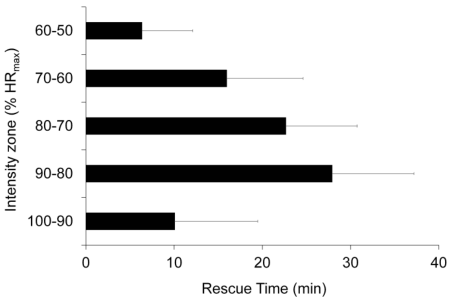
The average heart rate recorded during the rescues was 149 ± 10 bpm, corresponding to 79.4 ± 6.7% of the HRmax. No significant differences were found between the exercise intensity during the ascent and descent phases of the rescue. Figure 1 shows the distribution of exercise time across the different heart rate intensity zones. Participants spent the majority of the rescue duration (60.1 ± 10.7%) within the 70–90% HRmax range.
The analysis of CFF values showed no significant changes after the rescue (42.9 ± 2.0 vs. 43.6 ± 2.5 Hz). A mean increase of 1.5 ± 3.0% was observed, which may indicate heightened cortical arousal and, consequently, an absence of cognitive fatigue. However, when considering only the male rescuers to avoid potential sex-related bias, a significant negative correlation was found between the sum of nine skinfolds (100.3 ± 27.0 mm) and the increase in
CFF values (r = −0.52, p < 0.05). Additionally, in these participants, the sum of skinfolds was also significantly correlated (p < 0.05) with average exercise intensity during the rescue (r = 0.46), as well as with the percentage (r = 0.65) and the duration (r = 0.46) of time spent above 90% of HRmax.
Figure 1: Distribution of exercise time across heart rate intensity zones. Values are expressed as mean ± SD.
DISCUSSION
The present study aimed to evaluate, for the first time, cognitive fatigue in mountain rescuers following a simulated rescue operation, using the CFF as an objective measure. Despite the high physical demands observed (reflected by a mean heart rate of ∼79% of HRmax and a significant amount of time spent in the 70–90% intensity zone) no deterioration in cognitive performance was detected. On the contrary, a slight increase in CFF values was observed post-rescue, suggesting maintained or even slightly enhanced cortical arousal, rather than signs of central fatigue. These results are in line with previous findings in other emergency personnel, such as wildland firefighters, where moderate physical exertion under non-extreme thermal conditions did not induce cognitive impairment (Williams-Bell et al., 2017).
One of the most relevant findings was the significant negative correlation between the sum of skinfolds and the change in CFF values among
Assessment of Flicker Fusion Threshold in Mountain Rescuers 229
male participants. This suggests that individuals with higher levels of subcutaneous fat may be more susceptible to central nervous system fatigue following physical exertion. This relationship may be mediated by systemic inflammation or reduced thermoregulatory and metabolic efficiency, as suggested in previous literature (Crawford et al., 2011; Wang et al., 2018). Furthermore, the sum of skinfolds was also significantly correlated with several markers of exercise intensity, including mean heart rate, time spent above 90% HRmax, and the percentage of time in that intensity zone. These findings reinforce the idea that excess adiposity not only increases the relative physiological strain during high-demand tasks (Crawford et al., 2011; Kaipust et al., 2019), but may also impair cognitive resilience in operational settings (Wang et al., 2018).
The absence of a decrease in CFF values across the full sample may also be partially explained by the moderate environmental conditions (∼7
C), which may not have triggered thermal or hydration-related stress sufficient to compromise cognitive performance. Previous studies have suggested that only severe environmental conditions, such as significant hyperthermia or hypohydration, elicit declines in cognitive function (Morley et al., 2012; Williams-Bell et al., 2017). Additionally, the results of this study might have been influenced by the time elapsed between the end of the exercise and the completion of the CFF test. It has been reported that cognitive function changes are not typically noted until one hour or more following exercise (Morley et al., 2012).
In interpreting these findings, it is important to consider that the exercise intensity analyzed in this study was ∼14% lower than that previously reported in a rescue simulation by Callender, Ellerton and MacDonald (2012). Several factors may explain this discrepancy, including differences in participant characteristics, environmental conditions, test duration, and the loads carried. The rescuers in the current study were younger and operated at a lower ambient temperature (∼7
C), which may have reduced thermal stress and, consequently, heart rate responses (Cheuvront and Haymes, 2010). Additionally, the test duration in Callender, Ellerton and MacDonald (2012) was ∼30% longer, potentially contributing to greater cardiovascular drift. Terrain conditions may also have played a role, as participants in this study conducted the rescue on snow and ice, requiring slower and more cautious movement to maintain safety. Finally, the lighter loads carried during the descent in our study, compared to those in Callender, Ellerton and MacDonald (2012), may have contributed to the lower exercise intensity observed (Pinedo-Jauregi et al., 2022).
Taken together, these findings suggest that trained mountain rescuers may preserve cognitive function even under physically demanding scenarios, provided that environmental stress is moderate. However, body composition appears to play a critical role in modulating both physiological and cognitive responses to operational demands. Interventions aimed at optimizing body composition in emergency personnel could therefore enhance not only physical but also cognitive performance in real-world rescue operations. To our knowledge, this is the first study to assess cognitive fatigue in mountain
rescuers under near-real field conditions, providing novel insights relevant to occupational readiness and personnel preparation strategies.
CONCLUSION
Despite the high physical demands experienced by the rescuers during the field test, no deterioration in cognitive performance was observed. However, the correlations found highlight the potential negative impact that excess adiposity may have on increasing exercise demands and impairing cognitive function in emergency personnel.
ACKNOWLEDGMENT
The authors would like to express their sincere gratitude to all the mountain rescue professionals who volunteered their time and effort to participate in this study. This research was supported by the European Union’s Horizon 2020 research and innovation programme under grant agreement No. 883315. The contents of this publication do not necessarily reflect the position or opinion of the European Commission.
REFERENCES
Callender, N., Ellerton, J. and MacDonald, J. H. (2012) “Physiological demands of mountain rescue work”, Emergency Medicine Journal, 29, pp. 753–757. Carballo-Leyenda, B. et al. (2018) “Fractional contribution of wildland firefighters’
personal protective equipment on physiological strain”, Frontiers in Physiology, 9, p. 1139. Cheuvront, S. N. and Haymes, E. M. (2001) “Thermoregulation and marathon running: biological and environmental influences”, Sports Medicine, 31, pp. 743–762. Crawford, K. et al. (2011) “Less body fat improves physical and physiological
performance in army soldiers”, Military Medicine, 176(1), pp. 35–43. Davranche, K. and Audiffren, M. (2004) “Facilitating effects of exercise on information processing”, Journal of Sports Sciences, 22(5), pp. 419–428. Edwards, S. (1993) “High performance training and racing”, in Edwards, S. (ed.)
The Heart Rate Monitor Book. Sacramento: Feet Fleet Press, pp. 113–123. Kaipust, C. M. et al. (2019) “Sleep, Obesity, and Injury Among US Male Career Firefighters”, Journal of Occupational and Environmental Medicine, 61(4), pp. e150–e154. Morley, J. et al. (2012) “Cognitive function following treadmill exercise in
thermal protective clothing”, European Journal of Applied Physiology, 112(5), pp. 1733–1740. Pinedo-Jauregi, A. et al. (2022) “Physiological stress in flat and uphill walking with different backpack loads in professional mountain rescue crews”, Applied Ergonomics, 103, p. 103784. Rodríguez-Marroyo, J. A. et al. (2012) “Physiological work demands of Spanish
wildland firefighters during wildfire suppression”, International Archives of Occupational and Environmental Health, 85(2), pp. 221–228. Walker, A. et al. (2017) “Improving Body Composition May Reduce the Immune and Inflammatory Responses of Firefighters Working in the Heat”, Journal of Occupational and Environmental Medicine, 59(4), pp. 377–383.
Assessment of Flicker Fusion Threshold in Mountain Rescuers 231
Wang, Q. et al. (2018) “FGF21 Attenuates High-Fat Diet-Induced Cognitive Impairment via Metabolic Regulation and Anti-inflammation of Obese Mice”, Molecular Neurobiology, 55(6), pp. 4702–4717. Williams-Bell, F. M. et al. (2017) “The Effects of Simulated Wildland Firefighting
Tasks on Core Temperature and Cognitive Function under Very Hot Conditions”, Frontiers in Physiology, 8, p. 815. Williamson, A. et al. (2011) “The link between fatigue and safety”, Accident Analysis and Prevention, 43(2), pp. 498–515.
LISTED IN THE AHFE DIGITAL BOOKSTORE CATALOGUE
Explore the complete digital volume
Artificial Intelligence and Social Computing
Read this individual research paper free through the original publisher, or explore the full digital proceedings book.
ISBN 978-1-964867-39-7
Explore this ISBN in the AHFE Bookstore ↗Listed in the July 2026 bookstore catalogue; search by ISBN to confirm current availability · Digital book purchase optional