Jose A Rodríguez-Marroyo, Belén Carballo Leyenda, Pilar Sánchez Collado, David Suárez Iglesias, José G Villa (2022). Effect of Exercise Intensity and Thermal Strain on Wildland Firefighters' Central Nervous System Fatigue. In: Cognitive Computing and Internet of Things. AHFE Open Access, vol. 43, pp. 58–63. https://doi.org/10.54941/ahfe1001839
The arduous conditions (i.e., harsh environmental conditions, high physical and mental demands) in which wildland firefighters (WFFs) have to perform their work during wildfire suppression can lead to states of both physical and mental fatigue. Although several studies have delved into the first type of fatigue, there is a paucity of research on the decrease in WFFs’ cognitive performance. A decreased cognitive performance has been observed throughout multi-day suppression tasks, which could lead to poor decision-making and have unintended consequences on deployments. To our knowledge, the acute effect of tasks performed by WFFs on cognitive fatigue has not been studied. Therefore, the aim of this study was to analyze the effect of performing a specific circuit, which simulated the tasks performed by WFFs in their deployments, on central nervous system fatigue. Ten WFFs (34.4 ± 5.6 yr, 182.9 ± 6.1 cm and 92.8 ± 14.9 kg) participated in the study, who performed a field test composed of 4 specific tasks commonly used in their deployments. Each task was executed for 5 min interspersed by 90 s of recovery. This interval bout was repeated twice with 10 min of recovery in between. During the test heart rate (HR) and core temperature (CT) response were monitored. Both variables were used to calculate the physiological strain index (PSI). In addition, before and at the end of the field test, subjects’ critical flicker fusion (CFF) threshold was measured. The results obtained showed that the WFFs performed a high-exercise demand (mean HR, 85.3 ± 2.5% of maximal HR; CT, 38.3 ± 0.4 ºC and PSI, 6.0 ± 0.7). Despite this, CFF threshold measurements showed an increase (6.0 ± 6.0%, p < 0.05) in the sensory sensitivity threshold, suggesting an exercise induced increase in cortical arousal. Significant (p < 0.05) relationships between sensory sensitivity and time spent at high percentage of maximal HR (>90%), TC and PSI were found (r = -0.71, -0.74 and -0.69, respectively). In conclusion, the specific field test led an enhancement of sensory sensitivity and cortical arousal. However, the correlations found seem to indicate the potential negative effect of high-intensity exercise and thermal strain on central nervous system fatigue.
Wildfire firefighting is a demanding occupation (Ruby et al., 2002) where wildland firefighters perform different tasks (e.g., hiking, building fire lines,
Effect of Exercise Intensity and Thermal Strain 59
brush removal) wearing protective equipment (~6 kg) and using several tools (e.g., chainsaws, backpack pumps, swatters, and shovels) that may weigh up to 20 kg (Rodríguez-Marroyo et al., 2012). In addition, their deployments may last from minutes (~40 min) to several hours (~7 h) and even several days, which may contribute to increased exercise demands (Rodríguez-Marroyo et al., 2012; Vincent et al., 2016). Together with the environmental conditions in which these subjects have to perform their work, these circumstances mean that the thermal strain they are subjected to is high (Rodríguez-Marroyo et al., 2012).
The increase in thermophysiological strain may lead to states of fatigue that condition the WFFs’ performance (Carballo-Leyenda et al., 2018, 2021). In addition, this fact might increase mental fatigue (Jeklin et al., 2020) and compromise WFFs’ critical decision-making and situational awareness (Williamson et al., 2011). However, to the best of our knowledge, only a deterioration of WFFs’ cognitive performance has been reported throughout a 14-day fire line deployment (Jeklin et al., 2020). Although an effect of work time on cognitive performance was demonstrated in this study, it seems that there was a turning point in the deterioration of this performance from day 5 of work (Jeklin et al., 2020). These results would highlight the little effect, in the short term, that the tasks performed by the WFF have on cognitive per- formance. It has been suggested that hypohydration and hyperthermia might have a negative effect on cognitive function (Morley et al., 2012). There- fore, it may be speculated that the environmental conditions and the exercise demands performed by the WFFs in the study by Jeklin et al. (2020) were able to condition the results obtained. However, impaired cognitive function was also not observed under moderate hyperthermia in WFFs simulating wildfire firefighting tasks (Williams-Bell et al., 2017). Therefore, this study is aimed to delve into the acute effect of exercise demands on WFFs’ central nervous fatigue.
METHODS
Ten healthy male WFFs (34.4 ± 5.6 yr, 182.9 ± 6.1 cm, and 92.8 ± 14.9 kg) participated in the study. All of them had previous experience as wildland firefighters (>5 yr). Written informed consent was obtained from all subje- cts before starting the study. The study was conducted in accordance with the Declaration of Helsinki, and the protocol was approved by the Ethics Committee of the University of León (Spain).
WFFs performed a specific field test designed to simulate wildfires sup- pression work. The test was composed of the most frequent tasks performed by WFFs who participated in this study. Specifically, the test consisted of performing two bouts of four tasks: task#1, subjects completed a 45 m up-down linear walk on a slope carrying a 20 kg backpack; task#2, sub- jects simulated the use of the fire-swatter pretending to smother the flames; task#3, subjects dragged a charged hose at a distance of 10 m; task#4, subje- cts repeated task#1. The four tasks were performed consecutively, and each task was executed for 5 min with a recovery period of 90 s in between. There was a recovery of 10 min between each bout. WFFs had to adopt
the highest possible work pace to complete the 5 min. Participants were allowed to drink cool plain water ad libitum during all recovery periods. The test was performed wearing their personal protective equipment (i.e., protective trousers and jackets over a cotton T-shirt, helmet, gloves, and boots).
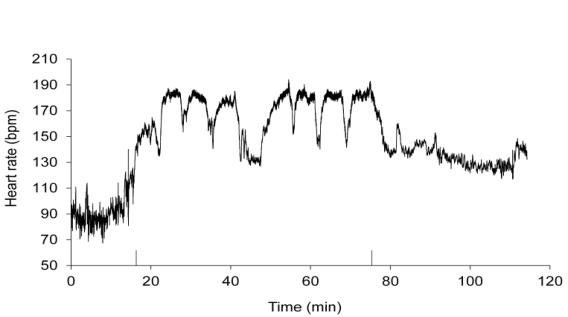
The heart rate (HR) response was continuously measured (RS800, Polar Electro Oy, Kempele, Finland) throughout the test (Figure 1). In addi- tion, core temperature (CT) was recorded every minute using a gastroin- testinal temperature pill (e-Celsius® Performance, Bodycap, Hérouville Saint-Clair, France), which was activated and swallowed by participants at least 10 h before starting the field test. The HR response was cate- gorized into 5 intensity zones according to different percentages of the maximal HR (Edwards, 1993): 100-90, 89-80, 79-70, 69-60, and 59-50%. The maximal HR was established from the theoretical maximal HR (Tanaka et al., 2001). Finally, both HR and CT were used to calcu- late the physiological strain index to assess heat strain on a 0-10 scale (Wen et al., 2015).
Central nervous system fatigue and cognitive performance were assessed using the critical flicker fusion (CFF) threshold. CFF measurements were per- formed before and immediately after the WFFs finished the field test in a room next to the field test site. Subjects were seated in front of a viewing chamber (Lafayette Flicker Fusion System, model 12022, Lafayette Instru- ment Co, Lafayette, IN, USA) where two light-emitting diodes were presented simultaneously for the left and right eye. The mean of three descending and ascending (1 Hz/s) measures from a high to a low (100-0 Hz) and from a low to high frequency (0-100 Hz) until WFFs perceived a flicker or fusion, respectively, were used to measure CFF threshold (Davranche and Audiffren, 2004).
RESULTS
The mean ambient, radiant temperatures and relative humidity were 32.2 ± 2.1 °C, 67.2 ± 11.9 °C, and 25.7 ± 7.3 %, respectively. In addition, the analy- zed wet bulb globe temperature (WBGT) was 26.7 ± 1.7 °C. Table 1 shows the mean values of the physiological variables monitored during the test. The individual pattern of these variables in one of the subjects who participated in the study is shown in Figure 1. The time spent in the established exercise intensity zones was 26.4 ± 8.0, 20.2 ± 5.7, 10.4 ± 1.6, 4.9 ± 3.2 and 0.5 ± 0.7 min between 100-90, 89-80, 79-70, 69-60, and 59-50% of the maximal HR, respectively.
The analysis of critical flicker fusion values showed a significant (p < 0.05) increase after the end of the field test (45.8 ± 5.9 vs. 48.7 ± 6.3 Hz). Mean HR, CT, and PSI during the CFF test were 134 ± 18 bpm, 38.06 ± 0.96 °C, and 4.5 ± 1.6 AU, respectively. Significant (p < 0.05) relationships between sensory sensitivity and time spent at high percentage of maximal HR (>90%), TC and PSI were found (r = −0.71, −0.74 and −0.69, respectively).
Effect of Exercise Intensity and Thermal Strain 61
Figure 1: Heart rate and core temperature pattern throughout the field test of one of the wildland firefighters who participated in the study.Table 1. Physiological variables analyzed during the field test.
Table available in the original PDF paper.
Mean ± SD Maximal HR (bpm) 194 ± 5 Mean HR (bpm) 165 ± 11 Percentage of maximal HR (%) 84.9 ± 4.5 Core temperature (°C) 38.2 ± 0.5 Physiological Strain Index (AU) 6.0 ± 0.6
HR, heart rate; AU, arbitrary units.
DISCUSSION
The results show the adverse environmental conditions in which the WFFs performed the tests, mainly due to the high radiant temperature. In addition, these results highlight the high-intensity exercise conducted by the subjects. The mean intensity analyzed was between 15-25% higher than that previ- ously reported in real wildfires (Rodríguez-Marroyo et al., 2012). Similarly, the time spent above 90% of maximal HR was approximately double that found in real deployments (Rodríguez-Marroyo et al., 2012). Under these circumstances, the CT observed was slightly higher than 38 °C, which might be considered mild hyperthermia (Jacklitsch et al., 2016). Despite the high cardiovascular and thermal strain analyzed, no decrease in critical flicker
fusion values was found after the test, which might be understood as an abse- nce of fatigue in the central nervous system. In contrast, an increase in cortical arousal was analyzed. This circumstance might have been due to the type of exercise performed. Brief exhausting exercises (i.e., intense anaerobic exe- rcise) have been reported to induce cognitive fatigue (Tomporowski, 2003). However, short-duration aerobic and anaerobic exercises, such as the one performed in this study, might improve cognitive performance (Tomporow- ski, 2003). Despite this, our results showed the negative influence that effort spent >90% of maximal HR may have on the WFFs’ cognitive performance.
Our findings agree with those reported previously (Morley et al., 2012; Williams-Bell et al., 2017). Thus, performing firefighting tasks during 3h did not affect WFFs’ cognitive function under neutral and very hot conditions (Williams-Bell et al., 2017). These authors suggested that the maintenance of euhydration and the relative drop in CT when the cognitive assessments were performed might have influenced the results. These same circumstances might have conditioned our results. Subjects in this study drank water ad libutum during recovery periods, which might prevent their dehydration. In addition, a rapid drop in CT after the end of the test was observed (Figure 1). CT during the CFF test was ~0.5 °C lower than that observed at the end of the field test.
Finally, the results of this study might be conditioned by the time elapsed between the end of the exercise and the completion of the CFF test. It has been reported that cognitive function changes are not noted until an hour or more following exercise (Morley et al., 2012). Therefore, further research should analyze the effect of post-exercise time on CFF measurements.
CONCLUSION
Despite the high exercise demand performed by the WFFs during the field test, no deterioration in their cognitive performance was observed. Conver- sely, an enhancement of sensory sensitivity and cortical arousal was found. The correlations found in this study show the potential negative effect that high-intensity exercise and thermal strain have on central nervous system fatigue.
ACKNOWLEDGEMENT
The authors would like to acknowledge to Rijeka (Croatia), Postojna (Slo- venia), and Gumpoldskirchen (Austria) fire brigades for their generous participation in the study. The authors acknowledge the infrastructure and support of the Šapjane Training Center of the Primorje and Gorski Kotar Fire Department (Croatia).
This research was supported by the European Union’s Horizon 2020 research and innovation program under grant agreement No 883315. The contents of this publication do not necessarily reflect the position or opinion of the European Commission.
Effect of Exercise Intensity and Thermal Strain 63
REFERENCES
Carballo-Leyenda, B., Gutiérrez-Arroyo, J., García-Heras, F., Sánchez-Collado, P., Villa-Vicente, J.G. and Rodríguez-Marroyo, J.A. (2021) “Influence of Personal Protective Equipment on Wildland Firefighters’ Physiological Response and Per- formance during the Pack Test”, International Journal of Environmental Research and Public Health, 18(10), 5050. Carballo-Leyenda, B., Villa, J.G., López-Satué, J., Collado, P.S. and Rodríguez-
Marroyo, J.A. (2018) “Fractional contribution of wildland firefighters’ personal protective equipment on physiological strain”, Frontiers in Physiology, 9, 1139. Davranche, K. and Audiffren, M. (2004) “Facilitating effects of exercise on information processing”, Journal of Sports Sciences, 22(5), 419–428. Edwards, S. (1993) “High performance training and racing”, in Edwards, S. (ed.)
The Heart Rate Monitor Book. Sacramento: Feet Fleet Press, pp. 113–123. Jacklitsch, B., Williams, W.J., Musolin, K., Coca, A., Kim, J-H. and Turner, N.
(2016) “NIOSH criteria for a recommended standard: occupational exposure to heat and hot environments” Cincinnati, OH: U.S. Department of Health and Human Services, Centers for Disease Control and Prevention, National Institute for Occupational Safety and Health, DHHS (NIOSH) Publication 2016–106. Jeklin, A.T., Davies, H.W., Bredin, S.S.D, Hives, B.A, Meanwell, L.E, Perrotta, A.S.
and Warburton, D.E.R. (2020) “Fatigue and sleep patterns among Canadian wild- land firefighters during a 17-day fire line deployment”, Journal of Occupational and Environmental Hygiene, 17(7-8), 364–371. Morley, J., Beauchamp, G., Suyama, J., Guyette, F.X., Reis, S.E., Callaway, C.W., et al. (2012) “Cognitive function following treadmill exercise in thermal protective clothing”, European Journal of Applied Physiology, 112(5), 1733–1740. Rodríguez-Marroyo, J.A., López-Satue, J., Pernía, R., Carballo, B., García-López, J.,
Foster, C. and Villa, J.G. (2012) “Physiological work demands of Spanish wildland firefighters during wildfire suppression”, International Archives of Occupational and Environmental Health, 85(2), 221–228. Ruby, B.C., Shriver, T.C., Zderic, T.W., Sharkey, B.J., Burks, C. and Tysk, S. (2002) “Total energy expenditure during arduous wildfire suppression”, Medicine and Science in Sports and Exercise, 34(6), 1048–1054. Tanaka, H., Monahan, K.D. and Seals, D.R. (2001). “Age-predicted maximal heart
rate revisited”, Journal of American College of Cardiology, 37(1), 153–156. Tomporowski, P.D. (2003) “Effects of acute bouts of exercise on cognition”, Acta Psychologica, 112(3), 297–324. Vincent, G.E., Aisbett, B., Hall, S.J and Ferguson, S.A. (2016) “Fighting fire
and fatigue: sleep quantity and quality during multi-day wildfire suppression”, Ergonomics, 59(7), 932–940. Wen, S., Petersen, S., McQueen, R. and Batcheller, J. (2015) “Modelling the physiological strain and physical burden of chemical protective coveralls”, Ergonomics, 58(12), 2016–2031. Williams-Bell, F.M., Aisbett, B., Murphy, B.A. and Larsen, B. (2017) “The Effects
of Simulated Wildland Firefighting Tasks on Core Temperature and Cognitive Function under Very Hot Conditions”, Frontiers in Physiology, 8, 815. Williamson, A., Lombardi, D.A., Folkard, S., Stutts, J., Courtney, T.K. and Connor, J.L. (2011) “The link between fatigue and safety”, Accident Analysis and Prevention, 43(2), 498–515.
LISTED IN THE AHFE DIGITAL BOOKSTORE CATALOGUE
Explore the complete digital volume
Cognitive Computing and Internet of Things
Read this individual research paper free through the original publisher, or explore the full digital proceedings book.
ISBN 978-1-958651-19-3
Explore this ISBN in the AHFE Bookstore ↗Listed in the July 2026 bookstore catalogue; search by ISBN to confirm current availability · Digital book purchase optional