Belén Carballo Leyenda, Jorge Gutiérrez Arroyo, José Gerardo Villa Vicente, Fabio García-Heras, Juan Rodríguez Medina, Jose A Rodríguez-Marroyo (2023). Laboratory assessment of heat strain in female and male wildland firefighters. In: Cognitive Computing and Internet of Things. AHFE Open Access, vol. 73, pp. 73–82. https://doi.org/10.54941/ahfe1003976
Wildland firefighters (WFF) face a set of specific work-related factors that directly affect their physical and cognitive abilities and compromise their health and safety. The working conditions include hard physical work and environmental conditions that combine high temperatures and high radiant heat. Such environments make using personal protective equipment (PPE) mandatory to protect them from risks. This fact restricts heat removal and adds extra weight, increasing thermal strain and the risk of heat-related illnesses on WFF. Since the number of females WFF has increased, it is necessary to study the repercussions of heat stress on this group. To date, it is not yet well-known whether sex-related differences in thermoregulation will be relevant when the individuals are wearing PPE and performing high physical effort in a hot environment. Therefore, we aimed to investigate the physiological response when performing moderate to high-intensity effort in a hot-dry environment while wearing PPE according to sex. Twenty WFF 10 females [23.9 ± 3.2 yr, 163.8 ± 3.4 cm and 62.7 ± 9.1 kg] and 10 males [31.9 ± 6.6 yr, 178.8 ± 5.8 cm and 73.9 ± 7.7 kg]) performed a 125 min treadmill test in a controlled ambient (30 ºC and 30% relative humidity). The protocol consisted of two exercise stages where WFF performed different continuous and variable exercise bouts in order to mimic the effort performed during real deployments. Participants wore the full standard PPE during the test. Oxygen uptake (VO2), heart rate (HR), core temperature (CT) and chest temperature (SkT) were monitored throughout the test. HR and CT were used to calculate the physiological strain index (PSI). Differences in body mass pre-post trials corrected for fluid intake were used to calculate sweat production (SwP), sweating rate (SwR), and evaporative efficiency (EE). Differences (p < 0.05) between females and males were found in %VO2max (62.5 ± 7.4 vs 55.3 ± 5.), HR (155 ± 10 vs 134 ± 14 beats·min–1), % of maximal HR (81.3 ± 3.5 vs 42.3 ± 6.5), CT (38.0 ± 10 vs 37.7 ± 0.33 ºC), SkT (36.0 ± 0.6 vs 35.3 ± 0.6 ºC) and PSI (4.1 ± 0.5 vs 3.5 ± 0.6). Even though SwR was higher (p < 0.05) for male participants (1001.5 ± 268.3 ml) compared to females (647.5 ± 145.9 ml), females had higher EE (32.9 ± 4.6 vs 16.7 ± 6.2 %). In conclusion, performing high-intensity exercise in hot-dry conditions while wearing PPE leads to a higher thermal and cardiovascular load for female WFF, making them more susceptible to heat illness. These results could be linked to lower aerobic fitness, sweating rate, and hormonal aspects that increased the thermal burden.
Wildland fire suppression is an extremely demanding occupation related to the specific factor it poses (Cuddy et al., 2015). During wildfire suppression, wildland firefighters (WFF) face a series of specific conditions, such as the orography of the terrain (Brotherhood, 2008), smoke inhalation (Wegesser et al., 2009), handling of heavy hand tools (3-20 kg) (Rodríguez- Marroyo et al., 2012), use of personal protective clothing (PPE) (Carballo-Leyenda et al., 2018) and the long duration of the effort in hot environmental conditi- ons (Carballo-Leyenda et al., 2021; Sol et al., 2018). Altogether, these factors lead to high physical demands (Rodríguez-Marroyo et al., 2012), accelera- ting the appearance of fatigue and increasing the risk of exertional heat illness as heat production often exceeds dissipation capacity (Cuddy et al., 2015). In this scenario, wearing personal protective equipment (PPE) is mandatory to preserve the security and health of workers. However, it has been shown that using PPE increases the production of metabolic heat and reduces the dissipation of body heat, mainly due to greater encapsulation by layers of clothing (Barr et al., 2009; Carballo-Leyenda et al., 2018). Consequently, the physiological response is further augmented and characterised by increased core and skin temperature, heart rate, sweat rate and subjective perceptions of effort and thermal sensation (Petruzzello et al., 2009).
The integration of women in the traditionally manly profession has rai- sed the question of their physical and physiological capabilities to perform equally effectively as their male counterparts. Literature has shown that, on average, women have a lower maximal oxygen consumption (VO2max), a higher body fat percentage, a larger body surface area-to-mass ratio and decreased sweat gland production in hot conditions, leading to decreased work capacity and higher rise in body temperature compared to men (Gagnon et al., 2009; Roberts et al., 2016). It has also been suggested that this effect may be exacerbated during the luteal phase of the menstrual cycle due to hor- monal fluctuations affecting central thermoregulatory centres (Charkoudian and Stachenfeld, 2016). These physiological and morphological differences would pose women with a higher risk of heat-related injuries during exercise under heat stress while wearing PPE (Renberg et al., 2022).
In recent years, the rate of female participation in physically demanding occupations such as the military and firefighting has increased (Anderson et al., 2022; Perroni et al., 2021), even reaching the 10-15% of wildland fire crews in the United States (Sol et al., 2018). Despite this fact, there is still a lack of studies on the role of sex in physical condition, work capa- city and thermoregulation in professional sectors. Therefore, we aimed to investigate the thermophysiological response when performing moderate to high-intensity effort in a hot-dry environment while wearing PPE according to sex.
METHODS
Participants Twenty-two active and healthy wildland firefighters candidates, 10 men (mean ± standard deviation; 31.9 ± 6.6 yr, 178.8 ± 5.8 cm and
Laboratory Assessment of Heat Strain in Female and Male Wildland Firefighters 75
73.9 ± 7.7 kg) and 10 women (23.9 ± 3.2 yr, 163.8 ± 3.4 cm and 62.7 ± 9.1 kg) who voluntarily participated in this study. All of them pas- sed a work capacity test prior to participating in the study. Written informed consent was obtained from the volunteers before beginning the study. The study protocol was developed by the guidelines of the Helsinki Conference for research in humans and was approved by the Ethics Committee of the University of León, Spain.
Experimental Design Each subject undertook two trials in two testing sessions separated by at least 48 h. Participants were asked to refrain from strenuous exercise and not to consume alcohol, caffeine, and tobacco for 24 h. previous. A graded exercise test was performed during the first testing session to determine the subjects’ maximal aerobic capacity (VO2max) and to subsequently use these data to program the intensity of the second trial specifically to each subject’s cha- racteristics. During the second trial, the participants performed a 125 min submaximal test wearing the personal protective equipment (PPE) curren- tly used by Spanish WFF, which includes thermal-resistant clothing (65% fire retardant viscose, 30% Nomex and 5% Kevlar, 1.5 kg, surface mass 270 g ± m-2, intrinsic thermal resistance 0.019 m2 K·W-1 and evaporative resistance 3.79 m2·Pa·W-1) and other protective elements such as a helmet, neck shroud, gloves and low calf hiking boots.
Graded Exercise Test All subjects performed a graded treadmill exercise test (h/p Cosmos Pulsar, h/p Cosmos sports and medical GMBH, Nussdorf-Traunstein, Germany). A 10-minute warm-up preceded each test at 60% of maximum heart rate (8-10 km h-1) and 5 minutes of stretching. The test began at 4 km·h-1 and a 10% gradient. Each minute the speed increased by 0.5 km·h-1 until reach- ing 6.5 km·h-1, from which time the slope increased 1 % every minute until volitional exhaustion.
Submaximal Treadmill Test The submaximal test was performed at the same time of day (between 09:00 and 13:00). Ambient temperature and relative humidity were controlled at 30
C and 30%, respectively simulating average conditions previously repor- ted in wildland fire suppression (Rodríguez-Marroyo et al., 2012). The overall experimental protocol consisted of 2 different exercise phases wal- king to varying intensities with a 15 min passive recovery period in between. Exercise stage 1 comprises two 20 min work bouts (6 km·h–1 and 3% slope) interspersed by 10 min passive recovery. Exercise stage 2 consists of two work bouts of 25 min interspersed by 10 min passive recovery. The intensity of the exercise in each work bout was set to elicit 7 min at a moderate- intensity (i.e., between the ventilatory thresholds), 15 min at a low-intensity (i.e., below the ventilatory threshold) and 3 min at a high-intensity (i.e., above the respiratory compensation threshold). This exercise intensity distribution
76 Carballo–Leyenda et al.
represents the mean effort distribution performed by WFF during wildland fire suppression of 1–3 h duration (Rodríguez-Marroyo et al., 2012).
Measurements ECG monitoring (Medisoft MedCard, Medisoft Group, Sorinnes, Belgium) was continuously measured throughout the tests. Breath-by-breath gas analy- sis (Medisoft Ergocard, Medisoft Group, Sorinnes, Belgium) was measured in periods of 3 min at the beginning and the end of each exercise bout. Core temperature (CT) was recorded every minute using a gastrointestinal temperature pill (e-Celsius® Performance, Bodycap, Hérouville Saint-Clair, France), which was activated and swallowed by participants at least 8 h before starting the field test. (Larsen et al., 2015). Chest skin temperature (SkT) was measured using an iButton (DS1922L-F50, Maxim Integrated, Sunnyvale, California, USA) attached on the left major pectoral using surgical tape (Fixomull, BSN Medical, Hamburg, Germany) (Cuddy et al., 2015).
TC and heart rate were used to calculate the physiological strain index (PSI) throughout the trials, according to Tikuisis et al. (2002). Subjects in underwear and each clothing component were separately weighted (50K150, COBOS, Hospitalet de Llobregat, Barcelona, Spain) at the beginning and the end of each trial. With body mass differences, we calculate the total sweat production (SwP), sweat rate (SwR) and sweat retained in the clothes (Kofler et al., 2015). Total sweat was corrected for the fluid intake. Finally, sweat evaporation efficiency (EE) was calculated as the ratio between sweat evaporation and total sweat (Kofler et al., 2015).
Statistical Analysis The results are expressed as mean ± standard deviation (SD). The assumption of normality was verified using the Shapiro-Wilk test. When a non-normal distribution was found, data were log-transformed for analysis. Significant differences between males and females in anthropometric and physiologi- cal data measured during the first testing session were analysed using an independent t-test. This same analysis was performed to compare the sweat measurements obtained according to the WFF sex. A two-way repeated mea- sures ANOVA was used to establish the influence of time and sex on the variables studied in the laboratory test. Bonferroni’s test was used to esta- blish significant differences between means when a significant F value was found. Significance level was set at p<0.05. SPSS+ V.26.0 statistical software (Chicago, Illinois, USA) was used.
RESULTS
Female WFF were younger (p < 0.05), shorter (p < 0.05), lighter (p < 0.05) and had a smaller (p < 0.05) body surface area (1.68 ± 0.11 vs. 1.92 ± 0.12 m2) than their male counterparts. However, no significant differences in the body mass index (23.1 ± 2.5 (kg·m-2) and body surface area-to-mass ratio (2.66 ± 0.16 cm2·kg-1) were found. In addition, the VO2max was similar in both sexes (47.5 ± 7.7 vs. 55.00 ± 9.6 ml·kg-1·min-1).
Laboratory Assessment of Heat Strain in Female and Male Wildland Firefighters 77
Table 1. Physiological parameters measured during the submaximal test (mean ± SD).
Table available in the original PDF paper.
Female Male Percentage of maximal HR (%) 81.31 ± 3.50 72.32 ± 6.5* Percentage of VO2max (%) 62.49 ± 7.43 55.25 ± 5.10* Core temperature (
C) 38.01 ± 0.22 37.70 ± 0.33* Chest skin temperature (
C) 36.0 ± 0.6 35.3 ± 0.6* Physiological Strain Index (AU) 4.1 ± 0.5 3.5± 0.6*
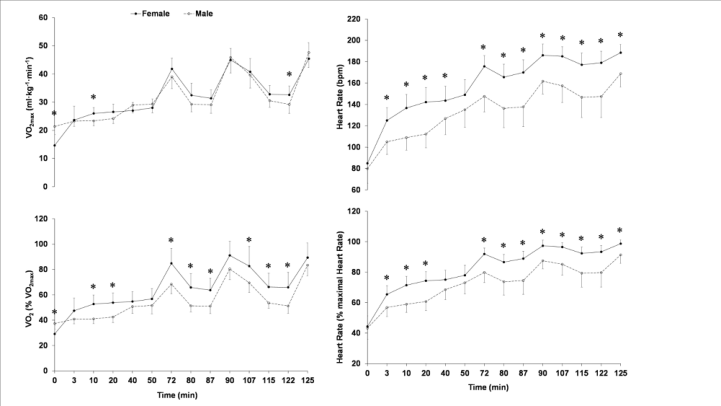
Females showed a significantly higher (p < 0.05) physiological (i.e., % HRmax and %VO2max) and thermal (i.e., CT and SkT) strain than males during the submaximal test (Table 1). Consequently, the PSI was higher (p < 0.05) for females compared to male participants.
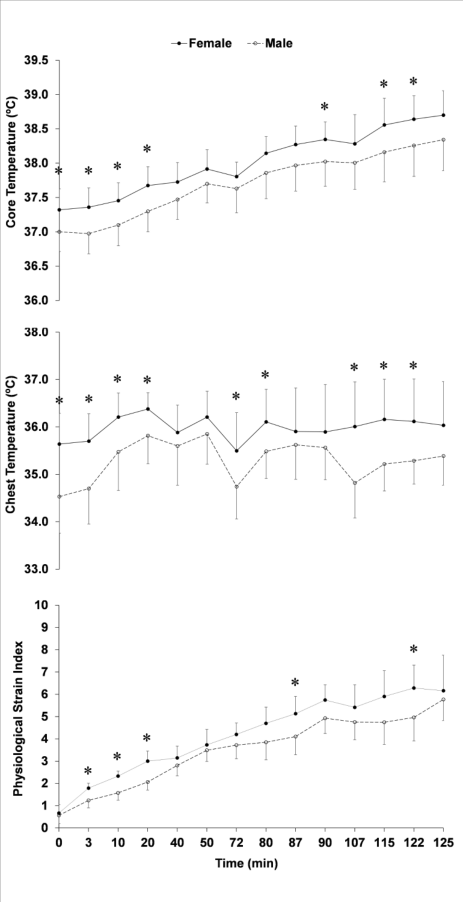
The physiological variables pattern throughout the submaximal test is shown in Figure 1. A greater (p < 0.05) physiological strain during the course of the test was observed in females. Significant differences (p < 0.05) were found between women and men in the baseline CT (37.3 ± 0.30 vs 37.0 ± 0.29) and at minutes 3, 10, 20, 90, 115 and 122 (Figure 2A). Simi- larly, the baseline SkT was significantly higher (p < 0.05) in women compared to that analysed in men (36.0 ± 0.6 vs. 35.3 ± 0.6
C). In addition, differences (p < 0.05) in SkT were observed at minutes 3, 10, 20, 72, 80, 107, 115, and 122 (Figure 2B). Finally, significant differences (p < 0.05) between groups in the PSI values were found in minutes 3, 10, 20, 87 and 122 (Figure 2C).
Total sweat (1570 ± 364 vs. 2546 ± 695 g) and sweat rate (648 ± 146 vs. 1002 ± 268 g·h-1) were significantly lower (p < 0.05) in women. However, the sweat evaporation efficiency (32.9 ± 4.6 vs. 16.7 ± 6.2%) was significantly higher in women (p < 0.05).
Figure 1: Comparative responses of oxygen uptake (A) and heart rate (HR) (B) during the laboratory test (mean ± SD). *, significant difference (p < 0.05).
78 Carballo–Leyenda et al.
Figure 2: Gastrointestinal (A), chest skin temperature (B) and physiological strain index (C) pattern recorded during the submaximal test (mean ± SD). *, significant difference (p<0.05).
DISCUSSION
The main objective of this study was to evaluate the thermophysiological dif- ferences between men and women during a long-duration submaximal test in a thermally stressful environment (30
C and 30% relative humidity) while wearing a PPE. The key findings of this study include: i) the thermally stres- sful conditions led women to perform a higher exercise intensity; ii) women started the test with a higher baseline temperature, however, both sexes expe- rienced similar rate of increase; iii) women obtained a higher evaporative efficiency despite their lower sweat rate.
Laboratory Assessment of Heat Strain in Female and Male Wildland Firefighters 79
The exercise intensity performed by women in terms of %VO2max was ∼7% greater than that performed by men. This circumstance possibly resulted from her worse physical fitness and could have meant that they accu- mulated more fatigue as the test progressed. This observation is supported by Yanovich et al. (2008), who found that women exercised at 19.4 %VO2max higher than men when they compared the physiological response between military men and women during a fitness program. Murphy et al. (2001) obtained a higher %VO2max for the group of women when comparing the physiological response while wearing chemical protective clothing. Roberts et al. (2016) pointed out that in real wildland fire suppression deployments, all crew members wear the same PPE, use the same equipment and have to meet the same performance objectives, so women maintain a higher work intensity. Results in the literature and those from our study support the idea that women’s lower physical fitness drives them to work at a higher percen- tage of their maximum aerobic capacity, accelerating the onset of fatigue (Epstein et al., 2013).
Women’s heightened intensity of effort resulted in a higher HR. The increa- sed cardiovascular load would be the result of the greater demand imposed by an increase in CT combined with continuous exercise in the heat that drives the increase in blood flow to the periphery to avoid the increase in body tem- perature (Anderson et al., 2022; Notley et al., 2019). Despite this, a similar increase in CT as SkT throughout the test was observed for female and male participants, highlighting that the combined demands imposed by exercise, environment and clothing lead to an uncompensable heat strain in both sexes. Interestingly, women started the test with a higher CT (∼0.3
C) and SkT (∼0.7
C) than men and these differences were maintained throughout the tri- als. This observation made us think that the test did not cause greater thermal strain in women but that the biological differences between men and women would explain the observed results. It has been described that women’s men- strual cycle can increase their CT by up to 0.5
C (Yanovich et al., 2020). Specifically, the influence of reproductive hormones would be behind this circumstance (Charkoudian and Stachenfeld, 2016). Seven women were in the luteal phase of their menstrual cycle when they performed the test, which could explain the ∼0.3
C difference between the women and men CT since the beginning of the test. Although it has been suggested that the higher area- to-mass ratio of women compared to men could favor their heat loss and increase their performance (Notley et al., 2017), this circumstance was not observed in this study since the area-to-mass ratio was similar between both sexes.
Another relevant result obtained from our study was that even though the women reached a greater exercise intensity, CT and SkT, they obtained a lower total sweat loss and lower sweat rate (38.3 and 35.4%, respectively). These results align with previous studies that have analysed the effect of sex on sweat response by controlling the metabolic heat production in adults, suggesting that females have decreased sweating capacity during exercise with high metabolic heat loads (Gagnon and Kenny, 2012a). Noteworthy despite the higher sweating rates in men, a higher evaporative efficiency was found in the group of women. These results do not agree with those described in the
80 Carballo–Leyenda et al.
literature, where higher absolute rates of evaporative heat loss have been seen in men (Gagnon et al., 2008). This observation could be due to the design and size of the protective clothing used by the females could have favoured sweat evaporation. The protective clothing used by the Spanish WFF is designed to consider the male framework, so its fit is improper for women due to their smaller body size. Using loose clothing when subjects exercise could facili- tate the dry heat exchange by enhancing the ventilation of the microclimate between clothing and the body (pumping effect) (Havenith, 2002; Nunneley, 1989), making the thermoregulation less dependent on sweat production.
CONCLUSION
Performing high-intensity exercise in hot-dry conditions while wearing a per- sonal protective equipment leads to a higher thermal and cardiovascular load for females. These results could be linked to lower aerobic fitness, sweating rate, and hormonal aspects that increased the thermal burden in women. Further studies comparing the thermoregulatory response between men and women wearing PPE are required to further substantiate these results.
ACKNOWLEDGEMENT
The authors would like to thank the volunteers for their generous partici- pation in the study. This research was supported by the European Union’s Horizon 2020 research and innovation program under grant agreement No 883315. The contents of this publication do not necessarily reflect the position or opinion of the European Commission.
REFERENCES
Anderson, C. A. J., Stewart, I. B., Stewart, K. L., Linnane, D. M., Patterson, M. J.
and Hunt, A. P. (2022), “Sex-based differences in body core temperature response across repeat work bouts in the heat”, Applied Ergonomics, Elsevier Ltd, Vol. 98 No. September 2021, p. 103586, doi: 10.1016/j.apergo.2021.103586. Barr, D., Gregson, W., Sutton, L. and Reilly, T. (2009), “A practical cooling strategy for reducing the physiological strain associated with firefigh- ting activity in the heat”, Ergonomics, Vol. 52 No. 4, pp. 413–420, doi: 10.1080/00140130802707675. Brotherhood, J. R. (2008), “Heat stress and strain in exercise and sport”, Journal of Science and Medicine in Sport, Vol. 11 No. 1, pp. 6–19, doi: 10.1016/j.jsams.2007.08.017. Carballo-Leyenda, B., Villa, J. G., López-Satué, J. and Rodríguez-Marroyo, J. A.
(2021), “Wildland firefighters’ thermal exposure in relation to suppression tasks”, International Journal of Wild land Fire, Vol. 30 No. 7, pp. 475–483, doi: 10.1071/WF20076. Carballo-Leyenda, B., Villa, J. G., López-Satué, J., Collado, P. S. and Rodríguez- Marroyo, J. A. (2018), “Fractional contribution of wildland firefighters’ personal protective equipment on physiological strain”, Frontiers in Physiology, Vol. 9 No. AUG, pp. 1–10, doi: 10.3389/fphys.2018.01139. Charkoudian, N. and Stachenfeld, N. (2016), “Sex hormone effects on autonomic
mechanisms of thermoregulation in humans”, Autonomic Neuroscience, Elsevier B. V., Vol. 196, pp. 75–80, doi: 10.1016/j.autneu.2015.11.004.
Laboratory Assessment of Heat Strain in Female and Male Wildland Firefighters 81
Cuddy, J. S., Sol, J. A., Hailes, W. S. and Ruby, B. C. (2015), “Work patterns dictate energy demands and thermal strain during wildland firefighting.”, Wil- derness & Environmental Medicine, Elsevier, Vol. 26 No. 2, pp. 221–6, doi: 10.1016/j.wem.2014.12.010. Epstein, Y., Yanovich, R., Moran, D. S. and Heled, Y. (2013), “Physiological
employment standards IV: Integration of women in combatunits physiological and medical considerations”, European Journal of Applied Physiology, Vol. 113 No. 11, pp. 2673–2690, doi: 10.1007/s00421-012-2558-7. Gagnon, D. and Kenny, G. P. (2012a), “Sex differences in thermoeffector responses during exercise at fixed requirements for heat loss”, Journal of Applied Physiology, Vol. 113 No. 5, pp. 746–757, doi: 10.1152/japplphysiol.00637.2012. Gagnon, D. and Kenny, G. P. (2012b), “Does sex have an independent effect on
thermoeffector responses during exercise in the heat?”, The Journal of Physiology, Vol. 590 No. 23, pp. 5963–5973, doi: 10.1113/jphysiol.2012.240739. Gagnon, D., Jay, O., Lemire, B. and Kenny, G. P. (2008), “Sex-related differences in evaporative heat loss: the importance of metabolic heat production”, European Journal of Applied Physiology, Vol. 104 No. 5, pp. 821–829, doi: 10.1007/s00421-008-0837-0. Havenith, G. (2002), “Interaction of clothing and thermoregulation”, Exogenous
Dermatology, Vol. 1 No. 5, pp. 221–230, doi: 10.1159/000068802. Kofler, P., Burtscher, M., Heinrich, D., Bottoni, G., Caven, B., Bechtold, T., Teresa Herten, A., et al. (2015), “Performance limitation and the role of core temperature when wearing light-weight workwear under moderate thermal conditions”, Jour- nal of Thermal Biology, Vol. 47, pp. 83–90, doi: 10.1016/j.jtherbio.2014.11.007. Larsen, B., Snow, R. and Aisbett, B. (2015), “Effect of heat on fire fighters’ work per-
formance and physiology”, Journal of Thermal Biology, Elsevier, Vol. 53, pp. 1–8, doi: 10.1016/j.jtherbio.2015.07.008. Murphy, M. M., Patton, J., Mello, R., Bidwell, T., & Harp, M. (2001). “Energy cost of physical task performance in men and women wearing chemical protective clothing”, Aviation, space, and environmental medicine, 72(1), 25–31. Notley, S. R., Dervis, S., Poirier, M. P. and Kenny, G. P. (2019), “Menstrual
cycle phase does not modulate whole body heat loss during exercise in hot, dry conditions”, Journal of Applied Physiology, Vol. 126 No. 2, pp. 286–293, doi: 10.1152/japplphysiol.00735.2018. Notley, S. R., Park, J., Tagami, K., Ohnishi, N. and Taylor, N. A. S. (2017), “Variations in body morphology explain sex differences in thermoeffector function during compensable heat stress”, Experimental Physiology, Vol. 102 No. 5, pp. 545–562, doi: 10.1113/EP086112. Nunneley, S. A. (1989), “Heat stress in protective clothing. Interactions among phy-
sical and physiological factors.”, Scandinavian Journal of Work, Environment & Health, Vol. 15 Suppl 1 No. c, pp. 52–7. Perroni, F., Cardinali, L., Cignitti, L., Gobbi, E., Grugni, F., Amatori, S., Rocchi, M. B. L., et al. (2021), “Are there sex differences in physiological parameters and reaction time responses to overload in firefighters?”, PLoS ONE, Vol. 16 No. 5 May, pp. 1–15, doi: 10.1371/journal.pone.0249559. Petruzzello, S. J., Gapin, J. I., Snook, E. and Smith, D. L. (2009), “Perce-
ptual and physiological heat strain: examination in firefighters in laboratory- and field-based studies.”, Ergonomics, Vol. 52 No. 6, pp. 747–754, doi: 10.1080/00140130802550216. Renberg, J., Lignier, M. J., Wiggen, Ø. N., Færevik, H., Helgerud, J. and Sandsund, M. (2022), “Heat tolerance during uncompensable heat stress in men and women wearing firefighter personal protective equipment”, Applied Ergonomics, Elsevier Ltd, Vol. 101 No. February, p. 103702, doi: 10.1016/j.apergo.2022.103702.
82 Carballo–Leyenda et al.
Roberts, D., Gebhardt, D. L., Gaskill, S. E., Roy, T. C. and Sharp, M. A. (2016), “Current considerations related to physiological differences between the sexes and phy- sical employment standards”, Applied Physiology, Nutrition, and Metabolism = Physiologie Appliquee, Nutritionet Metabolisme, Vol. 41 No. 6, pp. S108–S120, doi: 10.1139/apnm-2015-0540. Rodríguez-Marroyo, J. A., López-Satue, J., Pernía, R., Carballo, B., García-
López, J., Foster, C. and Villa, J. G. (2012), “Physiological work demands of Spanish wildland firefighters during wild fire suppression”, International Arch- ives of Occupational and Environmental Health, Vol. 85 No. 2, pp. 221–228, doi: 10.1007/s00420-011-0661-4. Sol, J. A., Ruby, B. C., Gaskill, S. E., Dumke, C. L. and Domitrovich, J. W. (2018), “Metabolic Demand of Hiking in Wildland Firefighting”, Wilderness and Envi- ronmental Medicine, doi: 10.1016/j.wem.2018.03.006. Tikuisis, P., McLellan, T. M. and Selkirk, G. (2002), “Perceptual versus physiological
heat strain during exercise-heat stress.”, Medicine and Science in Sports and Exe- rcise, Vol. 34 No. 9, pp. 1454–61, doi: 10.1249/01.mss.0000027764.43430.fe. Yanovich, R., Evans, R., Israeli, E., Constantini, N., Sharvit, N., Merkel, D., Epstein, Y., et al. (2008), “Differences in Physical Fitness of Male and Female Recruits in Gender-Integrated Army Basic Training”, Medicine & Science in Sports & Exercise, Vol. 40 No. 11, pp. S654–S659, doi: 10.1249/MSS.0b013e3181893f30. Yanovich, R., Ketko, I. and Charkoudian, N. (2020), “Sex differences in human
thermo regulation: Relevance for 2020 and beyond”, Physiology, Vol. 35 No. 3, pp. 177–184, doi: 10.1152/physiol.00035.2019.
LISTED IN THE AHFE DIGITAL BOOKSTORE CATALOGUE
Explore the complete digital volume
Cognitive Computing and Internet of Things
Read this individual research paper free through the original publisher, or explore the full digital proceedings book.
ISBN 978-1-958651-49-0
Explore this ISBN in the AHFE Bookstore ↗Listed in the July 2026 bookstore catalogue; search by ISBN to confirm current availability · Digital book purchase optional