Hyeongok Lee, Bo-Ok Seong (2023). Routing algorithm and diameter of hierarchical hyper-star network. In: Cognitive Computing and Internet of Things. AHFE Open Access, vol. 73, pp. 133–142. https://doi.org/10.54941/ahfe1003982
In this paper, we propose a new interconnection network topology, hierarchical hyper-star network HHS(Cn,Cn) is based on hyper-star network. Hierarchical networks based on hypercube have been previously proposed; it has been shown that these networks are superior to the basic networks, in terms of various performance including diameter, network cost, fault tolerance etc. Our results show that the proposed hierarchical hyper-star network performs very competitively in comparison to hyper-star network, HCN(n,n), and HFN(n,n) have been previously proposed. We also investigate a various topological properties of the hierarchical hyper-star network HHS(Cn,Cn) including routing algorithm, diameter, connectivity, broadcasting.
In recent years, the emergence of applied problems in scientific domains which uses large-scale data processing and AI-based models require a high volume of computational cost. Simultaneously, it demands real-time measu- res to process the series of the input dataset, which advances the milestone of research on parallel processing systems. Parallel computer structure is a high- performance parallel system, which processes large scale data processing and calculation utilizing many connected processors.
The field of parallel processing systems can be subdivided into the follow- ing two significant contents: interconnection network design and algorithm development. To categorize these interconnection networks with node num- ber with respect to that was previously suggested, there are Mesh types, Hypercube types, and Star graph types.
Hypercube graph is generally known for its interconnection network of parallel computer structure. Hypercube connection network is widely emplo- yed in researches and common used system on account of its merits, which readily provides communications network structure that is demanded in vari- ous application field. Hypercube network has simple routing algorithm with node and edge symmetry. Moreover it has maximal fault tolerance, recursive structure, and a forte : it could embed with other interconnection network (Esfahanian et al., 1991. Lee el al., 2002. Leighton, 1992). On the basis of this Hypercube graph, a hierarchical interconnection network HCN(n,n) and
HFN(n,n) was proposed. (Abraham, 1991. Duh et al., 1995. Johnsson, 1987. Vaidya, 1993). Hypercube interconnection node has 2n node and when the number of nodes increments the degree and diameter simultaneously incre- ases proportionally. For an amicable parallel processing, novel Hyper-Star connection network HS(m,k) was presented. (Kim and Shin, 1994. Kim et al, 2003). Hyper-Star connection network HS(m,k) has regular and irregular structures. Hyper-Star connection network HS(2n,n) is a regular structure with degree n. Hyper-Star connection network HS(2n,n) retains the pro- perties of the Hypercube and Star graph. Hyper-Star HS(2n, n) has similar properties to the Hypercube and the Star graph. When the number of nodes is identical, the Hyper-Star HS(2n, n) shows to be superior to Hypercube concerning network cost, and it improved the primary drawback of having an exponentially incrementing number of nodes in a Star graph network. Various research ramifications exist concerning the Hyper-Star graph netw- ork, including routing algorithms, Fault Diameter, Bipartite, Broadcasting algorithm, extensibility, fault tolerance, etc. (Lee et al., 2002. Kim et al., 2003). This research presents a novel Hierarchical HyperStar : HHS conne- ction network graph constructed upon the baseline structure of HyperStar HS(2n,n), and analyses routing algorithm and diameter. Moreover the novel HyperStar HHS graph that this research presents offers distinguished pro- perties in network cost compared to the Hierarchical graph of HCN(n,n) and HFN(n,n).
This thesis organization is as follows. In chapter 2 the fundamental cha- racteristics of Hyper-Star network connection will be presented. In chapter 3 we will design the novel Hierarchical Hyper-Star network connection this research proposes, and conduct a thorough analysis of its internal attributes from a theoretical perspective. Furthermore we will compare with the Hyper- Star connection HCN(n,n) and HFN(n,n) in the perspective of network cost, then destinate to conclusion.
PROPERTIES OF THE HYPER-STAR CONNECTION NETWORK When the bit-string that indicates the address of the node U of Hyper-Star connection network HS(m,k) is composed with total the number of m binary digit, number of “1” is k, and the number of a symbol “0” is constituted with the number of (m-k). Mark this bit-string of node U as U = 0m-k1k.
m
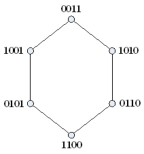
The total number of nodes in Hyper-Star network HS(m,k) is k , and the number of branches is (m-k) ∼k. This research analyzes the HS(2n,n), which has the equal number of degree in Hyper-Star connection network HS(m,k). Hyper-Star HS(2n,n) graph node is expressed through 2n bit-string b1b2...bi...b2n and is |bi=“1”|=|bi=“0”|=n, (1≤i≤2n). In the case of sym- bol b1 and bi in bit-string are complement, assume σi as a transposition of interchanging b1 and bi. In this circumstance an edge occurs between the two node u=bib2...b1...b2n and v=bib2...b1...b2n. (Figure 1) shows the Hyper-Star HS(4,2).
An arbitrary node U constitutes the Hyper-Star connection network HS(2n,n). In the node U, the routing path which successively applicates and
Routing Algorithm and Diameter of Hierarchical Hyper-Star Network 135
Figure 1: HS(4,2).
goes through the transposition σ k1, σ k2,..., σ kt , is indicated as [k1, k2,..., kt]. For instance, in HS(4,2), a route between node u=0011 and node v=1100 is either (Johnsson, 1987. Duh et al, 1995. Esfahanian et al., 1991).
Suppose u=u1u2...ui...u2n and v=v1v2...vi...v2n as an arbitrary two nodes from Hyper-Star connection network HS(2n,n). Apply Exclusive- OR function between the two nodes u and v and state the results as R=r1r2...ri...r2n, ri=ui⊕vi.
Equations and mathematical formulas are available in the original paper PDF.
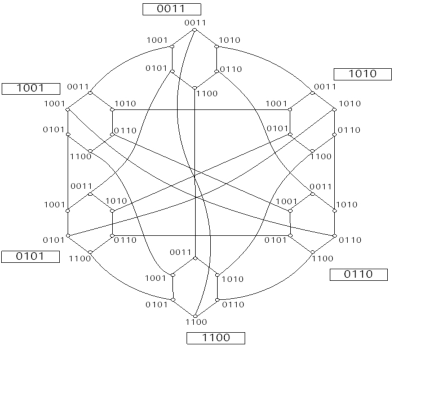
HIERARCHY HYPER-STAR CONNECTION NETWORK DESIGN AND ANALYSIS The Hyper-Star HHS(Cn,Cn) this thesis suggests is constructed based on Hyper-Star HS(2n,n) as a basic model. Name Hyper-Star HS(2n,n) which composes basic module as ‘cluster’ and remark it as Cn. The node of the graph HHS(Cn,Cn) is consist of two addresses like as (I,J). I represents the cluster, and J represents an address inside the cluster. The edge of HHS(Cn,Cn) graph is subdivided into n internal edges which are installed in basic module and 1 external edge that connects the basic module. Hierarchical Hyper-Star HHS(Cn,Cn) is composed with the amount of n of 2n combination cluster, and each node attains n+1 edges. External edge is classified into a diame- ter edge and non-diameter edge. Diameter edge is an external edge between the node (I,I) and (J,J). In this circumstance, I and J are complement to each other. An edge that is not in the category of diameter edge is classified as non-diameter edge. (Figure 2) indicates the structure of HHS(C2,C2).
ROUTING ALGORITHM Locate the start node of Hierarchical Hyper-Star HHS(C2,C2) as (I,J) and destination node as (K,L). A routing algorithm from start node (I,J) to desti- nation node (K,L) is as follows. If the cluster address of these two nodes are equivalent (that is, I=K), apply routing algorithm (Lee et al., 2002) of Hyper- Star graph and represent symbol as ⇒. The symbol →represents routing between clusters in the routing algorithm below.
1) Routing algorithm A : (I,J)⇒(I,K)→(K,I)⇒(K,L) 2) Routing algorithm B : (I,J)⇒(I,L)→(L,I)⇒(L,K)→(K,L)
3) Routing algorithm C : (I,J)⇒(I,M)→(M.I)⇒(M,M)→(M’,M’)⇒(M’,K) →(K,M’)⇒(K,L) part 1 : (I,J)⇒(I,M)→(M.I) ⇒(M,M) part 2 : (M’,M’)⇒(M’,K) →(K,M’) When M=I, part 1 is (I,I), and when M=K’, part 2 becomes (K,K). Routing distance is as follows.
RA = dist(J,K)+dist(I,L)+1 RB = dist(J,L)+dist(I,K)+2 RC = dist(M,I)+dist(M,J)+dist(M’,K)+dist(M’,L)+δ In the routing distance modification RC above, value δ is determined as follows. If M=I=K’, then δ=1. If M=I or M=K’(I̸=K’), then 2, or in every other case is 3. M refers to minimization cluster employed to generate routing distance RC the shortest distance. M could be found as follows.
Configure cluster M which effects routing distance Q=dist(M,I)+dist(M,J) +dist(M’,K)+dist(M’,L) become the shortest distance. In this case, when dist(M’,K)=dist(M,K’), dist(M’,L)=dist(M,L’), modification attained is as follows : Q = dist(M,I) + dist(M,J) + dist(M,K’) + dist(M,L’) = P2n i = 2{(Mi⊕Ii) + (Mi⊕Ji)+(Mi⊕K’i)+(Mi⊕L’i)}.
A set of Q-minimization cluster is deducted by discovering the bit string which minimizes the modification (Mi⊕Ii)+(Mi⊕Ji)+(Mi⊕K’i)+(Mi⊕L’i).
First, when IiJiK’iL’i ∈{0111,1011,1101,1110,1111}, Mi = 1. Second, when IiJiK’iL’i ∈{0000,0001,0010,0100,1000}, Mi = 0. Third, when IiJiK’iL’i ∈{0011,0101,0110,1001,1010,1100}, Mi = X(0 or 1). For instance, determine two arbitrary nodes as (I,J)=(0011,0101) and (K,L)=(0110,1100) from Hierarchy Hyper-Star connection network, then bit-strings from IiJiK’iL’I becomes 0010, 0100, 1001, 1111. Therefore, M=00X1.
Routing Algorithm and Diameter of Hierarchical Hyper-Star Network 137
As a result the set of Q- minimization cluster is {0001, 0011}, however, the number of bit string 0 and 1 which consists Hyper-Star node is equivalent as n. Consequently every bit string 0 and 1 in every cluster of HHS(4C2,4C2) must have identical number, and as a sequence set of Q- minimization cluster develop into {0011}, which the number of 0 and 1 corresponds.
Lemma 1 If two random nodes are called (I,J) and (K,L), and Q is a set of Q-minimization clusters, if I(or K’) is included in Qmin ,only I(or K’) is a minimization cluster, otherwise all clusters included in Qmin are minimization clusters.
Proof Routing path length of routing algorithm C is RC = Q +δ. In advance consider the circumstances that is̸ =K’. If I(or K’) is included in Qmin, then it is proved that Q and δ are shortest, therefore RC comes to be the shortest when M=I(or K’). As a conclusion I(or K’) is a minimization cluster. □ For instance, suppose (I,J)=(000111,101010) and (K,L)=(011001,101010), then the bit string of IiJiK’iL’I is 0110, 0001, 0100, 1011, 1110, 1001 with M=X0011X. Albeit 4 clusters generate in Qmin, ,
cluster {000111, 100110} is Qmin based on the fact that the number of 0 and 1 are equivalent. I and K’ are both minimization cluster because I(=000111) and K’(=100110) come under Qmin .
Lemma 2 Suppose arbitrary two nodes (I,J) and (K,L) (I̸=K), and set route P starting from node (I,J) to node (K,L). 5 theorem is established as a result.
2.1 If route P includes over 3 non-diameter edges, route P is not the minimum distance.
2.2 If route P includes over 2 diameter edges, route P is not the minimum distance.
2.3 Routing algorithm A is the shortest path for including one non- diameter edge.
2.4 Routing algorithm B is the shortest path for including two non- diameter edge.
2.5 Routing algorithm C is the shortest path for including one diameter edge.
Proof 2.1 Position (I,J) as source node and suppose destination node as (K,L). Indicate I=V0, J=V−1, K=Vx, L=Vx+1. If route P which connects two nodes contains the number of x non-diameter edge (x≥3), route P is composed as below.
Vi−2, Vi
(case 1) x is an odd number : Compose route Q, which includes one non- diameter, as follows.
i = 1 dist(Vi−2, Vi) + 1. As a sequ- ence, it is acknowledged that RQ<RP , the distance of route Q being shorter than route P.
138 Ok Seong and Ok Lee
(case 2) x is an even number : Compose route Q which includes two non- diameter edge as follows : Q = (V0,V-1) ⇒(V0,V1) ⇒(V0,V3) ⇒… ⇒(V0,Vx+1) →(Vx+1,V0) ⇒ (Vx+1,V2) ⇒(Vx+1,V4) ⇒… ⇒(Vx+1,Vx) →(Vx,Vx+1).
i = 1 dist(Vi−2, Vi) + 1. As a sequence, it is acknowledged that RQ<RP , the distance of route Q being shorter than route P.
Therefore if route P includes over 3 non-diameter edges, it is proved that route P is not the shortest distance.
2.2 Position (I,J) as source node and suppose destination node as (K,L). Set two arbitrary nodes as u and v. If two nodes both exist in the equivalent Hyper-Star and if the route follows algorithm A, the route u==>v signifies a routing path inherent in Hyper-Star.
i = 1 2dist(Vi, Vi + 1)+dist(V’x,K)+ dist(V’x,L)+γ , If γ ≥x, it includes minimum of x diameter edge. For verification, in this paper we subdivided into two cases depending on the amount of x.
(case 1) when x is an odd number : A path Q including only one diameter edge is configured as follows.
i = 1 2dist(Vi, Vi + 1)+dist(V’x,K)+ dist(V’x,L)+γ , If V1=I, γ is 1, if not γ is 2. When x≥3, it is acknowledged that RQ<RP , consequently route Q is in length shorter than route P.
(case 2) x is an even number : Compose a route Q which does not include any diameter edge.
i = 1 2dist(Vi, Vi + 1)+dist(V’x,K)+ dist(V’x,L)+1, It is acknowledged that RQ<RP , consequently route Q is in length shorter than route P.
Therefore, when route P includes over 2 diameter edges, it is acknowledged that route P is not the shortest route.
2.3 The non-diameter edge that connects the two node (I,J) and (K,L) is an arbitrary edge that also links cluster I and K. Thus a route containing one non-diameter edge must necessarily transit an edge that connects two nodes.
Routing Algorithm and Diameter of Hierarchical Hyper-Star Network 139
A route that accompanies routing algorithm A is an arbitrary route con- taining one non-diameter edge. Therefore routing algorithm A is a shortest distance among routes that contains one non-diameter edge.
2.4 Form route P including two non-diameter as follows. P = (I,J) ⇒(I,V) →(V,I) ⇒(V,K) →(K,V) ⇒(K,L), (V̸=I and V̸=I). Routing distance of route P is as follows. RP = dist(J,V)+dist(I,K)+dist(V,L)+2 It is acknowledged that RP≥RB , since RB = dist(J,L)+dist(I,K)+2 and dist(J,V)+dist(V,L) ≥dist(J,L). Therefore routing algorithm B is the shor- test distance among routes that includes two non-diameter edges. If dist(J,V)+dist(V,L) = dist(J,L), route P has the same route length as algorithm B and could be replaced as alternative route of B.
2.5 It is readily acknowledged from the definition of algorithm C. d=min(RA,RB,RC) According to lemma 2, a regular routing algorithm that connects node (I,J) and (K,L) (I̸=K) could be found in HHS(Cn,Cn). Regular routing algorithm is an algorithm that takes the shortest route among routing algorithm A, B, and C. Distance d, which is the distance between two nodes (I,J) and (K,L), comes to be the shortest path length among those three path lengths.
d=min(RA,RB,RC) To examplify, calculate the distance between two node (000111,101010) and (011001,101010). The minimization cluster M between two nodes is 000111. The length of the three routing path is as it shows below. RA = 3+3+1 = 7. RB = 4+0+2 = 6. RC = 3+1+2+2 = 8. It is acknowledged that routing algorithm B is the regular routing algori- thm since RB has the minimum value.
DIAMETER Diameter is the maximum value of the shortest distance between the two arbitrary nodes which composes connection network. A delay time occurs because data is conveyed via the whole interconnection network and diameter indicates this lower bound of the delay time.
j Theorem 1 The diameter of HHS(Cn,Cn) is 2n+
2n 3 k
Proof Assume source node as (I,J) and destination node as (K,L). In the case of I=K, the two nodes exist in the equivalent Hyper-Star and as a conse- quent the maximum distance is 2n-1. When I̸=K, the distance between two node could be found by the minimum value in three path length RA,RB,RC..
The three path length can be demonstrated as below. RA = dist(J,K)+dist(I,L)+1 = P2n
140 Ok Seong and Ok Lee
Table 1. IiJiKiLi and RAi, RBi, RCi, Mi.
Table available in the original PDF paper.
group IiJiKiLi RAi RBi RCi Mi 1 0000, 1111 0 0 2 Mi = X 2 0110, 1001 0 2 2 Mi = X 3 0101, 1010 2 0 2 Mi = X 4 0011, 1100 2 2 0 Mi = Ii = k’i 5 0010, 1101, 1000, 0111 1 1 1 Mi = Ii = ki 6 0001, 1110 1 1 1 Mi = Ii̸ = k’i 7 0100, 1011 1 1 1 Mi = ki̸ = Ii
M is minimization cluster, and when M=I=K’ δ=1, when M=I or M=K’(I̸=K’) it is 2, and in every other case 3. RAi, RBi, RCi can be presented as follows.
RAi = (Ji⊕Ki)+(Ii⊕Li), RBi = (Ji⊕Li)+(Ii⊕Ki), RCi = (Mi⊕Ii)+(Mi⊕Ji)+(Mi⊕K’i)+(Mi⊕L’i). The diameter D of HHS(Cn,Cn) is as follows.
Since it is intricate to express a relationship between three modification with XOR symbol (⊕), as an alternative we will employ plus sign (+) to represent the relationship.
The value of RAi, RBi, RCi, Mi depending on the amount of 4-bit IiJiKiLi(2≤i≤2n) was expressed on chart 1. The value of 4-bit IiJiKiLi , the amount of 2n-1, is subdivided into 7 groups depending on the value of RAi, RBi, RCi, Mi.
Assume bk as the number of 4-bit value which is in group k. For instance suppose two arbitrary nodes as (000111,010101), (110010,101100), then 5 of 4-bit value is 0110, 0001, 1101, 1010, 1100 which concludes to b2=1, b3=1, b4=1, b5=1, b6=1. Rest of bk is not existent.
Sigma bk (b1+b2+…+b7) is 2n-1. If b6=0, it is known that M=K’ and as a consequence Mi=K’i or Mi=X. If b7=0, M=I, which leads to a conclusion that Mi=Ii or Mi=X (2≤i≤2n). Therefore if b6=0 or b7=0, δ≤2. According to <chart 1>, three routing algorithm path length is indicated as below.
RA = 2b3+2b4+b5+b6+b7+1 RB = 2b2+2b4+b5+b6+b7+2 RC = 2b1+2b2+2b3+b5+b6+b7+δ, In the case of b6=0 or b7=0 it is δ≤2, or else it is δ=3. In this paper we will seperate cases into 4 and calculate diameter according to term of bk .
(case 1) b3≤b2, and b4≤b1+b2. In this case routing algorithm A is a regular routing algorithm. Distance d is as it shows below.
Routing Algorithm and Diameter of Hierarchical Hyper-Star Network 141
It is b3=b2, and when b4=b1+b2 it is proved that 2b3+2b4+b5+b6+b7+1 =2b1+4b2+b5+b6+b7+1, and as a consequence 2n-1=b1+b2+…+b7=2b1 +3b2+b5+b6+b7. Thus b2=(2n-2b1-b5-b6-b7-1)/3≤
2n−1 3 k j
2n−1 3 k (case 2) b3≤b2 and b4≥b1+b2+1. In this specific case routing algorithm C is regular routing algorithm. Distance d is as follows.
j
When b3=b2 and b4=b1+b2+1, it is that 2b1+2b2+2b3+b5+b6+b7+δ= 2b1+4b2+b5+b6+b7+δ, and 2n-1=b1+b2+…+b7=2b1+3b2+b5+b6+b7+1. Therefor b2=(2n-2b1-b5-b6-b7-2)/3, and 2b1=2n-3b2-b5-b6-b7-2. If b6=0 or b7=0 it is δ≤2, and since b5+b6+b7≥0 it is b2≤
2n−2 3 k
2n + 1 3 k
j
2n−4 3 k
2n−1 3 k
j
j
2n + 1 3 k
2n−1 3 k
2n−1 3 k
(case 3) b3≥b2+1 and b4≤b1+b3. In this case routing algorithm B is regular routing algorithm and distance d is indicated as below.
d=min(RA,RB,RC)=RB=2b2+2b4+b5+b6+b7+2≤2b1+4b3+b5+b6+b7. When b3=b2+1 and b4=b1+b3, it is that 2b2+2b4+b5+b6+b7+2=2b1+ 4b3+b5+b6+b7, and 2n-1=b1+b2+…+b7=2b1+3b3+b5+b6+b7-1.
2n 3 k
j
2n 3 k (case 4) b3≥b2+1 and b4≥b1+b3+1 In this case routing algorithm C is the regular routing algorithm. Distance d is as follows.
j
When b3=b2+1 and b4=b1+b3+1, it is 2b1+2b2+2b3+b5+b6+b7+δ= 2b1+4b3+b5+b6+b7+δ-2, and 2n-1=b1+b2+…+b7=2b1+3b3+b5+b6+b7. Thus b3=(2n-2b1-b5-b6-b7-1)/3, 2b1=2n-3b3-b5-b6-b7-1. If b6=0 or b7=0 it is δ≤2, since it is b5+b6+b7≥0, b3≤
2n−1 3 k j
2n−3 3 k
j
2n−1 3 k
2n−1 3 k
2n−1 3 k
142 Ok Seong and Ok Lee
j In this 4 cases the maximum distance is 2n+ , and as aconsequence
2n 3 k j
the diameter of Hierarchical Hyper-Star HHS(Cn,Cn) is 2n+
2n 3 k
CONCLUSION
This thesis constructs novel Hierarchical Hyper-Star connection network based on Hyper-Star connection network HS(2n,n), and propose routing algorithm. Also this paper analysis network cost through the diameter K of HHS(Cn,Cn). The novel HHS(Cn,Cn) graph this research presents offers distinguished properties in network cost compared to the HCN(n,n), HFN(n,n) graph upon the baseline of Hypercube.
ACKNOWLEDGMENT
This research was funded by National Research Foundation of KOREA(NRF) grant funded by the Korea government(MSIT) (No. 2020R1A2C1012363).
MIST: Ministry of Science and ICT.
REFERENCES
Abraham. S. (1991) The Twisted Cube Topology for Multiprocessor: A Study in Network Asymmetry. Journal of Parallel and Distributed Comput., Volume 13. pp. 104–110. D-R. Duh, G-H. Chen and J-F. Fang. (1995) Algorithms and Properties of a New
Two-Level Network with Folded Hyper cubes as Basic Modules. IEEE Trans. Parallel and Distributed Systems. Volume 6 No. 7. pp. 714–723. Esfahanian. A. H, L. M. Ni and B. E. Sagan (1991) The Twisted N-Cube with Application to Multiprocessing. IEEE Trans. Comput., Volume 40 No. 1. pp. 88–93. H.-M. Lee, I. Na, and Y.-C. Kim. (2022) A BPR-CNN Based Hand Motion Classifier
Using Electric Field Sensors. Computers, Materials & Continua, Volume 71 No. 3. pp. 5413–5425. H.-O. Lee, J.-S. Kim, E. Oh, H.-S. Lim. (2002) Hyper-Star Graph: A New Interconnection Network Improving the Network Cost of the Hypercube. Lecture Notes in Computer Science : EurAsia-ICT 2002, LNCS 2510, pp. 858–865. J. Kim and K-G. Shin. (1994) Operationally Enhanced Folded Hyper cubes. IEEE
Trans. Parallel and Distributed Systems. Volume 5 No. 12. pp. 1310–1316. J.-S. Kim, E.-S. Oh, H.-O. Lee and Y.-N. Heo. (2003) Topological and Communication Aspects of Hyper-Star Graphs. Computer and Information Sciences - ISCIS 2003, LNCS 2869. pp. 51–58. Johnsson. S. L. (1987) Communication Efficient Basic Linear Algebra Computations
on Hypercube Architectures. Journal of Parallel Distributed Comput., Volume 4 pp. 133–172. Leighton. F. T. (1992) Introduction to Parallel Algorithms and Architectures : Arrays, Hyper cubes. Morgan Kaufmann Publishers. S.-K. Yun and K.-H. Park. (1998) “Comments on Hierarchical Cubic Networks.”
IEEE Trans. Parallel Distributed syst. Volume 9 No. 4. pp. 410–414. Vaidya. A. S, P. S. N. Rao and S. r. Shankar. (1993) A Class of Hypercube_like Networks. Proc. of the 5th IEEE Symposium on Parallel and Distributed Processing. pp. 800–803.
LISTED IN THE AHFE DIGITAL BOOKSTORE CATALOGUE
Explore the complete digital volume
Cognitive Computing and Internet of Things
Read this individual research paper free through the original publisher, or explore the full digital proceedings book.
ISBN 978-1-958651-49-0
Explore this ISBN in the AHFE Bookstore ↗Listed in the July 2026 bookstore catalogue; search by ISBN to confirm current availability · Digital book purchase optional