Jounghyun Kim, Kwanmyung Kim (2025). Types of Interaction-Based Information Conveyed Through LED-Based Robot Expressions. In: Interdisciplinary Practice in Industrial Design. AHFE Open Access, vol. 183, pp. 70–76. https://doi.org/10.54941/ahfe1006428
LEDs have been increasingly used as expressive mediums in social robotics due to their versatility and efficiency. However, while LEDs effectively convey basic system statuses such as power, battery life, or error alerts, their potential to represent more complex forms of information remains largely unexplored. Current implementations often rely on designers’ intuition rather than a structured methodology, leading to inconsistencies and challenges in user interpretation. To address this gap, this study investigates Information types that can be conveyed through LED-based expressions and establishes a systematic framework for their design. This study categorizes LED-based signals into structured Information types that are either primary (serving as the main communication channel) or redundant (supporting other modalities). Additionally, we distinguish between referential expressions, which rely on contextual understanding, and non-referential expressions, which can be interpreted independently. By defining these categories, this research provides a foundation for enhancing LED-based communication in human-robot interaction (HRI). To build a foundation of this framework, we conducted an ideation study involving six graduate students specializing in product design and social robotics development. Participants explored how different LED design factors—On/Off states, intensity, rhythm, and color—can be manipulated to represent information. The study used a horizontally arranged LED strip to align with human perceptual tendencies, particularly those related to facial expressions and motion perception. The results identified 20 distinct Information types that can be effectively represented using LED-based expressions. These include system notifications, user responses, paralinguistic cues such as laughter or humming, gestures that mimic human movement, and affective states like happiness or surprise. Notably, the study found a direct relationship between the number of LEDs and the complexity of information representation. When the number of LEDs matched the information’s bit-level structure, users interpreted it in a discrete manner. However, when the number of LEDs exceeded the required bits, users perceived the expression holistically rather than as binary signals. For instance, to represent a concept like “water intake,” participants preferred a gradual illumination of LEDs rather than a strict binary encoding. Additionally, our findings suggest that LED-based expressions requiring contextual information for interpretation—such as ambiguous gestures or emotional states—may benefit from multimodal integration with other robotic expressions, such as motion or sound. However, certain gestures, particularly those involving multiple LEDs, were consistently recognized without external cues, suggesting that increasing the number of LEDs enhances independent interpretability. This research contributes to the field of HRI by providing a structured approach to LED-based expressions, improving their clarity, and reducing reliance on designer intuition. By integrating cognitive communication models, this study highlights the importance of aligning LED expressions with human perceptual and interpretative tendencies. Future research should focus on validating these findings through user studies and expanding the framework to incorporate dynamic and multicolor LED interactions. These insights have implications for the design of expressive robotic systems in both social and functional domains.
LEDs have been widely applied in various areas as media for delivering information. In social robotics, based on Frank Hegel’s (2011) typology of social robot expression, LED-based expressions mostly contribute to the artificial signals, the explicitly implemented conventional signs (symbols) to guide a user. The inner state of products can be effectively represented using conventional signs, such as battery status, power on/off, and error signs. Those kinds of conventional signs are the most powerful tools in this case that can help people easily and clearly understand the encoded information. However, in the case of the other information, there is still a lack of application due to the limitation of human memories and few academic approaches to LED-based expression design. Without a clear understanding of the information and the characteristics of light, designers have often relied on personal intuition to convey information through light (Paik, 2012). Therefore, this has frequently brought confusion to users in interpreting the expressions missing rationales.
To reduce confusion, it is important to understand the nature of communication and how the human cognitive model works. Based on the work done by Csányi, V. and Kampis, G. (1988), the higher the
Types of Interaction-Based Information Conveyed Through LED-Based Robot Expressions 71
correspondence of the cognitive model of sender and receiver was, the more accurate and easier their communication was perceived. They have classified communication into two types based on the correspondence rate of cognitive models; When they are aligned 100%, they named it as Type 1 communication, which can be easily seen in the interaction within the same species (e.g. human-to-human); Whereas Type 2 communication refers to cases where the alignment is less than 100%, in other words, ‘Interspecies Communication’ (e.g. human-to-dog). Based on their classification, the communication between humans and robots seems to be Type 2 communication (interspecies communication). However, due to the nature of robot development, robots are designed by humans. This indicates that designing the robot expressions similar to human expressions can enhance the accuracy of communication.
The importance of effective communication between humans and products is becoming increasingly relevant not only for social robots, whose primary function is to engage with users emotionally but also for functional robots/products regarding the clear delivery of functional intent. As an example, Audi’s ‘Dynamic turn signal’ adopted multiple LEDs to communicate with users. In this case, multiple LEDs made it possible to create distinctive LED expressions rather than using the same blinking signal to communicate multiple information, such as moving directions, emergencies, or gratitude, showing the potential of LED-based expressions.
AIM OF STUDY The aims of this study are as below.
1) This study aims to define the information types that can be conveyed through LED-based expressions. 2) This study aims to find the relationship between LED and information as a rationale for designing LED-based expressions.
METHOD
To define the information types and relationship between LED expression and information, we predefined the design factors of LED as on/off, intensity, rhythm, and color. We believe that LED-based expressions can be designed by controlling those four design factors. Then, we conducted an Ideation session with six graduate students. In this session, we focused on identifying the information that can be conveyed through LEDs and also we had the participants to discuss the ideas of how to design LED-based expressions of the information that they came up with.
Participants: Since we will run an intensive ideation session to collect how to design LED-based expressions, ideation skills and prior experience in product/robot development can play a significant role in this session. Therefore, we gathered 6 graduate students of UNIST(Ulsan National Institute of Science and Technology) consisting of three developers who have been involved in developing social robots and three product designers who are familiar with the ideation process (three males and three females in total).
72 Kim and Kim
Research subject: In this study, we used a linear LED arranged horizontally, considering the human’s field of view, natural mapping between LED arrangement and information, and the seamless application in products/robots. First, the human’s field of view is inherently wider in the horizontal direction than in the vertical. Studies on display ergonomics have shown that horizontal layouts better align with the natural span of human vision, enhancing visual comfort and reducing cognitive load (Kim, 2018). Second, the non-verbal cues such as facial expressions, eye movements, and mouth shape predominantly spread across the horizontal axis. Research on emotion recognition indicates that human perception of affective states is significantly influenced by facial expressions (Ekman, 1982). Horizontally arranged LEDs can effectively replicate these natural patterns, enabling intuitive emotional expression. For example, a horizontal LED display can mimic eye movements, widening for surprise or narrowing for focus. Third, to prevent it from being designed on a 4×4 LCD board as an image resembling facial expressions or icons, we arranged LEDs in a single horizontal line. This ensures that information is conveyed purely through signals rather than pictorial representations.
To clarify the data to be collected in this study, we specifically excluded information that has been designed and used conventionally among people. As mentioned above in the introduction, because of the long history of usage, conventional LED signals have been deeply adapted to our lives; therefore, no revisions are needed for those cases. The following ideation session was held referring to this scope. In designing LED-based expressions, we predefined four design factors of LED: on/off (binary presence of light), intensity (level of brightness), rhythm (temporal patterns of light), and color (hue changes). However, we only deal with three of them this time: every design factor except color. This paper explores how these design factors contribute to the cognitive mapping of the information to the LED design factors, based on data collected from an ideation session below.
Ideation: We conducted an Ideation session to explore the potential of LEDs in information representation. Participants were asked to brainstorm and list various types of information that could be conveyed through LED- based expressions. These data will be categorized into Information types later in the data analysis.
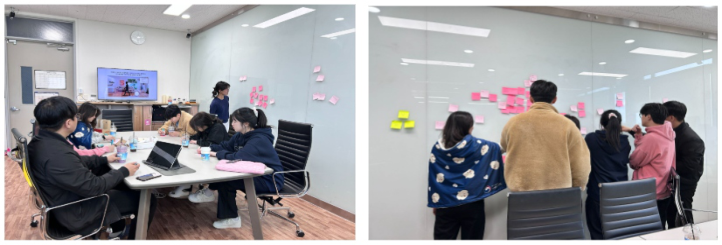
Figure 1: Ideation session.
Types of Interaction-Based Information Conveyed Through LED-Based Robot Expressions 73
1. Introduction & Briefing: Participants were introduced to the objective of the study and given an overview of design constraints, LED design factors (On/Off, Intensity, Rhythm, Color), and their possible applications. 2. Idea Generation: Participants individually wrote down different information on the sticky notes that they believed could be effectively expressed using LEDs. 3. Group Discussion & Refinement: Participants shared their ideas as a group, designing LED-based expressions and discussing the feasibility and clarity of each LED-based expression considering how different design factors could be applied.
Data Analysis: To systematically analyse the relationship between LED- based expressions and information types, we did data analysis focusing on single-color LEDs. Therefore, information that required color as a design factor was excluded from the analysis. The collected data were categorized based on the design rationale provided by the participants. For instance, information such as ‘humming’, ‘good morning’, and ‘dancing’ were classified into ‘soundwave type’ as they tried to visualize the vocal soundwave with LEDs. The number of LEDs used and the design factors applied in LED-based expression design process were labelled also.
To measure the number of information we used ‘bit’, a unit for measuring information. For example, if a single LED has two states, on and off, the total number of possible states is 21, meaning that a single LED stores 1 bit of information. In general, N such devices can store N bits, since the total number of possible states is 2N and log22N = N (Shannon, 1948).
RESULT
Information types: An ideation process provided valuable insights into how participants intuitively associate LED patterns with different types of information and helped form the foundation for analysing user perception of LED-based expressions. The identified information types and their corresponding design factors are summarized in Table 1 (see Appendix 1). There were in total 11 types of information.
DISCUSSION & CONCLUSION Patterns found in designing LED-based expressions: The study highlights how different LED design factors contribute to various information types. We found out that the same combination of LED design factors was consistently used within each information type to design LED-based expressions. This indicates that humans tend to relate a specific element of information to a specific design factor of LED, thus leveraging the possibility of framework development of the LED-based expression design.
74 Kim and Kim
Relationship between the number of information and the number of LEDs: There were two cases: 1) the LED expression design that conveyed the same number of bits as the number of LED diodes utilized, 2) the design that didn’t. When the number of bits in the information matched the number of LEDs used in expression design, we interpreted this case as the participants perceived the conveyed information in terms of individual bits. Conversely, when the number of bits did not align with the number of LEDs, the information was interpreted as a ‘chunk’, rather than a discrete unit. For example, in ‘gesture type’, the designed LED expression of ‘typing with user’ mimicked the gesture of a user typing. In this case, two LEDs corresponded to each hand, allowing one bit of information to be assigned per hand. This indicates that the number of LEDs directly represents the bit-level structure of the information. On the other hand, ‘amount type’ demonstrated a different pattern. For instance, ‘water intake’ represents the amount of water consumed by the user throughout the day. Let’s say there are four possible states, None/Less/Some/Much, and of course we can encode this information into a binary format (e.g., ‘None/Less/- Some/Much’ as 00, 01, 10, and 11). It requires only 2 bits of information, so theoretically, only two LEDs are needed. However, the ideation results indicated that the participants did not perceive ‘amount type’ information in a strict bitwise manner. Instead, they inferred ‘amount’ based on the number of illuminated LEDs. For example, when expressing ‘some’, participants found it more intuitive to light up two out of three LEDs simultaneously, rather than turning on the LED on the right using a strict binary encoding approach.
Potential of ‘gesture type’ information: LED-based expressions alone may not always be sufficient to convey meaning without supplementary cues such as voice. However, within ‘gesture type’, certain expressions distinctly differed from other LED-based information, indicating the potential as a primary expression channel. This can be attributed to the fact that as the number of LEDs increases, the range of unique expressions also expands. The greater the number of LEDs, the more variations of LED expressions can be created, enabling clearer differentiation of expressions without relying on other cues. For further research, validation of these findings and the experiment with more participants are needed.
ACKNOWLEDGMENT
This work was supported by the 2025 Webasto Research Fund (Webasto Graduate student Paper Support Project) of UNIST (Ulsan National Institute of Science & Technology).
Types of Interaction-Based Information Conveyed Through LED-Based Robot Expressions 75
APPENDIX
Table 1: Information Types.
Table available in the original PDF paper.
Information On/Off Intensity Rhythm Color Examples Type 1 Notification ⃝ Timer, schedule reminder, message/call notification, medicine remainder 2 Mode ⃝ Speaking, listening 3 A/B ⃝ Agree/disagree, unpleasant warning, yes/no 4 Soundware ⃝ ⃝ Humming, dancing, mimicking the sound of the surroundings, good morning, good night 5 Amount ⃝ Noise level, brightness of the house, temperature of the house, money spent, energy consumption, water level of the humidifier, humidity, physical activity gauge, communication gauge, laugh gauge, water intake, sports game score, number of people in a room, time spent in a certain area, count down 6 Location ⃝ Searching the location of an object, following the movement of an object, location of the bus 7 Loading ⃝ Confused, concerning 8 Heartbeat ⃝ ⃝ Cozy, relaxed, interested, curious, excited, fluttering, sleepy 9 Gesture(1) ⃝ Typing a keyboard, excited, schedule reminder Gesture(2) ⃝ ⃝ Speaking, listening, cheerful 10 Gaze ⃝ ⃝ Reading a book 11 Weather(1) ⃝ Sunny Weather(2) ⃝ ⃝ Windy, rainy
REFERENCES
Csányi, V. & Kampis, G. (1988) ‘Can We Communicate with Aliens?’, in Marx, G.
(ed.) Bioastronomy — The Next Steps. Astrophysics and Space Science Library, vol. 144. Dordrecht: Springer, pp. 393–401. doi: 10.1007/978-94-009-2959- 3_37. Ekman, P. (1982) ‘Methods for measuring facial action’, in Scherer, K. R. & Ekman, P.
(eds.) Handbook of methods in nonverbal behavior research. Cambridge: Cambridge University Press, pp. 45–90. Hegel, F., Gieselmann, S., Peters, A., Holthaus, P. & Wrede, B. (2011) ‘Towards a typology of meaningful signals and cues in social robotics’, 2011 RO-MAN, Atlanta, GA, USA, pp. 72–78. doi: 10.1109/ROMAN.2011.6005246. Holthaus, P., Schulz, T., Lakatos, G. & Soma, R. (2023) ‘Communicative Robot
Signals: Presenting a New Typology for Human-Robot Interaction’, ArXiv. Available at: https://doi.org/10.1145/3568162.3578631. Kim, D. (2016) ‘Study on the Relationship between the Display and the Visibility of Human Being’, Journal of Cultural Product & Design, (44), pp. 13–22. doi: 10.18555/kicpd.2016.44.2.
76 Kim and Kim
Paik, B., Seok, H. & Kim, M. (2012) ‘A Study on Information Representation Using Light Expression Elements: Abstract Situation Information Representation Using LED’, Archives of Design Research, 25(1), pp. 207–218. Shannon, C. E. (1948) ‘A mathematical theory of communication’, The Bell System Technical Journal, 27(3), pp. 379–423. doi: 10.1002/j.1538– 7305.1948.tb01338.x.
LISTED IN THE AHFE DIGITAL BOOKSTORE CATALOGUE
Explore the complete digital volume
Interdisciplinary Practice in Industrial Design
Read this individual research paper free through the original publisher, or explore the full digital proceedings book.
ISBN 978-1-964867-59-5
Explore this ISBN in the AHFE Bookstore ↗Listed in the July 2026 bookstore catalogue; search by ISBN to confirm current availability · Digital book purchase optional