Wasim Alshammary (2025). Effects of Glove Type and Gender on Lateral (Key) Pinch Strength Performance. In: Physical Ergonomics and Human Factors. AHFE Open Access, vol. 185, pp. 137–142. https://doi.org/10.54941/ahfe1006474
Gloves are widely used in various industrial tasks, many of which involve fine motor functions such as finger/thumb pinching, gripping, and torque generation with wrist flexion. This study aimed to evaluate the effects of gender and glove type on key (lateral) pinch strength. Twenty healthy participants (10 males and 10 females) performed maximal lateral pinch efforts using a Baseline® mechanical pinch gauge. Each participant completed trials under five glove conditions: no gloves, latex, cotton, plastic, and chlorinated polyethylene (CPE). The study investigated how glove material and user gender influence hand performance in tasks requiring precision grip.
Gloves are one of the most widely used personal protective devices (PPEs) in the industrial, medical and laboratory environments. Its main function is to protect hands from various occupational hazards, including mechanical injuries, chemical exposure, extreme heat, biological pollution, and electrical contact (Dianat et al., 2012; Griffin, 1998). In recent decades, the development of glove materials and designs has expanded considerably, with variations in thickness, rigidity, pliability, and fit that can affect user performance and comfort (Yao et al., 2018).
Although gloves are crucial to safety, numerous studies indicate that their use can have a negative impact on manual performance. Wearing gloves reduces grip and grip strength, affecting touch, limiting motion, and increasing fatigue in repetitive tasks (Zare, 2021; Khanlari, 2023). These effects are due to the mechanical properties of the glove material, which may change the biomechanical functioning of the hand and the neuromuscular feedback. In particular, interference caused by resistance in glove manufacture and reduced sensory input can cause a measurable decrease in the maximum voluntary contraction (MVC) grip and compression strength, ranging from 5% to 30% depending on the type of glove and the conditions of the work (Rock, 2001; Mira, 1994).
Furthermore, individual factors such as the gender of the user can play an important role in varying performance when wearing gloves. Research has consistently shown that men have higher hand strength than women,
a difference due to physiological and anatomical changes including muscle mass and hormone effects (Nicolay et al., 2005; Massy-Westropp et al., 2011). However, the interaction between the type and gender of gloves in certain motor tasks, such as the lateral (key) pinch strength, remains underexplored.
With the increase in the reliance on PPE in various sectors, particularly after COVID-19, the need to understand how the type and demographics of the glove affect functional hand performance is more urgent than ever before. Although previous studies have investigated the ergonomic effects of glove use, some studies have systematically investigated the combined effects of glove materials and gender on lateral pinch strength, an important component of manual skills used in many workplace tasks.
This study investigates this gap by assessing the impact of the four commonly used glove types (latex, cotton, plastics and chlorinated polyethylene (CPE)) on lateral pinch strength of men and women. Through controlled testing and statistical analysis, the research aims to provide evidence-based recommendations for the selection of gloves that optimize both the safety and performance of hands in the real world.
METHODOLOGY OF THE STUDY Participants: Twenty healthy college students (10 men and 10 women) in their early 20s (average age 21) voluntarily participated in the study. Eligibility criteria included the absence of any symptoms of musculoskeletal disorders, wrist pathologies or visual impairments of the upper limbs. Participants also had to maintain the eye-hand coordination, walk independently and take the right-hand. Before signing up, all individuals will receive detailed explanations of the objectives, procedures and potential risks of the study. Participation was entirely voluntary and each participant received written informed consent under the ethical principles of the Helsinki Declaration. Participants are assured of their right to withdraw from the study at any time without any consequences.
Procedure: Participants were asked to perform maximum effort trials for each task using their self-reported dominant hand (latex, cotton, plastics, and CPE gloves without gloves). It is a total of five trials per subject, randomized in order. Between the trials, a rest period of 10 minutes was provided. Data collection for each trial lasted 5 seconds. In order to study the rate of development of force, the subject is asked to begin with a relaxed initial state, develop the maximum force as quickly as possible, and maintain it. However, the time of reaction should not be reduced, the emphasis should be on maximum strength and the rate of development of the force. The pinch strength is measured by mechanical pinch gauges (30 lb capacity) from Baseline® pinch gauges. Each participant completed a test under each glove condition. The standard 10 minute rest interval is provided between the tests to reduce the effects of fatigue. The order of glove conditions for each participant is randomized to minimize possible order effects and improve the validity of the results.
Effects of Glove Type and Gender on Lateral (Key) Pinch Strength Performance 139
All tasks are carried out from the position of standing. The arm is fully extended anteriorly and the shoulder is 90
rotating, and the hand is in a lateral pull (key grip) posture. Gloves: Participants first carried out the first test without gloves. Four different types of gloves were then selected for the study, representing the range of materials and thicknesses commonly used in the industrial environment. 1-The first type is latex gloves, a disposable, multifunctional and tactilely sensitive rubber glove, which is commonly used in medical settings, free of powder. The second type used is cotton work gloves, which provide basic hand protection and are often used by technicians for tasks involving sensitive or sensitive objects. The third type consists of plastic disposable gloves (11.2 mm 9.8 mm), transparent, one size fits all, suitable for various hand sizes. 4-Lastly, CPE gloves (Cast Polyethylene), powder-free, CPE gloves (Cast Polyethylene), powder-free Commonly used in medical care for general patient care and examination. All types of gloves tested were medium-sized (M) to ensure consistency under all conditions.
RESULT AND DISCUSSION
Data analysis: The collected data are analysed by descriptive statistics, including mean and standard deviations, to summarize the force of the pinch under all conditions. To assess the effects of glove type and gender on pinch strength, the repeated measurement variance analysis (ANOVA) was conducted. If significant main effects or interactions are observed, we conduct post-hoc pairs comparisons with appropriate corrections (e.g. Bonferroni) to determine specific differences between gloves.
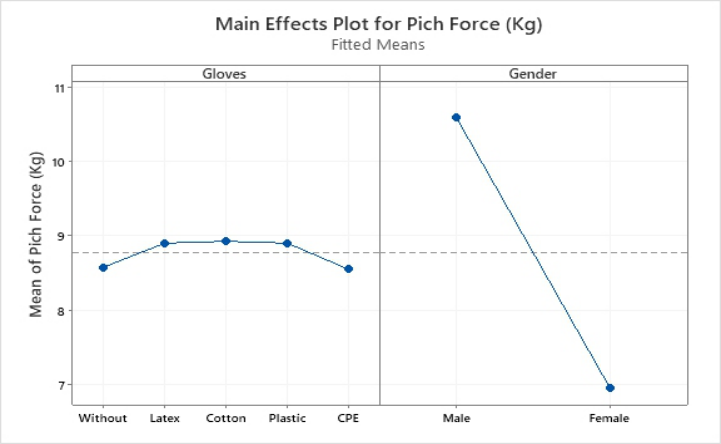
Results: A repeated measurement analysis of variance (ANOVA) was conducted to explore the effects of glove type and gender on pinch strength. The overall model is statistically significant (F (9,90) = 11.55, p.001), and the included variables explain a substantial proportion of the variance in the pinch strength (53.59 percent of the total variation). The linear component account for 52,29 percent of the variation and was statistically significant at F (5,90) = 20,32, p.001. In individual predictors, gender emerged as a very important factor, with F (1,90) = 100,82, p.001 contributing to 51,94% of variance. This result indicates a strong and consistent gender effect on pinch strength performance.
In contrast, the glove type had no statistically significant effect on the force of the pinch (F (4,90), 0.22, p = .927, and contributed only 0.45 per cent of the variation. This shows that variations in glove materials (latex, cotton, plastics, or CPE) do not significantly affect performance in this task.
The interaction between the glove type and pinch strength does not have statistical significance, F (4,90) = 0.58, p = .678, and contributes 1.20% of the variance. This suggests that the relationship between the type of glove and the strength of the pinch is not moderated by gender. The residual term (error) accounts for 46.41 per cent of the total variation, indicating that almost half of the pinch strength variation is due to factors that are not included in the model.
140 Alshammary
Table 1: Function table of analysis of variance (ANOVA).
The current study is aimed at evaluating the effect of different types of gloves and genders on the performance of the pinch strength using standardized mechanical pinch measuring tools. The results showed that gender had a significant and consistent impact on the resistance force, while male participants showed significantly higher values than female participants, as shown in Figure 1. This finding coincides with previous literature, which attributes these differences to anatomical and physiological factors such as increased muscle mass, cross-sectional area of tendon, and neuromuscular efficiency generally observed in males It is interesting to note that the glove type did not have a statistically significant impact on the force of the pinch. Despite testing four different glove materials (latex, cotton, plastics and CPEs) of the same size (M), the performance of participants remained consistent under conditions. This suggests that glove materials, at least in the tested types, do not significantly interfere with fine motor control or tactile feedback during pinching tasks. These results may have practical applications in the field or in the clinical
Effects of Glove Type and Gender on Lateral (Key) Pinch Strength Performance 141
environment, and indicate that workers can use different types of gloves without compromising the accuracy of their grips in tasks that involve pinch movements.
Furthermore, the interaction between the type of gloves and the gender was not significant, indicating that the effects of gloves on the strength of the pin were consistent between male and female participants. The relatively high percentage of unresolved differences (46.41%) suggests that other factors such as hand size, finger length, fatigue, and common gloves may contribute to individual differences and require further investigations.
CONCLUSION
This study provides evidence that gender has a significant impact on pinch strength, with males showing higher performance than females. However, the type of glove you wear (latex, cotton, plastic or CPE) does not significantly change the outcome of pressure resistance. These results show that glove material cannot be a limiting factor for tasks requiring precise handling, particularly in health care, manufacturing, and laboratory environments where glove use is compulsory. Further research is recommended to address the overall findings and explore other variables that influence hand performance, including a wide range of glove sizes, materials, and task complexity.
ACKNOWLEDGMENT
The author wishes to thank Al Yamamah University for the continuous support and resources that have enabled this research. Special thanks also go to the students who participated in the study, who were very involved and cooperative in the success of the work.
REFERENCES
Dianat, I., Haslegrave, C. M., & Stedmon, A. W. (2012). Methodology for evaluating gloves in relation to the effects on hand performance capabilities: A literature review. Ergonomics, 55(11), 1429–1451. Griffin, Michael J. Handbook of human vibration. Academic press, 2012. Khanlari, P., Ghasemi, F., & Heidarimoghdam, R. (2023). Protective gloves, hand
grip strength, and dexterity tests: A comprehensive study. Heliyon, 9(2). Mital, A., Kuo, T. S. U. A. N. G., & Faard, H. F. (1994). A quantitative evaluation of gloves used with non-powered hand tools in routine maintenance tasks. Ergonomics, 37(2), 333–343. N. Massy-Westropp, T. K. Gill, A. W. Taylor, R. W. Bohannon, and C. L. Hill, “Hand
grip strength: Age and gender stratified normative data in a population-based study,” BMC Res. Notes, vol. 4, pp. 127, 2011 Nicolay, C. W., & Walker, A. L. (2005). Grip strength and endurance: Influences of anthropometric variation, hand dominance, and gender. International journal of industrial ergonomics, 35(7), 605–618. Rock, K. M., Mikat, R. P., & Foster, C. (2001). The effects of gloves on grip strength
and three-point pinch. Journal of Hand Therapy, 14(4), 286–290.
142 Alshammary
Yao, Y., Rakheja, S., Gauvin, C., Marcotte, P., & Hamouda, K. (2018). Evaluation of effects of anti-vibration gloves on manual dexterity. Ergonomics, 61(11), 1530– 1544. https://doi.org/10.1080/00140139.2018.1497208 Zare Bidoki, F., Ezazshahabi, N., Mousazadegan, F., & Latifi, M. (2021). An
Overview of Protective Gloves with Regards to Hand Performance and the Evaluation Methods. Journal of Textiles and Polymers, 9(3), 3–20.
LISTED IN THE AHFE DIGITAL BOOKSTORE CATALOGUE
Explore the complete digital volume
Physical Ergonomics and Human Factors
Read this individual research paper free through the original publisher, or explore the full digital proceedings book.
ISBN 978-1-964867-61-8
Explore this ISBN in the AHFE Bookstore ↗Listed in the July 2026 bookstore catalogue; search by ISBN to confirm current availability · Digital book purchase optional