Ainslie Scott, Quazi Zaman (2025). Effects of the Global Pandemic on indoor air quality in dental surgeries: Evaluating practical alternatives to current guidelines and regulations in Scotland. In: Physical Ergonomics and Human Factors. AHFE Open Access, vol. 185, pp. 19–28. https://doi.org/10.54941/ahfe1006460
Publisher statistics will load when you open Metrics.
AHFE OPEN ACCESS OPEN ACCESS CONFERENCE PROCEEDINGS PAPER
Effects of the Global Pandemic on indoor air quality in dental surgeries: Evaluating practical alternatives to current guidelines and regulations in Scotland.
The COVID-19 pandemic focused attention on the role of ventilation on improving indoor air quality to mitigate against the risk of spread of infection. The aim of this study was to evaluate the effectiveness of increased ventilation and explore an alternative solution for improving indoor air quality to mitigate the risk of airborne infection in dental surgeries. Dental surgeries present a specific risk of airborne infection due to the bio-aerosols generated by high-speed dental instruments such as drills and air-water syringes. Studies show that particulate matter, volatile organic compounds, and carbon dioxide levels often exceed recommended thresholds during dental procedures, contributing to poor indoor air quality and increased health risks. To mitigate these risks, regulatory bodies recommended increasing air changes per hour to 10-12 in dental surgeries. Implementing such systems poses significant physical, financial, and regulatory challenges, alongside ongoing high energy consumption costs. The study evaluated the rapid changes to the requirements and guidance to avoid the risk of airborne infections in dental surgeries during the COVID-19 pandemic. A prototype for an at-source aerosol extraction device was developed and tested in a live dental surgery using an air quality monitor to determine if it could effectively remove aerosols at-source. The prototype was an articulated hose with nozzle positioned close to the patient’s mouth and connected to the existing surgery suction pump, which aspirates fluid during dental procedures. Air quality was monitored in the dental surgery during similar aerosol-generating procedures with 10 air changes an hour and then using the aerosol extraction device. The test results indicated that this alternative strategy performed better than providing 10 air changes an hour with the average of particulate matter of 1µg, 2.5µg, 4µg and 10µg recording an average concentration of 0.19mg/m3 compared to 0.33mg/m3 when using 10 air changes per hour. These results demonstrate that an at-source extraction device could provide a viable alternative to high ventilation strategies. In conclusion, this study demonstrates that an at-source extraction device could mitigate against airborne infections in a cost-effective and energy efficient manner. Further testing, including larger sample size and computational fluid dynamics modelling, is needed to refine the design and assess its applicability across different dental settings. This research provides an opportunity for revising existing guidelines and explore alternative indoor air quality management solutions that ensure both practitioner and patient safety.
Dentistry is potentially one of the workplaces with the greatest risk of transmission of infections due to the use of high-speed rotary equipment and air-water syringes during dental treatment which can generate ‘bio-aerosols’. Bio-aerosols are airborne biological materials that can contain bacterial cells, fungal spores, fungal hyphae and viruses.
In the dental surgery, bio-aerosols are produced due to bodily fluids being present. Therefore, there is an increased risk of the spread of infectious diseases (Raghunath, 2016). The dental community is aware of the risk of airborne infection, and its members implement a comprehensive regime of cross infection control procedures to minimise risks. Polednik reports that during treatment, sub-micrometre Particulate Matter of 1.0µm (PM1) particles and super micrometre PM>1 particle rose by a factor of 3.8 and 6.5, respectively, which is alarmingly 15.9 and 19.5 times higher than the outdoor average, which can cause respiratory illness (Polednik, 2021).
The Scottish Dental Clinical Effectiveness Programme has recommended ten air changes per hour (ACH) in treatment rooms is required as per the Scottish Health Planning Note 36 (Part 2 NHS Dental Services in Scotland) to remove any residual aerosol not eliminated by suction (Scottish Dental Clinical Effectiveness Programme, 25 January 2021).
The research aims to review and establish the risk of transmission of airborne pathogens and identify the long-term implications of implementing 10 ACH in dental practices and identify an alternative mechanism for improving Indoor Air Quality (IAQ) rather than implementing whole room ventilation with high ACH.
RISK OF AIRBORNE INFECTIONS AND VIRUSES IN DENTAL SURGERIES Implementing ten ACH will be expensive or impractical for many dental practices due to the premises’ physical constraints. High energy consumption is likely to result from high ACH as well as allowing the bio-aerosol to disperse throughout the entire space and settle on work surfaces, increasing cross-contamination risk.
A survey was conducted to assess the needs, requirements and limitations of dental professionals in relation to whole room ventilation. Results were obtained from 115 dental workers. The results showed that dentists were concerned about the cost of installation (23%), noise (21%), room temperature (18%), and maintenance costs (18%).
PM behaviour is predominantly affected by their aerodynamic diameter, with aerosols remaining airborne indefinitely (Fennelly, 2020). Aerosols behave like gas and follow the airflow patterns, whereas large particles fall to a surface (Polednik, 2021). As small particles can remain airborne indefinitely, the risk of infection is higher due to the prolonged exposure time (Pan, Lednicky, & Wu, 2019).
Oral procedures carried out by healthcare workers expose them to aerosol plumes (Fennelly, 2020) and ‘splatter’ (Raghunath, Meenakshi, Sreeshyla, & Priyanka, 2016). A study conducted by Polednik (2021) found that the
Effects of the Global Pandemic on Indoor Air Quality in Dental Surgeries 21
aerosol and bio-aerosol concentrations during dental treatment increased PM of all sizes. It was found that PM1 concentration increased by 3.8 times and PM>1 increased by 6.5 times. These studies also identified that bacterial concentrations increased by 2.1 times and fungi by 1.7 times (Polednik, 2021). Dental treatment can produce aerosols due to using high-speed drills, ultrasonic scalers and air and water syringes. These aerosols can combine with saliva, blood, microorganisms or viral particles present in the mouth to create bio-aerosols (Nulty, Lefkaditis, Zachrisson, Tonder, & Yar, 2020).
The close working proximity that is inherent to dentistry has led to dentistry being reclassified by the United States Occupational Safety and Health Administration as a very high-risk profession concerning the transmission of disease following the outbreak of SARS-CoV-2 (Nulty, Lefkaditis, Zachrisson, Tonder, & Yar, 2020).
In a study, comparing 50 dentists to a control group of 50 people of equivalent age and gender, it was found that despite wearing masks and eye protection, dentists had significantly elevated antibodies to both tested types of influenza and respiratory syncytial virus and slightly increased antibodies to adenoviruses. The study concluded that there exists an occupational risk to dental workers from respiratory tract viruses (Davies, Herbert, Westmoreland, & Bagg, 1994).
Ventilation as a Mitigation Against Airborne Infection High ACH combined with air filtration can dilute the concentration of airborne contaminants however, guidelines have been produced assuming perfect mixing of all the air (Cole & Cook, 1998). Indoor airflow tends to be turbulent, which has the greatest influence over airflow (Vuorinen, et al., 2020). It is suggested that providing a short and uninterrupted path between the contaminant and the exhaust has a significant effect on reducing the risk of the spread of Healthcare Acquired Infections (HAI) (Memarzadeh & Xu, 2012). It has been shown that there is an increase of 40% of particle concentrations in the pathway between source and extraction (Mousavi & Grosskopf, 2015).
Increasing ACH does not consequently diminish the risk of infection, however it can inadvertently increase the risk depending on positioning (Bolashikov, Melikov, Kierate, Popiolek, & Brand, 2012). Cetin et al. observed an optimum ACH rate to remove contaminants from a space is 5.76ACH above which there is little benefit in increasing airflow (Cetin, Avci, & O., 2019).
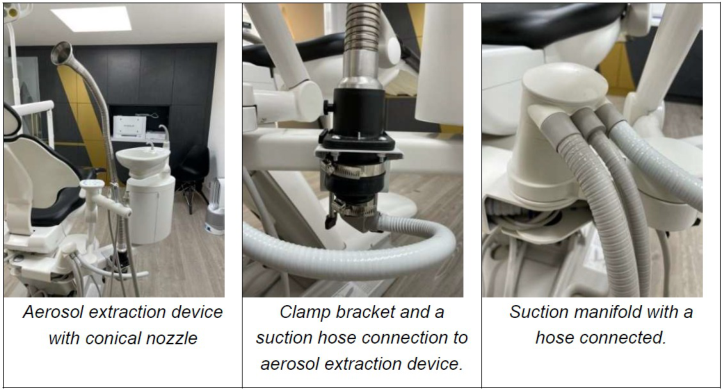
DESIGN DEVELOPMENT OF AEROSOL EXTRACTION DEVICE An aerosol extraction device was designed to mimic industrial local exhaust ventilation (LEV); which connects to the existing high-volume suction pump utilised in dental surgeries to aspirate fluids and aerosols from the patient’s mouth. The proposed aerosol extraction device referred to the HSE document ‘Controlling airborne contaminants at work: A guide to local exhaust ventilation (Health and Safety Executive, 2012)’ for the positioning, airflow and nozzle design.
22 Scottp and Zaman
The proposal is to capture aerosols and bio-aerosols that are escaping the patient’s mouth after the use of high-volume suction (Nulty, Lefkaditis, Zachrisson, Tonder, & Yar, 2020). The positioning of the LEV needs to be within the ‘capture zone’, which previous studies have shown to be approximately 300mm from the patient’s mouth (Nulty, Lefkaditis, Zachrisson, Tonder, & Yar, 2020).
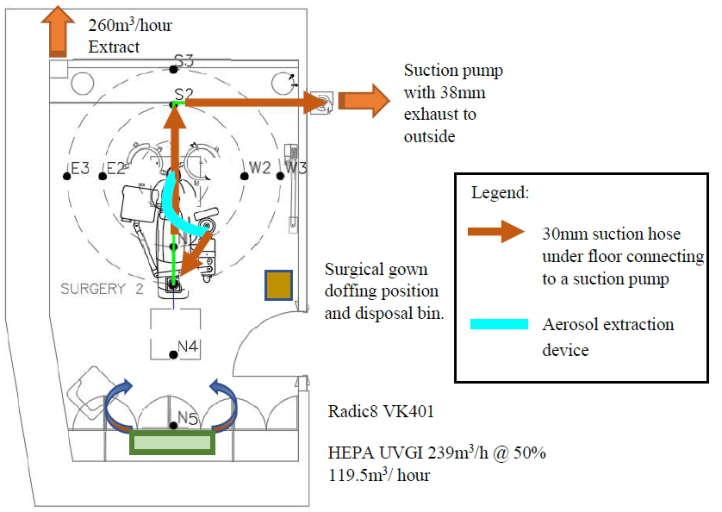
Figure 1: Aerosol extraction device prototype photos.Figure 2: Surgery layout and air quality sampling positions.
Effects of the Global Pandemic on Indoor Air Quality in Dental Surgeries 23
The suction pump exhausts to the outside or occasionally through a HEPA filter. The proposal is to attach an articulated, self-supporting directional hose and nozzle positioned above the patient’s mouth during dental treatment. The nozzle is positioned to draw aerosols away from the dental workers minimising their exposure to potential contamination. By collecting aerosols and bio-aerosols at the source, it may be possible to lower contamination of surfaces.
Experimental Details The testing site is in a dental practice located in the city centre of Aberdeen, Scotland. The test surgery is on the first floor of a two-storey, end-terrace property adjacent to a crossroad with moderate city traffic. The surgery has no opening windows but has two fixed domed roof lights.
Testing of PM concentration was conducted using a calibrated and certified DustTrak DRX handheld aerosol Monitor 8534, with built in fan and laser sensor. The monitor was mounted at breathing height for seated dental workers, 1300mm above floor level, and recorded concentration of mg/m3 for PM1.0, PM2.5, PM4, PM10, every two seconds.
Sampling was taken with the existing ventilation strategy, which accomplishes ten ACH using a mix of extraction and Radic8, UVGI air filtration, allowing a benchmark to be established against which the aerosol extraction device could be compared effectiveness.
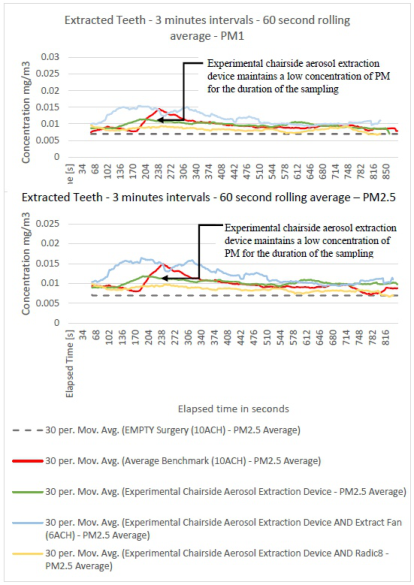
Figure 3 details the average PM concentrations sampled during drilling on extracted teeth with 3-minute intervals of high-speed drilling, break, slow-speed drilling, and a 3-minute break. During all the samples, a dental high-volume suction (HVS) was used. The benchmark of ten air changes per hour averaged a total PM concentration of 0.018 mg/m3, where the average of the aerosol extraction device was lower at 0.017 mg/m3. The graph demonstrates that the aerosol extraction device maintains a more stable level of PM concentration whilst the benchmark of ten air changes per hour provides increased fluctuations, particularly during high-speed drilling. Combining the aerosol extraction device with the room extract fan increases the PM concentration, possibly due to increased turbulence in the surgery.
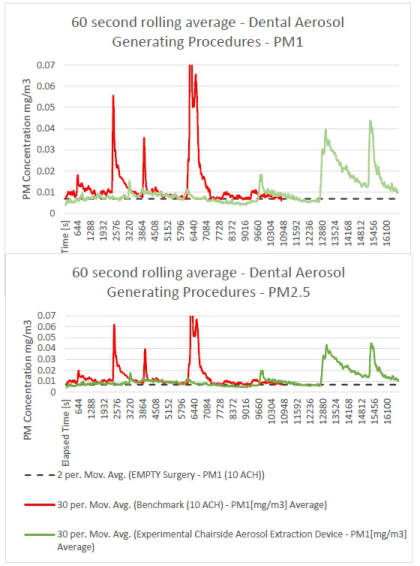
Figure 4 presents the air sampling undertaken during live aerosol- generating dental treatment. The red line provides a benchmark for such treatment with the equivalent of ten ACH implemented during treatment. The red line fluctuates significantly through the duration of the dental appointment. It is particularly noticeable during high-speed drilling, polishing and shaping of temporary crowns.
The green line that represents the use of the aerosol extraction unit remains relatively constant for most of the appointment except shaping of temporary crown shaping. For PM1 and PM2.5, the aerosol extraction device maintained a level below 0.01mg/m3 only briefly exceeded this level for PM4. The average benchmark PM concentration with 10 ACH was recorded as 0.033 mg/m3, with the average experimental aerosol extraction device readings being 0.02 mg/m3.
The procedure which causes the greatest increase in PM concentrations is the shaping of temporary crowns. Whilst the shaping of temporary crowns
24 Scottp and Zaman
often takes place outside of a patient’s mouth and therefore reduces the risk of bio-aerosol creation, it is worth noting that increased PM concentration can cause other health conditions such as inflammation of the lungs.
Air sampling was also undertaken during live oral hygiene treatment when the ultrasonic scaler was used. With ten ACH, PM concentration was recorded as 0.019 mg/m3, and an average of 0.021mg/m3 using the aerosol extraction device.
The aerosol extraction device unit generally maintained the concentration of particulate matter of any size at a constant low level for the duration of procedures. The data presented demonstrates that 10 ACH is generally less effective than providing air extraction at the source except for oral hygiene treatment.
Figure 3: Air sampling - 3 minutes interval drilling on extracted teeth - PM1& PM2.5.
Observations The dental workers’ removal of surgical gowns that are worn during aerosol- generating procedures, a process known as ‘doffing’, created an increase of particulate matter of all recorded sizes at the end of treatment. A doffing station adjacent to the extraction would exhaust PM from the space quicker.
The aspiration power was reduced to approximately 82% (5.9m/s to 4.8m/s) when the aerosol extraction unit was used. Conversely, the aerosol
Effects of the Global Pandemic on Indoor Air Quality in Dental Surgeries 25
extraction reduced during the use of the aspirator and returned to full power when the aspirator was switched off. The aspirator is used for approximately 33% of the appointment time during an aerosol-generating procedure. To provide the optimum power split, the valve on the aerosol extraction unit was opened to 50% of its full opening position.
Figure 4: Average air sampling during aerosol-generating dental procedures - PM1 & PM2.5.
During oral hygiene treatment, whole room ventilation performed better than the at-source extraction method. This may be due to the aspirator being used for the entire treatment time and therefore the at-source extraction power was reduced for a longer time. The splatter distribution pattern may also be more widespread because of the vibrations of the instruments and therefore a different shaped nozzle may improve the capture of aerosols. An expanded study including computational fluid dynamic modelling would help provide a clearer picture of why the at-source device was not as effective as 10 ACH during oral hygiene treatment.
CONCLUSION
This paper pays specific attention to the role of ventilation on improving indoor air quality in dental surgeries to mitigate against the risk of spread of infection and explore an alternative solution for improving indoor air quality.
Increased whole room ventilation does not necessarily address the problem of airborne infections. It has been found in some studies that a high air
26 Scottp and Zaman
change rates can exacerbate the problem with the pollution gathering around occupants and objects due to the turbulence being produced from high air velocity. Removal of contaminants should be by a short, direct, uninterrupted path. By removing contaminants at the source, less air needs to be captured and extracted to maintain a safe working environment. This approach to managing the risk of airborne infection also reduces the heat loss that can be experienced and consequently reduce energy consumption.
The design solution provided a chairside aerosol extraction device that could be positioned close to the patient’s mouth, allowing the aerosols and bio-aerosols to be removed close to the source with an uninterrupted airflow path. The consequence of removing aerosol at the source is that it reduces the risk of aerosol dispersing across the entire surgery.
Whilst the at-source extraction device has demonstrated its effectiveness to remove contamination; it is important to consider that no one approach will provide the optimum solution. Therefore, there should be layers of mitigations. The sampling taken during drilling on extracted teeth identified that the aerosol extraction device combined with the Radic8 and high-volume suction significantly improved the air quality in the dental surgery.
ACKNOWLEDGMENT
The author would like to acknowledge the contribution by Dr. Quazi Zaman and Dr. Taimoor Asim of the Robert Gordon University, Aberdeen. The author would also like to thank Anna Kelman for her assistance.
REFERENCES
Bolashikov, Z. D., Melikov, A. K., Kierate, W., Popiolek, Z., & Brand, M. (2012).
Exposure of health care workers and occupants to coughed airborne pathogens in a double-bed hospital patient room with overhead mixing ventilation. HVAC&R Research, 18(4), 602–615. doi: 10.1080/10789669.2012.682692. Cetin, Y., Avci, M., & O., A. (2019). Evaluation of air change rates for estimating particle dispersion on a reduced scale model. IOP conference series: Materials Science and Engineering, 609(3). doi: https://doi.org/10.1088/1757-899X/609/3/ 032019. Cole, E. C., & Cook, C. E. (1998). Charaterization of infectious aerosols in health
care facilities: An aid to effective engineering controls and preventive strategies. American Journal of Infection Control, 26(4), 453–464. doi: https://doi.org/ 10.1016/S0196-6553(98)70046-X. College of General Dentistry and FGDP. (2020). Implications of COVID-19 for the safe management of general dental practice - A practical guide: Version 2. London: College of General Dentistry and Faculty of General Dental Practice (UK) 2020. Retrieved from https://www.fgdp.org.uk/sites/fgdp.org.uk/files/editors/ FGDP%20CGDent%20Implications%20of%20COVID-19%20for%20the%20 safe%20management%20of%20general%20dental%20practice%202%20 Oct ober%202020%20v2.pdf. Comunian, S., Dongo, D., Milani, C., & Palestini, P. (2020). Air Pollution and
COVID-19: The Role of Particulate Matter in the Spread and Increase of COVID- 19’s Morbidity and Mortality. International Journal of Environmental Research and Public Health, 17(12). doi: 10.3390/ijerph17124487.
Effects of the Global Pandemic on Indoor Air Quality in Dental Surgeries 27
Davies, K., Herbert, A., Westmoreland, D., & Bagg, J. (1994). Seroepidemiological study of respiratory virus infections among dental surgeons. British Dental Journal, 176(7), 262–265. doi: 10.1038/sj.bdj.4808430. Fennelly, K. P. (2020). Particle size of infectious aerosols: Implications for infection
control. Lancet Respiratory Medicine, 8(9), 914–924. Gralton, J., Tovey, E., McLaws, M., & Rawlinson, W. (2013). Respiratory virus RNA is detectable in airborne and droplet particles. Journal of Medical Virology, 85(12), 2151–2159. doi: https://doi-org.ezproxy.rgu.ac.uk/10.1002/jmv.23698. Harrel, S. K., & Molinari, J. (2004). Aerosols and splatter in dentistry: A brief review
of the literature and infection control implications. Journal of American Dentistry Association, 135, 429–437. Health and Safety Executive. (2012). Controlling airborne contaminants at work: A guide to local exhaust ventilation (LEV). Retrieved March 01, 2021, from https:// www.hse.gov.uk/pUbns/priced/hsg258.pdf. Helmis, C., Tzoutzas, J., Flocas, H., Halios, C., Stathopoulou, O., Assimakopoulos,
V.,... Adam, E. (2007). Indoor air quality in a dentistry clinic. Science of the Total Environment, 377, 349–365. doi: 10.1016/j.scitotenv.2007.01.100. Kakr, D. A. (2020). Prevention of cross-contamination in dental clincs: Practical suggestions from Dr Ajay Kakr. Dental Tribune South Asia. Retrieved from https://in.dental-tribune.com/news/prevention-of-cross-contamination-in-dental- clinics-practical-suggestions-from-dr-ajay-kakar/. Kukadia, V., & Upton, S. (2019, March). Ensuring good indoor air quality in
buildings. Retrieved February 5, 2021, from https://www.bregroup.com/bretrust/ wp-content/uploads/sites/12/2019/03/Ensuring-Good-IAQ-in-Buildings-Trust- report_compressed-2.pdf. Li, Y., & Zhao, B. (2012). Application of building simulation tools for studying airborne infection and its control. Building Simulation, 5(1), 3–4. doi: https:// doi-org.ezproxy.rgu.ac.uk/10.1007/s12273-012-0072-9. Memarzadeh, F., & Xu, W. (2012). Role of air changes per hour (ACH) in possible
transmission of airborne infections. Building Simulation, 5(1), 15–28. doi: https:// doi.org/10.1007/s12273-011-0053-4. Mousavi, E., & Grosskopf. (2015). Ventilation Rates and Airflow Pathway in Patient Rooms: A Case Study of Bioaerosol Containment and Removal. The Annals of Occupational Hygiene, 59(9), 1190–1199. doi: 10.1093/annhyg/mev048. Nulty, A., Lefkaditis, C., Zachrisson, P., Tonder, Q. V., & Yar, R. (2020). A clinical
study measuring dental aerosols without a high-volume extraction device. British Dental Journal. doi: https://doi.org/10.1038/s41415-020-2274-3. Pan, M., Lednicky, J., & Wu, C.-Y. (2019). Collection, particle sizing and detection of airborne viruses. Journal of Applied Microbiology, 127(6), 1596–1611. Polednik, B. (2021). Exposure of staff to aerosols and bioaerosols in a dental office. Building and Environment (187). doi: https://doi.org/10.1016/ j.buildenv.2020.107388. Raghunath, A. (2016). Aerosols in Dental Practice - A Neglected Infectious Vector.
British Microbiology Research Journal, 14(2), 1–8. Raghunath, N., Meenakshi, S., Sreeshyla, N. S., & Priyanka, N. (2016). Aerosols in Dental Practice - A Neglected Infectious Vector. British Microbiology Research Journal, 14(2), 1–8. doi: 10.9734/BMRJ/2016/24101. Robles P. E., D. d., & Kramer, S. W. (2017). Improving Indoor Air Quality
Through The Use of Ultraviolet Technology In Commercial Buildings. Procedia Engineering, 196, 888–894. doi: https://doi.org/10.1016/j.proeng.2017.08.021.
28 Scottp and Zaman
Ryu, W.-S. (2017). Virus Structure. In Molecular Virology of Human Pathogenic Viruses (pp. 21–23). London: Elsevier. doi: https://doi.org/10.1016/B978-0-12- 800838-6.00028-X. Scottish Dental Clinical Effectiveness Programme. (25 January 2021). Mitigation of Aerosol Generating Procedures in Dentistry: A Rapid Review. Edinburgh: NHS Education for Scotland. Retrieved February 21, 2021, from https://www.sdcep.org.uk/wp-content/uploads/2021/01/ SDCEP-Mitigation-of-AGPs-in-Dentistry-Rapid-Review-v1.1.pdf. Vuorinen, V., Aarnio, M., Alava, M., Alopaeus, V., Atanasova, N., Auvinen, M.,...
Osterberg. (2020). Modelling aerosol transport and virus exposure with numerical simulations in relation to SARS-CoV-2 transmission by inhalation indoors. Safety Science, 130. doi: https://doi.org/10.1016/j.ssci.2020.104866.
LISTED IN THE AHFE DIGITAL BOOKSTORE CATALOGUE
Explore the complete digital volume
Physical Ergonomics and Human Factors
Read this individual research paper free through the original publisher, or explore the full digital proceedings book.
ISBN 978-1-964867-61-8
Explore this ISBN in the AHFE Bookstore ↗Listed in the July 2026 bookstore catalogue; search by ISBN to confirm current availability · Digital book purchase optional