Vanessa Tudor, Renate Motschnig (2025). Towards a Technology-Enhanced Team Coaching Framework for Higher Education. In: Human Interaction and Emerging Technologies (IHIET 2025). AHFE Open Access, vol. 197, pp. 357–367. https://doi.org/10.54941/ahfe1006728
In the landscape of computer science education, there is an increasing emphasis on collaborative problem-solving and adaptability. The incorporation of coaching methodologies into computer science courses holds the potential to foster students’ teamwork and professional competencies. In this paper a coaching framework which was piloted in a bachelor-level, course on project management and developed for a Human-Computer Interaction course at a European university will be presented. The framework combines person-centered coaching approaches, agile practices, visualizations, and support via interactions with generative AI tools to support team collaboration.The Person-Centered Approach focuses on the needs of an individual through transparency, active listening, and fostering the self-directed growth thus motivation while progressing in the project. Agile practices focus on collaboration, iterative progress and adaptive feedback cycles thus leveraging constructive communication within the team. Visualizations support transparency and understanding, and generative AI helps suggesting responses whenever technical, linguistic, or other support or ideas are needed. The integration of these four complementary assets into a unified framework aims to leverage the cultivation of key professional competencies, including communication, problem-solving, and adaptability in a time effective and inclusive way. A core component of the proposed coaching framework is the integration of emerging technologies like digital tools, smart online whiteboards and generative AI to facilitate collaboration. While whiteboards and visualization tools support keeping an overview, organization, brainstorming and task management, generative AI tools take on new roles in activities such as ideation, coding, and refinement of content. These tools allow students to engage more deeply with agile methodologies and the quality of their interaction and teamwork, in particular if supported by a mindful, person-centered coach. The outlook is that gradually course instructors who utilize the coaching framework would take on the role of coaches to accompany student teams in their self-determined, digitally empowered tasks.This paper presents the design and architecture of the framework, characteristic use cases in the context of the course on Human-Computer Interaction, the benefits as well as challenges of this innovative approach for students’ engagement, their project outcomes, their professional competencies development, and the potential implications for higher education. Preliminary findings suggest that integrating these coaching methods into computer science education not only improves teamwork but also prepares students for dynamic professional settings.
In today’s rapidly evolving academic and professional environments, the demand for computer science students to possess not only technical competencies but also effective collaboration, communication, and self- management skills has increased significantly.
In this regard, agile practices, reflective practices, and emerging digital tools like generative AI (genAI) present unprecedented promising opportunities for facilitating this development. However, the integration
of these practices and the development of competences to employ them effectively and responsibly in higher education means a major organization development step needing thoughtful, timely and proactive support (Brevik et al., 2019; Lam et al., 2022).
To address this challenge, this paper presents Co!Coach, a collaborative coaching framework designed and adapted over several semesters to assists student teams in achieving enhanced project outcomes while fostering (inter)personal growth. The framework integrates structured agile practices, visual methods for progress and ideation, AI tool usage, and a person- centered coaching philosophy. The primary aim of this paper is to introduce the framework, describe each of its components, and explore and analyze student teams’ initial application of its components in undergraduate computer science courses to gauche further refinement of the coCoach framework guided by Design Based Research (DBR). In this paper we answer the following research questions: RQ 1: Which benefits and potentials for improvement do students report when exposed to prototypical realizations of each of the four components of the Co!Coach framework?
RQ 2: Which benefits, and potentials for improvement does the coach derive from their first experience in coaching student teams using the initial concept of Co!Coach?
BACKGROUND AND THEORETICAL UNDERPINNING Agile Practices in Education
Agile methodologies, originally developed for Software Development, have been adapted for the use in higher educational settings. They support an iterative and incremental approach to project work, with a strong emphasis on continuous improvement. Their integration into the educational settings help students gain essential skills that are required by the industry (Neumann & Baumann, 2021). By applying agile practices students enhance their critical thinking, problem-solving, communication skills and overall team motivation (Al-Ratrout, 2019; Choque-Soto & Sosa-Jauregui, 2024). Moreover, they become better prepared for the demands of the professional world (Aggrawal & Magana, 2023; Dolezal & Motschnig, 2023).
Visualization and Management Tools Project management tools such as Trello, Asana, Jira and so on, help developers to plan their work which contributes to achieving the desired results (Özkan & Mishra, 2019). A project management tool has the functionality to plan, execute and monitor the project progress as well as time, cost and resources (Arya & Kulkarni, 2024). According to (Baul et al., 2024); project management tools help organization to save more money. Visualization tools need to be interactive and show data in real-time (Ali et al., 2016). Such tools are designed to improve teams’ communication, collaboration and they make communication easier and more transparent (Castro-Arquinigo et al., 2023). Collaborative tools such
Towards a Technology-Enhanced Team Coaching Framework for Higher Education 359
as online whiteboards, are particularly valuable in remote teaching sessions (Lam et al., 2022).
Person-Centered Coaching in Agile Education Coaching plays a crucial role in supporting students’ development of key professional skills such as communication, collaboration, critical thinking, and goal orientation (Gestwicki & McNely, 2016; Morales et al., 2017; Kinzel et al., 2015). Research has also shown that coaching can positively impact academic performance and student retention (Plotkowski & Joseph, 2011; Thomas et al., 2014; Morales et al., 2017). A particularly effective approach within educational coaching is the person-centered model, originally developed by the psychologist Carl Rogers. This meta-theoretical framework emphasizes the belief that individuals possess an inherent capacity for growth and self-actualization, which can flourish in a supportive environment where they feel unconditionally accepted (Joseph, 2006; Rogers, 1963).
In person-centered coaching, the coachee is positioned at the center of the developmental process, with an emphasis on autonomy, intrinsic motivation, and self-determination rather than external direction (Rogers, 1961). A trusting relationship between coach and coachee is essential. Coaching goals should be clearly defined and mutually agreed upon, enabling the coachee to actively shape their own journey (Van Zyl et al., 2016).
The Role of Generative Artificial Intelligence in Team Learning Generative Artificial Intelligence (genAI) has transformed traditional teaching by introducing innovative approaches that support students in developing professional skills such as teamwork (Amar & Benchouk, 2024), conflict management (Aggrawal & Magana, 2024), communication (Dai et al., 2024), and problem-solving (So et al., 2024). These tools offer students possibilities to enhance their motivation (Šumak et al., 2024), and receive personalized feedback (Ahmed et al., 2024) on their writing. GenAI tools, such as ChatGPT, are increasingly integrated into agile educational environments to support ideation, documentation, and conceptual exploration. These tools assist students in generating content, summarizing discussions, and exploring methodologies like Scrum or Kanban. Embedding AI tools into platforms like Miro or Mural enhances usability and collaborative learning.
METHODOLOGY
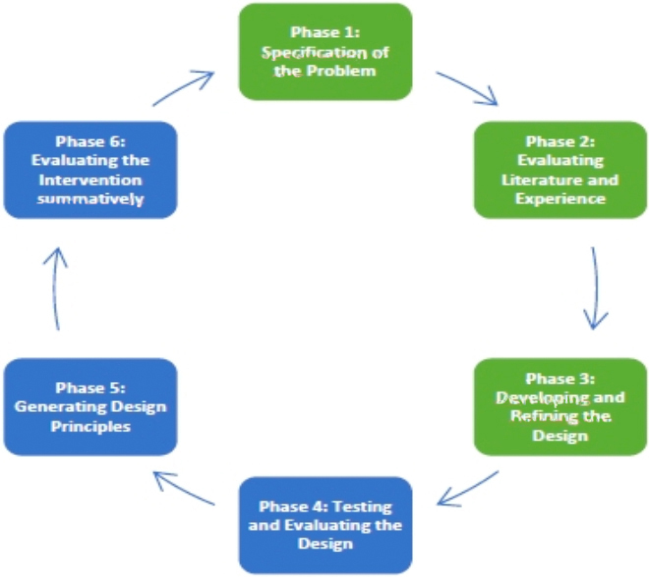
The research objective is to design and develop a coaching framework for undergraduate computer science students to enhance teamwork, communication, and professional competency development. The research follows design-based research (DBR) according to Euler’s approach (Euler, 2014) which is well-suited for exploratory, iterative and incremental development in an academic context. Figure 1 shows the phases of DBR as arranged in a cycle as suggested by Euler (Euler, 2014), whereby the current study followed the first three phases. The coaching framework was developed
360 Tudor and Motschnig
through an iterative, experience-based design process: For several semesters, part of the framework underwent refinement through its direct application in project-based learning environments, with feedback from students playing a pivotal role in this process (Tudor et al., 2024). Development activities included: 1) Focus groups with students from a project management course to identify common challenges in team collaboration and communication. 2) Team coaching sessions where person-centered coaching methods were piloted to support team development and individual growth. 3) Pre-surveys that explored student perspectives on why previous project teams struggled (Tudor et al., 2024). Overall, the DBR contributed to the theoretical and practical foundation of the Co!Coach framework.
Figure 1: Design-based research based on Euler (Euler, 2014, p. 20) (authors’ simplified visualization).
FINDINGS ALONG THE DBR CYCLE Phase 1: Specification of the Problem
The process began with the initial step involved to identify the need of a structured coaching framework to support higher education students in their teamwork projects. A problem analysis was done through a comprehensive literature review and observations of project-based teamwork. The review focused on 1) the application of agile methodologies in education, 2) the required professional competencies in modern work environment,
Towards a Technology-Enhanced Team Coaching Framework for Higher Education 361
3.) the usage of digital and AI-enhanced tools in collaborative learning, and 4) coaching approaches applicable to educational contexts. Surveys and feedback from students highlighted persistent challenges in team projects, such as poor communication, unequal workload distribution, and a general lack of planning and motivation of team members (Tudor et al., 2024). These findings presented the gap between students’ team experiences and the required demands of professional competencies, such as critical thinking, collaborative and communication skills, as well as the limited use of agile practices and coaching techniques in a university setting.
Phase 2: Evaluating Literature and Experience Based on insights from the literature review and prior team coaching sessions, a conceptual framework was developed that integrates agile elements such as retrospectives, the use of weeklies, work tracking in online task boards and coaching interventions into students’ teamwork projects.
In several coaching sessions, held both remotely and in person, student teams were supported in dealing with self-identified, yet broadly occurring challenges such as lack of workload management, communication, and planning. One team, for example, struggled to meet a milestone deadline due to a late start and poor distribution of work. In response, the coach introduced agile tools such as a Kanban board to help visualize the workflow, define due dates for individual tasks, and assign responsibilities more transparently. Weekly check-ins (“weeklies”) were introduced in the spirit of daily standups to introduce essential sharing, yet better-fit students’ schedules than daily meetings. These regular sessions helped the team reflect on their progress and identify what was still missing. By visualizing their tasks, the team gained a better understanding of their workload and improved their time management.
Another team independently decided to implement two fixed days per week for internal progress reviews, demonstrating increasing self- organization and responsibility. These interventions not only supported the teams in managing their projects more effectively but also provided valuable insights into how coaching and agile methods can be tailored to fit the needs of student teams. Building on these empirical observations, reflective practices, and experiences, a structured coaching framework, named Co!Coach (collaboration Coach) was developed.
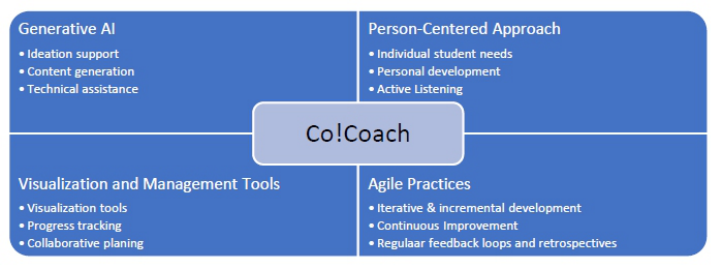
Figure 2 gives an overview of the Co!Coach framework, which comprises four core components: agile practices, person-centered coaching, visualization and management tools, and generative Artificial Intelligence tools. Each component includes a set of elements, such as tools, techniques, and practices, that are adjusted to boost students’ teamwork, communication, and professional competency development.
Phase 3: Developing and Refining the Design Core elements of each component of the Co!Coach framework were put into practice and evaluated with student teams over the course of three semesters, helping to respond to the first research question.
362 Tudor and Motschnig
Figure 2: Components of the coaching framework.
Agile practices were represented by the usage of kanban boards, which were used by student teams to visualize tasks and track the project’s progress. This helped work to be distributed equally and created transparency of what is still to be done. Students reported that they learned new tools and techniques through this process and found them helpful for organizing their teamwork more effectively.
In particular, the retrospective sessions stood out as a valuable tool for reflection. These sessions enabled teams to better understand the challenges they faced, explore root causes, and collaboratively develop strategies for improvement. Students highlighted that retrospectives contributed to building a more supportive team environment and helped them develop skills for giving and receiving constructive feedback.
Person-centered coaching was demonstrated by the coach’s emphasis on openness, active listening (Rogers & Farson, 1987), and communication at eye-level during coaching interventions. By creating a space of acceptance, respect and non-judgement students felt empowered to reflect on their teamwork and to identify obstacles, areas for improvement and to define actionable steps. This created a sense of ownership and helped resolve team conflicts or misunderstandings. Students reported that communication within their teams improved significantly as a result of the structured and empathic moderation provided during the coaching sessions. The guided conversations supported better alignment and contributed to a stronger team spirit over time. However, some students expressed a desire for more in-person coaching sessions, suggesting that face-to-face interaction could further strengthen team cohesion and trust.
In addition, several students had initially expected more topic-specific support, particularly related to project management. While this was not an explicit goal of the coaching role, it highlights the importance of clearly communicating the focus of coaching versus mentoring or technical advising. Going forward, one possible enhancement could be that coaches encourage students to use genAI tools to independently explore project management methods or domain-specific knowledge, thereby maintaining the coaching stance while still guiding students toward useful resources.
Towards a Technology-Enhanced Team Coaching Framework for Higher Education 363
Visualization and management tools such as Miro, facilitated collaboration in remote sessions as well as in person. Students noted that learning to use tools like Miro helped them make their work progress more visible and supported them in planning the tasks required for each milestone. This led to greater transparency and improved efficiency in task management across the team. One example was the incorporation of online whiteboards during retrospectives. Student feedback highlighted the positive impact of the retrospective sessions, which helped student teams to reflect on what went well and what didn’t go well to identify areas for improvement and to define concrete action items for the upcoming milestone. The implementation of such tools increased the collaborative environment in a remote session.
Generative AI tools were used by students for a variety of learning purposes, including clarifying terms and concepts, generating ideas, and improving their writing. They particularly appreciated the interactive nature of the tool, the immediacy of the feedback, and the innovative application of AI as a learning companion. Many highlighted how quickly and easily they could gain an initial understanding of new domains. At the same time, students noted concerns regarding the reliability of the responses and the risk of misinterpretation of their input, emphasizing the need for critical reflection.
Throughout the coaching period, qualitative and quantitative data was collected through student feedback, observations, focus groups, and surveys (Tudor et al., 2024). Students were invited to share their experience with the coaching process and the learned techniques as well as the usefulness of tools and practices and their perceived development of team-related competencies. Interview results indicated that students increasingly took ownership of task planning and appreciated having dedicated time for structured reflection and alignment.
Summarizing, the coaching succeeded in fostering self-organization, reflection, collaboration within student teams, and a constructive feedback culture. While RQ1 asking for the benefits, and potentials for improvement of Co!Coach’s components has been answered above, the response to RQ2 addressing the coach’ perceptions follow below.
The initial Co!Coach framework also provided valuable insights from the coach’s perspective. The coach (first author) observed that some team members naturally took on the roles of facilitator and moderator during remote and in-person meetings. Additionally, students who were initially shy at the beginning of the coaching interventions became more open after some time. There was also a noticeable shift towards more proactive behavior in terms of self-organization and shared ownership of tasks. The coach observed improvements in team dynamics, with team members identifying challenges or issues earlier in the project. They also reported needing support more regularly and proactively. Moreover, the coach noted the high level of productivity during a more structured session, where students were encouraged to use different creative tools and techniques. The teams generated ideas quickly and collaborated effectively throughout the process.
364 Tudor and Motschnig
One challenge that emerged was coordinating shared timeslots among team members. Additionally, students reported limited availability for coaching sessions due to the high volume of other commitments.
The next three phases of the DBR approach are going to be applied in upcoming semesters to systematically evaluate the effectiveness, usability and adaptability of the Co!Coach framework.
DISCUSSION
The initial application of the Co!Coach framework suggests that the integration of agile methods, person-centered coaching, digital visualization, and management tools, and genAI can significantly enhance students’ teamwork and self-organization in higher education project settings. Students reported improvements in communication, task planning, and reflection, while also developing soft skills such as leadership and a better feedback culture. These insights support prior research on the effectiveness of agile and coaching practices in education, while also contributing a novel integration of genAI in the coaching process while calling for critical reflection of this innovation.
From the coach’s perspective, the evolving group dynamics and increased proactivity of student teams indicate the potential for Co!Coach to support professional competency development in student projects.
However, several limitations emerged. First, some students expected more topic-specific guidance, such as project management support, which was outside the scope of the coaching role. This suggests the importance of clearly communicating the distinction between coaching, mentoring, and advising at the start. Second, the mix of in-person and remote sessions was well received, but students expressed a preference for more face-to-face interaction, highlighting the role of physical presence in building team trust and cohesion. Third, while generative AI tools were valued, concerns about reliability and misinterpretation indicate the need to further support critical digital literacy among students.
The study’s limitations include a relatively small sample size and its setting within a large European university, which may affect the generalizability of the findings to other cultural or institutional contexts. Additionally, the research focused only on the first three phases of the proposed cycle, leaving the later stages unexamined. These factors highlight the need for further studies with more diverse samples and a complete implementation of the framework.
CONCLUSION
This paper introduced Co!Coach, a coaching framework that integrates agile practices, visualization and management tools, AI-enhanced tools, and person-centered coaching to support undergraduate students’ team collaboration.
Iterative, formative evaluation of the concept following DBR showed several benefits, including improved team communication, better workload
Towards a Technology-Enhanced Team Coaching Framework for Higher Education 365
distribution, increased motivation, and the development of leadership skills. The use of digital tools including genAI fostered, in particular, transparency and proactive collaboration leading to students’ increased satisfaction and superior project outcome.
The coach also observed better team dynamics and an increase in students’ leadership skills. The structured sessions helped students tackle challenges early and engage proactively in their personal development. Further work is underway to overcome current limitations by exploring broader applications and refining the framework based on feedback, theory, and experience. The authors warmly welcome interested colleagues to join our endeavors in applying, refining, and evaluating the initial Co!Coach framewok and supporting students’ team projects, their qualification for professional work. as well as staff in maturing in their role as coaches.
ACKNOWLEDGMENT
The authors sincerely thank the course lecturers, participating students, and the Doctoral School of Computer Science (DoCS) for their support. Thanks are also due to Alejandra Magana and Sakhi Aggrawal for their thoughtful consultations.
REFERENCES
Aggrawal, S., & Magana, A. J. (2023). Undergraduate student experience with research facilitated by project management and self-regulated learning processes. Proceedings of the 2023 ASEE Annual Conference & Exposition. https://doi.org/ 10.18260/1-2–44530 Aggrawal, S., & Magana, A. J. (2024). Teamwork conflict management training and
conflict resolution practice via large language models. Future Internet, 16(5), 177. https://doi.org/10.339/fi16050177 Ahmed, Z., Shanto, S. S., Khanom, M. H., Morol, M. K., Fahad, N., Hossen, M. J., & Abdullah-Al-Jubair, M. (2024). The generative AI landscape in education: Mapping the terrain of opportunities, challenges, and student perception. IEEE Access, 12, 147023–147050. https://doi.org/10.1109/ ACCESS.2024.3461874 Ali, S. M., Gupta, N., Nayak, G. K., & Lenka, R. K. (2016). Big data visualization: Tools and challenges. In 2016 2nd International Conference on Contemporary Computing and Informatics (IC3I) (pp. 656–660). IEEE. https://doi.org/10.1109/ IC3I.2016.7918044 Al-Ratrout, S. (2019). Impact of using agile methods in software engineering
education: A case study. Proceedings of the 2019 6th International Conference on Control, Decision and Information Technologies (CoDIT), 1986–1991. IEEE. https://doi.org/10.1109/CoDIT.2019.8820377 Amar, S., & Benchouk, K. (2024). The role of generative AI in higher education: Fostering teamwork and interaction as a virtual teaching assistance. In General Aspects of Applying Generative AI in Higher Education (pp. 39–53). Springer Nature Switzerland. Arya, S., & Kulkarni, M. S. (2024). A comprehensive study of agile project
management tools. In 2024 4th International Conference on Innovative Practices in Technology and Management (ICIPTM) (pp. 1–6). IEEE. https://doi.org/ 10.1109/ICIPTM59628.2024.10563875
366 Tudor and Motschnig
Baul, S., Rana, M. R., Adan, S. K., Tafannum, N., & Alam, F. (2022).
Analyzing different software project management tools and proposing a new project management tool using process re-engineering on open-source and SaaS platforms for a developing country like Bangladesh. International Journal of Advances in Electronics and Computer Science, 9(7), 29–37. https://doi.org/ 10.5281/zenodo.7226788 Brevik, L., Guðmundsdóttir, G., Lund, A., & Strømme, T. (2019). Transformative agency in teacher education: Fostering professional digital competence. Teaching and Teacher Education, 86, Article 102875. https://doi.org/10.1016/ j.tate.2019.07.005 Castro-Arquinigo, M. F., Janjachi-Nieto, N. S., Peña-Flores, E. J., Alvaro-Enrriquez,
J. A., Huamanchahua, D., Escobar-Baquerizo, S., & Valcarcel-Castillo, H. (2023). Collaborative tools for project management: A technological review. In 2023 IEEE Colombian Caribbean Conference (C3) (pp. 1–6). IEEE. https://doi.org/ 10.1109/C358072.2023.10436211 Choque-Soto, V. M., & Sosa-Jauregui, V. D. (2024). Assessing the impact of agile frameworks on undergraduate software development education. Proceedings of the IEEE ANDESCON, 1–6. IEEE. https://doi.org/10.1109/ andescon61840.2024.10755615 Dai, D. W., Suzuki, S., & Chen, G. (2024). Generative AI for professional communication training in intercultural contexts: Where are we now and where are we heading? Applied Linguistics Review. https://doi.org/10.1515/applirev- 2024-0184 Dolezal, D., & Motschnig, R. (2023). What makes project teams succeed?
Students’ post-COVID perceptions on IT project management education fostering professional skills. In 2023 IEEE Frontiers in Education Conference (FIE) (pp. 1–9). IEEE. https://doi.org/10.1109/FIE58773.2023.10343002 Euler, D. (2014). Design-research – A paradigm under development. In D. Euler & P.
F. E. Sloane (Eds.), Design-based research (pp. 15–44). Franz Steiner Verlag. Gestwicki, P., & McNely, B. (2016). Interdisciplinary projects in the academic studio.
ACM Transactions on Computing Education, 16, 1–24. https://doi.org/10.1145/ 2732157 Joseph, S. (2006). Person-centred coaching psychology: A meta-theoretical perspective. International Coaching Psychology Review, 1(1), 47–55. Kinzel, R., Veltsos, J., Bates, R., Cohen, R., Sealy, W., & Nykanen, D.
(2015). Evaluation and continuous improvement in a multidisciplinary S-STEM program focusing on professional skills, goals & mentoring. Proceedings of the IEEE Frontiers in Education Conference, 1–7. https://doi.org/10.1109/ FIE.2015.7344343 Lam, K., Chan, W. K. V., Chung, L. I., Leung, W. B., Cheung, K. G., Lee, Y. L., & Yu, W. (2022). The use of interactive whiteboard drawing and concept/mind mapping to promote active learning in online/hybrid classes – A case study for science education. In 2022 IEEE International Conference on Teaching, Assessment and Learning for Engineering (TALE) (pp. 639–644). IEEE. https:// doi.org/10.1109/TALE54877.2022.00110 Morales, A., et al. (2017). The role of customized mentoring in a successful STEM
scholarship program for underrepresented groups. Proceedings of the ASEE Annual Conference & Exposition, Columbus, OH, USA. Neumann, M., & Baumann, L. (2021). Agile methods in higher education: Adapting and using eduScrum with real world projects. In Proceedings of the 2021 IEEE Frontiers in Education Conference (FIE) (pp. 1–8). IEEE. https://doi.org/10.1109/ FIE49875.2021.9637334
Towards a Technology-Enhanced Team Coaching Framework for Higher Education 367
Özkan, D., & Mishra, A. (2019). Agile project management tools: A brief comparative view. Cybernetics and Information Technologies, 19(4), 17–25. https://doi.org/10.2478/cait-2019-0033 Plotkowski, P., & Joseph, J. (2011). Enhancing graduation rates through high
impact activities: Experiential learning, engagement, mentoring, and scholarships. Proceedings of the ASEE Annual Conference & Exposition, Vancouver, BC, Canada, 22.618.1–22.618.9. https://doi.org/10.18260/1-2--17899 Rogers, C. R. (1961). On Becoming a Person: A Therapist’s View of Psychotherapy.
Houghton Mifflin, Boston. Rogers, C. R. (1963). Actualizing tendency in relation to “Motives” and to consciousness. In M. R. Jones (Ed.), Nebraska symposium on motivation (pp. 1–24). U. Nebraska Press. Rogers, C. R., & Farson, R. E. (1987). Active listening. Wholebeing Institute
https://wholebeinginstitute.com/wp-content/uploads/Rogers_Farson_Active- Listening.pdf. Šumak, B., López-de-Ipiña, D., Dziabenko, O., Correia, S. D., Carvalho, L. M. S. de, Lopes, S., ¸Sim¸sek, ˙I., Can, T., Kline, D. I., & Pušnik, M. (2024). AI-based education tools for enabling inclusive education: Challenges and benefits. Proceedings of the 2024 47th MIPRO ICT and Electronics Convention (MIPRO), 472–477. IEEE. https://doi.org/10.1109/MIPRO60963.2024.10569714 So, H.-J., Lee, C., Kim, S., & Drajati, N. A. (2024). Enhancing teacher
competency for creative problem solving with generative AI. In T. Bastiaens (Ed.), Proceedings of EdMedia + Innovate Learning (pp. 277–284). Association for the Advancement of Computing in Education (AACE). Thomas, N., Bystydzienski, J., & Desai, A. (2014). Changing institutional culture through peer mentoring of women STEM faculty. Innovative Higher Education, 40, 143–157. https://doi.org/10.1007/s10755-014-9300-9 Tudor, V., Dolezal, D., & Motschnig, R. (2024). Investigating computer science students’ perceptions of team coaching. Proceedings of the 2024 IEEE Frontiers in Education Conference (FIE), 1–9. https://doi.org/10.1109/ FIE61694.2024.10893037 Van Zyl, L. E., Motschnig-Pitrik, R., & Stander, M. W. (2016). Exploring positive
psychology and person-centred psychology in multi-cultural coaching. In L. E. van Zyl.
LISTED IN THE AHFE DIGITAL BOOKSTORE CATALOGUE
Explore the complete digital volume
Human Interaction and Emerging Technologies (IHIET 2025)
Read this individual research paper free through the original publisher, or explore the full digital proceedings book.
ISBN 978-1-964867-73-1
Explore this ISBN in the AHFE Bookstore ↗Listed in the July 2026 bookstore catalogue; search by ISBN to confirm current availability · Digital book purchase optional