Susanna Aromaa, Antti Väätänen (2025). Mixed reality glasses in remote R&D collaboration. In: Human Systems Engineering and Design (IHSED2025): Future Trends and Applications. AHFE Open Access, vol. 198, pp. 216–222. https://doi.org/10.54941/ahfe1006778
The digitalisation and the emergence of metaverse technologies are revolutionising the way we work, particularly in office tasks, where remote work has become increasingly prevalent. However, the implementation of interactive and illustrative tools to support location-independent collaboration during research and development (R&D) is still an area that requires further exploration. This study examines the application of two mixed reality (MR) glasses for remote collaboration in R&D, specifically focusing on dynamic 3D models of engines. Two human factors experts experimented the MR glasses and conducted a SWOT analysis. Findings revealed that MR glasses can enhance interactivity, user interfaces, sound, and imagery quality compared to traditional online tools. Challenges included time-consuming setup and initial stability issues, indicating a need for user expertise. The study highlights the potential of MR glasses in R&D collaboration while emphasising the importance of user experience and simplified system initialisation.
Remote work has increased significantly in recent years with the advent of new technologies (e.g., Microsoft Teams, Zoom). More interactive and illustrative tools such as virtual reality (VR), augmented reality (AR) and mixed reality (MR), has been also studied in remote collaboration (Pidel & Ackermann, 2020; Schäfer et al., 2022). For example, VR systems have been employed to create virtual environments where remote individuals can interact as if they were in the same physical space (He et al., 2020), or AR/MR systems have been applied in remote expert scenarios where a specialist provides guidance to on-site workers (Wang et al., 2021). According to Wang et al. (2020), AR/MR-based co-design systems can effectively support collaboration and expedite product design processes. However, they still see the challenge of bringing AR/MR-based co-design research to industry and widespread use. These technologies must advance further to achieve daily usability, including improvements in device comfort and practicality (Aromaa et al., 2020; Fang et al., 2023).
Aziz & Morris (2023) identified 22 criteria from the literature that highlight the competitive advantages of extended reality (XR) technologies in architecture, engineering, and construction (AEC) organizations. They utilised SWOT (strength, weakness, opportunity, and threat) based criteria (Benzaghta et al., 2021) to assess the usefulness of XR for these organisations.
Mixed Reality Glasses in Remote R&D Collaboration 217
For example, they listed factors related to human aspects (user experience, well-being), technology (infrastructure, system integration), and other enablers (management, processes, cybersecurity). Sorko et al. (2020) identified similar aspects as important when implementing AR/MR systems, such as addressing factors that influence the acceptance of the technology, including wearing comfort, mastery of controls, and effective change management.
In this paper, we focus on MR technology which represents the convergence of virtual and real environments, enabling dynamic interactions between the two (Milgram et al., 1995). Although the utilisation of MR technologies in collaboration has been studied, they have yet to become widely adopted for everyday use. This study addresses this gap by exploring the potential of MR glasses in location-independent collaboration during R&D.
MATERIAL AND METHODS The goal of this study was to evaluate a conceptual idea in which MR glasses could be employed to facilitate design discussions during R&D. Two different MR glasses models, Apple Vision Pro and Varjo XR4, were assessed by two human factors (HF) experts who had over 20 years’ experience in the field. They experimented with the systems in a laboratory and subsequently discussed their findings using SWOT (strengths, weaknesses, opportunities, and threats) framework (Benzaghta et al., 2021) to determine if these systems could enhance remote collaboration. The idea was to analyse a scenario in which two individuals, situated in different locations, aim to discuss and evaluate a product via visualising its 3D model. This use case involves not only the visualisation of the model but also the necessity for these individuals to establish communication through a platform, such as Microsoft Teams.
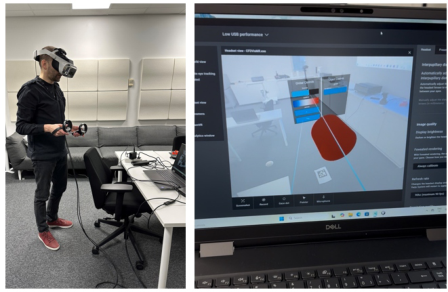
Two MR glasses were tested with slightly different content configurations. Using Varjo’s glasses, a computational fluid dynamics (CFD) model of an engine was assessed to facilitate discussions about its structure and airflow dynamics (see Figure 1). Typically, these CFD models are used with PCs with special software such as OpenFoam or ParaView. The demo software in Varjo glasses utilised a 3D CFD model and it was developed with Unity.
Figure 1: Use of Varjo XR4.
218 Aromaa and Väätänen
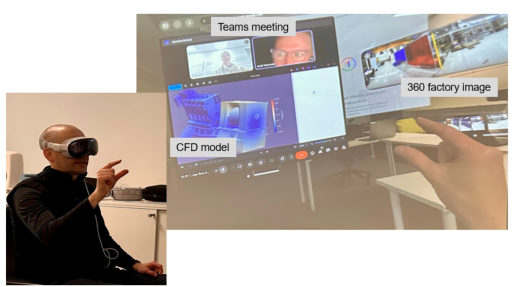
With Apple’s glasses, a different scenario was explored, displaying a factory’s 360-degree image alongside a browser window, which hosted an open Teams meeting with another participant (see Figure 2). The CFD model could also be examined through a commercial software in this setup. Both scenarios (Varjo and Apple) were then analysed and evaluated through a SWOT framework.
Figure 2: Use of Apple Vision Pro.
RESULTS
Through experimentation and discussions, an initial perspective on the potential of MR glasses in distributed R&D activities was developed by the two HF experts. It was found out that user interfaces can be more immersive, visual, and interactive compared to traditional online meeting tools. For instance, the quality of sound and imagery in the Apple glasses was good. Additionally, Apple solutions provide consistent user interfaces across applications, which facilitated ease of use from the beginning. However, there are challenges that need to be addressed before these solutions can be widely adopted in R&D collaboration. The setup process for the Varjo system was more time-consuming, and the initial stability of the system was suboptimal. This could be due to the users’ unfamiliarity with the system, but it indicates a need for greater expertise to effectively utilise these tools. The primary findings from the SWOT analysis are summarized in the Table 1 below.
Table 1: SWOT analysis of the use of MR glasses in distributed R&D.
Table available in the original PDF paper.
Strengths: Visual and immersive experience Shared understanding Cost-efficiency
Weaknesses: Complex systems Motion sickness, comfort and safety Required competence
Opportunities: New use cases and scenarios Use of AI Spatial navigation and avatars
Threats: Cybersecurity Enabling technologies Trust between stakeholders
Mixed Reality Glasses in Remote R&D Collaboration 219
Strengths: Utilising MR glasses offers a more interactive and immersive experience, making it easier to perceive 3D models, such as viewing them at their actual size and especially when they are analysed within their real environment. Additionally, glasses allow for real-time observation of models. This could facilitate communication between R&D personnel located in two different regions. It may enable them to form a shared perspective and engage in discussions based on that common understanding. Cost-efficiency and location independence are also significant advantages, as discussions can occur interactively without the need for travel.
Weaknesses: The use of MR glasses may introduce complexity in interactions, serving as an additional technology that must be integrated and may feature varying user interfaces. In some cases, this added complexity may fail to provide value and instead complicate workflows in ways that are difficult to grasp. Additionally, different participants in separate locations might view the model through distinct interfaces (e.g., PCs versus MR glasses), which could result in varied perceptions of the 3D model. Another obstacle to adoption could be motion sickness. It is possible that some users may not be able to use the glasses for extended periods, or others may not be able to use them at all, potentially compromising inclusivity principles within organisations. Prolonged use of MR glasses may also lead to ergonomic issues and discomfort. Additionally, safety concerns may arise due to an obstructed view of the real environment. Varjo glasses require a wired connection to a PC, which restricts user mobility and may increase the risk of accidents. The level of users’ skills may also present challenges. It might be difficult for an average user to adopt the programs, such as Unity, which may require higher levels of technical expertise.
Opportunities: The MR-glasses present numerous possibilities that were not explored in this study due to limited test setup. For instance, Apple glasses could enable various forms of connection with other people, such as Google Meets, Teams, and FaceTime. Within organisations, MR glasses could also be utilised for applications beyond R&D reviews, providing additional value in various scenarios. Integrating artificial intelligence (AI) into the use of MR glasses can open new opportunities and have positive effects on both user experience and efficiency. Additionally, possible opportunities were identified in spatial navigation and the potential to integrate avatars of participants around the 3D model.
Threats: Cybersecurity was identified as a potential threat – how to manage data and its distribution effectively. Issues related to technology can also pose challenges. This kind of system place significant demands on both its requirements and reliability. For instance, Varjo XR4 glasses need high-performance PCs with specific connectivity ports, and ensuring the stability of the devices and software employed is paramount. Additionally, internet connectivity must be seamless when using MR glasses to ensure real- time functionality, and compatibility issues with different software platforms (e.g., Windows, Android, Apple, Meta, Varjo) need to be addressed. Furthermore, the development of MR glasses is dependent on the companies who manufacture them. At times, progress may be very rapid, while at other times it can also be influenced by strategic and political factors.
220 Aromaa and Väätänen
Additional challenges may arise regarding how freely different partners can collaborate on R&D projects. While certain aspects may be intended for sharing, company-specific details might remain confidential.
DISCUSSION AND CONCLUSION The study revealed both opportunities and challenges associated with the use of MR glasses in the remote collaboration in R&D. These findings align with those observed in other studies conducted in various contexts (Aziz & Morris, 2023; Khan et al., 2021; Wang & Li, 2024). For example, immersive interaction with MR glasses has been identified as one of their strengths, whereas ergonomic and comfort issues—particularly during extended use— are frequently mentioned as weaknesses. The fact that similar issues continue to arise indicates that these devices have not yet become fully integrated into everyday use in all environments. This may be because not all challenges have been addressed yet. Additionally, the recurrence of such findings implies that there have been no major breakthroughs in technological development. For example, these MR glasses did not leverage the possibilities offered by AI.
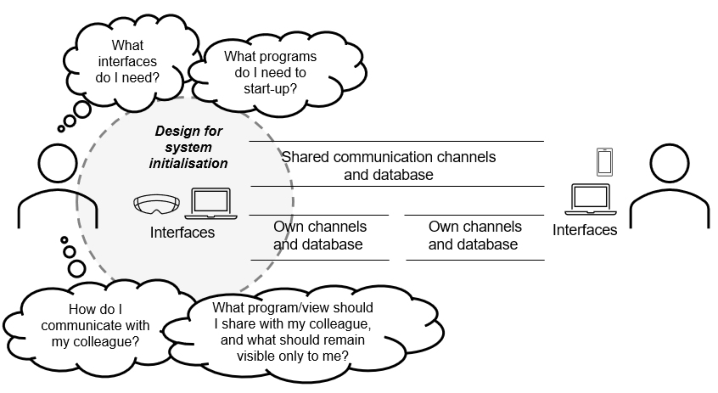
During the experiment, a trend was observed: the increasing complexity of systems. For instance, possessing strong Office skills may no longer suffice to adopt MR glasses without additional training. In addition to competence, to facilitate the integration of such tools into workplaces, special attention should be given to the “system initialisation” phase. For example, while the use of glasses may be highly intuitive when viewing a 3D model due to dedicated design efforts, the practical aspects of setting up devices and software for operation remain increasingly complex. Therefore, it is insufficient to focus solely on the study of human-technology interaction during the use of a product, which has already been extensively researched in relation to these technologies (Wang et al., 2020); consideration must also be given to the initialisation phase of the devices and their interoperability. This highlights the need for greater incorporation of human-centred design (HCD) and human factors and ergonomics (HFE) considerations. As a future research question, it would be important to focus on how to design and utilise MR systems in a way that simplifies the process of opening models, sharing views, and establishing communication with colleagues?
It can be said that MR glasses have the potential to enhance interactivity in location-independent R&D collaboration. Nonetheless, it is important to consider the users’ experience when adopting these kinds of systems and implement practices to simplify the use and initialisation phase if needed (see Figure 3). This study highlights the importance of continued research and development in MR technology to fully realise its potential in supporting remote collaboration and driving innovation in R&D processes. The findings from this study provide valuable insights for both the industry and research domains when considering the adoption of MR glasses for remote R&D collaboration.
Mixed Reality Glasses in Remote R&D Collaboration 221
Figure 3: System initialisation phase can be complex in distributed R&D collaboration.
This study provided a preliminary exploration of the potential applications of two different MR glasses with demo software in distributed design environments. To gain a broader and more in-depth understanding of the subject, additional expert and user testing with professional solutions would be necessary. Future research could focus on developing interfaces that are compatible with other systems and real industrial data, ensuring ease of use rather than increasing complexity with the introduction of new programs. This question also ties into the adoption of other new technologies within workplace settings, such as the utilisation of generative AI in professional tasks. The impact of such technologies is not limited to software but also reshapes the cognitive and operational processes of employees.
ACKNOWLEDGMENT
This work was supported by Business Finland and VTT Technical Research Centre of Finland Ltd. The authors are grateful to all who have contributed to and supported the work presented in this publication.
REFERENCES
Aromaa, S., Väätänen, A., Aaltonen, I., Goriachev, V., Helin, K., & Karjalainen, J.
(2020). Awareness of the real-world environment when using augmented reality head-mounted display. Applied Ergonomics, 88, 103145. Aziz, F., & Morris, A. (2023). SWOT Analysis of Extended Reality in Architecture Engineering and Construction Organizations. 2023 IEEE International Conference on Systems, Man, and Cybernetics (SMC). Benzaghta, M. A., Elwalda, A., Mousa, M. M., Erkan, I., & Rahman, M. (2021).
SWOT analysis applications: An integrative literature review. Journal of Global Business Insights, 6(1), 54–72.
222 Aromaa and Väätänen
Fang, W., Chen, L., Zhang, T., Chen, C., Teng, Z., & Wang, L. (2023). Head-mounted display augmented reality in manufacturing: A systematic review. Robotics and Computer-Integrated Manufacturing, 83, 102567. He, Z., Du, R., & Perlin, K. (2020). Collabovr: A reconfigurable framework for
creative collaboration in virtual reality. 2020 IEEE International Symposium on Mixed and Augmented Reality (ISMAR). Khan, A., Sepasgozar, S., Liu, T., & Yu, R. (2021). Integration of BIM and immersive technologies for AEC: A scientometric-SWOT analysis and critical content review. Buildings, 11(3), 126. Milgram, P., Takemura, H., Utsumi, A., & Kishino, F. (1995). Augmented reality:
A class of displays on the reality-virtuality continuum. Telemanipulator and Telepresence Technologies, 2351, 282–292. Pidel, C., & Ackermann, P. (2020). Collaboration in virtual and augmented reality: A systematic overview. Augmented Reality, Virtual Reality, and Computer Graphics: 7th International Conference, AVR 2020, Lecce, Italy, September 7–10, 2020, Proceedings, Part I 7. Schäfer, A., Reis, G., & Stricker, D. (2022). A survey on synchronous augmented,
virtual, andmixed reality remote collaboration systems. ACM Computing Surveys, 55(6), 1–27. Sorko, S. R., Trattner, C., & Komar, J. (2020). Implementing AR/MR–Learning factories as protected learning space to rise the acceptance for Mixed and Augmented Reality devices in production. Procedia Manufacturing, 45, 367–372. Wang, P., Bai, X., Billinghurst, M., Zhang, S., Zhang, X., Wang, S., He, W., Yan, Y., &
Ji, H. (2021). AR/MR remote collaboration on physical tasks: A review. Robotics and Computer-Integrated Manufacturing, 72, 102071. Wang, P., Zhang, S., Billinghurst, M., Bai, X., He, W., Wang, S., Sun, M., & Zhang, X.
(2020). A comprehensive survey of AR/MR-based co-design in manufacturing. Engineering with Computers, 36, 1715–1738. Wang, Q., & Li, Y. (2024). How virtual reality, augmented reality and mixed reality facilitate teacher education: A systematic review. Journal of Computer Assisted Learning, 40(3), 1276–1294.
LISTED IN THE AHFE DIGITAL BOOKSTORE CATALOGUE
Explore the complete digital volume
Human Systems Engineering and Design (IHSED2025): Future Trends and Applications
Read this individual research paper free through the original publisher, or explore the full digital proceedings book.
ISBN 978-1-964867-74-8
Explore this ISBN in the AHFE Bookstore ↗Listed in the July 2026 bookstore catalogue; search by ISBN to confirm current availability · Digital book purchase optional