Feng Jiang, Yongshi Guo, Jianhua Yan (2026). AI-Powered Tactile Glove for Human Recognition in Low-Visibility Fire Environments. In: Intelligent Human Systems Integration (IHSI 2026): Disruptive and Innovative Technologies. AHFE Open Access, vol. 200, pp. 178–183. https://doi.org/10.54941/ahfe1007077
Firefighters and rescue robots often face extremely low-visibility environments during fire emergencies, making it difficult and dangerous to locate and save victims. To address this challenge, we developed an AI-powered glove capable of automatically recognizing human body parts without requiring visual input or manual guidance.The system integrates 22 flexible, fire-resistant cermet matrix sensors onto a heat-resistant glove, forming a tactile sensing array. When the glove comes into contact with different body parts—such as the shoulder, arm, chest, or abdomen—it detects distinct pressure patterns that generate unique electrical signal distributions. These signals are then analyzed by a deep learning model trained to identify specific human body parts with high accuracy.This fusion of tactile sensing and artificial intelligence enables precise human recognition in low-visibility fire conditions, enhancing the safety and effectiveness of rescue operations. The project demonstrates how AI can be seamlessly integrated into real-world problem-solving to support first responders in life-saving missions.
Firefighting and rescue operations (Zare et al., 2018) require split-second decisions in conditions that often render traditional vision-based systems ineffective. Heavy smoke, high heat, and chaotic environments make it difficult to locate victims. Even advanced infrared imaging (Hou et al., 2022) can fail due to heat saturation and smoke scattering. Therefore, a tactile- based recognition system (Guo et al., 2024) offers an alternative modality for perception in visually obstructed environments.
In this study, we developed an AI-integrated, fire-resistant tactile glove that can identify human body parts purely through touch. Unlike conventional wearable sensors that degrade under heat (Zhang et al., 2021; 2023), our system employs flexible ceramic–metal (cermet) nanofiber (Velasco et al., 2016; Choi et al., 2023; Dong et al., 2023) sensors capable of maintaining electrical and mechanical stability up to 1300 °C. These sensors convert pressure variations into electrical signals, which are then classified by a deep learning algorithm to recognize which part of the human body is being touched.
AI-Powered Tactile Glove for Human Recognition in Low-Visibility Fire Environments 179 The system demonstrates a new paradigm where material science, artificial intelligence, and human–machine interaction converge to solve practical life-saving challenges. The glove provides firefighters with intelligent, high- temperature-resilient tactile feedback that enables victim detection without relying on sight or sound.
DESIGN PRINCIPLES AND MATERIALS The primary challenge in creating high-temperature tactile sensors lies in achieving stable ceramic–metal contact. Ceramics offer excellent heat resistance but are brittle and poor conductors, whereas metals provide high conductivity but fail under thermal stress due to mismatched expansion coefficients. To overcome this, we designed a cermet (ceramic–metal composite) structure based on flexible SiO2 nanofibers.
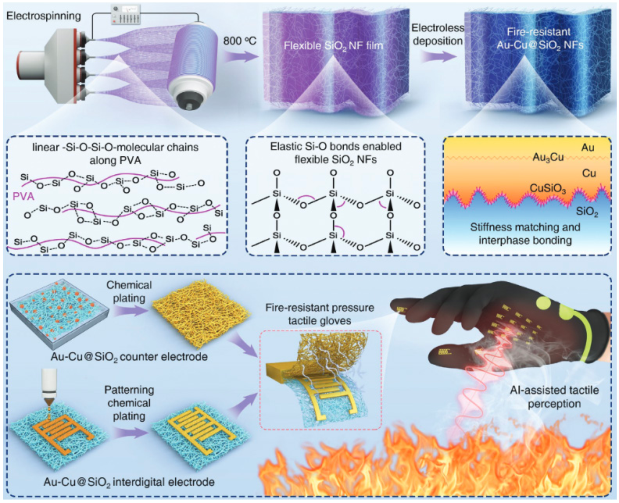
As shown in Figure 1, using a sol–gel electrospinning process followed by ultrasonic cavitation, we fabricated flexible SiO2 nanofiber (NF) films. The cavitation process rearranges the precursor molecules (TEOS) into linear chains, resulting in flexible –Si–O–Si– networks. These nanofiber films exhibit both softness and thermal durability, making them suitable for flexible electronics.
Figure 1: Large-scale assembly of flexible cermet NF interdigital electrode arrays for accurate perception in intelligent fire-resistant pressure tactile gloves.
Next, a chemical plating process was used to deposit thin layers of Cu and Au onto the SiO2 NFs. During a controlled thermal treatment at 800 °C, interdiffusion reactions formed conformal, interlocked interphases of CuSiO3 and Au3Cu. These interphases effectively bonded the metal and ceramic layers, creating a conductive yet mechanically stable film capable of withstanding repeated flexing and extreme heat.
Each sensor uses an interdigital electrode design—a pattern that increases surface contact area and enhances sensitivity to small pressure variations. The electrodes are patterned via inkjet printing of catalytic precursors before metallization. The resulting films maintain uniform conductivity across their surface and show negligible signal drift even under repetitive bending or high-temperature cycling.
A total of 22 sensors were mounted across a fire-resistant glove, covering key contact regions including the fingertips, palm, and dorsal hand. Fireproof adhesive and insulated mica–silver wiring were used to maintain durability and prevent short-circuiting. The sensors were arranged into a tactile matrix that maps pressure distribution in real time, producing spatially resolved data when the glove contacts a surface.
DATA ACQUISITION AND DEEP LEARNING FRAMEWORK When the glove touches different body parts, the distributed sensors produce varying voltage responses due to pressure, curvature, and tissue compliance differences. These analog signals are digitized and transmitted wirelessly via Bluetooth to a processing module. The resulting signal map is converted into a 2D pressure distribution matrix that represents tactile data in real time.
To interpret these tactile patterns, we implemented a perception system based on Convolutional Neural Network (CNN) (O’shea and Nash, 2015; Ma’arif et al., 2022). It is trained on a dataset of 2400 labelled samples representing contacts with the shoulder, arm, chest, and abdomen.
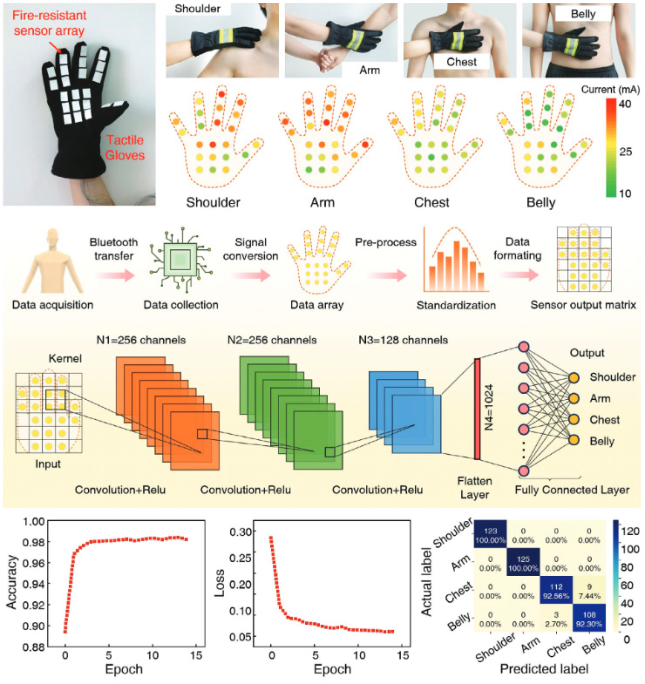
The perception system, as shown in Figure 2, comprises two key stages: data processing and deep learning-based recognition. The tactile signals are first collected by 22 distributed sensors integrated on the glove. Each sensor converts pressure-induced resistance changes into electrical signals, which are transmitted wirelessly via Bluetooth to a data collector. The electrical signal streams are then synchronized and transformed into a hand-shaped raw data array through signal conversion and digital reconstruction.
Next, the raw sensor data are standardized and rearranged into a 2D sensor output matrix that reflects the geometric layout of the glove’s tactile sensors. This matrix represents the pressure intensity distribution across the glove and forms the input for machine learning analysis. The structure of this array is illustrated in Figure 2, showing the spatial encoding of tactile information as a digital image.
We used a dataset of 2400 labeled samples to train a deep learning CNN model for body-part recognition, with 80% of the samples for training and 20% for evaluation. The CNN architecture included an input layer, three convolutional layers, a flattening layer, a fully connected layer, and an output layer. Specifically, the convolutional layers used 256, 256, and 128 channels, respectively, to extract tactile features from the sensor matrix. The flattening layer converted the 1024 output features into a 1D vector that was then passed to the fully connected layer for classification.
The final output layer used SoftMax activation to generate a probability distribution across four target categories: shoulder, arm, chest, and belly. This structure enabled robust feature extraction and classification, effectively distinguishing subtle tactile variations between different body regions.
Figure 2: Illustration of deep learning-assisted perception system using tactile gloves: a) The as-fabricated tactile glove that contained 22 flexible fire-resistant cermet NF sensor arrays. b) Distribution diagram of electrical signals on tactile gloves to recognize different body parts. c) Schematic diagram of data processing with the tactile gloves, and d) using a CNN model to recognize different body parts. e,f) Recognition accuracy and loss during fourteen training epochs of the CNN model. g) A confusion matrix diagram visualizing the perception accuracy of the CNN model.
During model training, we tracked both accuracy and loss across fourteen epochs to evaluate convergence and reliability. As shown in Figure 2 e,f, the model’s accuracy rapidly increased during early iterations and plateaued near 100%, while the loss declined sharply and stabilized, indicating efficient learning and generalization.
The perception accuracy achieved by this CNN reached 97% overall. To visualize performance, we constructed a confusion matrix (Figure 2). The vertical axis represents the true labels of body parts, while the horizontal axis represents predicted outcomes. The dark blue diagonal cells indicate correct classifications, whereas lighter off-diagonal cells mark misclassifications. The CNN achieved 100% recognition accuracy for shoulders and arms, while accuracies for chest and belly were 92.56% and 92.30%, respectively. Minor misclassifications were attributed to insufficient joint bending during certain
data collection sessions. Despite these variations, overall recognition accuracy remained exceptionally high at 97%, confirming the CNN’s capability to reliably interpret tactile data in real-world rescue scenarios.
EXPERIMENTAL CHARACTERIZATION Mechanical tests demonstrated that the cermet NF films achieved a fracture toughness of 23.62 J·m−³, a strength of 7.39 MPa, and an elongation of 1.63%, outperforming pure ceramic films. Thermal analysis confirmed stable electrical resistance between 200–500 °C, with transient operation verified at 1300 °C. In flame exposure tests, polymer-based controls failed within seconds, while the cermet films retained structural integrity. The sensors displayed a sensitivity of 112.18 kPa−¹ in the low-pressure range (0–10 kPa) and maintained reliable linearity up to 100 kPa. The response and recovery times were measured as 16 ms and 17 ms, respectively. Cyclic tests over 1000 loading cycles revealed no significant degradation in signal amplitude, confirming excellent mechanical and electrical endurance. Human-subject testing demonstrated clear signal differentiation across the four target body parts. Distinct pressure profiles were recorded for each region, influenced by anatomical curvature and tissue density. The CNN successfully translated these tactile signals into classified outputs in real time, effectively simulating human-like touch perception under zero-visibility conditions.
DISCUSSION
The AI-powered tactile glove represents a convergence of smart materials and artificial intelligence for human-centered rescue applications. Traditional sensory systems in firefighting are primarily visual, but this glove adds a tactile layer of perception that functions independently of light or visibility. By utilizing pressure pattern recognition, it achieves human identification even in dense smoke or darkness.
The success of the glove relies heavily on the CuSiO3/Au3Cu interphase, which bridges the stiffness and thermal expansion gap between the ceramic and metal layers. This breakthrough in material science eliminates delamination under thermal cycling and ensures long-term durability. Furthermore, the porous SiO2 nanofiber substrate enhances sensitivity by allowing small deformations under applied pressure. The tactile glove’s modular design allows integration with existing firefighting equipment and robotic systems. It can be used by human rescuers as an assistive tool or as a sensory component for robotic hands. Its resilience makes it viable for other extreme environments, such as space exploration, deep-sea missions, and industrial hazard zones. Although promising, the system currently recognizes only four body regions. Future iterations will expand the dataset to include more classes and develop multimodal learning frameworks that combine tactile and thermal sensing. Additionally, efforts will focus on embedding lightweight microcontrollers for on-glove edge computing, reducing latency and enabling real-time AI inference.
CONCLUSION
This study introduces a fire-resistant, AI-driven tactile glove that can identify human body parts through touch alone. Using 22 flexible cermet sensors with nanostructured Au3Cu/CuSiO3 interphases, the glove maintains sensitivity, durability, and accuracy in extreme fire conditions. Integrated with a CNN classifier, it achieves 97% recognition accuracy across multiple body parts without relying on vision.
By merging materials innovation and machine intelligence, the glove provides a powerful tool for enhancing firefighter efficiency and safety. It exemplifies how AI can be embedded into physical systems to perform life- saving functions in environments beyond human sensory limits.
ACKNOWLEDGEMENTS
Supported by the National Natural Science Foundation of China (No. T2122009) and the Fundamental Research Funds for the Central Universities (2232021A-04, 2232023Y-01).
REFERENCES
Choi, Daekyu, et al. “Transparent, flexible, and highly sensitive piezocomposite capable of harvesting and monitoring kinetic movements of microbubbles in liquid.” Advanced Functional Materials 33.43 (2023): 2307607. Dong, H. J., et al. “Ultrasonic-based surface patterning and interfacial reaction of
ZrO2 ceramics.” Journal of Materials Science & Technology 155 (2023): 202– 210. Guo, Yongshi, et al. “Large-Scale Synthesis of Flexible Cermet Interdigital Electrodes with Stable Ceramic-Metal Contact for Fire-Resistant Pressure Tactile Sensors.” Advanced Functional Materials 34.16 (2024): 2313645. Hou, Fujin, et al. “Review on infrared imaging technology.” Sustainability 14.18
(2022): 11161. Ma’arif, Alfian, et al. “Understanding of Convolutional Neural Network (CNN): A Review.” International Journal of Robotics & Control Systems 2.4 (2022). O’shea, Keiron, and Ryan Nash. “An introduction to convolutional neural
networks.” arXiv preprint arXiv:1511.08458 (2015). Velasco, S. Calderon, A. Cavaleiro, and S. Carvalho. “Functional properties of ceramic-Ag nanocomposite coatings produced by magnetron sputtering.” Progress in Materials Science 84 (2016): 158-191. Zare, Sajad, et al. “Comparison of the effect of typical firefighting activities, live fire
drills and rescue operations at height on firefighters’ physiological responses and cognitive function.” Ergonomics 61.10 (2018): 1334-1344. Zhang, Yuanyuan, et al. “Control of metal oxides’ electronic conductivity through visual intercalation chemical reactions.” Nature Communications 14.1 (2023): 6130. Zhang, Yuanyuan, et al. “Superior flexibility in oxide ceramic crystal
Intelligent Human Systems Integration (IHSI 2026): Disruptive and Innovative Technologies
Read this individual research paper free through the original publisher, or explore the full digital proceedings book.
ISBN 978-1-964867-76-2
Explore this ISBN in the AHFE Bookstore ↗Listed in the July 2026 bookstore catalogue; search by ISBN to confirm current availability · Digital book purchase optional