Seiko Kawashima, Motoharu Takao, Senri Komiya, Mana Hattori (2023). Right Visual Field Is Advantageous in Detecting Different Colors: An Implication for Appropriate Digital Graphics Arrangement. In: Neuroergonomics and Cognitive Engineering. AHFE Open Access, vol. 102, pp. 224–231. https://doi.org/10.54941/ahfe1003022
Many studies have so far revealed that the visual field biases influence visual tasks. These biases should be taken into consideration to arrange an Excel worksheet, draw a CAD (computer-aided design) blueprint and other digital graphics effectively. In this study, we investigated visual field biases in identifying different and same color lines shown on a computer display. Twelve male and two female college students (21-22yrs.; mean age 21.2yrs.) were recruited to participate in the experiment. All were physically and mentally healthy and had visual acuity (including corrected visual acuity) that does not interfere with the task performance and vision that allows color perception. All participants were right-handed. Visual stimuli were displayed on a 17-inch CRT monitor. White circle on a quadrant (1000 ms) was followed by Test1 image (1500 ms), checker pattern image as a distractor (4100 ms) and Test 2 image (4000 ms). White circle showed the quadrant to which a participant must pay attention in order to discriminate different and same colored lines shown in Test 1 image and Test 2 image. Immediately after a participant press a correct response key, a correct answer was fed-back to a participant. The participants were instructed to detect different and same colored lines in the visual field and press a correct response key as quickly as possible. The results demonstrated that the participants could detect different colored lines faster than match of color in both upper- and lower-right visual fields have advantages (F (1,13) =28.814, p<0.000; F (1,13) =8.120, p<0.014, respectively). However, there was no change in identifying different and same colored line in both upper- and lower-left visual fields (F (1,13) =13.000, ns.; F (1,13) =13.000, ns., respectively). Rates of correct responses to different and same colored lines were almost same in these visual fields (upper-right, lower-right, upper- left, lower-left visual fields) (F (1,13) = 0.027, ns.; F (3,39) =0.073, ns, F (1,13) = 0.071, ns; F (1,13) =1.779, ns, respectively). These results showed the advantage in identifying difference in colored lines in right visual field compared with left. This finding implies that right side is appropriate to arrange a manuscript for proofreading, a calculating worksheet, a CAD blueprint and other digital graphics for modification.
Humans and animals learn about the external world through their sensory organs to adapt well to their environment. This is known as perception. When stimuli are received inside or outside the body, they excite the sensory cells in the sensory organs, which then transmit the signals to the sensory nerves and central nervous system, which recognize and store them. Video and still images, which are easy to impress, and advertising signs and materials, which easily draw attention, facilitate human cognitive activities. Considering that science will continue to become more complex, this research aims to make
Right Visual Field Is Advantageous in Detecting Different Colors 225
science and technology simpler and smarter. Studies have revealed that visual field bias influences visual tasks. These biases should be considered when arranging an Excel worksheet and other digital graphics, and drawing a computer-aided design (CAD) blueprint effectively. In this study, we inve- stigated visual field biases in identifying different- and same-colored lines (henceforth referred to as mismatch and match, respectively) shown on a computer display.
Feng and Spence (2014), and Levine and McAnany (2005) reported aniso- tropy regarding the influence of the presenting visual field of view (upper, lower, right, left) of visual stimuli on visual short-term memory. Previc (1996), and Feng and Spence (2014) reported the superiority of the upper visual field compared to the lower visual field in studies of visual sea- rch and categorical judgments. Conversely, Genzano, Nocera, and Ferlazzo (2001), and Rezec and Dobkins (2004) found in the eight-block shape reco- gnition and shape discrimination studies that the upper visual field was inferior to the lower visual field. Kawashima, Shimada, Hayashi, and Takao (2021) found that the right visual field was significantly more correct than the lower and upper visual fields in a study of color recognition using mismatch- and match-colored square stimuli, suggesting that this is due to the aforementioned color recognition in mismatch-colored categories (domi- nance of the right visual field by the left hemisphere of the brain), and to the generation of representations by attention directed to the features of visual stimuli. A representation is an image of an external object that appears in consciousness based on perception, and is a stimulus stored in cognition.
However, there are no studies on the effects of the stimuli presentation field of view on recognition in mismatch- and match-colored line stimuli shown on a computer display. Therefore, in the present study, we investi- gated the effects of the stimuli presentation field of view on the accuracy of and time required for recognition in visual short-term memory for color using mismatch- and match-colored line stimuli. This study may have impli- cations to highlight appropriate arrangement of a manuscript for proofrea- ding, calculating worksheets, CAD blueprints, and other digital graphics for modification.
MATERIALS AND METHODS
A. Participants Twelve male and two female college students (age 21–22 years, mean age 21.2 yeas) were recruited to participate in the study. All participants were physically and mentally healthy and had visual acuity (including corrected visual acuity) that did not interfere with task performance and vision that allowed color perception. All the participants were right-handed. In accorda- nce with the Declaration of Helsinki, informed consent was obtained from the subjects before the start of the experiment, and personal information was protected. The research was approved by the Research Ethics Committee of Tokai University.
B. Experiment Environment The visual stimuli were presented on a 17-inch CRT monitor (NEC CRT display DV17D2) with an aspect ratio of 5:4 and resolution of 1280 × 1024 pixels. The stimuli were created using the graphic/image software Canvas 14 (ACD Systems, Tokyo, Japan), and the task was created using the psychologi- cal experimental control program software SuperLab 5 (Cedrus Corporation, CA, USA). The experiment was conducted in a shielded room, and the par- ticipants sat at 56 cm from the monitor and fixed their chin and forehead at a position. The measurement environment had a temperature of 21.2
C (18.0–25.5
C), and the average illuminance on the desk surface was 204 lx (204–205 lx). The brightness and chromaticity of the color stimuli were measured using a spectroradiometer SR-3A (TOPCON, Tokyo, Japan). The chromaticity was shown by the CIE 1931 chromaticity coordinates x and y.
C. Visual Stimuli The radius of the circle indicating the visual field was set to a 4.0
visual angle. Four circles were placed at a distance of 7.0
visual angle from the center of the screen to that of the circle for the four visual fields–upper-right, lower-right, upper-left, and lower-left. Three of the four circles were black, and one was white, and the color layout of the visual field in that area was stored. The size of the line shapes was set to 2.4
vertical × 0.4
horizontal in the visual field to ensure that they fit within a circle and did not inter- fere with others when rotated. The second-line stimuli were rotated in the orientation of the first line as an inhibitory stimulus. Rotation was made at the center of the line stimuli at an angle between 45
and 180
to the right.
D. Experimental Flow
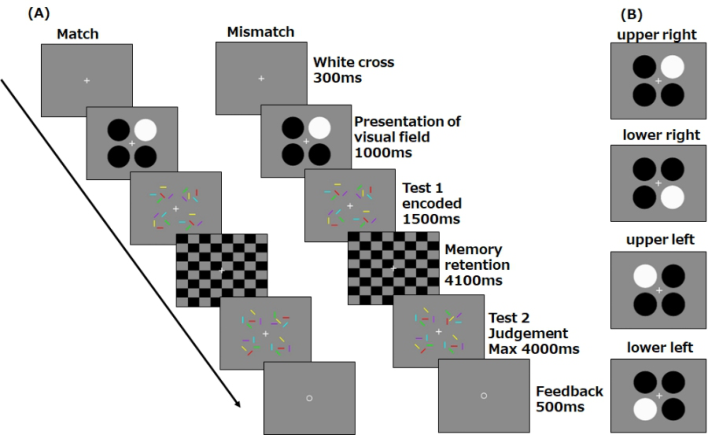
Figure 1 shows the experimental flow. After watching the white cross, the next white circle showed the quadrant to which a participant must pay attention to in order to identify mismatch- and match-colored lines shown in Test 1 and Test 2 images for 1000 ms. Next, the first colo- red line stimuli (Test 1) were presented for 1500 ms and encoded. After the checker pattern image was shown as a distractor for 4100 ms, the second colored line stimuli (Test 2) was presented to detect mismatch- and match-colored lines in the visual field. The participants needed to press the correct response key as quickly as possible within 4000 ms. Immediately after a participant pressed the response key, the correct answer was shown to them.
E. Data Analysis The correct answer rate was the rate at which a participant’s answer was correct and the reaction time was the duration between presentation of the
Right Visual Field Is Advantageous in Detecting Different Colors 227
Figure 1: (A) Experimental flow; (B) White circle shows the quadrant to which a participant must pay attention to .
color stimuli to the participant’s response. If the response button was pressed more than once in a trial, it was not reflected in the answer rate or reaction time.
The correct answer rate and reaction time were summarized for each par- ticipant. However, two participants had average correct answer rates and reaction times that exceeded three times the sample mean ± standard devia- tion. Therefore, data from 13 participants were used. Statistical analysis was performed using repeated two-way analysis of variance (ANOVA). Statistical significance was set at P < 0.05. Data were shown as mean ±SE and analyzed using the SPSS statistical software package (IBM SPSS ver. 22 for windows, Tokyo, Japan).
RESULTS
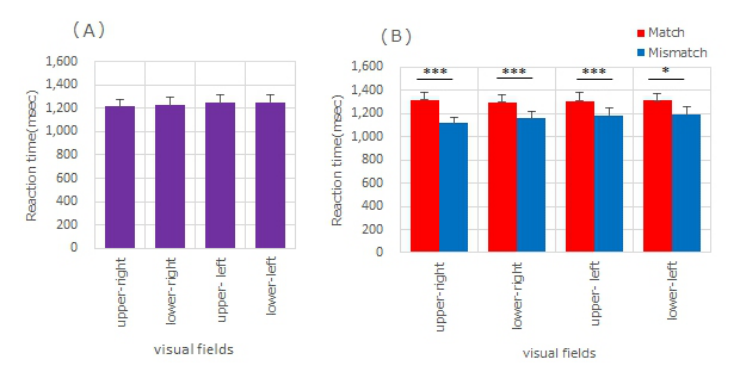
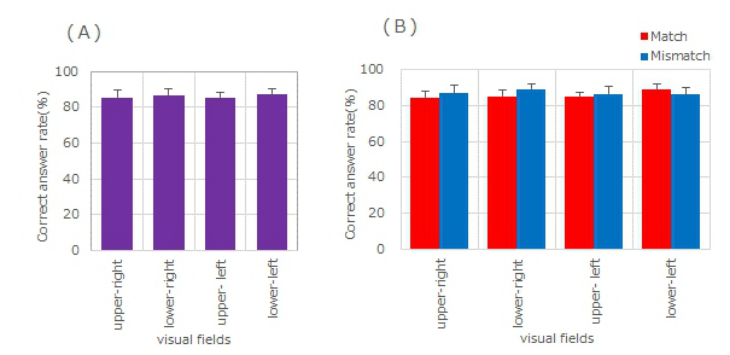
The results demonstrated that the participants could detect mismatch-colored lines faster than match-colored lines (F (1,13) = 59.276, p < 0.000). There was no change in visual field (F (3,39) = 1.584, ns). The results of the post hoc test demonstrated that the participants could detect mismatch- colored lines faster than match-colored lines in every visual field (upper-right, lower-right, lower-right, lower-left) (p < 0.000, p < 0.001, p < 0.000, and p < 0.039, respectively) (Figure 2). Recognition accuracy (correct answer rate) to mismatch- and match-colored lines was almost identical in the visual fields (upper-right, lower-right, upper-left, lower-left) (F (1,13) = 0.027, ns; F (3,39) = 0.073, ns; F (1,13) = 0.071, ns; F (1,13) = 1.779, ns, respectively) (Figure 3).
Figure 2: (A) Reaction time of recognition in upper-right, lower-right, upper-left, and lower-left visual fields. (B) Reaction time of recognition for the match and mismatch conditions when the presenting visual field of the color stimuli was upper-right, lower- right, upper-left, and lower-left visual fields. ***, p<0.001; **, p<0.01; *, p<0.05.Figure 3: (A) Recognition accuracy (correct answer rate) in upper-right, lower-right, upper-left, and lower-left visual fields. (B) Correct answer rate of recognition for the match and mismatch conditions when the presenting visual field of the color stimuli was upper-right, lower-right, upper-left, and lower-left visual fields.
DISCUSSION
First, we discuss the point that the expected right visual field dominance was not confirmed in our experiment. Visual information processing may also involve higher-order processing. It is known that abundant information from the external world is processed in stages for various features (attributes) in visual information processing. Independent features (attributes), such as bri- ghtness, color, motion, and depth, are extracted in lower-order vision, which
Right Visual Field Is Advantageous in Detecting Different Colors 229
is called initial vision. When multiple features (attributes) exist, the informa- tion is feature-integrated and processed as higher-order visual information in a top-to-bottom manner (Yokozawa 1999). In addition to the feature (attri- bute) of color, information processing in the present task consisted of two features (attributes) that were stimulated by changing the orientation of the line color stimuli as a disturbing factor, and it is assumed that the latter resul- ted in higher-order visual information that was processed through feature integration. However, the task that is influenced by the stimuli presentation visual field is the processing of one independent feature (attribute) in lower- order vision. Therefore, the expected dominance of the right visual field was not confirmed in this study.
Second, we compared the match/mismatch conditions using the vDMTS of other visual stimuli. Ding, Paffen, Naber, and Stigchel (2019) tested continu- ous flash suppression (CFS) with stimuli that changed in color and shape and were visually significantly different in color, such that the participants could detect mismatch-colored stimuli faster than match-colored stimuli. Kawash- ima, Sugino, Shimada, and Takao (2021), in a study on the effects of color placement among the elements of visual stimuli on memory, compared the time for earlier- and later-presented color stimuli placement in match and mismatch conditions. Their results are consistent with the results of the pre- sent study in that the reaction time was shorter in the mismatch condition than in the match condition. The authors noted that the 1500 ms presenta- tion time of the color stimuli was sufficient for the color information to be stored and retained as a representation, and that the stimuli might have had a high visual saliency that caused pop-out. Lee, Yang, Romero, and Mumford (2002) reported a pop-out phenomenon in which stimuli with a simple task content that appeared three-dimensional due to shading and a small number of interfering stimuli were found to induce pop-out. They also reported that pop-out occurs in the secondary visual cortex. Because the visual informa- tion processing, in which normal color perception occurs, is in the quaternary visual cortex, this pop-out phenomenon, which is recalled in the secondary visual cortex before the quaternary visual cortex, may have been involved in the transfer pathway of color information as a factor that accelerated color memory recall in the present study. In addition, the results demonstrated that the participants could detect different-colored lines faster than the same- colored lines in the upper-right, lower-right, and upper-left visual fields. The lower left visual field had a similar advantage, although to a lesser degree. As mentioned above, the pop-out occurred in the second quadrant, therefore, it was present in all visual fields; however, there were differences in significance depending on the visual field. In the present study, it is possible that visual attention was directed mainly to the upper-right, as reported by Hagenbeek and Strien (2002).
Finally, Kawashima, Shimada, Hayashi, and Takao (2021) studied the effe- cts of the presentation field of visual stimuli on short-term color memory, compared the reaction time and percentage of correct responses in the match and mismatch conditions for the arrangement of the earlier- and later- presented color stimuli, and summarized the results for each presentation field. The results were different from the present results in that no significant
difference was found in the time taken to recognize again, the main effect of match/mismatch was significant for the correct response rate, and the cor- rect response rate in the mismatch condition was lower than that in the match condition. In the study by Kawashima, Shimada, Hayashi, and Takao (2021), the color stimuli were red, cyan, green, and purple, and the condition crossed color categories. The ease of color naming may have caused verbal encoding during short-term memory, suggesting a left hemisphere of functional asym- metry in the human brain. In the present study, colors were the same, but orientation was added as a disturbing factor. As mentioned above, it is assu- med that higher-order visual information processing was involved and the right visual field dominance of color was lost.
We examined whether the same right visual field dominance as descri- bed above was observed when line-shaped visual stimuli were used as the color stimuli, and the angle (orientation) of the line-shaped color stimuli was changed as the interfering stimuli. The results showed no significant diffe- rence in the reaction time to the presented visual field. However, the main effect of match/mismatch was significant, with reaction times for mismatch being significantly shorter than those for match. We believe that the reason was the angle (orientation) of the line color stimuli, which involved higher- order visual information processing, and that lower-order vision and right visual field dominance was not obtained. This finding suggests that visual short-term memory for color may involve higher-order vision, and verbal and analytical abilities. Because the results of this study were limited to the misma- tch condition of a single experiment using visual line stimuli that varied only in color, we believe that there are limitations in drawing definitive conclusi- ons. Future research should investigate the effects of the match and mismatch conditions on recognition in short-term memory for color using line stimuli with additional visual elements different from those in the present study, such as other color stimuli and shapes.
CONCLUSION
The results demonstrated that the participants could detect different-colored lines faster than the same-colored lines in the upper-right, lower-right, and upper-left visual fields. The lower-left visual field had a similar advantage, although to a lesser degree. However, there was no difference in identifying different- and same-colored lines in upper- and lower-left visual fields. The rates of correct responses to different- and same- colored lines were almost the same in the visual fields (upper-right, lower-right, upper-left, and lower- left). The results showed the advantage of identifying differences in colored lines in the right visual field compared with that in the left. This finding implies that the right-hand side is appropriate for arranging a manuscript for proofreading, calculating worksheets, CAD blueprints, and other digital graphics for modification. New knowledge regarding the characteristics of visual stimuli can be applied to a wide range of fields, including industrial applications, medical applications, and human interface technology, leading to simpler and smarter technology that is expected to continue to become more complex in the future.
Right Visual Field Is Advantageous in Detecting Different Colors 231
ACKNOWLEDGMENT
The authors thank Mr. Hayashi who cooperated in the experiment of this research.
REFERENCES
Ding, Y., Paffen, CLE., Naber, M., Stigchel, SVD. (2019). Visual working memory and saliency independently influence the priority for access to visual awareness, J Vis, 19(9): 1–9. Feng, J., Spence, I. (2014). Upper visual field advantage in localizing a target among
distractors. I-Perception, 5: 97–100. Genzano, VR., Nocera, FD., Ferlazzo, F. (2001). Upper/lower visual field asymmetry on a spatial relocation memory task. Neuroreport, 12: 1227–1230. Hagenbeek RE., Strien JWV. Left-right and upper-lower visual field asymmetries for
face matching, letter naming, and lexical decision. (2002). Brain Cogn, 49: 34–44 Kawashima, S., Shimada, M., Hayashi, R., Takao, M. (2021). The visual field bias on visual short-term memory of color. Jpn J Physiol Anthropol, 26: 47–53. Kawashima, S., Sugino, T., Shimada, M., Hayashi, R., Takao, M. (2021). Misma-
tched stimuli in color figure placement enhance recognition speed in visual short-term memory of color. Jpn J Physiol Anthropol, 26: 15–20. Lee, TS., Yang, CF., Romero, RD., Mumford, D. (2002). Neural activity in early visual cortex reflects behavioral experience and higher-order perceptual saliency. Nat Neurosci. 5: 589–597. Levine, MW., McAnany, JJ. (2005). The relative capabilities of the upper and lower
visual hemifields. Vision Res, 45: 2820–2830. Previc, FH. (1996). Attentional and oculomotor influences on visual field anisotropies in visual search performance. Vis Cogn, 3: 277–302. Rezec, AA., Dobkins, KR. (2004). Attentional weighing: A possible account of visual
field asymmetries in visual search? Spat Vis., 17: 269–293. Yokozawa, K. (1999). Cognitive psychology of higher vision and functional brain measurement. Jpn J Cog Neurosci, 1(2): 152–156.
LISTED IN THE AHFE DIGITAL BOOKSTORE CATALOGUE
Explore the complete digital volume
Neuroergonomics and Cognitive Engineering
Read this individual research paper free through the original publisher, or explore the full digital proceedings book.
ISBN 978-1-958651-78-0
Explore this ISBN in the AHFE Bookstore ↗Listed in the July 2026 bookstore catalogue; search by ISBN to confirm current availability · Digital book purchase optional