The head of an adult human weighs approximately 5 kg. A heavy head is always supported by the neck, causing stiffness in the neck and shoulders. Stiffness results in physical and mental stress. A suspension pillow (SP; Hammock Pillow, M. I-Story, Japan) was devised to disperse the pressure on the neck while the user laid down on a mat. The SP has three pillars that suspend a hard cloth like a hammock. The head is held on the cloth. The SP is expected to decrease stiffness, relieve physical and mental stress, and improve the sleep quality. In the first experiment, we showed stress-relieving effect of the SP by measuring and analyzing fluctuation of heart beat interval (heart rate variability: HRV). HRV is indexed as LH/HF and signifies autonomic nervous system activity. The participant was instructed to lay the head on the pillow and exercise very lightly for 7 min to stretch the neck muscles and facilitate cardiovascular circulation. On the next day, he or she was asked to perform the same exercise without the SP. The experimental schedule was randomized among the participants (n=7). Heart beats were measured using a plethysmogram from the index finger. The LF/HF ratio decreased by 39% after exercise with the pillow. Statistical analysis also revealed significant activation of the parasympathetic nervous system and a stress-reducing effect of the SP. This indicates that the SP can be a tool for stress reduction. In the second experiment, we performed a sleep study to demonstrate the sleep-promoting effect of the SP. Middle-aged and older adults tend to explicitly complain of deteriorated sleep quality compared to young adults. Therefore, we recruited these participants for this experiment to demonstrate the sleep-promoting effect of the SP. Six participants (40-70 years old) participated in the experiment. They slept with the SP or a Japanese traditional and popular pillow stuffed with buckwheat chaff (JP) in their bedrooms for four to five consecutive nights. Data obtained during the first night with each pillow were excluded to avoid the first-night effect. The order of pillow usage was randomized among the participants. Heart beat and body movements were monitored using a plethysmogram on the index finger and an accelerometer placed around the wrist to measure nocturnal sleep quality. The results demonstrated that the SP improved sleep efficiency and increased the amount of deep sleep in NREM (non-REM sleep but decreased the counts and amount of nocturnal awakening. These results prove that the SP improves sleep quality in middle-aged and older adults. In the last experiment, we recorded polysomonography data from three young participants (21-23 years old) in an electromagnetically shielded room. We found that sleep latency was shortened significantly in the three young participants with the SP compared to JP. The findings obtained from three experiments revealed that the SP holds the head adequately, resulting in reduced stress by activating the parasympathetic nervous system and improving sleep quality.
The global sleeping pillow market is growing remarkably because more people demand good-quality sleep in developed and developing countries. Sleeping pillow manufacturers provide a wide variety of unique products to
Suspension Pillow Reduces Stress and Improves Nocturnal Sleep 217
fulfill user demands. Inadequate sleeping pillows increase the risk of neck pain, deteriorate sleep quality, and cause respiratory problems (Cazan et al., 2017; Chun-Yiu et al., 2017; Gordon et al., 2009). However, adequate sele- ction of sleeping pillows has been reported to improve sleep quality and ameliorate neck and shoulder pain and stiffness, which develop during the daytime (Chun-Yiu et al., 2017). Neck pain and stiffness are known to cause physical and mental stress (Kazeminasab et al., 2022).
Cervical height, position, and material of sleeping pillow are the key factors in these problems (Chun-Yiu et al., 2017; Kushida et al., 1999; Lee et al., 2017). The head of an adult human weighs approximately 5 kg. In the upright position, the heavy head is supported by the trapezius muscle in the neck, causing neck pain and stiffness. In the supine position, the head and neck were adequately supported with a sleeping pillow. Inadequate sleeping pillow use also increases the chance of neck pain and stiffness, although trapezius muscle activity is relatively low regardless of sleep stage (Müller et al., 2015).
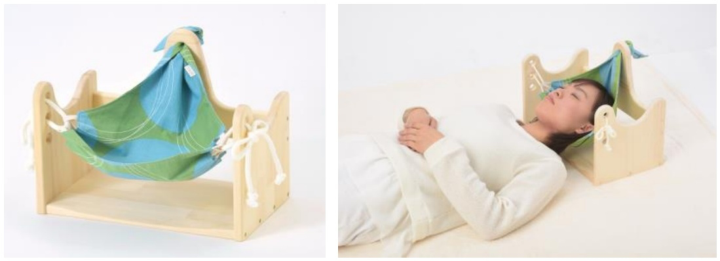
We developed a novel SP to disperse the pressure on the neck while the user lays down on a mat (SP; Hammock Pillow, M. I-Story, Japan; Figure 1). The SP has three pillars that suspend a hard cloth, like a hammock. The head is held on cloth. In this study, we tested the effects of the SP on parasympathetic nervous activity, stress reduction, and sleep quality.
This study comprised of three experiments. In the first experiment, the stress reduction effect of the SP was evaluated by measuring the autono- mic nervous activity. In the second experiment, we tested whether the sleep quality of middle-aged and older participants was improved by using the SP. In the last experiment, we recorded polysomnography results in healthy young adults.
Figure 1: Suspension pillow (left) and usage of the pillow (right).
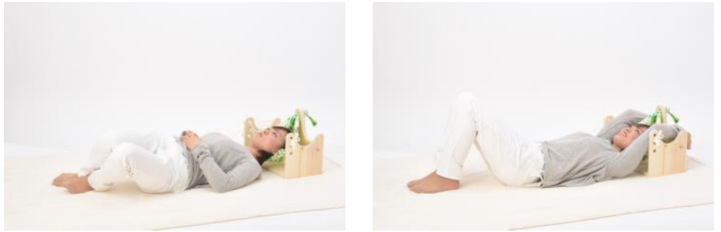
THE FIRST EXPERIMENT Seven participants (40-70 years old) were recruited for the first experiment. They were instructed to lay their head on the SP and exercise lightly for 7 min to stretch the neck muscles and facilitate cardiovascular circulation at home (Figure 2). On the next day, they were asked to perform the same exercise without an SP in the same room. The experimental schedule was
218 Takao and Sakamoto
Figure 2: Two scenes of light exercise with the SP. The head is fixed with the SP but the legs we move side by side slowly.
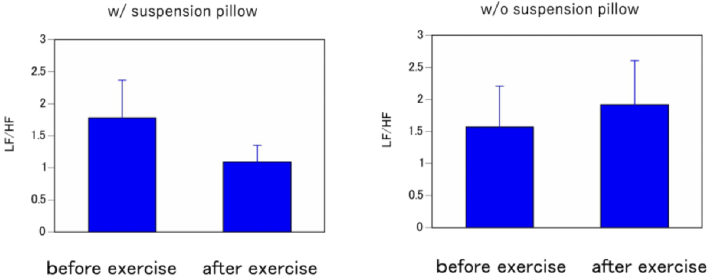
randomized among the participants. Heart beats were measured using a ple- thysmogram (Nemurism, Toshiba Corp., Japan). Heartbeats were analyzed using a computer to calculate heart rate variability (HRV; Acharya et al., 2006). The LF/HF ratio, an index of heart rate variability (HRV), decreased by 39% after exercise with the SP (left panel in Figure 3). Increases and decreases in the LF/HF ratio indicate the activation of the sympathetic and parasym- pathetic nervous systems, respectively. Student’s t-tests were performed using SPSS version 24 (IBM, NY). Data were shown as mean (standard deviation). Statistical analysis also revealed significant activation of the parasympathe- tic nervous system and a stress-reducing effect of the SP (t = 3.556, df = 6, p = 0.012). However, such exercise effect could not be found without the SP (t = 1.175, df = 6, ns; right panel of Figure 3).
Figure 3: LF/HF ratio change before and after exercise. Left panel shows heart rate vari- ability data recorded with suspension pillow (SP) and recorded without the SP in right panel. Increase and decrease of LF/HF ratio indicates that activation of sympathetic and parasympathetic nervous systems, respectively.
THE SECOND EXPERIMENT We performed a sleep study to show the sleep-promoting effect of the SP. Middle-aged and older people tend to explicitly complain of deteriorated
Suspension Pillow Reduces Stress and Improves Nocturnal Sleep 219
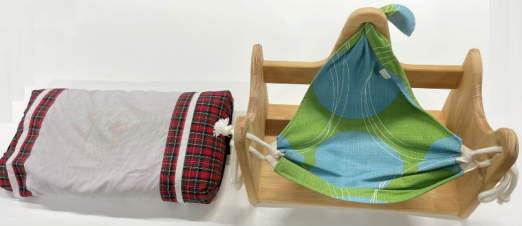
sleep quality compared to young people. Therefore, we recruited middle- aged and older participants for this experiment to show the sleep-promoting effect of the SP. Six participants (40-70 years old) participated in the expe- riment. They slept with the SP or a Japanese traditional and popular pillow stuffed with buckwheat chaff (JP) in their bedrooms for four to five consecu- tive nights (Figure 4). Data obtained during the first night with each pillow were excluded to avoid the first-night effect. The order of pillow usage was randomized among the participants. Heart beat and body movements were monitored by a plethysmogram on the index finger and an accelerometer pla- ced around the wrist to measure nocturnal sleep quality (Nemurism, Toshiba Corp., Japan).
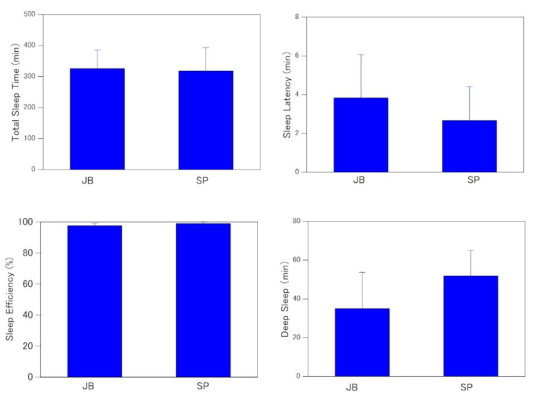
In Figure 5, the results demonstrated that the SP improved sleep efficiency (t = 4.472, df = 4, p = 0.011) and increased the amount of deep sleep in
Figure 4: Japanese traditional and popular pillow stuffed with buckwheat chaff (JP; left) and suspension pillow (SP; right).Figure 5: Sleep parameters. Total sleep time in min, sleep efficiency in %, sleep latency in min and deep sleep in min were shown in upper left, lower left, upper right and lower left panels, respectively. JP and SP are Japanese traditional and popular pillow stuffed with buckwheat chaff and suspension pillow, respectively.
220 Takao and Sakamoto
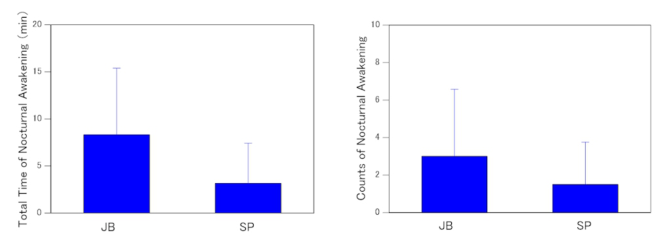
NREM (non-REM sleep; t = 5.445, df = 4, p = 0.006) while total sleep time and sleep latency were not different between the JP and the SB (t = 0754, df = 4, ns; t = 1.087, df = 4, ns, respectively); however, in Figure 6, it decre- ased the counts and amount of nocturnal awakening (t = 2.888, df = 4, p = 0.045; t = 5.250, df = 4, p = 0.006, respectively). These findings pro- ved that the SP significantly improves sleep quality in middle-aged and older adults.
Figure 6: Nocturnal awakening. Total time (min) and counts of nocturnal awakening are shown in left and right panels, respectively. JP and SP are Japanese traditional and popular pillow stuffed with buckwheat chaff and suspension pillow, respectively.
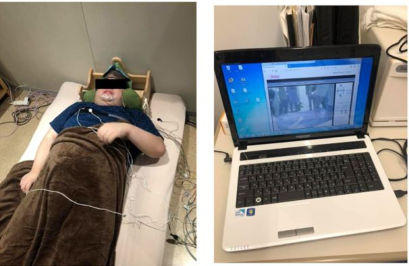
THE THIRD EXPERIMENT In the last experiment, we recorded polysomonograms from five young male participants (21-23 year old) in an electromagnetically shielded room (Sleep Watcher e Series; Teijin Pharma Co. Ltd., Japan; Figure 7). Electroencepha- lograms (EEG) were recorded at Fz, C3, Cz, C4, and P4. Electrocardiograms were recorded from an electrode placed on the sternum. Electooculographic and electromyographic recordings were performed to detect the REM stage. Body movements, respiration, blood oxygen saturation (SpO2), and snoring were recorded overnight. Sleep stages were analyzed automatically with sof- tware (PSG Online and NetBeacon & ProFusion PSG, Teijin Pharma Co.
Figure 7: Polysomnography (left panel) and monitoring of sleeping behavior (right panel).
Suspension Pillow Reduces Stress and Improves Nocturnal Sleep 221
Table 1. Sleep latency in 3 young participants. JB and SP are explained in the text.
Table available in the original PDF paper.
A (24 yrs) B (22 yrs) C (21yrs) JP 15.5 min 15.5 min 9.5 min SP 7.5 min 9.0 min 6.0 min
Ltd., Japan), and the sleep stages were checked manually by the author. Sleep apnea syndrome (SAS) was diagnosed by using the same software.
We found that sleep latency was shortened significantly in three young participants with SP compared to JP (Table 1). Middle-aged participants also showed shortened sleep latency with the SP compared with the JP (upper right panel in Figure 4). However, there was no difference in other sleep parameters, such as total sleep time, sleep efficiency, nocturnal awakenings, and SpO2.
DISCUSSION
In this study, we showed that the SP activates the parasympathetic nervous system and possibly reduces stress when users exercise very lightly. The sympathetic and parasympathetic nervous systems comprise the autonomic nervous system (McCorry 2007). Activated sympathetic nervous activity induces an emotional response, vasoconstriction, and physical and men- tal stresses, while an increase in parasympathetic nervous activity leads to relaxation, sleepiness, and vasodilation.
In the upright position, the head is supported by the trapezius muscle in the neck, causing neck pain and stiffness. We spend almost all our time in an upri- ght position in daily life, except for sleeping time. In the upright position, the sympathetic nervous system becomes more active than in the supine position. Hyperactivity of the sympathetic nervous system is known to cause vaso- constriction and maintain arterial blood pressure (Thomas & Segal, 2004). Moreover, continuous lower oxygenation and blood flow in the trapezius muscles result in worsening of these symptoms (Shiro et al., 2012).
The SP was intended to disperse the pressure from the heavy head on the neck while the user lays himself down on a mat. In the supine position, the parasympathetic nervous system is activated, while sympathetic nervous activity decreases. Oxygenation and blood flow of the trapezius muscles are improved by the SP, possibly because the pressure from the heavy head on the neck is successfully dispersed. In addition to these beneficial effects, light exe- rcise ameliorates muscle oxygenation and blood flow. In fact, the HRV data indicated that laying on the SP has a greater effect on the parasympathetic nervous system than simply lying on a mat.
The SP also had a greater effect on the improvement of sleep quality in middle-aged and older participants. There is a significant correlation between deteriorated sleep quality and continuous hyperactivity of the sympathetic nervous system (Hsu et al., 2021). Activated parasympathetic nervous acti- vity by the SP shortens sleep latency, prolongs slow wave sleep, and decreases nocturnal awakenings, resulting in improved sleep efficiency. However, only
222 Takao and Sakamoto
sleep latency was shortened in the young participants in our study. Young, healthy people tend to have no or fewer complaints about their sleep quality.
Our findings showed that the SP is an adequate pillow for relaxation and improvement of sleep quality, especially in middle-aged and elderly indivi- duals, who tend to complain of physical and mental stress as well as sleep problems. Although the detailed physiological mechanism is still unknown in this study, the HRV data demonstrated enhanced parasympathetic nervous activity by the SP. This physiological effect may reduce stress and improve sleep quality.
CONCLUSION
A suspension pillow (SP) is devised to disperse the pressure on the neck while the user lays down on a mat. The SP is expected to decrease stiffness, relieve physical and mental stress, and improve the sleep quality. In the first expe- riment, we demonstrated the stress-relieving effect of the SP by measuring and analyzing fluctuations in the heartbeat interval. In the 2nd experiment, we performed a sleep study to demonstrate the sleep-promoting effect of the SP. Middle- and elderly people tend to explicitly complain of deterio- rated sleep quality compared to young people. The results proved that the SP improves sleep quality in middle-aged and elderly individuals. In the last experiment, we recorded polysomonography data from three young partici- pants (21-23 year old) in an electromagnetically shielded room. We found that the sleep latency was significantly shortened in healthy participants with the SP. These findings obtained from three experiments revealed that the SP holds the head and secures the airway, resulting in reduced stress by activating the parasympathetic nervous system and improving sleep quality.
ACKNOWLEDGMENT
This study was financially supported by The Leading Project Grant-in-Aid from the Government of Yokohama City.
REFERENCES
Acharya, U. R., Joseph, K. P, Kannathal, N., Lim, C. M., Suri, J. S. (2006) Heart rate variability: A review. Med Biol Eng Comput, 44(12): 1031–51. Cazan, D., Mehrmann, U., Wenzel, A., Maurer, J. T. (2017) The effect on snoring of
using a pillow to change the head position. Sleep Breath, 21(3): 615–621. Chun-Yiu, J. P, Man-Ha, S. T, Chak-Lun, A. F. (2021) The effects of pillow designs on neck pain, waking symptoms, neck disability, sleep quality and spinal alignment in adults: A systematic review and meta-analysis. Clin Biomech (Bristol, Avon), 85: 105353. Gordon, S. J., Grimmer-Somers, K., Trott, P. (2009) Pillow use: The behaviour of cervical pain, sleep quality and pillow comfort in side sleepers. Man Ther, 14(6): 671–8. Hsu, H-C., Lee, H-F., Lin, M-H. (2021) Exploring the Association between Sleep
Quality and Heart Rate Variability among Female Nurses. Int J Environ Res Public Health, 18(11): 5551.
Suspension Pillow Reduces Stress and Improves Nocturnal Sleep 223
Kazeminasab, S., Seyed Aria Nejadghaderi, S. A., Amiri, P., Pourfathi, H., Araj- Khodaei, H. Sullman, M. J. M., Kolahi, A-A., Safirim S. (2022) Neck pain: Global epidemiology, trends and risk factors. BMC Musculoskelet Disord, 23(1): 26. Kushida C. A., Rao, S., Guilleminault, C., Giraudo, S., Hsieh, J., Hyde, P., Dement
W. C. (1999) Cervical positional effects on snoring and apneas. Sleep Res Online, 2(1): 7–10. Lee, W-H., Ko, M-S., M-S. (2017) Effect of sleep posture on neck muscle activity. J Phys Ther Sci, 29(6): 1021–4. Müller, C., Nicoletti, C., Omlin, S., Brink, M., Läubli, T. (2015) Relationship betw-
een sleep stages and nocturnal trapezius muscle activity. J Electromyogr Kinesiol. 25(3): 457–62. McCorry, L. K. (2007) Physiology of the Autonomic Nervous System. Am J Pharm Educ, 71(4): 78. Shiro, Y., Arai, Y-C. P., Matsubara, T., Isogai, S., Ushida, T. (2012) Effect of muscle load tasks with maximal isometric contractions on oxygenation of the trapezius muscle and sympathetic nervous activity in females with chronic neck and shoulder pain. BMC Musculoskelet Disord. 13: 146. Thomas, G. D., Segal, S. S. (2004) Neural control of muscle blood flow during
exercise. J Appl Physiol, 97: 731–738.
LISTED IN THE AHFE DIGITAL BOOKSTORE CATALOGUE
Explore the complete digital volume
Healthcare and Medical Devices
Read this individual research paper free through the original publisher, or explore the full digital proceedings book.
ISBN 978-1-958651-55-1
Explore this ISBN in the AHFE Bookstore ↗Listed in the July 2026 bookstore catalogue; search by ISBN to confirm current availability · Digital book purchase optional