Sam Frish, Ihor Romanovych (2026). Interaction Bandwidths of Non-Invasive BCI for Interactive AI. In: Neuroergonomics and Cognitive Engineering. AHFE Open Access, vol. 207, pp. 98–107. https://doi.org/10.54941/ahfe1007399
Brain-computer interface (BCI), particularly non-invasive consumer-grade EEG systems, have recently attracted renewed attention as advances in artificial intelligence (AI) are shaping a new interaction paradigm: Interactive AI. However, there remains limited clarity regarding the types of interactions that non-invasive BCI can realistically and reliably support outside clinical settings. Existing work in human factors and neuroergonomics has demonstrated the use of BCI for motor imagery control, cognitive, and assistive applications, while these approaches are often focused on decoding and accuracy rather than on their impact at the interaction level.This paper proposes an interaction-oriented framework that characterizes non-invasive BCI not as a direct communication channel for explicit user intent but as a contextual helper defined at the interaction level, leveraging available low-bandwidth channels more effectively within Interactive AI systems. We distinguish between control paradigms and indirect semantic alignment approaches mediated by AI, using contemporary large language and vision-language models (LLMs and VLMs). Drawing on prior work in applied human factors and an exploratory prototype using a consumer-grade EEG device, we illustrate how cognitive-state signals can be incorporated as adaptive inputs rather than command signals.An applied prototype further demonstrates how interactive AI behavior can be gated based on cognitive workload and engagement, highlighting feasibility and design implications while remaining mindful of performance. The findings highlight the potential of consumer BCI for human-centered adaptation. By reframing BCI integration in terms of interaction bandwidth, this work contributes a design-oriented perspective for developing cognitively aligned next-generation human-AI systems with the Interactive AI paradigm.
Interactive AI reshapes cognitive demands by shifting user effort from direct execution toward supervision, interpretation, and sensemaking. At the same time, expectations are increasing around non-invasive consumer-grade brain-computer interfaces (BCI) as a potential contextual mediation layer in human-AI interaction, as reflected in recent applied neuroergonomics and consumer EEG studies (Özkan, Çakır & Eren, 2018; Glavas et al., 2022).
Both invasive and non-invasive BCI systems, whether medical or research- grade, are still predominantly framed as command-oriented communication Received February 6, 2026; Revised April 1, 2026; Accepted April 20, 2026; Available online July 20, 2026
Interaction Bandwidths of Non-Invasive BCI for Interactive AI 99 channels. This framing underutilizes their potential role as interaction-level context signals supporting adaptive feedback loops and cognitively aligned system behavior, as discussed in passive and neuroadaptive BCI system research (Krol & Zander, 2017).
Terminology in this space remains unsettled. Similar to the early fragmentation of AR/VR terminology prior to the later convergence under the term XR, the language around BCI-enabled Interactive AI systems reflects an exploratory, still-forming field (Milgram & Kishino, 1994). In parallel, many capabilities previously discussed primarily as future risks or speculative scenarios of intelligence augmentation are now present in everyday human-AI interaction, shifting the focus from anticipation toward human-centered adaptation and governance (Barile et al., 2023).
Recent work on EEG-to-semantic and thought-to-text decoding using large language models further expands the conceptual scope of BCI-enabled systems, while often increasing model and data complexity (Mishra et al., 2025; Liu et al., 2024; Babu & Mathew et al., 2025). Together, these conditions motivate a structured interaction-level analytical lens for reasoning about the realistic role of non-invasive BCI in Interactive AI systems and about the types of interaction they can reliably support.
The paper is structured as follows. We first introduce the BCI Meta Analysis Interaction Design Framework (BCIMA-IDF). We then review prior work through the framework lenses, followed by an analysis of the BCI-enabled Interactive AI design space. Next, we describe an exploratory prototype based on consumer EEG, LSL streaming, and a classifier. Finally, we discuss limitations and directions for future work.
The main contribution of this paper is a formal interaction bandwidth lens and a lightweight framework (BCIMA-IDF) for reasoning about BCI- enabled Interactive AI systems.
BCI META ANALYSIS INTERACTION DESIGN FRAMEWORK We propose a framework which provides a structured lens built on a set of lenses for reasoning about the role of non-invasive brain-computer interfaces within Interactive AI systems. The framework treats BCI neither as a primary communication channel for explicit user intent nor as purely a set of contextual signals, but as an interaction-level construct that bridges these concepts. This framing reflects the practical constraints of consumer-grade BCI, including limited signal fidelity, variability, and low effective bandwidth in non-clinical settings.
The proposed framework is inspired by PRISMA (Preferred Reporting Items for Systematic Reviews and Meta-Analyses) (Page et al., 2021), a widely adopted guideline for transparent and structured reporting. The original PRISMA 2020 builds on transparency and explicit decision rules, while remaining focused on interaction-level analysis rather than systematic review synthesis.
100 Frish and Romanovych Instead of aggregating performance outcomes or experimental results, the framework systematically classifies BCI-based approaches according to a small set of interaction-relevant decisions.
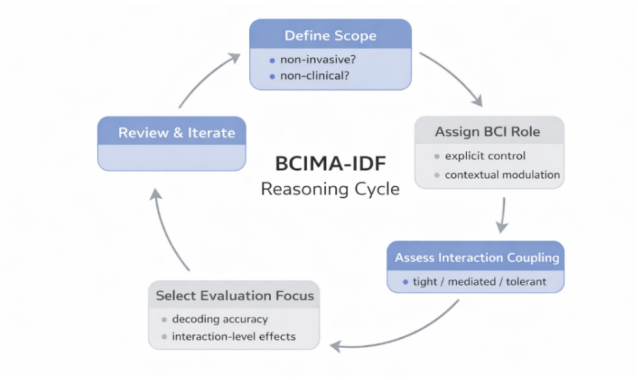
We provide a set of questions below, followed by a more extended description:
1. Scope – non-invasive and non-clinical? 2. Role of BCI – contextual or control? 3. Interaction coupling – tolerant or mediated? 4. Evaluation focus – interaction or adaptation?
The first decision concerns scope. The framework is explicitly focused on non-invasive, non-clinical BCI systems intended for everyday or exploratory interaction usage. Invasive and clinical BCI paradigms have been considered, yet remain out of scope, as their technical affordances and design constraints differ fundamentally from those of consumer-grade EEG systems. We use the term ‘yet’ because the analytical sources (Roots Analysis, 2025) suggest that invasive BCI will be democratized in the next few decades.
The second decision selects the role of BCI in interaction. Approaches are distinguished based on whether BCI signals are used for explicit control – such as issuing commands or selecting actions – or for contextual modulation, where signals influence how an Interactive AI system behaves without specifying explicit intent. This choice distinguishes between control-oriented and interaction-oriented paradigms and may be considered the central axis of the framework.
The third decision addresses interaction bandwidth, which refers to how effectively input signals influence system behavior in a reliable manner, given uncertainty, spatial, and temporal resolution. Approaches that require high precision or low latency to function are considered misaligned with the capabilities of non-invasive BCI. In contrast, approaches that rely on low- bandwidth, trend-based, or state-level modulation are considered feasible within the constraints of consumer BCI systems.
The fourth decision is the focus of evaluation. Rather than prioritizing signal decoding accuracy, the framework assesses whether an approach is a relevant type of decision on an interaction level. This shift enables comparing BCI approaches without reducing them to a single performance metric, and it prioritizes interaction over raw classification performance.
Together, these four decisions form a lightweight but systematic framework for mapping existing BCI work and for reasoning about future Interactive AI systems. The flow diagram below allows you to fast check your inputs against the framework, get the score, or reiterate.
The framework does not prescribe specific algorithms or interfaces; instead, it clarifies design assumptions and constraints, enabling consistent analysis across diverse BCI-enabled interaction paradigms.
We run the framework with the BCI research repository we’ve gathered during the last month. The results can be found in Table 1 below:
Table 1: Sample classification of BCI approaches using the BCIMA-IDF.
User Adaptation in BCI Games (Glavas et al., 2022) Workload / Attention EEG (Özkan et al., 2018) Contextual Tolerant State inference 1,1,1,0.5 (3.5)
Motor Imagery (MI) (Saibene et al. 2023)
Explicit control
Tight (action) Accuracy/latency 1,1,0,0 (2)
EEG2TEXT (Liu et al., 2024) Semantic decoding
Tight (semantic) Accuracy 1,1,0,0 (2) EEG Datasets (Xu et al., 2025) None (data) - ML benchmarks 0,0,0,0 (0)
More details can be found in the related work section, which is intentionally situated below.
BACKGROUND AND RELATED WORK Given the rapid evolution of AI and consumer neurotechnology, the literature was revisited broadly. Without formal pre-filtering, to update and expand prior knowledge, an initial sweep focused on paradigms that are reproducible with consumer-grade hardware and require minimal setup (Muse 2, 2025). This group includes motor imagery and related low-barrier paradigms such as emotion recognition and workload estimation using affordable EEG devices (Prapas et al., 2023; Glavas et al., 2022; Özkan et al., 2018). BCI-based games and gameplay interaction patterns have been systematically analyzed in earlier state-of-the- art reviews (Marshall et al., 2013), and consumer-grade EEG BCI games have been reviewed with a focus on affordable hardware and practical constraints (Vasiljevic & de Miranda, 2020). Multiple recent studies report performance levels that approach earlier laboratory and medical-grade benchmarks under constrained conditions, suggesting that certain interaction-relevant signals are now accessible outside clinical environments. This class of work is also directly aligned with our current experimental activities using consumer EEG devices.
A second cluster of literature explores near-direct or direct semantic decoding from EEG signals, correspondingly, including recent “thought-to-text” and EEG- to-language approaches supported by large language models and deep neural architectures (Mishra et al., 2025; Liu et al., 2024; Babu & Mathew et al., 2025).
As the literature base expanded, it became clear that comparing these approaches using decoding accuracy alone was insufficient at the interaction level. This observation motivated the development of a structured analytical lens, later formalized as the BCIMA-IDF framework described in this paper, inspired in part by structured reporting approaches such as PRISMA (Page et al., 2021).
The remainder of this section applies the Brain-Computer Interface Meta Analysis Interaction Design Framework (BCIMA-IDF) decision lenses with more details in the following section to represent prior work, organizing it by interaction role, coupling tolerance, and evaluation focus rather than by signal modality alone. Representative examples include co-creative and adaptive EEG interaction systems and neuroadaptive game environments (Duraisamy et al., 2025; Glavas et al., 2022).
Finally, several boundary and stress-case papers were included to test the limits of the framework, including passive neuroadaptive BCI systems and operational neuroergonomic scenarios (Krol & Zander, 2017). This worked as initially suggested, with the score of 4; two other edge cases (Duraisamy et al., 2025; Dehais et al., 2022) fall 0.5 below the initial suggestion. Such cases help clarify where the framework applies cleanly and where additional assumptions are required.
DESIGN SPACE FOR INTERACTIVE AI WITH BCI To validate the proposed interaction framework, we conducted an exploratory study using a representative consumer-grade device. The goal was not to benchmark state-of-the-art decoding, but to probe the effective interaction bandwidth – specifically, the reliability of the signal under conditions of visual distraction versus focused modulation.
Interaction Bandwidths of Non-Invasive BCI for Interactive AI 103 Rationale and Setup: We utilized the Muse 2 (Muse 2, 2025), a 4-channel dry-EEG headband (AF7, AF8, TP9, TP10), which is widely accessible but constrained by sparse sensor coverage and susceptibility to artifacts. This device represents the “lower bound” of BCI hardware likely to be integrated into consumer Interactive AI loops.
The “Boosted” Interaction Pipeline Standard: motor imagery pipelines typically rely on narrow-band filtering (8–30 Hz) and high-density spatial filters (CSP) to isolate motor cortex activity. However, our preliminary analysis indicated that consumer dry electrodes capture significant broad- band information correlated with general mental effort. To adapt to these constraints, we implemented a “Boosted” decoding pipeline: Broad-Band Filtering: A 5th-order Butterworth filter (4–40 Hz) was applied to capture Theta rhythm focus and low-Gamma activity, rejecting DC drift.
Temporal Augmentation: To compensate for a low channel count, we used a sliding-window approach (0.5s epochs with 50% overlap), doubling the density of training examples for the Linear Discriminant Analysis (LDA) classifier.
Protocol-Driven Constraints: To mitigate the “Human Factor,” we employed a “Director” protocol that automated the timing of Rest vs. Active states, enforcing a “slack jaw” and “no-blink” policy during active windows to minimize electromyographic (EMG) and electrooculographic (EOG) artifacts.
Experimental Conditions and Results: We compared decoding accuracy under two distinct interaction conditions to isolate the cost of visual attention: Condition A (Visual Control): The user kept eyes open, focusing on a fixation cross, mimicking a standard “direct control” task (e.g., steering an avatar) (Sheremetieva et al., 2023).
Condition B (Internal Modulation): The user closed their eyes and focused purely on kinesthetic sensation, mimicking a “contextual modulation” task (e.g., biasing an AI state).
Results: The difference in interaction bandwidth was statistically significant. Visual Control (Open Eyes): The system achieved a mean accuracy of 47.25%, which is statistically lower than random guessing. Visual processing and ocular micro-movements overwhelmed the frontal sensors (AF7/AF8), rendering the device unreliable for direct, continuous control tasks.
Internal Modulation (Closed Eyes): Under identical signal processing, the system achieved a peak accuracy of 84.25%.
Implications for Interaction Design: These results empirically validate the framework’s distinction between Control and Contextual roles. The drastic drop in performance during visual attention confirms that consumer BCI operates with a “fragile bandwidth” that collapses under multi-tasking loads. However, the robust accuracy of approximately 84% in the modulation condition demonstrates that the signal is reliable if treated as a dedicated, low-frequency input channel. Thus, consumer BCI is ill-suited for “joystick” operations but highly effective as a “dead man’s switch” or “focus gate” for Interactive AI.
To operationalize the proposed framework, we developed an exploratory design probe using off-the-shelf consumer hardware. The goal of the prototype was not to benchmark decoding accuracy against the clinical systems, but to empirically test the interaction bandwidth – specifically, the readability and interpretability of the signal when integrated into a real-time Interactive AI loop.
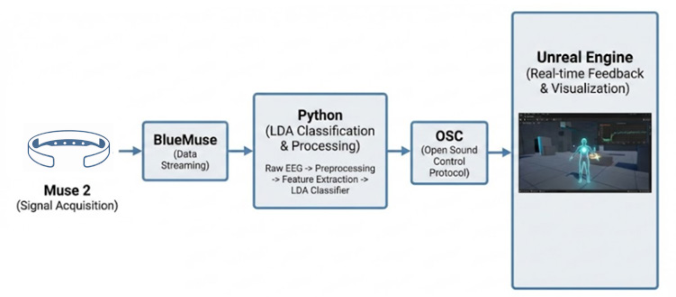
System Architecture: The prototype utilizes a modular, latency-optimized pipeline designed to bridge biological signals with game-engine environments (Figure 2).
The architecture description is summarized below, block by block:
Signal Acquisition: Raw EEG data is streamed from the Muse 2 via Bluetooth Low Energy (BLE) using BlueMuse, which rebroadcasts the signal as a Lab Streaming Layer (LSL) stream.
Decoding Engine: A custom Python middleware captures the LSL stream. It applies our “Boosted” preprocessing pipeline – specifically, a 4–40 Hz bandpass filter to capture broadband cognitive load and a sliding- window epoching strategy (0.5s, 50% overlap).
Classification: A Linear Discriminant Analysis (LDA) classifier, calibrated per session, discriminates between high-intensity mental states (e.g., focused modulation) and resting states.
Interaction Mapping: The classifier’s probabilistic output is converted into a normalized “Confidence Score” and transmitted via Open Sound Control (OSC) to Unreal Engine 5, where it drives environmental parameters (e.g., lighting intensity, fog density) rather than direct character control.
Figure 2: Exploratory prototype diagram with signal acquisition, processing, and feedback pipeline using a consumer-grade EEG device and real-time interactive visualization.
Observations: Cognitive Workload as an Adaptive Signal: Our testing revealed a distinct dichotomy in signal viability. When the user attempted visual control (Open Eyes), the system struggled to differentiate intent from ocular noise (average accuracy 47%). However, when the user shifted to a “Modulation”
Interaction Bandwidths of Non-Invasive BCI for Interactive AI 105 strategy (Closed Eyes, internal focus), the LDA classifier successfully tracked engagement shifts with high reliability (Accuracy above 84%).
LIMITATIONS AND FUTURE WORK The Fragility of Consumer-Grade EEG: The primary limitation identified is the hardware’s inability to spatially filter visual noise. The lack of central or parietal electrodes (C3/C4) means that visual processing signals often overwhelm the motor cortex activity necessary for traditional BCI paradigms. Consequently, applications must be designed around this constraint – either by mandating “eyes-closed” interaction modes or by accepting that the signal will be a noisy, low-bandwidth estimate of general workload rather than specific intent.
Longitudinal and Contextual Adaptation: Our current results are derived from discrete, session-specific calibrations. A critical gap remains in understanding long-term co-adaptation – how the user’s brain signals and the AI’s interpretation might evolve over weeks of usage. Future studies are intended to move beyond single-session probes to explore whether Interactive AI systems can “learn” a user’s specific noise profile over time or leverage feedback-loop-based compensation to effectively recover bandwidth loss in short-term benchmarks.
Based on these findings, we identify two promising directions for pilot deployment. In the gaming industry, consumer BCI should be positioned as a “passive mood director” that adjusts difficulty and atmosphere or adds more dimensions to the game design at the interaction level, based on players’ frustration and engagement levels, rather than an active controller. In research contexts, these devices offer a scalable platform for “Human-in-the-Loop” training of Generative AI (Frish et al., 2025), where the EEG signal serves as a coarse-grained Reward Model (RLHF) to align model outputs with human cognitive states without requiring explicit manual feedback.
CONCLUSION
This paper introduced the BCIMA-IDF framework as a lightweight analytical lens for reasoning about the role of non-invasive BCI for Interactive AI. Instead of treating BCI primarily as a command channel, the framework reframes consumer-grade BCI signals, such as EEG, as low- bandwidth contextual inputs better suited for adaptive modulation than for direct control.
Applying the framework across a diverse set of prior work demonstrated that high reported decoding accuracy alone is not a sufficient indicator. The distinction between control-oriented and contextual roles, together with coupling tolerance and evaluation focus, provides a more reliable basis for comparing BCI-enabled interaction approaches.
An exploratory prototype using consumer-grade EEG, LSL streaming, and a classifier provided a practical feasibility probe consistent with the framework assumptions.
Together, the proposed framework and prototype results support a design- oriented shift toward BCI-enabled Interactive AI. This perspective helps align
106 Frish and Romanovych expectations, design choices, and evaluation criteria for next-generation cognitively adaptive human-AI systems.
ACKNOWLEDGMENT
The authors would like to acknowledge the use of generative AI, specifically ChatGPT and Gemini, for text, table, and graphic processing.
REFERENCES
Atilla, F., Postma, M. & Alimardani, M., 2022. Gamification of motor imagery brain–computer interface training protocols: A systematic review. Frontiers in Human Neuroscience, 16, pp.1–18. Babu, N., Mathew, J. & Vinod, A. P., 2025. Large Language Models for EEG: A
Comprehensive Survey and Taxonomy. arXiv:2506.06353 [Preprint]. Barile, P., Barile, S., Bassano, C., Piciocchi, P., Saviano, M. and Spohrer, J. (2023).
T-Shaped Professional (T-SP) Model to support Human-Machine Interaction. In: Accelerating Open Access Science in Human Factors Engineering and Human- Centered Computing. AHFE Open Access. doi:10.54941/ahfe1003110 Dehais, F., Ladouce, S., Darmet, L., Nong, T.-V., Ferraro, G., Torre Tresols, J., Velut, S. & Labedan, P., 2022. Dual passive–reactive brain–computer interface: a novel approach to human–machine symbiosis. Frontiers in Human Neuroscience, 16, 891234. DOI: 10.3389/fnhum.2022.891234 Duraisamy, S., Roeser, N., Dubiel, M. & Leiva, L.A., 2025. An Adaptive Brain-
Computer Interface Game with Blink Controls and Cognitive State Monitoring. In: Proceedings of the 30th International Conference on Intelligent User Interfaces (IUI ’25). New York: ACM. Frish, S., Chernyshov, V., Romanovych, I. & Susulovska, N., 2025. Quantum Cats: Generative AI 3D-enabled Interactive Experience in Mixed Reality. In: AHFE Open Access Journal / Human Systems Engineering and Design. New York: AHFE DOI:10.54941/ahfe1006806. Available at: https://openaccess.cms-conferences.org/ publications/book/978-1-964867-74-8/article/978-1-964867-74-8_50 (Accessed: 05 Feb 2026). Glavas, K., Prapas, G., Tzimourta, K.D., Tzallas, A.T., Giannakeas, N. & Tsipouras,
M.G., 2022. Evaluation of the User Adaptation in a BCI Game Environment. Applied Sciences, 12, 12722. Krol, L.R. & Zander, T.O., 2017. Passive BCI-based neuroadaptive systems.
In: Proceedings of the 7th Graz Brain-Computer Interface Conference 2017. Graz: Graz University of Technology, pp. 1–6. DOI: 10.3217/978-3-85125-533-1-46 Liu, H., Hajialigol, D., Antony, B., Han, A. & Wang, X., 2024. EEG2TEXT: Open Vocabulary EEG-to-Text Decoding with EEG Pre-Training and Multi-View Transformer. arXiv:2405.02165 [Preprint]. Marshall, D., Coyle, D., Wilson, S. & Callaghan, M., 2013. Games, gameplay, and
BCI: the state of the art. IEEE Transactions on Computational Intelligence and AI in Games, 5(2), pp. 82–99. Milgram, P. & Kishino, F. (1994). A Taxonomy of Mixed Reality Visual Displays. IEICE Transactions on Information Systems, E77-D(12), pp. 1321–1329. https://www. scienceopen.com/book?vid=fe01a3a1-acee-4df9-8d5c-4fab0145bb32 Mishra, A., Shukla, S., Torres, J., Gwizdka, J. & Roychowdhury, S., 2025. Thought2Text:
Text Generation from EEG Signal using Large Language Models (LLMs). In: Findings of the Association for Computational Linguistics: NAACL 2025, pp. 3747–3759. Association for Computational Linguistics. DOI:10.18653/v1/2025.findings- naacl.207.
Interaction Bandwidths of Non-Invasive BCI for Interactive AI 107 Muse 2, 2025. Muse 2 EEG headband. Available at: https://choosemuse.
com (Accessed 05 Feb 2026). Page, M.J. et al., 2021. The PRISMA 2020 statement: an updated guideline for reporting systematic reviews. BMJ, 372, n71. Doi:10.1136/bmj.n71 Prapas, G., Glavas, K., Tzimourta, K.D., Tzallas, A.T. & Tsipouras, M.G., 2023. Mind
the Move: Developing a Brain-Computer Interface Game with Left-Right Motor Imagery. Information, 14(7), p. 354. DOI:10.3390/info14070354. Roots Analysis, 2025. Brain-Computer Interface Market Overview. Roots Analysis.
Available at: https://www.rootsanalysis.com/brain-computer-interface-market (Accessed: 05 Feb 2026). Saibene, A., Caglioni, M. & Gasparini, F., 2023. EEG-Based BCIs on Motor Imagery Paradigm Using Wearable Technologies: A Systematic Review. Sensors, 23(5), p. 2798. Sheremetieva, A. et al., 2024. What’s My Future: a Multisensory and Multimodal
Digital Human Agent Interactive Experience. Available at: https://www. researchgate.net/publication/373509013_Whats_my_future_a_Multisensory_ and_Multimodal_Digital_Human_Agent_Interactive_Experience (Accessed: 05 Feb 2026). Vasiljevic, G.A.M. & de Miranda, L.C., 2020. Brain–Computer Interface Games Based on Consumer-Grade EEG Devices: A Systematic Literature Review. International Journal of Human-Computer Interaction, 36(2), pp. 105–142. Wang, T. & Feng, X., 2023. Co-Presence, Connection, and Co-Creation: Building
Real-time Cross-person Neurofeedback Interactions. In: Proceedings of the ACM Conference on Human Factors in Computing Systems (CHI ’23). New York: ACM. Xu, J., Nunes, U. B., Jiang, W., Ryther, S., Pringle, J., Scotti, P. S., Delorme, A. & Kneeland, R., 2025. Alljoined-1.6M: A Million-Trial EEG-Image Dataset for Evaluating Affordable Brain-Computer Interfaces. arXiv:2508.18571 [Preprint]. Özkan, E., Çakır, M.P. & Eren, A., 2018. Measurement of cognitive workload by
use of combined methods including brain–computer interfaces. In: Advances in Neuroergonomics and Cognitive Engineering. Proceedings of the AHFE 2018 International Conference. Cham: Springer, pp. 107–117.
LISTED IN THE AHFE DIGITAL BOOKSTORE CATALOGUE
Explore the complete digital volume
Neuroergonomics and Cognitive Engineering
Read this individual research paper free through the original publisher, or explore the full digital proceedings book.
ISBN 978-1-964867-83-0
Explore this ISBN in the AHFE Bookstore ↗Listed in the July 2026 bookstore catalogue; search by ISBN to confirm current availability · Digital book purchase optional