Vadym Chernyshov, Ihor Romanovych, Nataliia Susulovska, Sam Frish (2025). Quantum Cats: Generative AI 3D-enabled Interactive Experience in Mixed Reality. In: Human Systems Engineering and Design (IHSED2025): Future Trends and Applications. AHFE Open Access, vol. 198, pp. 269–276. https://doi.org/10.54941/ahfe1006806
Humans love cats, at least half of humans. Quantum cats are even nicer to our minds. Thus, Generative AI (Gen AI) created and animated 3D cats of Schrödinger in mixed reality, which are close to infinite fun. In this project, we bring Schrödinger’s famous thought experiment to life by combining the power of Gen AI, Quantum Computing concepts, and Mixed Reality (MR). The result is an Interactive 3D experience that enables users to observe, influence, and explore the behaviors of AI-generated quantum cats within an immersive environment, promoting education, entertainment, and engagement.The goal is both playful and provocative: to offer a hands-on metaphor for quantum uncertainty and superposition through intuitive interactions. The project also highlights how generative AI accelerates 3D content creation, enabling rapid iteration and rich visual storytelling. By integrating these technologies, we aim to demonstrate a new kind of experiential interface – one that is scientific, artistic, and, unsurprisingly, fun.The demo includes a Gen AI-powered parts with 3D and Animation, Interactivity, Quantum and Spatial computing components. More details are presented below; the system architecture and implementation details will also be included in the final paper. Recent developments in Generative AI promise to accelerate the production speed of nearly everything, including interactive 3D experiences. Practically, Text-to-3D, Image-to-3D, and Multiview Image-to-3D provide production-ready results at least in terms of an edge Mixed Reality device. Furthermore, one can achieve not only the models but also the characters, rig them, and animate them. With the acceptable results in generation and animation, characters can be created faster than achievable by human artists, initially, and then even quicker, with better quality.We conducted a state-of-the-art literature review for 3D character generation. We performed experiments with the most promising tools and models, including Meshy 4 and 5 preview, Luma Genie, Tripo 2.5, Trellis, and Hunyuan 2.0. The generation results were visually acceptable with all the selected 3D models and tools. We identified two models that returned visually acceptable results compatible with the rig and animation pipelines. The models from Meshy and Tripo appeared to be compatible with Mixamo and Animate Anything, respectively. Our Interactive MR-enhanced demo offers a fresh perspective on the foundations of quantum computing, making them easy to grasp and even “touch”. The core idea derives from the iconic Schrödinger’s cat thought experiment with a twist. While the original setup focuses on the principle of superposition and involves a single cat to illustrate the behavior of a quantum system, which can exist in a superposition of multiple states simultaneously, we introduce additional cats to illustrate the concept of quantum entanglement. This phenomenon manifests itself in peculiar long-range correlations that cannot be accounted for classically and results in states of composite quantum systems, which cannot be factored into individual states of the constituting subsystems. The key premise of the experiment remains - the cats are placed into the box with poison vials triggered via a spontaneous mechanism of radioactive decay, introducing a true uncertainty element. As long as the box is closed to the observer, the cats can be viewed as both alive and dead at the same time. Within our virtual environment, additional separating walls can be shifted inside the box, allowing us to “entangle” the cats. Namely, if the cats are located in the same box compartment impacted by the same poison vial, upon inspection, they will both be found either alive or dead. The inspection itself is performed by opening the box and illustrates the measurement in quantum mechanics, which results in the collapse of the superposition to a single definitive state. In the light of quantum computing, cats in the proposed demo represent a system of qubits, while user interaction with cats’ results in unitary transformations applied to the state of this system. This is visualized using a dedicated widget containing a quantum circuit for state preparation. Therein, superposition is generated utilizing Hadamard gates, and the entanglement is introduced through the action of two-qubit CNOT gates. The state evaluation procedure is performed in a simulated manner. To implement the human-computer interaction system, we utilized the Magic Leap Unreal Engine SDK. During the development phase, we experimented with various input methods — both controller-based and hand-tracking — and ultimately chose hand-tracking for its ability to deliver a more intuitive, natural, and immersive user experience.We briefly presented our research and experimental work in Gen AI 3D and the HCI domain, incorporating the flavor of quantum physics.
The demo features Gen AI-powered components, including 3D and Animation, Interactivity, Quantum, and Spatial computing. Recent developments in Generative AI (Frey and Osborne, 2023) promise to accelerate the production speed of nearly everything, including interactive 3D experiences. Practically, Text-to-3D (Hong et al., 2024), Image-to-3D (Wang et al., 2024), and Multiview Image-to-3D (Melas-Kyriazi et al., 2024) provide production-ready results at least in terms of an edge Mixed Reality device. Furthermore, one can achieve not only the models but also the characters, rig them, and animate them. With acceptable results in generation and animation, characters can be created faster than achievable by human artists, initially, and then even quicker, with better quality.
GENERATIVE AI We present research on how to accelerate the production speed of interactive 3D experiences using Generative AI (Frey and Osborne, 2023). We have
experimented with various Text-to-3D (Hong et al., 2024), Image-to-3D (Wang et al., 2024), and Multiview Image-to-3D (Melas-Kyriazi et al., 2024) methods and achieved production-ready results, at least in terms of an edge Mixed Reality device. Furthermore, one can achieve not only the models with Text-to-3D but also create characters, rig them, and animate them. With visually acceptable results in generation and animation, characters can be produced faster than human artists can create them, and even more quickly with a relatively high quality. Moreover, the models of the characters can be applied with retopology for the edge device in our case.
3D Character Generation We conducted a state-of-the-art literature review, which is outside the scope of this study, selected candidates, and performed experiments with the most promising ones, including Meshy 4 and 5 preview (Meshy, 2024), Luma Genie (Luma AI, 2025). Tripo 2.5 (Tripo3d.ai, 2025), Trellis (Xiang et al., 2025), Hunyuan 2 (Zhao et al., 2025). The generation results were visually acceptable with all the listed 3d models and character generation models used. We identified two models that returned visually acceptable results with the rig and animation pipelines, which we describe in the following session.
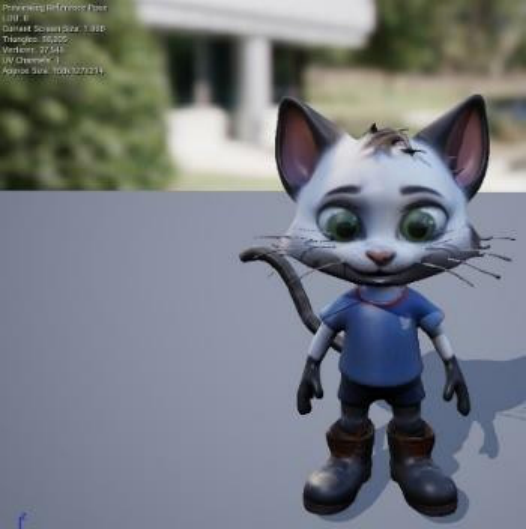
Figure 1: Text to 3D cat inside the Unreal Engine editor.
Rig and Animation The models from Meshy (Meshy, 2024) and Tripo (Tripo3d.ai, 2025) appeared to be compatible with Mixamo (Adobe, 2019). Moreover, Animate Anything (Anything World, 2025), Tripo, and Meshy provide the entire
Quantum Cats: Generative AI 3D-Enabled Interactive Experience in Mixed Reality 271
pipeline, from Text- to-3D (Hong et al., 2024) and Image-to-3D (Wang et al., 2024) to the animation itself. However, the combined pipeline offers richer possibilities, as Mixamo (Adobe, 2019) has an animation library that is an order of magnitude larger. Mixamo provides a semi-automated method for rigging characters, which requires manual setting of key points for hands or legs. In contrast, Animate Anything (Anything World, 2025) offers an entirely automated approach for rigging humanoid characters, AI rig, and animations.
QUANTUM COMPUTING The rapid rise of quantum technologies, which marks a computational paradigm shift and offers an unprecedented advantage over classical capabilities (Montanaro, 2016; Daley et al., 2022), calls for innovative educational approaches aimed at explaining quantum mechanical concepts, which are often counterintuitive and fall beyond the common human experience.
The core idea of the demo derives from the iconic Schrödinger’s cat (Trimmer, 1980) thought experiment with a twist. While the original setup focuses on the principle of superposition and involves a single cat to illustrate the behavior of a quantum system, which can exist in a superposition of multiple states simultaneously, we introduce additional cats to illustrate the concept of quantum entanglement. This phenomenon manifests itself in peculiar long-range correlations that cannot be accounted for classically and results in states of composite quantum systems, which cannot be factored into individual states of the constituting subsystems (Einstein, 1935; Horodecki 2009). The key premise of the experiment remains - the cats are placed into the box with poison vials triggered via a spontaneous mechanism of radioactive decay, introducing a true uncertainty element. As long as the box is closed to the observer, the cats can be viewed as both alive and dead at the same time. Within our virtual environment, additional separating walls can be shifted inside the box, allowing us to “entangle” the cats. Namely, if the cats are located in the same box compartment impacted by the same poison vial, upon inspection, they will both be found either alive or dead. The inspection itself is performed by opening the box and illustrates the concept of measurement in quantum mechanics, which results in the collapse of the superposition to a single definitive state. In the light of quantum computing, cats in the proposed demo represent a system of qubits, while user interaction with cats results in unitary transformations applied to the state of this system (Barenco et al., 1995). This is visualized using a dedicated widget containing a quantum circuit for state preparation. Therein, superposition is generated utilizing Hadamard gates, and the entanglement is introduced through the action of two-qubit CNOT gates (Williams, 2011). The state evaluation procedure is performed in a simulated manner. The experiment repeatability feature illustrates the workflow of a real quantum device, where a large number of measurement “shots” is performed over a pure state ensemble to extract information about the probability distribution.
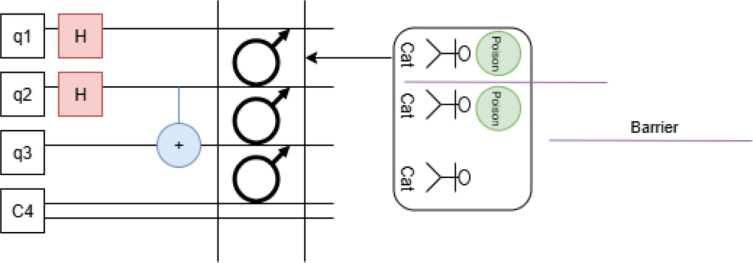
Figure 2 presents a quantum circuit for preparation of Schrödinger’s cat state corresponding to a given experimental setup, where one of the cats is separated from the others by the barrier placement. The state of the subsystem of qubits corresponding to the cats located in the same box compartment and affected by the same poison vial is entangled, which is facilitated by the application of a CNOT gate. The block on the right represents the experimental setup and one of the possible measurement outcomes corresponding to the scenario where all the cats stay alive.
Figure 2 illustrates the quantum circuit setup for the experiment.
Figure 2: A quantum circuit for preparation of a 3-qubit Schrödinger’s cat state corresponding to the experimental setup illustrated with the block on the right.
INTERACTIVITY Our Interactive MR-enhanced (Dang et al., 2025) demo offers a fresh perspective on the foundations of quantum computing, making them easy to grasp and even “touch” (Sheremetieva et al., 2022).
To implement the interaction system, we utilized Magic Leap (Magicleap.com, 2025) and Unreal Engine SDK (Magicleap.cloud, 2024). During the development phase, we experimented with various input methods — both controller-based and hand-tracking — and ultimately chose hand-tracking for its ability to deliver a more intuitive, natural, and immersive user experience.
As we have already mentioned, the core concept of the project was based on Schrödinger’s thought experiment, in which a cat exists in a state of quantum superposition — both alive and dead — until it is observed. Our goal was not only to visualize this paradox, but to let users physically participate in it. To achieve this, we implemented a two-finger pinch gesture that allowed users to pick up and move virtual cats. This interaction was designed to evoke a delicate and careful feel, as if the user were gently placing a fragile creature into a box, thereby reinforcing the idea of uncertainty and emotional investment in the cat’s quantum fate. The gesture transformed a simple action into an immersive moment of presence and responsibility within the experiment.
The same gesture was used to place poison vials near the cats, allowing users to “conduct” the experiment with their own hands. This intentional
Quantum Cats: Generative AI 3D-Enabled Interactive Experience in Mixed Reality 273
design emphasized the role of the observer, tying the user’s physical actions directly to the unfolding of the quantum event.
We assumed that people would place less poison when cats are already in the box; thus, we designed and implemented a workflow that lets place cats first, followed by walls and poison vials.
To support this process, we created a compact virtual control panel with large, colorful, and tactile buttons. Each button triggered a specific phase of the simulation: placing the cats, adding poison, and initiating the observation. The buttons were activated through direct hand interaction, further enhancing the physicality and realism of the experience.
Overall, the interaction system not only supported gameplay but reinforced the philosophical and conceptual foundation of the experience, making the user an active participant in the quantum experiment.
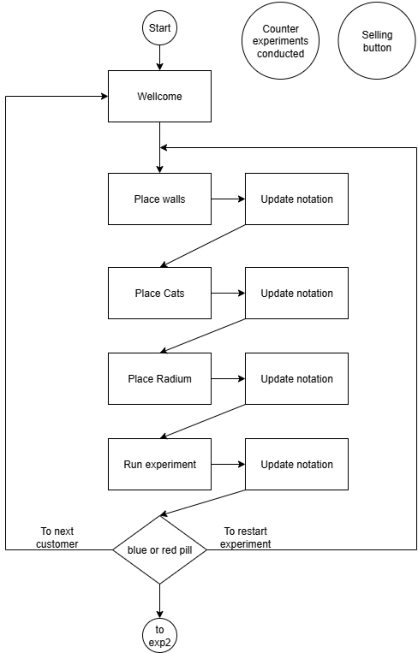
SYSTEM ARCHITECTURE Our system architecture integrates quantum computation principles, generative AI (Frey and Osborne, 2023), and mixed reality (MR) (Dang et al., 2025) interaction into a cohesive experimental pipeline (Figure 2). The portion of the architecture on the left visualizes a quantum circuit, where three qubits are initialized in superposition via Hadamard gates and entangled using controlled operations (Youvan, 2024). The measurement results represent the quantum “cat” states – an allusion to Schrödinger’s cat – driving variability in the experiment outcomes (Pati and Braunstein, 2009). Figure 3 illustrates the system architecture with a flow diagram. The lower flowchart maps these quantum states to an MR-driven interactive experience. Users begin with a guided setup that involves placing environmental components – walls, cats, and poison – within the MR space. Each action updates the system state, reflecting changes in both visual and quantum notation. The quantum logic outcomes determine variations in the animated 3D cat models and experimental outcomes, ensuring unpredictability and engagement.
Such a cyclical pipeline enables either repeating the experiment or transitioning users to the next phase via a metaphorical “blue or red pill” choice, allowing for replayability and personalization (Dang et al., 2025). The tight coupling between quantum computation and MR interactivity forms the core of our system, aligning cutting-edge technologies into a singular, user-centered experience.
DISCUSSION
We have covered a wide range of topics, including Generative AI, Quantum Computing, and Human-Computer Interaction. The most discussed topic in our minds is in the HCI domain: Is such a mixture
Figure 3: System architecture with a flow diagram.
engaging and educational? Are interaction styles and flow natural enough? Also, from the productivity and social implications side, the text-to-3D generation, AI-enabled animation, and rig are welcomed by creative humans. Finally, what would be the future steps for such experiences?
CONCLUSION
We have briefly presented our research and experimental work in Gen AI 3D and the Interactivity domain, incorporating the flavor of quantum physics through a thought experiment visualization and promotion. Users at the expos were satisfied with the natural and intuitive human-computer interaction (HCI). Gen AI in 3D accelerates prototyping cycles, fuels creativity, and speeds up production, demonstrating enormous potential in complex and futuristic fields, alongside its broad adoption across various industries. Gen AI 3D Quantum cats in MR are fun.
Quantum Cats: Generative AI 3D-Enabled Interactive Experience in Mixed Reality 275
Anything World — Creativity powered by Machine Learning. [online] Available at: https://anything.world/. [Accessed 3 Jul. 2025]. Barenco, A., Bennett, C. H., Cleve, R. (1995). ‘Elementary gates for quantum
computation’, Phys. Rev. A, 52(3457). Available at: https://doi.org/10.1103/ PhysRevA.52.3457. Chen, Z. et al. (2025). ‘3DTopia-XL: Scaling High-quality 3D Asset Generation via Primitive Diffusion’, arXiv [cs. CV] [Preprint]. Available at: http://arxiv.org/abs/ 2409.12957. Dang, B. et al. (2025). ‘Human–AI collaborative learning in mixed reality: Examining
the cognitive and socio-emotional interactions’, British Journal of Educational Technology. Available at: https://doi.org/10.1111/bjet.13607. Einstein, A., Podolsky, B., Rosen, N. (1935). ‘Can Quantum-Mechanical Description of Physical Reality Be Considered Complete?’, Phys. Rev., 47(777). Available at: https://doi.org/10.1103/PhysRev.47.777. Frey, C. & Osborne, M. (2023). The Oxford Martin Working Paper Series on
the Future of Work Generative AI and the Future of Work: A Reappraisal. [online] Available at: https://oms-www.files.svdcdn.com/production/downloads/ academic/2023-FoW-Working-Paper-Generative-AI-and-the-Future-of-Work-A- Reappraisal-combined.pdf. Hong, F. et al. (2024) ‘3DTopia: Large Text-to-3D Generation Model with Hybrid Diffusion Priors’, arXiv [cs. CV] [Preprint]. Available at: http://arxiv.org/abs/ 2403.02234. Horodecki, R., Horodecki, P., Horodecki, M. (2009). ‘Quantum entanglement’, Rev.
Mod. Phys., 81(865). Available at: https://doi.org/10.1103/RevModPhys.81.865. Luma AI - Genie. [online] Luma AI - Genie. Available at: https://lumalabs.ai/genie. [Accessed 3 Jul. 2025]. Magicleap.cloud. (2024). Unreal Engine 5 SDK Overview | MagicLeap Developer
Documentation. [online] Available at: https://developer-docs.magicleap.cloud/ docs/guides/unreal/unreal-overview/. Accessed 3 Jul. 2025]. Magicleap.com. (2025). Magic Leap 2 Devices. [online] Available at: https:// www.magicleap.com/legal/devices-ml2. [Accessed 3 Jul. 2025]. Melas-Kyriazi, L. et al. (2024) ‘IM-3D: Iterative Multiview Diffusion and Reconstruction for High-Quality 3D Generation’, arXiv [cs. CV] [Preprint]. Available at: http://arxiv.org/abs/2402.08682. Meshy - Free 3D Models Generated from Images and Text. (2024). Text to 3D -
Features - Meshy. [online] Available at: https://www.meshy.ai/features/text-to-3d. [Accessed 3 Jul. 2025]. Montanaro, A. (2016). ‘Quantum algorithms: an overview’, npj Quantum Information 2, 15023. Available at: https://doi.org/10.1038/npjqi.2015.23. Daley, A. J., Bloch, I., Kokail, C. et al. (2022). ‘Practical quantum advantage in quantum simulation’, Nature 607, 667–676. Available at: https://doi.org/10.1038/ s41586-022- 04940-6. Pati, A. K. and Braunstein, S. L. (2009). REVIEWS Role of entanglement in quantum computation. Journal of the Indian Institute of Science, [online] 89(3). Available at: https://www.researchgate.net/publication/ 228390144_REVIEWS_Role_of_entanglem ent_in_quantum_computation. Siddiqui, Y. et al. (2024) ‘Meta 3D AssetGen: Text-to-Mesh Generation with
High-Quality Geometry, Texture, and PBR Materials’, arXiv [cs. CV] [Preprint]. Available at: http://arxiv.org/abs/2407.02445.
Sheremetieva, A. et al. (2022) ‘Touch the Story: An immersive mid-air haptic experience’, in 2022 International Conference on Interactive Media, Smart Systems and Emerging Technologies (IMET), pp. 1–3. Available at: https://doi.org/ 10.1109/IMET54801.2022.9929479. [Accessed 3 Jul. 2025]. Shi, Y. et al. (2024) ‘MVDream: Multi-view Diffusion for 3D Generation’, arXiv
[cs. CV] [Preprint]. Available at: http://arxiv.org/abs/2308.16512. Tang, J. et al. (2024) ‘LGM: Large Multi-View Gaussian Model for High-Resolution 3D Content Creation’, arXiv [cs. CV] [Preprint]. Available at: http://arxiv.org/abs/ 2402.05054. Trimmer, J. D. (1980). ‘The Present Situation in Quantum Mechanics: A Translation
of Schrödinger’s “Cat Paradox”Paper’, Proceedings of the American Philosophical Society, 124(5). Tripo3d.ai. (2025). Platform of Tripo AI. [online] Available at: https:// platform.tripo3d.ai/. [Accessed 3 Jul. 2025]. Wang, Z. et al. (2024) ‘Phidias: A Generative Model for Creating 3D Content from Text, Image, and 3D Conditions with Reference-Augmented Diffusion’, arXiv [cs. CV] [Preprint]. Available at: http://arxiv.org/abs/2409.11406. Williams, C. P. (2011). ‘Quantum Gates’, in: Explorations in Quantum Computing.
Texts in Computer Science. Springer, London. Available at: https://doi.org/ 10.1007/978-1-84628-887-6_2. Xiang, J. et al. (2025) ‘Structured 3D Latents for Scalable and Versatile 3D Generation’, arXiv [cs. CV] [Preprint]. Available at: http://arxiv.org/abs/ 2412.01506. Youvan, D. C. (2024). Exploring the Hadamard Gate: A Gateway to Quantum Parallelism and Beyond. ResearchGate. [online] doi: https://doi.org/10.13140/ RG.2.2.29754.16327. Zhao, Z. et al. (2025) ‘Hunyuan3D 2.0: Scaling Diffusion Models for High
Resolution Textured 3D Assets Generation’, arXiv [cs. CV] [Preprint]. Available at: http://arxiv.org/abs/2501.12202.
LISTED IN THE AHFE DIGITAL BOOKSTORE CATALOGUE
Explore the complete digital volume
Human Systems Engineering and Design (IHSED2025): Future Trends and Applications
Read this individual research paper free through the original publisher, or explore the full digital proceedings book.
ISBN 978-1-964867-74-8
Explore this ISBN in the AHFE Bookstore ↗Listed in the July 2026 bookstore catalogue; search by ISBN to confirm current availability · Digital book purchase optional