Luyao Liu, Zhiyu Zhao (2026). Design Strategies for Mobile Games on ICH Education Based on Artificial Intelligence: A Case Study of Huangmei Cross-stitch Culture. In: Human Factors in Communication of Design. AHFE Open Access, vol. 216, pp. 288–298. https://doi.org/10.54941/ahfe1007645
Under the influence of globalisation and digitalisation, intangible cultural heritage (ICH) faces an inheritance crisis. This research focused on Huangmei cross-stitch culture in Hubei, China, exploring innovative applications of AI technology in designing popular science games about ICH. The study used literature review, questionnaires, and design practices. Based on the ARCS motivation model and the four-part method of game elements, a ‘Motivation-Experience’ dual-driven design model was proposed. An edutainment Cross-stitch Dream APP was developed based on this new model. This research demonstrated the dual value of AI in the digitalisation of ICH: improving interaction efficiency technically and engaging the recognition of young people culturally. This design addresses the issues of weak interactivity and high learning barriers in traditional ways of spreading ICH, opening a new replicable path for digital inheritance.
In the digital era, intangible cultural heritage ICH popularization APPs serve as a bridge connecting traditional culture with modern life (Zhou, 2018; Chen, Zhou & Xu, 2024). However, traditional ICH like Huangmei cross-stitch faces significant inheritance difficulties under the impact of modernisation. Huangmei cross-stitch, a distinctive traditional ICH in Huangmei County, Hubei Province, embodies rich regional culture and historical information, making it a treasure of ICH. This study explores innovative APP game design strategies for ICH popularisation using Huangmei cross-stitch as a case study. By integrating the ARCS motivation model with the four-factor model of game elements, this study develops a theoretical framework to enhance players’ learning motivation and participation, thereby increasing the educational significance of the game.
THEORETICAL MODELS AND DESIGN METHODS FOR ICH POPULARISATION APP GAME DESIGN ARCS Motivation Model and Four-Factor Model of Game Elements
Users’ engagement with popular science APPs constitutes a form of learning (Li, 2023). To effectively communicate ICH knowledge, enhance user concentration, and improve the communication efficiency of ICH popularisation APPs, this study integrates the ARCS learning motivation model with the four-factor model of game elements (Wang, 2023; Liu, Xie & Zhang, 2025). Originally based on the expectancy-value theory (Keller, 1987) and recognized for its high applicability across different learning fields (Li & Keller, 2018), the ARCS model consists of four key elements:
Attention: stimulating and holding learners’ focus
Relevance: connecting content to learners’ needs
Confidence: providing support and feedback
Satisfaction: creating fulfilling experiences The four-factor model of game elements is a game analysis model proposed by Jesse Schell in his book The Art of Game Design (Schell, 2016). He divided the basic elements of the game into four parts: Mechanics, Story, Aesthetics and Technology. Mechanics refer to the basic operating logic and rules of the game. The four-factor model provides theoretical support at the content level through Mechanics (operating logic), Story (narrative content), Aesthetics (visual and auditory elements), and Technology (technical support). By combining these two frameworks, the design of ICH popularisation mobile games can enhance users’ learning motivation and comprehensively improve the game experience across four dimensions, achieving edutainment and effective cultural preservation.
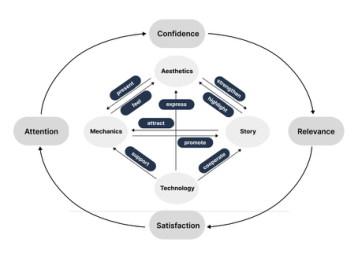
New ‘Motivation-Experience’ Dual-Driven Design Model Combining the ARCS motivation model and the four-factor theory of game design, this study proposes a new ‘Motivation-Experience’ dual-driven design model to guide ICH popularisation game design. The framework aligns the elements as follows:
Figure 1: New ‘motivation-experience’ dual-driven design model.
Attention and Mechanics: attract players’ attention by designing innovative game mechanics, such as using unique interaction methods or creative gameplay. These mechanics should encourage players to ask questions and explore, like promoting the game experience through solving puzzles and discovering new things. Game mechanics must evolve constantly to keep players’ interest, such as updating rules or introducing new challenges.
Relevance and Story: the story content should relate to players’ backgrounds and experiences so they can see themselves in the ICH story. The game’s goals should align with ICH’s cultural values and educational objectives, allowing players to learn ICH knowledge while working toward those goals. Additionally, the storyline should match players’ personal motivations, enabling them to experience the significance of ICH through role-playing and situational simulation.
Confidence and Aesthetics: the aesthetic design of the game should convey a sense of success and achievement, such as enhancing players’ self-confidence through visual and sound effects. At the same time, aesthetic elements should be designed into an environment that can provide challenges and give players hope for success, such as motivating players through artistic style and atmosphere creation. The aesthetic feedback of the game should also help players correctly attribute success and failure, and enhance their self-efficacy through positive visual effects and feedback.
Satisfaction and Technology: technology should support the natural flow of the game, enabling players’ actions to organically influence the game world and foster a sense of satisfaction. It should also facilitate the implementation of unexpected reward mechanisms, such as granting spontaneous rewards through random events or achievement systems, increasing the interest of the game’s appeal. Furthermore, it should ensure that players’ efforts receive positive feedback, like allowing players to share their achievements via social features, thereby enhancing their sense of satisfaction.
Through such alignment and integration, a game for popularizing ICH that motivates players to learn and offers a rich gaming experience can be developed. This approach can help balance education and entertainment, and effectively promote and protect ICH. To verify the practicality of this model, subsequent user evaluations will focus on its four core elements (Attention-Mechanics, Relevance-Story, Confidence-Aesthetics, Satisfaction-Technology). Specifically, evaluation metrics will be set for each element (e.g., measuring Attention through engagement duration, assessing Relevance via users’ perception of the connection between ICH and everyday life), with empirical data collected to confirm whether each element meets its intended objective. This ‘Design, Evaluation, Verification’ process will ensure the model is not merely theoretical but serves as a practical guide for designing ICH popularisation games.
CONNOTATION AND DESIGN ANALYSIS OF HUANGMEI CROSS- STITCH CULTURE Huangmei cross-stitch culture is selected as the main research object of the game strategy, mainly based on the consideration of four dimensions:
Design Strategies for Mobile Games on ICH Education Based on Artificial 291 cultural value, inheritance dilemma, market potential and game adaptability. Huangmei cross-stitch is a unique traditional handicraft in Huangmei County, Hubei Province, which contains rich regional culture and historical information. Its patterns often carry the local people’s yearning for a better life, and have special applications and meanings in folk activities such as weddings and festivals. It is an important material for studying local folk culture and traditional aesthetic concepts (Liu & Xu, 2023). Integrating it into the game can allow players to come into contact with authentic ICH and enrich the cultural connotation of the game.
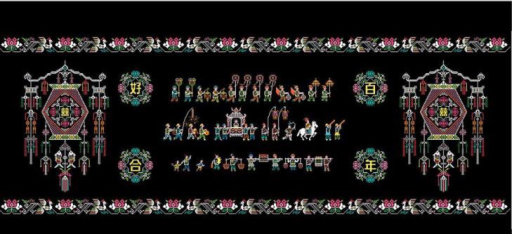
Huangmei cross-stitch has a long cultural background and contains rich folk cultural connotations. It plays an important role in marriage customs, and its patterns are closely related to marriage rituals. When a girl gets married, the clothes and supplies in her dowry are often decorated with Huangmei cross-stitch. These cross-stitch works are not only a symbol of the bride’s family wealth and status, but also a display of the bride’s craftsmanship and aesthetics. Common patterns in cross-stitch such as Enge Peach and Phoenix Chasing Phoenix, imply conjugal love and a harmonious marriage for a hundred years, reflecting people’s good wishes for a happy marriage and a happy family. (Pan, 2016). ‘Wedding Procession Picture’ also occupies an important position in Huangmei cross-stitch. It is not only a decoration, but also a record and inheritance of local marriage customs. In Chu culture, marriage is a major event in life. The grandeur and festivity of the wedding procession symbolise the union of two families and the beginning of a new life. Wedding Procession Picture permanently records this traditional custom in an artistic form, making it a part of culture. (Lian & Zhang, 2022).
The wedding patterns of Huangmei cross-stitch have great potential in digitalisation and gamification. Through digital technology, these traditional patterns can be transformed into interactive learning tools, allowing players to understand and experience the culture and skills of Huangmei cross-stitch in the game process. Therefore, the authors will design a game themed on Huangmei cross-stitch, in which players can play the role of tourists or cross- stitch artists, unlock new patterns and stories by completing tasks related to marriage, and learn the history and cultural background of cross-stitch at the same time. This design can not only attract players’ interest, but also effectively spread Huangmei cross-stitch culture, making it glow with new vitality in modern society.
Figure 2: Traditional Huangmei cross-stitch wedding procession picture.
292 Liu and Zhao CONCEPTUAL GAME DESIGN OF HUANGMEI CROSS-STITCH EMPOWERED BY THEORETICAL MODELS AND AI
Functions and Modules of Cross-Stitch APP The aim is to research and design a conceptual cultural popularisation mobile game APP, which can allow users to receive the input of Huangmei cross- stitch. Consequently, using lower cost to solve the dilemma of spreading this ICH culture. The authors intend to digitally and artistically integrate the original cross-stitch culture content into the APP. With the assistance of artificial intelligence (AI) and combining the theoretical model proposed above, users’ interest in the ICH of Huangmei cross-stitch through a colorful open-world game scenario and rich story interactions will be stimulated:
Attention and Mechanics: open-world game scenario exploration: this part is the core of the design and plays a crucial role in increasing user engagement. To align with the ‘Motivation-Experience’ dual-drive model, AI technology is integrated into the design to optimize the mechanism. Through AI algorithms, personalized exploration tasks are dynamically created. For example, there are embroidery puzzles based on Huangmei cross-stitch patterns. The difficulty level adjusts in real time based on user behavior data to maintain a balance between challenge and achievement. Additionally, the authors used AI to generate procedural Huangmei folk scene settings, allowing users to participate in wedding and marriage- related plots from a first-person perspective. The authors also employed Natural Language Processing (NLP) technology to build an intelligent narrative system, making conversations between users and Non-Player Characters (NPCs) more interactive. Every user response can influence the storyline’s direction. Furthermore, AI triggers diverse cultural knowledge points based on conversation content, avoiding a linear and didactic approach. This significantly enhances the game’s freedom and personalization. Users are encouraged to participate in AI-generated decryption games or uncover new elements within the plot to drive story development. This AI-supported dynamic mechanism helps maintain users’ interest continuously.
Relevance and Story: background plot and player settings: this part needs to assist the innovative game mechanism of open-world game scenario free exploration proposed above. It needs to improve users’ initiative in promoting the development of the plot in the plot setting. The authors designed the story content into scenes such as blocks that most users have been exposed to, which are related to users’ backgrounds and experiences. The protagonist is designed as a foreigner exploring this block, which is in line with most people’s motivation to explore the world. Through immersive role-playing, players can realise the importance of the ICH of cross-stitch. Furthermore, the goals of the game should be consistent with the cultural value and educational goals of the ICH, so that players can learn ICH knowledge while pursuing the game goals. When players complete tasks, NPCs will in combination with the cultural knowledge base retrieved in real time by AI, communicate customised knowledge
Design Strategies for Mobile Games on ICH Education Based on Artificial 293 content with users. For example, based on the users’ interests, NPCs may focus on elaborating on the symbolic meaning of the Phoenix Pursuing Phoenix pattern or the origin of the cross-stitch techniques in Huangmei embroidery. Thus, the effect of enabling users to understand the Huangmei cross-stitch culture imperceptibly can be achieved.
Confidence and Aesthetics: cross-stitch pattern customisation: the aesthetic design of the game should convey a sense of success and achievement, such as enhancing players’ self-confidence through visual and sound effects. The authors placed particular emphasis on introducing the AI-assisted creation feature. Using AI-based painting tools (like Ideogram), an intelligent creation module was built. When users input keywords (for example, modern geometry + traditional floral motifs), draft patterns of Huangmei cross-stitch can be generated. The AI system automatically produces variations based on traditional color-matching rules, giving users options and significantly lowering the barrier to design. Additionally, the AI animation engine traces the trajectories of cross-stitch techniques, enhancing the immersion during the creative process. On this foundation, users can further refine their designs or directly print patterns onto daily items for customised production, creating a meaningful link between real life and intangible cultural heritage. The AI-assisted approach not only boosts users’ visual sense of accomplishment and self-efficacy but also broadens participation in intangible cultural heritage by making creation easier. As a result, it effectively supports dissemination and science education.
Satisfaction and Technology: social module and achievement display: in this section, technology should support the natural flow of the game, allowing players’ behaviors to organically influence the game world, thereby providing a sense of satisfaction. During the design process, multi-terminal adaptation can be achieved through lightweight AI models. Machine learning techniques are used to analyse user operation data, including error rates and dwelling times. Based on this analysis, the triggering logic of random events and the achievement system are dynamically adjusted. For novice players, AI-generated achievement items can be triggered for guidance. In contrast, skilled players can unlock special rewards related to freeform creation, enhancing the game’s entertainment value. Additionally, the community interaction feature can intelligently recommend creative works that match users’ interests, encouraging idea exchange and collision. The achievement display cabinet uses AI to organise the knowledge graphs collected by users, which helps users review their learning accomplishments.
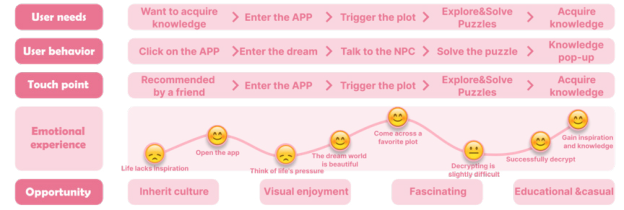
User Experience and Interface Design The interface design of the APP should focus on user experience, offering a smooth gameplay experience through intuitive controls and a user- friendly interface (Zhan, 2021). Therefore, the UI design for this conceptual game adheres to the principles of simplicity, clarity, logicality, and strong adaptability. Additionally, it enhances immersive UI design capabilities through AI, such as matching the interface style with the game theme, incorporating animated interface elements, and providing interactive feedback. The creators developed a user journey map to analyse users’
294 Liu and Zhao experience. This diagram traces the sequence of users’ needs and behaviors from their initial contact with the APP, through understanding and usage, to gaining benefits. It specifically examines users’ emotional changes during the process of using the APP. Based on this, the author has identified key opportunities for APP design.
Figure 3: User journey map of cross-stitch dream.
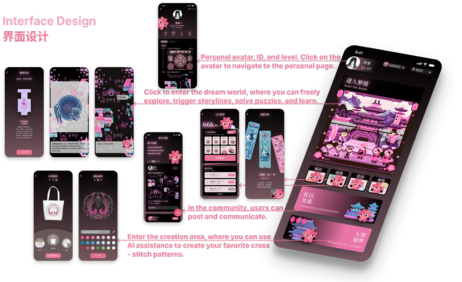
Prototype Design of Conceptual Cross-Stitch Dream Game The authors used AI to enhance UI immersion, reflected in three aspects. First, regarding interface style, AI drawing tools (such as Ideogram) generate pattern elements (like borders and icon backgrounds) that align closely with the theme of Huangmei embroidery, naturally blending the visual style with the core theme of the game. Second, around interface element animation effects, the AI animation engine simulated the intricate trajectories of embroidery stitches. This creates dynamic transitions, such as the movement of embroidery threads when buttons are clicked or pages are switched, improving interaction immersion. Regarding interaction feedback, AI analysed user operation data (such as click frequency and dwell time) to intelligently adjust the feedback’s intensity and form—novice users receive more noticeable animation prompts, while experienced users get concise, efficient feedback to minimise disruption. Regarding interface colour design, the authors combined the features of Huangmei cross-stitch works by using indigo fabric as the base and colourful embroidery threads. They used black and pink as the main colours, with black as the background and vibrant, high-saturation pink as the accent.
Figure 4: Interface design of cross-stitch dream.
Design Strategies for Mobile Games on ICH Education Based on Artificial 295 USER EVALUATION OF HUANGMEI CROSS-STITCH APP
User Evaluation Method and Summary of Feedback The evaluation goal of this study is to verify whether each model element achieves its preset effect, such as determining if Confidence-Aesthetics successfully enhances users’ sense of accomplishment. To achieve this, the evaluation is structured around four targeted dimensions aligned with the model’s core elements, each featuring specific indicators. Specifically, Attention Effectiveness (for Attention-Mechanics) is measured by average engagement time and re-engagement rate, while Relevance Perception (for Relevance- Story) is assessed through users’ recognition of the connection between intangible cultural heritage (ICH) and real life, as well as plot resonance. Additionally, Confidence Enhancement (for Confidence-Aesthetics) is evaluated based on the users’ sense of accomplishment during creation and their confidence in skill mastery. Finally, Satisfaction Degree (for Satisfaction- Technology) is measured by reward satisfaction and users’ willingness to share socially. To accurately capture these metrics, the questionnaire design includes specific questions directly linked to model details, such as asking users, “How long did you engage in AI-generated embroidery puzzles?” to evaluate Attention-Mechanics.
In November 2024, through an Internet survey, 89 questionnaires were sent to teachers and students at the School of Design of a university on the premise of protecting the privacy of respondents, and 66 people responded. This project has effectively realised the multi-dimensional inheritance and innovation of Huangmei cross-stitch through the game-based communication mechanism.
Connection Between Evaluation Results and ‘Motivation-Experience’ Dual-Driven Design Model This study empirically evaluated the four core components of the proposed model using survey data aligned with the predefined evaluation framework.
Attention-Mechanics (indicators: average engagement time, re-engagement rate): 81.8% of participants engaged with AI-generated dynamic embroidery puzzles for over 30 minutes, exceeding the 20-minute target threshold. 68.2% re-engaged within three days to explore additional folk- themed scenes. These results indicate that the “AI dynamic tasks + open- world exploration” mechanism effectively sustains user attention, fulfilling the model’s design objective. The 18.2% reporting low engagement were primarily attributable to minor initial difficulty calibration issues which is a refinement priority for subsequent iterations.
Relevance-Story (indicators: recognition of ICH–life connections, plot resonance): 78.8% explicitly recognized the contextual link between Huangmei cross-stitch and real-world marriage rituals through narrative wedding plots. 72.7% demonstrated sustained interest in dowry- related cultural narratives delivered by non-player characters (NPCs). Collectively, these findings confirm that the “modular scene design +
296 Liu and Zhao NPC-mediated cultural exposition” strategy strengthens experiential relevance between intangible cultural heritage (ICH) and users’ everyday frames of reference.
Confidence-Aesthetics (indicators: perceived accomplishment in creative activity, self-reported confidence in skill acquisition): 86.4% reported a strong sense of accomplishment following completion of AI-generated cross-stitch drafts. 80.3% indicated that simulated embroidery trajectories meaningfully enhanced their confidence in executing traditional cross- stitch techniques. Thus, the integration of “AI-assisted ideation + culturally grounded aesthetic rendering” successfully operationalizes the principle that aesthetic scaffolding fosters user confidence through iterative, low-risk creative success.
Satisfaction-Technology (indicators: satisfaction with adaptive rewards, willingness to share outputs socially): 80.3% expressed satisfaction with AI-personalized achievement unlocks. 74.2% voluntarily shared their AI-generated embroidery patterns in community forums or social platforms. This supports the efficacy of the “dynamic achievement system + integrated social dissemination module” in delivering timely, personalized reinforcement and fostering organic peer engagement— thereby substantiating the model’s foundational premise that technology- mediated feedback mechanisms underpin user satisfaction.
Empirical data shows 92.4% of participants lacked in-depth understanding of Huangmei cross-stitch (some never exposed to it). After immersive gameplay, most established basic cultural cognition grasping cross-stitch’s historical origin and core pattern symbolic meanings. Additionally, the stereotype of ICH as “profound and distant” was eliminated: 69.7% expressed strong interest in Huangmei cross-stitch, shifting cultural acceptance from passive to active. In terms of communication methods, 71.2% approved of the “interactive game + knowledge Q&A” format, which helps users master cross-stitch techniques or history in a relaxed way, integrating education and entertainment. Finally, the national creation platform stimulated 65.2% of participants to integrate traditional patterns into contemporary design and share socially. The “cultural cognition, creative practice, sense of accomplishment” loop promotes ICH from one-way communication to national co-creation, providing a replicable path for digital cultural heritage activation.
Connection Between Research Results and Theoretical Models This study’s user evaluation results strongly confirm the effectiveness of the proposed ‘Motivation-Experience’ dual-driven design model. From the perspective of the ARCS model, 81.8% attention retention, 78.8% relevance recognition, 86.4% confidence enhancement, and 80.3% satisfaction rates demonstrate that the model effectively stimulates users’ ICH learning motivation aligning with Keller’s view that four ARCS elements jointly boost motivation (Keller, 1987). According to the four-factor game element model, AI-enhanced Mechanics (dynamic puzzles), life-related Story (block exploration), immersive Aesthetics (simulated cross-stitch), and intelligent
Design Strategies for Mobile Games on ICH Education Based on Artificial 297 Technology (social feedback) are highly integrated, supporting Schell’s (Schell, 2016) assertion that game elements should cooperate to enhance experience. Compared with existing studies, the model innovates by combining ARCS with game elements that address Li’s critique of ARCS’ lack of interactive carriers (Li & Keller, 2018) and embedding AI in model links which solves Liu’s issue of traditional models failing to meet personalized needs (Liu, Xie & Zhang, 2025).
CONCLUSION
This study focused on designing an APP game for popularising intangible cultural heritage. A new ‘Motivation-Experience’ dual-driven design model has been proposed based on the ARCS motivation model and a four-factor model of game elements. Using this model and AI support, a Huangmei cross-stitch conceptual game with cultural communication and educational functions has also been developed. User research and empirical data evaluations confirmed the effectiveness of each core dimension within the model, demonstrating significant success in promoting cultural awareness and stimulating active user interest. The communication approach that combines interactive games and knowledge Q&A has received wide recognition from users. Moving forward, ongoing optimization and improvement of the model are necessary. Exploring deeper integration of the model with AI and continuously refining AI-driven design methods are expected to provide more targeted, innovative digital solutions for the sustainable transmission of intangible cultural heritage.
REFERENCES
Chen, Q., Zhou, Hao. & Xu, X. (2024). Digital Intelligence Empowers the Protection and Inheritance of Cultural Heritage - A Case Study of International Communication of Chinese Tea Culture. Journal of Library and Information Science in Agriculture, 36(6): 62–78. Keller, J. M. (1987). Development and use of the ARCS model of instructional design.
Journal of instructional development, 10(3):2–10. Li, K. & Keller, J.M. (2018). Use of the ARCS model in education: a literature review.
Computers & education, 122:54–62. Li, Y. (2023). Analysis of the Communication Mode of Knowledge Service. Journal of News and Communication Science, 11(4): 838–846. Lian, S. & Zhang, Y. (2022). The poetic expression of Huangmei cross-stitch patterns
in wedding custom culture. Art Education Research, (19): 44–46. Liu, S., Xie, P. & Zhang, Z. (2025). In-depth Exploration and Integration of Traditional Chinese Cultural Elements in Game Design and Practical Application. Science & Technology for China’s Mass Media, 32(5): 60–63. Liu, Y. & Xu, X. (2023). “Intangible Heritage +” Regeneration of Culture and Skills -
Taking the Art Practice of “Reborn” as an Example. Art Panorama, (01): 145–149. Pan, B. J. (2016). The Most Beautiful in Hubei: Huangmei Cross-stitch. Wuhan: Hubei Fine Arts Publishing House.
298 Liu and Zhao Schell, J. (2016). The Art of Game Design. 2nd Edition. Translated by Liu Jiajun, etc.
Beijing: Electronic Industry Press. Wang, Y. (2023). A study on the application of intangible cultural heritage gamification design in virtual reality environment: A case study of Dongyang bamboo weaving. Zhejiang University of Technology, Zhejiang. Zhan, Y. (2021). Research on Mobile Game Interface Design Based on Immersive
Experience. Art Science and Technology, 34(8): 192–194. Zhou, G. (2018). Digital Protection: A New Direction for the Protection of Intangible Cultural Heritage. Comparative Study of Cultural Innovation, 2(20): 146–147.
LISTED IN THE AHFE DIGITAL BOOKSTORE CATALOGUE
Explore the complete digital volume
Human Factors in Communication of Design
Read this individual research paper free through the original publisher, or explore the full digital proceedings book.
ISBN 978-1-964867-92-2
Explore this ISBN in the AHFE Bookstore ↗Listed in the July 2026 bookstore catalogue; search by ISBN to confirm current availability · Digital book purchase optional