Agris Raipalis, Dace Raipale, Biruta Sloka (2026). Socio-economic constraints and the 'illusion of choice': impact of alcohol excise tax policy on public health and alcohol-dependent labourers. In: Human Factors and Systems Interaction. AHFE Open Access, vol. 230, pp. 177–185. https://doi.org/10.54941/ahfe1007989
This research investigates the intersection of European Union (EU) excise tax policies and their unintended consequences on public health and occupational safety. While excise taxes are framed as fiscal or health tools, they create a systemic "choice architecture" that disproportionately affects low-income, alcohol-dependent individuals. This study addresses a critical gap in human factors: the point where economic constraints remove human agency, forcing a shift from "beverage preference" to "pure alcohol volume maximization." Using a multi-faceted econometric approach, the study identifies an "income threshold of forced choice" across various EU jurisdictions. By calculating the Alcohol Volume Value (AVV) – the ratio of pure ethanol obtainable per unit of currency – the methodology demonstrates how current tax group structures (Directive 92/83/EEC) create "tax loopholes." These gaps allow high alcohol content products, such as fortified wines or high-strength beers, to remain the cheapest path to meeting biological dependency needs. Preliminary results indicate that as incomes drop below the "Choice Loss Threshold," consumers maximize ethanol intake, leading to significant cognitive decline and increased workplace hazards. The qualitative assessment of work safety reports correlates these fiscal disparities with a higher frequency of safety protocol breaches and industrial accidents. The paper concludes by proposing a revised taxation model unified by pure ethanol content. This approach aims to prevent the economic steering of vulnerable populations toward high-potency products, thereby enhancing labour market stability and safeguarding the human factor in industrial environments.
The design of fiscal policy within the European Union is traditionally viewed through the lens of revenue generation and market regulation. However, from a human factors perspective, excise tax structures function as a profound “choice architecture” that dictates the behavioural boundaries of consumers. While the EU’s excise duty framework on alcohol (EU Directive 92/83/EEC and Directive 92/84/EEC) aims to harmonize competition, it also overlooks the cognitive and biological constraints of individuals suffering from alcohol dependency, particularly within the low-income labour force. The fundamental premise of neoliberal economic theory – that consumers Received February 6, 2026; Revised April 2, 2026; Accepted April 22, 2026; Available online July 20, 2026
exercise rational agency – fades when faced with the physiological necessity of alcohol consumption paired with extreme financial scarcity. This paper explores the “illusion of choice,” a phenomenon where systemic economic constraints remove human agency, forcing a transition from preference-based selection to a survivalist strategy of pure alcohol volume maximization.
The significance of this study is rooted in the intersection of ergonomics, public health and occupational safety. For a labourer at the lower end of the socio-economic spectrum, the primary metric of purchase is not brand, taste or social status, but the Alcohol Volume Value (AVV) – the maximum amount of ethanol obtainable per unit of currency. Current tax disparities between product categories (e.g., fermented vs. distilled beverages) create “tax loopholes” that provide high alcohol content and low-cost alternatives. By inadvertently steering the most vulnerable workers toward these products, current fiscal policies exacerbate risks in industrial environments. This research argues that the degradation of cognitive and motor functions resulting from this “forced maximization” directly correlates with increased workplace hazards and a failure of the systemic HSI (Human Systems Integration) approach to protect the workforce. Through an interdisciplinary analysis, we propose that a strategic re-evaluation and harmonisation of excise tax groups is essential. Rather than a singular focus on increasing rates for distilled spirits, a balanced policy must address the disproportionate advantages currently granted to specific beverage categories, which distort consumer choice and incentivise high-volume ethanol consumption. Such a revision is not merely a fiscal adjustment but a fundamental requirement for correcting market distortions, safeguarding public health, and ensuring long- term labour market stability.
The research employs an interdisciplinary, multi-faceted approach to investigate the systemic erosion of consumer agency within the EU’s fiscal framework. Firstly, the study adopts the legal dogmatic method, systematically analysing and interpreting primary EU normative documents, specifically Directive 92/83/EEC and the Treaty on the Functioning of the European Union (TFEU), to identify the legislative “disbalance” between revenue generation and health protection mandates. Secondly, a quantitative econometric modelling approach is used to define and calculate the Alcohol Volume Value (AVV). This metric, defined as the ratio of pure ethanol obtainable per unit of currency, serves as the primary tool for identifying tax loopholes across different beverage categories. Finally, these legal and economic findings are integrated into a Human Systems Integration (HSI) qualitative assessment. This phase correlates the identified “Choice Loss Threshold” – the point at which financial scarcity necessitates the maximization of ethanol volume – with established occupational safety data and work safety reports. By simulating consumer behaviour under conditions of dependency and low income, the research identifies the specific points where fiscal architecture compromises cognitive and motoric functions, thereby increasing eventual hazard risks in industrial and safety- critical environments.
LEGAL DIVERGENCE AND THE PUBLIC HEALTH JUSTIFICATION “European Region has the highest proportion of drinkers and the highest intake of alcohol in the world” (World Health Organization, 2026). Significant efforts have been made in EU level to define legal framework for alcohol production, labelling, distribution and to harmonise minimum legal requirements balancing excise tax and public health. Is there really a balance? EU Directive 92/83/EEC regulates the application of excise duty and tax exemptions for alcohol and alcoholic beverages. It defines 5 categories of alcoholic beverages, the methodology for tax calculation, as well as reliefs and reduced rates, specifies cases where excise duty is not applied (tax exemptions), e.g. when alcohol is used in the food industry, medicine and other cases. Another EU Directive 92/84/EEC sets minimum rates of excise duty to be applied in the member states to alcoholic beverages. The implementation of both EU Directives is not only the tool of tax regulation, de iure it must be a tool for defending public health through efficient tax calculation methodology, tax rates and appropriate use of reliefs, reduced rates and tax exemptions because the public health is a priority of EU.
Article 168.1. of Treaty on the Functioning of the EU (ex Article 152 TEC) states: “A high level of human health protection shall be ensured in the definition and implementation of all Union policies and activities.” EU Regulation 2021/522 establishing a Programme for the Union’s action in the field of health (EU4Health Programme) preamble (22) states: “The Programme should continue to support actions in the area of reducing and preventing alcohol-related harm, with particular emphasis on protecting the young.” The same document at preamble (24) defines that harmful use of alcohol is one of the risk factors to chronic and cardiovascular diseases, cancer. Alcohol as risk factor for disease and mortality has been widely researched (Aragam et al., 2022). Conclusion follows that public health is priority and tax policy should be developed with the aim defend health and minimise negative risks for health protection.
But there is disbalance, colisium between both documents. Both EU Directives 92/83/EEC and 92/84/EEC are a fiscal tool (regulation) which permits a zero rated excise duty on wine in several EU member states, e.g. in Italy and Spain, while maintaining high tax rates on ethyl alcohol. Directives ensure protection for certain industries, such as winemaking, fostering legal inequality where the ethanol molecule is taxed differently based on raw material – grapes or grain – rather than its chemical nature. On the other hand EU Regulation 2021/522 finances activities against the caused harm of alcohol consumption and defines existing risks. Conclusion follows that two opposite financial transactions take place simultaneously. This is not only legal gap it is also about ethics. Implementing EU Directive 92/84/EEC indirectly alcohol consumption is financed with 0 tax rate and implementing EU Regulation 2021/522 directly are financed campaigns against alcohol consumption. Existing situation does not comply with consistent values of EU previously described health defence.
Question is not about alcohol producing by itself, alcohol has long history and it was and will be product used by consumers. The analyse is about tax arbitrage. Producers can create beverages that are legally classified as other fermented beverages or intermediate products, e.g. fortified wine cocktails
that have high alcohol content, but are taxed significantly lower than vodka. The result of such legally compliant sales is the emergence of cheap products with high ethanol concentrations on the market, which specially target low income individuals and young people, thus rendering health protection de iure but not de facto. V.Trasberg insists of “good alcohol tax can correct and is fiscally capable and provides a good balance between raising revenue and influencing social behaviour” (Trasberg, 2015). Authors conclude that existing regulation in EU Directives 92/83/EEC and 92/84/EEC do not comply with contemporary technical possibilities of producers letting them in the frame of rules manipulate the composition of products in order to end up in a “cheaper” tax zone. Suggestion that chemical composition of the molecule, rather than the raw material, should be the valuable factor in alcohol tax policy planning, ensuring that cheap ethanol is not permitted in any alcohol group.
There are a lot medical researches about harm to health caused by alcohol consumption. But wider research is needed to clarify the habits and chosen alcoholic drinks from mentioned groups. “Research is therefore needed to establish whether, how and by whom no/lo drinks can be used effectively and safely to support reductions in high-risk drinking, meeting specific treatment goals or achieving successful recovery” (Holmes et al., 2025).
ECONOMIC DETERMINISM: THE ALCOHOL VOLUME VALUE (AVV) MODEL Explaining the Alcohol Volume Value (AVV) and how price elasticity fails in cases of dependency, it is necessary to remind price buildup of daily consumption alcohol that this particular target group is focused on. It is accepted to consider that majority of alcohol dependent persons are low- income persons looking for entry price level products to satisfy their needs. No doubt there is known group of alcohol dependent persons that are well situated and due to various reasons would prefer alcoholic beverages from upper shelves, but it is assumed to be way smaller than of those with low incomes and this research focuses particularly on them (Wagenaar, 2009). Therefore it is important to know that share of excise tax duty in majority of countries and for majority of alcoholic beverages is rather high – in average half of the price for medium price range and up to 75–80% of entry price level products, according to authors calculations. Obviously that share differs from country to country, but despite that impact of excise tax on final price is vast. In Table 1 authors show example of Latvian market on year 2025, for average price range products per each group of excise taxation. Excise tax per litre is indicated without VAT while for share of excise tax of a final price VAT is added to excise tax. From given data it is possible to derivate that average price of one litre beverage of each excise tax group product containing 1% ABV without excise tax and without VAT would cost in average 0,06eur. This once again confirms the importance of excise taxes in pricing and in guiding consumer decision-making through this aspect. But majority of researchers support only tax rate increase for all kind of alcohol as a solution to combat alcohol consumption (Manthey, 2024).
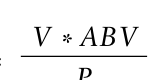
Socio-Economic Constraints and the ‘Illusion of Choice’ 181 AVV stands for the amount of alcohol, it shows absolute pure alcohol per 1 euro. If to assume that person has limited resources and available finances is one of them, then choice of alcoholic product to be consumed is based both on available amount of money and price of alcoholic beverages, that highly depend on excise tax rate that is different for each of excise tax groups. And if to assume that one litre price of alcoholic beverage per 1% ABV without excise tax is similar to all excise tax groups, then consumers choice dependence on taxation politics becomes obvious. And to calculate AVV is easy for consumers:
Equation reproduced from the original PDF.
In this formula P is price of one litre and ABV stands for alcohol content, while V stands for volume. For example, if price is 1€ and ABV is 5%, then AVV is 0,50ml of pure alcohol per 1€. Another approach is calculation of the Ethanol Unit Price (EUP) – defined as the cost of one litre of beverage at 1% alcohol by volume (ABV). This is expressed by the formula:
Equation reproduced from the original PDF.Table 1: Alcohol price and ABV dependence in Latvia (Authors according to market monitoring data and existing excise tax rates, 2025).
To find choice loss threshold at which alcohol dependent person would lose choice of preferred beverage and has to look for daily ethanol dosage, should be compared minimum income level and price of expected daily ethanol dosage. It could be so that in several countries with extremely high alcohol excise tax, right choice for dependent people is taken away even
with decent or moderate incomes, while quality of chosen products might decrease, what affects not only quality of life, but also might impact health as in alcoholic beverages not only alcohol is ruining sanity (Müller, 2023). From a profitability perspective, when consumer options exceed immediate needs yet remain financially accessible, there is a heightened propensity for the consumption of beverages with elevated alcohol content. This presents a critical risk for alcohol-dependent employees; fiscal policies may inadvertently incentivise a shift towards beverage categories that carry lower excise duties but higher alcohol concentrations. Under competitive market conditions, producers actively align with consumer purchasing power by developing products that cater to this price-sensitive demand (Horverak, 2012). Consequently, the interplay between state regulatory frameworks and market dynamics facilitates the emergence of novel products and consumption patterns, potentially undermining public health initiatives and occupational safety standards. For instance, a policy-driven price convergence between traditional low-alcohol beverages and higher-strength alternatives (such as fruit wine based RTDs etc., which excise tax is not dependent on ABV) may induce a substitution effect (Österberg, 2012). An individual who previously consumed a unit of beer – the physiological effects of which might dissipate prior to the commencement of shifts – may opt for a more potent alternative at a comparable price point, thereby significantly compromising their capacity for work and increasing risks of occupational hazards.
Price and choice elasticity in case addiction is more prospective, especially with limited financial resources. That is the reason why classical economic models where price increase should mean consumption decrease might not work in circumstances of severe addiction – instead might be observed downgrading towards cheaper products with unwanted additives and sometimes even with higher concentration of harm causing substance.
THE ILLUSION OF CHOICE AND WORKPLACE HAZARDS Correlation between low-cost ethanol consumption maximization and possible workplace accidents might be obvious, while most likely governments intentions would have been to decline such negative aspect. Truth is also that many production, construction, transport and other industries have modern equipment to detect alcohol consumed workers to prevent mischances, but it is not about all and even not the majority of employment cases (Rehm, 2024). Zero cases of alcohol relates accidents should be norm, even one is too much – therefore statistics can be avoided this case, because over all aim is both to lower consumption of alcohol and along with that to improve work safety. But OECD data for long period of time indicates Baltic states as the most consuming among European countries (OECD, 2024), and it is serious indicator also for job safety sector.
Such tax loopholes force vulnerable groups towards high alcohol content products, while in previous past they most likely had rights of choice and possibility to choose lower alcohol content products. At least for one simple reason – many of today existing products were not produced with previous alcohol excise tax policy conditions as there was not necessity for research and development that direction (Österberg, 2012). This is point where
Socio-Economic Constraints and the ‘Illusion of Choice’ 183 economy meets law and work safety as the systemic trap between legally approved tax loopholes and economic necessity (AVV), which may lead to higher consumption of absolute alcohol.
Impact on human factors is detectable as it may not be any more free choice of alcohol dependent person to choose alcoholic beverage according to taste or enjoyment preferences, it turns out now to be system imposed action. This touches legal aspects of limitations of individuals free choices, including those that would favour more safe choices – bearing less harm to health and safety.
Workplace safety usually correlates between cheaper alcohol availability and accidents at work. In circumstances of labour market instability where is noticeable lack of free workforce this situation is threatening even more as employers have to deal with alcohol dependent employees more and more, we can not exclude a group of society from participation in the labour market. Care must be taken to include everyone and also to care for those who may threaten job security in order to prevent this (Lehman & Bennett, 2002). We can conclude that the current fiscal policy does not punish the drunkard, but undermines the workplace safety ecosystem as a whole.
The transition from beverage preference to volume maximization represents a critical failure in human systems integration. When fiscal policy allows for a high AVV at low price points, it effectively subsidises high alcohol content consumption among the most socio-economically vulnerable workers. In safety-critical industrial environments this manifests as a systemic risk: the consumer is not merely purchasing alcohol, but is economically steered towards the most intoxicating form of it. Consequently, the resulting cognitive impairment and degradation of motor skills are not just individual health issues, but direct outputs of a flawed fiscal architecture that compromises the safety integrity of the entire workplace (Booker, 2025). Interesting correlation is also among countries dependence on alcohol excise tax revenue and consumption volume – for some reasons authors have to admit that with little exceptions state budgets are dependent on this revenue in countries with the highest consumption of alcohol in Europe (World Bank, 2022). It undermines that not only the consumers are dependent on alcohol, but also their economies and that should be improved by holistic approaches and switch in the system that allows states to improve quality of life (Eurostat, 2022). If a person is free in his choices, society might benefit in social safety and welfare.
CONCLUSION
The investigation into the “illusion of choice” demonstrates that alcohol excise tax policy is a critical component of the “choice architecture” that governs the safety and stability of the industrial workforce. This research has presented evidence that the current divergence in EU tax groups, where ethanol is taxed based on raw material rather than potency, creates systemic “tax loopholes” that facilitate high-volume consumption among low-income labourers. By defining the Alcohol Volume Value (AVV) and the Ethanol Unit Price (EUP), we have shown how fiscal disparities economically steer dependent individuals toward high-potency products, effectively removing
human agency and replacing preference with a biological necessity for volume maximization.
The development of a harmonised taxation framework, focused on the chemical nature of the ethanol molecule rather than industrial protectionism, will enable Member States to better protect the most vulnerable segments of the labour market. Recognising the human as an integral element of the socio-economic system requires a transition from fragmented fiscal regulation to a holistic public health strategy. By aligning excise policies with the goals of Human Systems Integration, policymakers can reduce the frequency of safety protocol breaches and cognitive impairment in industrial environments. Ultimately, correcting these market distortions is not merely a fiscal requirement but a fundamental step toward safeguarding occupational safety, promoting public health, and ensuring the long-term integrity of the European labour market.
ACKNOWLEDGMENT
The publication is financed by the Recovery and Resilience Facility project “Internal and External Consolidation of the University of Latvia” (No.5.2.1.1.i.0/2/24/I/CFLA/007).
REFERENCES
Ally, A.K., Meng, Y., Chakraborty, R., Dobson, P.W., Seaton, J.S., Holmes, J., Angus, C., Guo, Y., Hill-McManus, D., Brennan, A. and Meier, P.S. (2014) “Alcohol tax pass-through across the product and price range: do retailers treat cheap alcohol differently?”, Addiction, 109(12), pp. 1994–2002. Aragam, K.G. (2022) “Association of Habitual Alcohol Intake With Risk of
Cardiovascular Disease”, Jama Network Open, Volume 5, Issue 3. Website: https://jamanetwork.com/journals/jamanetworkopen/fullarticle/2790520 Arab, J.P. (2023) “Association between public health policies on alcohol and worldwide cancer, liver disease and cardiovascular disease outcomes”, Journal of Hepatology, Volume 80, Issue 3. Website: https://www.webofscience.com/wos/ woscc/full-record/WOS:001188598400001 Booker, L. (2025) Alcohol at Work: Tackling Workplace Drinking to Improve
Wellbeing (1st ed.). CRC Press. Eurostat. (2022) “Tax revenue statistics”. Website: https://ec.europa.eu/eurostat/ statistics-explained/index.php?title=Tax_revenue_statistics Holmes, J., Oldroyd, C.K., Drummond, C., Field, M., Kersbergen, I. and Allison,
M.E.D. (2025) “Zero tolerance for 0%? How should clinicians and other practitioners respond to the use of alcohol-free and low-alcohol products in higher risk groups”, Addiction. DOI 10.1111/add.70244 Horverak, Ø. (2012) “Does Norwegian alcohol policy favour lower alcohol content beverages? A historical overview”, Nordic Studies on Alcohol and Drugs, 29(1), pp. 7–23. Lehman, W.E.K. and Bennett, J.B. (2002) “Job risk and employee substance use: the
influence of personal background and work environment factors”, The American Journal of Drug and Alcohol Abuse, 28(2), pp. 263–286.
Socio-Economic Constraints and the ‘Illusion of Choice’ 185 Manthey, J., Gobiņa, I., Isajeva, L., Neneman, J., Reile, R., Štelemėkas, M. and
Rehm, J. (2024) “The impact of raising alcohol taxes on government tax revenue: Insights from five European countries”, Applied Health Economics and Health Policy, 22(3), pp. 363–374. Müller, V., Jarl, J. and Gerdham, U-G. (2023) “A measure of alcohol affordability for Sweden: Capturing trends among different demographic groups”, Nordic Studies on Alcohol and Drugs, 40(3), pp. 250–269. Nagy, L.E. (2024) “Designing clinical trials to address alcohol use and alcohol-
associated liver disease: an expert panel Consensus Statement”, Nature Reviews Gastroenterology & Hepatology, Volume 21, Issue 9, pp. 626–645. Organisation for Economic Co-operation and Development (OECD). (2022) “Alcohol consumption”. Website: https://www.oecd.org/en/data/indicators/ alcohol-consumption.html Österberg, E. (2012) “The effects of favouring lower alcohol content beverages: Four
examples from Finland”, Nordic Studies on Alcohol and Drugs, 29(1), pp. 41–56. Rehm, J., Rovira, P., Jiang, H., Lange, S., Shield, K.D., Tran, A. and Štelemekas, M. (2024) “Trends of alcohol-attributable deaths in Lithuania 2001–2021: Epidemiology and policy conclusions”, BMC Public Health, 24, Article 774. Trasberg, V. (2015) “Alcohol Excise Duties in the European Union”, Estonian
Discussions on Economic Policy, 23(2). Website: https://ojs.utlib.ee/index.php/ TPEP/article/view/12497/7571 Treaty on the Functioning of the European Union (2007) Official Journal of the European Union, C 326/47. Website: https://eur-lex.europa.eu/legal-content/EN/ ALL/?uri=CELEX:12016E168 World Bank. (2022) “Government spending vs. GDP, 2023”. Website: https://
ourworldindata.org/grapher/government-expenditure-vs-gdp?country=LVA ~LTU~EST World Health Organization (2026) “Alcohol Health Topics”. Website: www.who.
int/europe/health-topics/alcohol#tab=tab_1
LISTED IN THE AHFE DIGITAL BOOKSTORE CATALOGUE
Explore the complete digital volume
Human Factors and Systems Interaction
Read this individual research paper free through the original publisher, or explore the full digital proceedings book.
ISBN 979-8-950676-06-2
Explore this ISBN in the AHFE Bookstore ↗Listed in the July 2026 bookstore catalogue; search by ISBN to confirm current availability · Digital book purchase optional