Weiling Deng, Yulin Zhao, Yanhao Cai, Jinghuan Xu, Jinpeng Chen (2026). AI Empowers Design Education: Integrated Model of Prompt Teaching and Originality Cultivation in University Design Majors. In: Training, Education, and Learning Sciences. AHFE Open Access, vol. 231, pp. 28–38. https://doi.org/10.54941/ahfe1007993
With the in-depth penetration of artificial intelligence technology in the field of design, AI design tools such as Midjourney have become important auxiliary creative means for students majoring in design in universities. However, there is a significant disconnect in the application of AI in current university design teaching: students generally face pain points such as inaccurate prompt design, lack of systematic guidance in the creative process, and insufficient homogenization and originality of works. The traditional teaching model is difficult to meet the demand for cultivating design talents in the AI era. Against this background, this paper focuses on the teaching reform of AI application in university design majors, aiming to solve the practical problems and lack of originality in AI-assisted design, and explores a new integrated teaching model of prompt teaching and originality cultivation.The theoretical significance of this study lies in constructing a teaching framework for the in-depth integration of design education and AI technology under the background of AI empowerment, enriching the interdisciplinary research achievements in the field of design education, and providing theoretical reference for the teaching reform of design majors in the AI era. The research results can provide direct reference for the AI teaching practice of university design majors, help design education adapt to the development trend of the industry, and improve the quality of talent training.
The rapid advancement of generative artificial intelligence has drawn significant attention to its potential applications in education globally. Since the public release of ChatGPT in 2022, GenAI tools capable of generating text, images, audio, and other content have created new opportunities for personalized learning, teaching assistance, and assessment innovation. However, these technologies also pose ethical and pedagogical challenges, such as academic integrity issues, concerns about content accuracy, and risks of over-reliance (García-Penalvo et al., 2024).
Current research is predominantly focused on Western contexts, leaving a gap in understanding GenAI applications in Chinese education. Engineering Received February 2, 2026; Revised April 5, 2026; Accepted April 21, 2026; Available online July 20, 2026
AI Empowers Design Education: Research on the Integrated Model of Prompt 29 education in China emphasizes practicality and application, necessitating a culturally and disciplinarily sensitive approach to GenAI integration (Fan et al., 2024). The theoretical significance of this study lies in constructing a teaching framework that deeply integrates design education with artificial intelligence technology in the context of AI empowerment, enriching interdisciplinary research outcomes in the field of design education, and providing theoretical references for the reform of design-related professional education in the AI era.
RESEARCH OBJECTIVE AND SIGNIFICANCE This study aims to address the structural contradictions between the teaching system of design majors in universities and industry demands in the context of artificial intelligence technology deeply penetrating the field of design education. Providing an interdisciplinary perspective for the transformation of design education paradigms in the intelligent era, effectively enhancing students’ AI tool application efficiency and original design abilities, shortening the transition period from campus to workplace, and supplying the industry with versatile design talents who possess both algorithmic thinking and humanistic creative literacy. This study expands the theoretical boundaries of design education research by deconstructing the technical logic and educational principles of the full AI-assisted design process. It fills the research gap in design education regarding AI ethics governance and the protection of creative intellectual property, providing a new theoretical support for the transformation of educational paradigms empowered by intelligent technology.
INTERNATIONAL RESEARCH STATUS The application of generative artificial intelligence in the educational domain has become a major focus of the international academic community, with research in this area experiencing exponential growth following the launch of ChatGPT in 2022 (García-Penalvo et al., 2024). Scholars generally acknowledge the revolutionary potential of generative AI tools for education, which includes supporting personalized learning, enhancing creative efficiency, and fostering interdisciplinary integration. These tools enable students to rapidly acquire information and generate creative content; however, they also present significant risks.
Within the specific field of design education, international research has begun to focus on the practical application of AI tools. However, most scholars point out that current teaching methodologies lack systematic training in prompt engineering, making it difficult for students to effectively integrate AI-generated output with original thinking. This perspective provides theoretical support for AI-empowered design education, suggesting that teaching must balance the use of technological tools with the cultivation of humanistic literacy (García-Penalvo et al., 2024). Nevertheless, existing research is predominantly concentrated on general educational contexts.
CURRENT STATE OF DOMESTIC RESEARCH In recent years, the rapid advancement of artificial intelligence technology has spurred a growing body of research in China focusing on AI-enabled teaching reforms in design education. Scholars have primarily explored how AI can optimize instructional design, enhance student creativity, and address challenges posed by educational transformations. It is widely acknowledged that AI is profoundly reshaping design pedagogy through support for creative ideation, personalized learning, and interdisciplinary knowledge integration. Zhao (2022) analyzed issues in higher education art and design teaching, advocating for innovations in teaching philosophies and content to strengthen students’ innovative practical abilities in the AI era.
Current domestic research is gradually shifting from tool application to deeper pedagogical reforms. As Liu (2026) emphasized, AI not only innovates curriculum content and teacher roles but also drives design education toward a “human-machine collaboration” paradigm. However, avoiding content homogenization and strengthening critical thinking remain key foci for future exploration.
RESEARCH INNOVATIONS This study centers on the core proposition of “AI-empowered design education,” focusing on the integration mechanism between prompt engineering instruction and originality cultivation. It constructs a trinity research framework encompassing “technology tools—teaching methods—competency evaluation.” Through bibliometric analysis and case study methods, the study systematically reviews the application status of AI design tools in university design curricula, revealing core issues in current teaching practices: fragmentation in prompt design, lack of standardized guidance for creative workflows, and weakening of students’ original creative abilities.
THE CONCEPT AND CHARACTERISTICS OF ARTIFICIAL INTELLIGENCE With the rapid advancement of artificial intelligence (AI) technology, its integration into the field of education has become a significant direction for reform. This section will analyze how AI empowers design education, promoting its development toward personalization and efficiency.
Artificial intelligence is an “artificial system” constructed by humans based on the laws of intelligent activities, whose essence is to simulate human thinking processes and intelligent behaviors through computers (Carranza Alcántar et al., 2024). AI possesses a logical reasoning intelligent core, self-iterative learning capabilities, and generative creative technical characteristics, combining both tool attributes and intelligent attributes (Liu, 2026). Generative artificial intelligence, as an important branch of AI, such as ChatGPT and DeepSeek, uses deep learning technologies to generate text, images, and other content, demonstrating great potential in creative support anssd process optimization (Fan et al., 2024). These characteristics make AI a transformative force in design education, driving the iteration of educational content and methods (Zhang et al., 2020).
THEORETICAL FOUNDATIONS OF THE INTEGRATION OF ARTIFICIAL INTELLIGENCE AND DESIGN EDUCATION The integration of artificial intelligence and design education is rooted in various educational theories. First, self-determination theory emphasizes that learners’ intrinsic motivation can be enhanced by satisfying the psychological needs for autonomy, competence, and relatedness (Fan et al., 2024). In design education, AI provides personalized support through adaptive learning paths, thereby stimulating students’ creativity and initiative (Fan et al., 2024). For example, generative AI tools can offer real-time feedback based on student needs, enhancing learning engagement. Second, constructivist learning theory posits that knowledge is actively constructed by learners through exploration, reflection, and critical inquiry (Zhang et al., 2020). AI supports students in problem-solving and critical thinking by simulating authentic design scenarios, aligning with the constructivist principle of “learning by doing” (Fan et al., 2024).
Furthermore, multiple intelligences theory suggests that AI can mobilize students’ diverse intelligences (e.g., linguistic, spatial, logical) and foster creativity through multimodal content generation (Fan et al., 2024). In design education, AI tools offer differentiated support tailored to students’ intellectual strengths, such as reinforcing spatial thinking through visual generation techniques (Zhang et al., 2020). AI’s real-time feedback mechanisms help students quickly identify design flaws and optimize learning strategies (Liu, 2026). These theories collectively form the foundational pillars for integration, driving design education toward a “human-machine collaboration” paradigm.
THEORETICAL APPLICATION AND PATHWAYS IN DESIGN EDUCATION The integration of artificial intelligence and design education requires adopting distinctive pathways. The constructivism-oriented “integration of arts and engineering” model advocates building intelligent knowledge structures based on design experience . In project practice, AI can assist students in data cleaning and solution generation, thereby strengthening practical abilities(Zhang et al., 2020). Furthermore, humanistic theory is implicitly embedded in AI integration, necessitating vigilance against over-reliance on technology while emphasizing critical thinking and ethical awareness (Carranza Alcántar et al., 2024). Teachers should guide students to dialectically use AI, avoid creative homogenization, and ensure that “technology serves humanism” (Liu, 2026). The theoretical framework for integrating AI and design education is multidimensional and profound, encompassing learning motivation, knowledge construction, and technology acceptance (Fan et al., 2024). In the future, further exploration of the practical pathways of these theories in specific courses is needed to promote the innovative development of design education in the intelligent era.
DEFINITION AND EVALUATION CRITERIA OF ORIGINALITY IN DESIGN EDUCATION In the context of the rapid development of artificial intelligence technology, the concept of originality in design education is facing structural challenges. Traditional design education emphasizes the independent creativity and personal expression of works, but the intervention of generative artificial intelligence requires that “originality” shift from isolated individual creation to a human-computer collaboration paradigm (Chen & Liu, 2025). As an interdisciplinary field, originality in design is not only reflected in formal innovation but also relates to design thinking, cultural transformation, and ethical considerations. This paper, based on literature analysis, redefines the concept of originality in design education and proposes dynamic evaluation criteria to address the changes brought by the AI era.
Reconstruction of the Definition of Originality In design education, originality has long been equated with “creative outcomes independently completed by designers.” However, generative artificial intelligence can assist in the design process, such as generating sketches, optimizing solutions, or simulating user interactions, which necessitates a greater focus on “creative contribution” rather than “absolute independence” (Chen & Liu, 2025). The AI era should establish a “new framework of originality under the human- computer collaboration paradigm,” meaning that the evaluation emphasis shifts from “whether AI is used” to “how AI enhances the depth and breadth of design thinking” (García-Penalvo et al., 2024). In design teaching, if students use AI tools for inspiration or technical implementation and can critically screen and reconstruct the generated content, it should still be considered original. This reconstruction avoids the “AI shame” phenomenon and encourages designers to exert subjectivity, treating AI as a tool to enhance creativity rather than a substitute.
CURRENT STATUS AND CHALLENGES OF AI APPLICATIONS IN DESIGN EDUCATION IN HIGHER EDUCATION INSTITUTIONS The current status and challenges of AI applications in design education in higher education institutions can be summarized as follows: First, Among faculty members, most have attempted to integrate AI tools into lesson preparation, case demonstrations, and assignment grading, but there are significant differences in the frequency and depth of use. Among students, over half use AI tools for completing assignments and generating creative ideas, but their levels of dependency on AI and proficiency in using these tools vary widely.corporate designers generally regard AI as an efficiency tool but have higher standards for originality requirements and copyright compliance.
Second, the practice and bottlenecks of prompt engineering pedagogy: Some faculty members have begun to introduce prompt design theories into their classes, but teaching methods primarily rely on “case demonstrations” rather than systematic training. This over-reliance on “safe templates” generated by AI leads to homogeneous prompts, inhibiting original expression. The
AI Empowers Design Education: Research on the Integrated Model of Prompt 33 design of this survey questionnaire aims to systematically investigate the current status and existing problems of AI technology applications in design education in higher education institutions.The survey targets three core groups—faculty members, students, and industry designers—to construct a comprehensive portrait of the educational ecosystem.
QUESTIONNAIRE DESIGN AND SURVEY IMPLEMENTATION The questionnaire employs a stratified design approach, with dedicated surveys tailored for three distinct groups: teachers, students, and industry designers. The teacher questionnaire emphasizes teaching practice dimensions; the student questionnaire focuses on learning experiences; and the industry questionnaire centers on talent needs.
In terms of content design, the questionnaire features the following characteristics: First, questions follow a logical sequence of “current status- perception-needs.” Taking the teacher questionnaire as an example, it begins with basic usage patterns, gradually deepens into teaching practices, and concludes with developmental needs, forming a complete research loop. Second, quantitative and qualitative methods are combined. Third, sensitive topics are handled with tact. For potentially defensive subjects like “lack of originality,” indirect phrasing is used—such as the multiple-choice “main obstacles” question—to gently address core issues. This survey spans the entire country(see Table 1).
Table 1: Sample selection and allocation table.
Table available in the original PDF paper.
Group Sample Size Allocation Logic University Design Faculty 60 Covering comprehensive, arts, and vocational institutions, while accommodating teachers with varying years of experience.
Design majors 60 Covering undergraduate freshman through graduate levels, with specializations including visual communication, environmental design, and more.
Industry Designer 60 Coverage of company size , work experience
ANALYSIS OF QUESTIONNAIRE DATA FROM COLLEGE FACULTY The questionnaire for university faculty (sample size: 61) focused on the current state of prompt-based instruction and originality cultivation. Data indicates that AI tools have been deeply integrated into design education, yet significant challenges persist.
Current AI Tool Application: Faculty most frequently use AI tools for classroom instruction (83.61%), followed by lesson preparation (50.82%). This reflects AI primarily serving as an auxiliary teaching method rather than replacing traditional instruction. 78.69% of teachers identified “poor prompt design” as the greatest difficulty, far exceeding other options (e.g., high learning cost at 24.59%). This indicates that the lack of prompting skills is a key bottleneck limiting the effectiveness of AI tools. Although specific proportions were not provided, open-ended responses suggest that
34 Deng and Zhao most teachers acknowledge AI enhances efficiency but require solutions to address homogenization issues.
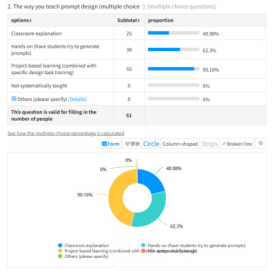
Prevalence of Prompt Word Instruction: 98.36% of teachers have incorporated prompt word content into their teaching, primarily through project-based learning (90.16%) and hands-on practice (62.3%), indicating a strong emphasis on practical approaches. 67.21% of teachers identify “cultivating students’ precise expression skills” as the primary challenge, indicating students’ difficulty in translating abstract ideas into effective commands(see Figure 1). Only 55.74% affirm prompt word instruction as a “critical component,” while 27.87% disagree, reflecting ongoing disagreements about the role of AI education.
Figure 1: Level of implementation in prompt-based teaching practices.
Challenges in Cultivating Originality: 86.89% of teachers believe originality primarily relies on “personalized prompt design” rather than secondary creation (32.79%), emphasizing the core role of prompts themselves. 96.72% of teachers point to “homogeneous AI-generated results” as the main obstacle, while 83.61% cite insufficient teaching time, highlighting the gap between resources and demand. 81.97% of teachers cultivate students through “originality assessment specialized courses,” yet only 24.59% encourage integration with traditional skills, indicating that blended approaches remain underdeveloped. While the teaching community broadly recognizes the value of AI tools, inadequate prompt design capabilities and the absence of originality cultivation mechanisms present prominent contradictions, necessitating structured training support.
INDUSTRY DESIGNER QUESTIONNAIRE ANALYSIS The industry questionnaire (sample size: 61 respondents) reveals a gap between corporate expectations for design talent capabilities and university education.
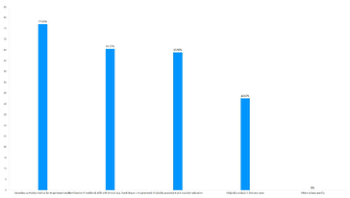
AI Tool Usage Frequency: 31.15% of designers use AI daily, while 37.7% use it 1-3 times weekly, indicating AI has become a routine tool. 75.41% use AI for “idea generation,” while 52.46% utilize it for “client communication,” highlighting its utility in initial conceptualization and client interactions (see Figure 2). 98.36% of designers express concern over “insufficient originality
AI Empowers Design Education: Research on the Integrated Model of Prompt 35 in AI-generated outcomes,” and 91.8% believe “imprecise prompt design” impacts output quality, pointing to dual demands for originality and precision.
Figure 2: Frequency of AI tool usage among industry designers.
Demand for Higher Education: 91.8% of designers emphasized that students must possess the “ability to adapt prompts to industry scenarios,”far surpassing other options , indicating the industry’s emphasis on applied adaptability. Only 26.23% of designers are willing to participate in university teaching activities, preferring“project mentoring”, suggesting industry- education integration requires more pragmatic approaches.
Originality Requirements: 57.38% of designers believe originality manifests in “unique creativity,” while “secondary creation skills” account for only 34.43%, indicating the industry places greater emphasis on the innovation of initial concepts (see Figure 3). The industry strongly urges universities to enhance scenario-based prompt application and original expression, yet current educational content remains disconnected from industry workflows.
Figure 3: Designers’ demand for originality.
STUDENT QUESTIONNAIRE ANALYSIS The student questionnaire (sample size: 60) reveals practical challenges in AI tool usage and expectations for teaching reform.
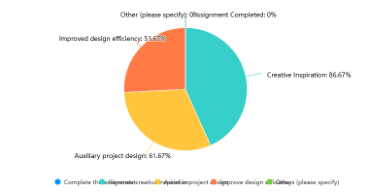
Purpose of AI tool use: 86.67% of students use AI to “generate creative inspiration,” while 61.67% use it to “assist with project design,” indicating AI primarily serves as an inspiration tool rather than a core creative method. 45% of students believe AI “somewhat improves” learning outcomes, while 13.33% report it “reduces effectiveness,” reflecting divergent results. 58.33% complain that “AI-generated outputs fail to meet expectations,” and 40% worry that “overreliance may diminish creative abilities,” highlighting concerns about controllability and ethical implications (see Figure 4).
Figure 4: Purpose of student AI tool usage.
Prompt Learning Needs 68.33% of students have received prompt instruction, yet 61.67% acquired knowledge through “self-study,” revealing insufficient teaching coverage. 96.67% of students expressed interest in learning “prompt structure and logic,” while 90% focused on “the relationship between prompts and originality,” indicating a strong desire for integrating foundational theory with innovative methods. Only 11.67% rated the effectiveness as “excellent,” 41.67% as “good,” and 30% as “average,” suggesting room for improvement in current teaching practices.
Originality Perception and Practice: 68.33% of students deem originality “important” or “very important,” yet 95% fear their work being labeled “plagiarism,” reflecting copyright awareness and psychological barriers. Students urgently require systematic prompt instruction and originality guidance, yet current teaching methods fail to effectively alleviate usage anxiety.
INNOVATIONS AND LIMITATIONS OF THE QUESTIONNAIRE The questionnaire’s innovations are primarily reflected in three aspects: First, it establishes a cross-group comparative framework enabling dialogue among teachers, students, and industry perspectives. it organically links technology application with educational objectives , transcending traditional instrumentalist perspectives. it balances academic rigor with practical feasibility, enabling the research to both reveal patterns and guide practice.
However, the questionnaire also has certain limitations: First, sample acquisition convenience may introduce selection bias. Second, self-reported data may be influenced by social expectations. Finally, the cross-sectional design struggles to capture the dynamic evolution of AI applications in education.
CONCLUSION
This study systematically analyzes the application pathways and practical models of artificial intelligence technology in design education, revealing AI’s positive role in promoting innovation and transformation within design pedagogy. Research indicates that AI significantly enhances teaching efficiency and student creativity by assisting in creative generation, optimizing design processes, and supporting personalized learning. Future research may expand in the following dimensions to help educators adapt to teaching demands
AI Empowers Design Education: Research on the Integrated Model of Prompt 37 amid technological iteration: Promote the establishment of interdisciplinary curriculum frameworks to integrate knowledge across design studies, computer science, engineering, sociology, and other fields, cultivating multidisciplinary design talents with technical proficiency and humanistic perspectives.
ACKNOWLEDGMENT
The successful completion of this thesis would not have been possible without the support and assistance of numerous mentors and peers, to whom I extend my most sincere gratitude. First and foremost, I would like to express my heartfelt thanks to my thesis advisor, Professor Zhao. From the meticulous refinement of the research topic to the construction of the study framework, Professor Zhao guided me through every critical stage with rigorous scholarship, profound academic expertise, and unwavering patience. Moving forward, I will carry this gratitude forward, dedicating myself to deepening my work at the intersection of design and education. I pledge to live up to the trust placed in me and make the most of my youth.
REFERENCES
Buele, J., & Llerena-Aguirre, L. (2025). Transformations in academic work and faculty perceptions of artificial intelligence in higher education. Frontiers in Education, 10, 1603763. https://doi.org/10.3389/feduc.2025.1603763 Carranza Alcantar, M. R., Macias Gonzalez, G. G., Gomez Rodriguez, H., Jimenez
Padilla, A. A., & Jacobo Montes, F. M. (2024). Teacher perceptions about the integration of generative AI applications in the university teaching process. REDU. Revista de Docencia Universitaria, 22(2), 158–176. https://doi.org/10.4995/ redu.2024.22027 Chen, H., & Liu, Y. (2025). Challenges of generative artificial intelligence to academic originality and coping strategies [In Chinese]. Journal of Changzhou University (Social Science Edition), 26(6), 109–116. https://doi.org/10.3969/j.issn.2095- 042X.2025.06.011 Fan, L., Deng, K., & Liu, F. (2024). Educational impacts of generative artificial
intelligence on learning and performance of engineering students in China. Journal of Educational Technology & Society, 28(2), 1–22. Feng, X. (2025). Exploration and application of generative artificial intelligence (GenAI) in teaching design for higher vocational fine arts education [In Chinese]. Shoes Technology and Design, 5(24), 108–110. https://doi.org/10.3969/j. issn.2096-3793.2025-24.036 Gao, C., Liu, L., & Wang, J. (2024). Research on the teaching mode of design
under AI intelligent assistance: The role and impact of artificial intelligence [In Chinese]. Art and Design, 226, 125–128. https://doi.org/10.16824/j.cnki. issn10082832.2024.03.033 García-Peñalvo, F. J., Llorens-Largo, F., & Vidal, J. (2024). The new reality of education in the face of advances in generative artificial intelligence. RIED-Revista Iberoamericana de Educacion a Distancia, 27(1), 9–39. https://doi.org/10.5944/ ried.27.1.37716 Liang, Y., Xu, S., & Shen, Y. (2025). The logic, dilemmas and countermeasures of
the coupling of artificial intelligence and digitalization of vocational education [In Chinese]. Journal of Changzhou University (Social Science Edition), 26(6), 109–116. https://doi.org/10.3969/j.issn.2095-042X.2025.06.011
38 Deng and Zhao Liu, J. (2026). Artificial intelligence empowers the exploration of teaching reform in
college design science [In Chinese]. Online Education, 73, 73–76. Sun, J. (2025). Research on creative generation and design optimization of artificial intelligence in digital media art [In Chinese]. Academic Journal of Art and Design, 6, 65–67. Yuan, Y., Ren, S., Ding, X., Shi, Q., & Wang, X. (2026). Exploration of generative
artificial intelligence empowering junior high school mathematics classroom teaching [In Chinese]. China Educational Technology & Equipment, 619, 23–27. Zhang, X., Hui, L., & Yao, X. (2020). An analysis on the construction of featured artificial intelligence basic education in college design science [In Chinese]. Industrial Design, 33(3), 33–36.
LISTED IN THE AHFE DIGITAL BOOKSTORE CATALOGUE
Explore the complete digital volume
Training, Education, and Learning Sciences
Read this individual research paper free through the original publisher, or explore the full digital proceedings book.
ISBN 979-8-950676-07-9
Explore this ISBN in the AHFE Bookstore ↗Listed in the July 2026 bookstore catalogue; search by ISBN to confirm current availability · Digital book purchase optional