Li Shucheng, Yufeng Yang (2026). Cross-Modal Evidence on Website Interface-Induced Emotions and Search Efficiency in Time-Limited Ticket Purchase. In: Usability and User Experience. AHFE Open Access, vol. 232, pp. 163–174. https://doi.org/10.54941/ahfe1008045
Limited-time purchase interfaces increasingly embed temporal scarcity cues (e.g., countdown timers), requiring users to search and act under time pressure. Yet most evaluations rely on outcome-level indicators, leaving limited process-level evidence on how interface-induced emotions shape search efficiency. This study investigates how valence and arousal in web interface design affect goal-directed search in a timed ticket-purchase flow, integrating subjective affect mapping with synchronized eye- and mouse-tracking. In Study 1, forty participants rated 18 standardized above-the-fold webpage screenshots using a grid-based Circumplex Model of Affect (CMA), positioning each stimulus in valence–arousal space. K-means clustering (k = 4) identified four quadrant-aligned emotional profiles, from which one representative webpage per quadrant was selected. In Study 2, these four emotional profiles were implemented as isostructural ticketing prototypes that held information architecture and task demands constant while manipulating emotion-related design tokens. Thirty participants completed within-subject timed purchase task while eye movements and mouse behavior were recorded. Across repeated-measures analyses and cross-modal evidence fusion, arousal emerged as the most reliable driver of efficiency: higher-arousal interfaces accelerated progression and strengthened gaze-to-action coupling, yielding faster and more stable interaction rhythms. Valence mainly affected local processing fluency but did not consistently reduce total completion time. These findings provide process-level evidence for emotion-aware, efficiency-oriented design in time-pressured purchase interfaces.
Limited-time offers (LTOs) have become a core strategy in online marketing and e-commerce (Hmurovic et al., 2023). By constraining the duration of an offer, they create time pressure that alters attention allocation and purchasing tempo, prompting individuals to transition from browsing to checkout more swiftly (Suri & Monroe, 2003). A recent meta-analysis suggests that time- limited offers and scarcity cues are widely adopted and, overall, enhance purchase intentions (Ladeira et al., 2023). Psychologically, time pressure increases arousal, and emotions commonly elicited in limited-time contexts
164 Li and Yang –such as fear of missing out (FOMO), excitement, and state anxiety–are correlated with impulsive buying and immediate decision making (Tiemessen et al., 2023).
Limited-time offers (LTOs) have become a core strategy in online marketing and e-commerce (Hmurovic et al., 2023). By constraining the duration of an offer, they create time pressure that alters attention allocation and purchasing tempo, prompting individuals to transition from browsing to checkout more swiftly (Suri & Monroe, 2003). A recent meta-analysis suggests that time-limited offers and scarcity cues are widely adopted and, overall, enhance purchase intentions (Ladeira et al., 2023). Psychologically, time pressure increases arousal, and emotions commonly elicited in limited- time contexts –such as fear of missing out (FOMO), excitement, and state anxiety–are correlated with impulsive buying and immediate decision making (Tiemessen et al., 2023).
Within these scarcity-driven online environments, interface design can shape customer behavior by modulating emotion. User interfaces translate information architecture into visual and interactive cues (e.g., hue, contrast, typography, whitespace) that guide attention and alter online shoppers’ emotional and cognitive states (Cyr, 2013; Lindgaard et al., 2006; Tuch et al., 2012), thereby influencing both outcomes and process efficiency (Eroglu et al., 2001). In limited-time purchase contexts, these emotion- laden design tokens are especially likely to produce measurable differences in how efficiently users search for and select products (Hmurovic et al., 2023). Research on online shopping has predominantly relied on clickstream outcomes and self-reported states (Kim & Lennon, 2013; Moe & Fader, 2004), providing limited insight into how interface-induced emotions shape the process of searching and deciding, especially under pressure. Work on limited-time scenarios suggests that urgency and scarcity should be reflected in the process speed and temporal stability, including shorter reaction times at key steps, more consistent action intervals, and smoother pointer trajectories (Huang et al., 2012; Leiva & Arapakis, 2020; Mazza et al., 2020). Eye- tracking metrics capture the pace of the locate, screen, and decide sequence (Modi & Singh, 2023), while mouse movements capture the generation and temporal dynamics of actions. Because eye movements primarily reflect visual attention and information uptake and mouse trajectories capture motor execution, the two modalities are complementary, providing a feasible basis to move beyond self-report and outcome-only measures by operationalizing “purchase efficiency” as objectively measured process evidence in limited- time online shopping.
However, objective process-level evidence for how interface emotional tone influences search efficiency under time pressure is still scarce. To address this gap, we selected webpage stimuli with distinct emotional tones based on valence–arousal ratings and conducted a within-subject 2 × 2 (Valence × Arousal) experiment in a limited-time purchase task. Eye movements and mouse behaviors were recorded simultaneously. Search efficiency was
Cross-Modal Evidence on Website Interface-Induced Emotions 165 operationalized as the speed and temporal stability with which participants completed the locate–select–submit sequence within a fixed time limit. The hypotheses were as follows:
H1: High-arousal interfaces will yield higher search efficiency than lowarousal interfaces. H2: High-valence interfaces will yield higher search efficiency than low-
valence interfaces. H3: Valence and arousal will exhibit an additive effect such that the highvalence/high-arousal condition produces higher search efficiency than conditions in which only one dimension is high.
STUDY1: EMOTIONAL MAPPING AND STIMULUS SELECTION Study 1 aimed to locate candidate webpage stimuli in a two-dimensional valence–arousal space and to select representative interfaces for each of the four quadrants (high/low valence × high/low arousal). The resulting stimulus set provides a systematic foundation for constructing task-relevant emotional stimuli in Study 2.
Participants Forty participants completed the interface emotion-rating task (50% female; M_age = 20.2 years, SD = 1.8). They were recruited via campus advertisements, provided written informed consent, and met eligibility criteria of being at least 18 years old, with normal or corrected-to-normal vision and normal color vision.
Stimuli and Emotion Ratings Representative pages were sampled from domestic and international e-commerce websites in the retail, ticketing, and travel sectors. For each website, only the above-the-fold portion of the desktop webpage was captured as evaluation material. All screenshots were standardized in width, resolution, and height range. Based on dominant color schemes, these stimuli were classified into cool, warm, and achromatic categories.
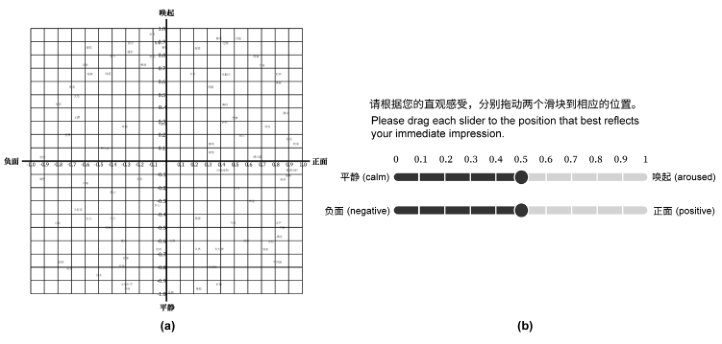
Emotional positioning was obtained using a grid-based CMA (Russell, 1980). combined with a dual-slider rating tool (Figure 1). Emotional experience was situated in a two-dimensional space defined by valence (x-axis) and arousal (y-axis), with both axes discretized into equally spaced numerical grid points ranging from −1.0 to 1.0 for quantitative aggregation. The two sliders separately measured valence and arousal on a 0–1 scale with a neutral midpoint at 0.5; slider ratings were linearly mapped onto the grid-based CMA coordinates and averaged across participants to obtain webpage-level mean valence and mean arousal coordinates for subsequent clustering and stimulus selection.
Figure 1: Grid-based CMA and dual-slider ratings. (a) CMA grid for positioning stimuli in valence–arousal space; (b) dual-slider tool for valence and arousal.
Procedure Prior to formal ratings, participants completed a practice section to familiarize themselves with the rating tools. They then completed 18 trials. In each trial, an above-the-fold webpage screenshot was displayed for a minimum of 5 seconds, after which participants indicated their emotional response by placing a magnet on a large CMA board and subsequently provided valence and arousal using the dual sliders. A neutral image was displayed as an inter-trial interval. After the final trial, all screenshots were displayed simultaneously and participants could adjust magnet positions if desired.
Results
Valence and arousal ratings from the dual sliders (0–1, with 0.5 indicating neutrality) were linearly transformed to the −1 to 1 range used in the grid- based CMA. We then averaged the transformed ratings across participants for each webpage to obtain webpage-level mean valence and mean arousal coordinates.
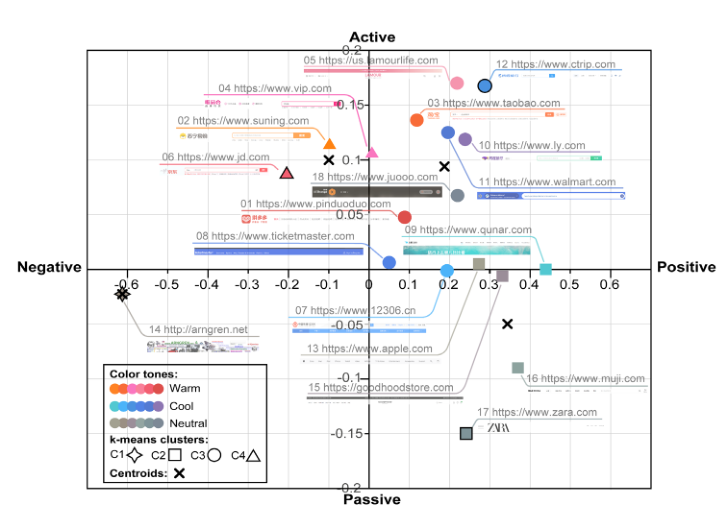
Figure 2 plots the 18 webpages in valence–arousal space. Most stimuli fell on the positive-valence side, with comparatively few webpages in the negative- valence region. Within the positive-valence area, points concentrated in two arousal bands. Warm-toned webpages were mainly located in the higher- arousal band, whereas cool-toned and neutral-tone webpages clustered more in the high-valence × low-arousal quadrant. The low-valence × low-arousal quadrant contained only a small number of webpages.
Based on the webpage-level coordinates, k-means clustering (k = 4) yielded four groups corresponding to the HH, HL, LH, and LL quadrants. The average silhouette coefficients ranged from 0.47 to 0.62, indicating acceptable separation for the four-cluster solution. One representative webpage was selected from each cluster for Study 2 (IDs 6, 12, 14, and 17), ensuring that the task stimuli covered all four quadrants of the emotional space.
Figure 2: Distribution of webpage stimuli in valence–arousal space and k-means clustering results.
STUDY2: TIMED TICKETING EXPERIMENT Building on Study 1, Study 2 examined how emotionally tuned interfaces influence search efficiency in a limited-time online ticket-purchase task.
Participants Forty-five participants were initially recruited; fifteen were excluded based on predefined eye-tracking data-quality criteria, yielding a final sample of 30 valid participants (56.7% female; M_age = 22.4 years, SD = 2.2). Participants were primarily recruited via campus advertisements, provided written informed consent, and met eligibility criteria of being at least 18 years old, with normal or corrected-to-normal vision and normal color vision.
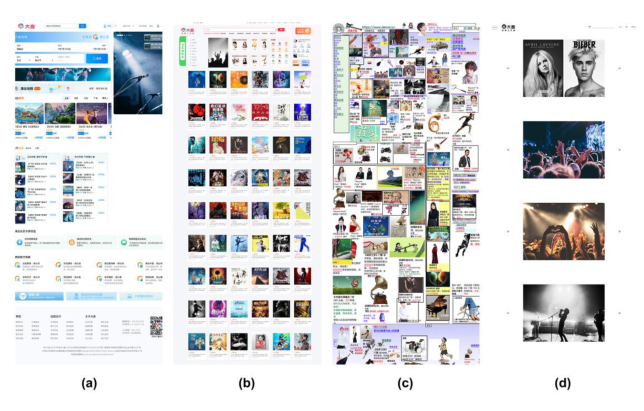
Interface Prototypes and Manipulation Building on Study 1, four isostructural webpage sets were developed in Figma to manipulate emotional interface cues across valence × arousal quadrants (Figure 3). Emotional cues were operationalized as design tokens, while interface structure, content, and navigation depth were held constant across conditions. All versions followed the same sequence (“Login → Homepage → List → Detail → Purchase”) to minimize confounds.
Figure 3: Homepage prototypes for the four emotional interface conditions of valence and arousal:HH (a), HL (b), LH (c), LL (d) in Study 2.
Task and Procedure To simulate a limited-time offer, participants completed an online concert ticket-purchasing task under time pressure. Each trial featured a 5-minute countdown timer, and a printed cue card specified the target (e.g., city, date, session). The task followed the predefined sequence (“Login → Homepage →List → Detail → Purchase”) and ended upon successful completion or timeout. At each page, only one navigation path was defined as correct; clicking the correct target element was necessary to advance, whereas any non-target click triggered an error message and did not allow progression. A trial was successful only if the participant selected the correct options and clicked “Purchase now” on the final page before timeout. Apparatus and data collection
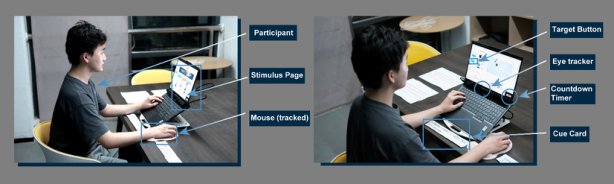
Eye movements were recorded using a Tobii Pro X3-120 eye tracker (120 Hz) with standard calibration and processing in Tobii Pro Lab. Mouse behavior was captured via a custom web-based logging system (move/click/hover/scroll, millisecond timestamps), and both data streams were synchronized via a shared system clock for cross-modal analyses; the laboratory setup is shown in Figure 4.
Figure 4: Laboratory setup and data acquisition in Study 2.
Cross-Modal Evidence on Website Interface-Induced Emotions 169 Measures
Task outcomes were determined by the system using the target cue card and page-level logs, with success defined as reaching the final control and clicking “Purchase now” within the time limit. Visual search efficiency was quantified using AOI-based eye-tracking metrics, where the single correct element required to advance on each page was defined as the target AOI; AOI size, position, and labeling were kept identical across the four interface versions to ensure comparability. Operational definitions of the eye-tracking measures and their links to search efficiency are summarized in Table 1. Mouse-tracking measures were derived from interaction logs to capture temporal cost, operation frequency, and behavioral stability under time pressure; operational definitions and units are summarized in Table 2.
Table 1: Eye-tracking metrics: Operational definitions and links to search efficiency.
Table available in the original PDF paper.
Indicator Operational Definition Link to Search Efficiency Time to First Fixation (TTFF) Latency from page onset to the first fixation within the target AOI.
Shorter time to first fixation indicates faster guidance to the target AOI and higher search efficiency.
Time to First Visit (TTFV)
Latency from page onset to the start of the first visit to the target AOI.
Shorter latency to the first visit of the target AOI reflects faster localization and higher efficiency.
Shorter FRT indicates faster visual–motor coupling and higher efficiency.
Fixation-to- Response Time (FRT)
Latency from the last fixation on the target AOI to the corresponding click.
First-Fixation Duration (FFD)
Duration of the first fixation within the target AOI.
Shorter first fixation indicates rapid initial uptake and higher efficiency.
Total Fixation Duration (TFD)
Sum of all fixation durations within the AOI/page.
Lower total fixation time within the AOI or page indicates reduced redundancy and greater efficiency.
Total Visit Duration (TVD)
Sum of durations of all visits to the same AOI.
Lower cumulative time across all visits denotes more economical information processing and higher efficiency.
Fixation Count (FC)
Number of fixations within the AOI/Page.
Fewer fixations to achieve the response denote more economical viewing and higher efficiency.
Number of Visits (Visits)
Total count of entries into the AOI.
Fewer visits to the same AOI indicate a more stable scan strategy and higher efficiency.
Table 2: Mouse-tracking metrics: operational definitions and links to search efficiency.
Table available in the original PDF paper.
Indicator Operational Definition Link to Search Efficiency Completion Time (CT) Elapsed time from page onset to the timestamp of the final target click.
Shorter completion time indicates higher efficiency.
Number of Clicks (Clicks)
Fewer clicks to complete the task indicate lower interaction cost and higher efficiency.
Total count of mouse-click events occurring from page onset to the final target click, including both correct and erroneous clicks.
(Continued)
Table 2: Continued.
Table available in the original PDF paper.
Indicator Operational Definition Link to Search Efficiency Higher click rate during successful execution indicates brisk action pacing and higher efficiency.
Click Rate (CR) Total clicks divided by completion time (clicks per second), computed within the same interval as CT; indicates clicking frequency during task execution.
Inter-click Coefficient of Variation (Inter- click CV)
Coefficient of variation (SD/mean) of successive inter-click intervals within the CT interval; reflects temporal variability of clicking behavior.
Lower variability of inter-click intervals indicates a more stable motor rhythm and higher efficiency.
Mean Inter-click Interval (Mean ICI)
Arithmetic mean of successive time intervals between consecutive clicks, indicating average click pacing.
Shorter average interval between consecutive clicks indicates faster action pacing and higher efficiency.
RESULTS
For each dependent metric, we conducted 2 × 2 repeated-measures ANOVAs (Valence × Arousal). Effect sizes were reported as Cohen’s dz, and p values were adjusted using Benjamini–Hochberg FDR correction (denoted as p_ FDR). To evaluate cross-modal consistency, eye- and mouse-derived evidence was integrated using signed-Z transformation and Stouffer’s Z method.
In terms of task outcomes, failures occurred only in the HL interface (success rate = 90.0%, 27/30), whereas the other three conditions achieved 100% success. Completion time (M ± SE) followed HH < LH < LL < HL: HH = 80.48 ± 5.61 s, LH = 123.10 ± 8.94 s, LL = 147.46 ± 11.34 s, and HL = 182.54 ± 12.77 s. Planned contrasts showed HH < HL (Δ = −102.06 s, p_FDR < 0.001) and HL > LL (Δ = 35.08 s, p_FDR = 0.048). One LH trial involved a temporary network interruption (268.106 s) but was counted as completed because the final target control had already been reached.
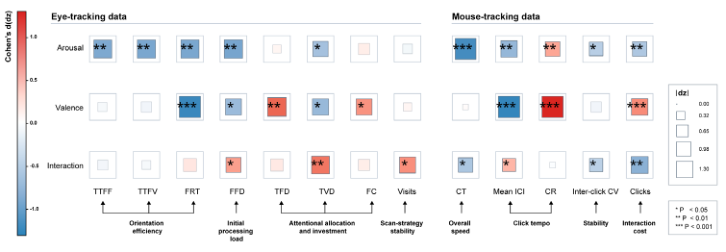
In eye tracking, arousal significantly shortened early-orienting and gaze- to-action latencies: TTFF (dz = −0.675, p_FDR = 0.002), TTFV (dz = −0.694, p_FDR = 0.002), and FRT (dz = −0.698, p_FDR = 0.002) were all significantly shorter under high arousal. First-fixation duration also decreased (FFD: dz = −0.712, p_FDR = 0.002), and total visit duration was reduced (TVD: dz = −0.481, p_FDR = 0.024). Valence showed a distinct pattern: high valence shortened FRT (dz = −0.958, p_FDR < 0.001) and reduced FFD (dz = −0.529, p_FDR = 0.011), but increased TFD (dz = 0.737, p_FDR = 0.001) and FC (dz = 0.535, p_FDR = 0.011) while decreasing TVD (dz = −0.545, p_FDR = 0.011). Significant Valence × Arousal interactions were observed for FFD (dz = 0.474, p_FDR = 0.044), TVD (dz = 0.670, p_FDR = 0.009), and Visits (dz = 0.550, p_FDR = 0.024). Taken together, high arousal compressed the key temporal stages of information access and response initiation and reduced time spent revisiting the page, thereby improving search and execution efficiency without increasing overall fixation investment or visit frequency.
Mouse-tracking measures showed that arousal improved process efficiency by reducing completion time (CT: dz = −1.200, p_FDR < 0.001), shortening
Cross-Modal Evidence on Website Interface-Induced Emotions 171 mean inter-click interval (Mean ICI: dz = −0.731, p_FDR = 0.001), lowering inter-click variability (Inter-click CV: dz = −0.491, p_FDR = 0.016), increasing click rate (CR: dz = 0.571, p_FDR = 0.008), and reducing total clicks (Clicks: dz = −0.563, p_FDR = 0.008). Valence increased interaction tempo and action volume, with higher CR (dz = 1.260, p_FDR < 0.001), shorter Mean ICI (dz = −1.268, p_FDR < 0.001), and more Clicks (dz = 0.742, p_FDR < 0.001). Significant Valence × Arousal interactions were also found for CT (dz = −0.580, p_FDR = 0.012), Clicks (dz = −0.797, p_FDR = 0.001), Mean ICI (dz = 0.471, p_FDR = 0.027), and Inter-click CV (dz = −0.476, p_FDR = 0.027). These findings indicate that high arousal enhanced search efficiency by accelerating task progression and reducing redundant operations.
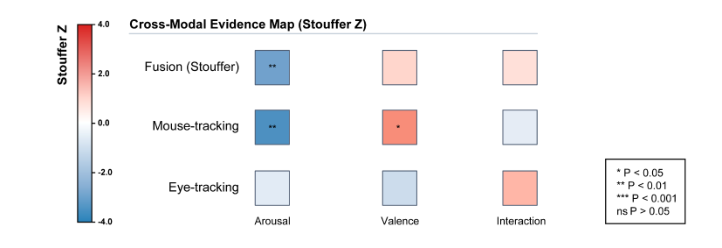
At the fusion level, cross-modal integration indicated a significant arousal effect (Z = −3.147, p_FDR = 0.005), whereas valence and the interaction were not significant. By modality, both arousal and valence were significant in mouse tracking (arousal: Z = −3.566, p_FDR = 0.002; valence: Z = 2.251, p_FDR = 0.049), while in eye tracking arousal was nonsignificant (Z = −0.885, p_FDR = 0.452) and valence was significant but in the opposite direction (Z = −2.310, p_FDR = 0.049). Because valence effects pointed in opposite directions across modalities, they canceled out in the fused analysis. Taken together, the cross-modal integration indicates that H1 is supported, whereas H2 and H3 are not supported at the fusion level.
Figure 5: Cohen’s dz heatmap for eye- and mouse-tracking metrics (color indicates the sign of dz; square size indicates |dz|).Figure 6: Cross-modal evidence map (Stouffer’s Z).
DISCUSSION AND CONCLUSION This study extends e-commerce research on emotion and consumer behavior by providing observable, process-level evidence linking interface- induced emotion to search efficiency in a time-pressured ticket-purchase task. By operationalizing interface emotion in a continuous valence– arousal space using the grid-based CMA and collecting synchronized eye- and mouse-tracking data, the study moves beyond self-report–dominant evidence and offers a clearer view of what happens along the locate– select–submit path.
In the valence–arousal space, the pattern was clear: arousal aligned more consistently with faster, steadier execution, while valence effects were more related to how information was processed than to end-to-end speed. Eye tracking indexed attentional guidance to the target AOI, and mouse metrics indexed execution rhythm. We grouped the measures into attentional allocation and operational rhythm to describe and compare search efficiency.
The findings yield practical implications for limited-time purchase interfaces. When information architecture and content are held constant, selectively increasing arousal at key conversion nodes can improve search efficiency; in practice, this can be implemented by strengthening the prominence of primary actions (e.g., call-to-action buttons, prices, and countdown elements) through controlled use of color, contrast, and constrained motion, while simplifying competing elements nearby to reduce salience competition. In addition, pleasure-oriented cues should be distributed strategically: around critical decision points, positive valence can support processing fluency and reduce perceived effort, whereas outside critical steps, a calmer visual style for backgrounds and secondary elements can help prevent unnecessary competition for attention.
Several limitations should be noted. The sample was student-dominant and tasks were conducted on desktop in a lab setting, so generalization to broader populations and mobile commerce requires replication. In addition, stimuli were anchored in real websites, and product imagery and familiarity could not be fully standardized; future work should test de-branded interactive prototypes and graded time-pressure regimes.
In conclusion, the present study demonstrates that dimensional interface emotion can be linked to observable process indicators in a realistic, time- pressured purchase task, and that cross-modal evidence helps distinguish emotion signals that reliably translate into efficiency from those that are more context-dependent.
ACKNOWLEDGMENT
This work was funded by the Fundamental Research Funds for the Central University (Excellent Graduate Education Innovation Program, 2025CXZZ121) and the National Experimental Teaching Demonstration Center for Comprehensive Liberal Arts, Central China Normal University (WZ2024-01).
REFERENCES
Benjamini, Y., & Hochberg, Y. (1995). Controlling the false discovery rate: A practical and powerful approach to multiple testing. Journal of the Royal Statistical Society Series B: Statistical Methodology, 57(1), 289–300. https://doi. org/10.1111/j.2517-6161.1995.tb02031.x Cyr, D. (2013). Website design, trust and culture: An eight country investigation.
Electronic Commerce Research and Applications, 12(6), 373–385. https://doi. org/10.1016/j.elerap.2013.03.007 Eroglu, S. A., Machleit, K. A., & Davis, L. M. (2001). Atmospheric qualities of online retailing: A conceptual model and implications. Journal of Business Research, 54(2), 177–184. https://doi.org/10.1016/S0148-2963(99)00087-9 Hmurovic, J., Lamberton, C., & Goldsmith, K. (2023). Examining the Efficacy of
Time Scarcity Marketing Promotions in Online Retail. Journal of Marketing Research, 60(2), 299–328. https://doi.org/10.1177/00222437221118856 Huang, J., White, R. W., Buscher, G., & Wang, K. (2012). Improving searcher models using mouse cursor activity. Proceedings of the 35th International ACM SIGIR Conference on Research and Development in Information Retrieval, 195–204. https://doi.org/10.1145/2348283.2348313 Kim, J., & Lennon, S. J. (2013). Effects of reputation and website quality on online
consumers’ emotion, perceived risk and purchase intention: Based on the stimulus- organism-response model. Journal of Research in Interactive Marketing, 7(1), 33–56. https://doi.org/10.1108/17505931311316734 Ladeira, W. J., Lim, W. M., De Oliveira Santini, F., Rasul, T., Perin, M. G., & Altinay, L. (2023). A meta-analysis on the effects of product scarcity. Psychology & Marketing, 40(7), 1267–1279. https://doi.org/10.1002/mar.21816 Leiva, L. A., & Arapakis, I. (2020). The attentive cursor dataset. Frontiers in Human
Neuroscience, 14, 565664. https://doi.org/10.3389/fnhum.2020.565664 Lindgaard, G., Fernandes, G., Dudek, C., & Brown, J. (2006). Attention web designers: You have 50 milliseconds to make a good first impression! Behaviour & Information Technology, 25(2), 115–126. https://doi.org/10.1080/01449290500330448 Mazza, C., Monaro, M., Burla, F., Colasanti, M., Orrù, G., Ferracuti, S., & Roma,
P. (2020). Use of mouse-tracking software to detect faking-good behavior on personality questionnaires: An explorative study. Scientific Reports, 10(1), 4835. https://doi.org/10.1038/s41598-020-61636-5 Modi, N., & Singh, J. (2023). Understanding online consumer behavior at E-commerce portals using eye-gaze tracking. International Journal of Human– Computer Interaction, 39(4), 721–742. https://doi.org/10.1080/10447318.2022 .2047318 Moe, W. W., & Fader, P. S. (2004). Dynamic conversion behavior at E-commerce
sites. Management Science, 50(3), 326–335. https://doi.org/10.1287/ mnsc.1040.0153 Russell, J. A. (1980). A circumplex model of affect. Journal of Personality and Social Psychology, 39(6), 1161–1178. https://doi.org/10.1037/h0077714 Suri, R., & Monroe, K. B. (2003). The effects of time constraints on consumers’
judgments of prices and products. Journal of Consumer Research, 30(1), 92–104. https://doi.org/10.1086/374696 Tiemessen, J., Schraffenberger, H., & Acar, G. (2023). The time is ticking: The effect of limited time discounts on consumers’ buying behavior and experience. Extended Abstracts of the 2023 CHI Conference on Human Factors in Computing Systems, 1–11. https://doi.org/10.1145/3544549.3585735
174 Li and Yang Tuch, A. N., Presslaber, E. E., Stöcklin, M., Opwis, K., & Bargas-Avila, J. A. (2012).
The role of visual complexity and prototypicality regarding first impression of websites: Working towards understanding aesthetic judgments. International Journal of Human-Computer Studies, 70(11), 794–811. https://doi.org/10.1016/j. ijhcs.2012.06.003
LISTED IN THE AHFE DIGITAL BOOKSTORE CATALOGUE
Explore the complete digital volume
Usability and User Experience
Read this individual research paper free through the original publisher, or explore the full digital proceedings book.
ISBN 979-8-950676-08-6
Explore this ISBN in the AHFE Bookstore ↗Listed in the July 2026 bookstore catalogue; search by ISBN to confirm current availability · Digital book purchase optional