Yijia Wang (2026). Design and Evaluation of a Wearable Biofeedback System for Real-Time Regulation of Social Anxiety Based on the System Desensitization Theory. In: Human-Computer Interaction & Emerging Technologies. AHFE Open Access, vol. 233, pp. 199–204. https://doi.org/10.54941/ahfe1007519
This study explores the effective translation of Systematic Desensitization (SD) theory from clinical psychology into wearable interactive systems for social contexts. Addressing the challenges faced by individuals with Social Anxiety Disorder (SAD)—specifically the difficulty in perceiving physiological arousal and the lack of discreet regulation tools during real-world interactions—this paper proposes a design translation framework based on the "Detection–Guidance–Regulation" loop. The core contribution of this framework lies in the application of Peripheral Interaction techniques, which transform complex psychological intervention processes into non-intrusive, rhythmic feedback. To demonstrate the technical feasibility and design rationale of this translation path, an ear-worn biofeedback prototype was developed. Preliminary pilot evaluations indicate that the system achieves an engineering-grade response latency of 245 ms. Furthermore, small-scale usability testing (n=10) demonstrated high levels of wearable comfort and social discretion. This research establishes a replicable human factors paradigm for translating psychotherapeutic principles into everyday functional artifacts.
The core of human factors engineering lies in the comprehensive integration of human capabilities—cognitive, physiological, and sensory—into system design to achieve optimal overall system performance. For individuals with Social Anxiety Disorder (SAD), the intense cognitive load experienced during social tasks often prevents spontaneous and effective self-regulation during the early stages of physiological arousal (e.g., increased heart rate or disrupted breathing patterns). While Systematic Desensitization (SD) theory has been proven to establish new conditioned reflex pathways in controlled clinical environments, its application in volatile, real-world social scenarios faces the dual challenges of interaction, real-time responsiveness, and social discretion.
200 Wang The contribution of this study is categorized as an Artifact System Contribution: Specifically, how to utilize design translation to integrate rigorous psychological intervention procedures into interactive actions that are acceptable and impose a low cognitive burden during dynamic social interactions. In alignment with the goals of Human Systems Integration (HSI), the system is designed to optimize total performance while adapting to the specific characteristics of the user population. We contend that an effective social intervention system should not function as an explicit “therapeutic device.” Instead, it should act as an augmented sensory plug-in, leveraging the peripheral areas of human perception to achieve the unconscious synchronization of physiological regulation. This research focuses on the construction of the design path and prototype-level functional verification.
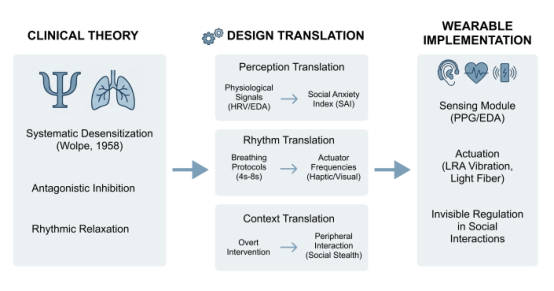
The core methodological contribution of this research is visually articulated in Figure 1, which presents the Design Translation Framework. This framework facilitates the seamless conversion of clinical Systematic Desensitization protocols—specifically Wolpe’s antagonistic inhibition—into executable wearable interaction logic. By structuring the translation across three linked tiers—Perception, Rhythm, and Context—the model effectively embeds therapeutic rhythmic feedback into the background of dynamic social interactions, maximizing ‘social stealth’ while optimizing total system performance.
Figure 1: The design translation framework: converting clinical systematic desensitization into executable wearable interface logic. (Adapted from Wolpe, 1958).
BACKGROUND AND THEORETICAL FOUNDATION To establish a robust foundation for the design of social anxiety intervention systems, this research integrates principles from clinical psychology and human factors engineering. This section first examines the clinical paradigm of SD to identify its core therapeutic mechanisms. Subsequently, within the framework of HSI, it discusses the constraints imposed by cognitive workload and task interference. Finally, Peripheral Interaction theory is introduced as a methodological bridge to resolve the conflict between high- intensity psychological interventions and the requirements of real-time social performance.
Design and Evaluation of a Wearable Biofeedback System for Real-Time 201 The Paradigm of Systematic Desensitization in Social Contexts
SD is a cornerstone of classical behavioral therapy and holds a significant historical position in anxiety intervention. Its core mechanism involves establishing “Antagonistic Inhibition” to block anxiety responses. According to Wolpe (1958), when individuals are exposed to gradually increasing stressful stimuli, the simultaneous practice of rhythmic relaxation—such as controlled breathing—is believed to reshape conditioned reflex pathways.
However, existing intervention research is largely confined to controlled clinical settings. In real-world social scenarios, users often experience “high arousal” states and are constrained by social etiquette, making it difficult to perform explicit psychological regulation exercises. This gap between clinical theory and everyday application scenarios necessitates a shift in the intervention mechanism: from active practice to subconscious guidance.
Challenges in Human Systems Integration and Cognitive Load In accordance with the principles of HSI, the design of artifacts must ensure that system functions align with the operational characteristics of the user in complex environments; otherwise, the system is prone to failure in practical operation. While current wearable biofeedback research has made progress in the precision of physiological data acquisition (e.g., HRV, EDA), the design of intervention feedback often overlooks the impact of Cognitive Load.
In social interactions, where the primary task occupies the vast majority of an individual’s attention, any active regulation behavior that requires the user to “check a screen” or “execute complex instructions” may lead to diminished effectiveness due to limited cognitive resource allocation. Booher (2003) emphasizes that the goal of HSI should be to optimize total system performance, which implies that anxiety intervention systems must operate without interfering with the user’s primary social tasks.
Peripheral Interaction as a Non-Intrusive Intervention Methodology Peripheral Interaction theory provides a critical path for resolving the conflict between social interference and psychological intervention. The theory posits that information can be transmitted to the brain through the peripheral regions of human perception (such as the tactile or visual periphery) without interrupting the user’s primary task. This interaction paradigm allows information to shift seamlessly between the user’s “center of attention” and “periphery of perception.” The entry point of this study is the application of peripheral interaction techniques to translate the rhythmic relaxation signals of SD (e.g., a 4-second inhalation and 8-second exhalation guide) into low-intensity “ambient background” feedback. This translation not only meets the human factors requirement for low interference but also reduces the cost of “social stigma” associated with explicit intervention behaviors. This theoretical bridging provides the methodological foundation for the three-layer design translation framework proposed in the following section.
THE DESIGN TRANSLATION FRAMEWORK This research proposes a three-layer translation logic, serving as a systematic methodological path for mapping SD theory onto wearable interactive systems.
The translation at the perception layer ensures that the system moves beyond merely outputting raw physiological data. Instead, it employs algorithms to map physiological signal fluctuations into a Social Anxiety Index (SAI). As a composite metric, SAI is derived from both standardized heart rate acceleration and the reduction in short-term HRV. This translation transforms ambiguous physiological responses into definitive trigger criteria for the system’s closed-loop control.
The translation of the rhythmic layer focuses on the establishment of antagonistic conditioned reflexes, which is the crux of SD. In this stage, the clinically mandated breathing control rhythm—consisting of a 4-second inhalation and an 8-second exhalation—is mapped onto physical-layer vibration pulses and light-wave frequencies. This translation maintains structural consistency with traditional clinical rhythmic training while adapting the intervention for non- intrusive, real-time application within a wearable system.
The translation of the environmental layer prioritizes the critical requirement of social discretion by mapping feedback signals onto the user’s peripheral perception. By utilizing micro-vibrations in the concealed post- auricular region and low-intensity pulses delivered via lateral light-guide fibers, the system transforms therapeutic instructions into subtle background signals perceptible only to the wearer. This strategic translation significantly mitigates the risk of social stigma typically associated with conspicuous assistive devices, ensuring that the intervention remains private and non- disruptive within dynamic social interactions.
The three-layer translation logic corresponds to the dimensions of signal abstraction, intervention structural preservation, and social context embedding, respectively. Together, these dimensions constitute a structured mapping process that bridges the gap between clinical theory and artifact systems.
SYSTEM DESIGN AND IMPLEMENTATION To validate the aforementioned translation framework, an ear-worn biofeedback prototype was developed. An ear-hook structure was selected for the hardware form factor to ensure stable skin contact for the sensing modules during social body movements. Simultaneously, this design mimics the appearance of standard commercial headsets, fulfilling the requirements for social discretion.
The core hardware system consists of a Photoplethysmography (PPG) sensor, a 32-bit embedded processing unit, and an actuation module. To ensure data reliability within dynamic social environments, the sampling frequency of the PPG sensor was set to 50 Hz. Combined with a low-noise analog front-end, this configuration captures subtle HRV features, providing the raw data necessary for calculating the SAI.
Design and Evaluation of a Wearable Biofeedback System for Real-Time 203 To account for body movements during social interactions, the embedded terminal incorporates the Adaptive Median Filter and Moving Average Filter algorithms. This combination effectively suppresses interference from motion artifacts, extracting smooth pulse waveforms from the fluctuating raw signals.
The central logic of the system establishes a closed-loop feedback loop. To accommodate individual physiological baseline differences, an adaptive thresholding algorithm was introduced: the system automatically calibrates the user’s resting physiological baseline during the first 60 seconds of each session, dynamically setting the trigger criteria for the SAI. When the real- time SAI exceeds the personalized threshold, a distributed actuation module generates haptic guidance via a Linear Resonant Actuator (LRA). The LRA was selected for its rapid response characteristics and high energy efficiency in compact wearable systems, allowing it to recreate the “4-second inhalation, 8-second exhalation” rhythm through varying vibration frequencies. This process bypasses screen-based interaction entirely, relying solely on haptic and visual periphery to provide low-visibility physiological guidance during ongoing social interactions.
PROTOTYPE VERIFICATION AND USABILITY PILOT As this research is positioned as an exploration of design translation and engineering feasibility, the validation process employed prototype-level testing and a usability-oriented pilot study (n = 10) rather than a large-scale clinical controlled trial. The technical evaluation focused on the system’s real-time responsiveness, with prototype testing data revealing an end-to-end latency of approximately 245 ms from the detection of physiological feature points to the activation of the feedback mechanism. This result demonstrates the technical reliability and real-time performance of the proposed translation path.
To verify the design’s rationale, ten participants with social anxiety tendencies were recruited for a small-scale pilot test (see Table 1) where they wore the prototype during simulated social tasks, such as impromptu self-introductions. Evaluation results indicated a high level of wearable comfort, with an average score of 4.38/5. Qualitative interviews revealed that most participants achieved initial synchronization with the breathing rhythm within two to three vibration cycles. Furthermore, only a few participants reported that the interaction caused subjective interference with their social expression. These preliminary observations suggest that the peripheral feedback strategy does not impose a substantial cognitive burden or significant interference on the primary social task.
Table 1: Engineering performance and usability-oriented pilot test results.
Table available in the original PDF paper.
Dimension Metric Result System Performance End-to-end Latency 245 ms Interaction Experience Wearable Comfort (Scale 1–5) 4.38 ± 0.62
Task Compatibility Subjective Social Interference Minimal (<20% of participants)
CONCLUSION
This research proposes and validates a design pathway for translating SD theory into wearable artifacts at the prototype level. Through prototype construction and preliminary pilot testing, we demonstrate how human factors engineering can integrate psychological regulation functions into lightweight hardware without significantly interfering with primary social tasks. While the current scale of validation is insufficient to assess long-term clinical efficacy, this approach provides a reproducible design translation pathway for the engineering implementation of mental health intervention systems. Beyond SAD intervention, this design framework offers a reference for developing wearable systems in other high-cognitive-load scenarios where secondary physiological regulation must run parallel to primary tasks. Future research will evaluate the stability of this framework within larger sample sizes and long-term usage scenarios, while further exploring its adaptability across diverse physiological signal sensing and multifaceted feedback modalities.
ACKNOWLEDGMENT
The authors would like to acknowledge the Institute of Creativity and Innovation for providing experimental facilities and technical support.
REFERENCES
Booher, H.R. (ed.) (2003). Handbook of human systems integration. New Jersey: Wiley. Booher, H.R. and Minninger, J. (2003). ‘Human systems integration in army systems acquisition’, in Booher, H.R. (ed.) Handbook of human systems integration. New Jersey: Wiley, pp. 663–698. Chapanis, A. (1996). Human factors in systems engineering. Hoboken, NJ: Wiley. Folds, D., Gardner, D. and Deal, S. (2008). ‘Building up to the human systems
integration demonstration’, INCOSE Insight, 11(2), pp. 19–21. Wolpe, J. (1958). Psychotherapy by reciprocal inhibition. Stanford: Stanford University Press.
Read this individual research paper free through the original publisher, or explore the full digital proceedings book.
ISBN 979-8-950676-09-3
Explore this ISBN in the AHFE Bookstore ↗Listed in the July 2026 bookstore catalogue; search by ISBN to confirm current availability · Digital book purchase optional