Ayca Aygun, Matthias Scheutz (2026). Comprehensive Modeling and Evaluation of Workload in Driving Simulation Using the VACP Paradigm. In: Human-Computer Interaction & Emerging Technologies. AHFE Open Access, vol. 233, pp. 249–259. https://doi.org/10.54941/ahfe1007524
Understanding and quantifying driver workload is essential for designing safe and effective human–vehicle interaction systems, especially in complex, multi-task driving contexts. Traditional workload measures often rely on aggregate or subjective indices, limiting insight into how distinct perceptual, auditory, cognitive, and motor demands evolve over time. To address this gap, this study adopts the Visual–Auditory–Cognitive–Psychomotor (VACP) paradigm as a structured framework for decomposing driver workload and evaluating its physiological validity using eye gaze measures. Using a pre-existing simulated driving dataset, workload was modelled during a primary driving task combined with three secondary tasks: braking, dialogue-based interactions, and a tactile Detection Response Task (DRT). The driving timeline was segmented into five conditions: baseline driving, braking only, dialogue only, DRT only, and simultaneous braking–dialogue events with onset asynchrony. For each condition, detailed VACP workload models quantified visual, auditory, cognitive, and psychomotor demands across task phases. Physiological relevance was assessed using pupillometry as an objective indicator of cognitive workload. Pupil diameter was analysed in relation to time-varying VACP workload estimates. Results showed a clear correspondence between increased VACP-defined workload and pupil dilation. Pronounced pupil responses occurred during high-demand braking and dialogue events involving concurrent workload components, while smaller but consistent responses were observed for discrete secondary tasks such as DRT and dialogue interactions. These findings demonstrated that pupil diameter is sensitive to both magnitude and composition of VACP workload, supporting the framework’s ability to capture meaningful variations in driver demand. Overall, the results validated the VACP paradigm as a systematic tool for modelling driver workload in complex, multi-task scenarios, with implications for driver monitoring, human–machine interface evaluation, and adaptive vehicle technologies.
Human workload is a critical factor influencing performance, safety, and decision-making in complex multitask environments, such as driving, aviation, and industrial control. Accurate assessment of workload requires a clear understanding of how multiple cognitive and perceptual resources are engaged over time. The Visual–Auditory–Cognitive–Psychomotor
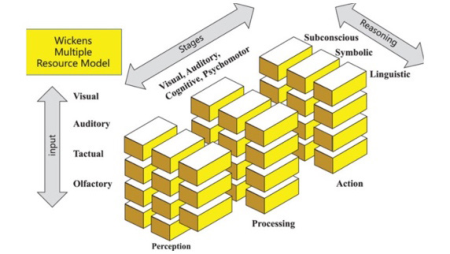
250 Aygun and Scheutz (VACP) paradigm (McCraken, 1984) provides a structured framework for decomposing overall workload into four domains (visual, auditory, cognitive, and psychomotor) allowing for a fine-grained analysis of task demands (Figure 1). VACP uses an objective scoring system to quantify moment-by- moment resource utilization during task performance, enabling researchers to identify the most demanding task components and potentially reduce the overall workload (Wen, 2021; Laux, 2007; Zhang, 2024).
Figure 1: Understanding information processing using diverse resources (Zhang, 2024).
Previous research has demonstrated VACP’s utility across safety-critical domains, including remotely-piloted aircraft operations (Rusnock, 2018), maritime tasks (Zhang, 2023), and nuclear power plant control rooms (Zoaktafi, 2016). In particular, studies have reported significant correlations between analytically derived VACP workload scores and subjective workload ratings such as NASA-TLX, supporting the model’s ability to capture perceived task demands (Huang, 2023). Despite this validation, most prior VACP applications rely heavily on expert interpretation and individuals’ self reports. Subjective measures, are influenced by personal bias and individual differences, and they generally provide only aggregate assessments after task completion. Consequently, these measures cannot capture moment-to-moment fluctuations in workload, limiting insight into dynamic cognitive demands.
In contrast, physiological measures offer continuous, time-resolved assessment of mental workload. Metrics such as cardiac signals, brain signals, and eye gaze have been shown to reliably reflect momentary changes in cognitive effort (Masi, 2023). Among these, pupillometry has emerged as a particularly robust indicator of workload. Task-evoked gaze responses, including changes in pupil diameter, increase with rising cognitive demands and have been validated across diverse domains, from classical laboratory tasks (Kahneman, 1966; Beatty, 1982) to driving simulations (Palinko, 2010; Palinko, 2011; Kun, 2013). Pupillary dynamics reliably track task complexity and subjective workload at high temporal resolution (Radhakrishnan, 2023; Carisio, 2017; Zeeb, 2016; Unni, 2017).
We use the VACP paradigm to model workload in a driving simulation with primary driving and secondary tasks (braking, dialogue, and DRT). Analytically derived VACP scales are linked to eye-tracking measures, with pupil diameter serving as a moment-to-moment indicator of cognitive load.
Comprehensive Modeling and Evaluation of Workload in Driving Simulation 251 This integration bridges traditional workload models and physiological data, offering validation and deeper insight into dynamic cognitive resource allocation in complex multitask environments.
RELATED WORKS The VACP paradigm is a well-established analytical method for decomposing human workload into distinct resource components grounded in multiple resource theory. VACP has been applied across a variety of safety-critical domains, including aviation, nuclear power plant operations, emergency medical services, and driving simulations. Prior studies have demonstrated that VACP enables systematic task analysis and the construction of continuous analytic workload profiles (CAWP), offering fine-grained insight into how workload evolves over time as task demands change.
Despite its widespread use, VACP research has largely relied on subjective ratings or task-analysis predictions rather than physiological validation. (Huang et al., 2003) showed that analytically derived VACP scales correlate significantly with subjective workload measures (e.g., NASA-TLX), supporting VACP’s ability to capture perceived task demands. Similarly, (Zoaktafi, 2016) validated the VACP workload assessment in a nuclear power plant control room by demonstrating a significant positive correlation between analytically assigned VACP workload ratings and operators’ NASA- TLX scores, supporting VACP’s effectiveness for predicting mental workload in safety-critical environments. (Zhang et al., 2023) introduced a risk-based workload control method, demonstrating that VACP-derived workload predictions align with subjective ratings in maritime tasks.
However, subjective workload measures are inherently based on self- report, which can be influenced by individual differences, recall bias, and post- hoc interpretation of task difficulty. Moreover, these measures are typically administered after task completion, limiting their ability to capture moment-by- moment fluctuations. In contrast, physiological indicators can provide continuous, time-resolved estimates of workload that more closely reflect transient changes in cognitive demand. Recent ergonomics and human factors research reviews emphasize the value of physiological measures, including gaze metrics obtained from pupillometry, for workload assessment in simulated environments, noting that pupillary dynamics often reflect variations in cognitive effort (Masi, 2023).
Physiological eye-tracking research provides a strong basis for linking analytical workload models such as VACP to objective indicators of cognitive load. Classic psychophysiological studies show that task-evoked pupillary responses increase reliably with cognitive demand (Kahneman, 1966; Beatty, 1982). In driving and simulation contexts, pupil diameter has been shown to vary systematically with task complexity and multitasking, providing a reliable estimate of mental workload (Palinko, 2010; Radhakrishnan, 2023; Carisio, 2017). Similar effects have been reported in automated driving scenarios, where pupil dilation increases under higher workload and aligns with subjective workload measures (Zeeb, 2016; Unni, 2017). These findings support eye gaze as a non-intrusive measure for validating analytically derived workload models such as VACP.
METHODS
Experimental Data The dataset used in this study consists of multimodal measurements (pupillometry, EEG, fNIRS, skin conductance, and respiration) collected from 82 participants with an average age of 20 years during simulated driving (Aygun, 2025b). Participants were instructed to drive in a realistic simulator while performing additional tasks. Each participant completed two driving sessions separated by a short break. In both sessions, they drove on a four-lane highway with a speed limit of 65 mph. The first three minutes of each session involved driving only, allowing participants to adapt before secondary tasks were introduced. During the sessions, participants periodically completed communication tasks, answering a total of 40 questions, with 20 questions per session. These questions were presented every 30 to 60 seconds and required either yes/no responses or brief verbal explanations. Each session included 10 braking events in which a lead vehicle appeared 200 m ahead, was followed at 75 m for 20 s, then braked suddenly for 5 s before accelerating away.
VACP Workload Components Visual workload refers to effort required to identify or distinguish between different objects with the help of their eyes (Archer, 2005). (Matthews, 1986) examined how visual performance may be affected by visual workload history and demonstrated that the performance is more prone to be impacted by a sudden decrease in the amount of information than by an immediate increase. (Lin, 2008) found out that light colour had notable effects on visual awareness and subjective visual fatigue, and that illumination had significant impacts on reaction time.
Auditory workload refers to insistence of identifying emotions, tones, or mood via sound (Boles, 2007). (Birkmire, 1991) proposed that the aim of estimating auditory workload is to assess the task efficacy from linguistic and aspects of speech communications and individual distinctions. (House, 1963) defined three types of factors to affect auditory workload: transmission (intelligibility and structure), linguistic (complexity, criticality, and expectancy), and individual (ability and training), then quantified auditory workload based on reaction time, operation time, accuracy, retention, and dispersion.
Cognitive workload is linked to working memory allocated for accomplishing the task (Sweller, 1988) and can be further divided into three categories (Das, 2023): (1) intrinsic cognitive load induced by the number of items that need to be memorized (Cook, 2017) and elements that need to be processed simultaneously (Sweller, 2023); (2) extraneous cognitive load caused by external factors which are irrelevant to the target task (Das, 2023); and (3) germane cognitive load linked directly to the experimental setup (Cook, 2017) and the complexity of workload in long-term memory (Das, 2023). Psychomotor workload is the result of the coordination of sensory processes with motor activity and increases in stressful conditions (Sahar, 2022).
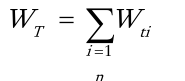
Finally, the overall workload is calculated based on different workload components with the following equation (Zhang, 2024):
Equation reproduced from the original PDF.
1
Equation reproduced from the original PDF.
V A C P
∑ =
1 ( )
ti ti ti ti i
where Wt, Wti, Vti, Ati, Cti, and Pti represent the operator’s overall workload, the ith event’s workload, the ith event’s visual workload component, the ith event’s auditory workload component, the ith event’s cognitive workload component, and the ith event’s psychomotor workload component, respectively.
Our VACP Design We developed the VACP model for our driving simulation data based on the primary driving task and the three types of secondary events including tactile stimulation (DRT), dialogue communications, and braking. We partitioned the timeline based on five different cases: 1) baseline case, 2) only braking case, 3) only dialogue case, 4) only DRT case, and 5) SOA event (the combination of braking and dialogue events).
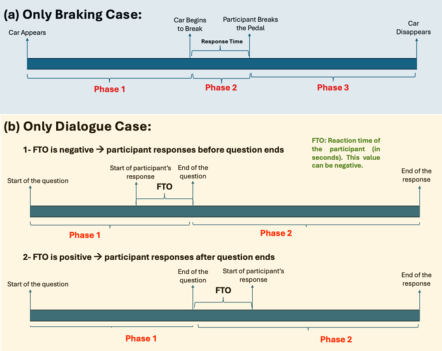
Figure 2: The schematic of the VACP design for (a) braking event and (b) for the dialogue event of the driving simulation.
Only Braking Case: Figure 2 (a) shows the schematic of the VACP design for only-braking event. We recognized only braking case as the situation in which the participants were asked for completing the braking event while proceeding driving. Based on Table 1, we evaluated the only braking event case into three phases to identify the VACP scales given that the participants’ possible VACP workload responses would be different based on different stages of the braking event. First, Phase 1 represents the timeline between the appearance of the car and the onset of the braking of the car. During this period, participants only see a car appearing in front of them. We defined the VACP scales as 4.4 (track/follow), 0 (no auditory activity, 4.6 (evaluation/ judgment), and 4.6 (manipulative, tracking) for the visual, auditory, cognitive,
254 Aygun and Scheutz and psychomotor workload components, respectively. Second, Phase 2 starts with the onset of the braking the front vehicle and ends with the participants’ reaction to break the pedal. We identified the VACP scales for visual, auditory, cognitive, and psychomotor workload components as 5 (visually discriminate, detect visual difference), 0 (no auditory activity), 5 (sign/signal recognition), and 4.6 (manipulative, tracking), respectively. Lastly, Phase 3 encompasses the time period starting when the participant engages the brake pedal and concluding when the front vehicle is no longer visible.
Only Dialogue Case: Figure 2 (b) shows the schematic of the VACP design for only-dialogue event. We designated only braking case as the condition in which the participants were asked for responding yes/no or explanation questions while driving. Based on Table 1, we evaluated the only dialogue event case into two phases to define the VACP scales. Phase 1 represents the time period between the starting and the ending of the question. The participant may or may not start responding the questions. Based on the onset of participant’s responses, we defined the FTO (the reaction time of the participant in seconds) which will be negative if the participant starts before the question ends and included in Phase 1. We defined the VACP scales for visual, auditory, cognitive, and psychomotor workload components as 0 (no visual activity), 3 or 6, 1.2 or 4.6, and 0 (no psychomotor activity), respectively. Besides, Phase 2 begins with the ending of the question and concludes with the participant’s response. We determined the VACP scales for visual, auditory, cognitive, and psychomotor workload components as 0 (no visual activity), 0 (no auditory activity), 1.2 or 4.6, and 0 (no psychomotor activity), respectively.
0 0 3 or 6 0 1.2 or 4.6 1.2 or 4.6 0 0 Only DRT - 0 1 5 2.2
SOA (Braking + Dialogue - 4.4 3 or 6 6.8 4.6 We selected auditory workload levels of 3 or 6 in Phase 1 based on the type of question: a level of 3 was used for yes/no questions, which involve interpreting simple semantic speech content consisting of one to two words, while a level of 6 was used for explanation questions, which require interpreting more complex semantic speech content at the sentence level. Similarly, cognitive workload levels of 1.2 or 4.6 were selected for both Phase 1 and Phase 2 based on the type of answer, with a level of 1.2 applied to yes/no question answers involving alternative selection, and a level of 4.6 applied to explanation question answers that require evaluation or judgment while considering a single aspect.
Comprehensive Modeling and Evaluation of Workload in Driving Simulation 255 Only DRT Case: The DRT event starts with triggering the button and ends with the participant’s reaction by pressing the button). Based on these definitions, we identified the VACP scales for visual, auditory, cognitive, and psychomotor workload components as 0 (no visual activity), 1 (detect/register sound), 5 (sign/signal recognition ), and 2.2 (discrete actuation), respectively.
SOA Event (Braking and Dialogue Together): The SOA event starts with either the end of the question (dialogue event ends) or the car appears (braking event starts) whichever comes first, and ends with the end of participant’s response (as the dialogue event will finish). We defined the VACP scales for visual, auditory, cognitive, and psychomotor workload components as 4.4 (visual track/follow), 3 or 6 (based on the question type, 3 for yes/no questions and 6 for explanation questions), 6.8 (evaluation/judgment, consider several aspects), and 4.6 (manipulative, tracking), respectively.
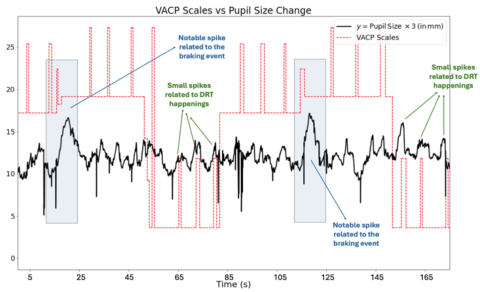
Figure 3: The association between the change in pupil size and the VACP scales captured from a participant performing the simulated driving.
RESULTS
Figure 3 illustrates fluctuations in pupil size corresponding to changes in VACP scales, as defined in our VACP design summarized in Table 1. We adopted the VACP scale definitions from Rusnock (2018) and amplified the pupillometry signal by a factor of three to highlight variations correlated with the VACP scales. Notably, the data reveal prominent peaks (highlighted by the two blue rectangles) associated with increased VACP output, primarily due to braking events. Additionally, smaller transient spikes (indicated by green arrows) correspond to VACP increases resulting from discrete DRT occurrences every 6–10 seconds.
These results indicate a clear correlation between VACP scales and pupil size. Given our previous findings that pupil size reflects human workload (Aygun, 2022) as well as other cognitive states such as mind wandering and sense of urgency (Scheutz et al., 2024; Aygun et al., 2024; Aygun et al., 2025a) in simulated driving, VACP scaling emerges as a potential alternative method for assessing cognitive workload. The present dataset offers a valuable framework to investigate VACP dynamics and their relationship with mental workload during multitask simulated driving scenarios.
DISCUSSION
Our study demonstrates that analytically derived VACP workload scales correspond closely with physiological markers of cognitive load, specifically pupil diameter fluctuations, in simulated driving environment. Peaks in pupil size were observed during high-demand events (braking and dual-task (SOA) conditions), and smaller but consistent changes were associated with discrete secondary tasks, such as DRT stimuli. These findings suggest that VACP framework captures meaningful variations in cognitive and psychomotor demands, and pupillometry provide continuous, time-resolved validation of these analytical estimates.
Importantly, our results highlight several advantages of integrating physiological measures with analytic workload models. First, while subjective measures like NASA-TLX provide valuable insight into perceived workload, they are susceptible to recall bias, individual differences, and post-hoc interpretation. In contrast, pupillometry captures moment-by-moment cognitive dynamics, allowing for detection of transient peaks and subtle workload fluctuations that may be overlooked in self-report data. This more detailed timing make workload assessment more accurate and help identify important parts of the task.
Despite these promising findings, several limitations must be noted. First, our study used a pre-existing driving simulation dataset (Aygun et al., 2025b), which may not capture all real-world complexities or environmental variability. Second, while pupillometry is a sensitive measure of workload, it can also be influenced by non-task-related factors such as luminance changes, emotional states, or fatigue. Future work could integrate additional physiological modalities (e.g., heart rate variability, EEG) to provide multimodal validation of VACP estimates. Finally, the generalizability of these results to other task domains remains to be explored; extending this approach to aviation, industrial control, or other high-stakes environments would help establish the broader applicability of the VACP–physiology framework.
CONCLUSION
This study provides evidence that analytically derived VACP workload scales align with moment-to-moment physiological markers of cognitive load, particularly pupil diameter, in a multimodal and multitask driving simulation environment. By linking structured, resource-specific workload modelling with continuous eye gaze metrics, we demonstrated the potential for combining analytic and physiological approaches to achieve more accurate, dynamic workload assessment. Our results supported the use of VACP not only as a theoretical framework for task analysis but also as a practical tool for evaluating objective real-time cognitive demands in complex environments.
The integration of pupillometry with VACP offers several practical implications. It enables the identification of different workload components that contribute excessively to overall workload, informs adaptive interface design, and provides a foundation for real-time monitoring of operator state in safety-critical systems. Future research should explore multimodal physiological validation, real-world deployment, and the extension of VACP
Comprehensive Modeling and Evaluation of Workload in Driving Simulation 257 models to diverse task environments to further strengthen the link between analytical workload models and human cognitive dynamics.
ACKNOWLEDGMENT
This project was in part supported by AFOSR grant #FA9550-18-1-0465.
REFERENCES
Archer, Susan, Gosakan, Mala, Shorter, Paul, and Lockett, J. (2005) “New Capabilities of the Army’s Maintenance Manpower Modeling Tool”, Journal of the International Test and Evaluation Association, Vol. 26, No. 1, pp. 19–26. Aygun, A. (2025). Assessment of Human Cognitive States via Physiological Signals in
a Multi-Modal Human-Robot Interaction (Doctoral dissertation, Tufts University). Aygun, A., Blaney, G., Haga, Z., McWilliams, T., Mertens, J., de Ruiter, J. P., ... & Scheutz, M. (2025). A Multimodal Virtual Reality Data Acquisition Platform and Dataset to Assess Systemic Human Cognitive States. Scientific Data. Aygun, A., Nguyen, T., & Scheutz, M. (2024). Assessment of Multiple Systemic
Human Cognitive States using Pupillometry. In Proceedings of the Annual Meeting of the Cognitive Science Society (Vol. 46). Aygun, Ayca, Lyu, Boyang, Nguyen, Thuan, Haga, Zachary, Aeron, Shuchin, and Scheutz, Matthias. (2022) “Cognitive Workload Assessment via Eye Gaze and EEG in an Interactive Multi-Modal Driving Task”, Proceedings of the International Conference on Multimodal Interaction, pp. 337–348. Aygun, Ayca, Nguyen, Thuan, Haga, Zachary, Aeron, Shuchin, and Scheutz, Matthias.
(2022) “Investigating Methods for Cognitive Workload Estimation for Assistive Robots”, Sensors, Vol. 22, No. 18, Article 6834. Beatty, Jackson. (1982) “Task-Evoked Pupillary Responses, Processing Load, and the Structure of Processing Resources”, Psychological Bulletin. Birkmire, Deborah P. (1991) “Auditory Performance: A Model to Predict Performance
as a Function of Auditory Workload—Linguistic Factors”, Proceedings of the Human Factors Society Annual Meeting, Vol. 35, No. 10, pp. 618–621. Boles, David B., Bursk, Jonathan H., Phillips, Jeffrey B., and Perdelwitz, Jason R. (2007) “Predicting Dual-Task Performance with the Multiple Resources Questionnaire (MRQ)”, Human Factors, Vol. 49, No. 1, pp. 32–45. Carisio, M., et al. (2017) “Pupil Diameter as an Indicator of Mental Workload in
Driving-Related Tasks”, Applied Ergonomics. Cook, David A., Castillo, Richmond M., Gas, Becca, and Artino Jr., Anthony R.
(2017) “Measuring Achievement Goal Motivation, Mindsets and Cognitive Load: Validation of Three Instruments’ Scores”, Medical Education, Vol. 51, No. 10, pp. 1061–1074. Das Chakladar, Debashis, and Roy, Partha Pratim. (2023) “Cognitive Workload Estimation Using Physiological Measures: A Review”, Cognitive Neurodynamics, pp. 1–21. Edgar, G., Aygun, A., McWilliams, M., & Scheutz, M. (2024). Toward Genuine
Robot Teammates: Improving Human-Robot Team Performance Beyond Shared Mental Models with Proactivity. In Discovering the Frontiers of Human-Robot Interaction: Insights and Innovations in Collaboration, Communication, and Control (pp. 1-22). Cham: Springer Nature Switzerland. House, Arthur S., Williams, Carl, Hecker, Michael H. L., and Kryter, Karl D. (1963) “Psychoacoustic Speech Tests: A Modified Rhyme Test”, The Journal of the Acoustical Society of America, Vol. 35, No. 11 (Supplement), p. 1899.
258 Aygun and Scheutz Huang, Yanrong, Zhang, Nanxi, and Li, Zhizhong. (2023) “Generalizability of Mental
Workload Prediction Using VACP Scales in Different Fields”, Proceedings of the International Conference on Human-Computer Interaction, Springer, pp. 79–94. Kahneman, Daniel, and Beatty, Jackson. (1966) “Pupil Diameter and Load on Memory”, Science. Kun, Andrew L., Palinko, Oskar, Medenica, Zeljko, and Heeman, Peter A. (2013) On
the Feasibility of Using Pupil Diameter to Estimate Cognitive Load Changes for In-Vehicle Spoken Dialogues, U.S. Department of Justice, Office of Justice Programs. Laux, Lila, and Plott, Christopher. (2007) “Using Operator Workload Data to Inform Human Reliability Analyses”, Proceedings of the IEEE 8th Human Factors and Power Plants and HPRCT 13th Annual Meeting, pp. 309–313. Lin, Chiuhsiang Joe, Feng, Wen-Yang, Chao, Chin-Jung, and Tseng, Feng-Yi.
(2008) “Effects of VDT Workstation Lighting Conditions on Operator Visual Workload”, Industrial Health, Vol. 46, No. 2, pp. 105–111. Masi, Giulia, Amprimo, Gianluca, Ferraris, Claudia, and Priano, Lorenzo. (2023) “Stress and Workload Assessment in Aviation—A Narrative Review”, Sensors, Vol. 23, No. 7, Article 3556. Matthews, Michael L. (1986) “The Influence of Visual Workload History on Visual
Performance”, Human Factors, Vol. 28, No. 6, pp. 623–632. McCraken, J., and Aldrich, T. (1984) “Implications of Operator Workload and System Automation Goals”, U.S. Army Research Institute, Technical Report ASI- 479-024-84B. Palinko, Oskar, and Kun, Andrew. (2011) “Exploring the Influence of Light and
Cognitive Load on Pupil Diameter in Driving Simulator Studies”, Proceedings of the Driving Assessment Conference. Palinko, Oskar, Kun, Andrew L., Shyrokov, Alexander, and Heeman, Peter.
(2010) “Estimating Cognitive Load Using Remote Eye Tracking in a Driving Simulator”, Proceedings of the Eye Tracking Research & Applications Symposium. Radhakrishnan, Vishnu, Louw, Tyron, Gonçalves, Rafael Cirino, Torrao, Guilhermina, Lenné, Michael G., and Merat, Natasha. (2023) “Using Pupillometry and Gaze- Based Metrics for Understanding Drivers’ Mental Workload During Automated Driving”, Transportation Research Part F: Traffic Psychology and Behaviour, Vol. 94, pp. 254–267. Rusnock, Christina F., and Borghetti, Brett J. (2018) “Workload Profiles: A
Continuous Measure of Mental Workload”, International Journal of Industrial Ergonomics, Vol. 63, pp. 49–64. Sahar, Yotam, Wagner, Michael, Barel, Ariel, and Shoval, Shraga. (2022) “Stress- Adaptive Training: An Adaptive Psychomotor Training According to Stress Measured by Grip Force”, Sensors, Vol. 22, No. 21, Article 8368. Scheutz, M., Aeron, S., Aygun, A., de Ruiter, J. P., Fantini, S., Fernandez, C., Haga, Z.,
Nguyen, T., & Lyu, B. (2024). Estimating systemic cognitive states from a mixture of physiological and brain signals. Topics in Cognitive Science, 16(3), 485-526. Sweller, John. (1988) “Cognitive Load During Problem Solving: Effects on Learning”, Cognitive Science, Vol. 12, No. 2, pp. 257–285. Sweller, John. (2023) “Cognitive Load Theory: What We Learn and How We Learn”,
in Learning, Design, and Technology: An International Compendium of Theory, Research, Practice, and Policy, Springer, pp. 137–152. Unni, Anjum. (2017) “Driver Workload in Automated Driving: Effects of Automation and Driving Context”, Human Factors. Wen, Hanguan, Yang, Ming, Liang, Jieheng, and Xu, Zhihui. (2021) “Research on
Modeling in Operator Mental Workload Based on VACP Method”, Proceedings of the 3rd International Conference on System Reliability and Safety Engineering (SRSE), IEEE, pp. 359–362.
Comprehensive Modeling and Evaluation of Workload in Driving Simulation 259 Zeeb, Katharina, Buchner, Axel, and Schrauf, Markus. (2016) “Measuring Cognitive
Workload in Automated Driving Using Pupillometry”, Transportation Research Part F: Traffic Psychology and Behaviour, Vol. 42, pp. 31–43. Zhang, Nanxi, Bao, Chunye, Wang, Xin, Han, Qiming, Deng, Ye, Zhang, Yijing, and Li, Zhizhong. (2023) “A Mental Workload Control Method Based on Human Performance or Safety Risk”, Proceedings of the International Conference on Human-Computer Interaction, Springer, pp. 168–177. Zhang, Yuxin, Wen, Hanguan, Dai, Xinyu, Liang, Jieheng, Xu, Zhihui, Xue, Ke, and
Yang, Ming. (2024) “Research on Modeling in Operator Mental Workload Based on VACP Method”, Quality and Reliability Engineering International, Vol. 40, No. 1, pp. 19–33. Zoaktafi, Mojgan, Zakerian, Seyed Abolfazl, Choobine, Alireza, and Nematolahi, Samane. (2016) “Validation of a Task Demand Measure (VACP) for Predicting Mental Workloads of Control Room Operators (A Case Study: Pars Combined Cycle Power Plant)”, Iranian Journal of Ergonomics, Vol. 4, No. 3, pp. 26–32.
Read this individual research paper free through the original publisher, or explore the full digital proceedings book.
ISBN 979-8-950676-09-3
Explore this ISBN in the AHFE Bookstore ↗Listed in the July 2026 bookstore catalogue; search by ISBN to confirm current availability · Digital book purchase optional