Helene Reiter, Rimbert Rudisch-Sommer (2026). Human-Centered AI for Exploring Global Framing Patterns in Climate Disaster News. In: Human Systems Engineering and Design (IHSED2026): Future Trends and Applications. AHFE Open Access, vol. 237, pp. 284–292. https://doi.org/10.54941/ahfe1008168
Climate disaster news shapes public understanding of global events, yet coverage of the same disaster often varies across regions and media outlets. Differences in framing (e.g., tone, narrative emphasis, source selection) influence how responsibility, urgency, and impact are perceived. At the same time, the growing volume of digital news makes systematic comparison difficult. While natural language processing enables automated analysis, results are typically presented as abstract labels that are difficult for non-experts to interpret. This paper presents an interactive, human-centered AI system for exploring global framing patterns in climate disaster news. The system integrates automated article retrieval, content extraction, AI-based analysis, event-level grouping, and interactive visualizations that support cross-source and cross-regional comparison. A central contribution is the design of AI-generated explanations using progressive disclosure, providing optional interpretive support while maintaining a concise interface. This approach aims to reduce cognitive load and avoid overreliance on AI outputs. An empirical user study investigates how explanations support understanding and reasoning processes, as well as the identification of cross-regional framing patterns. Positioned at the intersection of HCI, explainable AI, and media literacy, this work contributes design insights for supporting reflective engagement with AI-driven analysis.
Comparing how different media outlets report on the same climate disaster is often difficult, as variations in language, emphasis, and source usage are not immediately visible. At the same time, readers face an overwhelming volume of information, making critical comparison and reflection on journalistic choices challenging. Strengthening media literacy is therefore essential for navigating digital news environments. In this work, framing is understood as the combination of tone, narrative emphasis, and source selection that shapes how events are presented and interpreted, influencing perceptions of responsibility, urgency, and impact (Entman, 1993).
Received May 13, 2026 Revised June 22, 2026 Accepted July 5, 2026 Available online September 25, 2026
Human-Centered AI for Exploring Global Framing Patterns in Climate Disaster News 285 Although AI-based analysis can identify such patterns, its results are often presented as abstract labels that provide limited insight into how and why differences occur, creating a gap between automated analysis and meaningful interpretation.
To address this, this work introduces an interactive system that supports exploratory comparison of news articles across regions and sources.
The guiding research question is: How do AI-generated explanations support users’ understanding of global framing patterns in climate disaster news and influence critical reflection during exploratory analysis?
The paper contributes to research at the intersection of HCI, NLP, and media literacy by investigating how AI can support reflective exploration rather than replace human judgment. It presents an interactive system for exploring global framing patterns in climate disaster news using event-based grouping and multi-level visualizations, a human-centered explanation design based on progressive disclosure that provides optional and context-sensitive interpretive support, and an empirical study examining how AI-generated explanations influence users’ reasoning, reflection, and engagement during exploratory analysis.
RELATED WORK
Automated framing detection has advanced significantly with developments in natural language processing. Framing is widely understood in communication research as the process by which media highlight certain aspects of reality to shape audience interpretation (Entman, 1993). Prior work has focused on detecting framing through computational cues such as word choice, labeling, and emphasis (Hamborg, 2020; Wang et al., 2025), with systems like Newsalyze combining NLP analysis and visualizations to support comparison across outlets (Hamborg et al., 2020). Recent studies show that large language models can improve framing analysis when prompted with explanations (Pastorino et al., 2024), and that tone variations can significantly influence reader interpretation even when factual content remains constant (Tohidi et al., 2025). Large-scale analyses further reveal that framing patterns exhibit regional clustering (Huang et al., 2024).
Despite these advances, most systems focus on classification and provide limited support for interpretation or user-centered exploration. Explainable AI research addresses this limitation by emphasizing the role of explanations in supporting understanding. Prior work shows that explanations do not uniformly improve intelligibility and depend on context, user needs, and task complexity (Lim et al., 2009). Approaches such as progressive disclosure aim to balance transparency and cognitive load by providing explanations on demand (Ansari and Alam, 2025), while explainability is increasingly framed as a sociotechnical design challenge that must align with user needs and contexts (Okolo and Lin, 2024).
Research on climate disaster reporting highlights the importance of comparative and global perspectives. Media coverage often reflects national political and economic contexts (Vu et al., 2019), while disasters in the Global South remain underrepresented in global reporting (Fetzer and Garg, 2025). These findings underscore the need for tools that support cross-regional and cross-source analysis.
286 Reiter and Rudisch-Sommer In summary, prior work has focused primarily on detecting framing, with limited support for comparative exploration and interpretation. This work addresses that gap by framing analysis as an exploratory, user-driven process supported by explainable, interactive visualizations.
APPROACH The system is designed to support comparative, global analysis of climate disaster news through automated text analysis and interactive visual exploration. It follows a four-stage pipeline: article collection, content extraction, AI-based analysis, and interactive presentation.
A central design decision is to represent news articles as interconnected reports of a shared event. Articles are clustered into event-level groups based on textual similarity, enabling users to compare how the same event is framed across sources and regions. This shift from document-level to event- level analysis supports the identification of systematic differences in framing.
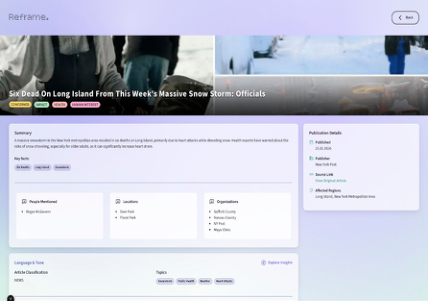
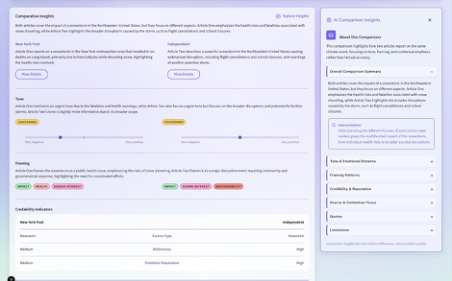
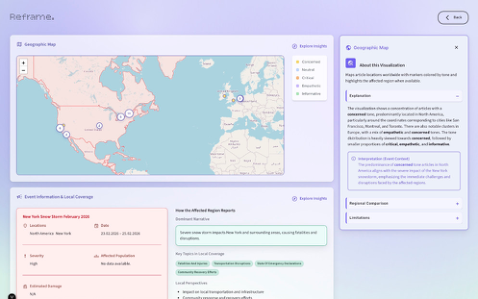
The system provides three complementary levels of exploration. An Article Detail View enables inspection of individual articles and their extracted attributes. A Comparison View supports side-by-side analysis of two articles, facilitating the identification of differences in language and emphasis. A Global View aggregates patterns across events and regions, enabling the exploration of distributed framing tendencies. This multi-level design allows users to move iteratively between detailed inspection and broader pattern recognition, aligning with visual analytics approaches (Keim et al., 2008).
Explainability is integrated through progressive disclosure. AI-generated explanations are available on demand and provide contextual support when needed, rather than being persistently displayed. This design balances transparency and cognitive load, while positioning explanations as optional interpretive support that encourages reflection on underlying evidence.
Overall, the system supports exploratory, user-driven analysis. Rather than providing definitive judgments, it enables users to compare, question, and contextualize framing patterns, aligning with sensemaking processes in which understanding is iteratively constructed through interaction and comparison (Pirolli & Card, 2005).
IMPLEMENTATION The system is implemented as a client–server web application consisting of a Node.js backend (Express) and a Vue-based frontend. The architecture separates data acquisition and analysis from user interaction, enabling scalable processing while supporting responsive exploration.
The backend handles article retrieval, content processing, AI-based analysis, data storage, and event association. News articles are retrieved via the Mediastack API based on user queries, which are expanded with predefined climate-related keywords to improve coverage. Retrieved metadata is stored in a MongoDB database for reuse across analysis tasks.
A custom extraction pipeline retrieves and processes full article content from source URLs, ensuring consistent input for downstream analysis despite heterogeneous website structures. Articles are then analyzed using AI-based methods to derive structured attributes, including framing (e.g., tone and narrative emphasis), key entities, quoted voices, dominant topics, and narrative focus.
The data model separates raw article data, source metadata, event representations, and AI-generated interpretations. Articles are linked through an event inference step that clusters them into shared disaster contexts based on textual similarity, forming the basis for cross-source and cross-regional comparison.
The frontend implements three main views: an Article Detail View, a Comparison View, and a Global View (Figures 1–3). These views support a progression from individual article inspection to comparative and aggregated analysis, enabling users to navigate between different levels of abstraction.
Interactive visualizations are realized using Chart.js for categorical distributions and Leaflet for geographic representations, supporting the exploration of regional patterns. An AI-insights panel is integrated as an optional, collapsible interface element that provides on-demand explanations, enabling interpretive support without increasing interface complexity.
Overall, the implementation prioritizes modularity, robustness, and seamless integration of analysis and interaction components, supporting exploratory, comparative analysis while maintaining transparency and usability.
Figure 3: The global view with the open on-demand insights panel.
EVALUATION To investigate how AI-generated explanations influence users’ interpretation of climate disaster news and their recognition of framing patterns, an empirical user study was conducted across the three interaction levels: article detail, comparison, and global view.
Research Questions and Hypotheses The evaluation investigates how AI-generated explanations support users’ understanding of global framing patterns and their engagement in reflective analysis. Based on this, the following hypotheses were formulated:
H1: Participants with access to AI-generated explanations produce more accurate interpretations of framing differences.
H2: AI-generated explanations lead to more evidence-based reasoning,
as reflected in the quality and depth of participants’ justifications.
H3: Participants use AI-generated explanations in combination with global visualizations to identify cross-regional framing patterns.
The study also explores how users engage with explanations and whether they critically reflect on or challenge AI-generated outputs.
Study Design and Procedure A single-condition exploratory design was used, in which all participants interacted with the full system, including the AI-insights panel. This setup enables analysis of explanation usage within an integrated workflow.
Ten participants with general familiarity with digital news consumption and AI tools took part in the study. Each session lasted 40–45 minutes and consisted of three tasks aligned with the system’s interaction levels: analyzing a single article, comparing two articles, and exploring global visualizations. Participants were asked to interpret framing patterns and justify their responses.
Human-Centered AI for Exploring Global Framing Patterns in Climate Disaster News 289 Sessions included think-aloud interaction, questionnaire responses, and a semi-structured interview focusing on reasoning strategies, perceived understanding, and explanation usage.
Measures and Analysis The evaluation combines behavioral, subjective, and qualitative measures.
Behavioral measures include identification accuracy, justification quality (0–3 scale), interaction behavior, and explanation usage. Subjective measures capture perceived understanding, helpfulness, and directiveness of explanations, cognitive load, and reflective engagement. Questionnaire responses are analyzed descriptively.
Qualitative data from think-aloud protocols, open-ended responses, and interviews were analyzed using thematic coding, focusing on explanation usage, reasoning strategies, and instances of reflection and justification.
RESULTS AND DISCUSSION
Quantitative and qualitative findings examine how AI-generated explanations influence users’ interpretation of framing patterns in climate disaster news and their engagement in exploratory reasoning.
Quantitative Results Task performance differed across interaction levels. Identification accuracy increased from 60% in the article-level task to 100% in both comparison and global tasks, indicating improved recognition of framing patterns when multiple perspectives or aggregated representations were available. In contrast, justification quality remained relatively stable (60–70%), suggesting that improved performance did not necessarily lead to more detailed reasoning.
Evidence use increased with task complexity. Explicit references to textual or visual evidence rose from 50% in the article task to 90% in the global task, indicating stronger reliance on system-provided information. Participants also spent more time on global tasks, reflecting higher cognitive effort.
AI usage behavior varied accordingly. In article-level and comparison tasks, interactions were dominated by discovery and confirmation, with limited dependence on AI explanations. In the global task, dependence increased substantially while confirmation decreased, suggesting that explanations became more important for interpreting aggregated patterns.
Subjective measures indicate high perceived understanding (M ≈ 4.3– 4.6/5), high perceived helpfulness of explanations (M ≈ 4.4/5), and low perceived directiveness (M ≈ 2.5/5). Cognitive load remained moderate to low, and participants retained independent reasoning, including the ability to disagree with AI outputs.
Structured representations played a central role in supporting understanding. Participants relied on framing-related labels (e.g., tone and narrative emphasis), summaries, and highlights to efficiently identify relevant aspects without fully reading articles.
AI-generated explanations were used selectively, primarily when uncertainty or complexity increased. Participants typically formed initial interpretations independently and used explanations to confirm or refine them. Explanations were most effective when grounded in concrete examples.
The system encouraged evidence-based reasoning. Participants increasingly supported interpretations with textual and visual references and considered credibility, source diversity, and missing perspectives.
User engagement strongly influenced outcomes. More active exploration and reflection led to more detailed and well-supported interpretations, while superficial interaction resulted in less nuanced reasoning.
DISCUSSION
The findings highlight several implications for the design of AI-supported exploratory systems.
Structured representations form the primary basis for understanding. Improvements in identification accuracy are strongly associated with comparative and aggregated views rather than explanations alone, suggesting that explanation design should complement well-structured outputs.
AI-generated explanations function as situational support rather than primary drivers of interpretation. Participants used explanations mainly to confirm or refine their own reasoning, particularly in more complex tasks. This behavior reflects sensemaking processes in which users iteratively refine interpretations through comparison and evidence integration (Pirolli & Card, 2005).
The results provide nuanced support for the hypotheses. Explanations supported the identification of framing differences (H1) and evidence- based reasoning (H2), but their effects remained context-dependent. In contrast, combining visualizations with explanations clearly supported the identification of cross-regional patterns, strongly supporting H3.
The findings also challenge the assumption that explainability inherently improves understanding. While explanations increased confidence and supported reasoning, they did not significantly improve justification quality. This aligns with prior work showing that explanations do not uniformly enhance intelligibility (Lim et al., 2009).
Overall, effective explanation design requires balancing interpretive support with user autonomy. Explanations are most valuable when integrated with visual representations and provided as context-sensitive, evidence-based support, enabling active sensemaking rather than passive consumption.
LIMITATIONS This study has several limitations that should be considered when interpreting the findings.
The sample size (N = 10) is relatively small, limiting generalizability. While the study provides detailed insights into user behavior and reasoning processes, the findings should be validated with larger and more diverse participant groups.
The single-condition study design prevents causal isolation of specific system components. Because all participants had access to AI-generated explanations, their independent effects cannot be distinguished from other factors, such as structured representations or visualization design.
The controlled study setting may limit ecological validity, as real-world use involves varying motivation, time constraints, and usage contexts that could affect how explanations are applied.
Finally, the system relies on AI-generated framing analysis, which may introduce inaccuracies or oversimplifications. While interpretations are supported by explanations and visualizations, they may still be influenced by incomplete or imperfect system outputs.
These limitations highlight the need for further research on explanation design, user engagement, and real-world application contexts.
CONCLUSION AND FUTURE WORK This paper presented a human-centered AI system for exploring global framing patterns in climate disaster news through event-based grouping, multi- level visualizations, and explainable AI. The system supports comparative analysis across articles, regions, and events while emphasizing user-driven interpretation.
A central contribution is the design of AI-generated explanations using progressive disclosure, positioning explanations as optional, context- sensitive support. The findings show that structured representations and visualizations play a primary role in supporting understanding, while explanations are used selectively to confirm, refine, or clarify interpretations. Their effectiveness depends on task complexity and user engagement, and they do not automatically improve the quality of reasoning.
These results highlight that explainability should be designed as part of a broader interaction framework that supports active sensemaking, balancing interpretive support with user autonomy. Future work should extend the evaluation with larger and more diverse participant groups, investigate alternative explanation strategies and levels of detail, and examine how such systems support reasoning and media literacy in real-world and cross- domain contexts.
REFERENCES
Ansari, S., & Alam, M. Z. (2025). From AI fact-checks to user understanding: Explaining misinformation detection to non-expert audiences. Proceedings of the 4th ACM International Workshop on Multimedia AI against Disinformation, 28–36. https://doi.org/10.1145/3733567.3735568 Entman, R. M. (1993). Framing: Toward clarification of a fractured paradigm. Journal
of Communication, 43(4), 51–58. https://doi.org/10.1111/j.1460-2466.1993. tb01304.x Fetzer, T., & Garg, P. (2025). Social and genetic ties drive skewed cross-border media coverage of disasters. arXiv preprint. https://arxiv.org/abs/2501.07615 Hamborg, F. (2020, July). Media bias, the social sciences, and NLP: Automating
frame analyses to identify bias by word choice and labeling. In S. Rijhwani, J. Liu, Y. Wang, & R. Dror (Eds.), Proceedings of the 58th Annual Meeting of the Association for Computational Linguistics: Student research workshop (pp. 79–87). Association for Computational Linguistics. https://doi.org/10.18653/ v1/2020.acl-srw.12 Hamborg, F., Zhukova, A., Donnay, K., & Gipp, B. (2020). Newsalyze: Enabling news consumers to understand media bias. Proceedings of the ACM/ IEEE Joint Conference on Digital Libraries in 2020, 455–456. https://doi. org/10.1145/3383583.3398561 Huang, H., Zhu, H., Liu, W., et al. (2024). Uncovering the essence of diverse media
biases from the semantic embedding space. Humanities and Social Sciences Communications, 11(656). https://doi.org/10.1057/s41599-024-03143-w Keim, D. A., Mansmann, F., Schneidewind, J., Thomas, J., & Ziegler, H. (2008). Visual analytics: Scope and challenges. IEEE Computer Graphics and Applications, 28(1), 26–31. https://doi.org/10.1109/MCG.2008.19 Lim, B. Y., Dey, A. K., & Avrahami, D. (2009). Why and why not explanations
improve the intelligibility of context-aware systems. Proceedings of the SIGCHI Conference on Human Factors in Computing Systems, 2119–2128. https://doi. org/10.1145/1518701.1519023 Okolo, C. T., & Lin, H. (2024). Explainable AI in Practice: Practitioner Perspectives on AI for Social Good and User Engagement in the Global South. Proceedings of the 4th ACM Conference on Equity and Access in Algorithms, Mechanisms, and Optimization. https://doi.org/10.1145/3689904.3694707 Pastorino, V., Sivakumar, J. A., & Moosavi, N. S. (2024). Decoding news narratives:
A critical analysis of large language models in framing detection. arXiv preprint. https://arxiv.org/abs/2402.11621 Pirolli, P., & Card, S. (2005). The sensemaking process and leverage points for analyst technology as identified through cognitive task analysis. Presented at the International Conference on Intelligence Analysis. Tohidi, A., Haider, S., & Watts, D. J. (2025). Rethinking news framing with large
language models. Scientific Reports, 15. https://doi.org/10.1038/s41598-025- 29519-9 Vu, H. T., Liu, Y., & Tran, D. V. (2019). Nationalizing a global phenomenon: A study of how the press in 45 countries and territories portrays climate change. Global Environmental Change, 58, 101942. https://doi.org/10.1016/j. gloenvcha.2019.101942 Wang, J. S., Haider, S., Tohidi, A., Gupta, A., Zhang, Y., Callison-Burch, C.,
Rothschild, D., & Watts, D. J. (2025). Media bias detector: Designing and implementing a tool for real-time selection and framing bias analysis in news coverage. Proceedings of the 2025 CHI Conference on Human Factors in Computing Systems. https://doi.org/10.1145/3706598.3713716
FIND THE COMPLETE VOLUME IN THE AHFE DIGITAL BOOKSTORE
Explore the complete digital volume
Human Systems Engineering and Design (IHSED2026): Future Trends and Applications
Read this individual research paper free through the original publisher, or explore the full digital proceedings book.