Eric Lim, Chao Tian, Jason Li, Rick Chua, Thye Sang Ho (2026). Heat Suit-Enhanced VR Training for Emergency Methanol Firefighting in Maritime Operations. In: Human Systems Engineering and Design (IHSED2026): Future Trends and Applications. AHFE Open Access, vol. 237, pp. 694–704. https://doi.org/10.54941/ahfe1008208
The present study demonstrates a novel heat suit-based Virtual Reality (VR) training system for emergency response to methanol fires in the maritime industry, a significant driver of decarbonization in maritime as methanol becomes an increasingly attractive sustainable fuel. In contrast to conventional fires, methanol burns with near-invisible flames and rapid vaporization, hazards that cannot be reproduced safely through normal education. To address that, we modified an existing heat suit and seamlessly integrated it into the VR environment and provided this feedback in the form of thermo-haptic feedback, allowing Trainees to physically sense the growing heat as they walk towards a methanol fire on the drip tray of a container-ship manifold station. The unique novelty of our method is the inclusion of this thermo-feedback integration, which adds visual and auditory stimuli to enhance situational awareness and decision-making processes under thermal conditions. The system provides interactive fire behaviour and fire extinguisher simulation for a safe training experience. In bridging the sensory void of VR-only simulations, our design not only provides a leap forward for maritime firefighting readiness but also sets the standard for immersive training towards the unique environmental challenges associated with methanol-fuelled vessels.
Maritime is witnessing a paradigm shift to cleaner sources of energy, with methanol quickly emerging as a low-emission option for maritime fuels. Due to the high energy density, ease of handling, and potential for carbon-neutral production, methanol is an important part of global decarbonization solutions for shipping (DNV, 2026) (Methanex, 2023). Such solutions will need high- fidelity and immersive training that empowers methanol-fueled operations, especially during emergency responses. While live-firefighting exercises are expensive, logistically complex, and risky – Virtual Reality (VR) provides a relatively safe and repeatable experience to create realistic fire scenarios in a stable environment. (Adam Kimmel, 2024) (Flashgroup, 2022). Conventional virtual reality simulators, on the other hand, do not provide the necessary thermal cues required for accurate thermal stress decision-making. Here Received March 6, 2026 Revised June 26, 2026 Accepted July 20, 2026 Available online September 25, 2026
Heat Suit-Enhanced VR Training for Emergency Methanol Firefighting 695 we have modified an off-the-shelf heat suit which provides thermos-haptic feedback on our VR training system. Trainees could feel an increasing heat from the physical temperature as they come closer to a methanol fire inside a manifold drip tray inside a container ship. This multisensory enhancement is based on prior studies that highlight the relevance of heat and other sensory variables as critical drivers for virtual safety training (Lawson et al., 2019) and is the major novelty of our method.
MULTISENSORY VR: THERMO-FEEDBACK IN VARIOUS DOMAINS Thermo-feedback integrated, multisensory VR systems have shown significant advantages in both research and commercial settings. For example, the Soft Wearable Thermotouch Haptic Interface (T²HI) has emerged as a novel soft wearable-compatible device, with a single end-effector that can simultaneously apply touch and thermal stimulation, substantially increase user engagement level and perceived realism when compared to single-modality haptic hardware (Lee et al., 2024). Simultaneously, a skin-integrated, wireless thermo-haptic stimulator provides high spatial resolution programmable heating and cooling and rapid response time, thus facilitating applications in surgical simulation, telepresence and prosthetic training through localized thermal signals (Kim et al., 2024).
Commercial first-responder VR training systems have begun integrating modified heat suits to simulate live-fire conditions, demonstrating marked improvements in hazard perception, situational awareness, and decision- making accuracy while obviating the risks and costs associated with traditional drills (U.S. Department of Homeland Security, 2023). Similarly, industrial safety training studies have shown that VR scenarios enhanced with thermal feedback led to substantially better learning outcomes: Trainees are able to recall more procedural steps than those who underwent conventional exercises, underscoring the pedagogical value of thermal immersion in safety- critical workflows (Kubr et al., 2024).
Design-oriented research into just-in-time thermo-feedback further refines this paradigm by coupling hand-motion prediction algorithms with thermal actuators, delivering heat cues precisely when and where the Trainee expects them to occur, thus minimizing sensory latency and reinforcing realistic interactions (Chernyshov et al., 2018).
Despite these advances, existing solutions predominantly employ localized actuators or point-based haptic devices. Our approach transcends these limitations by modifying an off-the-shelf heat suit to provide graded, upper body heat sensations synchronized with proximity to a methanol fire on a drip tray in a manifold station onboard a container ship. This upper body thermo-feedback integration bridges the sensory gap inherent in VR-only simulations, enhances situational awareness under thermal stress, and establishes a new benchmark for immersive maritime emergency training.
MAINTAINING THE INTEGRITY OF THE SPECIFICATIONS Virtual Reality simulators for maritime training routinely deliver high- fidelity visual and auditory cues, replicating bridge operations, machinery diagnostics, and generic firefighting drills, but they seldom incorporate true thermal feedback, a critical sensory input in real-world emergencies (Vukelic et al., 2023). In actual methanol-fuelled fire incidents, where flames are nearly invisible and heat intensity increases rapidly, tactile heat cues serve as both danger signals and procedural indicators; omitting this dimension compromises realism and may hinder Trainees’ ability to gauge safe approach distances or determine the need for advanced PPE (Saghafian et al., 2020).
To uphold the integrity of our training specifications, we have modified an off-the-shelf heat suit and seamlessly integrated it into the VR environment, delivering graded, whole-body thermal sensations precisely synchronized with proximity to a methanol fire on a container ship manifold drip tray. This approach builds on prior multisensory VR research, such as the FLAIM Trainer system, which embeds heat-generating components within protective clothing to simulate fire-ground conditions (Levin et al., 2019). Yet our system represents the first application tailored to the dynamic thermal signature of methanol fires in maritime contexts. By embedding authentic heat feedback directly into the simulation loop rather than relying on point-based actuators or retrospective debriefings, we preserve specification-level fidelity, reinforce correct behavioural responses under thermal stress, and establish a new benchmark for immersive maritime emergency training.
SYSTEM DESIGN AND IMPLEMENTATION To address the limitations discussed in the above sections, we have developed a heat suit–enhanced VR training system tailored for methanol fire emergencies on board container ships. Trainees must exhibit heightened vigilance, situational awareness, and mastery of firefighting protocols to effectively respond when a methanol fire is triggered at the manifold drip tray.
In this VR scenario, Trainees begin by selecting, inspecting, and donning all required PPE and equipment via an interactive checklist. When the fire alarm sounds, they are teleported to the entrance of the manifold station, where they employ a gas detector and Infrared Thermal Imaging Camera to verify the presence of a methanol fire, searching for the nearly invisible flames while experiencing escalating heat through the heat suit. Once the fire is confirmed, Trainees enter the manifold station, deploy firefighting equipment (such as activating a water curtain with hoses), and advance toward the fire source, using real-time heat feedback to manage their proximity safely. After extinguishing the fire, they perform a systematic post-fire inspection, utilizing thermal imaging and gas detection to locate any residual hotspots, verify safe atmospheric readings, and then stand down.
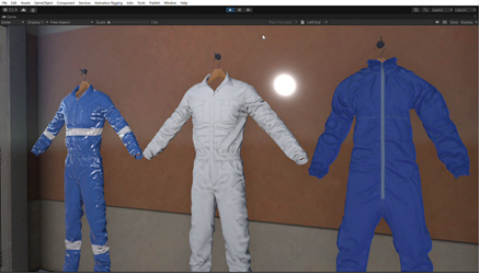
DONNING OF PPE AND FIREFIGHTING EQUIPMENT The trainees start to engage in the scenario in a virtual PPE room, where they hear a fire alarm blaring in the background to build urgency. On a digital rack, you can see three body-suit options: a lightweight cotton suit, a chemical-spill gas suit, and a standard flame-retardant coverall (Fig. 1). Trainees visually inspect each suit before making their selection. Only the chemical-spill gas suit provides the comprehensive protection needed for methanol fire scenarios, underscoring the critical importance of correct gear choice prior to proceeding to the manifold station.
Figure 1: Selection of appropriate body suits (screenshot from VR application, 2025).
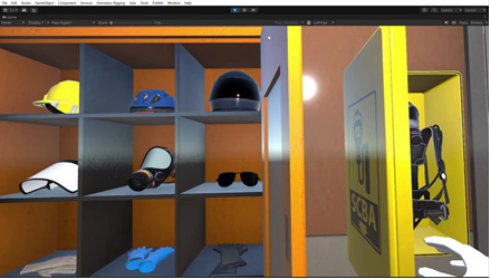
After donning the chemical-spill gas suit, the Trainee moves to the PPE cabinet to outfit the remaining gear in a logical head-to-toe sequence. They begin by selecting the helmet from the head-protection rack. Next, they retrieve and don the chemical-resistant gloves, followed by the chemical- resistant boots (Fig. 2). Finally, they open the wall-mounted case to equip the self-contained breathing apparatus (SCBA), completing the full PPE ensemble.
Figure 2: Equipping PPE (screenshot from VR application, 2025).
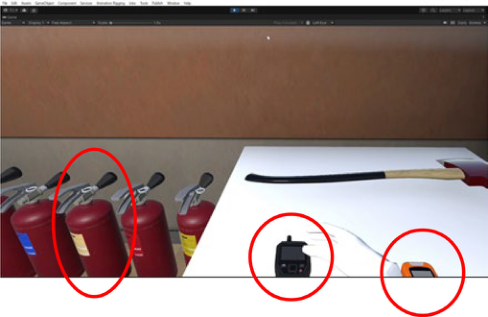
Once all body PPE is in place, the Trainee proceeds to arm themselves with the required portable and firefighting tools. They first equip a VHF radio for wireless communication, followed by an Infrared Thermal Imaging Camera to visualize the near-invisible methanol flames and a gas detector to monitor ambient gas concentrations. Next, they pick up standard-issue firefighting tools, a firefighting axe for manual interventions, and an explosion-proof handheld torch for operations in low-light conditions. Finally, the Trainee selects the appropriate fire extinguisher amongst the other distractors: an Alcohol-Resistant Firefighting Foam (AR-FFF) unit, the only effective agent against methanol fires (Fig. 3).
Figure 3: Selection of portable equipment and fire extinguishers (screenshot from VR application, 2025).
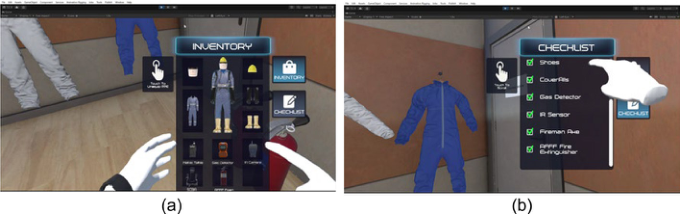
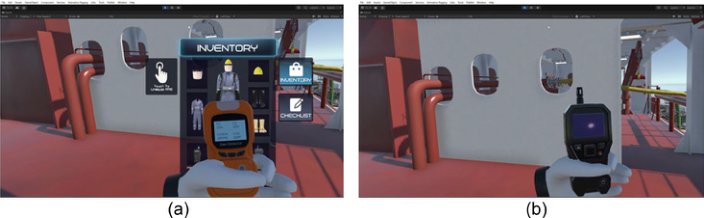
Once fully equipped, Trainees can review their gear using an Inventory Menu accessed through their wrist-mounted display (Fig. 4a). In this menu, they may tap any item slot to unequip gear and then return to the body-suit rack or PPE cabinet to make a new selection (Fig. 2). To reinforce correct PPE choice, a real-time checklist (Fig. 4b) displays every equipped item and flags any omissions.
Figure 4: Verifying of equipped PPE: (a) via Inventory Menu (b) checklist to ensure all PPEs and Equipment are selected (screenshot from VR application, 2025).
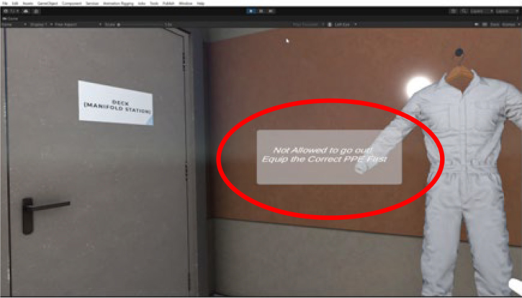
Heat Suit-Enhanced VR Training for Emergency Methanol Firefighting 699 Trainees cannot exit the PPE room toward the manifold station until all checklist criteria are met (Fig. 5), ensuring they grasp the critical importance of each piece of equipment.
Figure 5: Trainee cannot exit the PPE room until all required PPE and equipment have been correctly selected (screenshot from VR application, 2025).
PRE-FIREFIGHTING CHECKS Upon exiting the PPE room with all PPEs and equipment, Trainees proceed cautiously toward the manifold station. Before entry, they pause to activate their Infrared Thermal Imaging Camera (Fig. 6a) and gas detector (Fig. 6b). When activated, the gas detector emits an audible beep and displays elevated vapor readings, confirming the presence of a methanol fire.
Figure 6: Checking for presence of methanol leakage and fire: (a) portable gas detector (b) infrared infrared thermal imaging camera (screenshot from VR application, 2025).
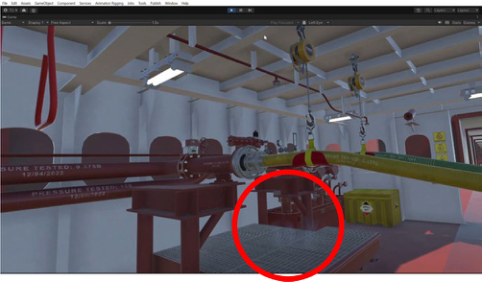
Methanol fires burn with near-invisible flames in the daylight. As an answer to the trade-off between authenticity and training efficiency, our VR system converts these flames into a subtle pale-blue hue (Fig. 7) when occurring in shaded locations such as the manifold station. This method of representation maintains the characteristic low visibility of methanol combustion while presenting Trainees a visual cue and enhances realism and immersion.
Figure 7: A pale-blue methanol flame flickers on the drip tray housed within a shaded manifold station (screenshot from VR application, 2025).
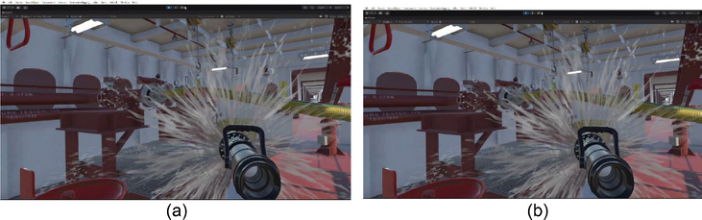
FIREFIGHTING OPERATION – ACTIVATION OF WATER CURTAIN Upon verification of the presence of a methanol fire, the Trainee opens the Inventory Menu and selects the fire hose (Fig. 8a) and activates the fire hose water curtain mode of the spray hose (Fig. 8b). This water curtain acts as a shield to prevent the methanol fire from harming the firefighter.
Figure 8: Activating the Water Curtain: (a) via Inventory Menu (b) proceeding towards fire source (screenshot from VR application, 2025).
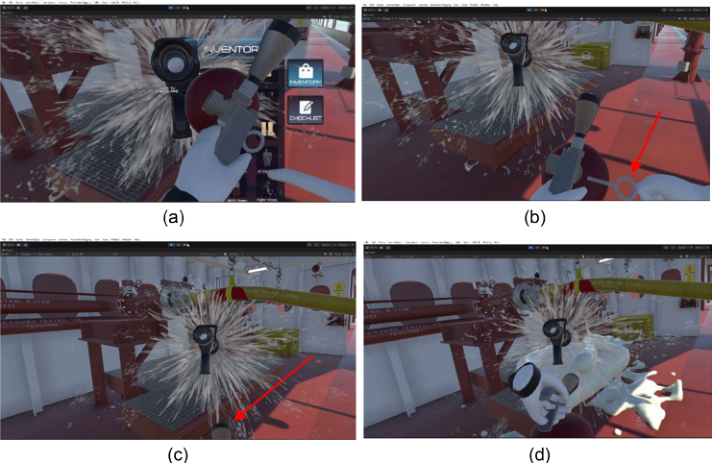
FIREFIGHTING OPERATION – EXTINGUISHING THE METHANOL FIRE As the Trainee near the fire source, they first deploy a water curtain by switching to the fog mode on the Fire Nozzle in front of the drip tray to shield themselves from the heat and prevent fire from spreading. They then activate the Alcohol-Resistant Firefighting Foam (AR-FFF) extinguisher (Fig. 9a).
Holding the AR-FFF extinguisher securely, the Trainee executes the P.A.S.S. protocol: they Pull the safety pin to unlock the lever (Fig. 9b), Aim the nozzle at the flame’s base on the drip tray (Fig. 9c), Squeeze the lever to release the alcohol-resistant foam, and Sweep the nozzle in a controlled side-to-side
Heat Suit-Enhanced VR Training for Emergency Methanol Firefighting 701 motion until the fire appears fully suppressed (Fig. 9d). Importantly, the Trainee continues to blanket the entire drip tray surface even after the visible flames vanish; this ensures any residual methanol and its vapours are sealed off from oxygen, preventing re-ignition.
Figure 9: P.A.S.S. protocol to extinguish the methanol fire: (a) equip extinguisher (b) pull the pin (c) aim the fire extinguisher (d) squeeze the handle and sweep the fire extinguisher from side-to-side (screenshot from VR application, 2025).
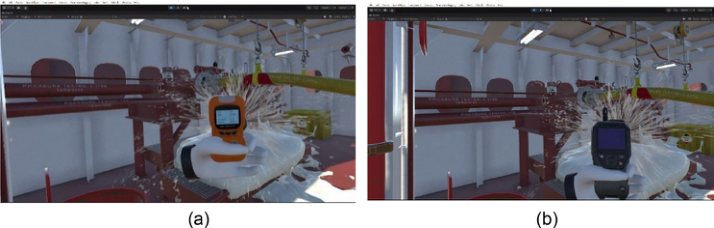
FIREFIGHTING OPERATION – EXTINGUISHING THE METHANOL FIRE After the foam has thoroughly blanketed the drip tray and surrounding area, the Trainee reactivates the Portable Gas Detector (Fig. 10a) and infrared Thermal Imaging Camera (Fig. 10b) to verify safe conditions. The gas detector must display normal vapor readings, and the Infrared Thermal Imaging Camera should reveal no remaining hotspots, confirming the fire hazard has been fully neutralized.
Figure 10: Verifying presence of methanol fire via: (a) portable gas detector (b) infrared thermal imaging camera (screenshot from VR application, 2025).
Once the Portable Gas Detector and Infrared Thermal Imaging Camera confirm that vapor levels and temperatures have returned to their prescribed safe limits, the Trainee may unequip the extinguisher and fire hoses. At this point, the exercise is formally concluded.
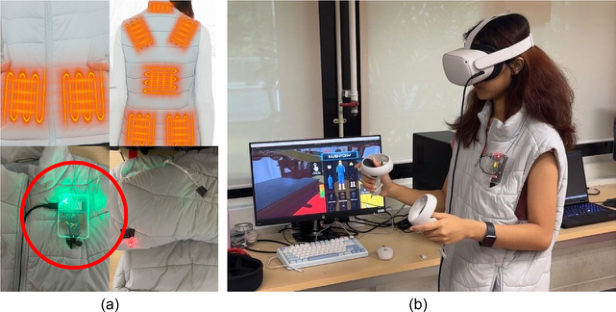
INTEGRATION OF THERMO-FEEDBACK HEAT SUIT IN VR The Smart Heat Vest (Fig. 11a) is a wearable thermo-haptic feedback system developed to enhance immersive VR training for methanol firefighting scenarios. It delivers heat stimulation to three distinct zones: front, back, and top using embedded heating pads controlled wirelessly via an ESP32 microcontroller. The vest was originally purchased as an off-the-shelf product and subsequently modified to integrate with VR, enabling it to be controlled directly by the virtual environment. By linking heating responses to specific elements in a VR scenario, such as proximity to virtual fire, the system enables Trainees to receive real-time thermal feedback aligned with their actions. It interfaces with Unity-based applications via C# scripting, enabling real-time, programmable simulation of heat sensations in response to VR events. This not only enhances situational awareness but also supports more realistic and engaging emergency response training.
The system utilizes the ESP32 in SoftAP (Software Access Point) mode, which allows it to create a standalone Wi-Fi network without relying on external routers—improving portability and deployment flexibility. The microcontroller operates with a default gateway and receives custom HTTP GET commands sent from Unity based on the Trainee’s movement in the VR environment. Commands like /onall, /onlow, or /offall activate or deactivate heating zones depending on the Trainee’s proximity to heat sources within the VR scenario. For example, entering a high-risk area near a virtual drip tray triggers the /onall command to activate all heating zones simultaneously.
Figure 11: Thermo-feedback heat suit developed in-house: (a) modified off- the-shelve heat vest (b) full gear set up (photos, 2025).
CONCLUSION
In this paper, we have demonstrated how a purpose-built VR firefighting system for methanol emergency scenarios directly advances maritime decarbonization and safety training. By immersing Trainees in pre-firefighting and suppression sequences, our approach enables repeated practice of high- risk procedures without ever exposing personnel or vessels to real fire or toxic fumes. The use of VR thus not only strengthens technical proficiency and decision-making under pressure, but also dramatically lowers logistical costs and safety liabilities associated with live drills.
Crucially, the integration of our in-house innovations, specifically the synchronized virtual Gas-Detector and Infrared Thermal Imaging Camera feedback loops, elevates the realism of the VR Training. Trainees receive immediate insights on fire-fighting techniques, situational awareness, and adherence to standard operating procedures, allowing instructors to tailor debriefs and reinforce best practices.
Together, these elements set a new benchmark for maritime emergency preparedness: a safe, reusable, and objective training platform that aligns with the industry’s transition to low-carbon fuels while upholding the highest standards of crew safety. As methanol and other alternative fuels become more prevalent, such VR-based methodologies will be indispensable for equipping seafarers with the confidence and competence needed to meet tomorrow’s sustainability and safety challenges.
ACKNOWLEDGMENT
The authors would like to acknowledge the support of the Centre of Excellence in Maritime Safety (CEMS) at Singapore Polytechnic, as well as the contributions of subject matter experts, and students who supported the development, testing and validation of this work.
REFERENCES
Adam Kimmel. (2024) Why VR Training for firefighters is beneficial for fire departments. The Verizon Website: https://www.verizon.com/business/resources/ articles/s/how-virtual-reality-helps-improve-firefighter-training-programs/ DNV. (2023) Methanol as a fuel head for mainstream in shipping. The DNV Website:
https://www.dnv.com/expert-story/maritime-impact/Methanol-as-fuel-heads-for- the-mainstream-in-shipping/ Flashgroup. (2022) Firefighter Safety: How VR Training Solutions Are Transforming It? The Flashgroup Website: https://flashgroupxr.com/firefighter-safety-how-vr- training-solutions-are-transforming-it/ G. Chernyshov, K. Ragozin, C. Caremel, and K. Kunze. (2018) Hand motion
prediction for just-in-time thermo-haptic feedback in: Proc. ACM Symp. Virtual Reality Softw. Technol., 2018, pp. 1–2 Website: https://dl.acm.org/ doi/10.1145/3281505.3281573 G Lawson, E Shaw, T Roper, T Nilsson, L Bajorunaite, A Batool. (2019) Immersive virtual worlds: Multi-sensory virtual environments for health and safety training Website: https://arxiv.org/abs/1910.04697
G. Vukelic, D. Ogrizovic, D. Bernecic, D. Glujic, and G. Vizentin. (2023) Application of VR Technology for Maritime Firefighting and Evacuation Training – A Review in: J. Mar. Sci. Eng., vol. 11, no. 9, Art. no. 1732 Website: https://doi.org/10.3390/ jmse11091732 J.-H. Kim et al. (2024) A wirelessly programmable, skin-integrated thermo-haptic
stimulator system for virtual reality in: Proc. Natl. Acad. Sci. U.S.A., vol. 121, no. 22, e2404007121 Website: https://www.pnas.org/doi/10.1073/pnas.2404007121 J. Kubr, A. Lochmannová, and P. Hořejší. (2024) Immersive Virtual Reality Training in Industrial Settings: Effects on Memory Retention and Learning Outcomes Website: https://www.researchgate.net/publication/385768706_Immersive_ Virtual_Reality_Training_in_Industrial_Settings_Effects_on_Memory_ Retention_and_Learning_Outcomes M. Saghafian et al. (2020) The Evaluation of Virtual Reality Fire Extinguisher
Training in: Frontiers in Psychology, vol. 11, Art. no. 593466 Website: https:// www.frontiersin.org/articles/10.3389/fpsyg.2020.593466/full Methanex. (2026) Why Methanol as a marine fuel? The Methanex Website: https:// www.methanex.com/our-products/about-methanol/marine-fuel/ S. Lee, S. Jang, and Y. Cha. (2024) Soft wearable thermotouch haptic interface for
virtual reality in: iScience, vol. 27, no. 12, Art. no. 111303 Website: https://www. sciencedirect.com/science/article/pii/S2589004224025288 T. Levin, S. Chessum, J. Mullins, N. Yoshihashi, and K. Hayashi. (2019) Ensuring Greater Safety for Our Firefighters and Our Communities: Integrating FLAIM TrainerTM and hitoeTM in: NTT Technical Review, vol. 17, no. 2, pp. 24–31 Website: https://doi.org/10.53829/ntr201902fa3 U.S. Department of Homeland Security. (2023) Virtual Reality Training Systems for
First Responders in: SAVER TechNote SAVER-T-TN-40 National Urban Security Technology Laboratory Website: https://www.dhs.gov/sites/default/files/2023- 06/Virtual%20Reality%20Training%20Systems%20for%20First%20 Responders%20TechNote.pdf
FIND THE COMPLETE VOLUME IN THE AHFE DIGITAL BOOKSTORE
Explore the complete digital volume
Human Systems Engineering and Design (IHSED2026): Future Trends and Applications
Read this individual research paper free through the original publisher, or explore the full digital proceedings book.