Melissa McLain, Sarah Bostrom, Richard Niemeyer, Leanne Hirshfield (2026). Beyond True or False: Measuring Information Discernment in a Simulated Joint Operations Environment. In: Human Factors in Design, Engineering, and Computing. AHFE Open Access, vol. 238, pp. 1194–1204. https://doi.org/10.54941/ahfe1008349
Information disorder and adversarial exploitation of human cognition pose growing challenges for military decision making in saturated information environments. Although most research focused on veracity discernment, operational settings require broader information discernment: evaluating, contextualizing, and determining whether information should influence decisions and action. This study addressed limitation of laboratory paradigms and classified operation settings through an iterative experiment in the U.S. Air Force Academy’s Multi-Domain Laboratory (MDL), an unclassified simulation of a joint all-domain operations center. Across two semesters, measures were refined for assessing information interaction in a naturalistic, high-information density (HID) environment. Initial instruments emphasized decision and response selection but could not distinguish participants who failed to notice information from those who identified it as inaccurate or irrelevant. Fall 2025 methods incorporated component-specific, time-stamped information supplements and retrospective debrief measures of information belief and decision influence. Findings and results from 771 observations are presented to explore the debrief instrument’s utility for assessing metacognitive processes underlying information discernment without disrupting wargame execution.
In both military and academic contexts, the cognitive domain and information processing are becoming increasingly important with the rise of adversarial exploitation of information disorder in today’s messy media ecosystem (Facciani, 2025). Information disorder describes the propagation of false, misleading, or harmful information and the resulting information overload that can inhibit cognitive performance from perception through decision making (Wardle & Derakhshan, 2017; Wickens & Carswell, 2021). Adversaries recognize the low cost, scalability, and potentially outsized impacts of cognitive warfare against US military forces (François, 2019; Helmus et al., 2020; Lange, 2024). Understanding how individuals and teams interact with contested information in complex operational settings is therefore essential for mitigating the strategic effects of cognitive warfare.
Beyond True or False: Measuring Information Discernment in a Simulated Joint 1195 A central challenge is that much of the existing research on information disorder focuses on individual veracity discernment, or the ability to determine if information is true or false (Cho et al., 2024; Crum et al., 2025; Facciani, 2023; Guay et al., 2023). Existing tools assess constructs such as susceptibility to fake news, willingness to engage in open-minded thinking, or accuracy in identifying misinformation. These instruments are valuable in controlled laboratory settings, where researchers can clearly identify when participants receive a stimulus and can then evaluate whether participants assess it accurately (Ecker et al., 2022; Lewandowsky et al., 2022; Pariser, 2011; Pennycook et al., 2019; Roozenbeek et al., 2022). However, operational information environments create different measurement problems.
In naturalistic or semi-naturalistic settings, researchers must distinguish among several possible forms of participant interaction with information, which requires the participants to have metacognitive awareness (Rousseau et al., 2010). Information disorder research provides this problem in context: individuals and teams must evaluate information that may be false, misleading, incomplete, harmful, or intentionally adversarial (Ecker et al., 2022; Lange, 2024; Lewandowsky et al., 2022; Pariser, 2011; Pennycook et al., 2019; Roozenbeek et al., 2022). A participant may fail to notice a piece of information, notice it but ignore it, inspect it and assess it irrelevant, inspect it and assess it false, assess it accurately but fail to communicate it, or assess it inaccurately and deliberately decide not to act on it (Bak-Coleman et al., 2022; Guay et al., 2023; Lewandowsky, 2022; McGrew, 2024; Pennycook et al., 2019). Traditional veracity-discernment measures often emphasize the individual’s assessment of accuracy and do not capture the broader sequence of human-information interaction (Kozyreva et al., 2024; Tandoc et al., 2021). This limits their generalizability to operationally relevant military settings, where information discernment is embedded within time pressure, team communication, mission demands, and competing streams of task-relevant content (Crum et al., 2024; Roozenbeek et al., 2024).
To address this gap, the present research developed a metacognitive debrief instrument to assess information discernment from a retrospective self-assessment. Information discernment, as used here, refers to the higher- order cognitive skills used to evaluate the accuracy, relevance, implications, and actionability of information within complex and dynamic environments (Ecker et al., 2022; Rousseau et al., 2010; Wickens & Carswell, 2021). The instrument is designed to assess information discernment using participant self-reflection to explain why they decided to believe the information and how the information influenced downstream decision-making, rather than as a single truth-or-falsehood judgment. The dynamic nature of the operational information environment creates work systems in which humans, teams, digital tools, communication channels, adversarial information, and workload interact of interest to human factors, human computer interaction, and future-of-work studies.
METHODS
Research Setting: The Multi-Domain Lab (MDL) Wargame This research was conducted in the United States Air Force Academy’s (USAFA) MDL, an immersive learning environment designed to simulate a joint all-domain operations center. The MDL provides a useful middle ground between laboratory control and operational complexity. Like controlled studies, it allows researchers to know when and where specific ISs are introduced. Like naturalistic settings, it embeds those supplements within workload, role responsibilities, team communication, time pressure, and mission-relevant decision making.
The MDL wargame provides the culminating experience for the cadets to complete the Military and Strategic Studies (MSS) core class. The wargame is conducted, each semester, across four one-hour class sessions, with cadets resuming from the prior session’s endpoint. The resulting high- information-density (HID) environment introduces cognitive demands consistent with potential cognitive overload. Within gameplay, participants must identify and act upon signals within noise, including communicating relevant information to other component teams (Baughan et al., 2022; Ruiz et al., 2024). This environment is well suited for studying information discernment because it preserves several features of operational information work: multiple information channels, distributed team roles, time-sensitive decisions, variable workload, and mission consequences associated with communication or inaction. At the same time, it remains unclassified and repeatable, which supports research access, instrument development, and iterative refinement.
Participants and Data Collection Participants were sophomore and junior cadets enrolled in a required 200-level MSS course. As part of the coursework, cadets completed 30 lessons on military doctrine and operational planning and developed an operational plan for the wargame. All cadets in selected course sections were invited to participate without compensation or extra credit. Cadets were assigned to one of six components (i.e., air, land, maritime, cyber, space, special operations), with allocated resources and forces for the team to utilize. The individual team member assignment was stable across all four wargame execution sessions. However, each component team included a different number of participants based on anticipated workload in the scenario (i.e., air included a maximum of six teammates while space included two). Two additional leadership participant roles existed outside of the components. The Joint Force Commander (JFC) led all the component teams and made decisions. The Operations Commander (J3) coordinated inputs from the components to the JFC and vice versa. This resulted in varied representation for each component and leadership roles within the dataset as follows (n = 759 valid responses): Air – 28.2%, Land – 14.8%, Maritime – 14.2%, Cyber – 8.8%, Space – 8.8%, Special Ops – 15.9%, Leadership – 9.2%.
Beyond True or False: Measuring Information Discernment in a Simulated Joint 1197 Information discernment was evaluated across two academic semesters of data collection and four to twelve participating course sections each semester (n = 771 consenting participants). Data collection occurred during the daily wargame execution to mark key events and immediately following through a structured debrief instrument. This design allowed the research team to embed IS into the wargame environment, containing both accurate and inaccurate, as well as relevant and irrelevant information, to participants. The research team collected self-reported retrospective data daily across four sessions. The debrief instrument asked participants to reflect on information discernment processes related to information in the IS (e.g., shared with a colleague, influence on decision making or actions).
Information Supplements (IS) Information discernment was assessed by disseminating a daily IS at the beginning of each day of wargame execution. The IS was distributed through the wargame’s information chat channel (i.e., mIRC) and was embedded within the normal flow of scenario-relevant information. Each component received a different update specific to their role. A total of 24 unique IS’s were delivered over the course of the 4-day wargame, with three IS’s containing disinformation. For example, the air component received inaccurate information on the Day 1 (D1) about the surface-to-air missiles (SAMs) having a longer range than initially reported, which if believed would influence air route planning for ingress.
Debrief Instrument The debrief instrument was developed to address limitations in traditional veracity-discernment measures when applied to naturalistic or semi- naturalistic environments (Crum et al., 2024; Roozenbeek et al., 2024). In laboratory misinformation studies, researchers can often control when and how participants receive a stimulus and then assess whether they classified it correctly. In the MDL environment, however, participants operate within a naturalistic, HID environment in which exposure, attention, interpretation, team communication, and action cannot be assumed, nor do they necessarily occur in chronological order.
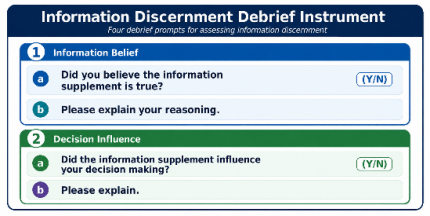
The debrief instrument was administered immediately after each day of the wargame execution. The instrument included four questions to capture participants’ retrospective, self-reported Information Belief and Decision Influence. The debrief instrument was comprised of two yes/no questions for quantitative analysis and two free response questions for qualitative analysis (reference Figure 1 for the debrief questions with numbering (e.g., 1a to 2b). In designing the debrief instrument, priority was given to a concise, logical flow of questions categorized by Information Belief and Decision Influence. These questions provided indicators of where breakdowns in the information-discernment process may have occurred, without interrupting the naturalistic setting of the wargame. In future data analysis, the ‘indicators’ from the debrief instrument (e.g., incorrect belief assessment) will be used as a starting point (e.g., participant role, day, information, key event) to then collate data streams (e.g., audio, screen recordings, and chat logs), enabling
a systematic evaluation of information discernment using multi-modal data. For the purposes of this paper only the results and findings from debrief data will be discussed.
Figure 1: Debrief instrument.
Information Belief (1a/b) assesses whether the belief in the day’s IS was correct. A score of 1 indicates that the participant was incorrect in their accuracy assessment of the IS (mismatch between the veracity of the IS and the participant’s belief) whereas a score of 2 indicates a correct assessment (congruent IS veracity and participant belief). The mean accuracy score across all four days of MDL execution is 1.73 indicting mostly accurate assessments of the IS’s.
Decision Influence (2a/b) assesses whether participants acted upon the information in the IS (e.g., decision-making, planning). A score of 0 indicates that the IS did not influence action whereas as score of 1 indicates that it informed an action. The mean decision score is 0.54 indicating that the ISs influenced approximately half of decision-making processes. Respondent rates (e.g., n-values) and descriptive statistics for the information belief and decision influence are presented in Table 1 below.
Table 1: Descriptive statistics.
Table available in the original PDF paper.
N Mean (%) Std Dev Min Max Information Belief 755 1.73 0.44 1.00 2.00
Decision Influence 633 0.54 0.49 0.00 1.00
ANALYSIS The fixed response Information Belief and Decision Influence measures were examined using one-way ANOVAs by team and Tukey’s Honestly Significant Difference (HSD) test for pairwise comparisons of significant ANOVA tests. ANOVAs were completed for each day of MDL wargame execution to eliminate confounding impacts of repeated participant responses over time. Missing data were excluded from the analysis; this included participants that skipped these questions or were absent during the data collection session. The accuracy scores for space component participants were adjusted based on semester of data collection to account for the differential timing of the inaccurate space information supplement between the fall and spring data collection sessions.
Beyond True or False: Measuring Information Discernment in a Simulated Joint 1199 Free response answers (1b, 2b) were analysed using thematic analysis. Both a manual and AI-generated process was used to create the codebook based upon the most prominent themes that emerged from the free response answers. The manual and AI-generated (e.g., ChatGPT Pro) codebooks were compared to inform the consolidation of similar themes per question. This process resulted in four themes for 1b and two themes for 2b. From this process, the theme about noticing the IS also emerged in free responses to 1b. The determination was made to annotate not noticing the IS separately from the themes selected for Information Belief and Decision Influence. The themes, response rates, and key concepts used to code the identified themes are annotated in Table 2 below. Themes are labelled from one to six and are referenced in the results section accordingly (e.g., Theme 1: T1).
Table 2: Thematic analysis *COA = Course of action.
Table available in the original PDF paper.
Question & Theme N Key Concepts or Phrases for Coding Information Belief T1: Scenario
209 53
T2: Corroboration
48
T3: Scepticism
42
T4: Acceptance
15
Operational consistency, cross-component coordination Internal or official-source trust, evidence gap, cross source-check Question source credibility, propaganda concern, realism judgment No change from previous day, brief or limited explanation
Decision Influence T5: COA Planning
94 - T6: Msn Relevance -
Approach changes, adapted overtime, asset positioning, COA update Tactical tasking, prioritization, team or msn performance
RESULTS & DISCUSSION The debrief instrument distinguished information belief, decision influence, and action without disrupting wargame execution. Participants were classified as novices in operational planning, wargaming, and interface use. This classification guided interpretation relative to situation-awareness research dominated by expert samples, as limited task and interface familiarity may have increased cognitive demands, particularly on Day 1. The instrument captured metacognitive processes participants self-reported retrospectively with yes/no answers in addition to free response rationales. The free-response rationales are critical in high-information-density environments, where assessing relevance and accuracy depends on situational context. Results are presented in survey question order: Information Belief followed by Decision Influence.
Information Belief (1a). Information-assessment accuracy differs significantly amongst teams on Day 1 (F = 41.28, p < 0.001) (see Table 3 for significant results, full findings available upon request). Tukey’s HSD pairwise comparisons showed that the Air and Cyber teams, which
received disinformation, were less accurate than teams receiving accurate information (see Table 4 for significant results, full findings available upon request). No significant differences occurred between the Air and Cyber teams or among teams receiving accurate information. Team accuracy did not differ on subsequent days. This suggests that on Day 1 (D1), teams that received disinformation were significantly worse at assessing the accuracy of the IS. However, there were no significant differences in team accuracy on subsequent execution days.
Table 3: Team accuracy one way anova.
Table available in the original PDF paper.
Accuracy Day 1 Sum of Squares df Mean Square F Between Groups 23.89 6 3.81 41.28***
Within Groups 14.70 159 0.09 Note: * p<0.05, ** p<0.01, *** p<0.001
Table 4: Pairwise comparisons of Day 1 accuracy between teams.
Table available in the original PDF paper.
Team Comparison Mean Difference 95% Confidence Interval Land- Air 0.64*** [0.42, 0.87]
Leadership- Air 0.63*** [0.37, 0.89] Maritime- Air 0.68*** [0.45, 0.91]
Space- Air 0.80*** [0.52, 1.09] Special Ops- Air 0.80*** [0.58, 1.02]
(1b). Forty-four percent of participants provided a substantiative response to 1b (see Table 2). Participants reported considering if the information connected to the scenario and mission; corroborated other intelligence or source credibility, expressed scepticism about information plausibility or realism, noting possible propaganda, or reported broad acceptance. These responses demonstrate that participants relied on multiple interpretive cues rather than making only binary true—false judgments.
For example, one participant in the Cyber component on D2 responded “seemed to be simple fearmongering” (T3), in a report about attacks on the U.S. population. On D3, a different participant also in the Cyber component stated, “The source was an Intel report, and it seemed like valid intel that was actively being seen in our cyber component” (T2). On D1, participants from the Air component, but in different sections and semesters assessed the disinformation about the extended range of the SAMs as true (e.g., “I think
Beyond True or False: Measuring Information Discernment in a Simulated Joint 1201 the information is reliable.” T2) and as false (e.g., “The sources seemed off, and the information was very lofty as compared to previous information we had been given.” T3). Interestingly, both participants said the information did not influence decision making, which demonstrated how expanding research beyond veracity discernment enables a more holistic understanding of potential information interactions and outcomes.
Decision Influence (2a). Reported use of the supplements did not differ significantly among teams on any execution day. Importantly, teams receiving disinformation were no more likely to report using their supplements in decision-making than teams receiving accurate information. This is a positive signal as teams that received disinformation were not more likely to use this information to shape decisions than their counterparts that received accurate information.
(2b). Responses explaining how the information influenced decisions were limited (n = 94; 18%); therefore, the identified themes indicate the presence (see Table 3), but not the absence of specific reasoning processes. The most dominant theme (T5) involved connecting the supplement to course-of-action (COA) planning and strategy, including adjustments intended to reduce operational risk. Participants expressed adjusting existing plans to reduce the risk to forces based on the content in the IS (e.g., D1 Air: “It helped me understand they [SAMs] could fire farther.” | D3 SOF: “We made adjustments based on the intel.”). Other participants appropriately rejected information they considered irrelevant (T6) to their assigned role or the wargame scenario. For example, one participant assigned to SOF, noted on D4, “didn’t involve SOF much”, in response to information regarding U.S. reliance on STEM-talent from other nations and immigrants. The debrief instrument is unique with the focus on information discernment and underlying rationale. The instrument captured metacognitive processes indicative of participants’ reasoning for why they believed the IS and how the IS influenced decision making in an operational scenario.
CONCLUSION
This study advances human factors research on information disorder by emphasizing the need to collect data on metacognitive processes that shape information discernment in team-based operational environments. This structure supports naturalistic assessment of metacognitive processes that are otherwise latent or difficult to measure without interrupting the scenario. Understanding distinctions within information discernment processes can inform cognitive security education, interface design, team communication and performance procedures, thus developing agency of thought in contested information environments.
Applied in the USAFA MDL wargame, the analysis of debrief responses identified distinctions across information discernment processes including information belief and decision influence. The wargame provided an unclassified, repeatable setting that offered greater operational realism than static discernment tasks with prompts for veracity assessments, while retaining research control. Uncertainty surrounding if participants ‘noticed’ the IS and
lower D1 Information Belief accuracy were consistent with attentional and perceptual limitations due to the heightened cognitive load of the first day in the MDL, which aligns with Endsley’s Level 1 Situational Awareness stage (Perception). Free responses reflected comprehension through assessments of relevance, credibility, corroboration, and plausibility, whereas Decision Influence responses reflected projection of operational consequences and decision-making. The absence of component differences in responses, despite earlier differences in Information Belief demonstrates that information exposure or inaccurate assessment does not necessarily translate into action. Incorrect assessments and actions may arise from variables outside of the scope of this study (e.g., workload, role boundaries, communication friction, or time pressure).
The findings remain limited due to retrospective self-report, uneven response rates, novice participants, exclusive focus on debrief instrument results, and the constraints of simulation. Furthermore, uncertainty about whether participants ‘noticed’ and comprehended the information in the IS is unknown. Future studies should incorporate read receipts within the software and/or provide the IS for reference within the debrief instrument. Further analyses beyond the scope of this paper will integrate multi-modal data (e.g., chat logs, observations, audio, screen recordings, behavioral traces, and performance outcomes) to reduce the limitations discussed above. Triangulating these data streams beyond self-reported survey response, will strengthen measurement of metacognitive processes and improve understanding of how individuals and teams manage information disorder under realistic HID conditions. Overall, the debrief instrument provides an instrument for locating information discernment breakdowns upstream of action. However, further investigation is required to determine if the self-reported data is also reflected in the observed participant behaviour. Based upon these limitations the conclusions in this article are constrained and should not be generalized to other use cases or operational environments.
Future research can build upon this study’s methodology and focus on information discernment processes. A study in a different naturalistic setting could incorporate a similar information supplement and debrief instrument to assess self-reported metacognitive processes with the intent to isolate indicators of information discernment breakdowns. The goal of future information disorder research would be to shift studies from simplistic veracity discernment lab-based tasks to more complex naturalistic metacognitive information discernment processes.
ACKNOWLEDGMENT
The authors would like to acknowledge the extensive support and collaboration provided by the Military and Strategic Studies department at USAFA, the Multi-Domain Lab team, and USAFA Systems Engineering Capstone cadets. Declaration of Conflicting Interests: The authors declare no conflicts of interest. Funding: FA9550-23-1-0453 PA#: USAFA-DF-2026-151
REFERENCES
Bak-Coleman, J.B., Kennedy, I., Wack, M., Beers, A., Schafer, J.S., Spiro, E.S., Starbird, K. and West, J.D. (2022) ‘Combining interventions to reduce the spread of viral misinformation’, Nature Human Behaviour, 6(10), pp. 1372–1380. doi: 10.1038/ s41562-022-01388-6.
Baughan, A., Zhang, M. and Rao, R. (2022) ‘“I don’t even remember what I read”: How design influences dissociation on social media’, in Proceedings of the CHI Conference on Human Factors in Computing Systems. New York: Association for Computing Machinery, pp. 1–13. doi: 10.1145/3491102.3501899.
Cho, H., Cannon, J., Lopez, R. and Li, W. (2024) ‘Media literacy interventions: A meta-analytic review’, Human Communication Research, 50(2), pp. 57–95. doi: 10.1093/hcr/hqad041.
Crum, J., Spencer, C., Doherty, E., Richardson, E., Sherman, S., Hays, A.W., Saxena, N., Niemeyer, R.E., Anderson, A.P., Ceko, M. and Hirshfield, L. (2024) ‘Misinformation needs ecological validity’, Nature Human Behaviour, 8(12), pp. 2268–2271. doi: 10.1038/s41562-024-02015-2. Crum, J., Allred, A., Bostrom, S., Doherty, E., McLain, M., Richardson, E., Spencer, C., Niemeyer, R., Hayman, A., Tossell, C., Čeko, M. and Hirshfield, L. (2025) ‘Understanding the neurocognitive mechanisms of cognitive security’, Neuroscience & Biobehavioral Reviews, 179, 106448.
Ecker, U.K.H., Lewandowsky, S., Cook, J., Schmid, P., Fazio, L.K., Brashier, N., Kendeou, P., Vraga, E.K. and Amazeen, M.A. (2022) ‘The psychological drivers of misinformation belief and its resistance to correction’, Nature Reviews Psychology, 1(1), pp. 13–29. doi: 10.1038/s44159-021-00006-y.
Endsley, M.R. (1995) ‘Toward a theory of situation awareness in dynamic systems’, Human Factors, 37(1), pp. 32–64.
Facciani, M. (2025) Misguided: Where misinformation starts, how it spreads, and what to do about it. New York: Columbia University Press.
François, C. (2019) Actors, behaviors, content: A disinformation ABC. Working paper. Graphika and Berkman Klein Center for Internet & Society at Harvard University, Transatlantic Working Group. Available at: https://www.ivir.nl/twg/
Guay, B., Berinsky, A., Pennycook, G. and Rand, D.G. (2023) ‘How to think about whether misinformation interventions work’, Nature Human Behaviour, 7(8), pp. 1231–1233.
Helmus, T.C., Marrone, J.V., Posard, M.N. and Schlang, D. (2020) Russian propaganda hits its mark: Experimentally testing the impact of Russian propaganda and counter-interventions. Santa Monica, CA: RAND Corporation. Available at: https://www.rand.org/pubs/research_reports/RRA704-3.html
Kozyreva, A., Lorenz-Spreen, P., Herzog, S.M. et al. (2024) ‘Toolbox of individual- level interventions against online misinformation’, Nature Human Behaviour, 8, pp. 1044–1052. doi: 10.1038/s41562-024-01881-0.
Lange, S. (2024) ‘Algorithmic cognitive warfare: The next frontier in China’s public diplomacy’, SCSP Substack, 21 November.
Lewandowsky, S. et al. (2022) ‘Tackling misinformation: Psychological approaches to evidence evaluation’, Nature Reviews Psychology, 1(1), pp. 31–42.
McGrew, S. (2024) ‘Teaching lateral reading: Interventions to help people read like fact checkers’, Current Opinion in Psychology, 55, 101737. doi: 10.1016/j. copsyc.2023.101737.
Pariser, E. (2011) The filter bubble: What the Internet is hiding from you. New York: Penguin Press.
Pennycook, G. and Rand, D.G. (2019) ‘Lazy, not biased: Susceptibility to partisan fake news is better explained by lack of reasoning than by motivated reasoning’, Cognition, 188, pp. 39–50. doi: 10.1016/j.cognition.2018.06.011. Roozenbeek, J., Traberg, C.S. and van der Linden, S. (2022) ‘Technique-based inoculation against real-world misinformation’, Royal Society Open Science, 9(5), 211719. doi: 10.1098/rsos.211719.
Rousseau, R., Tremblay, S., Banbury, S., Breton, R. and Guitouni, A. (2010) ‘The role of metacognition in the relationship between objective and subjective measures of situation awareness’, Theoretical Issues in Ergonomics Science, 11(1–2), pp. 119–130. doi: 10.1080/14639220903010076.
Ruiz, N., León, G. and Heuer, H. (2024) ‘Design frictions on social media: Balancing reduced mindless scrolling and user satisfaction’, in Proceedings of Mensch & Computer 2024 (MuC ’24). New York: Association for Computing Machinery, pp. 442–447. doi: 10.1145/3670653.3677495.
Tandoc, E.C. et al. (2021) ‘Assessing media literacy interventions with formative tasks’, Journalism & Mass Communication Educator, 76(4), pp. 483–501.
Wardle, C. and Derakhshan, H. (2017) Information disorder: Toward an interdisciplinary framework for research and policy making. Strasbourg: Council of Europe.
Wickens, C.D. and Carswell, C.M. (2021) ‘Information processing’, in Salvendy, G. and Karwowski, W. (eds.) Handbook of human factors and ergonomics. 5th edn. Hoboken, NJ: Wiley, pp. 114–158.
SEARCH THE AHFE DIGITAL BOOKSTORE BY ISBN
Explore the complete digital volume
Human Factors in Design, Engineering, and Computing
Read this individual research paper free through the original publisher, or explore the full digital proceedings book.