Di Liu, Mengyu Liu (2026). Assessing Embodied-AI Humanoid Robots for Construction: A Task- Capability-Human-Compatibility (TCHC) Framework. In: Human Factors in Design, Engineering, and Computing. AHFE Open Access, vol. 238, pp. 1316–1326. https://doi.org/10.54941/ahfe1008360
Embodied-artificial-intelligence (AI) humanoid robots offer a potential pathway for automating human-scale construction work, yet advances in isolated robot skills do not establish readiness for complex construction operations or effective participation in human crews. This paper proposes a Task-Capability-Human-Compatibility (TCHC) framework to assess humanoid suitability at the level of construction action sequences and collaborative work. The framework comprises three connected stages. First, building construction work is decomposed from trade operations into executable actions, with contextual, physical, quality, safety, and interaction requirements. Second, actions are mapped to humanoid capabilities in locomotion, perception, manipulation, force regulation, planning, and adaptation. Third, six Human Embodiment Compatibility (HC) dimensions conceptualize morphological, environmental, tool-handling, sensorimotor, interaction, and cognitive-social compatibility. The integrated TCHC framework is illustrated through qualitative construction task scenarios involving carpentry tool handling, roofing, and piping placement. The cases reveal distinct bottlenecks: precise and safe tool use, stable contact-rich work on sloped surfaces, and coordinated handling within constrained shared workspaces. These analyses do not constitute empirical robot validation; rather, they identify testable capability and human-humanoid teaming requirements. TCHC contributes a construction-focused bridge between physical humanoid capabilities and human-autonomy teaming, supporting more discriminating use-case selection and future experimental evaluation.
Construction work combines labor-intensive manual actions with variable environments, evolving site conditions, and interdependent trade activities. Specialized construction robots can automate well-bounded operations, but their usefulness does not automatically extend to heterogeneous, labor- intensive workflows. Embodied-AI humanoid robots are attractive because their general-purpose body configuration may allow access to human-oriented
Assessing Embodied-AI Humanoid Robots for Construction 1317 tools and workspaces. Whether this morphology yields useful construction labor, however, depends on much more than a robot’s physical ability to demonstrate walking, grasping, or tool manipulation.
Three research gaps motivate this study. First, physical capability is not equivalent to embodied intelligence in practice. (Hurst, 2026) explains that actuation, compliance, inertia, and contact dynamics fundamentally constrain what software can achieve. This argument on humanoid physical capabilities is essential but does not specify how construction operations should be decomposed to expose the relevant constraints. Second, demonstrations of robotic skills do not establish general-purpose readiness. (Park, 2026) describes the transition from impressive isolated humanoid behaviors toward generality as an unresolved challenge, while (Gu et al., 2026) synthesize advances and remaining challenges in locomotion control. Neither directly provides a construction task-sequence evaluation method. Third, task compatibility does not guarantee teamwork. (Walliser et al., 2019) found that simply framing an autonomous agent as a teammate improved affective and behavioral measures without improving performance, whereas goal setting and role clarification improved broader teaming outcomes. Their findings motivate explicit consideration of collaboration, but their experimental tasks do not establish physical human-humanoid compatibility in contact-rich construction work.
To address these gaps, this paper proposes the Task-Capability-Human- Compatibility (TCHC) framework. Its contribution is a construction-focused, task-centered qualitative assessment structure connecting action-level construction requirements, humanoid physical and computational capabilities, and human-humanoid teaming conditions. Moreover, this paper illustrates three applicable task scenarios based on the most common construction trades.
RELATED STUDIES AND CONCEPTUAL FOUNDATION Construction Task Structure and Robotic Capabilities - Construction tasks are usually structured by work breakdown structures (WBS) to organize scope, cost, and schedule, but project-level WBS elements are generally too coarse to describe executable robot behavior (Jung and Woo, 2004). Hierarchical task analysis (HTA) offers a complementary method for specifying goals, subtasks, actions, and plans (Salmon et al., 2010, 2022). CSI MasterFormat provides a recognizable organization of common construction trade works (“MasterFormat® - CSI” 2024), although it is a specifications classification rather than a robotic action taxonomy. These complementary sources motivate a two-level mapping from trade operations to action sequences. On the other hand, existing construction automation demonstrates the value of task-specific perception, planning, and digital coordination. For example, Zhu et al., (2023) review crane-lift automation and Wang et al. (2024) develop BIM-driven closed-loop digital-twin workflows for human– robot collaboration (Wang et al., 2024; Zhu et al., 2023). Such approaches provide useful construction-specific mechanisms, but do not by themselves
1318 Liu and Liu characterize how one humanoid embodiment transfers across manual trades or how the robot teams with human crews with physical and social compatibility.
Embodied AI and The Generality Gap - Embodied AI links perception and decision-making to consequential action through a physical body. Recent humanoid work has advanced locomotion, whole-body control, imitation, and cross-embodiment learning, and tactile manipulation (Gu et al., 2026; Lum et al., 2025; Xu et al., 2023; Ye et al., 2026). Simulated humanoid benchmarks, including HumanoidBench, support systematic testing of locomotion and manipulation primitives (Sferrazza et al., 2024). Yet benchmark success or demonstration transfer cannot be treated as evidence of reliable tool use under common construction job environments often occupied with dust, clutter, variable loads, dynamic human proximity, and changing construction sequences. As (Hurst, 2026) emphasizes, morphology and visually plausible motion do not imply suitable physical dynamics. (Park, 2026) similarly identifies generalization beyond showcased skills as a central challenge. There is a necessity to address the missing domain-specific application-level translation by explicitly making the required sequence and operating context.
From Embodied Robotic Action to Embodiment Compatible Human- Autonomy Teaming - Embodied cognition emphasizes that cognition is situated in perception-action interaction rather than detached from the physical environment (Sandini et al., 2025; Wilson, 2002). Research on intention alignment and collaborative robotic learning broadens this view toward adaptation between agents (Chen et al., 2026; Dey et al., 2026). Nevertheless, a learned motor policy does not necessarily communicate intent, clarify roles, or sustain predictable shared decisions and actions. (Walliser et al., 2019) provide direct evidence that team structure and role clarification matter beyond a nominal teammate identity, although their results concern autonomous agents rather than construction humanoids.
The author’s previous work on human-autonomy teaming (HAT) proposes a multidimensional construction human–autonomy teaming (HAT) model integrating human and agent capabilities, task and environmental complexity, and their team process constructs (Liu and Liu 2024, forthcoming). The proposed TCHC framework builds on this team-oriented perspective but serves a different purpose: it translates those broad interdependencies into assessable conditions for particular humanoid bodies, actions, and human co-workers. The six HC dimensions below are qualitative categories inspired by embodied cognition, physical interaction, and HAT.
METHODOLOGY
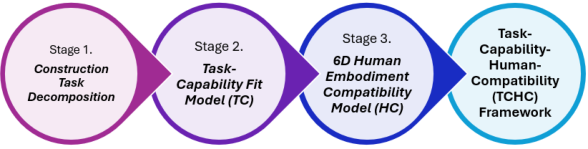
A three-stage methodology is utilized for developing the TCHC framework: (1) decomposing construction tasks into executable actions, (2) mapping task requirements to humanoid capabilities, and (3) assessing these actions across six Human Compatibility (HC) dimensions (Figure 1). This allows the establishment of a systematic, task-centered approach to identifying
Assessing Embodied-AI Humanoid Robots for Construction 1319 capability requirements and compatibility challenges associated with humanoid deployment in construction environments.
Figure 1: Research methodology.
Stage 1: Decompose Construction Tasks into Executable Actions - The scope of Stage 1 is to restrict humanoid actions to human-scale building construction work. CSI MasterFormat is used to identify representative work families, while HTA informs decomposition into trade, operation, subtask, and executable action. Each action is annotated for terrain and obstacles of common construction jobsites; load, posture, leverage, and repetition; dimensional and surface-quality requirements; hazard exposure and worker proximity; and solo execution versus shared execution. These attributes are requirements to be verified in future site observation or controlled trials, not measurements collected in this paper. Two initial classifications distinguish construction vehicle-mediated operations (A) (Table 1), in which major mobility or force is supplied by machinery, from manual human-scale operations (B) (Table 2), in which human mobility and manipulation dominate. Notably, Classification A is not categorically irrelevant to humanoids: humanoids may assist with rigging, signaling, inspection, and interfaces, even when the automated machinery remains primary; Classification B is further extended by mapping into HumanoidBench motion elements.
Table 1: Classification A: Dominated by heavy construction machinery operation and automation.
Table available in the original PDF paper.
Construction Trade Task Types Core Actions Humanoid Relevance A1. Earthwork and site operations Operation assistance/ inspection
Assessing Embodied-AI Humanoid Robots for Construction 1321 Stage 2: Map Action Demands to Embodied Robot Capabilities - Each action is further mapped to perception and inspection; locomotion and whole- body stability; reach, grasp, and bimanual manipulation; tool-mediated action; force/compliance regulation; and sequencing, adaptation, and recovery. The action vocabulary in Table 3 supports consistent comparisons across trades, indicating future humanoid capability requirements. For an entire operation, feasibility requires the relevant skills to be integrated in the required order, under task-specific load and safety constraints. An unverified critical action is therefore a deployment bottleneck even when other actions have been demonstrated.
Stage 3: Conceptualize Human Embodiment Compatibility (HC) – A six-dimension (6d) Human Embodiment Compatibility model was derived conceptually by integrating (i) embodied cognition and the constraints of physical action, (ii) human-oriented environments and tools, and (iii) the team interaction and cognition constructs emphasized by HAT (Liu and Liu forthcoming; Sandini et al., 2025; Wilson, 2002) . These six qualitative dimensions are interconnected (Table 4). The first four dimensions principally address embodied physical compatibility, whereas interaction and cognitive- social compatibility address the formation and maintenance of joint decision- making. In the applicable task scenarios, the author documented the relevant HEC constraints and potential observations, such as workspace clearance, reachability, tool interface, contact-force adjustment, communication timing, role clarity, and recovery from coordination breakdown.
Table 3: Humanoid action vocabulary for construction tasks.
Perception and Inspection Cut, Drill, Fasten, Spread, Smooth, Wipe, seal
Walk, Climb, Crouch, Balance, Traverse, obstacles
Reach, Grasp (apply force and precision), Hold under load, Lift, Carry,Push/pull, Insert, Align, Rotate, release
Visual alignment, Surface quality assessment, Gap detection, Error recognition
Table 4: Six-dimension human embodiment compatibility (HC) model.
Table available in the original PDF paper.
Dimensions Descriptions
1 Morphological compatibility (Morph)
Compatible with physical shape, size, appearance, kinematics, DOFs Compatible with operating in human co-working spaces
2 Environmental compatibility (Env)
3 Tool compatibility (Tool) Compatible with using human tools/interfaces
4 Sensorimotor compatibility (SenMtr)
Compatible with operating human-like movement/control patterns for each action
5 Interaction compatibility (Inter)
Compatible with communicating and physically coordinating with humans
6 Cognitive-Social compatibility (CogSo)
Compatible with continuing to update shared intent, shared goal, and team trust
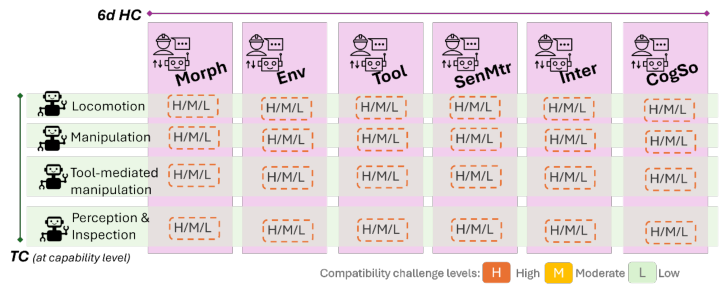
1322 Liu and Liu Integrated TCHC framework - The integrated TCHC framework (Figure 2) combines the humanoid action vocabulary with the six dimensions of Human Compatibility (HC) through a task-conditioned assessment matrix. The four action categories (Table 3), locomotion, manipulation, tool-mediated manipulation, and perception and inspection, form the matrix rows, while six human-embodiment compatibility dimensions (Table 4) form the columns. Each intersection represents the compatibility challenges associated with performing a particular category of actions under specified construction task conditions. These challenges are qualitatively classified as low (L), moderate (M), or high (H), reflecting the extent of adaptation required to accommodate human-oriented workspaces, tools, movement patterns, and collaborative interactions. Importantly, the challenge levels are task-dependent rather than fixed attributes of a humanoid robot. For example, locomotion may present relatively low environmental compatibility challenges during indoor carpentry but substantially higher challenges during roofing on sloped surfaces. The matrix therefore provides a consistent assessment structure while allowing compatibility requirements to vary across construction tasks. The TCHC framework identifies potential constraints and priorities for subsequent robot-specific capability evaluation and empirical validation.
Figure 2: Integrated TCHC framework.
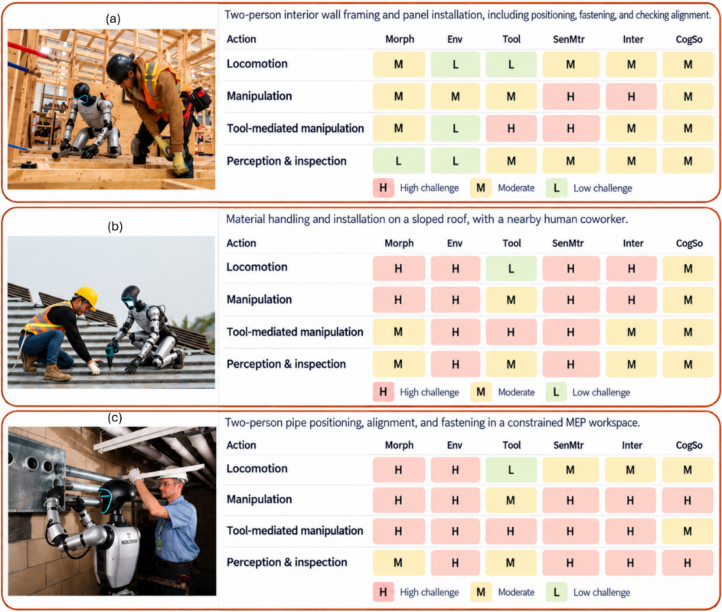
PRELIMINARY SCENARIO APPLICATION Three representative construction scenarios, carpentry, roofing, and piping, were selected from the manual construction task classification (Table 2) to illustrate the application of the proposed TCHC framework. As shown in Figure 3, these scenarios involve distinct combinations of humanoid actions and human compatibility requirements, ranging from precision-oriented tool manipulation to mobility under challenging environmental conditions and physically coordinated teamwork. The scenarios are analyzed conceptually based on their task characteristics rather than empirical performance measurements. Accordingly, the compatibility challenges identified below represent preliminary assessments that require subsequent validation.
Construction Scenario 1 – Carpentry (tool handling and fastening): Representative carpentry operations involve measuring, grasping, positioning, holding, cutting, fastening, and inspecting construction materials. These
Assessing Embodied-AI Humanoid Robots for Construction 1323 operations primarily require manipulation, tool-mediated manipulation, and perception and inspection, with locomotion supporting movement between work positions. Within the HC model (Figure 3a), tool compatibility and sensorimotor compatibility are particularly important because conventional construction tools require appropriate grasp configurations, force regulation, positioning accuracy, and responses to tool–material contact. Morphological compatibility further influences the humanoid’s ability to reach and manipulate materials within human-oriented workspaces. When a human worker and humanoid jointly position or secure a workpiece, interaction and cognitive-social compatibility become relevant for coordinating actions, communicating intentions, and maintaining shared task understanding. Thus, the compatibility challenges extend beyond isolated tool-use capabilities to the integration of physical actions and collaborative coordination.
Construction Scenario 2 – Roofing (sloped-surface mobility and material placement): Roofing operations involve transporting materials, navigating inclined surfaces, maintaining stable postures, positioning roofing components, fastening or sealing materials, and inspecting installation quality. Unlike carpentry, roofing imposes substantial locomotion and environmental compatibility challenges because the humanoid must maintain stability on sloped or potentially uneven surfaces while performing manipulation tasks. Sensorimotor compatibility is also critical, as changes in posture, external loads, and contact conditions require continuous adjustments to balance and applied forces. Although recent advances in humanoid locomotion control demonstrate increasing adaptability (Gu et al., 2026), these capabilities do not establish reliable performance under construction-specific roofing conditions. In collaborative operations, interaction compatibility additionally concerns maintaining safe separation, coordinating material handling, and avoiding physical interference with nearby workers. Consequently, as shown in Figure 3b, roofing illustrates how environmental constraints can substantially increase compatibility challenges even when the underlying manipulation actions resemble those performed in other trades.
Construction Scenario 3 – Piping (constrained-space shared placement): Representative piping operations include transporting pipe segments, navigating congested workspaces, positioning and aligning components, holding materials during connection, fastening supports, and inspecting completed installations. These operations require coordinated locomotion, manipulation, and perception, particularly when pipe placement involves restricted clearances and irregular geometries (Figure 3c). Morphological and environmental compatibility determine whether the humanoid can access the required installation positions without interfering with surrounding components. Sensorimotor compatibility concerns precise alignment, contact- force regulation, and adjustments during shared material handling. When a worker and humanoid jointly support or position a pipe, interaction and cognitive-social compatibility become especially important for communicating movement intentions, coordinating force and timing, negotiating task responsibilities, and maintaining shared situational understanding. This scenario illustrates that successful individual manipulation capabilities do
1324 Liu and Liu not necessarily translate into effective collaborative task execution without compatible physical and cognitive coordination mechanisms.
Figure 3: Representative construction scenarios for TCHC framework.
CONCLUSION
The proposed TCHC framework responds to the three motivating gaps, namely, the hardware argument, the generality challenge, and the necessity of meaningful team structure and role clarification in human-humanoid collaboration. The proposed framework also identifies an important distinction between physical embodiment and social teaming. Human- like body proportions may permit access to a tool or workstation, but do not ensure safe compliance, intelligible motion, calibrated trust, or shared understanding. Likewise, technical task completion does not necessarily imply improved crew throughput, reduced workload, or safer work. A future evaluation should therefore report at least three separate outcomes: action/sequence success, safe physical execution, and crew-level coordination quality.
Several limitations constrain interpretation. The Task-Capability taxonomy is selective rather than exhaustive, and the applicable task scenarios have not been independently coded or validated by construction craft workers. The six HC dimensions are conceptually proposed and may overlap.
Assessing Embodied-AI Humanoid Robots for Construction 1325 The framework does not specify robot-platform thresholds, quantitative weights, or an experimentally supported composite score. Site hazards, certification, and human safety requirements cannot be inferred from a general capability label. Future research should use expert task elicitation, inter-rater agreement, robot-platform testing, and human–humanoid trials in both simulated and real testbeds with measures such as contact conflict, task time, intervention frequency, perceived trust, role clarity, and team cohesion.
REFERENCES
Chen, X., Y. Gao, H. Liu, F. Yang, A. Ghadirzadeh, J. Yang, B. Liang, C. Zhang, T. L.
Lam, and S.-C. Zhu. 2026. “Cross-robot behavior adaptation through intention alignment.” Science Robotics, 11 (112): eadv2250. American Association for the Advancement of Science. https://doi.org/10.1126/scirobotics.adv2250. Dey, S., R. Riener, S. Dosen, and S. V. Albrecht. 2026. “From autonomy to alliance: Robotic foundation models must learn with us, not just for us.” Science Robotics, 11 (113): eaea1822. American Association for the Advancement of Science. https://doi.org/10.1126/scirobotics.aea1822. Gu, Y., G. Shi, F. Shi, I.-C. Chang, Y.-J. Wang, Q. Cheng, Z. Olkin, I. Lopez-Sanchez,
Y. Feng, J. Zhang, A. D. Ames, H. Su, and K. Sreenath. 2026. “Evolution of humanoid locomotion control.” Science Robotics, 11 (117): eaed3973. American Association for the Advancement of Science. https://doi.org/10.1126/scirobotics. aed3973. Hurst, J. 2026. “Physical AI is enabled by mechanical hardware.” Science Robotics, 11 (117): eaee2921. American Association for the Advancement of Science. https://doi.org/10.1126/scirobotics.aee2921. Jung, Y., and S. Woo. 2004. “Flexible Work Breakdown Structure for Integrated Cost
and Schedule Control.” Journal of Construction Engineering and Management, 130 (5): 616–625. American Society of Civil Engineers. https://doi.org/10.1061/ (ASCE)0733-9364(2004)130:5(616). Liu, D., and R. Liu. 2024. “Enhancing Communication Transparency and Teaming in Human-Autonomy Systems: Integrating Large Language Models for On-Site Construction Operations.” In: Human Factors in Design, Engineering, and Computing. AHFE Open Acces. Liu, D., and R. Liu. forthcoming. “A Team-Oriented Multidimensional Model of
Human-Autonomy Teaming in Construction.” Journal of Computing in Civil Engineering. ASCE. https://doi.org/10.1061/JCCEE5/CPENG-8265. Lum, T. G. W., O. Y. Lee, C. K. Liu, and J. Bohg. 2025. “Crossing the Human-Robot Embodiment Gap with Sim-to-Real RL using One Human Demonstration.” arXiv. “MasterFormat® - CSI.” 2024. MasterFormat® - Construction Specifications
Institute. Accessed September 30, 2024. https://www.csiresources.org/standards/ masterformat. Park, H.-W. 2026. “From acrobatics to generality: Humanoid robots at an inflection point.” Science Robotics, 11 (117): eaek7970. American Association for the Advancement of Science. https://doi.org/10.1126/scirobotics.aek7970. Salmon, P., D. Jenkins, N. Stanton, and G. Walker. 2010. “Hierarchical task analysis
vs. cognitive work analysis: comparison of theory, methodology and contribution to system design.” Theoretical Issues in Ergonomics Science, 11 (6): 504–531. Taylor & Francis. https://doi.org/10.1080/14639220903165169.
G. J. M. Read. 2022. “Hierarchical Task Analysis (HTA).” Handbook of Systems Thinking Methods. CRC Press. Sandini, G., A. Sciutti, and P. Morasso. 2025. “Mutual human-robot understanding for a robot-enhanced society: the crucial development of shared embodied cognition.” Frontiers in Artificial Intelligence, 8. Frontiers. https://doi.org/10.3389/ frai.2025.1608014. Sferrazza, C., D.-M. Huang, X. Lin, Y. Lee, and P. Abbeel. 2024. “HumanoidBench:
Simulated Humanoid Benchmark for Whole-Body Locomotion and Manipulation.” arXiv. Walliser, J. C., E. J. de Visser, E. Wiese, and T. H. Shaw. 2019. “Team Structure and Team Building Improve Human–Machine Teaming With Autonomous Agents.” Journal of Cognitive Engineering and Decision Making, 13 (4): 258–278. SAGE Publications. https://doi.org/10.1177/1555343419867563. Wang, X., H. Yu, W. McGee, C. C. Menassa, and V. R. Kamat. 2024. “Enabling
Building Information Model-Driven Human-Robot Collaborative Construction Workflows with Closed-Loop Digital Twins.” Computers in Industry, 161: 104112. https://doi.org/10.1016/j.compind.2024.104112. Wilson, M. 2002. “Six views of embodied cognition.” Psychonomic Bulletin & Review, 9 (4): 625–636. https://doi.org/10.3758/bf03196322. Xu, M., Z. Xu, C. Chi, M. Veloso, and S. Song. 2023. “XSkill: Cross Embodiment
Skill Discovery.” arXiv. Ye, Q., Q. Liu, S. Wang, J. Chen, Y. Cui, K. Jin, H. Chen, X. Cai, G. Li, and J. Chen.
2026. “Visual-tactile pretraining and online multitask learning for humanlike manipulation dexterity.” Science Robotics, 11 (110): eady2869. American Association for the Advancement of Science. https://doi.org/10.1126/scirobotics. ady2869. Zhu, A., Z. Zhang, and W. Pan. 2023. “Technologies, levels and directions of cranelift automation in construction.” Automation in Construction, 153: 104960. https://doi.org/10.1016/j.autcon.2023.104960.
SEARCH THE AHFE DIGITAL BOOKSTORE BY ISBN
Explore the complete digital volume
Human Factors in Design, Engineering, and Computing
Read this individual research paper free through the original publisher, or explore the full digital proceedings book.