Jianan Li (2026). Zili Patrol Robot: A Human–Robot Collaborative Inspection System for Sub-Canopy Orchards. In: Human Factors in Design, Engineering, and Computing. AHFE Open Access, vol. 238, pp. 262–274. https://doi.org/10.54941/ahfe1008260
Dense canopies, slopes, gullies, and root obstacles in hilly orchards prevent traditional manual inspection, drones, and wheeled robots from reliably reaching leaf undersides, stems, and occluded near-ground areas. Drawing on embodied intelligence, this study proposes a sensory extension paradigm through a quadruped inspection robot, Zili Patrol Robot, and a companion app. Together, they form an embodiment–intelligence–environment coupled orchard inspection system that makes the robot a perceptual medium for farmers rather than their replacement. A single-group simulated system test was conducted in a laboratory orchard. The system uses a Mini Pupper 2 quadruped robot equipped with 2D LiDAR and an RGB camera. Simultaneous localisation and mapping (SLAM) supports real-time mapping and autonomous navigation, while colour-block recognition triggers anomaly detection. Anomaly coordinates, image evidence, and inspection reports are synchronised to the mobile app. Across 15 prototype trials, cumulative pass rates for five sequential stages were 100% (autonomous mapping), 93.3% (inspection-route navigation), 86.7% (obstacle avoidance), 73.3% (disease-anomaly triggering) and 73.3% (report generation).The full workflow from mapping to reporting was completed in the controlled setting, but only 73.3% of trials reached the final stage, and triggering remained sensitive to low light, occlusion, and targets at the edge of the camera's field of view. This study advocates embodied sensory extension instead of automated substitution. The robot extends the farmer's vision, mobility, and capacity for structured recording. Both diagnostic interpretation and intervention decisions remain with the farmer.
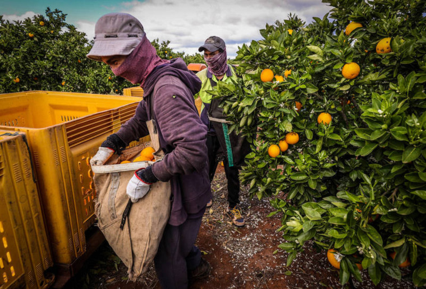
Population ageing and labour shortages are raising orchard-management costs and driving agricultural robotics (Spagnuolo et al., 2025; Fontani et al., 2025; Fountas et al., 2020; National Bureau of Statistics of China, 2021). Citrus inspection, pruning, and spraying remain labour-intensive, especially on slopes and beneath dense canopies with gullies and exposed roots (Fig. 1). Manual monitoring varies with lighting, viewing angle, and access; drones and imaging sensors extend coverage but remain limited by occlusion and symptom scale (Mahlein, 2016; Neupane and
Zili Patrol Robot: A Human–Robot Collaborative Inspection System 263 Baysal-Gurel, 2021). Crop losses from pests and diseases therefore reinforce the need for timely, continuous inspection (Savary et al., 2019; National Agricultural Technology Extension Service Center, 2023).
Figure 1: Research background.
The central gap is the inaccessible sub-canopy zone, where leaf undersides, stems, and roots are difficult to reach or document (Wang et al., 2025; Jiang and Ahamed, 2023; Neupane and Baysal-Gurel, 2021; Botta et al., 2022). Legged platforms can support near-ground inspection across complex terrain (Zhang et al., 2024; Kataoka et al., 2026). This study frames that problem as a perception–interaction gap and uses human–robot collaboration to extend farmers’ reach, observation, and recording.
Embodied intelligence couples body, action, and environment, while human–robot collaboration combines complementary capabilities rather than pursuing substitution (Wilson, 2002; Brooks, 1991; Sun and Qiu, 2025; Tsolakis and Gasteratos, 2023; Zhang et al., 2025; Jarrahi, 2018). Zili Patrol Robot therefore acts as the farmer’s mobile eyes in blind spots, and the app records location, image, and time evidence. Diagnostic and intervention decisions remain with the farmer.
This study asks three questions: Which perception–interaction gaps limit existing sub-canopy inspection tools (RQ1)? How can an embodiment– intelligence–environment system make the robot a sensory extension of the farmer (RQ2)? What early performance and environmental-adaptability limitations appear in a simulated test site (RQ3)?
The study contributes an embodied-intelligence framework for agricultural HCI, the quadruped-and-app Zili Patrol Robot inspection loop, and early simulation evidence with reflection on environmental-adaptability limits in real-orchard transfer.
RELATED WORK
Current Agricultural Inspection Robots Agricultural robots support inspection, spraying, weeding, harvesting, and transport (Spagnuolo et al., 2025; Fontani et al., 2025; Fountas et al., 2020). Orchard systems use radar for trunks, navigation, and environmental models,
264 Li and vision for leaves, fruit, and disease cues (Wang et al., 2025; Karim et al., 2024; Jiang and Ahamed, 2023; Mahlein, 2016). Yet drones favour aerial coverage, wheeled robots favour automated ground operations, and recognition systems favour result output. These approaches improve specific tasks but can weaken farmer involvement and still struggle with occluded, near-ground areas.
Zili Patrol Robot retains task management and automated reporting while using a low-viewpoint quadruped for slopes, gullies, roots, and other unstructured terrain. Close-range sensing complements drones and wheeled platforms, and familiar app interactions support review. The robot is positioned as a sensory extension and decision-support medium rather than a substitute for farmer judgement (Table 1).
Table 1: Three existing types of orchard equipment and their operational boundaries for sub-canopy inspection.
Table available in the original PDF paper.
Identifier and Device
Principal Advantages
Sub-Canopy Limitation Implication for This Study
I Eufly aerial inspection drone
Retain large-area inspection and automated reporting while adding close-range sub-canopy sensing.
High coverage efficiency and automated report generation; suitable for large, level plots.
The aerial viewpoint is obstructed by the canopy and cannot reliably capture leaf undersides, stems, or near-ground disease details.
II Eufar wheeled unmanned ground vehicle
The wheeled chassis is constrained by steep slopes, gullies, exposed roots, weeds, and other physical obstacles.
Use a biomimetic quadruped platform to improve traversal potential on unstructured orchard ground.
Supports close- range ground operations and is suitable for specific terrain at larger spatial scales.
III DJI Agras agricultural drone
Designed mainly for pesticide application and work management; the flight viewpoint still cannot enter dense canopies.
Adopt its task- management and app interactions, but do not rely on an aerial platform for close-range disease evidence.
Mature management workflow and a complete app; suitable for organising operations by agricultural service teams.
Human–Robot Collaboration and Embodied Intelligence Human–robot collaboration combines machine strengths in wide-area sensing, precise recording, and sustained operation with human strengths in contextual judgement, experience, and value-based decisions (Sun and Qiu, 2025; Tsolakis and Gasteratos, 2023; Amershi et al., 2019; Jarrahi, 2018; Dellermann et al., 2019). Because agricultural inspection affects pesticide use, cost, and ecological risk, systems should present evidence without
Zili Patrol Robot: A Human–Robot Collaborative Inspection System 265 replacing intervention decisions with opaque conclusions (Diefenbach et al., 2022; Dara et al., 2022).
Embodied intelligence treats perception as a product of body geometry, movement, and environmental feedback: body form controls reach, action generates new perception, and understanding develops through situated presence (Wilson, 2002; Brooks, 1991; Zhang et al., 2025). The orchard robot is therefore designed as a sensory extension of farmers’ vision, mobility, and recording, while decision-making authority remains human.
METHODOLOGY AND DESIGN FRAMEWORK Requirements and Insights From Farmers’ Experience
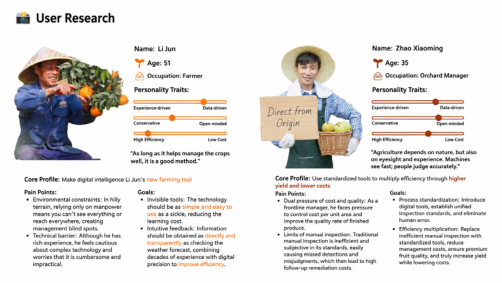
The study combined semi-structured interviews with field observation involving two experienced frontline citrus farmers, Mr Zhang and Mr Zhao, and one orchard manager (Fig. 2). Questions followed the path from noticing an anomaly to action: where participants stood and moved, required lighting and angles, leaf turning or touch, seasonal and environmental cues, and recording, review, and intervention. Observation also captured crouching, reflections, touch, movement around plants, and repeated checking.
Participants identified red spider mites, caterpillars, huanglongbing, anthracnose, aphids, and vegetation-related citrus-canker risk. They relied on visual and manual checking rather than specialised early detection; aphids received routine February control, while other problems were treated after detection. The manager found annual government drone spraying insufficient because fieldwork remained, but welcomed mobile review of robot results and identified pesticide preparation and application as difficult tasks. Technology was acceptable when it entered the field, retained intelligible evidence, and preserved intervention control.
Figure 2: User profiles of frontline farmers and an orchard manager.
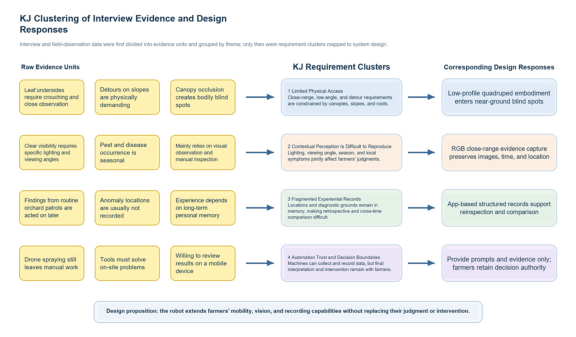
A two-step affinity-diagram (KJ) analysis grouped the evidence into four requirement categories (Fig. 3). Interview and observation records were first divided into single-meaning units and openly clustered by perceptual cues, bodily actions, environmental constraints, recording, and decision boundaries. The clusters were then compared with prototype functions so
266 Li each design element remained traceable to user evidence. This abductive process moved from field evidence to design response.
First, physical access is limited by crouching, slopes, canopies, gullies, and roots. A low-profile quadruped extends mobility and brings sensors into occluded near-ground areas without drawing conclusions for farmers.
Second, disease cues vary with lighting, angle, season, temperature, humidity, location, and posture. Close-range RGB images therefore retain time, location, and field status for review. Colour-block triggering validates this evidence chain but is not treated as diagnosis.
Third, anomaly locations, observations, and interventions often remain in individual memory. The app externalises experience by structuring coordinates, images, time, trajectories, and intervention notes for comparison and return visits.
Fourth, automation creates trust and decision-boundary concerns. Participants criticised drones for leaving fieldwork unresolved but accepted mobile review. The system therefore flags anomalies, displays evidence, and organises review; the farmer interprets and decides.
Together, the requirements prioritise physical access, contextual evidence, externalised experience, and retained human authority, defining the system as a sensory extension rather than automated substitution.
Figure 3: KJ clustering derived from interview and field-observation evidence: four categories of pain points and their design responses.
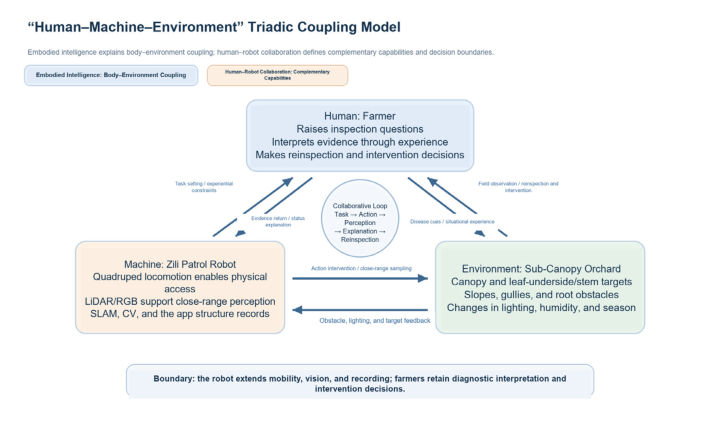
Development of the Design Framework The resulting triadic human–machine–environment model contains three bidirectional relationships (Fig. 4). Human–environment coupling preserves farmer observation and intervention while disease cues update experience. Human–machine coupling exchanges inspection areas, targets, and constraints for robot-returned locations, images, trajectories, and status. Machine–environment coupling uses the quadruped perception–action loop to reach sub-canopy space, with terrain, occlusion, lighting, and target status constraining subsequent action.
Zili Patrol Robot: A Human–Robot Collaborative Inspection System 267 The farmer asks questions, interprets evidence, and decides. The machine—quadruped, LiDAR, RGB camera, SLAM, CV, and app—provides access, perception, and structured recording, while the environment supplies both constraints and cues. Repeated task setting, action, feedback, evidence return, and field review extend mobility, vision, and recording without transferring diagnostic or intervention responsibility.
Figure 4: The triadic human–machine–environment coupling model, based on body– environment coupling and complementary capabilities.
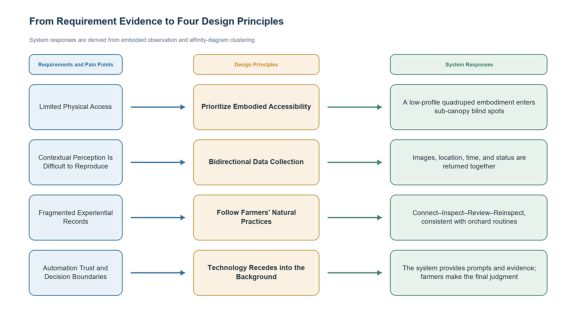
Four principles follow (Fig. 5): prioritise low-profile embodied access to blind spots; return images, location, time, and status together; retain farmers’ connection–inspection–review–reinspection sequence; and keep technology supportive and unobtrusive. The system presents evidence, while farmers diagnose and intervene.
Figure 5: Four design principles derived from requirement evidence and their corresponding system responses.
SYSTEM AND INTERACTION DESIGN Quadruped Robot Workflow
Zili Patrol Robot uses the Mini Pupper 2 quadruped as a functional embodiment. Its low profile and legged locomotion address narrow sub- canopy spaces, slopes, roots, gullies, weeds, and small obstacles while bringing inspection close to the ground.
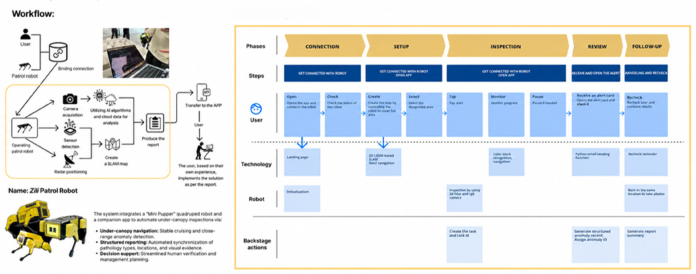
The workflow spans connection, mapping, area selection, and task start (Fig. 6). LiDAR supports localisation and route updates, while the RGB camera captures leaves and fruit. A trigger stores coordinates and image evidence and creates an anomaly card. The app then provides a report, heat map, and reinspection reminder for farmer review and intervention decisions.
Figure 6: Zili Patrol Robot workflow from connection and configuration to inspection, review, and field reinspection.
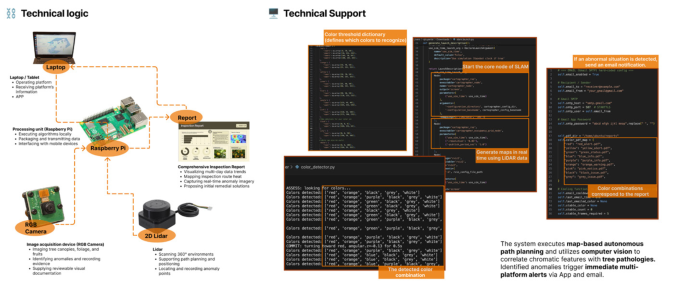
Technical Implementation Implementation has four layers (Fig. 7): 2D LiDAR and RGB sensing for environmental models and images; SLAM localisation for real-time mapping and autonomous navigation; CV colour-block recognition for close-range simulated anomaly triggers and coordinates; and app feedback through anomaly cards, heat maps, reports, and intervention suggestions.
Figure 7: Technical implementation comprising Raspberry Pi, an RGB camera, 2D LiDAR, SLAM, and colour recognition.
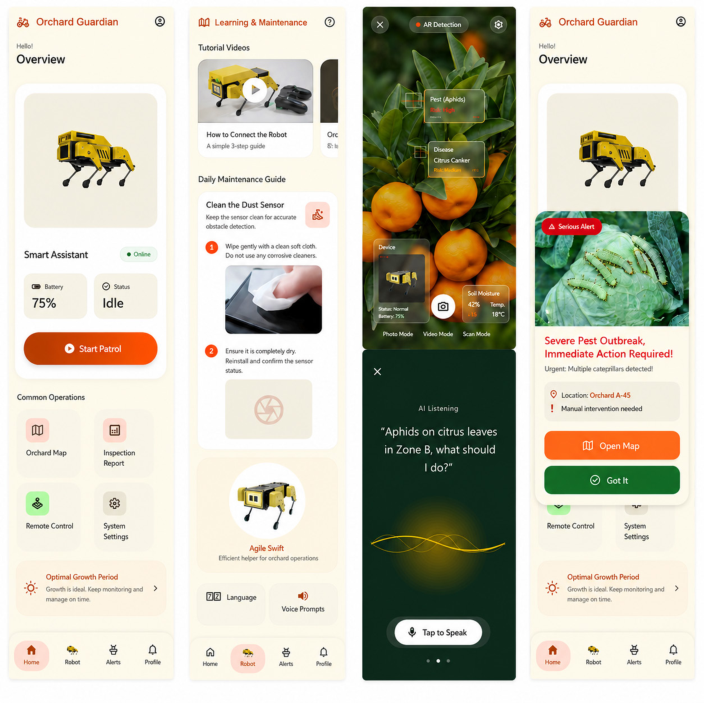
Zili Patrol Robot: A Human–Robot Collaborative Inspection System 269 Interaction is limited to prompts and evidence, leaving decisions with the farmer. This responds to distrust of full automation and follows transparent- feedback, user-takeover, and intelligibility principles (Amershi et al., 2019; Diefenbach et al., 2022; Rzepka and Berger, 2018). One app view combines task status, anomaly records, and reinspection access so farmers can locate an anomaly, inspect evidence, and understand the next step (Fig. 8).
Figure 8: Mobile-app interfaces for task status, anomaly records, and field reinspection.
PRELIMINARY EVALUATION Test Design
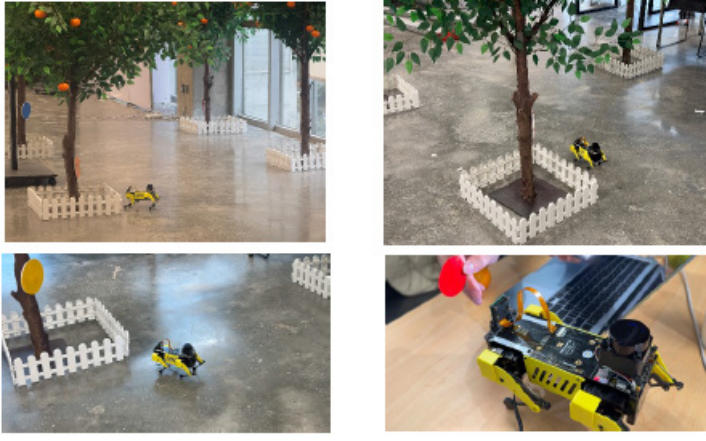
Because the prototype is not ready for long-term orchard deployment, feasibility was tested in a simulated laboratory orchard. White barriers represented terrain obstacles and coloured blocks represented disease targets. A Mini Pupper 2 with Raspberry Pi, 2D LiDAR, and RGB camera provided locomotion, mapping, localisation, and target capture.
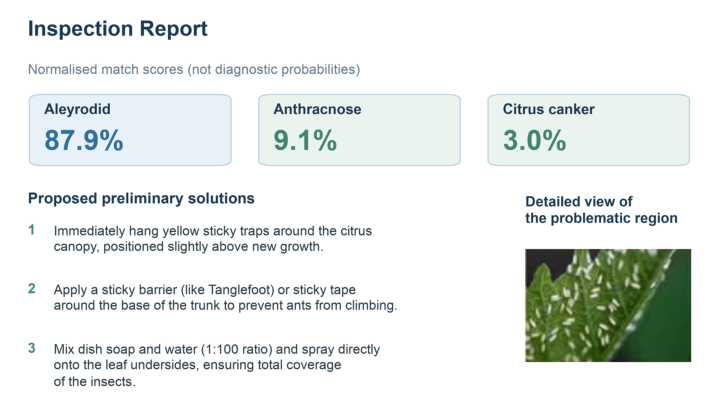
270 Li disease-anomaly triggering and report generation. Disease-anomaly triggering used colour-composition matching. Field surveys showed that each condition has a distinct colour mix: green with a large white fraction for aleyrodids; mainly yellow with orange and green for citrus canker; orange, yellow, black and green for anthracnose; brown, pale yellow and green for citrus leafminer; and mainly dark red with green and black for Unaspis yanonensis. The simulated orchard reproduced these multi-colour compositions. At each inspection point, captured images were converted to HSV space and their colour proportions were compared with these references. An anomaly was triggered when the measured colour composition differed from that of healthy green foliage. The system then generated an inspection report for each triggered target, listing the three best-matching conditions with normalised probabilities, preliminary treatment suggestions and a detailed view of the affected region.
Because failure prevented later stages, robustness was measured as the cumulative proportion of all trials completing each stage. Observation targets and the simulated orchard appear in Fig. 9.
Figure 9: Prototype-validation settings: orchard observation targets and the laboratory- based simulated orchard.
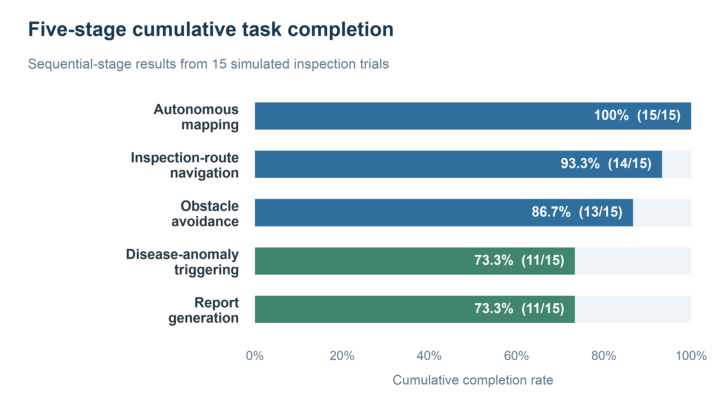
Evaluation Results Cumulative pass rates formed a funnel (Fig. 10): autonomous mapping reached 100% (15/15), inspection-route navigation 93.3% (14/15), and obstacle avoidance 86.7% (13/15). Disease-anomaly triggering reached 73.3% (11/15), mainly because low-light conditions, occlusions and targets near the edge of the camera view degraded colour recognition. Report generation also reached 73.3% (11/15), since it depended on a successful
Zili Patrol Robot: A Human–Robot Collaborative Inspection System 271 anomaly trigger; trials in which no anomaly was triggered produced no report (Fig. 11).
Figure 10: Cumulative task-completion rates across the five sequential stages of simulated inspection (n = 15).Figure 11: Example inspection report generated by the system, shown as one representative of the 11 trials that reached the report-generation stage.
The complete mapping-to-reporting workflow was feasible in the controlled setting, but disease-anomaly triggering remained the least reliable stage and the root cause of the downstream failures.
DISCUSSION AND LIMITATIONS Embodied sensory extension operated at three levels: the quadruped extended mobility into some inaccessible sub-canopy spaces; RGB and LiDAR extended vision by capturing and locating targets; and the app extended memory by converting anomalies into traceable, reviewable records.
All three extensions remain preliminary. Real orchards add wet ground, sloping roots, soft soil, and unpredictable branch and leaf occlusion. Colour- block recognition validates workflow triggering but is not a mature multi- disease diagnostic model. It relies only on colour. Sunlight, shadow and wet leaf surfaces shift hue and brightness and therefore the measured colour proportions. The signatures also overlap between conditions: citrus canker and anthracnose share orange, yellow and green, and brown and dark red are close in HSV space at low brightness. Ripe fruit, senescent leaves, bark and soil show the same colours as symptoms and can cause false triggers. The method additionally ignores the texture and shape used in real diagnosis, and the laboratory blocks were more uniform than real symptoms. Further tests must address outdoor-light readability, weak-network synchronisation, and interaction burdens for farmers with limited technical experience.
The fifteen trials used one robot in one fixed indoor layout, so these rates describe task completion rather than diagnostic accuracy: no confusion matrix, precision or recall are reported, and the normalised scores in the reports are relative match scores, not calibrated probabilities.
Future work should prioritise Sim2Real transfer and long-term orchard tests of quadruped stability, collect real leaf and fruit disease data for stronger recognition, and use participatory farmer evaluation to refine anomaly cards and reinspection reminders.
CONCLUSION
This study proposed and validated Zili Patrol Robot for sub-canopy inspection blind spots in hilly orchards. Its quadruped, sensing, SLAM, CV triggering, and app implement embodied sensory extension rather than farmer replacement by supporting access, evidence, and reinspection while retaining human judgement. The prototype completed the mapping-to- reporting workflow, but recognition stability and real-orchard deployment remain central challenges. Long-term field testing should assess inspection efficiency, experiential recording, and intervention decisions.
REFERENCES
Amershi, S., Weld, D., Vorvoreanu, M., Fourney, A., Nushi, B., Collisson, P., Suh, J., Iqbal, S., Bennett, P. N., Inkpen, K., Teevan, J., Kikin-Gil, R. and Horvitz, E. (2019) “Guidelines for Human-AI Interaction”, proceedings of the 2019 CHI Conference on Human Factors in Computing Systems, pp. 1–13. Botta, A., Cavallone, P., Baglieri, L., Colucci, G., Tagliavini, L. and Quaglia, G. (2022).
A Review of Robots, Perception, and Tasks in Precision Agriculture, Applied Mechanics Volume 3 No. 3, pp. 830–854.
Zili Patrol Robot: A Human–Robot Collaborative Inspection System 273 Brooks, R. A. (1991). Intelligence without representation, Artificial Intelligence
Volume 47 No. 1–3, pp. 139–159. Dara, R., Hazrati Fard, S. M. and Kaur, J. (2022). Recommendations for ethical and responsible use of artificial intelligence in digital agriculture, Frontiers in Artificial Intelligence Volume 5, Article 884192. Dellermann, D., Ebel, P., Söllner, M. and Leimeister, J. M. (2019). Hybrid Intelligence,
Business & Information Systems Engineering Volume 61 No. 5, pp. 637–643. Diefenbach, S., Christoforakos, L., Ullrich, D. and Butz, A. (2022). Invisible but Understandable: In Search of the Sweet Spot between Technology Invisibility and Transparency in Smart Spaces and Beyond, Multimodal Technologies and Interaction Volume 6 No. 10, Article 95. Fontani, M., Luglio, S. M., Gagliardi, L., Peruzzi, A., Frasconi, C., Raffaelli, M. and
Fontanelli, M. (2025). A Systematic Review of 59 Field Robots for Agricultural Tasks: Applications, Trends, and Future Directions, Agronomy Volume 15 No. 9, Article 2185. Fountas, S., Mylonas, N., Malounas, I., Rodias, E., Hellmann Santos, C. and Pekkeriet, E. (2020). Agricultural Robotics for Field Operations, Sensors Volume 20 No. 9, Article 2672. Hameed, I. A. (2014). Intelligent Coverage Path Planning for Agricultural Robots
and Autonomous Machines on Three-Dimensional Terrain, Journal of Intelligent & Robotic Systems Volume 74 No. 3–4, pp. 965–983. Jarrahi, M. H. (2018). Artificial intelligence and the future of work: Human-AI symbiosis in organizational decision making, Business Horizons Volume 61 No. 4, pp. 577–586. Jiang, A. and Ahamed, T. (2023). Navigation of an Autonomous Spraying Robot for
Orchard Operations Using LiDAR for Tree Trunk Detection, Sensors Volume 23 No. 10, Article 4808. Karim, M. R., Reza, M. N., Jin, H., Haque, M. A., Lee, K.-H., Sung, J. and Chung, S.-O.
(2024). Application of LiDAR Sensors for Crop and Working Environment Recognition in Agriculture: A Review, Remote Sensing Volume 16 No. 24, Article 4623. Kataoka, R., Aratani, M., Hamada, K. and Kurihara, T. (2026). Development of a Quadruped Robot System for Load-Carrying Support in Orchard Operations, Journal of Robotics and Mechatronics Volume 38 No. 2, pp. 543–552. Mahlein, A.-K. (2016). Plant Disease Detection by Imaging Sensors – Parallels and
Specific Demands for Precision Agriculture and Plant Phenotyping, Plant Disease Volume 100 No. 2, pp. 241–251. Mier, G., Valente, J. and de Bruin, S. (2023). Fields2Cover: An Open-Source Coverage Path Planning Library for Unmanned Agricultural Vehicles, IEEE Robotics and Automation Letters Volume 8 No. 4, pp. 2166–2172. Miller, A. (2019). The intrinsically linked future for human and Artificial Intelligence
interaction, Journal of Big Data Volume 6 No. 1, Article 38. National Agricultural Technology Extension Service Center (2023). Forecast of major crop diseases and pests in China in 2023. Ministry of Agriculture and Rural Affairs of the People’s Republic of China Website: https://www.moa.gov.cn/ ztzl/2023cg/jszd_29356/202302/t20230209_6420225.htm National Bureau of Statistics of China (2021). Questions and answers at the press
conference on the main results of the Seventh National Population Census. National Bureau of Statistics of China Website: https://www.stats.gov.cn/sj/ xwfbh/fbhwd/202302/t20230203_1901089.html Neupane, K. and Baysal-Gurel, F. (2021). Automatic Identification and Monitoring of Plant Diseases Using Unmanned Aerial Vehicles: A Review, Remote Sensing Volume 13 No. 19, Article 3841.
regulation of a wheel-legged all-terrain mobile robot, Mechanical Science and Technology for Aerospace Engineering. Advance online publication, 26 March. Rzepka, C. and Berger, B. (2018) “User Interaction with AI-enabled Systems: A Systematic Review of IS Research”, proceedings of the 39th International Conference on Information Systems (ICIS 2018), San Francisco, California, Paper 7. Savary, S., Willocquet, L., Pethybridge, S. J., Esker, P., McRoberts, N. and Nelson, A.
(2019). The global burden of pathogens and pests on major food crops, Nature Ecology & Evolution Volume 3 No. 3, pp. 430–439. Solanes, J. E., Gracia, L. and Valls Miro, J. (2024). Advances in Human–Machine Interaction, Artificial Intelligence, and Robotics, Electronics Volume 13 No. 19, Article 3856. Spagnuolo, M., Todde, G., Caria, M., Furnitto, N., Schillaci, G. and Failla, S. (2025).
Agricultural Robotics: A Technical Review Addressing Challenges in Sustainable Crop Production, Robotics Volume 14 No. 2, Article 9. Sun, J. and Qiu, L. (2025). Human-Machine Collaboration: Definitions, Models, and Socio-Economic Impacts, International Journal of Crowd Science Volume 9 No. 3, pp. 149–163. Tsolakis, N. and Gasteratos, A. (2023). Sensor-Driven Human-Robot Synergy:
A Systems Engineering Approach, Sensors Volume 23 No. 1, Article 21. Wang, Y., Zhang, Z., Jia, W., Ou, M., Dong, X. and Dai, S. (2025). A Review of Environmental Sensing Technologies for Targeted Spraying in Orchards, Horticulturae Volume 11 No. 5, Article 551. Wilson, M. (2002). Six views of embodied cognition, Psychonomic Bulletin &
Review Volume 9 No. 4, pp. 625–636. Zhang, Y., Tian, J. and Xiong, Q. (2025). A review of embodied intelligence systems: A three-layer framework integrating multimodal perception, world modeling, and structured strategies, Frontiers in Robotics and AI Volume 12, Article 1668910. Zhang, Z., He, W., Wu, F., Quesada, L. and Xiang, L. (2024). Development of a
bionic hexapod robot with adaptive gait and clearance for enhanced agricultural field scouting, Frontiers in Robotics and AI Volume 11, Article 1426269. Zhou, C., Ampatzidis, Y., Guan, H., Liu, S., Liu, W., de Oliveira Costa Neto, A., Kunwar, S. and Batuman, O. (2025). Agrosense: Accelerating precision orchard management through an AI-enabled monitoring system, Precision Agriculture Volume 26 No. 4, Article 73.
SEARCH THE AHFE DIGITAL BOOKSTORE BY ISBN
Explore the complete digital volume
Human Factors in Design, Engineering, and Computing
Read this individual research paper free through the original publisher, or explore the full digital proceedings book.