Yibo Qiang, Sébastien Hélie, Jeffrey M. Haddad, Sogand Hasanzadeh, Behzad Esmaeili (2026). Do Close-Range Drone Operations Affect Workers’ Emotional States and Stress Levels? A Mixed-Reality Study. In: Human Factors in Design, Engineering, and Computing. AHFE Open Access, vol. 238, pp. 1579–1589. https://doi.org/10.54941/ahfe1008386
Unmanned aerial vehicles (UAVs, or drones) are increasingly deployed on construction sites for tasks such as material delivery, progress monitoring, and safety surveillance. In many applications, drones may operate near workers in shared workspaces, raising safety concerns among researchers and industry practitioners. Specifically, drones operating near workers can be perceived as a potential threat or a psychological stressor, which may elicit changes in workers’ emotional states and physiological stress, potentially impairing health and well-being. However, there is a lack of empirical evidence on how drone presence influences construction workers’ emotional states and stress levels, and whether these effects vary across proximity levels. To address this gap, this study employed a mixed-reality technique to simulate a roofing task, in which participants installed shingles on a roof while a drone approached and hovered at two distances (near: 0.45 m; far: 1.2 m). Emotional states were assessed using the Positive and Negative Affect Schedule (PANAS), and stress levels were quantified using electrodermal response (EDR). Thirty-one participants completed the experiment. Results indicate that positive affect remained relatively stable across conditions, whereas negative affect increased significantly when the drone presence in proximity. EDR-based stress levels were highest in the near-drone condition, while the far-drone condition was comparable to baseline. These findings suggest that close drone operation can impose measurable emotional and physiological costs and highlight that proximity management can be a practical strategy for safer and more effective human–drone collaboration on jobsites.
Unmanned Aerial Vehicles (also known as drones), as a representation of emerging autonomous technologies, have been increasingly deployed in the construction industry and are expected to play an important role on jobsites. Construction has emerged as one of the most active adopters of drones among major industries (Zhu et al., 2023). In practice, drones can conduct activities in inaccessible places or areas, move more safely and quickly than manned vehicles at a lower cost, and can be equipped with various sensors to collect and transfer high-resolution data for assisting documentation, inspection, and decision-making (Zhu et al., 2023). Thus, drones are widely used in safety surveillance, progress monitoring, quality inspection, and material delivery (Gheisari and Esmaeili, 2019).
While the deployment of drones on jobsites is growing, construction remains a human-centred industry, indicating that drones are needed to interact and collaborate with workers to conduct various tasks before the industry achieves full automation. Thus, in numerous cases, drones must work side by side with humans in shared workspaces (Zhu et al., 2023). Such close-proximity interactions raise safety concerns: when drones operate near workers, their rapid motion may increase the risk of collision. Also, drone noise and visual stimuli may affect workers’ stress levels and emotional responses (Bretin et al., 2023), thereby potentially impairing workers’ situational awareness and hazard recognition (Pooladvand and Hasanzadeh, 2023). Therefore, understanding how drone operation in proximity influences workers’ emotional states and stress levels is necessary to ensure the safety, health, and well-being of construction professionals and to support effective human–drone interaction and collaboration on jobsites.
This study investigates how drone operation in proximity impacts workers’ emotional states and stress levels, and whether different drone approach distances lead to differential effects. The findings aim to provide insights into developing effective strategies that enable workers to interact and collaborate comfortably and safely with drones.
BACKGROUND
Emotion states and stress in construction. Previous literature suggested that 70% of on-site workers and 85% of office-based workers report moderate to extreme stress in the UK (Winkler et al., 2024). Under overwhelming stress, workers tend to rely more on heuristic thinking to process disorganized information in the dynamic and complex environment, seeking the fastest solutions (Morshedi and Kashani, 2022). However, such heuristic processing could reduce workers’ capability to accurately identify, comprehend, and predict hazards in the work environment, thereby increasing risk- taking behaviors and raising the probability of accidents (Pooladvand and Hasanzadeh, 2023). In addition to stress, emotional state also plays an important role in the safety and health of the construction workforce (Leung et al., 2012; Leung et al., 2017). Prolonged negative emotional states can undermine workers’ dedication and diminish their attentional focus at work (Leung et al., 2012). Moreover, negative emotions can affect cognitive
Do Close-Range Drone Operations Affect Workers’ Emotional States 1581 processing and decision making (Bhandari et al., 2016), which in turn impairs workers’ hazard assessment abilities (Bhandari et al., 2016), diminishes their risk perception, and increases unsafe behaviours, thereby elevating safety risks (Leung et al., 2017). Thus, examining the emotional and stress-related impacts of drones in human–drone interaction is essential to developing safer strategies.
Drone presence and proximity. Drones can act as a distracting stimulus that captures workers’ visual attention and diverts limited attentional resources away from the primary tasks (Bretin et al., 2024). Such distraction can impair performance and hinder rational risk evaluation associated with the working environments (Namian et al., 2018). Moreover, the noise and airflow generated by a drone (propeller wind) have been identified as a potential stressor (Bretin et al., 2023). These stimuli can increase avoidance tendencies (Bretin et al., 2022) and reduce humans’ acceptance (Bretin et al., 2024). However, prior studies found that the effect of drone proximity on participants’ responses might vary: Bretin et al., (2023) observed the greatest discomfort when the drone entered the intimate-distance zone (<0.45 m), whereas Wojciechowska et al., (2019) found that increasing the human– drone distance to 2.4 m did not significantly improve comfort. These findings suggest that the effects of drone proximity may be context-dependent. This issue is particularly relevant in construction, where drones often need to operate near workers to support on-site tasks. Based on the Edward Hall’s “proxemics” theory (Hall, 1966), four main zones between human and human were defined, i.e., intimate (0 - 0.45m), personal (0.45 - 1.2m), social (1.2 - 3.6m), and public (> 3.6m). This framework has been applied in human-drone interaction studies and has been provided a theoretical basis for systematically examining the impacts of proximity effects on workers.
POINT OF DEPARTURE Most existing studies focus on examining the effects of drone presence on individuals’ comfort, threat perception, acceptance, and stress in social scenarios (Namian et al., 2018; Wojciechowska, 2019; Bretin et al., 2023). However, construction sites are more complex, dynamic, and hazardous environments, significantly differing from general social scenarios. Thus, it is necessary to investigate the impacts of drone presence in construction. Several studies have used virtual reality (VR) to examine how drone presence and proximity affect site supervisors’ attention, psychophysiological responses, and attitudes (Albeaino et al., 2023a; Albeaino et al., 2023b). However, there is still a lack of empirical evidence on how close-range drone operations influence frontline workers’ emotions and stress. This gap is important because frontline workers typically perform physically demanding tasks under hazardous conditions (e.g., work at height), which may elicit different emotional and stress responses to drones. To address this gap, this study employs a mixed-reality (MR) approach to simulate hands-on construction tasks under different drone-to-worker distance conditions. Specifically, we investigate: (1) how close-range drone operations influence workers’ emotional states and stress levels, and (2) whether these effects vary across proximity levels.
METHODOLOGY
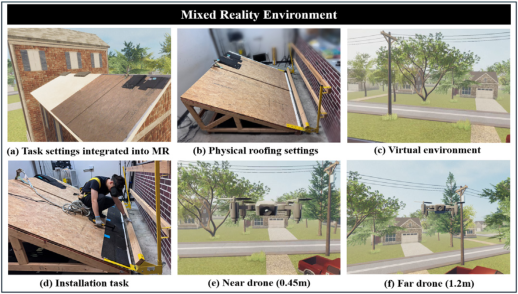
Experimental Design. An immersive mixed reality (MR) setup was developed to simulate a real-world, high-risk, physically demanding residential roofing task, as presented in Figure 1. In this experiment, participants worked as roofers to physically install shingles on a sloped roof while a drone was present at different distances. The MR environment was implemented by integrating a Varjo XR-3 headset and a physical sloped roof mock-up. The work area (2.4 m × 1.8 m, slope of 27°) was physically constructed from the actual roof, and the environmental elements (e.g., roads, sky, neighbours, and wind noise) were rendered in the virtual environment. Participants completed the task using real materials and tools, including shingles, a hammer, and personal protective equipment (PPE). To manipulate drone- related stimuli, a virtual drone was integrated into the MR scene. While participants installed shingles, the drone approached the participants at two drone-worker distances: 0.45 m (near drone; representing close inspection) or 1.2 m (far drone; representing safety monitoring). These distances were selected to align with proximity levels commonly used in prior human–drone interaction studies (Zhu et al., 2023; Albeaino et al., 2023a).
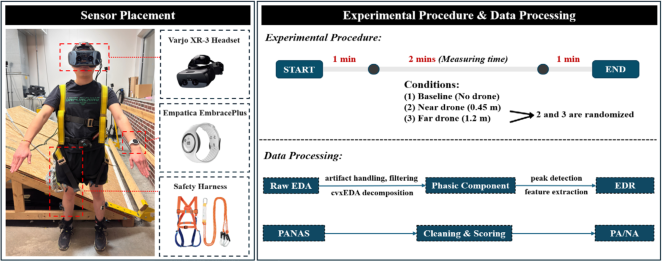
Figure 1: The MR experimental environment developed in this study.Figure 2: Overview of sensor placement, experimental procedure, and data processing.
Do Close-Range Drone Operations Affect Workers’ Emotional States 1583 Experimental procedure. As shown in Figure 2, each participant completed three 4-minute shingle-installation trials under the following conditions: (1) baseline (no drone), (2) near drone at 0.45 m, (3) far drone at 1.2 m. To avoid order effects, the sequence of conditions 2 and 3 was randomized across participants. In the drone conditions, the drone entered the scene 1 minute after the trial onset and then hovered at the assigned distance for 2 minutes. At the start, participants were informed of the study purpose and procedures and provided with written consent. The experimenter then demonstrated the shingle-installation procedures on the sloped roof within the MR environment and introduced the safety precautions and proper PPE use. Participants subsequently donned the XR headset, motion trackers, PPE, and an Empatica wristband, and performed the task using real shingles and a hammer.
In the experiment, participants’ electrodermal activity (EDA) was monitored by an Empatica wristband to measure their stress levels during the drone presence. Emotional states were evaluated through the Positive and Negative Affect Schedule (PANAS), which was filled out after each trial. Equal rest breaks were provided after each trial to reduce fatigue. All procedures were approved by the Purdue University Institutional Review Board.
Participants. A total of 31 participants took part in this experiment. They represent the next generation of the construction workforce who are likely to work alongside and interact with drones on future jobsites. All subjects were recruited from civil and construction engineering, construction management technology, and industrial engineering programs at Purdue University.
Data processing and analysis. In this study, EDA data and PANAS were used to evaluate participants’ stress levels and emotional states. Previous studies have shown that EDA is a reliable indicator of psychophysiological responses, particularly sympathetic arousal and stress, making it well-suited for analysis in dynamic task environments (Kreibig, 2010). The EmbracePlus wristband provided raw EDA signals, which were decomposed into phasic and tonic components using the cvxEDA algorithm (Greco et al., 2015). The phasic component reflected rapid, stimulus-evoked electrodermal response (EDR) and captured short-term sympathetic activation (Benedek and Kaernbach, 2010). Given the 2-min drone stimulus, EDR was used to capture moment- to-moment sympathetic changes. To smooth the signals and reduce artefacts, a moving average filter with a 2-second window was applied. Following the previous literature, EDR peaks were detected using a minimum threshold of 0.01 μS, and a duration criterion of 1.5 seconds between onset and offset was applied to address superimposed responses (Benedek and Kaernbach, 2010). The detected peaks were then used to compute EDR metrics for subsequent analyses.
PANAS is a well-developed self-report survey to assess individuals’ emotions (Watson et al., 1988). It measures two independent dimensions: Positive Affect (PA) (e.g., feeling active, enthusiastic, alert) and Negative Affect (NA) (e.g., feeling upset, nervous, distressed), using a small set of mood terms on a Likert-type scale (Watson et al., 1988). Scores for PA and NA are typically computed by summing the corresponding items, with higher scores indicating higher levels of positive or negative affect, respectively.
Prior to the main analyses, normality was tested using the Shapiro–Wilk test, and sphericity using Mauchly’s test. When Mauchly’s test indicated
a violation of the sphericity assumption (p < .05), Greenhouse–Geisser- corrected results were reported. Because NA was not normally distributed, differences in NA across baseline, near-drone, and far-drone conditions were tested using the Friedman test. For PA and EDR, one-way repeated- measures ANOVAs were conducted to compare participants’ stress levels and emotional states across the three conditions. Post-hoc pairwise comparisons were performed using Wilcoxon signed-rank tests for NA and pairwise t-tests for EDR and PA, with Bonferroni correction. Statistical significance was set at α = 0.05.
RESULTS
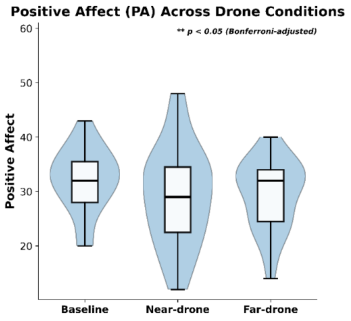
This study conducted an ANOVA to compare participants’ positive affect (PA) across baseline (31.74 ± 6.25), near-drone (29.16 ± 8.95), and far- drone (30.06 ± 7.05) conditions. As shown in Table 1, the ANOVA result indicated no significant effect of these drone conditions on participants’ PA (F (1.41, 42.36) = 3.09, p = 0.072). Figure 3(a) presents an overview of how the PA varies according to the drone conditions.
Table 1: Summary of participants’ PA across drone conditions.
Figure 3: An overview of PA and NA across drone conditions.
Then, the Friedman test was performed to compare participants’ negative affect (NA) across baseline (16.58 ± 6.17), near-drone (20.42 ± 5.22), and far-drone (19.16 ± 4.42) conditions. As shown in Table 2, the Friedman
Do Close-Range Drone Operations Affect Workers’ Emotional States 1585 result indicated a significant effect of these drone conditions on participants’ NA (χ²(2, N = 31) = 23.66, p < 0.001). Figure 3(b) presents a graphic overview of post-hoc analysis. The Wilcoxon signed-rank tests indicated the significant differences (i) between the baseline and near-drone conditions (ZNear-Baseline = −3.73, pNear-Baseline < 0.001), and (ii) between the baseline and far- drone conditions (ZFar-Baseline = −3.77, pFar-Baseline < 0.001), while the difference between the near-drone and far-drone conditions was not significant (ZNear-Far = −1.80, pNear-Far = 0.072).
Table 2: Summary of participants’ NA across drone conditions.
Table available in the original PDF paper.
Conditions NA (Mean ± STD) Test Statistic (χ²) P-value Post-hoc Baseline 16.58 ± 6.17
Note: Post-hoc p-values were Bonferroni-adjusted. **p-value < 0.05.
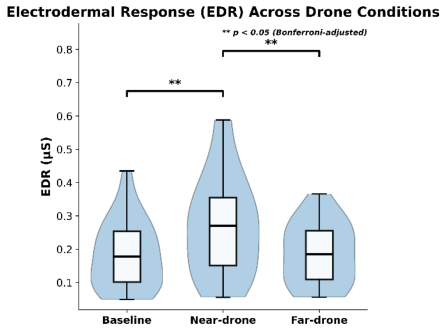
On the other hand, this study examined whether different drone conditions influence participants’ stress levels. The descriptive results showed relatively higher EDR in the near-drone (0.278 ± 0.159) and far-drone conditions (0.198 ± 0.111), and lower EDR in the baseline (0.183 ± 0.101), as presented in Table 3. A significant difference in stress levels among the three drone conditions could be observed through an ANOVA test (F (2, 60) = 14.49, p < 0.001). As shown in Figure 4, the pair-wise t-tests indicated that there were significant differences (i) between the baseline and near-drone conditions (tBaseline-Near = 4.61, pBaseline-Near = 0.003), and (ii) between the near-drone and far-drone conditions (tNear-Far = 4.08, pNear-Far = 0.003), whereas no significant difference was found between the baseline and far-drone conditions (tBaseline-Far = 0.92, pBaseline-Far = 0.366).
Table 3: Summary of participants’ EDR across drone conditions.
Note: Post-hoc p-values were Bonferroni-adjusted. **p-value < 0.05.
Figure 4: An overview of EDR across drone conditions.
DISCUSSION
This study empirically investigated how close-range drone operations influence construction workers’ emotional states and stress levels, and whether these effects vary across proximity levels in shared workspaces. The results suggest that, although drones show great potential for collaborative construction tasks, their presence can elicit negative emotional responses and increase workers’ stress, with stress effects varying by drone proximity levels.
First, regarding stress levels, the EDR results demonstrate that drone presence increased workers’ physiological stress during the hands-on roofing task, and this effect was dependent on drone proximity. Specifically, stress levels (indexed by EDR) were highest in the near-drone condition and were significantly greater than both baseline and far-drone conditions, whereas the far-drone condition was comparable to baseline. This pattern suggests that increased stress is not a universal consequence of drone presence. The near-drone operation is more likely to trigger sympathetic arousal. Due to stronger visual motion cues and more noticeable noise stimuli, a drone operating in proximity is more perceptually intrusive, making workers more likely to feel their “intimate space” is being invaded (Bretin et al., 2023). Workers may perceive it as a more serious potential threat (e.g., concerns about collision, interference with operations, or impact on stability), which could prompt them to allocate more attentional resources to continuously monitor the drone’s position and movement (Bretin et al., 2022; Albeaino et al., 2023a). This attentional allocation could increase cognitive load, disrupt task-relevant information processing, and diminish their sense of control over the work process (Pooladvand and Hasanzadeh, 2023). As perceived threat increases and perceived control decreases, workers are more likely to experience higher physiological stress. By contrast, increasing the distance to 1.2 m likely reduced both the intensity of sensory stimulation and the perceived risk, as the drone becomes less salient and blends more into the surroundings (Wojciechowska et al., 2019).
Do Close-Range Drone Operations Affect Workers’ Emotional States 1587 Second, regarding workers’ emotional states, the results indicate that drone presence primarily affected negative emotional experience instead of positive mood. Specifically, PA remained relatively stable across the baseline, near-drone, and far-drone conditions, suggesting that drone presence did not significantly change participants’ positive emotional experience, such as feeling active, enthusiastic, and excited. However, NA was elevated in both drone conditions, suggesting that working alongside a drone would introduce an emotional burden to workers. Regardless of proximity, workers were continuously exposed to noise and visual disturbances. These persistent stimuli may have required ongoing vigilance and generated unease, irritation, or concern about potential task interference throughout the interaction (Bretin et al., 2022, 2023). Thus, the drone’s entry into the workers’ immediate space may be sufficient to elicit negative affect, while reducing the distance from 1.2 m to 0.45 m produced little additional emotional impact. The different patterns observed for EDR and NA may indicate that EDR is more sensitive to acute, distance-dependent physiological arousal, whereas NA reflects the cumulative emotional experience of working alongside a drone.
This study has important practical implications. The results emphasize that the safe and effective human-drone interaction should consider not only operational performance but also workers’ emotional states and stress levels. Close-range drone operations can elicit negative affect. Besides, proximity management is crucial, as a near drone can further increase stress levels, whereas operating at a far distance can mitigate these adverse effects. Thus, construction teams should consider establishing a minimum drone- worker distance in standard operating procedures, especially for physically demanding and hazardous tasks such as roofing. In addition to distance, drone deployment could adopt complementary strategies to further reduce stress and negative affect, including quieter platforms or noise-reduction measures, and clear communication of drone intent and arrangement.
CONCLUSIONS AND FUTURE WORK This study developed a mixed reality experimental platform to empirically investigate how close-range drone operations influence construction workers’ emotional states and physiological stress during a hands-on roofing task and whether these effects vary across proximity levels. The results indicate that positive affect remained relatively stable across drone conditions, negative affect increased significantly when the drone operated at a near distance (0.45m) and a far distance (1.2m), showing a drone-presence effect. However, stress levels (indexed by EDR) were highest in the near-drone condition and did not differ significantly between the far-drone and baseline conditions. Together, these findings suggest that the drone operation in proximity can impose measurable emotional and physiological costs, whereas operating at a far distance might mitigate stress effects in shared workspaces.
From a practical perspective, proximity management would be a practical strategy for supporting safer and more effective human-drone interaction on construction sites. Establishing a minimum drone-worker distance may help reduce negative affect and physiological stress, particularly for physically demanding and hazardous tasks. Future research could investigate (1) how
other drone operational behaviours (e.g., flight speed, approach direction, etc.) influence workers’ safety and (2) how drone proximity interacts with other jobsite factors (such as task complexity) to impact workers’ affective and physiological responses.
ACKNOWLEDGMENT
The authors express our gratitude to the National Science Foundation for providing support to the research presented in this paper (under grant numbers 2128867 and 2310210). Any opinions, findings, conclusions, or recommendations expressed in this material are those of the authors and do not necessarily reflect the views of the National Science Foundation.
REFERENCES
Albeaino, G., Brophy, P., Jeelani, I., Gheisari, M., and Issa, R.R.A. (2023a).
“Psychophysiological impacts of working at different distances from drones on construction sites.” Journal of Computing in Civil Engineering, Volume 37, No. 5. Albeaino, G., Brophy, P., Jeelani, I., Gheisari, M., and Issa, R.R.A. (2023b). “Impact of drone presence on construction individuals working at heights.” Journal of Construction Engineering and Management, Volume 149, No. 11. Benedek, M., and Kaernbach, C. (2010). “A continuous measure of phasic
electrodermal activity.” Journal of Neuroscience Methods, Volume 190, No. 1, pp. 80–91. Bhandari, S., Hallowell, M.R., Van Boven, L., Gruber, J., and Welker, K.M. (2016).
“Emotional states and their impact on hazard identification skills.” Proceedings of Construction Research Congress 2016, ASCE, Reston, VA, pp. 2831–2840. Bretin, R., Cross, E.S., and Khamis, M. (2022). “Co-existing with a drone: Using virtual reality to investigate the effect of the drone’s height and cover story on proxemic behaviours.” CHI Conference on Human Factors in Computing Systems Extended Abstracts, pp. 1–9. Bretin, R., Khamis, M., and Cross, E. (2023). “‘Do I run away?’: Proximity, stress
and discomfort in human-drone interaction in real and virtual environments.” Proceedings of the IFIP Conference on Human-Computer Interaction, pp. 525–551. Bretin, R., Cross, E.S., and Khamis, M. (2024). “Co-existing with drones: A virtual exploration of proxemic behaviours and users’ insights on social drones.” International Journal of Social Robotics, Volume 16, No. 3, pp. 547–567. Gheisari, M., and Esmaeili, B. (2019). “Applications and requirements of unmanned
aerial systems (UASs) for construction safety.” Safety Science, Volume 118, pp. 230–240. Greco, A., Valenza, G., Lanata, A., Scilingo, E.P., and Citi, L. (2015). “cvxEDA: A convex optimization approach to electrodermal activity processing.” IEEE Transactions on Biomedical Engineering, Volume 63, No. 4, pp. 797–804. Hall, E.T. (1966). The hidden dimension. Anchor Books. Kreibig, S.D. (2010). “Autonomic nervous system activity in emotion: A review.”
Biological Psychology, Volume 84, No. 3, pp. 394–421. Leung, M.Y., Chan, I.Y.S., and Yu, J. (2012). “Preventing construction worker injury incidents through the management of personal stress and organizational stressors.” Accident Analysis & Prevention, Volume 48, pp. 156–166.
Do Close-Range Drone Operations Affect Workers’ Emotional States 1589 Leung, M., Liang, Q., and Chan, I.Y. (2017). “Development of a stressors–stress–
performance–outcome model for expatriate construction professionals.” Journal of Construction Engineering and Management, Volume 143, No. 5, 04016121. Morshedi, M.A., and Kashani, H. (2022). “Assessment of vulnerability reduction policies: Integration of economic and cognitive models of decision-making.” Reliability Engineering & System Safety, Volume 217, 108057. Namian, M., Albert, A., and Feng, J. (2018). “Effect of distraction on hazard
recognition and safety risk perception.” Journal of Construction Engineering and Management, Volume 144, No. 4, 04018008. Pooladvand, S., and Hasanzadeh, S. (2023). “Impacts of stress on workers’ risktaking behaviors: Cognitive tunneling and impaired selective attention.” Journal of Construction Engineering and Management, Volume 149, No. 8, 04023060. Watson, D., Clark, L.A., and Tellegen, A. (1988). “Development and validation of
brief measures of positive and negative affect: The PANAS scales.” Journal of Personality and Social Psychology, Volume 54, No. 6, pp. 1063–1070. Winkler, R.B., Middleton, C., and Remes, O. (2024). “Work-related stress and coping: A comparative analysis of on-site and office-based workers in UK building construction.” Healthcare, Volume 12, No. 21, 2117. Wojciechowska, A., Frey, J., Sass, S., Shafir, R., and Cauchard, J.R. (2019). “Collocated
human-drone interaction: Methodology and approach strategy.” Proceedings of the 14th ACM/IEEE International Conference on Human-Robot Interaction (HRI), pp. 172–181. Zhu, Z., Jeelani, I., and Gheisari, M. (2023). “Physical risk assessment of drone integration in construction using 4D simulation.” Automation in Construction, Volume 156, 105099.
SEARCH THE AHFE DIGITAL BOOKSTORE BY ISBN
Explore the complete digital volume
Human Factors in Design, Engineering, and Computing
Read this individual research paper free through the original publisher, or explore the full digital proceedings book.