Debra Henneberry, Dimitrios Ziakkas, Ian Roth (2026). From Emerging Technologies to Operational Capability: Human- Centred Transition Pathways for AI Implementation. In: Human Factors in Design, Engineering, and Computing. AHFE Open Access, vol. 238, pp. 1739–1747. https://doi.org/10.54941/ahfe1008402
Emerging technologies frequently demonstrate technical maturity before organisations develop equivalent operational capability. This paper presents a structured implementation methodology integrating digital twins, AI analytics, simulation, competency-based training and Human-AI Teaming within a unified transition pathway. Rather than evaluating technologies individually, the framework examines how emerging capabilities interact with organisational processes, workforce competencies and safety management. Aviation provides practical examples of AI-supported implementation, while the proposed methodology is transferable to multiple safety-critical sectors.
Technology maturity and operational capability are not the same thing. Technology Readiness Levels (TRLs) were developed to describe how far a technology has progressed from basic principles to proven operation (Mankins, 1995; 2009), and they remain the dominant language for judging when an innovation is ready. Yet a technology can be demonstrated in its operational environment while the organisation that must use it still lacks trained people, adapted procedures, safety arguments and regulatory acceptance. Studies of TRL use in industry report precisely this limitation: readiness scales describe the artefact, but integration, human performance and organisational factors are often the source of delay and failure (Olechowski, Eppinger and Joglekar, 2015).
Organisational research has long recognised the gap. Implementation is a process of mutual adaptation in which both the technology and the organisation change (Leonard-Barton, 1988), and its success depends on the climate and fit of the implementing organisation rather than on the innovation alone (Klein and Sorra, 1996). A study of cardiac surgery teams adopting a new technology found that implementation success depended on
how teams learned and disrupted established routines, not on the technology or on the surgeons’ individual expertise (Edmondson, Bohmer and Pisano, 2001). Artificial intelligence (AI) intensifies these dynamics because it changes the distribution of cognitive work between people and machines (McNeese et al., 2018; Endsley, 2023).
In aviation, our earlier work on AI in transportation, risk management and safety management systems has identified the same pattern: technologies arrive faster than the competencies, procedures and oversight needed to use them (Ziakkas and Henneberry, 2024; Henneberry, Ziakkas and Doerrstein, 2025; Ziakkas, Cortes and Henneberry, 2025). This paper therefore presents an Operational Capability Transition Pathway (OCTP) that treats readiness as multi-dimensional and positions digital twins, AI analytics, simulation, competency-based training and Human-AI Teaming (HAT) as enablers of transition rather than as isolated technologies. Three research questions (RQs) guided the work: which dimensions of readiness determine whether an emerging technology becomes an operational capability (RQ1); how emerging technologies can be used to accelerate readiness in the dimensions that lag (RQ2); and what aviation implementations reveal about the interaction between technology, workforce, processes and safety management (RQ3).
BACKGROUND
Readiness Beyond Technology Several extensions of the TRL concept address its limitations. System Readiness Levels combine technology maturity with integration readiness, recognising that mature components can form an immature system (Sauser et al., 2006). The Human Readiness Level scale, published as an American National Standard, rates the extent to which human performance considerations have been addressed at each stage of system development (ANSI/HFES, 2021), and it was deliberately aligned with the TRL structure so that human readiness can be assessed alongside technical maturity (Salazar and Russi-Vigoya, 2021). What remains missing is an integrated view that includes workforce competency, organisational processes and safety assurance, which in safety- critical industries frequently determine when a capability can be used.
Technology Adoption as Socio-Technical Transition Diffusion research shows that adoption depends on perceived advantage, compatibility, complexity, trialability and observability (Rogers, 2003). The multi-level perspective on transitions describes how innovations in protected niches become established only when they align with existing regimes of practice, regulation and infrastructure (Geels, 2002). Structuration theory adds that technology is enacted through use, so the same system can produce different outcomes in different organisations (Orlikowski, 1992). In healthcare, the NASSS framework explains non-adoption and a bandonment of technologies through the interaction of technology, value proposition, adopters, organisation and the wider regulatory context (Greenhalgh et al., 2017). These perspectives converge on a single point: capability emerges from the fit between technology and its socio-technical context.
From Emerging Technologies to Operational Capability 1741 Enabling Technologies for Transition
Emerging technologies can themselves accelerate readiness. Digital twins allow systems, procedures and operational scenarios to be rehearsed virtually before introduction (Jones et al., 2020; Li et al., 2022). Simulation supports skill acquisition and transfer when its use is grounded in training needs rather than fidelity alone (Hays et al., 1992; Salas, Bowers and Rhodenizer, 1998). Competency-based and data-driven training programmes, such as the US Advanced Qualification Program, link training design to performance data (FAA, 2017). HAT research shows that effective human-AI teams depend on interactive team cognition, communication and coordination (Cooke et al., 2013; McNeese et al., 2018) and on transparency that supports situation awareness (Endsley, 2023). Finally, safety management must treat change itself as a hazard, because latent conditions are frequently introduced during transitions (Reason, 1997), and highly reliable organisations sustain safety through sensitivity to operations and commitment to resilience (Weick and Sutcliffe, 2007).
METHODOLOGY
The study used best-fit framework synthesis, in which an existing framework provides the initial structure and is then extended with themes that it does not capture (Carroll, Booth and Cooper, 2011). The TRL and Human Readiness Level scales formed the a priori framework; constructs from implementation research, transition theory, simulation-based training, HAT and safety management were then coded against it, generating additional readiness dimensions and the stages of the pathway. The resulting methodology was examined through three illustrative aviation cases, an approach suited to demonstrating how a conceptual framework operates in practice (Siggelkow, 2007). The cases were selected to represent three distinct enabling technologies: a remote digital air traffic control tower, a virtual reality flight simulation training device, and an AI route-optimisation system used by airline dispatchers. Evidence was drawn from published organisational announcements and regulatory information, and each case was coded against the five readiness dimensions to identify which dimension constrained the transition. The research method is summarised in Table 1.
Table 1: Research method of the study.
Table available in the original PDF paper.
Element Design Decision Rationale Synthesis approach Best-fit framework synthesis (Carroll, Booth and Cooper, 2011)
Extends established readiness scales rather than building from nothing
A priori framework
Widely recognised in engineering and human factors practice
TRL (Mankins, 1995) and Human Readiness Levels (ANSI/HFES, 2021) Extension sources
Captures workforce, organisational and safety dimensions
Implementation research, transition theory, simulation, HAT, safety management Case strategy Three illustrative aviation cases (Siggelkow, 2007)
Demonstrates how the pathway operates in practice (Continued)
Table 1: Continued Element Design Decision Rationale
Table available in the original PDF paper.
Case selection Remote digital tower; VR training device; AI dispatch optimisation
Distinct enabling technologies and operational domains Publicly verifiable evidence
Data sources Organisational announcements and regulatory information Analysis Coding of each case against five readiness dimensions
Identifies the dimension that constrained transition
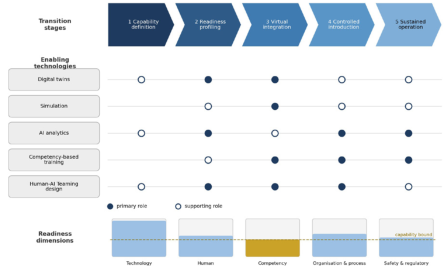
THE OPERATIONAL CAPABILITY TRANSITION PATHWAY The synthesis produced five readiness dimensions. Technology readiness describes the maturity of the artefact. Human readiness describes how far interfaces, roles, workload and trust have been designed for the people who will use it. Competency readiness describes whether the workforce has been trained and assessed in the behaviours that the new capability requires. Organisational and process readiness describes whether procedures, responsibilities, data flows and management systems have been adapted. Safety and regulatory readiness describes whether risks introduced by the change have been assessed and whether the capability is accepted by the relevant authority. The central proposition of the OCTP is that operational capability is constrained by the least-ready dimension, so investment should be directed to the dimension that lags rather than to further technical refinement.
The pathway comprises five stages (Figure 1). Stage 1, capability definition, describes the operational need and current work-as-performed, avoiding a technology-first framing. Stage 2, readiness profiling, assesses all five dimensions and identifies the capability lag between technology readiness and the least-ready dimension. Stage 3, virtual integration, uses digital twins and simulation to rehearse the new capability, co-evolving procedures, interfaces and competencies before live exposure. Stage 4, controlled introduction, deploys the capability in shadow, advisory or limited modes, using AI analytics to monitor both system performance and human reliance. Stage 5, sustained operation, embeds the capability in competency-based training and safety management and continues to monitor all dimensions, feeding lessons back into capability definition.
Figure 1: The Operational Capability Transition Pathway (OCTP): stages, enabling technologies and an illustrative readiness profile.
From Emerging Technologies to Operational Capability 1743 Each enabling technology has a primary role. Digital twins support process and safety readiness by allowing integration to be tested virtually. Simulation supports competency and human readiness by providing practice and evaluation opportunities. Competency-based training converts new requirements into trained and assessed behaviours. HAT design specifies roles, authority and transparency. AI analytics provides the measurement layer throughout, allowing organisations to observe whether readiness is actually increasing.
CASE FINDINGS London City Airport became the first major international airport to be fully controlled by a remote digital tower. Sixteen high-definition cameras and sensors on a 50-metre mast relay a 360-degree view to controllers at the NATS centre in Swanwick, 115 kilometres away, where live images can be overlaid with flight and weather data to create an enhanced view (London City Airport, 2021). The tower was completed in 2019 and entered full operation only after a period of testing and live trials, with operations beginning at the end of January 2021 (London City Airport, 2021). The technology had already been proven at smaller Swedish airports, so the constraining dimensions were human, competency, process and regulatory readiness at a busy international airport, which were developed during the testing period by a dedicated controller team.
Loft Dynamics developed a virtual reality flight simulation training device with a full-scale replica cockpit, 360-degree view and six-degrees-of-freedom motion platform. The device was first qualified by EASA and, in 2024, became the first virtual reality device qualified by the FAA, following evaluation under 14 CFR Part 60 of its H125 helicopter device at Marshall University (Loft Dynamics, 2024). Qualification allowed pilots to receive credit toward ratings for training in engine failures, emergency procedures, instrument approaches and demanding manoeuvres. The case shows that the operational value of a mature simulation technology depended on regulatory readiness, which converted a training tool into a recognised training capability.
Alaska Airlines introduced the Flyways AI platform to its dispatchers, who remain responsible for route decisions. During an initial six-month trial, Flyways identified opportunities to reduce distance and fuel for 64 per cent of mainline flights, of which dispatchers evaluated and accepted 32 per cent of recommendations (Alaska Airlines, 2021). After four years of use, the airline reported optimisation opportunities for 55 per cent of flights, fuel savings of three to five per cent on flights longer than four hours, and more than 1.2 million gallons of fuel saved in one year (Alaska Airlines, 2024). The case shows the interaction between AI capability and human readiness: the value realised depended on dispatchers’ evaluation and acceptance of recommendations, with authority retained by the licensed professional. Table 2 summarises the findings.
Across the cases, no transition was constrained by technology readiness at the point of introduction. In each case the pace of capability was set by human, competency, organisational or regulatory readiness, and the mechanisms that closed the gap were staged trials, qualification processes
and advisory deployment with human authority retained. These findings support the central proposition that capability is bounded by the least-ready dimension.
Table 2: Findings: aviation cases coded against the five readiness dimensions.
Table available in the original PDF paper.
Case Enabling Technology
Transition Mechanism
Lesson for the OCTP
Constraining Readiness Dimension
London City remote digital tower
Cameras, sensors and enhanced-reality displays
Extended testing and live trials with a dedicated controller team
Human, competency, process and regulatory readiness
Proven technology still requires a staged transition in each new context
Loft Dynamics VR training device
Virtual reality simulation with motion platform
Safety and regulatory readiness
EASA and FAA qualification enabling training credit
Regulatory acceptance converts a tool into a training capability
Alaska Airlines Flyways
AI route optimisation for dispatchers
Human readiness and calibrated reliance
Advisory deployment with dispatcher authority retained
Value depends on human evaluation and acceptance of AI outputs
DISCUSSION
In response to RQ1, the study identified five readiness dimensions, namely technology, human, competency, organisational and process, and safety and regulatory readiness, that jointly determine operational capability. In response to RQ2, the OCTP assigns emerging technologies explicit roles in accelerating the lagging dimensions: digital twins and simulation for rehearsal and practice, competency-based training for workforce readiness, HAT design for role clarity, and AI analytics for measurement. In response to RQ3, the aviation cases show that capability was paced by non-technical readiness in every instance.
The framework contributes to readiness theory by extending the TRL and Human Readiness Level scales (Mankins, 2009; ANSI/HFES, 2021) with competency, organisational and regulatory dimensions, and to implementation theory by specifying how mutual adaptation (Leonard-Barton, 1988) can be deliberately managed. The Flyways case illustrates the practical meaning of calibrated reliance: the partial acceptance of recommendations is not a failure of the technology but evidence of professionals exercising judgement, which organisations should monitor rather than attempt to maximise. The London City case illustrates that proven technology must still transition within each new operational context, consistent with the multi-level perspective (Geels, 2002). The simulation case shows that simulation is not only an enabler of competency readiness but also a capability whose own value depends on regulatory acceptance, which is directly relevant to the emerging use of simulated environments for air traffic communication
From Emerging Technologies to Operational Capability 1745 training (Aranda, Ziakkas and Henneberry, 2025) and to the certification of new aircraft categories such as eVTOLs (Ziakkas and Henneberry, 2025). The methodology is transferable to rail, maritime and healthcare, where frameworks such as NASSS already recognise the multi-dimensional nature of adoption (Greenhalgh et al., 2017).
The study has limitations. The cases rely on public organisational announcements, which emphasise success and provide limited detail on training, procedures or safety assessments. The readiness dimensions have not yet been operationalised as a scored instrument. Future research should develop and validate a readiness assessment instrument, apply the pathway prospectively in an airline or training organisation, and investigate how reliance on AI recommendations evolves over time among professionals such as dispatchers and controllers.
CONCLUSION
Emerging technologies become operational capabilities only when people, competencies, processes and safety arrangements are ready to use them. The Operational Capability Transition Pathway integrates digital twins, AI analytics, simulation, competency-based training and Human-AI Teaming into a unified methodology that profiles readiness across five dimensions and directs effort to the dimension that lags. The aviation cases show that the pace of capability is set not by technology alone but by the human and organisational systems into which it is introduced. By focusing on those systems, the pathway offers aviation and other safety-critical sectors a structured route from technical promise to operational capability.
ACKNOWLEDGMENT
The authors thank colleagues at Purdue University and Coventry University for discussions that informed this work.
REFERENCES
Alaska Airlines (2021). Alaska Airlines and Airspace Intelligence announce first-ofits-kind partnership to optimize air traffic flow with artificial intelligence and machine learning. Press release, May 2021. Seattle, WA: Alaska Airlines. Alaska Airlines (2024). Alaska Airlines renews partnership with Air Space
Intelligence, solidifying AI-powered innovation driving fuel efficiency goals. Press release, August 2024. Seattle, WA: Alaska Airlines. ANSI/HFES (2021). ANSI/HFES 400-2021 Human Readiness Level Scale in the System Development Process. Washington, DC: Human Factors and Ergonomics Society. Aranda, W., Ziakkas, D. and Henneberry, D. (2025). The role of simulated air traffic
control environment (SATCE) in the implementation of ICAO level 4 requirements. Paper presented at the 16th International Conference on Applied Human Factors and Ergonomics (AHFE 2025), Orlando, FL, 26–30 July. Carroll, C., Booth, A. and Cooper, K. (2011). A worked example of ‘best fit’ framework synthesis: A systematic review of views concerning the taking of some potential chemopreventive agents. BMC Medical Research Methodology, 11, 29.
Cooke, N.J., Gorman, J.C., Myers, C.W. and Duran, J.L. (2013). Interactive team cognition. Cognitive Science, 37(2), pp. 255–285. Edmondson, A.C., Bohmer, R.M. and Pisano, G.P. (2001). Disrupted routines: Team
learning and new technology implementation in hospitals. Administrative Science Quarterly, 46(4), pp. 685–716. Endsley, M.R. (2023). Supporting human-AI teams: Transparency, explainability, and situation awareness. Computers in Human Behavior, 140, 107574. FAA (2017). Advisory Circular 120-54A: Advanced Qualification Program.
Washington, DC: Federal Aviation Administration. Geels, F.W. (2002). Technological transitions as evolutionary reconfiguration processes: A multi-level perspective and a case-study. Research Policy, 31(8–9), pp. 1257–1274. Greenhalgh, T., Wherton, J., Papoutsi, C., Lynch, J., Hughes, G., A’Court, C., Hinder,
S., Fahy, N., Procter, R. and Shaw, S. (2017). Beyond adoption: A new framework for theorizing and evaluating nonadoption, abandonment, and challenges to the scale-up, spread, and sustainability of health and care technologies. Journal of Medical Internet Research, 19(11), e367. Hays, R.T., Jacobs, J.W., Prince, C. and Salas, E. (1992). Flight simulator training effectiveness: A meta-analysis. Military Psychology, 4(2), pp. 63–74. Henneberry, D., Ziakkas, D. and Doerrstein, F. (2025). The role of artificial
intelligence (AI) applications in aviation risk management. Paper presented at the 13th International Conference on Human Interaction and Emerging Technologies: Artificial Intelligence and Future Applications (IHIET-AI 2025), Malaga, Spain, 22–24 April. Jones, D., Snider, C., Nassehi, A., Yon, J. and Hicks, B. (2020). Characterising the digital twin: A systematic literature review. CIRP Journal of Manufacturing Science and Technology, 29, pp. 36–52. Klein, K.J. and Sorra, J.S. (1996). The challenge of innovation implementation.
Academy of Management Review, 21(4), pp. 1055–1080. Leonard-Barton, D. (1988). Implementation as mutual adaptation of technology and organization. Research Policy, 17(5), pp. 251–267. Li, L., Aslam, S., Wileman, A. and Perinpanayagam, S. (2022). Digital twin in
aerospace industry: A gentle introduction. IEEE Access, 10, pp. 9543–9562. Loft Dynamics (2024). Loft Dynamics becomes world’s first VR flight simulation training device to receive FAA qualification. Press release, 31 July 2024. Santa Monica, CA: Loft Dynamics. London City Airport (2021). London City becomes first major airport to be controlled
by remote digital tower. Press release, April 2021. London: London City Airport. Mankins, J.C. (1995). Technology Readiness Levels: A White Paper. Washington, DC: NASA Office of Space Access and Technology. Mankins, J.C. (2009). Technology readiness assessments: A retrospective. Acta
Astronautica, 65(9–10), pp. 1216–1223. McNeese, N.J., Demir, M., Cooke, N.J. and Myers, C. (2018). Teaming with a synthetic teammate: Insights into human-autonomy teaming. Human Factors, 60(2), pp. 262–273. Olechowski, A., Eppinger, S.D. and Joglekar, N. (2015). Technology readiness
levels at 40: A study of state-of-the-art use, challenges, and opportunities. In: Proceedings of PICMET ‘15: Management of the Technology Age. Portland, OR: IEEE, pp. 2084–2094. Orlikowski, W.J. (1992). The duality of technology: Rethinking the concept of technology in organizations. Organization Science, 3(3), pp. 398–427.
From Emerging Technologies to Operational Capability 1747 Reason, J. (1997). Managing the Risks of Organizational Accidents. Aldershot:
Ashgate. Rogers, E.M. (2003). Diffusion of Innovations, 5th edn. New York: Free Press. Salas, E., Bowers, C.A. and Rhodenizer, L. (1998). It is not how much you have but how you use it: Toward a rational use of simulation to support aviation training. International Journal of Aviation Psychology, 8(3), pp. 197–208. Salazar, G. and Russi-Vigoya, M.N. (2021). Technology readiness level as the
foundation of human readiness level. Ergonomics in Design, 29(4), pp. 25–29. Sauser, B., Verma, D., Ramirez-Marquez, J. and Gove, R. (2006). From TRL to SRL: The concept of systems readiness levels. In: Proceedings of the Conference on Systems Engineering Research. Los Angeles, CA. Siggelkow, N. (2007). Persuasion with case studies. Academy of Management
Journal, 50(1), pp. 20–24. Weick, K.E. and Sutcliffe, K.M. (2007). Managing the Unexpected: Resilient Performance in an Age of Uncertainty, 2nd edn. San Francisco, CA: Jossey-Bass. Ziakkas, D. and Henneberry, D. (2024). The challenges of the implementation
of artificial intelligence (AI) in transportation. Paper presented at the 15th International Conference on Applied Human Factors and Ergonomics (AHFE 2024), Nice, France, 24–27 July. Ziakkas, D. and Henneberry, D. (2025). The role of human factors in the certification of eVTOLs in the artificial intelligence (AI) era. Paper presented at the 16th International Conference on Applied Human Factors and Ergonomics (AHFE 2025), Orlando, FL, 26–30 July. Ziakkas, D., Cortes, G.S. and Henneberry, D. (2025). The implementation of AI in
the eVTOL safety management systems. Paper presented at the 16th International Conference on Applied Human Factors and Ergonomics (AHFE 2025), Orlando, FL, 26–30 July.
SEARCH THE AHFE DIGITAL BOOKSTORE BY ISBN
Explore the complete digital volume
Human Factors in Design, Engineering, and Computing
Read this individual research paper free through the original publisher, or explore the full digital proceedings book.