Dimitrios Ziakkas, Debra Henneberry (2026). Building Sustainable Business Value Through Human-Centred AI Transition Pathways. In: Human Factors in Design, Engineering, and Computing. AHFE Open Access, vol. 238, pp. 1942–1950. https://doi.org/10.54941/ahfe1008422
Successful AI implementation depends as much on organisational readiness as on technological maturity. This paper proposes a business-oriented transition framework linking Human Factors, competency development, AI governance and organisational transformation. The model aligns investment decisions with operational performance, workforce capability and long-term resilience rather than technology acquisition alone. Aviation case studies demonstrate how organisations can generate measurable business value through structured implementation pathways that integrate AI, Human-AI Teaming and competency assurance into everyday operations.
Investment in artificial intelligence (AI) has accelerated across industry, yet the conversion of that investment into business value remains uneven. A large global survey found that only about one in ten organisations reported significant financial benefits from AI, and that those which did were distinguished less by their algorithms than by how they redesigned processes and learned alongside the technology (Ransbotham et al., 2020). Economic analysis points in the same direction: general purpose technologies such as AI require substantial complementary investment in skills, processes and organisational design, so measured productivity often falls before it rises, a pattern described as the productivity J-curve (Brynjolfsson, Rock and Syverson, 2021). Business value from AI is therefore an organisational achievement rather than a property of the technology.
Safety-critical industries amplify this challenge. In aviation, AI must be introduced into operations governed by safety management systems (ICAO, 2018), competency-based training (ICAO, 2013; 2020) and an emerging AI regulatory framework comprising the EU Artificial Intelligence Act (European Parliament and Council, 2024) and EASA guidance on AI trustworthiness, human factors and Human-AI Teaming (HAT) (EASA, 2024; 2025).
Building Sustainable Business Value Through Human-Centred AI Transition Pathways 1943 Organisations that treat AI as a technology acquisition, justified by a narrow return-on-investment case and handed to operations after procurement, risk under-realised benefits, eroded workforce expertise and new safety exposures (Parasuraman and Riley, 1997; Raisch and Krakowski, 2021). Our earlier work on AI and human performance in transportation reached a similar conclusion: the decisive variable is the human and organisational system into which AI is placed (Ziakkas and Plioutsias, 2024; Ziakkas and Henneberry, 2025).
Existing business frameworks for AI adoption rarely incorporate Human Factors or competency assurance, while Human Factors frameworks rarely speak the language of investment decisions. This paper bridges the two by proposing the Human-Centred AI Value Transition (HAVT) framework. Three research questions (RQs) guided the study: which organisational capabilities determine whether AI investment generates sustainable business value in safety-critical operations (RQ1); how these capabilities can be sequenced into a structured transition pathway that informs investment decisions (RQ2); and what aviation implementation cases reveal about the conditions under which value is realised (RQ3).
THEORETICAL BACKGROUND AI Business Value and Organisational Readiness
The resource-based view holds that sustained advantage derives from resources that are valuable, rare and difficult to imitate (Barney, 1991). Commodity AI tools rarely meet these criteria on their own; advantage arises from their combination with firm-specific human capital, data and routines. Dynamic capabilities theory extends this argument, locating advantage in an organisation’s ability to sense opportunities, seize them through investment decisions and reconfigure its resources accordingly (Teece, 2007). Empirical work supports this view: an organisation-level AI capability, comprising data, technology, skills and coordination, predicts firm performance more strongly than technology investment alone (Mikalef and Gupta, 2021). Practitioner research similarly recommends augmenting rather than replacing professional work and piloting projects that build organisational learning (Davenport and Ronanki, 2018). Organisational readiness for change, defined as members’ shared commitment and perceived capability to implement a change, is a precondition for such reconfiguration (Weiner, 2009) and can be deliberately built through communication and participation (Armenakis, Harris and Mossholder, 1993).
Human Factors, Competency and Human-AI Teaming as Value Drivers Human Factors and Ergonomics (HFE) has long argued that designing for people improves both wellbeing and system performance, and that its value must be communicated in terms that business decision-makers recognise (Dul et al., 2012). Cost-benefit evidence shows that ergonomics interventions frequently repay their investment through productivity, quality and safety gains (Hendrick, 2003). For AI, the central Human Factors issue
1944 Ziakkas and Henneberry is appropriate reliance: trust must be calibrated to actual system capability to avoid both misuse and disuse (Lee and See, 2004), which requires attention to transparency, team coordination and shared situation awareness (O’Neill et al., 2022; Shneiderman, 2020). Raisch and Krakowski (2021) show that automation and augmentation are interdependent: organisations pursuing short-term automation gains can erode the human expertise on which long- term performance depends. Competency frameworks make this expertise visible and assessable. The ICAO competency-based training and assessment (CBTA) and evidence-based training (EBT) frameworks define observable behaviours that can be trained, measured and reported (ICAO, 2013; 2020), offering organisations a managerial instrument for human capability comparable to the instruments available for financial capital.
AI Governance AI governance provides the accountability structures that allow value to be realised without unacceptable risk. Berente et al. (2021) characterise AI management as a response to the autonomy, learning and inscrutability of AI systems. ISO/IEC 42001 specifies requirements for an AI management system, integrating AI policy, risk assessment, lifecycle controls and continual improvement into organisational management (ISO/IEC, 2023), while the NIST AI Risk Management Framework structures governance around the functions of govern, map, measure and manage (NIST, 2023). In aviation, EASA’s NPA 2025-07 proposes guidance on AI assurance, human factors and ethics (EASA, 2025), and Article 4 of the EU AI Act requires deployers to ensure sufficient AI literacy among their staff (European Parliament and Council, 2024). Governance is thus increasingly entangled with workforce competency, reinforcing the need to integrate the two.
METHODOLOGY
The study adopted a pragmatist philosophy, judging knowledge by its usefulness for practical decisions (Saunders, Lewis and Thornhill, 2019), and a design science research strategy, because the intended contribution is a framework that must be theoretically grounded and usable by practitioners (Hevner et al., 2004). The framework was developed abductively from the literature above and then examined through a qualitative multiple- case study, which supports analytical rather than statistical generalisation and is suited to building theory from contrasting cases (Eisenhardt, 1989; Yin, 2018). Three publicly documented aviation cases were selected by theoretical sampling to span distinct operational domains and value logics: AI-supported air traffic control at London Heathrow, AI-enabled predictive maintenance through the Airbus Skywise platform, and the transition to EBT and CBTA at Turkish Airlines. The third case does not involve AI directly; it was selected as a contrasting case of competency assurance infrastructure, which the framework predicts is a precondition for Human-AI Teaming at scale. Data comprised company and industry publications and peer- reviewed case documentation. Each case was analysed individually against
Building Sustainable Business Value Through Human-Centred AI Transition Pathways 1945 the four pillars of the framework, followed by cross-case pattern matching to derive propositions. Because one case draws on the authors’ prior published work (Ziakkas, Sarikaya and Natakusuma, 2023), and both authors hold operational aviation backgrounds, reflexive attention was paid to confirmation bias, and claims were restricted to those supported by the published sources. Table 1 summarises the research method.
Table 1: Research method of the study.
Table available in the original PDF paper.
Element Design Decision Rationale Philosophy Pragmatism (Saunders, Lewis and Thornhill, 2019)
Knowledge judged by usefulness for investment and implementation decisions
Approach to theory
Abduction Iteration between business, Human Factors and governance theory and case evidence Strategy Design science research with an embedded multiple-case study (Hevner et al., 2004; Yin, 2018) Framework must be both theoretically grounded and practically usable
Case selection Theoretical sampling of three aviation cases: air traffic control, maintenance, training
Contrasting domains and value logics support analytical generalisation (Eisenhardt, 1989) Focuses on transition rather than technology
Unit of analysis The AI or competency implementation pathway within each organisation
Publicly verifiable evidence; no confidential data required
Data sources Company and industry publications; peer-reviewed case documentation
Derives propositions linking pathway design to value realisation
Analysis Within-case coding against four pillars; cross-case pattern matching Quality criteria Source triangulation; reflexivity on authors’ positionality; claims limited to documented evidence
Enhances credibility and confirmability of secondary-data inferences
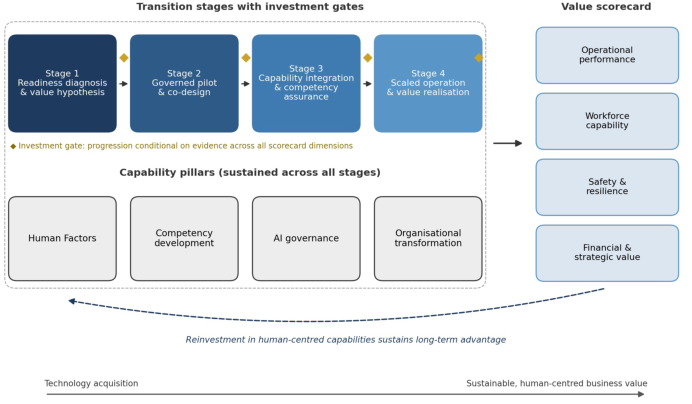
THE HUMAN-CENTRED AI VALUE TRANSITION FRAMEWORK The HAVT framework (Figure 1) combines four capability pillars with four transition stages and a multi-dimensional value scorecard. The pillars are Human Factors, competency development, AI governance and organisational transformation. The value scorecard adapts the logic of the balanced scorecard (Kaplan and Norton, 1992) by measuring operational performance, workforce capability, safety and resilience, and financial and strategic value, so that investment decisions are evaluated against the full range of outcomes that AI affects rather than against technology cost alone.
Figure 1: The Human-Centred AI Value Transition (HAVT) framework.
Stage 1, readiness diagnosis and value hypothesis, assesses organisational readiness across all four pillars (Weiner, 2009) and formulates the business case as a multi-dimensional value hypothesis. It also declares the intended role of the human, whether augmented, collaborating or supervising, because the choice between automation and augmentation shapes long-term value (Raisch and Krakowski, 2021). Stage 2, governed pilot and co-design, establishes AI management system controls (ISO/IEC, 2023) and co-designs the AI function with the professionals who will use it, measuring pilots on human-system performance rather than on model accuracy alone. Stage 3, capability integration and competency assurance, funds the complementary investments that the productivity J-curve predicts (Brynjolfsson, Rock and Syverson, 2021): process redesign, AI literacy, and new observable behaviours embedded within CBTA and EBT, together with instructor development. Stage 4, scaled operation and value realisation, monitors the scorecard, captures learning from everyday performance (Hollnagel, 2014) and reinvests in the capabilities that sustain advantage. Each stage ends with an investment gate at which progression is conditional on evidence across all four scorecard dimensions.
CASE FINDINGS At London Heathrow, NATS established a digital tower laboratory in which ultra-high-definition cameras feed an AI platform, Aimee, developed by Searidge Technologies. The platform tracks arriving aircraft and informs the controller when the runway has been vacated, while the controller retains the decision to clear the next arrival (NATS, 2019). The value hypothesis addressed the landing capacity lost when the control tower is enveloped in low cloud, estimated at around 20 per cent in those conditions (NATS, 2019). Non-operational trials monitored more than 40,000 arrivals before evidence
Building Sustainable Business Value Through Human-Centred AI Transition Pathways 1947 was presented towards regulatory acceptance (Searidge Technologies, 2022). Commentators observed that such conditions occur relatively infrequently, questioning whether a single-scenario business case captures the full value (Royal Aeronautical Society, 2019); NATS itself framed the laboratory as a platform for wider capabilities (NATS, 2019).
Airbus launched the Skywise data platform in 2017, integrating operator and manufacturer data such as work orders, component data and pilot reports to support predictive maintenance and reliability analysis (Airbus, 2017). easyJet’s early adoption followed two years of joint work to identify the airline’s principal technical issues, and a trial on 85 aircraft focusing on three issues led to 14 components being removed before they could cause disruption (ADS Group, 2017). The value logic was operational reliability, yet the enabling work was predominantly human and organisational: engineers defining problems, data being shared across organisational boundaries, and maintenance planning adapting to act on predictions.
The Turkish Airlines case documented the carrier’s transition to competency-based pilot training, including the development of a competency framework, instructor standardisation and assessment practices grounded in observable behaviours (Ziakkas, Sarikaya and Natakusuma, 2023). Although not an AI implementation, the case illustrates the competency infrastructure that allows new behaviours, including those required for Human-AI Teaming, to be specified, trained and evidenced across a workforce. Table 2 summarises the cross-case findings.
Table 2: Cross-case findings mapped to the HAVT framework.
Table available in the original PDF paper.
Case Value Logic in Published Sources
Human-Centred Enablers Evident
Transition Lesson and HAVT Stage
Recover landing capacity lost when the tower is in low cloud; reduce delays
Controller retains decision authority; non-operational trials; evidence for regulator
Single-scenario value case is fragile; platform option value matters (Stages 1–2)
NATS Heathrow digital tower (AI runway- clearance monitoring) Airbus Skywise and easyJet (predictive maintenance)
Joint problem definition with engineers; cross- organisational data sharing
Prevent technical delays and cancellations through early component removal
Value realised through redesigned maintenance decisions, not prediction alone (Stages 2–4)
Competency- based, evidence- driven training and assessment
Turkish Airlines EBT and CBTA transition (competency assurance)
Competency infrastructure is a reusable asset enabling Human-AI Teaming at scale (Stage 3) Cross-case pattern matching yielded four propositions. First, value was realised in proportion to complementary investment in people and processes, consistent with the productivity J-curve. Second, retaining human decision authority supported regulatory acceptance and allowed value to be
1948 Ziakkas and Henneberry staged incrementally. Third, value hypotheses defined by a single scenario or metric were fragile, supporting a multi-dimensional scorecard. Fourth, competency assurance infrastructure functions as a strategic resource in the resource-based sense, because it lowers the cost and risk of each subsequent AI implementation.
DISCUSSION
In response to RQ1, the study identified four capabilities, namely Human Factors, competency development, AI governance and organisational transformation, that jointly determine whether AI investment yields sustainable value. In response to RQ2, the HAVT framework sequences these capabilities into four stages with evidence-based investment gates. In response to RQ3, the aviation cases indicate that value is realised where human authority is preserved, domain professionals co-design the application, and competency infrastructure exists to absorb new ways of working.
Theoretically, the framework connects the dynamic capabilities and resource-based views (Barney, 1991; Teece, 2007) with Human Factors and Human-AI Teaming research by specifying the human and organisational complements that convert AI from a commodity into a source of advantage. It also operationalises the automation-augmentation paradox (Raisch and Krakowski, 2021) within investment governance, since each gate asks whether workforce capability is being strengthened or depleted. Practically, the framework suggests that investment committees should fund pathways rather than tools, budgeting explicitly for co-design, competency development and post-deployment monitoring; that business cases should report scorecard outcomes beyond financial return; and that AI governance and training functions should be integrated, a direction already implied by the AI literacy obligation of the EU AI Act. For aviation organisations, existing CBTA and EBT programmes represent a ready platform for AI-related competencies and a source of the performance data that value assessment requires.
The study has limitations. The cases rely on publicly available sources, which may emphasise success and omit costs, and no primary financial data were analysed. One case draws on the authors’ prior research, and the framework has not yet been applied prospectively. Future research should develop and validate a readiness assessment instrument aligned with the four pillars, conduct longitudinal cost-benefit studies of AI implementations that track all scorecard dimensions, and test the framework in other safety-critical sectors such as rail, maritime and healthcare.
CONCLUSION
AI generates sustainable business value when organisations invest in the people, competencies, governance and processes that allow it to work in everyday operations. The Human-Centred AI Value Transition framework offers decision-makers a structured pathway that aligns investment with operational performance, workforce capability and long-term resilience. The aviation cases show that the most durable returns come not from acquiring
Building Sustainable Business Value Through Human-Centred AI Transition Pathways 1949 technology but from building the human-centred capabilities through which AI, Human-AI Teaming and competency assurance become part of how the organisation works.
ACKNOWLEDGMENT
The authors thank colleagues at Coventry University and Purdue University for discussions that informed this framework.
REFERENCES
ADS Group (2017). Paris Air Show: EasyJet deploys Airbus Skywise. ADS Group Industry Member News, 20 June 2017. Airbus (2017). Airbus launches Skywise – aviation’s open data platform. Press
release, June 2017. Toulouse: Airbus. Armenakis, A.A., Harris, S.G. and Mossholder, K.W. (1993). Creating readiness for organizational change. Human Relations, 46(6), pp. 681–703. Barney, J. (1991). Firm resources and sustained competitive advantage. Journal of
Management, 17(1), pp. 99–120. Berente, N., Gu, B., Recker, J. and Santhanam, R. (2021). Managing artificial intelligence. MIS Quarterly, 45(3), pp. 1433–1450. Brynjolfsson, E., Rock, D. and Syverson, C. (2021). The productivity J-curve: How
intangibles complement general purpose technologies. American Economic Journal: Macroeconomics, 13(1), pp. 333–372. Davenport, T.H. and Ronanki, R. (2018). Artificial intelligence for the real world.
Harvard Business Review, 96(1), pp. 108–116. Dul, J., Bruder, R., Buckle, P., Carayon, P., Falzon, P., Marras, W.S., Wilson, J.R. and van der Doelen, B. (2012). A strategy for human factors/ergonomics: Developing the discipline and profession. Ergonomics, 55(4), pp. 377–395. EASA (2024). EASA Concept Paper: Guidance for Level 1 & 2 Machine Learning
Applications, Issue 02. Cologne: European Union Aviation Safety Agency. EASA (2025). Notice of Proposed Amendment 2025-07: Artificial Intelligence Trustworthiness (RMT.0742). Cologne: European Union Aviation Safety Agency. Eisenhardt, K.M. (1989). Building theories from case study research. Academy of
Management Review, 14(4), pp. 532–550. European Parliament and Council (2024). Regulation (EU) 2024/1689 laying down harmonised rules on artificial intelligence (Artificial Intelligence Act). Official Journal of the European Union, L series, 12 July 2024. Hendrick, H.W. (2003). Determining the cost–benefits of ergonomics projects and
factors that lead to their success. Applied Ergonomics, 34(5), pp. 419–427. Hevner, A.R., March, S.T., Park, J. and Ram, S. (2004). Design science in information systems research. MIS Quarterly, 28(1), pp. 75–105. Hollnagel, E. (2014). Safety-I and Safety-II: The Past and Future of Safety
Management. Farnham: Ashgate. ICAO (2013). Manual of Evidence-based Training (Doc 9995). Montréal: International Civil Aviation Organization. ICAO (2018). Safety Management Manual (Doc 9859), 4th edn. Montréal:
International Civil Aviation Organization. ICAO (2020). Procedures for Air Navigation Services – Training (PANS-TRG, Doc 9868), 3rd edn. Montréal: International Civil Aviation Organization.
1950 Ziakkas and Henneberry ISO/IEC (2023). ISO/IEC 42001:2023 Information Technology – Artificial Intelligence
– Management System. Geneva: International Organization for Standardization. Kaplan, R.S. and Norton, D.P. (1992). The balanced scorecard: Measures that drive performance. Harvard Business Review, 70(1), pp. 71–79. Lee, J.D. and See, K.A. (2004). Trust in automation: Designing for appropriate
reliance. Human Factors, 46(1), pp. 50–80. Mikalef, P. and Gupta, M. (2021). Artificial intelligence capability: Conceptualization, measurement calibration, and empirical study on its impact on organizational creativity and firm performance. Information & Management, 58(3), 103434. NATS (2019). NATS to trial use of artificial intelligence at Heathrow Airport to cut
delays. Press release, January 2019. Whiteley: NATS. NIST (2023). Artificial Intelligence Risk Management Framework (AI RMF 1.0), NIST AI 100-1. Gaithersburg, MD: National Institute of Standards and Technology. O’Neill, T., McNeese, N., Barron, A. and Schelble, B. (2022). Human–autonomy
teaming: A review and analysis of the empirical literature. Human Factors, 64(5), pp. 904–938. Parasuraman, R. and Riley, V. (1997). Humans and automation: Use, misuse, disuse, abuse. Human Factors, 39(2), pp. 230–253. Raisch, S. and Krakowski, S. (2021). Artificial intelligence and management: The
automation–augmentation paradox. Academy of Management Review, 46(1), pp. 192–210. Ransbotham, S., Khodabandeh, S., Kiron, D., Candelon, F., Chu, M. and LaFountain, B. (2020). Expanding AI’s Impact with Organizational Learning. MIT Sloan Management Review and Boston Consulting Group. Royal Aeronautical Society (2019). NATS clears AI for take-off at Heathrow.
AeroSociety News. London: Royal Aeronautical Society. Saunders, M., Lewis, P. and Thornhill, A. (2019). Research Methods for Business Students, 8th edn. Harlow: Pearson. Searidge Technologies (2022). Heathrow ‘tower in cloud’ project. Ottawa: Searidge
Technologies. Shneiderman, B. (2020). Human-centered artificial intelligence: Reliable, safe & trustworthy. International Journal of Human–Computer Interaction, 36(6), pp. 495–504. Teece, D.J. (2007). Explicating dynamic capabilities: The nature and microfoundations
of (sustainable) enterprise performance. Strategic Management Journal, 28(13), pp. 1319–1350. Weiner, B.J. (2009). A theory of organizational readiness for change. Implementation Science, 4, 67. Yin, R.K. (2018). Case Study Research and Applications: Design and Methods, 6th
edn. Thousand Oaks, CA: Sage. Ziakkas, D. and Henneberry, D. (2025). The challenges of integrating AI in aviation incident-accident investigations: A human-centric approach. In: Intelligent Human Systems Integration (IHSI 2025): Integrating People and Intelligent Systems. AHFE International, 160, pp. 246–255. Ziakkas, D. and Plioutsias, A. (2024). Artificial Intelligence and Human
Performance in Transportation. Boca Raton, FL: CRC Press. https://doi. org/10.1201/9781003480891 Ziakkas, D., Sarikaya, I. and Natakusuma, H.C. (2023). EBT-CBTA in aviation training: The Turkish Airlines case study. In: Harris, D. and Li, W.-C. (eds.) Engineering Psychology and Cognitive Ergonomics. HCII 2023. Lecture Notes in Computer Science, 14018. Cham: Springer.
SEARCH THE AHFE DIGITAL BOOKSTORE BY ISBN
Explore the complete digital volume
Human Factors in Design, Engineering, and Computing
Read this individual research paper free through the original publisher, or explore the full digital proceedings book.