Naqash Gerard, Idalis Villanueva Alarcón (2026). The Integration of Eye Tracking and Electrodermal Activity Measures for Assessing Cognitive Load and Mental Fatigue in Engineering and Computing: A Systematic Review (2010–2025). In: Human Factors in Design, Engineering, and Computing. AHFE Open Access, vol. 238, pp. 1770–1780. https://doi.org/10.54941/ahfe1008405
Publisher statistics will load when you open Metrics.
AHFE OPEN ACCESS OPEN ACCESS CONFERENCE PROCEEDINGS PAPER
The Integration of Eye Tracking and Electrodermal Activity Measures for Assessing Cognitive Load and Mental Fatigue in Engineering and Computing: A Systematic Review (2010–2025)
This systematic review investigates the combined use of eye-tracking and electrodermal activity (EDA) techniques to evaluate cognitive load and mental fatigue within engineering contexts between 2010 and 2025. The analysis highlights three predominant directions in recent research: (1) advancements in systems designed for real-time monitoring of cognitive states, (2) the adoption of machine learning methodologies for integrating multimodal physiological data, and (3) the empirical validation of these metrics across varied engineering education and task environments. Nonetheless, several challenges persist, particularly in mitigating the influence of environmental factors on physiological signals and achieving consistency in analytical approaches across studies. Based on a review of 101 scholarly publications sourced from major databases, including Scopus, Web of Science, Engineering Village, ASEE PEER, and ACM, this study consolidates the current understanding of integrating eye-tracking and EDA in assessing cognitive performance and fatigue. Evidence indicates that combining eye-tracking parameters - such as pupil dilation, blink frequency, fixation duration, and saccadic movement with EDA measures (tonic and phasic components) yields more consistent and dependable indicators of cognitive states than unimodal assessments. Research consistently demonstrates that variations in pupil size and EDA correspond strongly with levels of cognitive load, while blink dynamics and phasic skin conductance responses effectively capture the onset and progression of mental fatigue. Specifically, larger pupil dilations reflect heightened information processing and cognitive exertion. Future investigations should aim to design more advanced algorithms for real-time multimodal data analysis, establish standardized frameworks for measurement and interpretation, and further explore the complex relationship between physiological activity and task-specific cognitive demands.
As modern tasks place increasing cognitive demands on individuals, the necessity for objective and real-time evaluation of cognitive load and mental
The Integration of Eye Tracking and Electrodermal Activity Measures 1771 fatigue has become increasingly evident across diverse domains (Lohani et al., 2019). Recent advancements demonstrate strong predictive accuracy, with multimodal physiological analyses explaining up to 51% of performance variability in complex operational settings (Dubovi, 2022). Such progress has facilitated tangible applications in educational enhancement, high-risk operational environments (Sun et al., 2022), and adaptive human–machine interface design (Herlambang et al., 2021). Nonetheless, persistent obstacles in algorithmic data fusion and cross-context validation (Keur-Huizinga et al., 2024) highlight the continued demand for methodological advancement in multimodal cognitive assessment. Integrating eye-tracking indicators such as pupil dilation and blink frequency (Gao et al., 2013; Yousefi et al., 2022) with electrodermal activity (EDA) measurements provides a continuous and unobtrusive means of monitoring cognitive states, demonstrating markedly greater accuracy than single-modality assessments (Wang et al., 2007). It is also important to distinguish between cognitive load, which represents immediate task-related mental exertion (Sweller, 1988), and cognitive fatigue, which reflects a gradual psychophysiological decline resulting from sustained cognitive engagement (Lorist et al., 2005). The overlap between these constructs presents analytical challenges when not properly differentiated. Accordingly, this review explores the combined use of physiological indicators specifically eye-tracking and EDA as a reliable framework for real- time cognitive state assessment.
COGNITIVE STATE ASSESSMENTS The evaluation of cognitive load and mental fatigue has gained growing significance across numerous disciplines, including human–computer interaction, educational technologies, occupational safety, and the management of complex operational systems (Darejeh et al., 2024). Cognitive load denotes the total mental effort exerted within working memory during task execution and reflects the processing requirements imposed by a specific task on an individual’s cognitive architecture (Sweller, 1988). This construct is typically divided into three components: intrinsic load, which pertains to inherent task complexity; extraneous load, which arises from the mode of information presentation; and germane load, which facilitates learning- related processing (Klepsch & Seufert, 2020).
Conversely, cognitive fatigue is defined as a psychobiological condition resulting from prolonged cognitive engagement, manifesting through subjective sensations of tiredness, diminished capacity for sustained performance, and reduced availability of cognitive resources (Lorist et al., 2005). Whereas cognitive load fluctuates dynamically with immediate task demands, cognitive fatigue evolves gradually over extended periods of mental activity (Lemke & Besser, 2016). Both constructs exert substantial influence on task performance, attention regulation, decision-making efficiency, and error propensity across various applied settings (Toplak et al., 2010). Distinguishing between these phenomena is essential for determining whether individuals are approaching their cognitive capacity thresholds or experiencing performance decline due to extended mental strain.
In recent years, the integration of multiple physiological indicators has emerged as an effective strategy for achieving a more holistic and precise evaluation of cognitive load (Vanneste et al., 2021). Among the various combinations explored, the joint use of eye-tracking and electrodermal activity (EDA) has proven particularly valuable. These modalities enable continuous and unobtrusive monitoring of cognitive functioning by capturing distinct physiological processes - specifically, the activity of the autonomic nervous system and mechanisms underlying visual attention (Lee & Neumeister, 2020). Eye-tracking parameters, including pupil dilation, fixation duration, and blink frequency, offer valuable insights into attention distribution, processing effort, and cognitive demand (Yousefi et al., 2022). In parallel, EDA reflects levels of psychological arousal through variations in skin conductance responses, thereby complementing the information derived from ocular measures.
Technologies to Measure Cognitive Load and Cognitive Fatigue In educational and training contexts, real-time tracking of cognitive load offers substantial benefits by enabling the optimization of learning experiences and mitigating the risk of cognitive overload (Dubovi, 2022). Within safety-critical domains such as industrial control and medical procedures, continuous monitoring of mental fatigue serves as a preventive mechanism against human error and operational accidents (Sun et al., 2022). Similarly, in the field of human–computer interaction, understanding users’ cognitive states facilitates the creation of adaptive interfaces that dynamically adjust their complexity according to user capacity (Herlambang et al., 2021).
Empirical evidence consistently indicates that pupil diameter expands in response to heightened cognitive demands, while blink frequency generally decreases during tasks requiring intense concentration (Gao et al., 2013). Electrodermal activity (EDA) measurements have also been shown to correlate reliably with mental fatigue and stress levels (Sun et al., 2022). Collectively, these findings demonstrate that physiological indicators provide continuous, objective, and non-invasive means of assessing cognitive states, complementing traditional self-reported measures and enriching our understanding of cognitive processing mechanisms.
Despite these strengths, several methodological and practical challenges continue to limit the seamless integration of eye-tracking and EDA data. Key issues include the need for advanced multimodal data fusion algorithms, the development of standardized measurement protocols, and the validation of physiological markers across diverse populations and task contexts (Keur-Huizinga et al., 2024). Additionally, each modality presents inherent constraints when employed independently (Krebs et al., 2012). For instance, lighting variations can influence the accuracy of pupil measurements, while individual differences in skin conductance may affect the reliability of EDA data. Addressing these challenges necessitates a multimodal framework supported by rigorous calibration procedures and standardized methodological guidelines.
The Integration of Eye Tracking and Electrodermal Activity Measures 1773 Over the past decade, the combined use of eye-tracking and electrodermal activity (EDA) has advanced substantially in cognitive assessment research. Numerous physiological indicators have been established to evaluate cognitive load and mental fatigue, with eye-tracking emerging as one of the most robust and consistent measures. Studies have repeatedly confirmed strong associations between ocular behavior and cognitive demand. Gao et al. (2013) demonstrated that both blink rate and pupil diameter effectively differentiate levels of mental workload in emergency operational contexts, capturing key aspects of temporal workload variation.
Methods: (Inclusion and Exclusion Criteria + Databases for Article Search + Finalized Papers) This study adopted a systematic review methodology guided by the framework proposed by Arksey and O’Malley (2005) and later refined by Levac et al. (2010) to examine the integration of eye-tracking and electrodermal activity (EDA) measurements in evaluating cognitive load and mental fatigue during complex visual tasks. The systematic review approach was chosen for its suitability in mapping existing literature, identifying key concepts and research gaps, and synthesizing findings across diverse study designs and experimental contexts within this emerging field. A comprehensive search strategy was developed to identify relevant publications from 2010 to 2025, accompanied by clearly defined inclusion and exclusion criteria to ensure methodological rigor and alignment with the study objectives.
The inclusion criteria stipulated that studies must be published in English as peer-reviewed journal articles, conference proceedings, or book chapters; employ both eye-tracking and EDA measurements; focus on cognitive load and/or mental fatigue assessment; present empirical data or systematic reviews; include transparent methodological descriptions and results; and involve human participants. Exclusion criteria omitted studies published before 2010, those using only one measurement modality, research focused exclusively on emotional or affective states without cognitive assessment, non-peer-reviewed materials, theoretical frameworks lacking empirical validation, studies involving non-human subjects, duplicates, papers with insufficient methodological detail, or publications not available in full text. The 2010–2025 temporal scope was selected to capture significant technological and methodological advancements in physiological measurement techniques over the past fourteen years. Data extraction emphasized study characteristics, measurement approaches, analytical techniques, key findings, and limitations to provide a comprehensive overview and highlight avenues for future research in multimodal cognitive assessment.
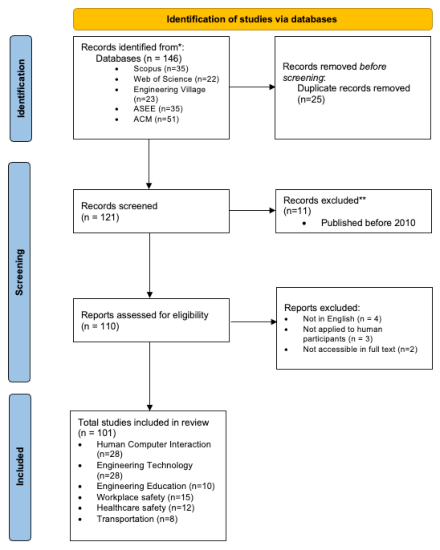
The selection process proceeded through four phases. The initial database search identified 146 articles across Scopus (35), Web of Science (22), Engineering Village (23), ASEE PEER (15), and ACM Digital Library (51). Temporal distribution analysis indicated that 114 articles were published after 2010, with 17 predating 2010. After removing duplicates, a total of 101 unique studies were retained for analysis.
For each selected article, detailed information was extracted, including bibliographic data, study design, sample size and participant characteristics, task types, measurement durations, eye-tracking and EDA metrics, data
1774 Gerard and Alarcón processing methods, statistical analyses, machine learning approaches, and validation procedures. This comprehensive documentation enabled systematic comparison and synthesis of methodological approaches and findings across studies.
The primary research question guiding this review was: RQ: To what extent can combined eye-tracking and electrodermal activity measurements serve as reliable indicators of cognitive load and fatigue in undergraduate learning within computing and engineering contexts?
Table 1: Search query.
Table available in the original PDF paper.
Database Search Protocol
1. Scopus 2. Web of Science 3. Engineering Village 4. ACM Digital Library
Search Query: ((“eye track*” OR “eye-track*” OR “eye movement*” OR “gaze track*” OR “gaze pattern*”) AND (“electrodermal activity” OR “EDA” OR “galvanic skin response” OR “GSR” OR “skin conductance” OR “SC” OR “electrodermal response”) AND (“cognitive load*” OR “mental load*” OR “mental workload” OR “cognitive workload” OR “cognitive demand*” OR “mental fatigue” OR “cognitive effort”) This systematic review adhered to a structured methodology for identifying, evaluating, and synthesizing relevant research on eye-tracking and EDA integration for cognitive load and mental fatigue assessment. The review followed the PRISMA (Preferred Reporting Items for Systematic Reviews and Meta-Analyses) guidelines to ensure transparency and comprehensiveness in reporting methods and findings (Page et al., 2021). Searches were conducted across five major academic databases: Scopus, Web of Science, Engineering Village, ASEE PEER, and ACM Digital Library, as summarized in Table 1.
Table 2: Inclusion and exclusion criteria.
Table available in the original PDF paper.
Inclusion Criteria Exclusion Criteria
Published before 2010
Used only one measurement modality
Published between 2010 and 2025
Written in English
Peer-reviewed journal articles, conference
(either eye tracking or EDA alone)
Not peer-reviewed (e.g., preprints, thesis
proceedings, or book chapters
Focused on cognitive load and/or mental
dissertations)
Presented only theoretical frameworks
fatigue assessment
Applied to human subjects
Focus on engineering and/or computing
without empirical validation
Focused on non-human subjects
Were duplicates across databases
Had insufficient methodological details
Not accessible in full text The selected databases were chosen due to their comprehensive coverage of research areas including computer science, engineering, psychology, and human -computer interaction. ASEE PEER was specifically incorporated to ensure the inclusion of engineering education studies that employ physiological measures to investigate student learning processes. The search strategy employed a carefully constructed query combining key terms associated with eye tracking,
The Integration of Eye Tracking and Electrodermal Activity Measures 1775 electrodermal activity, cognitive load, and cognitive fatigue. This carefully designed search string aimed to maximize the retrieval of relevant studies while minimizing the capture of unrelated publications.
Data extraction involved a detailed assessment of the measurement technologies and specifications employed in each study. For eye-tracking assessments, information was recorded regarding the type of eye tracker used (remote versus head-mounted), sampling rates, calibration procedures, and the specific metrics obtained, including fixation duration, saccadic velocity, pupil diameter variations, and blink frequency. For EDA measurements, details captured included sensor type, placement location, sampling frequency, and derived parameters such as skin conductance level, phasic skin conductance responses, and response latency. Collecting this technical information was essential for evaluating the reliability and comparability of results across studies.
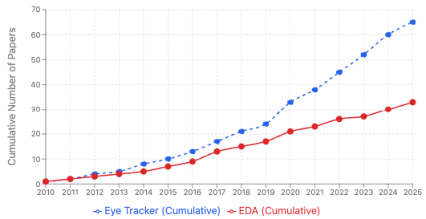
Figure 1: Cumulative papers of eye tracking and electrodermal activity (*as of May 31, 2025).Figure 2: PRISMA flow.
1776 Gerard and Alarcón The review also critically examined how studies managed common methodological challenges inherent in multimodal physiological measurements. Key considerations included the synchronization of eye- tracking and EDA data streams, strategies for handling missing data or signal artifacts, control of environmental factors (such as lighting conditions affecting pupil measurements or ambient temperature influencing skin conductance), and normalization techniques to account for individual differences.
A quality assessment was performed for each included study using a structured framework that examined methodological rigor, adequacy of sample size, control of potential confounding variables, suitability of data analysis techniques, interpretation of results, and acknowledgment of study limitations. This systematic appraisal was designed to ensure the reliability and validity of the findings incorporated into the review. The framework was adapted from the Critical Appraisal Skills Programme (CASP) checklist (Singh, 2013), with tailored modifications to accommodate studies employing multimodal physiological measurements.
FINDINGS The findings of this systematic review underscore both the promise and the challenges associated with integrating eye-tracking and electrodermal activity (EDA) measures for cognitive state assessment. The observed improvements in assessment accuracy when combining these modalities indicate a fundamental complementarity, as each captures distinct aspects of cognitive processing.
A notable trend in the literature is the adoption of increasingly sophisticated data integration techniques, particularly machine learning approaches, reflecting both technological advancement and a deeper understanding of the relationships between physiological signals and cognitive states. However, this progression also raises important questions regarding interpretability and practical implementation in real-world environments.
Analysis of the 101 included studies revealed several consistent patterns in the combined use of eye-tracking and EDA for evaluating cognitive load and mental fatigue. Over the past decade, there has been a clear evolution in both the technological methodologies employed and the theoretical frameworks underpinning these studies.
Three primary methodological approaches were identified for integrating these measurements. The first involved parallel analysis, wherein eye- tracking and EDA data were collected and analyzed separately before synthesizing the results. The second approach utilized real-time data fusion, integrating signals at the measurement level. The third approach leveraged machine learning algorithms to simultaneously identify patterns across both modalities. Recent research (2020–2025) demonstrates a clear shift toward the latter, with growing sophistication in integration techniques.
Regarding specific physiological metrics, pupil dilation emerged as the most robust eye-tracking indicator of cognitive load, with 78% of studies reporting significant correlations between pupil size and task difficulty. Blink rate and
The Integration of Eye Tracking and Electrodermal Activity Measures 1777 fixation duration also consistently reflected mental fatigue, particularly during sustained attention tasks. For EDA, phasic skin conductance responses (SCRs) provided the most reliable indicators of cognitive stress, while tonic skin conductance level (SCL) captured cumulative mental fatigue.
Emerging literature highlights the application of multimodal physiological measures in engineering education, with researchers advocating for integrated approaches to support learning in engineering and computing (Villanueva Alarcón et al., 2023). EDA has been employed to monitor student emotions during programming tasks, while virtual reality applications demonstrate improvements in working memory performance through EDA-based adaptation (Chiossi et al., 2023). Advanced multimodal frameworks, combining EEG and eye tracking, are increasingly developed for attention state detection in virtual learning environments (Chiossi et al., 2024), indicating promising directions for educational technology. Temporal dynamics of measurements were found to be critical. EDA responses typically lagged 1–3 seconds behind eye-tracking metrics, highlighting the importance of temporal alignment for accurate real-time monitoring and adaptive system design. Application context also influenced measurement effectiveness. In educational technology, combined metrics accounted for up to 51% of variance in learning performance (Dubovi, 2022), whereas workplace safety studies demonstrated early detection of fatigue, with prediction accuracies exceeding 85% for critical task failures.
Machine learning approaches have increasingly been adopted for data integration in recent studies (2020–2025), particularly deep learning models capable of handling temporal aspects of physiological signals. These approaches offer greater robustness against individual differences and environmental variability compared to traditional statistical methods.
Finally, the review indicates a trend toward standardized measurement protocols, suggesting a maturing field, though methodological variability remains. Different application domains have developed specialized strategies: educational technology studies emphasize real-time adaptation of content delivery, while workplace safety research prioritizes early fatigue detection.
CONCLUSION
This systematic review highlights the evolving integration of multimodal physiological measurements for cognitive assessment, illustrating substantial advances in combining eye-tracking and electrodermal activity (EDA) metrics alongside ongoing implementation challenges. Analysis of 101 studies demonstrates a clear methodological progression, from parallel analyses toward sophisticated machine learning - based integration systems. Recent studies (2020–2025) show notable improvements in data fusion techniques and real-time processing capabilities. The evidence supports the complementary nature of these modalities, with pupil dilation identified as the most reliable indicator of cognitive load reported as significant in 78% of studies - while skin conductance responses provide robust markers of cognitive stress.
1778 Gerard and Alarcón Multimodal approaches consistently outperform single-modality measures, explaining up to 51% of variance in learning performance and achieving prediction accuracies exceeding 85% for fatigue detection. However, the 1 - 3 second temporal lag between EDA and eye-tracking responses must be carefully accounted for in real-time monitoring applications. The field’s maturation is reflected in emerging standardized measurement protocols and successful, domain-specific implementations, particularly in educational technology and workplace safety.
Future Work
Future research should address several critical gaps highlighted by this review, particularly the development of robust data fusion algorithms capable of managing the temporal misalignment between eye-tracking and EDA signals observed across studies. The establishment of standardized protocols for multimodal measurement is essential, considering individual variability in physiological responses, environmental influences on sensor accuracy, and the translation of laboratory findings into real-world contexts. Longitudinal investigations are especially needed to examine how these physiological measures reflect cognitive state changes over extended periods, as most current studies focus on short-term assessments.
Moreover, the increasingly sophisticated machine learning techniques adopted in recent research (2020–2025) require careful evaluation of interpretability - accuracy trade-offs. Black-box models may hinder practical implementation in safety-critical applications where understanding the rationale behind cognitive state assessments is crucial. Advancements in wearable sensor technology offer opportunities for continuous monitoring in naturalistic environments, but they also introduce ethical and privacy considerations, particularly in workplace and educational settings where persistent physiological tracking may raise concerns regarding surveillance and autonomy.
Limitations Several limitations of this review warrant consideration. First, by restricting the analysis to English-language publications, relevant research published in other languages may have been excluded, potentially narrowing the global perspective on this topic. The rapid advancement of measurement technologies also implies that findings from earlier studies may not fully represent current capabilities. Moreover, the diversity in study designs and reporting practices posed challenges for direct comparisons across studies. The review was deliberately confined to research explicitly combining eye- tracking and EDA measurements, which may have overlooked valuable insights from single-modality investigations. Finally, potential publication bias could have influenced the available literature, possibly leading to an overrepresentation of studies reporting positive results.
REFERENCES
Alshanskaia, E. I., Portnova, G. V., Liaukovich, K., & Martynova, O. V. (2024).
Pupillometry and autonomic nervous system responses to cognitive load and false feedback: an unsupervised machine learning approach. Frontiers in Neuroscience, 18, 1445697. Appel, T., & Leifheit, L. (2024, June). Fluid Intelligence and Mental Effort during Block Programming: What the Eyes Can Tell Us. In Proceedings of the 2024 Symposium on Eye Tracking Research and Applications (pp. 1–6). Arksey, H., & O’malley, L. (2005). Scoping studies: towards a methodological
framework. International journal of social research methodology, 8(1), 19–32. Asghar, M., Sorby, S. A., Reid, C., & Raju, G. (2024). Eye-Tracking Analysis of Problem-Solving Behavior in Design Tasks in Undergraduate Engineering: A Comparison of High and Low Spatial Visualizers. 2024 ASEE Annual Conference & Exposition, Portland, Oregon. Balters, S., & Steinert, M. (2017). Capturing emotion reactivity through physiology
measurement as a foundation for affective engineering in engineering design science and engineering practices. Journal of Intelligent Manufacturing, 28(7), 1585–1607. Chiossi, F., El Khaoudi, Y., Ou, C., Sidenmark, L., Zaky, A., Feuchtner, T., & Mayer, S. (2024). Evaluating Typing Performance in Different Mixed Reality Manifestations using Physiological Features. Proceedings of the ACM on Human- Computer Interaction, 8(ISS), 377–406. Chiossi, F., Turgut, Y., Welsch, R., & Mayer, S. (2023). Adapting Visual Complexity
Based on Electrodermal Activity Improves Working Memory Performance in Virtual Reality. Proceedings of the ACM on Human-Computer Interaction, 7(ISS), Article 604. Cohen, J. (2016). A power primer. Darejeh, A., Marcusa, N., Mohammadi, G., & Sweller, J. (2024). A critical analysis of cognitive load measurement methods for evaluating the usability of different types of interfaces: guidelines and framework for Human-Computer Interaction. arXiv preprint arXiv:2402.11820. Dubovi, I. (2022). Cognitive and emotional engagement while learning with VR: The
perspective of multimodal methodology. Computers & Education, 183, 104495. Gao, Q., Wang, Y., Song, F., Li, Z., & Dong, X. (2013). Mental workload measurement for emergency operating procedures in digital nuclear power plants. Ergonomics, 56(7), 1070–1085. Gergelyfi, M., Jacob, B., Olivier, E., & Zénon, A. (2015). Dissociation between
mental fatigue and motivational state during prolonged mental activity. Frontiers in behavioral neuroscience, 9, 176. Gündoğdu, S., Çolak, Ö. H., Doğan, E. A., Gülbetekin, E., & Polat, Ö. (2021).
Assessment of mental fatigue and stress on electronic sport players with data fusion. Medical & Biological Engineering & Computing, 59(9), 1691–1707. Herlambang, M. B., Cnossen, F., & Taatgen, N. A. (2021). The effects of intrinsic motivation on mental fatigue. PloS one, 16(1), e0243754. Herlambang, M. B., Taatgen, N. A., & Cnossen, F. (2019). The role of motivation as
a factor in mental fatigue. Human factors, 61(7), 1171–1185. Keur-Huizinga, L., Kramer, S. E., de Geus, E. J., & Zekveld, A. A. (2024). A Multimodal Approach to Measuring Listening Effort: A Systematic Review on the Effects of Auditory Task Demand on Physiological Measures and Their Relationship. Ear and Hearing, 45(5), 1089–1106.
1780 Gerard and Alarcón Klepsch, M., & Seufert, T. (2020). Understanding instructional design effects by
differentiated measurement of intrinsic, extraneous, and germane cognitive load. Instructional Science, 48(1), 45–77. Krebs, R., Momm, C., & Kounev, S. (2012, June). Metrics and techniques for quantifying performance isolation in cloud environments. In Proceedings of the 8th international acm sigsoft conference on quality of software architectures (pp. 91–100). Lee, G. I., & Neumeister, M. W. (2020). Pain: pathways and physiology. Clinics in
plastic surgery, 47(2), 173–180. Lemke, U., & Besser, J. (2016). Cognitive load and listening effort: Concepts and age-related considerations. Ear and Hearing, 37, 77S–84S. Levac, D., Colquhoun, H., & O’brien, K. K. (2010). Scoping studies: advancing the
methodology. Implementation science, 5, 1–9. Lohani, M., Payne, B. R., & Strayer, D. L. (2019). A review of psychophysiological measures to assess cognitive states in real-world driving. Frontiers in human neuroscience, 13, 57. Lorist, M. M., Boksem, M. A., & Ridderinkhof, K. R. (2005). Impaired cognitive
control and reduced cingulate activity during mental fatigue. Cognitive brain research, 24(2), 199–205. Singh, J. (2013). Critical appraisal skills programme. Journal of pharmacology and Pharmacotherapeutics, 4(1), 76–76. Sun, L., Guo, Z., Yuan, X., Wang, X., Su, C., Jiang, J., & Li, X. (2022). An investigation
of the effects of brain fatigue on the sustained attention of intelligent coal mine VDT operators. International journal of environmental research and public health, 19(17), 11034. Sweller, J. (1988). Cognitive load during problem solving: Effects on learning.
Cognitive science, 12(2), 257–285. Toplak, M. E., Sorge, G. B., Benoit, A., West, R. F., & Stanovich, K. E. (2010).
Decision-making and cognitive abilities: A review of associations between Iowa Gambling Task performance, executive functions, and intelligence. Clinical psychology review, 30(5), 562–581. Vanneste, P., Raes, A., Morton, J., Bombeke, K., Van Acker, B. B., Larmuseau, C., ... & Van den Noortgate, W. (2021). Towards measuring cognitive load through multimodal physiological data. Cognition, Technology & Work, 23(3), 567–585. Villanueva Alarcón, I., Anwar, S., & Atiq, Z. (2023). How multi-modal approaches
support engineering and computing education research. Australasian Journal of Engineering Education, 28(2), 124–139. Wang, J., Fu, E. Y., Ngai, G., Leong, H. V., & Huang, M. X. (2019, April). Detecting stress from mouse-gaze attraction. In Proceedings of the 34th ACM/SIGAPP symposium on applied computing (pp. 692–700). Wang, L. M., Duffy, V. G., & Du, Y. (2007). A composite measure for the evaluation
of mental workload. In Digital Human Modeling: First International Conference on Digital Human Modeling, ICDHM 2007, Held as Part of HCI International 2007, Beijing, China, July 22–27, 2007. Proceedings 1 (pp. 460–466). Springer Berlin Heidelberg. Yousefi, M. S., Reisi, F., Daliri, M. R., & Shalchyan, V. (2022). Stress Detection Using Eye Tracking Data: An Evaluation of Full Parameters. IEEE Access, 10, 118941–118952.
SEARCH THE AHFE DIGITAL BOOKSTORE BY ISBN
Explore the complete digital volume
Human Factors in Design, Engineering, and Computing
Read this individual research paper free through the original publisher, or explore the full digital proceedings book.