Jari Jussila, Andreea Cotoranu, John Cronin, Markku Mikkonen (2026). From Water Quality Data to Sustainable Innovation: Designing Learning Ecosystems for Systemic Transformation. In: Human Factors in Design, Engineering, and Computing. AHFE Open Access, vol. 238, pp. 1951–1961. https://doi.org/10.54941/ahfe1008423
This paper presents design principles and a transferable model for developing sustainability-oriented learning ecosystems that connect emerging technologies, business relevance, public engagement, and international collaboration. Sustainability challenges are often addressed as stand-alone educational assignments, despite requiring engagement with complex socio-technical systems involving data infrastructures, governance, stakeholders, communities, values, and organizational decision-making. The study examines how learning ecosystems can be intentionally configured to support systemic transformation while developing students’ capabilities in systems thinking, stakeholder engagement, responsible innovation, and cross-institutional collaboration. Using an Action Design Research approach, the paper reports the iterative development of a learning ecosystem built around the “Right to Know H2O” challenge, which focuses on access to, interpretation of, and action based on real-time water quality information. The learning ecosystem connects student teams, university-based innovation hubs, domain experts, mobility activities, and public-facing communication mechanisms. Building on insights from three iterative design cycles, the paper articulates nine design principles that synthesize into a transferable model for organizing sustainability-oriented learning ecosystems. The model comprises three interrelated components – challenge configuration, ecosystem amplification, and codification and assessment – that together provide practical and theoretically informed guidance for universities and partner organizations seeking to organize learning around authentic sustainability challenges. The study contributes transferable design knowledge for organizing learning ecosystems that integrate emerging technologies while generating stakeholder value, societal relevance, and learning experiences that extend beyond conventional course boundaries.
Universities are increasingly expected to act as change agents for sustainability transformation, yet many higher education practices still address sustainability through relatively narrow curricula, isolated courses and strict disciplinary orientation (Friman et al., 2021; Salminen et al., 2024). Recent research argues that sustainability education needs to move beyond fragmented content delivery toward educational ecosystems that connect learning with societal, economic, technological, environmental, and institutional systems (Leal Filho et al., 2019, 2018). Environmental issues such as water quality are therefore not only technical problems of measurement or classroom assignments. They involve infrastructures for monitoring, digital data systems, public authorities, laboratories, communities, policy frameworks, business opportunities, and questions of trust, interpretation, legitimacy, and value creation.
This creates a challenge for higher education. If sustainability challenges are framed as bounded course tasks, students may learn to produce competent academic outputs without encountering the systemic nature of the problem. Whole-institution, University 5.0, and transformative sustainability education perspectives instead emphasize co-creative collaboration, real- world projects, inter-organizational networks, and university–community interfaces (Carayannis and Morawska, 2023; Gamede et al., 2025; Trevisan et al., 2024). Such approaches suggest that sustainability education should enable students and institutions to sense, learn, and act from the perspective of the wider social-ecological system rather than from isolated organizational interests (Scharmer and Kaufer, 2013). Scharmer argues that individuals and institutions need to shift the quality of attention, awareness, and action from ego-system perspectives toward eco-system awareness (Kunnari et al., 2021).
When students engage with authentic challenges that are connected to external stakeholders and public-facing outcomes, they can develop capabilities that are more aligned with responsible innovation: systems thinking, stakeholder engagement, international collaboration, business awareness, and the ability to translate data into meaningful action.
However, there is still limited understanding of how higher education institutions can intentionally design such learning ecosystems in practice. This paper addresses this gap by examining how the Right-to-Know H20 challenge was developed as an educational ensemble around water quality data, stakeholder engagement, international collaboration, and public-facing innovation. The research question guiding the study is: How can higher education institutions design learning ecosystems that enable students to address complex socio-technical sustainability challenges through data, stakeholder engagement, international collaboration, and responsible innovation?
RESEARCH METHODOLOGY This study employs Action Design Research (ADR) to describe and theorize the development of a learning ecosystem for sustainability-oriented innovation (Sein et al., 2011). ADR is appropriate because the research
From Water Quality Data to Sustainable Innovation: Designing Learning Ecosystems 1953 objective is not only to observe an educational practice but also to design, intervene in, evaluate, and refine an artifact in a real-world setting. The ADR artifact is conceptualized as an educational ensemble, consistent with ADR’s notion of an ensemble artifact, rather than a single course, tool, or activity. It consists of the pedagogical structure, institutional partnerships, student project work, stakeholder interfaces, data and laboratory infrastructures, mobility arrangements, and public-facing communication mechanisms that together support learning for systemic sustainability transformation.
The methodological choice follows prior educational design research, ADR, and action design studies that treat educational innovations as emergent artifacts shaped through iterative cycles of design and use. Hustad and Olsen (2014) show that teaching frameworks for complex information systems topics can be developed through repeated cycles of design, intervention, evaluation, and refinement. Marjanovic (2016) demonstrates how ADR can guide educational innovation in authentic teaching settings, particularly when the artifact includes organizational and pedagogical arrangements rather than only digital tools. Guo et al. (2020) provide a useful precedent for redesigning digitally mediated learning environments to strengthen online learning community. El Idrissi et al. (2023) further demonstrate how ADR can be used to design responsible innovation training and to evaluate whether students develop reflective capabilities. Building on these studies, the present paper applies ADR to a sustainability challenge in which the educational artifact is shaped through interaction among institutions, students, stakeholders, data infrastructures, laboratories, and public engagement platforms.
The empirical setting is the Right-to-Know H20 challenge, which focuses on how real-time water quality information can be made meaningful and actionable for citizens, organizations, and communities. The educational model was developed collaboratively by the NYC Design Factory and the Gale Epstein Center for Technology, Policy and the Environment at Pace University in the United States and by HAMK Design Factory at Häme University of Applied Sciences in Finland. The collaboration initially began between the two Design Factory units, NYC Design Factory and HAMK Design Factory, and was subsequently expanded when the Gale Epstein Center became involved as an expert partner and introduced the Right- to-Know H20 challenge. The challenge was selected because it combines environmental relevance, data-intensive monitoring, public interpretation, stakeholder communication, and innovation potential. It therefore provided a suitable context for examining how sustainability education can move from stand-alone course assignments toward a wider learning ecosystem. The research was conducted through three ADR cycles, each generating empirical insight that informed the refinement of the educational ensemble and the progressive articulation of transferable design principles. Across these cycles, the artifact was progressively expanded from an international and interdisciplinary student co-creation project into a broader learning ecosystem involving expert partners, external networks, international mobility, public engagement, and the synthesis of lessons learned.
Data were generated as part of the design and intervention process rather than collected from a detached experimental setting. The materials included project documentation, stakeholder interactions, public communication
materials, and the evolving artifacts produced during the three cycles. The materials were analysed through iterative reflection on how they informed the design, implementation, and refinement of the learning ecosystem across the three ADR cycles. After each cycle, the research team examined what had been designed, how the design functioned in practice, what design tensions and opportunities emerged, and how the learning ecosystem should be refined in the next cycle. The analysis therefore focused on the relationship between the sustainability challenge, the educational arrangements, stakeholder engagement, and the evolving design principles for learning ecosystems.
Evaluation in this study was formative and design-oriented. Rather than assessing a completed intervention only at the end, the ADR process evaluated the artifact through its capacity to support authentic sustainability learning by fostering cross-institutional collaboration, stakeholder engagement, student meaning-making, and the translation of water-quality data into communicable innovation ideas. The quality of the research was strengthened by documenting design decisions across cycles, connecting empirical observations to prior ADR and sustainability education literature, and treating the learning ecosystem as an evolving artifact whose form changed in response to practical feedback and emerging opportunities. The methodological contribution of the study is therefore twofold: it documents the development of a sustainability-oriented learning ecosystem, and derives transferable design knowledge for higher education institutions seeking to organize learning around complex socio-technical sustainability challenges.
ADR PROCESS The Right-to-Know H20 learning ecosystem was developed through three iterative ADR cycles. The starting point was a concrete sustainability challenge: how real-time water quality information could be made meaningful and actionable for citizens, organizations, and communities. Poor water quality is a significant public health concern, as it is associated with increased disease burden and mortality linked to inadequate water, sanitation, and hygiene conditions (Wolf et al., 2023). These stakes motivated the design of a learning ecosystem in which students could address water quality transparency while developing systems thinking, stakeholder engagement, international collaboration, and responsible innovation competencies.
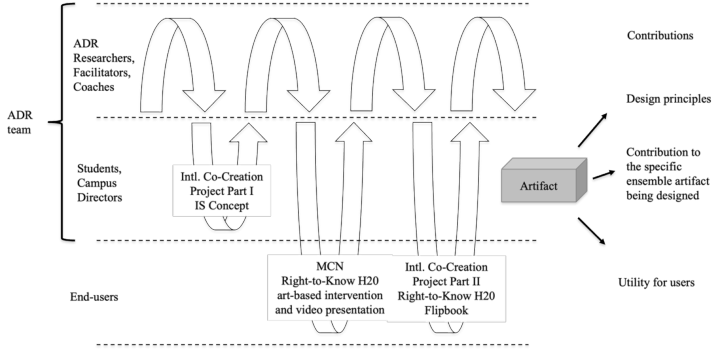
Across the ADR cycles, the artifact was treated as an educational ensemble rather than as a single teaching intervention. It combined the water quality challenge, challenge-based pedagogy, institutional collaboration between HAMK Design Factory, NYC Pace Design Factory, and the Gale Epstein Center for Technology, Policy and the Environment, student innovation work, expert input, mobility arrangements, public communication, and assessment mechanisms. Figure 1 illustrates the ADR process.
Figure 1: Researcher process used in the study (Adapted from Sein et al., 2011).
The research was executed in three ADR cycles, each of which expanded the educational ensemble and generated progressively richer design knowledge. The first cycle framed water quality transparency as an international student innovation challenge and focused on the development of a water quality alerting concept. The second cycle expanded the learning ecosystem through the Millennium Campus Network (MCN) and Erasmus+ KA171- supported mobility, enabling students to connect their project work with public engagement, laboratory environments, and international stakeholder contexts. The third cycle codified the learning process through final documentation, learning diaries, assessment, and an online flipbook that could support future course offerings.
FIRST ADR CYCLE The first ADR cycle transformed United Nations Sustainable Development Goal 6 – Clean Water and Sanitation (SDG6) from a broad sustainability theme into a concrete, data-oriented student innovation challenge. The collaboration originated through International Design Factory Week discussions between NYC Pace Design Factory and HAMK Design Factory and was strengthened when the Gale Epstein Center introduced the Right-to-Know H20 challenge. The cycle framed water quality data not merely as technical information but as a public-value resource involving citizens, authorities, laboratories, infrastructures, interpretation, trust, and potential service innovation. As a result, the learning artifact was configured as an educational ensemble that connected sustainability, data, technology, institutional collaboration, and student project work.
Second ADR Cycle The second ADR cycle amplified the learning ecosystem through external networks and international mobility. After students were accepted into the Millennium Fellowship and Erasmus+ KA171 funding was approved, the
project was connected to the MCN, Pace University contexts, laboratory and stakeholder environments, and public-facing communication requirements. Four HAMK students from the first cycle continued in the Fellowship and were joined by additional HAMK and Pace University students. The one-week mobility period in New York supported student teams in developing arts-based interventions and preparing a collective video presentation for the MCN. During the mobility week, selected museum visits in New York were also used to stimulate arts-based reflection on public engagement, interpretation, and the societal communication of sustainability challenges.
The design intention of the second cycle was to expose students to international, public-facing, and stakeholder-rich contexts. Arts-based methods were used to help students make values, tacit assumptions, and alternative perspectives visible in relation to the water quality challenge (Taylor and Ladkin, 2009; Scharmer and Kaufer, 2010). The cycle generated design knowledge about amplification mechanisms: external networks, mobility funding, stakeholder contexts, public presentations, and international collaboration can increase the authenticity, visibility, and reach of student work when deliberately connected to the learning design.
Third ADR Cycle The third ADR cycle codified the temporary project experience into assessment evidence and reusable learning material. After the MCN programme, HAMK students completed the university requirements for credits and grading by submitting a project flipbook, which served as the final report and documentation of the project, together with individual learning diaries. The project flipbook documented the SDG6 challenge, international collaboration, project solution, and supporting evidence, while the learning diaries made individual workload, reflection, and contribution visible for assessment.
The design intention of the third cycle was to transform project activity into institutional learning. The flipbook and learning diaries helped document the process, support fair credit allocation, and make the learning experience available for future course development. This cycle generated design knowledge about codification: learning ecosystems require mechanisms through which temporary project activities are documented, assessed, reflected upon, and reused.
RESULTS
The primary outcome of the ADR process is a set of nine design principles for constructing sustainability-oriented learning ecosystems around authentic socio-technical challenges. Rather than treating the Right-to-Know H20 case as a single educational intervention, the iterative development of the educational ensemble generated transferable design knowledge that can guide similar initiatives in other higher education contexts. The principles are organized according to the three phases of the ADR process: challenge-based configuration, ecosystem amplification, and codification and assessment. Table 1 summarizes the principles and their relationship to the ADR cycle.
Table 1: Design principles for sustainability-oriented learning ecosystems derived from the ADR cycles.
Begin learning ecosystem design from a concrete socio- technical sustainability challenge rather than from predefined course content.
DP2 Cycle 1: challenge configuration
Treat data as a socio-technical and public-value resource, not only as technical information.
DP3 Cycle 1: challenge configuration
Configure sustainability learning as an educational ensemble rather than as a single course, tool, or activity.
DP4 Cycle 2: ecosystem amplification
Connect students with real stakeholders and external networks that provide expertise, legitimacy, feedback, and dissemination pathways.
DP5 Cycle 2: ecosystem amplification
Use international collaboration and mobility as amplification mechanisms that broaden students’ interpretation of the sustainability challenge.
DP6 Cycle 2: ecosystem amplification
Build contingent pathways that allow external opportunities to be integrated into the learning ecosystem when they become available.
DP7 Cycle 3: codification and assessment
Embed public-facing outputs into the learning process so that student work has relevance beyond academic assessment.
DP8 Cycle 3: codification and assessment
Codify temporary project experiences into reusable learning resources that support institutional memory and future course development.
DP9 Cycle 3: codification and assessment
Design assessment mechanisms that make individual contribution, workload, and evidence-based learning visible within collective ecosystem projects.
The nine design principles constitute the central design knowledge generated through the ADR process. Together they describe how universities can intentionally configure, expand, and sustain learning ecosystems around authentic sustainability challenges. Rather than functioning as independent recommendations, the principles synthesize into a transferable model consisting of three mutually reinforcing components that mirror the progression of the ADR process.
The first component, challenge configuration (DP1–DP3), establishes the sustainability challenge as the organizing logic of the learning ecosystem. Rather than beginning with predefined course content, learning is organized around an authentic socio-technical problem that connects data, challenge- based pedagogy, institutional collaboration, expert knowledge, and student innovation activities. In the Right-to-Know H20 case, SDG6 and water quality transparency provided the shared context through which students engaged with systems thinking, responsible innovation, and public value creation.
The second component, ecosystem amplification (DP4–DP6), extends learning beyond the initial course environment by intentionally connecting students with external programmes, stakeholder organizations, international mobility, public engagement, and laboratory environments. The Millennium
Fellowship (MCN) and Erasmus+ KA171-supported mobility were not supplementary activities but integral elements of the educational design that increased the authenticity, visibility, and societal reach of student work while exposing students to diverse institutional and cultural perspectives. The principles also highlight the importance of maintaining flexibility so that emerging opportunities can be incorporated into the evolving learning ecosystem.
The third component, codification and assessment (DP7–DP9), transforms temporary project experiences into reusable educational knowledge. Public-facing outputs, project documentation, reflective learning artifacts, and assessment mechanisms preserve institutional learning while making individual contributions visible within collaborative projects. In the Right- to-Know H20 case, this challenge became particularly important because participation in the Millennium Fellowship did not itself provide academic credit. To address this, the Fellowship activities were aligned with HAMK’s competence-based curriculum, and assessment was designed to recognize both collective ecosystem participation and individual evidence of learning. Students’ final evaluation combined the project flipbook as the collective project outcome, individual learning diaries documenting workload, reflection, and contribution, and participation in meetings, stakeholder interactions, teamwork, and international collaboration. Rather than serving only as a grading mechanism, assessment became part of the learning ecosystem itself by translating authentic ecosystem participation into documented educational achievement while creating resources that support future course development.
The Right-to-Know H20 case illustrates how these three components operate together. Throughout the ADR process, water quality data functioned as a boundary object that connected environmental monitoring, digital infrastructures, laboratories, citizens, public authorities, universities, international networks, and students’ innovation work. Rather than reducing the challenge to either a technical measurement problem or a conventional classroom assignment, the shared focus on water quality enabled students and institutional partners to collaborate around interpretation, trust, communication, decision support, public value, and service innovation within a common learning ecosystem.
The resulting model suggests that sustainability-oriented learning becomes more transformative when students are positioned within an ecosystem of actors, infrastructures, institutional partnerships, programmes, and communication channels rather than within an isolated course assignment. In such settings, learning extends beyond producing project deliverables to include interpreting complex data, understanding system relationships, negotiating stakeholder expectations, communicating public value, justifying decisions with evidence, and considering how technological and service innovations influence communities and organizational decision-making. The model therefore demonstrates how educational design can intentionally connect challenge-based learning, institutional partnerships, stakeholder engagement, international collaboration, assessment practices, and public communication into learning ecosystems that support both student learning and systemic sustainability transformation.
CONCLUSION
This study contributes transferable design knowledge for intentionally designing sustainability-oriented learning ecosystems through ADR. Like prior educational ADR work (El Idrissi et al., 2023; Guo et al., 2020; Marjanovic, 2016), the value of the study lies in theorizing from a situated intervention toward more generalizable design knowledge while preserving the practical conditions that enable the intervention.
The main theoretical implication is that sustainability-oriented learning ecosystems should be understood as configurable socio-technical arrangements rather than as extensions of existing course formats. This reframes educational design from the question of how sustainability content can be incorporated into teaching toward the question of how institutions can intentionally organize actors, infrastructures, data, mobility, assessment, and communication around a shared transformation challenge. In this sense, the study extends prior sustainability education literature (Friman et al., 2021; Leal Filho et al., 2019, 2018) and educational ADR research (El Idrissi et al., 2023; Guo et al., 2020; Marjanovic, 2016) by demonstrating that an educational artifact may consist of an evolving constellation of pedagogical, organizational, technical, and public-facing elements rather than a single course design, digital platform, or classroom intervention.
For educational practice, the study suggests that the central design task is not only to provide students with authentic projects, but to create the conditions under which such projects can accumulate educational, stakeholder, and societal value over time. This requires identifying mechanisms for connecting student work to external expertise, public communication, international collaboration, and institutional learning. It also requires designing assessment practices that recognize both collective ecosystem participation and individual contribution. These implications are particularly relevant for universities seeking to act as catalysts for sustainability transformation, because their educational impact increasingly depends on their ability to connect learning with wider systems of knowledge production, civic engagement, and responsible innovation.
The findings also indicate important boundary conditions. The model is most applicable when a sustainability challenge can be connected to data, stakeholders, public value, and institutional partners. It also benefits from staff capacity to coordinate across organizational boundaries and from flexible structures that allow external opportunities to be incorporated as they emerge. In the present case, HAMK Design Factory, Pace University NYC Design Factory, the Design Factory Global Network, the Gale Epstein Center, the Millennium Campus Network, and Erasmus+ KA171 funding created favourable conditions for experimentation. These conditions strengthened the intervention, but they also mean that the model should be adapted rather than copied directly in contexts with fewer networks, limited funding, or more rigid curricula.
Several limitations should be acknowledged. First, the study is based on one practice-based ADR case developed within a specific institutional and pedagogical setting. Second, student participation in the second cycle was shaped by external selection into the Millennium Fellowship, which may
have influenced motivation, commitment, and the quality of outcomes. Third, the evaluation was formative and design-oriented rather than based on comparative measurement of learning outcomes. Future studies should therefore examine how similar ecosystem-based models function with broader student groups, different disciplinary settings, alternative sustainability challenges, and more systematic evidence of competence development over time.
In conclusion, the study argues that sustainable systemic transformation in higher education requires more than authentic assignments or interdisciplinary projects. It requires deliberately designed learning ecosystems in which students, teachers, institutional partners, data infrastructures, mobility mechanisms, assessment practices, and public communication are connected around a shared sustainability challenge. By applying ADR to the Right- to-Know H20 case, the study shows how such ecosystems can be built iteratively and how transferable design knowledge can be derived from their design and use. The broader contribution is a practice-based account of how universities can design educational arrangements that move students from data interpretation toward stakeholder value, responsible innovation, and societal impact.
REFERENCES
Carayannis, E.G., Morawska, J., 2023. University and Education 5.0 for Emerging Trends, Policies and Practices in the Concept of Industry 5.0 and Society 5.0, in: Machado, C.F., Davim, J.P. (Eds.), Industry 5.0. Springer International Publishing, Cham, pp. 1–25. https://doi.org/10.1007/978-3-031-26232-6_1 El Idrissi, S.C., Corbett, J., Mellouli, S., 2023. An action design research study on
responsible innovation teaching and training for information systems students. Communications of the Association for Information Systems 53, 728–750. Friman, M., Schreiber, D., Mutanen, A., Perälä, S., Salminen, J., 2021. Wicked problems: University research topic convergence despite divergence in local educational and innovation policies. International Journal of Sustainability in Higher Education 22, 108–124. Gamede, N., Munsamy, M., Telukdarie, A., 2025. Unpacking Key Systems Towards
a Sustainable Education Ecosystem. Sustainability 18, 282. Guo, Z., Leong, C., Zhou, Y.V., Lee, B.K., Monson, D.M., 2020. Turning Lemons into Lemonade: Designing Remote Teaching to Foster a Sense of Online Learning Community through Action Design. Hustad, E., Olsen, D.H., 2014. Educating reflective Enterprise Systems practitioners:
A design research study of the iterative building of a teaching framework. Information Systems Journal 24, 445–473. https://doi.org/10.1111/isj.12032 Kunnari, I., Tuomela, V., Jussila, J., 2021. Teacher-facilitators’ job-crafting: Making meaning and relevance in authentic learning environments. International Journal of Management, Knowledge and Learning 10, 115–126. Leal Filho, W., Raath, S., Lazzarini, B., Vargas, V.R., de Souza, L., Anholon, R.,
Quelhas, O.L.G., Haddad, R., Klavins, M., Orlovic, V.L., 2018. The role of transformation in learning and education for sustainability. Journal of cleaner production 199, 286–295.
From Water Quality Data to Sustainable Innovation: Designing Learning Ecosystems 1961 Leal Filho, W., Shiel, C., Paço, A., Mifsud, M., Ávila, L.V., Brandli, L.L., Molthan-Hill,
P., Pace, P., Azeiteiro, U.M., Vargas, V.R., 2019. Sustainable development goals and sustainability teaching at universities: Falling behind or getting ahead of the pack? Journal of cleaner production 232, 285–294. Marjanovic, O., 2016. Designing innovative education through action design research: Method and application for teaching design activities in large lecture environments. Journal of Information Technology Theory and Application 17, 1. Salminen, J., Friman, M., Mikkonen, K., Mutanen, A., 2024. Higher education
of sustainable food systems: A literature review. International Journal of Sustainability in Higher Education 25, 358–377. Scharmer, O., Kaufer, K., 2010. In front of the blank canvas: sensing emerging futures. Journal of Business Strategy 31, 21–29. Scharmer, O., Kaufer, K., 2013. Leading from the emerging future: From ego-system
to eco-system economies. Berrett-Koehler Publishers. Sein, M.K., Henfridsson, O., Purao, S., Rossi, M., Lindgren, R., 2011. Action Design Research. MIS quarterly 35, 37–56. Taylor, S.S., Ladkin, D., 2009. Understanding Arts-Based Methods in Managerial
Development. AMLE 8, 55–69. https://doi.org/10.5465/amle.2009.37012179 Trevisan, L.V., Leal Filho, W., Pedrozo, E.A., 2024. Transformative organisational learning for sustainability in higher education: A literature review and an international multi-case study. Journal of Cleaner Production 447, 141634. Wolf, J., Johnston, R.B., Ambelu, A., Arnold, B.F., Bain, R., Brauer, M., Brown, J.,
Caruso, B.A., Clasen, T., Colford, J.M., 2023. Burden of disease attributable to unsafe drinking water, sanitation, and hygiene in domestic settings: A global analysis for selected adverse health outcomes. The Lancet 401, 2060–2071.
SEARCH THE AHFE DIGITAL BOOKSTORE BY ISBN
Explore the complete digital volume
Human Factors in Design, Engineering, and Computing
Read this individual research paper free through the original publisher, or explore the full digital proceedings book.