Mark Miller, Sam Holley, Aric Raus (2026). Integrating Human Factors With Safety Risk Management Through the Bowtie Analysis: Forming a Commercial Pilot Mental Health Risk Management System. In: Human Factors in Design, Engineering, and Computing. AHFE Open Access, vol. 238, pp. 1828–1838. https://doi.org/10.54941/ahfe1008411
Commercial pilot mental health has become a complicated issue in the United States. While a portion of the pilot population would like to seek help openly with their ongoing mental health problems, many of those pilots are unwilling to seek the help due to the risk it poses in jeopardizing their pilot careers. While pilots with current mental health issues are unwilling to visibly gain the help they need, many other pilots are potentially borderline dealing with oncoming mental issues due to being under tremendous pressure with fatigue and stress issues underlying their performance. The Federal Aviation Administration (FAA) has recently addressed the issue, but the FAA, the airlines, the pilots’ union and the pilots are still hard pressed to come up with a working solution. The researchers propose that such a complex aviation safety issue infused with human factors (HF) should be analyzed from a different perspective of risk management (RM) and HF through a safety technique called the Bowtie method that is designed to both deal with prevention and reducing the consequences through RM. By integrating realistic prevention programs, the researchers complete a risk assessment (RA) of the preventative left side of the Bowtie. The researchers then integrate realistic recovery mitigations to reduce the consequences followed by the RA of the right side of the Bowtie. In both cases of RA on the prevention and recovery sides of the Bowtie analysis, both RA matrix and mathematical probability support the risk reduction. The safety RM analysis of the HF interventions through the Bowtie method proves that the complex problem of pilot mental health may not ever be 100 % resolved but instead can be adequately managed by RM HF interventions through the Bowtie method integrated into a pilot mental health RM Safety Management System (SMS).
Pilot mental health has garnered a great deal of attention in the US since Horizon Airlines Flight 2059 of October 2023 where off duty Alaskan Air pilot Joseph Emerson was riding in the cockpit jump seat and tried to pull the fire suppression handles to shut down the engines. The crew was able to subdue Emerson and safely land the aircraft in Portland, Oregon (Alaska Airlines, 2023). The incident prompted high level discussions in the US commercial industry about pilot mental health, and the issues pilots
Integrating Human Factors With Safety Risk Management 1829 have using the mental health resources available to them. On the regulatory side the FAA immediately launched widespread systematic reforms in an effort to stop the culture of silence involving pilots and mental health. To accomplish this the FAA immediately created a Mental Health Task Force rulemaking committee to identify and breakdown the causes of pilots not seeking care. The FAA quickly changed its policy to allow pilots to receive routine counselling and therapy without risking grounding or loss of medical certificates. The FAA also expanded its approved mental health medications for pilots to manage mild depression or anxiety while maintaining a licence. The FAA then increased institutional support and regulatory protections for airline managed peer support programs. This was soon followed by Congressional legislation in the form of the Mental Health in Aviation Act to make the changes in Federal Law of which the Act has passed the US House of Representatives in September 2025 but has yet to pass the US Senate. The goal of the Act is that it would mandate the FAA to rewrite the FAR Part 67 regulations and encourage voluntary reporting and treatment of pilot mental health issues without the pilots being afraid of loss of their license or grounding. It would also streamline the medical certification process for pilots to reduce back logs and reliance on lengthy mental health testing. A big break through from the legislation is that it would require the FAA to continuously update on a yearly basis new mental health treatments and medications. To ensure these relevant changes are brought to fruition the legislation supports the hiring of more FAA Medical Examiners through allocated funding. It also has a budgeted public awareness campaign to build trust between the pilots and regulators. While the two major goals of the Mental Health in Aviation Act are noteworthy in updating FAA pilot mental health policy and addressing the stigma that pilots have of losing their jobs for seeking mental health care, at the same time it will still be a very complex aviation safety HF problem that is merely just getting started to be resolved in the US airline industry. The European industry also started addressing the pilot mental health issue over a decade ago after the fateful Germanwings A320 crash in the Alps in 2015 that fatally injured all 150 on board when the first officer deliberately flew the plane into a mountain (CBS, 2015).
A NEW BEGINNING FOR PILOT MENTAL HEALTH IN US The pilot mental health legislation along with the long overdue FAA related changes are welcomed in US commercial aviation, but how do we ensure that this will be enough as the commercial industry in the US continues rapidly to expand while a pilot mental health incident or accident could still potentially occur. The reasoning behind this caution is that we see the pilot mental health problem in the US from the tip of the exposed iceberg in the form of one severe incident. But the rest of that substantial submerged iceberg that we fail to see related to pilot mental health in the US is a highly complex HF safety problem complicated by a slow regulatory progress, differences in organizational operations and cultures, and differences in what organizations have to offer the pilot with mental health needs. To add on to the problem it is estimated that close to 1 in 5 American adults suffer from some form of mental health issue (NIMH, 2022). It is therefore a proper assumption to make that commercial
pilots match this due to the high pressure demands of their jobs when fatigue, stress, anxiety and depression are considered. The other side of this is how complex each individual pilot mental issue can be. The individual pilot mental health issue is of utmost importance as the current industrial outlook portends to be predicated on pilots that are already predisposed to mental health issues. The system takes in little account for the pilot who could easily succumb to some form of mental health issue from working in the industry over time and other issues in private life possibly converging to exacerbate mental health. The most complicated part of the hidden iceberg is that with every pilot being different, many factors can and have prevented pilots from seeking mental health help. With such a large and complex HF safety problem, any current change that promotes progress is obviously welcomed, but at some point, the industry needs to figure out a way to manage the problem instead of reacting to it as more of the hidden iceberg is revealed.
The Fusion of HF and SMS/RM to Manage US Pilot Mental Health The current trend in aviation safety in the US is found in recently mandated SMS programs for the commercial industry. The FAA has mandated SMS for FAR Part 121 commercial operations since 2017 and recently has added both FAR Part 135 and Part 91 operations since 2024. For the commercial industry in the US this means that RM as a core pillar of SMS must be utilized to manage hazards. Meanwhile HF safety issues like pilot fatigue are encouraged to be managed in airlines by SMS tools like RM to form what are called Fatigue RM Systems. While these systems are in their early stage of development, they do lend insight to the potential of managing the risk of even more complicated HF issues like pilot mental health. To accomplish such a complex HF RM system in the future, the researchers propose using a safety analysis system that can first handle the amount of complexity related to pilot mental health problems in terms of both preventing the pilot mental health risk from causing an incident or accident while at the same time having the same RM level to reduce the consequences of a pilot mental health incident on the flight deck should it still occur. To accomplish this analysis the researchers chose the Bowtie risk assessment method of mapping causes and preventative controls to a central event related to a pilot mental health failure while also including recovery mitigation to reduce the consequences of a pilot mental health event (Saltegra, 2025).
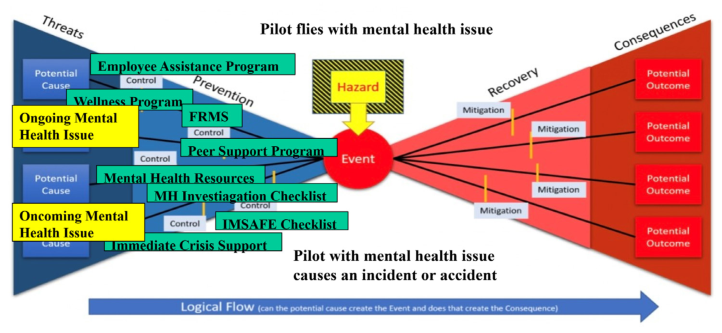
Pilot Mental Health Bowtie: Mapping the Hazard to Events and Threats Starting the analysis of pilot metal health means identifying the hazard and placing that hazard in Figure 1 in the middle of the diagram. For the purposes of the Bowtie analysis the hazard will be ‘The pilot flies with a mental health issue’. From that hazard an event could potentially occur from the range of a minimal incident to a severe incident, or an accident. In the worst case a fatal catastrophic accident like the Germanwings A320 crash in the Alps could occur. The idea behind this is to show the immediacy of the hazardous threat and then diffuse it first from the prevention side and then through reducing the consequences side of the event should it start to occur. The other value to the Bowtie is that while it works on diffusing the hazard at the same time it can take on a very complicated
Integrating Human Factors With Safety Risk Management 1831 problem and organize it for RM analysis purposes on both the prevention side and on the reducing the consequences side. Once the hazard and event with its potential severity are portrayed, the analysis using the Bowtie method then starts on the far left of the Bowtie by identifying the basic threats that could cause the hazard of a commercial pilot flying with a mental health issue. Although this could be many potential threats at the beginning of the Bowtie model, for purposes of the benefit of capturing a RM analysis throughout the Bowtie model, simplifying and categorizing the threats at the beginning of the model allows the power of both HF and RM to work together in the Bowtie analysis. Therefore, two threats will be identified at the beginning for entry on the left side of the Bowtie as causes in yellow in Figure 1: ‘pilots with an ongoing mental health issue’ and ‘pilots with a potential oncoming mental health issue arising in the future’. The two categories are important because currently most of the mental health stigma placed upon US commercial pilots is focused on pilots with ongoing mental health issues ranging from depression and anxiety to more complicated mental health issues like bipolar disorder, psychosis and personality disorders. While this ongoing threat entry into the Bowtie is complicated and depends on proper diagnosis, the other entry of pilots with potential oncoming mental health issue arising is also important even though it is not an immediate threat. This often-overlooked part of the pilot mental health puzzle simply needs to be accounted for as pilots in a demanding industry that is highly pressurized and profit driven can quickly be changed from pilots with good pilot mental health or a dormant mental health issue to pilots with mental health issues depending on many factors working in that pilot’s life. To ultimately account for the unknown mental health issues is the only way to gain a true HF risk analysis for a pilot mental health problem while the Bowtie accommodates both threat entries. It also advocates for proactive mental health wellness for the commercial pilot population which thrives on a demanding mission of delivering passengers and cargo safely to the destination. Advocating for pilot mental health awareness and wellness can produce a new educated attitude for the industry to continue to deliver passengers and cargo safely while ensuring that for every pilot’s mental health.
Figure 1: Pilot mental health Bowtie; threats and prevention. (Adopted from Saltegra, 2025).
Mental Health Bowtie: From Threat Causes to Preventative Controls With so much diversity at the root cause of the pilot mental health problem, the only solution is to have multiple prevention controls that can in some way match up with the different individual pilots’ issues and in a safe job protective way. For a system of this nature to work as a combined giant net to capture every pilot with a mental health problem or potential mental health problem, an assumption would have to be made that every preventative control program must meet a valid inspection level standard by the FAA at that airline. While this seems like a stretch for the FAA to manage keeping these preventative mental health programs at each airline up to an accountable and acceptable standard, it would be the only way to make such a RM lead model work. If the airline’s program meets the standard, then it can be used in the RM Bowtie model. If it does not meet the standard than it must be excluded from that airlines Bowtie model until it does meet the minimum standard. For purposes of this study eight reasonable programs are listed as prevention programs and each address a different mental health need. Employee Assistance Programs (EAPs) give free confidential support services to help pilots and other employees and families to handle personal, emotional and work challenges. Employee Wellness programs cover a broad spectrum of areas in physical, mental and emotional health, and can be a good resource in maintaining good mental health for pilots. While Fatigue RM systems seem to be separate issue from pilot mental health, extreme fatigue that can occur in airline pilots if left unmanaged can lead to serious physical health and mental health issues directly affecting cognition. Peer Support Programs directly allow others to help a pilot with mental health issues in a confidentially safe environment. While many of the programs garner a certain fit from each pilot’s mental health perspective, mental health resources for pilots might be the most versatile as it aims to educate all pilots on mental health. Mental health investigative checklists could prove invaluable for future prevention if an accident or incident being investigated involved a pilot mental health issue. From a preflight perspective perhaps, nothing could be more important than the IMSAFE checklist for each pilot to do a personal inventory of their mental health at that moment before going to fly. The last program to mention is an airline having a dedicated Immediate Crisis Support System where a pilot having a serious mental health issue can call for help. While there are certainly more types of mental health programs for the purpose of the Bowtie model demonstration the previous eight mentioned programs will suffice to show the power of multiple intervention programs working together to reduce the overall pilot mental health risk in an airline. It also assumes that all these programs if approved to the appropriate standard by the FAA would provide the pilots who use them job protection.
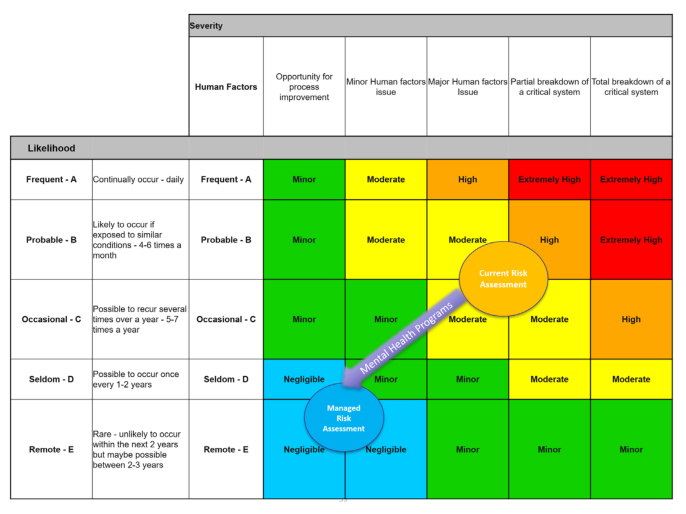
Preventative Control Interventions Managing the Mental Health Risk By asserting preventative controls all at an approved FAA level of compliant standard, the correct amount of pilot mental health related programs could reduce the risk in that airline through an RM process by reducing the current pilot mental health RA from what it was before standards were met to a much lower level of RA level demonstrated in Figure 2 in a HF-oriented RA
Integrating Human Factors With Safety Risk Management 1833 matrix. If a pilot made it to the flight deck with any mental health related problem, what would the RA be?
Figure 2: Commercial pilot HF mental health RA chart. (Adopted from SMS PRO, 2026).
The severity should be deemed borderline as a ‘Major Human Factors Issue’ or ‘High’ moving toward a ‘Breakdown of a critical system’ or ‘Extremely High’. If this was a major US airline with 17,000–18,000 active pilots, it would be feasible to assume from a conservative input that the likelihood of occurrence would be ‘Likely to occur if exposed to similar conditions 4–6 times a month’ and deemed ‘Probable’. As per Figure 2, the current RA marked by the orange circle would be on the border between ‘moderate’ and ‘high’. Adding the constructed acceptable amount of standard pilot mental health programs to the airline could realistically drive that RA down. As each distinct working program is attracting more of the pilots to match and meet their mental health needs, the managed RA for pilots with a mental health issue should fall into the ‘Minor’ or ‘Negligible’ range marked by the blue circle in Figure 2. This is made possible by greatly reducing the likelihood of a pilot with a mental health issue reaching the flight deck down to the ‘Seldom’ or ‘Remote’ range where the situation would occur once in 1 to 2 years or maybe once in 3 years range while reducing the overall Severity of the problem. While this seems apparent from the RA matrix in Figure 2 it is also supported through the means of basic mathematical probability that was used before RA matrix models became available. Assuming each company pilot mental health program meets an effective compliant level through the FAA to meet
that minimum standard, the conditional probability number that reduces is based on age, health and environment of each company pilot mental health program asset from 0–1 where: P(failure) = 1–P(success) P(tot) = P(1) × P(2) × P(3) × P(4) × P(5) × P(6) × P(7) × P(8)
Adding all the compliant programs to the airline, the P(success) factors multiply to increase the P(success) and make the probability of failure lower (TDS, 2026).
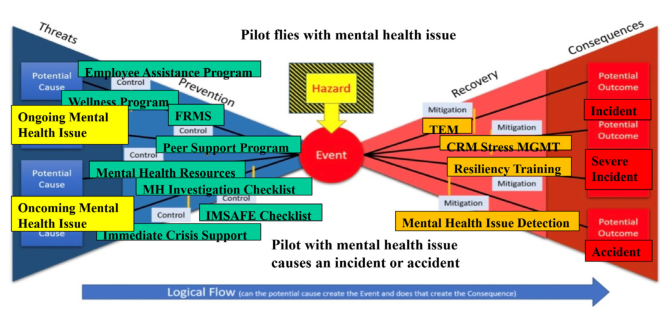
Adding a Reduce the Consequences Side to Complete the Bowtie While the left prevention side of the Bowtie allows for a clear risk reduction picture to preventing pilots with mental health issues from reaching the flight deck and causing the hazard of an incident, severe incident or an accident from occurring, is this good enough? Some safety experts might say that the risk of a pilot with a mental health problem has been reduced so much with the FAA compliant control programs the airline has created that the current risk is acceptable. While this may be true, adding the extra insurance on the right side of the Bowtie by reducing the consequences accounts for the plenitude of human errors that could still occur allowing a pilot with a mental health problem to still make it to the flight deck. This will also further reduce the overall risk. While the focus of the left side of the Bowtie is based on preventing threats with control programs, the focus on the right side of the Bowtie is reduction of the consequences through recovery mitigations (Hawkins, 1987). While these reduction mitigation programs are fewer than their counterparts on the left side of the Bowtie, they are equally important in case a pilot with a mental health issue still makes to the flight deck as a threat. Threat Error Management (TEM), Crew Resource Management (CRM) Stress Management, Resiliency Training and Mental Health Issue Detection, are all strong candidates to form a nucleus of CRM trained recovery mitigations for the right side of the Bowtie to reduce the consequences of a pilot with a mental health issue working on the flightdeck. The foundation must be laid with a legitimate TEM program integrated into CRM program at each airline. This would mean that not only a threat of mental health is briefed but also recognized in flight while reacting to it appropriately in terms of the immediate needs of safe flight. Along with this, Stress Management must become a legitimate part of the CRM program, and the CRM training must reflect that. To ensure this occurs the CRM program must have designed Resiliency Training integrated into its Line Operations Flight Training (LOFT) in the simulator so that crews can practice mental health scenarios and recovery techniques on the flight deck in a safe practice environment. Lastly, all airline pilots should be trained on detecting mental health issues amongst their constituency to gain a broader situational awareness of a potential pilot having a mental health issue and not just having a bad day.
Figure 3: Pilot mental health Bowtie recovery mitigations (Adopted from Saltegra, 2025).
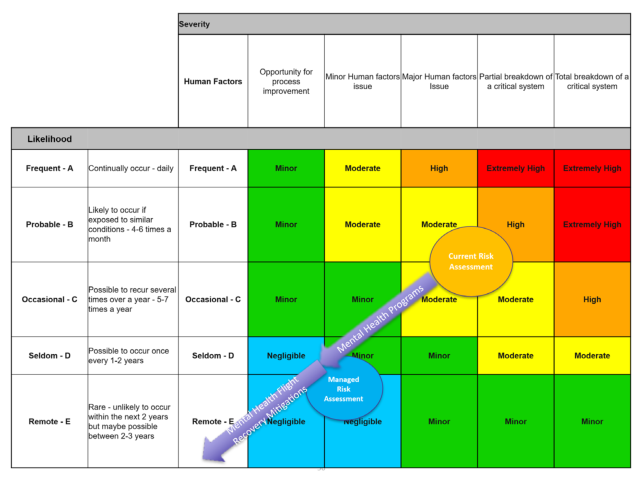
Adding Power of Reducing the Consequences to Risk Management Attaining the extra added power of reducing the consequences of a pilot with a mental health issue making it to the flight deck can now be gained through a well-designed airline CRM training program as each mitigation recovery element (TEM, CRM Stress management, Resiliency LOFT simulator training and Mental Health Issue Detection) shown in Figure 3 on the right side of the Bowtie should be integrated into every US airlines CRM training program. With all the pilot mental health related recovery elements embedded in the airline’s CRM training program, the FAA could set national compliant standards to assess each mitigation recovery element in the CRM program related to pilot mental health. With compliant standards in place and provided the airline met the FAA compliant standards, the CRM related pilot mental health hazard mitigation recovery standards could now act as a further RM buffer to lower the RA of a pilot with a mental health problem working on the flight deck. If all the standard prevention programs on the left side of the Bowtie fail, the preparation for reducing the consequences using recovery mitigations on the right side of the Bowtie becomes critical to further reducing a risk that has suddenly in a rare circumstance threatened to increase. It is now paramount that each CRM pilot mental health mitigation element act together through the airline’s CRM program to reduce the consequences of an incident becoming a severe incident or accident. Plugging these recovery mitigations into a continued RA evaluation in Figure 4 accounts for both the Likelihood/Exposure and the Severity level of a pilot that flies with a mental health issue and causes an event to occur which affects the original program prevention RA from the left side of the Bowtie. For purposes of this study, it will be assumed that at a large US airline it could happen seldomly and may occur once every 2–3 years as a worst-case scenario. Severity would initially be moving back towards the original Severity level of a ‘major human factors issue’ to a ‘partial breakdown of a critical system’ level as the pilot flying with a mental health issue could cause a catastrophic accident from the event. This places the original RA moving back toward borderline ‘Moderate’ to
‘High’ due to the extreme severity of the situation and places a high value on the mitigations available to reduce the consequences. Instead, the synergy of the CRM recovery training would take over to immediately drive the new risk hazard RA down. As the four recovery mitigations are added by the CRM training through the RA chart, each change the momentum of the risk being driven by severity and instead reduces the RA to a more acceptable level of ‘minor’ and an acceptable recovery outcome of an incident or serious incident and thus greatly reducing the probability of an accident or fatal accident. The more layered recovery mitigations available through the CRM training that offer recovery and meet a FAA working standard, the higher the chances of greatly reducing the consequences of the event and preventing the very rare mental health issue from causing an accident. While these recovery mitigations seem singular, they are more likely to work together in a scenario through CRM and can certainly be practiced as such in a simulated LOFT resiliency training recovery event. The concept shown in the RA Matrix in Figure 4 is that each mitigation recovery method embedded in the CRM not only stops the momentum of the mental health problem potential on the flight deck but will reduce the RA and drive it lower to an exposure of ‘Remote’ to ‘Negligible’, and a Severity of an ‘Opportunity for Process Improvement’ to a ‘Minor Human Factors Issue’. In terms of mathematical probability, assuming each CRM mitigation recovery method is effective and rated compliant by the FAA to a meet a minimum standard, the conditional probability number available to be reduced based on age, health and environment of an asset from 0–1 is: P(failure) = 1–P(success) P(tot) = P(1) × P(2) × P(3) × P(4)
Figure 4: Pilot mental health RA with flight recovery (Adopted from SMS PRO, 2026).
Integrating Human Factors With Safety Risk Management 1837 Different recovery mitigations in the airline’s CRM training program of P(success) factors multiply and the probability the P(failure) is again reduced (TDS, 2026).
Creating an SMS/RM Human Factors Pilot Mental Health System Using an SMS RM program to tackle the complex HF problem of US commercial pilot mental health is strongly supported through the Bowtie in both preventive terms and by reducing the consequences. However, to be fully effective in terms of SMS, the other three pillars of SMS need to be accounted for through SMS Policy, Promotion, and Assurance. This type of program could only work if supported by an FAA SMS Policy on the preventive programs and the CRM-related mitigation recovery methods with the airlines following suite. Not only must the FAA and company maintain a strong SMS Policy, but they must also strongly Promote such a commercial pilot mental health system with top-down leadership, training and build a trustworthy culture in support. Lastly, the FAA and companies need to continuously be vigilant in watching such prevention programs and CRM mitigation recovery programs from deteriorating and ensure through SMS Assurance that they are consistently strong and updated.
CONCLUSION
SMS has been adopted by the FAA as the cornerstone safety regulation for US commercial aviation. It therefore brings with it the core RM principle to manage hazards. Complex HF hazards like pilot mental health are better served by integrating SMS RM through tools like the Bowtie to effectively manage the complex risk they present through a combination of preventative programs to reduce risk and mitigation recovery techniques to further reduce the consequences of the risk. In the case of pilot mental health, both preventative programs and CRM related recovery programs critical to RM must be upheld to national standards that the FAA would regulate at each airline to maintain the RM program integrity while protecting the jobs of the participating pilots. This will allow SMS RM to work to the benefit of all pilots in the form of a new and improved Pilot Mental Health Risk Management System to vastly improve future flight safety.
REFERENCES
Alaska Airlines. (2023). Our Statement on Alaska Airlines Flight 2059, Operated by Horizon Air. Alaska Airlines website: https://news.alaskaair.com CBS. (2015). New Details of Germanwings Crash from Data Recorder. CBS News
Website: https://www.cbsnew.com Hawkins, F. (1987). Human Factors in Flight. Gower Publishing. Surrey: United Kingdom Martin, S. (2026). What is a Risk Matrix and Risk Assessment in Aviation Safety
SMS. SMS PRO website: https://aviationsafetyblog.msaspro.com
National Institute of Mental Health. (2022). Mental Illness. NIST Website: https://www.nimh.nih.gov Saltegra. (2025). What is the Bowtie method and how does it apply to Risk
Management. Saltegra Consulting website: https://saltegra.com TDS. (2026). Math behind layered risk management. Towards Data Science website: https://towardsdatascience.com
SEARCH THE AHFE DIGITAL BOOKSTORE BY ISBN
Explore the complete digital volume
Human Factors in Design, Engineering, and Computing
Read this individual research paper free through the original publisher, or explore the full digital proceedings book.