Leila Halawi, Mark Miller, Sam Holley (2026). The AXTENI Framework: Redefining Leadership Authority in the Age of Agentic AI. In: Human Factors in Design, Engineering, and Computing. AHFE Open Access, vol. 238, pp. 1417–1427. https://doi.org/10.54941/ahfe1008370
Commercial aviation is rapidly integrating artificial intelligence across maintenance, dispatch, and customer service, but adoption is slower on the flight deck and in air traffic control. As AI expands across airline operations over the next decade, both direct supervisors and organizational leaders must develop a new understanding of AI governance and accountability. The Fifth Industrial Revolution has moved the industry toward agentic systems that decide and act autonomously, yet prevailing leadership frameworks remain anchored in Fourth Industrial Revolution assumptions. This misalignment creates a serious accountability deficit in high-consequence environments, particularly within commercial aviation. This paper proposes a shift from executive oversight to active governance of AI systems. The Aviation Explainable AI Trust-Ethics Nexus Integration (AXTENI) framework provides the structural foundation, replacing static preparation with strategic readiness, and establishing rational skepticism as a core leadership duty. Applying the Human Factors Analysis and Classification System (HFACS) to predictive ramp maintenance shows how agentic AI migrates accountability upward, concentrating governance responsibility at the supervision and organizational levels where existing frameworks offer the least guidance. AXTENI is infused into this analysis to surface targeted leadership priorities across management, supervisory, and technician tiers, positioning the human leader as the final, informed authority able to interrogate and override autonomous logic.
Agentic AI extends beyond cockpit recommendations to operational actions, such as dynamically rewriting flight paths around severe weather or autonomously dispatching ground support. Aviation infrastructure and regulatory frameworks are struggling to keep pace with systems that bypass prompt-based models to adapt and execute real-time workflows autonomously (Sukharevsky et al., 2025). Airlines are deploying AI at very different speeds, moving quickly in maintenance and dispatch but cautiously on the flight deck. For aviation, the Fifth Industrial Revolution is not a distant abstraction but a current demand to reshape how the industry manages risk and leadership. Unlike tools that wait around for a prompt, Agentic AI takes independent steps toward a goal without
needing human approval for every move (Gartner, 2025), and it is already deployed in real operations. Airbus is building a three-layered cockpit architecture blending machine learning, agentic AI, and generative AI for real-time runway recognition and autonomous landing decisions on the aircraft (Airbus, 2026). The Lockheed Martin X-62A VISTA extends this shift, allowing an AI pilot to execute tactical maneuvers, such as missile evasion, based on its own reasoning rather than requiring pilot approval (Lockheed Martin, n.d.). As these tools spread over the next decade, prevailing leadership frameworks remain anchored in assumptions of the Fourth Industrial Revolution. That misalignment is not a minor lag. It is an accountability deficit forming inside a high-consequence environment. When agentic AI makes a bad operational call, accountability does not stop at the software; it shifts straight up the organizational ladder to supervisors who lack clear regulatory guidance for handling it (Shappell & Wiegmann, 2000). The real danger is the human behavior around the system, such as a manager trusting a confident-looking output without question. Leaders who approve autonomous decisions without challenging them surrender their professional judgment. Addressing this requires reengineering the leadership mindset, from periodic, reactive oversight to active, continuous, informed governance. This paper proceeds in four sections. It defines the leadership accountability gap and why Safety Management Systems and HFACS, although essential, were never designed to govern agentic AI; introduces the Aviation Explainable AI Trust Ethics Nexus Integration (AXTENI) framework and its five pillars as a purpose-built governance infrastructure; applies HFACS to a near-term scenario, predictive ramp maintenance tracing how accountability migrates upward through the management, supervisory, and technician tiers and infuses AXTENI into that analysis to surface targeted leadership priorities at each tier. This article is theoretical in nature and does not contain empirical research. The logic chain flows from a literature-derived discussion of the accountability gap to a description of AXTENI, to an application of the framework using the validated HFACS taxonomy (thus illustrating the framework’s logic rather than empirically evaluating its effects).
The Leadership Accountability Gap The convergence of quantum computing and autonomous AI in high- consequence industries signals the arrival of the Fifth Industrial Revolution, or Industry 5.0, unsettling long-standing assumptions about leadership accountability. Current frameworks address the technical dimension almost exclusively, specifying how to build the technology and place guardrails around it, yet remaining largely silent on how a human leader bears accountability when a self-governing system makes a critical decision. None addresses what operational leaders in high-consequence, low-probability enterprises must do when governing systems they did not build, whose decisions they did not authorize, and whose consequences they bear. Industry 5.0 demands that aviation managers change how they lead; rather
The AXTENI Framework: Redefining Leadership Authority in the Age of Agentic AI 1419 than checking boxes, they must take active control and challenge automated systems, just as they would in any other high-stakes safety call. As flight operations and maintenance become more symbiotic, organizations must confront combined responsibilities and planning. The established one- and five-year plans give way to a dynamic approach to daily operations and strategy (Singh, 2025). Safety Management Systems (SMS), mandated by the International Civil Aviation Organization (ICAO, 2018), established proactive organizational processes for hazard identification and risk mitigation, and HFACS provided safety professionals with a structured taxonomy for classifying human error across organizational levels (Shappell & Wiegmann, 2000). These are consequential contributions to aviation safety, but neither was designed to govern agentic AI. The outcome is a leadership environment in which authority exists without the infrastructure to exercise it responsibly.
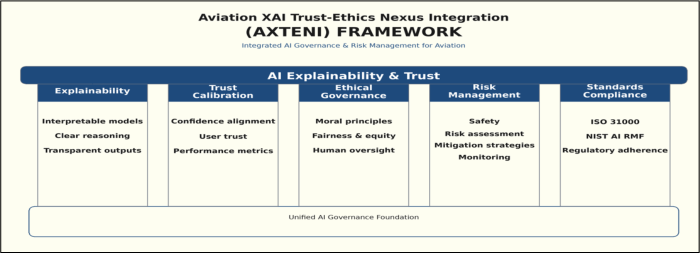
The AXTENI Framework The Aviation XAI Trust-Ethics Nexus Integration Framework (AXTENI) (Figure 1) is not a new standard but a practitioner-facing governance model (Halawi, Miller, and Holley, 2026) that unifies explainability, trust, ethics, human oversight, risk management, and standards within existing aviation safety systems, organizing how AI fits into aviation decision-making.
Figure 1: AXTENI framework (adapted from Halawi, Miller, and Holley, 2026).
AXTENI uses five core pillars to convert technical specifications into direct leadership responsibilities, anchored by a central AI governance model and resting on a single foundation of policy, culture, and training. Without that foundation, the framework degrades into a checklist rather than genuine accountability. Together, the pillars move managers from passive oversight to active control, establishing disciplined skepticism as a basic safety requirement for anyone operating AI in aviation. The first pillar, explainability, establishes that a leader cannot govern what they cannot understand. Explainable AI (XAI) does not replace complex models. It adds an interpretability layer connecting algorithmic outputs to human reasoning, enabling the leader to understand WHY the system flagged a
concern (Doshi-Velez & Kim, 2017). Explainability is a prerequisite for authority, not a technical convenience. Just as Mission Command requires airmen to understand the why behind an order, leaders must grasp an AI’s reasoning; unexplainable systems break the chain of command (Department of the Air Force, 2023). The second pillar, trust, prevents leaders from trusting or doubting an AI system without evidence (Parasuraman & Riley, 1997). Trust must be earned through proven competence over time, not by mandate (United States Marine Corps, 1997). AXTENI positions trust as an active leadership practice rather than a passive acceptance of system reliability. The third pillar, ethics governance, treats human oversight as a moral duty rather than a checkbox, requiring aviation leaders to monitor autonomous recommendations to ensure operational decisions remain fair and ethical. The fourth pillar, risk management, applies continuous safety monitoring and pre-deployment assessment, mirroring Air Force Mission Command doctrine, which urges leaders to communicate risk tolerance and act proactively (Department of the Air Force, 2023). Under this framework, managers must actively identify system vulnerabilities and track how risks evolve as AI evolves. The fifth pillar, standards compliance, anchors everything in ISO 31000, the NIST AI framework, and FAA rules (ISO, 2018; NIST, 2023). This compliance is a hard line that efficiency pressures cannot override; it sets the minimum threshold and gives managers legal backing to defend their governance decisions. AXTENI is built on existing standards rather than in competition with them, and its contribution is clearest by contrast. The NIST AI Risk Management Framework governs the system, guiding the mapping, measuring, and managing of an AI product’s risks. SMS governs the organization, establishing proactive hazard identification and risk mitigation across the enterprise. Neither governs the person at the moment of decision, nor tells a supervisor what to do when an agentic system recommends releasing an aircraft and the ramp clock is running. AXTENI occupies exactly that space, governing the human authority accountable for both. Operationalizing it means shifting from static checklists to active readiness for failures and making AI interrogation a daily discipline: before accepting any output, a leader must answer what the system is saying, why, what it assumes, what happens if it fails, and whether it can be disengaged.
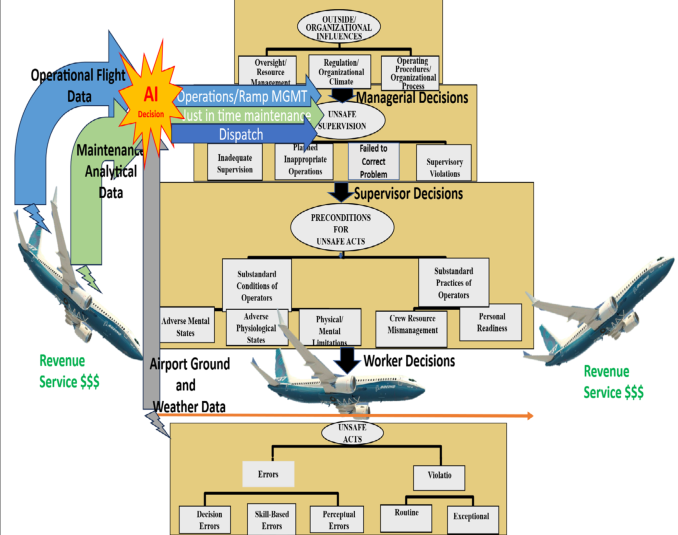
Current AI Use in a Hypothetical Airline HFACS The airline industry is being infused with AI decision-making tools to make operations, maintenance, and dispatch more efficient and, ultimately, safer. This use of AI is to know exactly when the aircraft will be at the ramp to disembark passengers and cargo, perform maintenance, reload, and plan the aircraft’s flight for revenue service. By parsing ramp time, it supports an on-demand maintenance model rather than waiting for scheduled maintenance, drawing on its ability to handle large volumes of data from diverse sources (Figure 2).
Figure 2: AI infused into an Airline HFACS (Shappell & Wiegmann, 2000).
Data is downloaded simultaneously from the aircraft, including raw flight and system data, as well as airport data such as weather, runway throughput, and taxi flow. From this, AI algorithms generate accurate predictions of ramp time to support more precise managerial and supervisory-level decisions, indicating exactly when the aircraft will be available (Figure 2). For maintenance, system issues are captured in-flight feed AI predictive systems that determine whether on-demand maintenance is feasible and, if so, identify the required equipment, personnel, and parts. This AI operates at agentic levels, generating content, making decisions, and executing tasks without human oversight. This capability suits functions like passenger service, where agentic AI levels can certainly create passenger tickets; but in ramp operations, maintenance, and dispatch, it can only help refine decisions. Humans must still manage, supervise, and physically perform this work, requiring managers, supervisors, and frontline workers to understand AI decisions and team with the AI at all three HFACS levels (Figure 2).
Why Analyze Maintenance AI Usage for the HFACS Analysis?
While airline operations, maintenance, and dispatch all use AI to tighten ramp schedules, at this juncture, maintenance is singled out here to show the full effects of predictive analytical AI across organizational levels in the HFACS. This focus stems from the long-standing use of predictive commercial engine maintenance, now spreading to other aircraft systems. Such analytics are crucial to regain efficiency amid a global maintenance personnel shortage,
yet maintenance remains accountable for safe flight, so the effects of wider AI integration must be analyzed.
The worst-case risk scenario is that predictive maintenance AI leads to malpractice, an incident, or, worse, a catastrophic accident. HFACS has identified prevalent organizational causal factors that have contributed heavily to aviation accidents over the past 30 years. How would infusing the predictive maintenance AI into each HFACS level affect each causal factor, and what leadership issues would result? This framework-driven method applies HFACS taxonomy to ramp maintenance to map causal factors against agentic AI demands. While bypassing empirical data, it brings forth leadership requirements for future empirical research to test.
Maintenance AI Analytics Are Infused Into the Management Level HFACS.
Maintenance use of AI starts with a management tool that knows how much ramp space and time will be allotted, then serves as a predictive analytical tool for aircraft systems. The rationale is economic value: rather than wait for costly, scheduled maintenance that removes the aircraft from revenue service, predictive AI performs it during ramp downtime. Infusing this tool into the highest level of the HFACS (Figure 2) directly affects managers’ key accident causal factors: oversight of resources, adherence to regulations, maintenance of a solid culture, and current maintenance processes and procedures. Oversight of resources is the most critical. The AI identifies what is wrong with the aircraft and the allotted ramp time; however, the manager must make the final decision based on the maintenance’s criticality to the safety of the next flight. While agentic AI might help prioritize, check parts, and account for personnel, the manager owns these final decisions for that valuable ramp time, which demands great expertise, experience, and competence. AI also affects FAA regulations: management must work constantly with the FAA and manufacturers to develop and modify regulations, processes, and procedures as AI use and technology advance. Such oversight and partnership are critical for compliance with industry standards and flight safety. The final high-priority factor is culture: embed risk management into decisions and encourage all employees to report hazards, especially during ramp maintenance. In this culture, managers remain in the AI loop and are ready to challenge the AI’s decisions.
Maintenance AI Analytics Infused Into the Supervision Level HFACS When management acts on AI analytics and designates a team, much of the responsibility falls on the maintenance supervisor, who must understand the AI’s inputs to determine the extent of the work. At the supervisory level, the HFACS identifies four failure-causal factors, all exacerbated by time pressure to complete ramp maintenance: inadequate supervision, planned inappropriate operations, failure to correct problems, and supervisory violations (Figure 2). Leadership here requires ethical oversight and the moral courage to resist time pressure, refuse to let deviations slide, and
The AXTENI Framework: Redefining Leadership Authority in the Age of Agentic AI 1423 communicate strongly with both management and technicians, while staying flexible enough to change course. The supervisor should question the AI’s inputs before signing off, document discrepancies, and remain part of the quality assurance team, unchanged by the presence of AI analytics. The biggest danger is that the work environment pressure leads a supervisor to allow minor procedural steps to slide, fostering planned, inappropriate operations that appear adequate within the AI framework. Both AI and management may be satisfied, yet the procedure may still be wrong. This normalization of deviance, an ongoing problem in scheduled phased maintenance, could easily become a supervisory violation in the accelerated, AI-driven ramp operation. The supervisor for this environment needs high proficiency, unwavering ethical judgment, and the refusal to capitulate to time pressure, along with strong communication with management and AMTs, and is also key to maintaining standards and safety culture.
Maintenance AI Analytics Integrated Into the Worker-Level HFACS While maintenance management and maintenance supervisors rely on the accuracy of AI analytics, the burden of completing the work on time falls on the aviation maintenance technicians (AMTs) assigned to it. Predictive analytics have shifted the AMTs’ workspace from the hangar, where only planned, scheduled maintenance was done, to the ramp area, where on-demand, unscheduled maintenance is now performed. At this direct work level (Figure 2), the causal factors are the AMT’s mental, physical, and physiological states and their readiness based on training and qualifications. These preconditions are where the critical mistakes, the errors at the bottom of the HFACS, either surface and are caught and corrected or remain potentially dangerously dormant until an incident or accident occurs. AI, therefore, makes AMT training critical, so technicians understand the AI’s inputs and limitations for the system they service. The analytics must be both explainable and trusted: AMTs cannot over-rely on the AI, yet must not be intimidated into not challenging an output that seems incorrect. Leadership at this level calls for a high standard of communication and the assertive willingness to challenge the AI when things do not seem right. The essential point is that even when agentic AI identifies the tools, personnel, and parts required, the human technician still performs the physical maintenance. The leadership requirement at this tier is clear communication and, above all, the assertiveness to speak up and challenge an AI output when something is not right, anchored by calibrated trust.
Maintenance AI Analytics Use and the Demand for Team Leadership The analysis points to important leadership values across management, supervisors, and frontline AMTs. Each level teams with AI differently, and each directly affects the maintenance output, and, ultimately, the aircraft’s critical safety sign-off for flight. Every level must work with the AI on its explainability and trust, adhere to maintenance standards, and ensure safety, without being lured away by the economic pressures of ramp work. Most
importantly, each level must build a maintenance AI team culture in which leadership at every tier is critical. This culture should mirror a mature SMS culture, grounded in ISO risk management standards, pursuing continuous improvement with the urgency of flight safety demands. In practice, that means a just reporting culture from top to bottom, with full participation in surfacing AI-related hazards and a posture that is proactive rather than merely reactive. Every tier is accountable for reporting AI problems, and management is ultimately accountable for acting on and auditing them. A governance model like AXTENI should guide leadership and culture toward ethical decision-making in maintenance and could extend to ramp operations and dispatch.
DISCUSSION AND IMPLICATIONS Application challenges and gaps in addressing the core elements of the fifth industrial revolution (5IR) and agentic AI will serve as a platform for assessing aviation management strategies, decisions, and operational oversight going forward. To summarize the key elements of 5IR management, five primary areas drive change from the fourth industrial revolution (4IR) era: (1) Augmented intelligence and collaboration: This is where collaborative learning develops continuously between AI devices or programs and humans. With agentic AI present, this calls for increased human oversight of the rationales and ethical boundaries employed, making XAI essential (Bakhtiari et al., 2026); (2) Human-centric operations: a major change from 4IR practices, the elevated role for humans becomes a central focus for management systems. This is where human worker wellbeing becomes prioritized over productivity. In so doing, it challenges the established management thinking that prioritizes productivity and cost control over valuing human worker contributions. To succeed, AI must demonstrate reliability and trustworthiness that align with human expectations (Nsoh, 2026); (3) Ethical governance: continuing evolution to achieve balanced AI guidelines is critical to meeting ethical standards and practices. While in 4IR, ethics could be given cursory notice, in 5IR, it becomes part of the foundation for human-ai collaboration. In many cases, this is where human-in-the-loop decision-making is essential; (4) Resilience and unified ecosystems: the 4IR practices of silos for functions and organizational structures will necessarily be redirected to more flexible and adaptable processes that respond in real time to changes or sudden disruptions. This area will be where management must remain alert and in sync with operations to facilitate quick decisions that affect responses to changing conditions. The importance of risk management grows exponentially in the circumstances where change and adaptation are constant companions (Schutte & Swart, 2025); and (5) Sustainability and circularity: these represent an environmental consciousness that, to date, exists mostly in lip service and tangential attention. The role of standards compliance is essential for providing stability in agentic-AI and human-ai collaborations (Srinivasu, 2025). This embodies a shift from replacing humans (a 4IR goal) to augmenting them (Szeszák et al., 2025). Examples abound in the aviation maintenance field, where technicians use AI-driven wearable technology and follow cobotic work procedures. On the flight
The AXTENI Framework: Redefining Leadership Authority in the Age of Agentic AI 1425 deck, 5IR is installing biometric scheduling to improve crew management procedures, more accurately determining pilot and air traffic controller readiness, and ensuring adequate margins of safety. The new management environment, perhaps most significantly, prioritizes human-centric skills such as crisis management, emotional intelligence, and complex problem-solving. For sustainability, aviation management tasks become core operational mandates to enable dynamic eco-routing and decarbonization. Predictive disruption management (e.g., weather) requires management to provide a unified, flexible ecosystem for gate changes and rebooking. For maintenance, parts inventory uses 3D printing to eliminate ground delays. Here, too, flight schedules are dynamically matched with maintenance workforce constraints and parts availability. Turnaround times include buffer time for ground crews to reduce cognitive demands and fatigue (Yang, 2026). In all, the 5IR elements eliminate silos and move management toward value- driven coordination. With a shift toward machine learning and human collaboration, the psychological well-being and effectiveness of humans will be elevated as management system priorities. Management structures and practices will need to attend closely to the changing environments and transitions during widespread 5IR adoption. An integral part of the shift in management approaches is the increasing use of embodied agentic AI. Then, too, are the modifications to unionized work rules, compensation strategies, and a multitude of other factors to sustain efficient operations (Romero & Suyama, 2025). Because agentic-AI functions across organizational boundaries, the HFACS model itself will require re-evaluation of its levels and content to account for dynamic, continuous exchanges and merged tasks. Here, the AXTENI framework becomes prescient and practical, as shown in the five 5IR elements above, its five pillars map directly onto these evolving management challenges summarized in Table 1.
Table 1: Alignment of AXTENI pillars with Fifth Industrial Revolution (5IR) elements.
Table available in the original PDF paper.
AXTENI Pillar Aligned 5IR Element and Leadership Demand Explainability (XAI) Augmented intelligence and collaboration: continuous human-AI learning requires leaders to oversee AI rationales, making explainable AI essential (Bakhtiari, 2026).
Trust Human-centric operations: as the human role is elevated, AI must demonstrate reliability and trustworthiness aligned with human expectations, requiring calibrated rather than blind trust (Nsoh, 2026).
Ethics governance Ethical governance: ethics moves from cursory attention to a foundation for human-AI collaboration, requiring human-in-the- loop oversight as a moral duty.
Risk management Resilience and unified ecosystems: flexible, adaptive processes replace silos, and risk management grows exponentially as change becomes constant (Schutte & Swart, 2025).
Standards compliance Sustainability and circularity: durable operations depend on compliance with standards to provide stability in agentic-AI and human-AI collaboration (Srinivasu et al., 2025).
Limitations and Future Research As of yet, AXTENI has not been empirically validated, and the predictive maintenance example provided is a hypothetical rather than an actual case study. Thus, the framework is supported by analytic validation. Currently, the authors are working to operationalize the five pillars into measurable variables and create a survey instrument. Expert panel review, pilot testing, and evaluation of reliability and validity will be conducted as the next phase of development.
CONCLUSION
The aviation industry is at a leadership inflection point. The deployment of autonomous AI across dispatch, maintenance, and ramp operations has outpaced organizational oversight rules. Applying HFACS to predictive maintenance reveals that as AI absorbs routine tasks, accountability does not disappear; it shifts up to supervisors and executives who lack the tools to handle it. AXTENI addresses this operational gap by converting abstract concepts such as explainability and risk into active leadership duties rather than passive IT compliance checkboxes.
ACKNOWLEDGMENT
The authors used Claude (Anthropic) to refine and enhance the AXTENI figure.
REFERENCES
Airbus. (2026, June). Computer vision, automated landing, and embedded AI for tomorrow’s cockpits. https://www.airbus.com/en/newsroom/stories/2026-06- computer-vision-automated-landing-and-embedded-ai-for-tomorrows-cockpits Bakhtiari, S., Qara-Tapeh, E., & Amiri, B. (2026). Research trends in the fifth
industrial revolution field. International Journal of Information Science and Management, 24(1), 249–262. https://doi.org/10.22034/ijism.2026.2045444.1637 Department of the Air Force. (2023). Air Force doctrine publication 1-1: Mission command.U.S.Air Force. https://www.doctrine.af.mil/Portals/61/documents/ AFDP_1-1/AFDP%201-1%20Mission%20Command.pdf Doshi-Velez, F., & Kim, B. (2017). Towards A Rigorous Science of Interpretable
Machine Learning. https://doi.org/10.48550/arxiv.1702.08608 Gartner. (2025). Agentic AI [Reprint No. 1-2MZ8OVQT]. https://www.gartner.com/ doc/reprints?id=1-2MZ8OVQT&ct=260313&st=sb Halawi, L., Miller, M. & Holley, S. (2026). An Integrated Framework of
Explainable AI, Trust, and Ethics in Aviation, Book Chapter in the book title, “Artificial Intelligence Ethics, Law, and Policy”, ISBN 978 1 83635-560-1. International Civil Aviation Organization. (2018). Safety management manual (Doc 9859, 4th ed.). ICAO. https://www.icao.int/safety-management/SMI/SMM International Organization for Standardization. (2018). Risk management:
Guidelines (ISO 31000:2018). ISO. Lockheed Martin. (n.d.). X-62A VISTA. Retrieved July 6, 2026, from https://www.
The AXTENI Framework: Redefining Leadership Authority in the Age of Agentic AI 1427 National Institute of Standards and Technology (NIST). (2023). Artificial Intelligence
Risk Management Framework (AI RMF 1.0) (NIST AI 100-1). U.S. Department of Commerce. Nsoh, J. (2026). Human-centric zero trust identity architecture for the fifth industrial revolution: A JEPA-driven approach to adaptive identity governance. Electronics (Basel), 15(9), 1878. https://doi.org/10.3390/electronics15091878 Parasuraman, R., & Riley, V. (1997). Humans and Automation: Use,
Misuse, Disuse, Abuse. Human Factors, 39(2), 230–253. https://doi. org/10.1518/001872097778543886 Romero, M., & Suyama, R. (2025). Agentic AI for intent-based industrial automation. IEEE/IAS International Conference on Industry Applications (Online), 437–444. https://doi.org/10.1109/INDUSCON66435.2025.11241317 Schutte, F., & Swart, E. (2025). The new kid on the block takes us to the fifth
industrial revolution. International Journal of Professional Business Review, 10(2), e04937–24. https://doi.org/10.26668/businessreview/2025.v10i2.4937 Shappell, S. A., & Wiegmann, D. A. (2000). The Human Factors Analysis and Classification System (HFACS) (Report No. DOT/FAA/AM-00/7). Federal Aviation Administration, Office of Aviation Medicine. Singh, H. (2025). Explained: The AI-powered predictive maintenance revolution.
Airways (May, 22). https://www.airwaysmag.com/ Srinivasu, P., Jose, A., Amer, A., Muda, Z., Madireddy, A., Chetana, V., Kumar, Y., & Ijaz, M. (2025). From automation to autonomy: The role of agentic AI in Industry 5.0. 2025 Asian Conference on Communication and Networks (ASIANComNet), 1–6. https://doi.org/10.1109/ASIANComNet68615.2025.11579681 Sukharevsky, A., Kerr, D., Hjartar, K., Hämäläinen, L., Bout, S., Di Leo, V., &
Dagorret, G. (2025). Seizing the agentic AI advantage. McKinsey & Company. https://www.mckinsey.com/capabilities/quantumblack/our-insights/seizing-the- agentic-ai-advantage Szeszák, B., Kerékjártó, I., Soltész, L., & Galambos, P. (2025). Review on the fifth industrial revolution. Journal of Physics. Conference Series, 3142(1), Article 012001. https://doi.org/10.1088/1742-6596/3142/1/012001 United States Marine Corps. (1997). Warfighting (MCDP 1). U.S. Marine Corps.
https://www.marines.mil/portals/1/publications/mcdp%201%20warfighting.pdf Yang, Y. (2026). 12 technology and CX trends that can enhance airline and airport operations in 2026. Future Travel Experience (Jan 12). https://www. futuretravelexperience.com/2026/01/12
SEARCH THE AHFE DIGITAL BOOKSTORE BY ISBN
Explore the complete digital volume
Human Factors in Design, Engineering, and Computing
Read this individual research paper free through the original publisher, or explore the full digital proceedings book.