Anna Kucharski, Avishek Choudhury (2026). Radiological Incident Awareness and Preparedness Among the Public and First Responders: A Systematic Review. In: Human Factors in Design, Engineering, and Computing. AHFE Open Access, vol. 238, pp. 1384–1395. https://doi.org/10.54941/ahfe1008367
Industrial and Management Systems Engineering, Benjamin M. Statler College of Engineering and Mineral Resources, West Virginia University, Morgantown, West Virginia, United States ↗
This study examines awareness and preparedness for radiological incidents among the public and first responders within the context of occupational safety, risk management, and emergency preparedness systems, with particular attention to human factors and system-level performance in real-world environments. The objective of this study is to identify gaps in the literature concerning hazard knowledge, safety training practices, and operational preparedness in radiological incident scenarios. A systematic literature search was conducted across PubMed, IEEE Xplore, and Web of Science to identify English-language studies published between January 2014 and January 2024. A total of 15,047 records were identified, and 12 studies met the inclusion criteria for final review following PRISMA screening procedures. The reviewed studies primarily focused on radiation exposure and health outcomes, including cancer, cataracts, cardiovascular disease, and thyroid disorders, while limited research directly examined preparedness, hazard awareness, responder decision-making, or human performance during radiological emergencies. Most included studies were observational and focused primarily on health outcomes rather than operational preparedness. The findings indicate that the literature provides limited direct evidence on how radiation hazard knowledge translates into preparedness-related practices and limited reporting of human factors, training approaches, hazard recognition, and preparedness protocols. These findings highlight an evidence gap regarding the relationship between hazard awareness, training, and operational preparedness during radiological incidents and support consideration of an occupational radiological preparedness framework connecting these factors.
Radiological exposure has always been a serious concern in both occupational and public settings. It is important to understand the potential health effects of radiation to protect workers, the public, and the environment. As a matter of fact, ionizing radiation exposure has been linked to an elevated risk of cancer in both public and occupational populations, as demonstrated by longitudinal epidemiologic investigations (Berrington de González, 2011).
Radiological Incident Awareness and Preparedness 1385 Unlike many hazards in the workplace, radiation is not easily detected; it may accumulate over time and often produces delayed health effects.
It is known that occupational exposure can occur in many different places, including health care, nuclear facilities, industrial radiography, research laboratories, military operations, and emergency response work. Due to the different types of radiation sources, contamination may also occur in different ways, such as through external radiation, breathing it in, swallowing it, or contact with contaminated surfaces. Radiological contamination can spread quickly because radioactive material can disperse via air and contaminate nearby areas. However, the majority of occupational exposures are long- term and low dose, although a significant radiological exposure situation can happen during nuclear emergencies, equipment failure, or transportation incidents (International Atomic Energy Agency [IAEA], 2018; Nuclear Regulatory Commission [NRC], 2020). Radioactive events can quickly affect nearby communities and go beyond occupational limitations. This is why it is so important for emergency responders, medical professionals, and the general public to be prepared. In addition, the national emergency guidelines recognize the importance of protective measures, and responder knowledge in the event of radioactive events (Centers for Disease Control and Prevention [CDC], 2021).
During a radiological incident, first responders and medical professionals are often the first to arrive on the scene. Emergency responders may be required to deal with insufficient information, maintain situation awareness, communicate with the public and other agencies, and make rapid operational decisions while managing personal safety concerns. Emergency personnel performance in radiological environments is highly dependent on the quality of training, communication systems, and organizational preparedness. In the real world, however, conditions are not always the same as in the training environment, which can contribute to poor decision-making and decreased levels of safety performance (Brooks, 2018).
However, the translation of radiation safety knowledge into operational preparedness and decision-making remains underexplored in empirical research. At present, most research has focused more on radiation dose and long-term health effects than on preparedness and how the response actually unfolds in practice. This systematic review therefore examines existing scientific evidence on radiation-related health and safety outcomes associated with radiation exposure in occupational and population-based settings, with emphasis on implications for occupational safety and emergency preparedness. The review also identifies gaps in the literature and considers the potential implications of human factors, training, and organizational systems on the application of radiation safety knowledge during emergency situations. This study therefore contributes to the literature on radiological safety and public preparedness by examining the extent to which existing research addresses radiation protection, awareness, training, human factors, and preparedness-related outcomes, while identifying gaps in the available evidence. In addition, this research seeks to explore the impact of training and awareness programs on the ability to respond appropriately to radiological incidents (Nuclear Regulatory Commission [NRC], 2020).
BACKGROUND
Past tragic events, in which many innocent lives were lost, influenced governmental organizations to regulate nuclear proliferation activities. Furthermore, the Manhattan Project and the Atomic Energy Act of 1946 contributed to a new era in the control of ionizing radiation (U.S. Congress, 1946; U.S. Department of Energy [DOE], Office of History and Heritage Resources, 1994).
The aftermath revealed the public was not aware and unprepared, highlighting the need to protect not only workers but also members of the public who may be affected by radiation exposure (U.S. Department of Energy, 2015). These events contributed to the establishment of important radiation safety regulations and proper policies, such as strict limits on radiation exposure.
Furthermore, routine monitoring and the inclusion of the ALARA principle (“As Low As Reasonably Achievable”) were established to minimize worker and public exposure (Nuclear Regulatory Commission, 2020). To help improve safety, occupational radiation protection standards were enforced to monitor radiological exposure in occupational settings (Occupational Safety and Health Administration [OSHA], 2021). While these measures improve exposure control, they do not necessarily address operational preparedness or responder performance during emergency situations.
Consequently, structured radiation protection systems were developed to reduce the likelihood of future harm. Most radiation policies, however, are geared toward occupational and environmental protection and do not address public awareness and preparedness for radiological emergencies. Although emergency plans exist, evidence indicates that public awareness of the appropriate protective actions (e.g., sheltering in place, evacuation, contamination avoidance, and decontamination procedures) is low during nuclear or radiological incidents. Federal guidance also stresses coordinated protective actions and emergency response planning during radiological incidents.
Despite this, gaps in awareness may reduce compliance with emergency instructions and negatively affect protective response behaviors during radiological emergencies. This is important because occupational radiation safety functions as a critical interface between controlled radioactive materials and the public. In particular, during a radiological incident that may occur during handling, storage, or transportation, both first responders and surrounding populations may be exposed. During such impactful events, insufficient awareness and preparedness can significantly increase harm, even in systems with strong regulatory controls.
In the end, current governmental policies and regulations do provide exposure limits and safety requirements, but their effectiveness in ensuring adequate preparedness for radiological emergencies is not fully developed. The outcomes of emergency response operations with respect to operational safety are heavily dependent on human performance, responder awareness, the reliability of communication, and decision- making under stress.
APPROACH The systematic review is presented in accordance with the Preferred Reporting Items for Systematic Reviews and Meta-Analyses (PRISMA) checklist. The PRISMA framework was used to guide the identification, screening, eligibility assessment, and inclusion of relevant studies. Because this study analyzed previously published research and did not collect any data from human participants, institutional approval and informed consent were not required.
The objective of this study is to identify gaps in the literature concerning hazard knowledge, safety training practices, and operational preparedness in radiological incident scenarios. Due to limited preparedness-focused studies, occupational radiation health literature was used to identify and interpret system-level gaps in preparedness based on the absence of direct human factors and operational response data. An extensive search was conducted in January 2025 utilizing PubMed, Web of Science, and IEEE Xplore databases to identify studies published from January 2014 through January 2024 using PRISMA-based procedures.
The corresponding databases were chosen because they cover occupational health, environmental safety, engineering systems, emergency preparedness, and radiation-related research relevant to radiological risk communication, training systems, and response operations. Research studies were included if they addressed radiation exposure in occupational or population-based settings and provided relevant information on health outcomes, safety practices, training, preparedness systems, risk communication, emergency countermeasures, or operational response capacity. Search terms were developed through a step- by-step process focused on radiological incident preparedness and safety system performance. Keywords included radiation exposure, radioactivity, radioisotopes, occupational risk, safety, training, hazards, mitigation, nuclear exposure, radiological incidents, public health, first responders, and radiation protection. Boolean operators such as “AND” and “OR” refined searches across databases. Table 1 shows the search terms used.
Table 1: Search terms used in the search strategy for systematic review.
- Injury English-language peer-reviewed articles published from January 2014 to January 2024 were reviewed. Studies were excluded if they were non-English, outside the timeframe, not relevant to radiation exposure or radiological safety, not peer-reviewed, not available in full text, or outside the scope of occupational safety, emergency preparedness, or radiological incident management.
1388 Kucharski and Choudhury After duplicate removal, titles and abstracts were screened for relevance to hazard awareness, training adequacy, and operational preparedness. Full-text articles were then assessed for eligibility based on predefined inclusion criteria. At the end, a total of 12 studies were included in the final synthesis.
The screening process was then followed by structured data extraction of key study characteristics and findings. This allowed the extraction of key variables such as country of origin, radiation exposure type, research purpose and study design, health outcomes, and findings relevant to disaster preparedness and occupational safety. The structured screening process guided this extraction. The extracted data were organized according to study population, radiation exposure type, health outcomes, public awareness, safety practices, and human factors or preparedness relevance. These categories were used to compare the included studies and identify recurring findings and gaps related to awareness, training, operational preparedness, and human performance.
In addition, attention was given to how the literature addressed responder awareness, operational safety systems, training implications, and broader preparedness-related aspects. For example, safety and preparedness aspects were documented where reported (Akleyev et al., 2017). The process was also able to identify additional exposure and outcome details from cohort- based studies involving radiation worker populations (Azizova et al., 2017).
Methodological and epidemiological context was also recorded from long- term occupational studies examining chronic exposure effects (Azizova et al., 2018). Cross-national occupational exposure research was considered where applicable (Laurent et al., 2016). In addition, data from medical cohorts pertaining to health outcomes were extracted as well (Lee et al., 2020). Some of the occupational cohort studies provided exposure- and outcome-related evidence to inform system limitations relevant to preparedness (Azizova et al., 2017; Azizova et al., 2018). Moreover, healthcare-related occupational radiation exposure and exposure-management contexts were considered (Lee et al., 2020).
A narrative synthesis was performed to integrate findings, compare training and preparedness systems, identify recurring gaps, and evaluate methodological limitations across studies in accordance with established systematic review principles (Creswell, 2018).
The synthesis focused on discrepancies between hazard knowledge, training implementation, and operational preparedness across radiological incident contexts. Because preparedness-focused evidence was limited, the synthesis included studies that provided relevant contextual evidence on radiation exposure, occupational safety, emergency countermeasures, surveillance, and long-term health outcomes. These included occupational exposure studies (Azizova et al., 2018), post-incident population analyses (Fridman et al., 2016), dose–response analyses (Kato et al., 2023), survivor cohort studies (Kitamura et al., 2015), occupational exposure monitoring (Liu et al., 2024), multi-cohort analyses (Preston et al., 2016), cancer-risk analyses (Sadakane et al., 2019), and comparative incident analyses (Uyba et al., 2017).
All included studies were observational in design, primarily cohort and registry-based epidemiological studies, with limited direct evidence relevant to emergency preparedness, safety systems, and operational response capacity. The cross-study gap analysis was conducted by examining additional studies capturing occupational cohorts (Azizova et al., 2018), post-incident
Radiological Incident Awareness and Preparedness 1389 populations (Fridman et al., 2016), exposure modeling frameworks (Kato et al., 2023), survivor studies (Kitamura et al., 2015), surveillance systems (Liu et al., 2024), and comparative incident analyses (Uyba et al., 2017).
In addition, data were analyzed to explore exposure-response patterns relevant to preparedness discussions (Akleyev et al., 2017; Laurent et al., 2016). Finally, the Mixed Methods Appraisal Tool (MMAT) was used to assess the quality of the studies. This tool looked at how well the studies were designed, how clearly exposure was measured, and how valid the overall findings were, with particular emphasis on how well the studies supported interpretation of preparedness systems and training effectiveness (Hong et al., 2018).
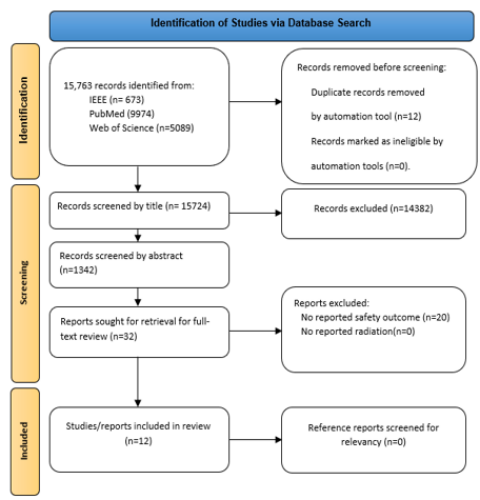
OUTCOME Study selection was driven by the PRISMA framework from identification to full-text eligibility evaluation. Twelve studies that met the inclusion criteria were included in the final synthesis out of the 15,047 records that were retrieved. The study selection procedure and the flow of records through each screening, eligibility, and inclusion stage are illustrated in Figure 1.
The 12 included studies were subsequently compared using the extracted categories described in the Approach section, allowing the review to identify patterns in radiation exposure and health outcomes as well as the extent to which awareness, safety practices, training, human factors, and preparedness were reported.
Figure 1: PRISMA flow diagram of study selection process.
1390 Kucharski and Choudhury Most of the studies were published between 2017 and 2024 and originated in countries with substantial nuclear and radiation-related research infrastructure, particularly Japan and Russia. The included studies were categorized into two exposure categories: radioactive element decay (n = 10) and nuclear exposure (n = 2). Table 2 summarizes the populations, health effects, exposure type, method, country of origin, and significant findings.
Very few studies directly addressed preparedness systems, responder awareness, or operational response effectiveness. All studies were observational, mainly cohort and registry-based, and most were rated moderate quality. Disparities in exposure assessment, follow-up, and reporting might limit comparability. Preparedness-related variables were generally not reported across the included studies, limiting direct assessment of operational response performance. Although these studies provide important evidence regarding radiation exposure and health consequences, they provide limited information about responder training, decision-making, communication, or operational performance during an emergency. Several studies reported associations between radiation exposure and short- and long-term health effects. For example, the long-term environmental contamination resulting from the 1957 Kyshtym accident was investigated by Akleyev et al. (2017), while Azizova et al. (2018) reported that women exposed to radiation were at a higher risk of developing cataracts. Sadakane et al. (2019) reported an increased risk of liver, biliary tract, and pancreatic cancers among some atomic bomb survivors exposed before age 30. Kato et al. (2023) examined dose– response relationships for childhood thyroid cancer following the Fukushima accident. Lee et al. (2020) studied low-dose occupational radiation exposure. Moreover, Azizova et al. (2017) reported an association of occupational exposure with circulatory disease mortality in Mayak workers. Lastly, Uyba et al. (2017) compared Chernobyl and Fukushima responses, and Preston et al. (2016) combined cohorts to strengthen exposure–response estimates.
Importantly, the findings also varied according to exposure context, age, timing, and environmental conditions. The study by Fridman et al. (2016) examined post-Chernobyl papillary thyroid carcinoma among individuals exposed during childhood. Kitamura et al. (2015) examined the relationship between radiation exposure and long-term cancer risk among atomic bomb survivors. Nevertheless, Laurent et al. (2016) found that the CURE program addresses significant research gaps on uranium exposure. In general, the studies emphasize the importance of long-term exposure monitoring and occupational safety procedures.
(Continued)
Key Findings
risk associated with
prolonged low-dose
exposure
increase in solid cancer
risk
risks associated with
uranium exposure
with radiation exposure
relationship for cancer
risk
cases observed in cohort
/ Preparedness
Relevance
factors relevance Increased cataract
No human
factors relevance Significant long-term
factors relevance Elevated occupational
factors relevance Increased cancer risk
factors relevance Clear dose–response
factors relevance Over 6,000 cataract
infrastructure
noted
Awareness Safety Practices Human Factors
Not
addressed Not described No human
addressed Limited
addressed Not described No human
addressed Not described No human
addressed Not described No human
addressed Not described No human
Posterior
subcapsular,
cortical, nuclear
cataracts
Cancer incidence
and mortality Not
Lung cancer, kidney
disease Not
Liver, biliary tract,
pancreatic cancer Not
Leukemia, solid
cancers Not
Cataracts Not
Mayak
workers
(1,467,411
person-years
follow-up)
Mayak
cohort
Equations and mathematical formulas are available in the original paper PDF.
Uranium
miners and
nuclear
workers
Hiroshima/
Nagasaki
survivor
cohort
Atomic bomb
survivor
cohort
Radiation
workers
Objectives Population Health Outcome Public
Assess cataract
risk in exposed
workers
Assess long-term
consequences of
Mayak accident
Assess uranium
worker health
risks
Assess cancer
risk in atomic
bomb survivors
Evaluate long-
term cancer risk
in survivors
Assess low-dose
occupational
radiation risk
Radiation
Type
Pu-239,
U-235 (alpha)
Cs-137, Sr-90,
Pu-239,
I-131
U-238, U-235
(alpha)
Japan
Mixed alpha,
beta, and
gamma
emitters
Japan
U-235,
Pu-239,
Sr-90, I-131,
Cs-137
Medical
isotopes
(unspecified)
Table 2: Characteristics and key findings of included studies.
Table available in the original PDF paper.
Study Country &
Azizova et
al. (2018) Russia
Akleyev et
al. (2017) Russia
Laurent et
al. (2016) Europe
Sadakane
et al.
(2019)
Kitamura
et al.
(2015)
Lee et al.
(2020) South Korea
Key Findings
thyroid cancer following
Fukushima accident
in early-life exposure
group
events in medical
imaging settings
mortality associated
with chronic exposure
Fukushima exposure
significantly lower
than Chernobyl due to
countermeasures
confirmed exposure–
response relationships
/ Preparedness
Relevance
factors relevance Increased detection of
factors relevance Elevated thyroid cancer
Indirect system
relevance Documented adverse
factors relevance Increased cardiovascular
Indirect system
relevance
(emergency
countermeasures
discussed)
factors relevance Cross-cohort analysis
risk management
reported
Iodine
prophylaxis and
contamination
controls
Awareness Safety Practices Human Factors
addressed Not described No human
addressed Not described No human
Not
addressed Occupational
addressed Not described No human
awareness
campaigns
reported
addressed Not described No human
Thyroid cancer Not
Thyroid cancer Not
Radiation
exposure–related
adverse events
Cardiovascular
disease mortality Not
Thyroid disease risk Public
Cancer and
leukemia Not
Public
population
Exposed
children
cases)
Radiation
293 adverse
events)
Mayak
workers
General
population
Combined
cohorts
(approx.
80,000
participants)
Objectives Population Health Outcome Public
Assess thyroid
cancer post-
Fukushima
Assess thyroid
cancer in
children post-
Chernobyl
Assess
occupational
imaging
exposure risks
Assess
cardiovascular
mortality risk
Compare
Chernobyl vs
Fukushima
countermeasures
Assess cancer
and leukemia
risk across
cohorts
Radiation
Type
I-131(beta/
gamma)
I-131,
Cs-137, Sr-90,
Pu-239
I-131
(medical
imaging
exposure)
Pu-239,
U-238 (alpha)
I-131 (beta/
gamma)
Mixed
isotopes
(alpha, beta/
gamma)
Table 2: Continued.
Table available in the original PDF paper.
Study Country &
Kato et al.
(2023) Japan
Fridman et
al. (2016) Belarus
Liu et al.
(2024) China
Azizova et
al. (2017) Russia
Uyba et al.
(2017) Japan
Preston et
al. (2016) Russia
Note: Public awareness and safety practice data were extracted only when reported in the original studies.
LIMITATIONS This review has several limitations. Only 12 studies met the inclusion criteria from the 15,047 records initially identified, which limited the available evidence on radiological preparedness, particularly for first responders and the public. Most included studies focused on radiation exposure and long- term health outcomes rather than preparedness, responder performance, or public awareness. As a result, information on training, decision-making, communication, and human factors was limited. Differences in study populations, exposure types, follow-up periods, and outcome measures also made some findings difficult to compare. In addition, the review was limited to English-language, peer-reviewed studies published from January 2014 through January 2024 and searched only PubMed, IEEE Xplore, and Web of Science. Therefore, the findings should be viewed as a synthesis of the available literature and an identification of research gaps rather than direct evidence of operational preparedness during actual radiological emergencies.
CONCLUSION
This literature review emphasizes radiation-related occupational health concerns and their implications for public health and safety. Turning this evidence into practice depends on effective radiation safety principles, together with planning, training, coordination between systems, and compliance with current regulations and organizational preparedness structures. Unfortunately, the evidence on preparedness outcomes is still limited, particularly in relation to operational response and real-world emergency conditions. This highlights a continuing gap in the literature on how risks are understood and how responses are managed during radiological incidents, especially under conditions of uncertainty. Human factors in decision-making, situational awareness, and communication during radiological incidents remain insufficiently examined in the available literature and therefore represent an important research gap for understanding real-world responder performance and emergency preparedness under uncertainty.
Future research should therefore examine how radiation hazard awareness and training translate into operational preparedness, decision-making, communication, and protective actions among first responders and the public.
REFERENCES
Akleyev, A. V., Krestinina, L. Y., Degteva, M. O., & Tolstykh, E. I. (2017).
Consequences of the radiation accident at the Mayak Production Association in 1957 (the “Kyshtym accident”). Radiation and Environmental Biophysics, 56(1), 1–14. https://doi.org/10.1007/s00411-016-0666-3 Azizova, T. V., Grigorieva, E. S., Hunter, N., Pikulina, M. V., & Moseeva, M. B.
(2017). Risk of mortality from circulatory diseases in a Mayak workers cohort following occupational radiation exposure. International Journal of Radiation Biology, 93(7), 710–719. https://doi.org/10.1080/09553002.2017.1302654 Azizova, T. V., Hamada, N., Grigorieva, E. S., & Bragin, E. V. (2018). Risk of various types of cataracts in a cohort of Mayak workers following chronic occupational exposure to ionizing radiation. Radiation Research, 190(5), 485–494. https://doi. org/10.1667/RR15195.1
1394 Kucharski and Choudhury Berrington de González, A. (2011). The epidemiology of radiation-related cancer.
Seminars in Radiation Oncology, 21(2), 72–80. https://doi.org/10.1016/j. semradonc.2010.11.002 Brooks, A. L. (2018). Radiation-induced health effects in radiation workers. Health Physics, 114(2), 122–129. https://doi.org/10.1097/HP.0000000000000821 Centers for Disease Control and Prevention. (2021). Radiation emergencies:
Information for first responders. https://www.cdc.gov/nceh/radiation/emergencies Creswell, J. W. (2018). Research design: Qualitative, quantitative, and mixed methods approaches (4th ed.). Sage. Environmental Protection Agency. (2020). Protective action guides and planning
guidance for radiological incidents. https://www.epa.gov Federal Emergency Management Agency. (2022). Planning guidance for response to a nuclear detonation (3rd ed.). https://www.fema.gov Fridman, M., Lam, A. K. Y., & Krasko, O. (2016). Characteristics of young adults
of Belarus with post-Chernobyl papillary thyroid carcinoma. Thyroid Research, 9(1), 1–9. https://doi.org/10.1186/s13044-016-0036-8 Hong, Q. N., Pluye, P., Fàbregues, S., et al. (2018). Mixed Methods Appraisal Tool (MMAT), version 2018: User guide. McGill University. International Atomic Energy Agency. (2018). Preparedness and response for a
nuclear or radiological emergency (IAEA Safety Standards Series No. GSR Part 7). https://www.iaea.org Kato, T., Yamada, K., & Hongyo, T. (2023). Area dose–response and radiation origin of childhood thyroid cancer in Fukushima. Journal of Radiation Research, 64(1), 45–58. https://doi.org/10.1093/jrr/rrac079 Kitamura, H., Okubo, T., Kodama, K., & Nuclear Emergency Workers Study
Group. (2015). Epidemiological research on radiation-induced cancer in atomic bomb survivors. Radiation Protection Dosimetry, 166(1–4), 23–29. https://doi. org/10.1093/rpd/ncv050 Laurent, O., Gomolka, M., Haylock, R., et al. (2016). Concerted uranium research in Europe (CURE). International Journal of Environmental Research and Public Health, 13(3), 287. https://doi.org/10.3390/ijerph13030287 Lee, D., Cha, E. S., Park, S., et al. (2020). Cohort profile: The Korean Radiation
Workers Study (KRWS). BMJ Open, 10(4), e034510. https://doi.org/10.1136/ bmjopen-2019-034510 Liu, G., Niu, L., Liu, Y., et al. (2024). Occupational health risk recognition, evaluation, and management of radiation workers in Gansu Province, China. Journal of Radiation Protection and Research, 49(2), 123–138. Nuclear Regulatory Commission. (2020). Emergency preparedness for nuclear
power plants (NUREG-0654/FEMA-REP-1). https://www.nrc.gov Occupational Safety and Health Administration. (2021). Ionizing radiation standard (29 CFR 1910.1096). https://www.osha.gov Preston, D. L., Sokolnikov, M. E., Krestinina, L. Y., & Stram, D. O. (2016). Estimates
of radiation effects on cancer risks in Mayak Worker, Techa River, and atomic bomb survivor studies. Radiation Research, 186(5), 485–503. https://doi. org/10.1667/RR14411.1 Sadakane, A., French, B., Brenner, A. V., et al. (2019). Radiation and risk of liver, biliary tract, and pancreatic cancers among atomic bomb survivors. Cancer Epidemiology, 60, 1–9. https://doi.org/10.1016/j.canep.2019.03.003 United Nations Scientific Committee on the Effects of Atomic Radiation. (2022).
Sources, effects and risks of ionizing radiation: UNSCEAR 2020/2021 report (Vol. I). United Nations. U.S. Congress. (1946). Atomic Energy Act of 1946. https://www.govinfo.gov
Radiological Incident Awareness and Preparedness 1395 U.S. Department of Energy, Office of History and Heritage Resources. (1994).
The Manhattan Project: An interactive history. https://www.osti.gov/opennet/ manhattan-project-history U.S. Department of Energy. (2015). Radiation protection of the public and the environment. https://www.energy.gov Uyba, V., Samoylov, A., & Shinkarev, S. (2017). Comparative analysis of
countermeasures following Chernobyl and Fukushima. Radiation Protection Dosimetry, 175(1), 12–20. https://doi.org/10.1093/rpd/ncw158 World Health Organization. (2016). Communicating radiation risks in participatory ways: A people-centred approach to radiological emergency preparedness and response. https://www.who.int
SEARCH THE AHFE DIGITAL BOOKSTORE BY ISBN
Explore the complete digital volume
Human Factors in Design, Engineering, and Computing
Read this individual research paper free through the original publisher, or explore the full digital proceedings book.