Tejas Patil, Priyanka Koppolu, Amey Gohil, Preyash Yadav, Chen-Nee Chuah, Shreyas Aswar, Sarah Tomaszewski Farias, Alyssa Weakley (2026). Evaluating Integrated Multimedia Communication Designed for Cognitive Accessibility Within a Remote Caregiving Platform. In: Human Factors in Design, Engineering, and Computing. AHFE Open Access, vol. 238, pp. 2281–2291. https://doi.org/10.54941/ahfe1008454
Communication applications can impose memory, sequencing, and navigation demands that are difficult for people with cognitive impairment. We conducted a proof-of-concept field evaluation of Interactive-Care (I-Care) Messaging, an integrated text, image, video, and video-call module within a remote caregiving platform. Two family caregiver–care receiver dyads (N = 4) completed structured usability tasks and exploratory post-task questionnaires. The study was designed to expose workflow breakdowns and guide refinement, not to estimate population-level usability. Care receivers completed 11 of 12 tasks independently and one with guidance. Caregivers completed 10 of 12 tasks; both incomplete tasks involved ending an externally launched video call and returning to messaging. Forced-choice responses favored or equated familiar methods, but those comparisons bundled platform familiarity with communication modality, device, and workflow reliability. The findings identify practical promise in the integrated text and visual-media functions and support continued evaluation of I-Care as a complement, rather than a replacement, for familiar communication methods.
Family caregivers often help people living with cognitive impairment sustain social contact, exchange care information, and coordinate everyday needs (Vikström et al., 2008). When caregivers and care receivers live separately, communication technology can bridge households (Wang et al., 2021), but it can also transfer work to the user. Users must locate the correct device, recognize a notification, remember a sequence of controls, recover from an error, and move between applications. These demands are consequential when memory, attention, executive function, or confidence with technology is reduced. Accordingly, cognitive accessibility is not only a property of
an individual screen. It depends on whether the complete communication workflow remains understandable and recoverable for both members of a caregiving dyad.
The research trajectory has moved from explaining technology adoption to designing dementia-specific communication and testing it in everyday care. Foundational work linked use to cognition, self-efficacy, and anxiety and called for people with dementia to participate as active users (Czaja et al., 2006; Topo, 2009). Early videoconferencing and multimedia systems demonstrated the social value of remote contact while revealing the need to reduce procedural demands (Tsai & Tsai, 2010; Astell et al., 2010). Inclusive- design studies then made the full call workflow a concern by identifying broad accessibility requirements and difficulty answering and ending calls (Boman et al., 2012; Boman et al., 2014).
Later research shifted to domestic practice. Home-care studies showed that risk, independence, routines, and combinations of formal and consumer technology shape use (Gibson et al., 2015). Reviews found that direct interaction alone does not ensure independence (Joddrell & Astell, 2016), while field work emphasized personalization, contextual testing, participation, and ethical deployment (Meiland et al., 2017). Later longitudinal and ethnographic evidence separated initial task success from sustained adoption (Mitzner et al., 2019; Lariviere et al., 2021). Recent studies likewise show that video may require facilitation and that acceptance depends on attitudes, familiar forms, navigation, and contextual fit (Hardy et al., 2022; König et al., 2022). Together, this evidence motivates end-to-end evaluation of call recovery and treats preference as a design signal rather than a direct usability measure.
An important gap remains at the intersection of these lines of work. Many studies evaluate a single device, modality, or intervention, while real caregiving communication crosses roles, devices, browsers, media types, and external services. Less is known about what happens when text, photographs, short videos, and video calls are placed in one care-specific workflow, or whether accessibility is preserved when a call leaves that interface. I-Care is a remote caregiving web platform for care receivers and authorized family caregivers. Its Messaging module integrates persistent text, photographs, short videos, notifications, and video-call initiation within the care interface. This proof- of-concept evaluation had three formative objectives. It documented whether each role could complete core communication tasks, located breakdowns across the end-to-end workflow, and characterized exploratory ratings and comparisons with each dyad’s current method. These objectives organize participant-level evidence and a refinement roadmap; they do not support population-level effectiveness or preference claims.
RELATED WORK AND DESIGN RATIONALE Prior work suggests four requirements. Communication controls should be simple, recognizable, and recoverable throughout the call lifecycle
Evaluating Integrated Multimedia Communication Designed for Cognitive Accessibility 2283 (Boman et al., 2012; Boman et al., 2014). Personal photographs and familiar forms can help orient interaction without making the technology conspicuous (Astell et al., 2010; König et al., 2022). Evaluation should cover the domestic arrangement because assistive systems may add work when they conflict with established practices (Gibson et al., 2015; Lariviere et al., 2021). Finally, perceived ease during a study session should be separated from longer-term acceptance (Mitzner et al., 2019).
These findings motivated recognizable relationship-based contacts; persistent conversation history with few actions; preserved context across text, media, and calls; and value from asynchronous communication without requiring replacement of familiar telephone use. The field evaluation therefore measured both task performance and comparison with each dyad’s current method.
Prior work within the I-Care ecosystem established complementary modules and access pathways. Interactive-Wear connected a speech-to-text smartwatch with the web platform (Pimento et al., 2024); calendar co-design improved independent task completion (Weakley et al., 2025); and a plug- and-play desktop configuration reduced login and navigation demands in four homes (Aswar et al., 2026). A separately accepted study added independently verified, language-model-proposed actions for calendar and task coordination (Yadav et al., 2026). The present study instead evaluates multimedia communication across the dyad and the external video-call handoff.
I-CARE MESSAGING Architecture and Access Model
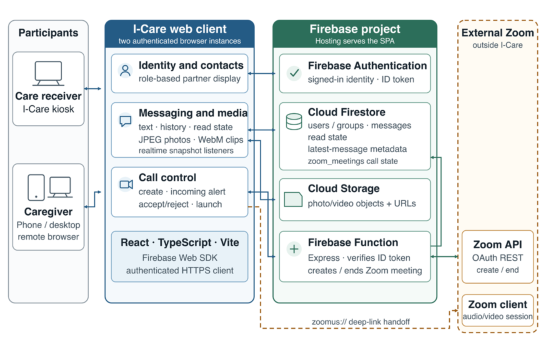
I-Care is a responsive React, TypeScript, and Vite single-page application served by Firebase Hosting; each participant used a separate browser instance. Firebase Authentication provides the signed-in identity. In the client, a role-specific filter uses the user relationship field to determine which partner accounts are displayed with a personal image and name. As shown in Figure 1, Firestore snapshot listeners synchronize users and groups, ordered messages, read and latest-message metadata, and Zoom meeting state. Cloud Storage holds photograph and video objects referenced by the message documents.
For video calls, the browser sends an HTTPS request with its Firebase ID token to an Express application deployed as a Firebase Function. The middleware verifies the token, creates or ends the meeting through the Zoom REST API, and writes meeting state under the corresponding Firestore conversation. Both clients observe that state in real-time; initiating or accepting the call then launches the external Zoom client through a deep link. The study assessed functional usability, not privacy or security.
Figure 1: Study-period I-Care messaging architecture. Double-headed arrows denote authenticated client–Firebase exchange; the Function controls Zoom through its REST API and writes meeting state to Firestore; the dashed path denotes the external deep- link handoff.
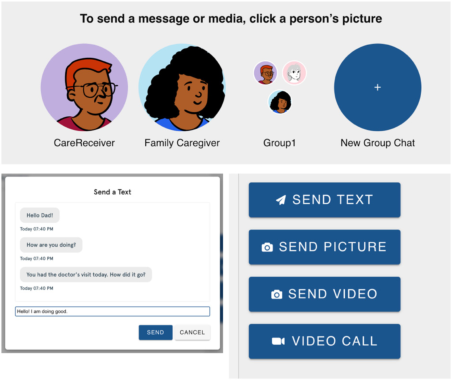
Conversation and Media Workflow Selecting a contact opens one view for reading, composing, and reviewing history. Text submission updates both the message collection and latest- message metadata; notifications open the associated conversation. For photographs, the browser camera captures a nominal 640 × 480 JPEG and offers retake or send. Short videos are recorded as WebM clips. After preview and Cloud Storage upload, a typed media message is appended to the same thread, keeping text and visual context together. Figure 2 illustrates the contact, composition, and action states exercised by the field tasks.
Figure 2: Representative I-Care workflow. Panel (a) shows relationship-based contact selection, panel (b) shows text composition with conversation context, and panel (c) shows integrated text, photograph, recorded-video, and video-call controls. Screens contain synthetic accounts and messages and no participant-identifiable information.
Evaluating Integrated Multimedia Communication Designed for Cognitive Accessibility 2285 Video-Call Workflow
The call control requests meeting information through the authenticated Function. Creation of a Firestore meeting document triggers the recipient’s incoming-call dialog; the recipient can accept or reject. Initiation or acceptance assigns the Zoom deep link to the browser location, handing control to the Zoom client. The task therefore crosses an application boundary, and return depends on the device preserving a usable path back to I-Care.
METHODS
Study Design and Participants We conducted a formative field-usability study in participants’ homes after approximately six months of exposure to I-Care. Eligibility required being at least 60 years old, having mild difficulty with memory or thinking, and having a study partner who lived separately. Two caregiver–care receiver dyads participated (N = 4). Both care receivers were in their late 80s and their adult children caregivers were in their early-mid 60s. Cognitive impairment was established using Montreal Cognitive Assessment scores (Nasreddine et al., 2005), with care receivers scoring within 21–24. We use labels Dyad 1 and Dyad 2 to limit disclosure.
Procedure Research staff facilitated and observed the sessions in person. Both care receivers accessed I-Care through the deployed kiosks in their homes. The Dyad 1 caregiver used an iOS phone, while the Dyad 2 caregiver used a desktop computer and Android phone. The session began with participants describing their current communication practices. Next, a research staff read each task to be completed and timed the attempt. The observer recorded task accuracy outcome, time to complete task, confusion, and any need for assistance. Guidance was provided when a participant could not continue and was distinguished from independent completion.
Care receivers completed seven fixed-order tasks. (1) They navigated to the I-Care’s messaging portal; (2) located their caregivers image and clicked on it; (3) read a message; (4) replied “I am okay;” (5) opened a photograph; (6) initiated a video call; and (7) ended the call and returned to I-Care. Caregivers (1) navigated to the I-Care’s messaging portal; (2) located their care receivers image and clicked on it; (3) located the conversation and sent text, photograph, and video content; (4) initiated a call and returned to I-Care.
Role-specific, investigator-developed ratings used a five-point Likert scale ranging from 1=strongly disagree, to 5=strongly agree. Care-receiver items addressed ease, comfort, confidence, finding the intended person or content, and connection. Caregiver ite ms addressed learning, clarity, check-ins, emotional connection, and cognitive suitability. Separate forced-choice questions compared I-Care with their current method of communication as experienced; the comparison did not hold communication modality or device
constant. A follow-up timed telephone call initiation and termination with their familiar device was completed. These observations only contextualize the call workflow.
Measures and Analysis Outcomes were independent, guided, or incomplete task; time on task; and observed barriers. We report participant-level values and descriptive statistics without inference. Post-task averages weight valid item responses equally; they are exploratory summaries, not validated scale scores. The caregiver average summarizes 18 of 20 planned item responses. There were two unrated video-call responses due to lack of caregivers’ device preserving a usable path back to I-Care when a call was ended. This did not interfere with quality or completion of the call. Notes were summarized descriptively, and no formal qualitative analysis was performed.
Ethics The study was approved by the University of California, Davis Institutional Review Board. All participants provided consent.
RESULTS
Current Communication Practices Both dyads primarily used voice calls several times per day; Dyad 2 also used FaceTime. Reported barriers included solicitation calls, misplaceing mobile phone, difficulty explaining information by telephone, and inconsistent phone checking. Care receivers nevertheless described calls as the easiest or most straightforward familiar option.
I-Care Task Performance Care receivers completed 11 of 12 tasks independently and one with guidance, for 12 of 12 total completions. The Dyad 2 care receiver required help finding the control to end Zoom and return to I-Care. Median times for locating, reading, replying, opening a photograph, initiating a call, and returning were 15.5, 12.5, 38.5, 3.0, 64.0, and 69.0 seconds, respectively; the last value combines one independent and one guided completion.
Caregivers completed 10 of 12 tasks, or 83.3%. They completed all text and media tasks, but neither end-call-and-return task. The Dyad 1 caregiver reached initiation in 14.5 seconds, after which Safari reported an invalid Zoom link. The Dyad 2 caregiver reached initiation in 22 seconds but could not complete the Zoom return workflow due to non-user technical issues. Failures therefore occurred at the external call boundary.
Table 1: I-Care task completion time and outcome by dyad.
Open photograph 4/C 2/C Initiate video call 77/C 51/C
End call and return to messaging 21/C 117/G Caregiver Task Dyad 1 Dyad 2
Locate and open conversation 0/Ca 8/C Send text message 17/C 6/C
Send photograph 46/C 45/C Send short video 65/C 31/C
Initiate video call 14.5/Cb 22/C End call and return to messaging —/I —/I
Note. Times are reported in seconds. C indicates independent completion, G indicates completion with guidance, and I indicates incomplete. a The recorded 0-second value reflects immediate completion because the Dyad 1 caregiver was already on the Messaging page when timing began. b I-Care initiation completed, but Safari did not open a valid Zoom link.
Familiar-Method Call Benchmark Care receivers initiated familiar calls in 30.32 and 38.22 seconds and ended them in 4.55 and 9.01 seconds. Caregivers initiated them in 23.11 and 11.63 seconds. One caregiver termination was unrecorded, and the other was 1.68 seconds. I-Care initiation took 51–77 seconds for care receivers and 14.5–22 seconds for caregivers, but different modalities, devices, and two dyads preclude a performance comparison.
Ratings and Stated Preference Exploratory item responses were generally favorable. Table 2 reports participant-level descriptive averages and valid-item counts for transparency. The values are not validated scale scores or estimates of acceptability, and the caregiver summary excludes the video-call item left unrated by each caregiver following the unsuccessful Zoom workflows.
Table 2: Exploratory descriptive averages.
Table available in the original PDF paper.
Role Dyad 1 Dyad 2 Pooled Mean Valid Items Care receiver 3.90 4.00 3.95 20/20
Caregiver 4.56 4.89 4.72 18/20 Note. Scores are on a five-point Likert scale ranging from 1=strongly disagree, to 5=strongly agree
Both care receivers preferred their current method, citing experience and familiarity. For caregiver suitability, Dyad 1 selected the current method and Dyad 2 selected both as equal; no participant selected I-Care alone. Ease
responses were mixed. One care receiver selected I-Care and the other selected the current method; caregivers chose the current method or rated both methods equally. One care receiver requested hands-on training. Caregivers identified Zoom as difficult, suggested an application rather than a website, and requested a repaired call path. These comparisons describe the systems as experienced; they cannot separate familiarity from differences in voice versus video, device demands, or the observed call-path failures.
DISCUSSION
Principal Findings Care receivers independently completed contact, text, photograph, and call- initiation tasks, supporting the formative usability of the picture-first contact view and persistent thread in these deployments. Caregivers completed every asynchronous task, but neither full call-return pathway. The observed failures occurred after participants reached the I-Care call controls. One was a Safari- specific invalid-link event that may be correctable through link configuration or browser handling; the other involved an unsuccessful return from Zoom. These cases do not establish that external handoffs are intrinsically unusable. They expose a broader dependency class in which completion relies on deep- link resolution, third-party client state, and a recoverable path back to I-Care.
Call ending and facilitation are known accessibility concerns (Boman et al., 2014; Hardy et al., 2022). The most visible failures occurred for caregivers. An accessible care-receiver interface is insufficient when a remote partner encounters an invalid link or loses the return path. Evaluation must span the dyad and every service boundary. Likewise, the forced-choice results show only that I-Care did not displace current methods under these study conditions. Because the comparison bundled platform familiarity, modality, device, and reliability, it cannot isolate a general preference for familiar technology or lower cognitive load.
Design Implications Own the complete call lifecycle. The immediate priority is to repair and regression-test the observed defects through link validation, browser- appropriate deep-link configuration, and a fallback when the external client does not open. The broader design requirement is recovery across the transition. The interface should expose ringing, connected, ended, failed, and returned states; preserve conversation state; and provide a persistent return. In-platform calling could reduce handoff cost but needs accessibility, privacy, and reliability testing.
Preserve partner and conversation context. Retain recognizable contact tiles, selected-partner identity, chronological history, and text and media in one thread. Recovery should restore that context; errors should state what happened and offer one next action.
Design for progressive adoption. Because participants invoked experience and familiarity, deployment should complement the telephone, provide hands-on training, and introduce modalities gradually. This accords with
Evaluating Integrated Multimedia Communication Designed for Cognitive Accessibility 2289 evidence that familiar forms and routines influence use (König et al., 2022; Lariviere et al., 2021). Longitudinal data must test whether preference changes.
Treat the caregiver environment as part of accessibility. Test browser and device variation in permissions, deep links, and session resumption. Automated state tests should be paired with device-level tasks because the Safari failure occurred beyond the core message store.
Limitations Two deployment dyads cannot represent diverse cognitive profiles, relationships, devices, or technology experience. Clinical diagnoses, fuller cognitive and demographic characterization, and relevant technology experience were unavailable. Fixed task order, moderator presence, and guidance may have affected performance. Ratings were investigator- developed, and both caregivers left the video-call ease item unrated following the unsuccessful Zoom workflows. Open responses were not formally coded. Familiar-method timing was incomplete, and preference comparisons contrasted unmatched combinations of voice, video, device, and platform. The Safari event may reflect a correctable implementation defect rather than a general limitation of external handoffs. With two dyads, this study identifies failure modes but cannot estimate their prevalence. It measured initial performance, not adoption, burden, or clinical benefit.
A subsequent dyadic study should use a larger, characterized sample, established usability measures, and modality-matched comparison tasks. Longitudinal logs and interviews are then needed to test adoption, caregiver burden, and whether preferences change with training and use.
CONCLUSION
This two-dyad proof of concept supports continued development, rather than abandonment, of I-Care for communication. Completion of every text and visual-media task and most call tasks suggests near-term utility as a complementary channel for persistent information and caregiver check-ins, not as a replacement for familiar telephone use or in-person socializaiton. Broader deployment requires reliable end-to-end calling, participant training, and larger longitudinal studies of adoption, caregiver burden, connection, and care coordination.
ACKNOWLEDGMENT
The authors thank the study participants and their families for their time and generous contributions to this research. This project was supported by the NIH funding NIA 1K23AG080152-01 and NIBIB 1R01EB041352-01. The content is solely the authors’ responsibility and does not necessarily represent official NIH views.
REFERENCES
Astell, A. J., Ellis, M. P., Bernardi, L., Alm, N., Dye, R., Gowans, G., and Campbell, J.
(2010). Using a touch screen computer to support relationships between people with dementia and caregivers. Interacting with Computers, 22(4), 267–275. https://doi.org/10.1016/j.intcom.2010.03.003 Aswar, S., Weakley, A. T., Koppolu, P., Farias, S. T., and Weakley, A. (2026). A plugand-play desktop system for remote care of older adults with Alzheimer’s disease. In J. Kalra (Ed.), Human Factors in Aging and Special Needs (Vol. 214, pp. 85–95). AHFE International. https://doi.org/10.54941/ahfe1007576 Boman, I.-L., Rosenberg, L., Lundberg, S., and Nygård, L. (2012). First steps in
designing a videophone for people with dementia. Identification of users’ potentials and the requirements of communication technology. Disability and Rehabilitation: Assistive Technology, 7(5), 356–363. https://doi.org/10.3109/17 483107.2011.635750 Boman, I.-L., Lundberg, S., Starkhammar, S., and Nygård, L. (2014). Exploring the usability of a videophone mock-up for persons with dementia and their significant others. BMC Geriatrics, 14, 49. https://doi.org/10.1186/1471-2318-14-49 Czaja, S. J., Charness, N., Fisk, A. D., Hertzog, C., Nair, S. N., Rogers, W. A., and
Sharit, J. (2006). Factors predicting the use of technology. Findings from the Center for Research and Education on Aging and Technology Enhancement. Psychology and Aging, 21(2), 333–352. https://doi.org/10.1037/0882-7974.21.2.333 Gibson, G., Dickinson, C., Brittain, K., and Robinson, L. (2015). The everyday use of assistive technology by people with dementia and their family carers. A qualitative study. BMC Geriatrics, 15, 89. https://doi.org/10.1186/s12877-015-0091-3 Hardy, M.-S., Fanaki, C., Savoie, C., et al. (2022). Acceptability of videoconferencing
to preserve the contact between cognitively impaired long-term care residents and their family caregivers. A mixed-methods study. Geriatric Nursing, 48, 65–73. https://doi.org/10.1016/j.gerinurse.2022.09.006 Joddrell, P., and Astell, A. J. (2016). Studies involving people with dementia and touchscreen technology. A literature review. JMIR Rehabilitation and Assistive Technologies, 3(2), e10. https://doi.org/10.2196/rehab.5788 König, T., Pigliautile, M., Àguila, O., et al. (2022). User experience and acceptance
of a device assisting persons with dementia in daily life. A multicenter field study. Aging Clinical and Experimental Research, 34, 869–879. https://doi.org/10.1007/ s40520-021-02013-8 Lariviere, M., Poland, F., Woolham, J., et al. (2021). Placing assistive technology and telecare in everyday practices of people with dementia and their caregivers. Findings from an embedded ethnography of a national dementia trial. BMC Geriatrics, 21, 121. https://doi.org/10.1186/s12877-020-01896-y Meiland, F., Innes, A., Mountain, G., et al. (2017). Technologies to support
community-dwelling persons with dementia. A position paper on development, usability, effectiveness, deployment, and ethics. JMIR Rehabilitation and Assistive Technologies, 4(1), e1. https://doi.org/10.2196/rehab.6376 Mitzner, T. L., Savla, J., Boot, W. R., et al. (2019). Technology adoption by older adults. Findings from the PRISM trial. The Gerontologist, 59(1), 34–44. https:// doi.org/10.1093/geront/gny113 Nasreddine, Z. S., Phillips, N. A., Bédirian, V., et al. (2005). The Montreal Cognitive
Assessment, MoCA. A brief screening tool for mild cognitive impairment. Journal of the American Geriatrics Society, 53(4), 695–699. https://doi.org/10.1111/ j.1532-5415.2005.53221.x
Evaluating Integrated Multimedia Communication Designed for Cognitive Accessibility 2291 Pimento, S. N., Agarwal, H., Minor, B., Karia, S., Cook, D., Schmitter-Edgecombe, M.,
Farias, S. T., Lorabi, R., and Weakley, A. (2024). Interactive-Wear. An intelligent watch application to aid memory for intentions and everyday functioning in older adults with cognitive impairments. In 2024 IEEE First International Conference on Artificial Intelligence for Medicine, Health and Care (pp. 145–152). IEEE. https://doi.org/10.1109/AIMHC59811.2024.00033 Topo, P. (2009). Technology studies to meet the needs of people with dementia and their caregivers. A literature review. Journal of Applied Gerontology, 28(1), 5–37. https://doi.org/10.1177/0733464808324019 Tsai, H.-H., and Tsai, Y.-F. (2010). Older nursing home residents’ experiences
with videoconferencing to communicate with family members. Journal of Clinical Nursing, 19(11–12), 1538–1543. https://doi.org/10.1111/j.1365- 2702.2010.03198.x Vikström, S., Josephsson, S., Stigsdotter-Neely, A., and Nygård, L. (2008). Engagement in activities. Experiences of persons with dementia and their caregiving spouses. Dementia, 7(2), 251–270. https://doi.org/10.1177/1471301208091164 Wang, J., Fu, Y., Lou, V., Tan, S. Y., and Chui, E. (2021). A systematic review of
factors influencing attitudes towards and intention to use long-distance caregiving technologies for older adults. International Journal of Medical Informatics, 153, 104536. https://doi.org/10.1016/j.ijmedinf.2021.104536 Weakley, A., Pimento, S., Gohil, A., Hegde, P., Kaur, A., Koppolu, P., Agarwal, H., Yadav, P., Patil, T., Weakley, A. T., and Tomaszewski Farias, S. (2025). Promoting autonomy in older adults with cognitive impairment. Co-designing an interactive calendar for memory support. In T. Ahram, W. Karwowski, and J. Kalra (Eds.), Human Factors in Design, Engineering, and Computing (Vol. 199, pp. 1616– 1627). AHFE International. https://doi.org/10.54941/ahfe1006972 Yadav, P., Agarwal, H., Koppolu, P., et al. (2026). Bounded delegation of a large
language model in a conversational agent for dementia support. Paper accepted at the AIxMHC 2026 AIS Workshop.
SEARCH THE AHFE DIGITAL BOOKSTORE BY ISBN
Explore the complete digital volume
Human Factors in Design, Engineering, and Computing
Read this individual research paper free through the original publisher, or explore the full digital proceedings book.