With a growing aging population with cognitive impairment, there is increasing emphasis on developing caregiving interventions that support aging-in-place. In this paper, we focus on a video call feature designed specifically for older adults living alone with cognitive impairment to support connection, remote assistance and intervention. A custom Zoom Workplace Pro application was integrated within a caregiving platform displayed in kiosk mode on a computer within participants' homes. The application was configured for easy connection, screen sharing, and remote control of the users’ screen. Our feasibility pilot study included 2 older adults with mild-to-moderate cognitive impairment and low-to-moderate technology experience. To assess the accessibility of the video call feature, we evaluated the accuracy and time it took participants to complete specific tasks prompted by an examiner (e.g., answer calls, make calls, and share screen). Post testing, participants completed a questionnaire to evaluate Perceived Ease of Use, Perceived Usefulness, and Intention to Use. Regarding results, users completed each task with 100% accuracy within approximately one minute and provided high ratings on Perceived Ease of Use. By eliminating the need to navigate between external applications or web browsers, we observed successful and rapid task completion. Participants identified screensharing as a high-value tool for both technical support and family communication. These findings provide a compelling framework for future caregiving interventions, particularly in rural or remote settings where in-person training and troubleshooting are limited.
Cognitive impairment related to Alzheimer’s disease and Alzheimer’s disease related dementia (AD/ADRD) limits individuals’ ability to age-in-place, a strong desire for many older adults (Pradipta & Adianto, 2025; Portacolone & Cohen, 2024). Well-designed assistive technology has the potential to promote independence in individuals with AD/ADRD (Albarqi, 2024; Azizan, Endrini, & Abdullah, 2025; Ciarmoli, 2022); yet, tools that support
Streamlining Remote Care: Computer Access Solutions for Older Adults 2261 remote care, assistance, and intervention from a distance are currently lacking. Our team is addressing this gap with Interactive-Care (I-Care), a web-based platform designed to support both care receiver independence and remote caregiving (Aswar et al., 2026; Pimento et al., 2024; Weakley et al., 2025; Yadav et al., 2026). I-Care promotes independence for older adults with cognitive impairment and aims to bridge the physical gap in remote caregiving. I-Care eases daily management of medications, events, and other activities through co-designed calendars and to-do lists. This aids with the physical aspect of caregiving that remote caregivers spend much of their time managing (Edwards, 2014). However, caregivers desire digital applications that integrate multiple functions beyond care management in a single tool, including engagement of care recipients in management of their own daily activities and streamlined communication (Williamson, Gorman, & Jimison, 2014).
Regarding communication, family members of individuals with AD/ ADRD struggle to maintain connection with their loved ones because standard phone or video call services, even those that were once familiar, cause confusion and frustration for individuals with AD/ADRD (Dixon et al., 2022; Handrigan, 2026). When communication breaks down, the ripple effects are serious and include failure of adhering to medications and attending medical appointments, higher emergency utilization and increased strain on caregivers (Fonareva & Oken, 2014). Additionally, communication plays a vital role in maintaining social connections, which is important for slowing cognitive decline (Imamura et al., 2025; James, Wilson, Barnes, & Bennett, 2011), and minimizing loneliness, which is prevalent in older adults residing alone (Burholt, Windle, Gott & Morgan, 2020).
Further, previous research showed that lack of communication during COVID caused mental and psychological distress in individuals with dementia (Krendl & Perry, 2021). Importantly, the I-CONECT intervention focused on improving social conversation through online video-chat, have shown improved cognition, fMRI connectivity, and increased social satisfaction in individuals with mild cognitive impairment (Dodge et al., 2024), suggesting that individuals with cognitive impairment can benefit from online social interventions.
While these studies confirm the benefits of communication tools, research also underscores thea importance of dementia-specific design and training (Ambegaonkar, Ritchie, & de la Fuente Garcia, 2021). In recent years, communication technologies have been adapted or developed to support communication for individuals who struggle with making or accepting calls. For example, Amazon’s ‘Care Hub’ allows users to make and receive calls through Alexa voice and caregivers can “drop-in,” by forgoing the requirement for the care receiver to answer the call. While this does make connecting with a family member who lacks the ability to answer possible, notable privacy concerns exist when drop-ins occur when unwanted. Our prior caregiver focus group study results also suggests voice assistants are often discontinued secondary to low accessibility and acceptability by care receivers (Weakley et al., 2025b).
In addition to technology for social communication, technology that can be easily and independently accessed and used for assisting with tasks (e.g., help with setting an appointment), conducting interventions (e.g., user interface training), and evaluations (e.g., assessing mood) is needed, particularly for individuals residing in remote settings. While telemedicine and digital health technology in general is well received among individuals with AD/ADRD, there are considerable barriers to self-administration, with prior research citing limitations regarding burden of technology proficiency and caregiver support (Julie et al., 2021).
This paper focuses on the development and evaluation of a video call feature designed specifically for older adults with cognitive impairment to reduce the challenges present in existing communication tools which require high cognitive load and lack ability to remotely assist older adults with cognitive impairment. We hypothesize that individuals with cognitive impairment will be able to use our custom communication tool and that both care receivers and caregivers will provide positive technology acceptance ratings, including intention to use.
METHODS
We developed a custom Zoom Workplace Pro application programming interface (API) which we integrated within our I-Care caregiving platform. I-Care is accessible to user in their own homes on an all-in-one computer displaying I-Care in kiosk mode (see Aswar et al., 2026 for details). Once signed in, the user does not need to recall passwords or how to navigate to I-Care, thereby reducing reliance on memory and executive functions, which are impacted by individuals with AD/ADRD. Two older adults (both aged 88) with mild-to-moderate cognitive impairment (Montreal Cognitive Assessments score of 21–24) and low-to-moderate technology experience evaluated the video call feature.
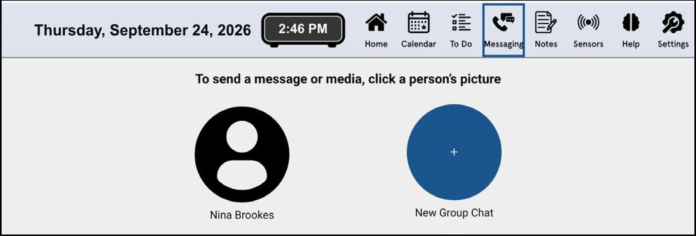
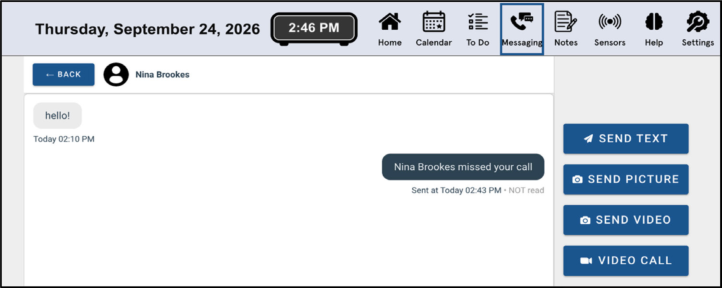
System Design and Architecture The video-call feature was implemented through a coordinated workflow between the I-Care web interface, I-Care middleware, Cloud Firestore, Zoom Workplace, and the care receiver’s kiosk computer. Video calls are initiated from the Messaging interface (see Figure 1) by selecting a contact and then pressing the video-call button (Figure 2). After confirmation, I-Care sends an authenticated request to its middleware, which uses Zoom Server-to- Server OAuth and the Zoom REST API to create an instant meeting. Meeting information and call status are then stored in Cloud Firestore. The receiving user’s I-Care session monitors these meeting records and, when a new active call is detected, presents an incoming-call notification with an audible ringtone and on-screen options to accept or decline the call. Accepting the call opens the associated Zoom meeting through a deep link, allowing the call to be initiated and answered through I-Care without requiring users to independently locate or configure a Zoom meeting.
Figure 1: Interactive-care messaging interface.
For care receivers, I-Care and Zoom Workplace were configured on a the provided all-in-one computer operating in kiosk mode at the participant’s home. I-Care remains continuously available through a Chromium kiosk session, while Zoom runs as a companion application in the background. Zoom protocol handlers allow meeting links initiated from I-Care to open directly in the Zoom client. After the meeting window closes, the kiosk configuration minimizes the remaining Zoom interface and returns focus to I-Care. This setup reduces the navigation required before and after a call and returns the care receiver to the familiar I-Care interface rather than leaving them within the external conferencing application.
Figure 2: Interactive-care contact interface.
During an active meeting, participants are asked to use Zoom Workplace’s screen-sharing and remote-control capabilities. Screen sharing enables a caregiver to view the care receiver’s I-Care interface, while remote control, when granted by the care receiver, enables the caregiver to interact with that computer remotely. These functions allow caregivers to assist with I-Care activities directly rather than relying solely on verbal instructions. Screen sharing and remote control are provided by Zoom Workplace rather than implemented as separate I-Care functions; the I-Care integration manages the meeting lifecycle and the transition between the caregiving interface and the Zoom session.
Evaluation To assess the video call feature, we evaluated the accuracy and time (in seconds) it took the participant to complete specific tasks prompted by an examiner (e.g., answering calls, making calls, and screen sharing). There were two sessions, one between participant with examiner and another between participant with their study partner (adult child caregiver). The examiner connected with the participant via a laptop computer and caregivers connected with the care receiver via their phone’s I-Care webapp. The participants were asked to complete the following tasks during each session: (1) start a video call by navigating to the messaging page, click on the examiner or study partner profile, then click the video call button; (2) once the call is accepted, click screenshare and provide remote control access once requested; (3) end call; and (4) accept call from examiner/study partner.
Post testing, participants completed a modified version of the Technology Acceptance Model (TAM; see Table 2) questionnaire which included Likert ratings (1–5, 5 being very high) based on Perceived Ease of Use (i.e., making and answering video calls is straightforward), Perceived Usefulness (i.e., the video call feature provides an effective way to communicate), and Intention to Use (i.e., I plan to use the video call feature to stay in touch with my caregiver). Additionally, caregivers also completed a TAM questionnaire modelled by their use of the video call feature.
RESULTS
Users successfully completed each task (100% accuracy) within less than 2 minutes in the initial session with the examiner. Specifically, they were able to receive calls (M = 37.19; Range: 12.32–62.05) and make calls (M = 82.65; Range: 47.36–117.93) in an appropriate manner. Importantly, users were also able to share their screen with minimal instruction and accept requests for remote control (M = 67.59; Range: 38.87–96.30). Additionally, users were able to end calls in around a minute (M = 66.25; Range: 46.38–86.11).
During the second session, between the participant and their caregiver, all tasks (100%) were again successfully completed within one approximately minute or less. Specifically, they were able to receive calls (M = 44; Range: 36–52) and make calls (M = 45.98; Range: 32.45–59.5) in an appropriate manner. Importantly, users were able to share their screen with minimal instruction and accept requests for remote control (M = 43.40; Range: 11.67–75.12). Additionally, users were able to independently end calls (M = 52.04; Range: 36.43–67.65).
Table 1: Task completion.
Table available in the original PDF paper.
Participant With Examiner Participant With Caregiver Making Calls 82.65 (47.36–117.93) 45.98 (32.45–59.5)
Screensharing 67.59 (38.87–96.30) 43.40 (11.67–75.12) Note. Average times in seconds are displayed and the range is in parentheses.
Streamlining Remote Care: Computer Access Solutions for Older Adults 2265 The Video Call feature was generally rated as high for perceived ease of use for making and answering calls (M = 4.5; Range: 4–5) by the care receiver (see Table 2). Other features, including sharing screen (M = 4.25; Range: 3.5–5) and giving remote control access (M = 4; Range: 3–5), received high ratings for ease of use. Furthermore, users rated the feature highly for being able to use the feature without extensive help (M = 4; Range: 3–5). Overall, users rated the usefulness of the video call feature high as an effective method for learning how to use caregiver technology (M = 5; Range: 5–5) and communicating with family and friends (M = 4.5; Range: 4–5). Participants rated high intention to use the video call to stay in touch with their caregiver (M = 4; Range: 4–4). However, participants were mixed on their intention to use the screen share (M = 3; Range: 2–4) and remote-control features (M = 2.5; Range: 2–3). This was driven by the reasoning that one participant has very low experience with technology and did not feel comfortable enough to use such features. They felt it was very new for them and would take some time to get used to it compared to their current communication method (i.e. telephone).
Table 2: TAM questionnaire – care receiver.
Table available in the original PDF paper.
Category Question Rating 4.5 (4–5) Perceived Ease of Use I find making and answering video calls through I-CARE straightforward
4.25 (3.5–5)
I was able to share my screen without needing extensive help.
4 (3–5)
I was able to give remote control access without needing extensive help.
4 (3–5)
I can navigate through the video call features without needing extensive help.
5 (5–5)
Perceived Usefulness
Remote control of my screen provides an effective method for reviewing I-Care functions with staff and learning how to use I-Care.
4.5 (4–5)
The video call feature provides an effective way to communicate with friends/family.
Intention to Use I plan to use the video call feature to stay in touch
4 (4–4)
with my caregiver.
I plan to use the screen share feature. 3 (2–4) I plan to use the remote control feature. 2.5 (2–3)
Note. (1 = disagree; 2 = somewhat disagree; 3 = neutral; 4 = somewhat agree; 5 = agree); Mean (Range) Regarding caregivers’ technology acceptance of the Video Call feature (See Table 3), both caregivers strongly agreed that making and answering calls was easy (M = 5; Range: 5–5). Other features, including sharing screen and requesting remote control access (M = 4.5; Range: 4–5) received high ratings for ease of use. Caregivers also provided the highest positive rating for care receivers ability to use the feature without extensive help (M = 5; Range: 5–5). Overall, users rated the usefulness of the video call feature high as an effective method for learning how to use caregiver technology (M = 5; Range: 5–5) and communicating with care receivers (M = 5; Range: 5–5).
Participants rated highly on their intention to use the video call to stay in touch with their caregiver (M = 5; Range: 5–5). Additionally, participants indicated a high intention to use the screen share (M = 5; Range: 5–5) and remote-control features (M = 4.5: Range: 4–5). Finally, caregivers endorsed appreciation for the flexibility of being able to connect with their care receiver via the webapp either on their computer or phone.
Table 3: TAM questionnaire - caregiver.
Table available in the original PDF paper.
Category Question Rating 5 (5–5) Perceived Ease of Use I find making and answering video calls through I-CARE straightforward
4.5 (4–5)
I was able to request remote control access without needing extensive help.
5 (5–5)
I can navigate through the video call features without needing extensive help.
5 (5–5)
Perceived Usefulness
Remote control of my screen provides an effective method for reviewing I-Care functions with staff and learning how to use I-Care.
5 (5–5)
The video call feature provides an effective way to communicate with the care receiver.
Intention to Use I plan to use the video call feature to stay in touch
5 (5–5)
with the care receiver.
I plan to use the screen share feature. 5 (5–5) I plan to use the remote control feature. 4.5 (4–5)
Equation reproduced from the original PDF.
DISCUSSION
We successfully developed and integrated a custom Zoom Workplace API that allowed video calling to occur within the confines of I-Care. The goal of this integration was to reduce the use of multiple interfaces and navigation steps, while eliminating the need to recall separate logins which would limit accessibility for individuals with cognitive impairment.
This pilot study involving 2 care dyads demonstrated that older adults with mild to moderate cognitive impairment can successfully navigate an integrated video call feature independently. Remarkably, participants completed tasks with 100% accuracy within less than two minutes and with low frustration. Importantly, care receiver participants rated the messaging tool’s ease of use as high, and they identified screen-sharing as a high-value tool for both technical support and family communication. Despite this, the intention to use in the future was mixed. This result may be driven by one participant’s lack of technology use, noting that they would prefer phone calls because the video call feature felt “too new” for them.
Caregivers also provided information on the usability of the video call feature. Caregivers rated the video call feature highly on ease of use, listing no issues in their or their care receiver’s navigation through the different
Streamlining Remote Care: Computer Access Solutions for Older Adults 2267 features, including the screen sharing and remote-control access. Caregivers also rated the system high on perceived usefulness of the video call feature, including using screen sharing and remote-control access, as an effective method for staying in touch with their care receiver and for technical support. Additionally, the caregivers emphasized the video call feature as a tool they would intend to use in the future to communicate with the care receiver and to navigate through I-Care on. Caregivers that the ability to call on I-Care with their mobile phone was helpful for them. In a follow-up interview, one caregiver noted how by reducing the use of multiple interfaces and the addition of alarms would provide an easier method for communication compared to a smartphone or landline.
Limitations Considering that this was a feasibility pilot study, our cohort size was limited to just 2 dyads. We aim expand this cohort size in follow-up efficacy studies. This study was also limited to just 2 interactions with the video feature. Future studies will also examine real world use of the feature following training to further assess acceptability and intent to use. A limitation to the messaging system is that participants were required to manually complete the tasks through a multistep, albeit simplified, process. In the future we will examine utilizing our agentic-AI chatbot system to assist with this process (Yadav, 2026).
CONCLUSION
By eliminating the need to navigate between external applications or web browsers, we observed that older adults with cognitive impairment can independently and rapidly connect with family members with 100% accuracy. This pilot study validates the benefits of integrated system design in reducing cognitive load and enhancing accessibility and acceptability among older adults with cognitive impairment and their caregivers. These findings provide a compelling framework for future caregiving interventions, particularly in rural or remote settings where in-person communication, training, and troubleshooting are limited and digital accessibility is essential.
ACKNOWLEDGMENT
The authors acknowledge the participants who provided invaluable guidance and suggestions. This project was supported by the NIH funding NIA 1K23AG080152–01 and NIBIB 1R01EB041352–01. The content is solely the authors’ responsibility and does not necessarily represent official NIH views.
REFERENCES
Albarqi, M. N. (2024, October). Exploring the effectiveness of technology-assisted interventions for promoting independence in elderly patients: A systematic review. In Healthcare (Vol. 12, No. 21, p. 2105). MDPI.
Ambegaonkar, A., Ritchie, C., & de la Fuente Garcia, S. (2021). The use of mobile applications as communication aids for people with dementia: Opportunities and limitations. Journal of Alzheimer’s Disease Reports, 5(1), 681–692. Aswar, S., Weakley, A., Koppolu, P., Farias, S., Weakley, A. (2026). A Plug-and-
Play Desktop System for Remote Care of Older Adults with Alzheimer’s Disease. In: Jay Kalra (eds) Human Factors in Aging and Special Needs. AHFE (2026) International Conference. AHFE Open Access, vol 214. AHFE International, USA. Azizan, P. D. A., Endrini, P. D. S., & Abdullah, P. D. K. H. (2025). A research landscape analysis on alzheimer’s disease and gerontechnology: Identifying key contributors, hotspots, and emerging trends. Archives of Gerontology and Geriatrics Plus, 2(1), 100125. Burholt, V., Windle, G., Gott, M., & Morgan, D. J. (2020). Technology-mediated
communication in familial relationships: Moderated-mediation models of isolation and loneliness. The Gerontologist, 60(7), 1202–1212. Ciarmoli, D. (2022). Assistive Technology for Promoting the Independence and the Quality of Life in Persons With Alzheimer’s Disease: A Selective Review. Assistive Technologies for Assessment and Recovery of Neurological Impairments, 173–195. Dixon, E., Michaels, R., Xiao, X., Zhong, Y., Clary, P., Narayanan, A., ... & Lazar, A.
(2022, October). Mobile phone use by people with mild to moderate dementia: uncovering challenges and identifying opportunities: Mobile phone use by people with mild to moderate dementia. In Proceedings of the 24th International ACM SIGACCESS Conference on Computers and Accessibility (pp. 1–16). Dodge, H. H., Yu, K., Wu, C. Y., Pruitt, P. J., Asgari, M., Kaye, J. A., ... & Silbert, L. C.
(2024). Internet-based conversational engagement randomized controlled clinical trial (I-CONECT) among socially isolated adults 75+ years old with normal cognition or mild cognitive impairment: topline results. The Gerontologist, 64(4), gnad147. Edwards M. Distance Caregivers of People with Alzheimer’s Disease and Related Dementia: A Phenomenological Study. British Journal of Occupational Therapy. 2014;77(4):174–180. Fonareva, I., & Oken, B. S. (2014). Physiological and functional consequences 385
of caregiving for relatives with dementia. International Psychogeriatrics, 26(5), 386 725–747. Handrigan, G. (2026). Smartphone use in older adults with dementia. Canadian Family Physician, 72(4), 249. Imamura, K., Kawai, H., Ejiri, M., Sasai, H., Ihara, K., Nakada, H., ... & Obuchi,
S. (2025). Association between the use of information and communication technology and cognitive decline stratified by social isolation: The otassha study. The Journal of Prevention of Alzheimer’s Disease, 12(6), 100138. James, B. D., Wilson, R. S., Barnes, L. L., & Bennett, D. A. (2011). Late-life social activity and cognitive decline in old age. Journal of the International Neuropsychological Society, 17(6), 998–1005. Julie, S. Y., Pittman, C. A., Price, C. L., Nieman, C. L., & Oh, E. S. (2021). Telemedicine
and dementia care: a systematic review of barriers and facilitators. Journal of the American Medical Directors Association, 22(7), 1396–1402. Krendl, A. C., & Perry, B. L. (2021). The impact of sheltering in place during the COVID-19 pandemic on older adults’ social and mental well-being. The Journals of Gerontology, Series B: Psychological Sciences and Social Sciences, 76(2), e53–e58.
Streamlining Remote Care: Computer Access Solutions for Older Adults 2269 Pimento, S., Agarwal, H., Minor B., Karia, S., Cook., D., Schmitter-Edgecombe, M.,
Tomaszewski Farias, S., Lorabi, R., Weakley, A. (2024). Interactive-Wear: An intelligent watch application to aid memory for intentions and everyday functioning in older adults with cognitive impairments. Paper Published in IEEE’s Inaugural International Conference on Artificial Intelligence in Medicine, Health, and Care conference proceedings. Portacolone, E., & Cohen, A. B. (2024). Living Alone With Dementia: A Reality 411 Check. The American Journal of Geriatric Psychiatry, 32(11), 1322–1324. Pradipta, A. N., & Adianto, J. (2025). The Binding Factor for “Aging In Place”:
A Literature Review. International Journal of Built Environment and Scientific Research, 9(1), 11–22. Weakley, A., Pimento, S., Gohil, A., Hegde, P., Kaur, A., Koppolu, P., Agarwal, H., Yadav, P., Patil, T., Weakley, A. T., Tomaszewski Farias, S. (2025a). Promoting Autonomy in Older Adults with Cognitive Impairment: Co-Designing an Interactive Calendar for Memory Support. In: Tareq Ahram, Waldemar Karwowski and Jay Kalra (eds) Human Factors in Design, Engineering, and Computing. AHFE (2025) International Conference. AHFE Open Access, vol 199. AHFE International, USA. Weakley, A., Park, R., Sangrawiakararat, P., Namboodiri, S., Farias, S. T., Mohammed,
O., Brown, B., Meyer, M., & Hinton, L. (2025b). Technology use patterns, preferences, and desires of non-co-residing family members caring for older individuals with memory impairment. Presented at the fifty-third International Neuropsychological Society, New Orleans, Louisiana. Williamson SS, Gorman PN, Jimison HB (2014). A mobile/web app for long distance caregivers of older adults: functional requirements and design implications from a user centered design process. AMIA Annu Symp Proc, 2014, 1222–1231. Yadav, P., Cohn, M., Koppolu, P., Agarwal, H., Gohil, A., Patil, T., Pimento, S., &
Weakley, A. (2026). AI-Care: A conversational agentic system for task coordination in Alzheimer’s disease care. Proceedings of IEEE Connected Health: Applications, Systems and Engineering Technologies (IEEE CHASE). Yeshua-Katz, D., Shapira, S., Aharonson-Daniel, L., Clarfield, A. M., & Sarid, O. (2023). Matching Digital Intervention Affordances with Tasks: The Case of a Zoom and WhatsApp Mental Health Intervention for Seniors during the COVID-19 Pandemic. Health Communication, 38(3), 499–511.
SEARCH THE AHFE DIGITAL BOOKSTORE BY ISBN
Explore the complete digital volume
Human Factors in Design, Engineering, and Computing
Read this individual research paper free through the original publisher, or explore the full digital proceedings book.