Young Ae Kim, Ikjoon Chang (2026). From Uncertainty to Confidence: Emotional UX and Cross-Cultural Co-Design in Campus Wayfinding. In: Human Factors in Design, Engineering, and Computing. AHFE Open Access, vol. 238, pp. 1129–1141. https://doi.org/10.54941/ahfe1008343
University wayfinding systems frequently develop through incremental additions, creating inconsistent signs, unclear entrances, limited awareness of one's current location, missing information at decision points, and weak connections between exterior and interior navigation. These conditions affect more than efficiency: uncertainty can produce anxiety, hesitation, dependence, and a diminished sense of welcome. This practice-based case study examines how emotional user experience principles can be incorporated into campus wayfinding through Campus Connections: Reimagining the Wayfinding Experience, a collaborative workshop involving graphic and communication design students from the University of South Dakota and Chiba University in Japan. Cross-cultural teams investigated campus facilities through observation, route analysis, emotional journey mapping, collaborative ideation, and prototyping while comparing culturally situated assumptions and negotiating shared design decisions. Preliminary analysis of workshop artifacts and critiques identified recurring challenges at entrances, transitions, decision points, and destinations. The resulting concepts emphasized information hierarchy, repeated confirmation, recognizable landmarks, accessible route guidance, visual continuity, and supportive language. Japanese public wayfinding provided a comparative reference through its frequent use of advance notice, layered cues, and considerate behavioral guidance. The study proposes six connected stages: arrival and place recognition, orientation and awareness of current location, route decision, progress confirmation, recovery from error, and destination recognition. The study presents reassurance as an essential measure of wayfinding quality, emphasizing that users should feel confident, independent, and included throughout their journey.
University campuses are complex public environments rather than closed systems used only by experienced students and employees. Prospective students and families, alumni, event attendees, vendors, community members, and international visitors may enter with little knowledge of building names, institutional abbreviations, parking rules, or interior circulation. Current students, faculty, and staff can also become unfamiliar users when
1130 Kim and Chang departments move, construction changes routes, or events take them into buildings they rarely visit. The wayfinding system must therefore support different levels of familiarity, language proficiency, mobility, sensory ability, cognitive processing, and purpose.
Campus wayfinding often evolves incrementally. Individual buildings acquire new plaques, temporary notices, donor names, departmental identifiers, accessibility signs, digital maps, and event-specific directions at different times and under different administrative units. Although each addition may solve a local problem, the cumulative system can become fragmented. Users may encounter competing names for the same destination, signs that appear after a decision is required, entrances that are visually prominent but restricted, or maps whose orientation does not match the viewer’s position. These gaps increase navigation time and error, but their emotional effects are equally important. A person who cannot determine whether a route is correct may feel exposed, embarrassed, anxious, or dependent on asking for help.
Wayfinding research has traditionally emphasized spatial legibility, decision making, signage, and performance. Lynch (1960) established the importance of paths, edges, districts, nodes, and landmarks in the mental image of an environment. Passini (1984, 1996) described wayfinding as a problem- solving process involving decision plans, environmental information, and the execution of movement. O’Neill (1991) demonstrated that floor-plan complexity and signage influence accuracy, wrong turns, and travel behavior. These foundations remain essential, yet efficiency alone does not explain whether an environment feels welcoming, trustworthy, or safe.
This study examines emotional wayfinding and cross-cultural co-design as interconnected areas of inquiry. It considers how culturally diverse teams translated comparative research into site-specific proposals and how differences in cultural experience, language, campus familiarity, and design education made hidden assumptions visible. The study presents a preliminary wayfinding framework and examines cross-cultural collaboration as a method of situated design learning.
WAYFINDING AS A COGNITIVE AND EMOTIONAL EXPERIENCE Wayfinding is not equivalent to following signs. It requires users to establish a destination, interpret the environment, choose among alternatives, monitor progress, and recover when expectations and surroundings do not match. In Passini’s (1996) account, spatial organization and environmental communication work together: architecture structures the problem, while visual and spatial information helps users solve it. Signage cannot fully compensate for an illegible environment, and a legible building can still become difficult to navigate when its information is inconsistent or poorly timed.
Cognitive demand rises when users must remember unfamiliar abbrevia tions, compare a map with a differently oriented corridor, or decide before sufficient information is visible. Research on architectural legibility indicates that increasing plan complexity can reduce wayfinding performance,
From Uncertainty to Confidence: Emotional UX and Cross-Cultural Co-Design 1131 while well-designed textual and graphic information can support different aspects of travel behavior (O’Neill, 1991). The placement and sequence of information are therefore as important as its visual appearance. A sign encountered after a turn may be accurate yet functionally late. A directory that lists a room without identifying its floor may be complete as a database entry but incomplete as a journey cue.
Emotional design provides another lens. Norman (2004) argues that experience operates across visceral, behavioral, and reflective levels. Applied to wayfinding, visual form and environmental tone shape immediate impressions; clarity and feedback affect behavioral control; and the overall journey influences how users interpret the institution. A visitor who repeatedly receives useful confirmation can build trust in the system. A visitor who reaches a dead end without recovery guidance may interpret the failure not only as a signage problem but also as evidence that the place was not designed with unfamiliar users in mind.
Emotional wayfinding does not add decoration to a functional system. It treats reassurance, autonomy, dignity, and belonging as functional outcomes. Progress confirmation reduces the need to carry uncertainty between decision points. Courteous and direct language can guide behavior without making unfamiliar users feel blamed. Accessibility information provided at the start of a route supports planning and independence; information revealed only at a barrier shifts the burden to the user. The emotional quality of wayfinding is therefore produced through the timing, hierarchy, consistency, and tone of information across the complete journey.
CROSS-CULTURAL CO-DESIGN AS A RESEARCH SETTING The University of South Dakota (USD) x Chiba University Design Workshop used cross-cultural collaboration as both a pedagogical structure and a research setting. Co-design shifts participants from being passive sources of information toward shared creative activity (Sanders and Stappers, 2008). In this project, students did not receive a predetermined visual solution. They collectively observed environments, compared assumptions, negotiated terminology, organized information, and developed prototypes. The teams’ different linguistic and cultural experiences made conventions visible that might otherwise remain unexamined.
Before arriving in South Dakota, the Chiba University students conducted visual research on wayfinding and signage in New York City. They documented how a dense urban environment organizes information through typography, symbols, color, placement, architectural integration, and repeated directional cues. The research was shared as precedent material at the beginning of the workshop, creating a three-context comparison among Japanese public wayfinding, New York City, and the USD campus. This preparation helped teams separate transferable communication principles from visual treatments that depended on a particular setting.
The USD campus provided a complex local context for this comparison. Its built environment includes historic buildings, contemporary architecture, and newer expansions physically connected to older structures. Many campus buildings also have distinctive facades, recognizable aerial forms, irregular
1132 Kim and Chang footprints, and combinations of traditional and contemporary materials. Although these architectural characteristics contribute to each building’s identity, they also create varied entrances, circulation patterns, floor configurations, and transitions between spaces. Many campus buildings lack clearly displayed floor plans and consistent directional signage to help unfamiliar users understand their current location, select a route, and confirm that they are moving toward the correct destination. Portable and temporary signs are often introduced when additional guidance is needed for events or changing activities. Although these signs address immediate needs, they may not provide a consistent visual hierarchy or continuous wayfinding experience. The campus therefore offered students an opportunity to examine how architectural diversity, building expansion, inconsistent information, and temporary communication practices affect orientation and confidence.
Japanese public wayfinding served as a comparative reference because it frequently layers maps, color, symbols, floor information, advance warnings, repeated confirmation, and behavioral guidance. Qiu’s (2025) analysis of Kenya Hara’s Umeda Hospital signage likewise shows how material, typography, and spatial communication can express care as well as direction. The relevance of these examples was not the identification of a single national style. Treating Japanese design as uniform would replace one simplification with another. Instead, the workshop examined particular communicative qualities: anticipating questions before a decision, making transitions explicit, repeating information when confidence may decrease, and using language that communicates consideration for users.
This distinction is important for cross-cultural design. Srikanth (2023) argues that design interventions can become problematic when designers assume universal values without understanding local cultures and value systems. Escobar (2018) similarly advances a pluriversal approach that recognizes multiple situated ways of knowing and making. Accordingly, the workshop asked students to translate principles rather than import visual conventions. A dense transit environment in Tokyo, for example, differs from a comparatively dispersed campus in South Dakota in scale, travel mode, user expectation, and institutional identity. The task was to determine which underlying strategies could be adapted responsibly to the local context.
The collaboration also reframed expertise. USD students contributed situated knowledge of campus names, habits, and circulation, while Chiba University students could more readily recognize assumptions hidden by familiarity. Neither position was sufficient alone. Familiar users risk overlooking confusing conventions because they have learned them; unfamiliar users can identify uncertainty but may not understand operational constraints. Cross-cultural teams created a productive exchange between insider knowledge and outsider perception, requiring students to explain assumptions, compare interpretations, and develop shared design decisions.
CASE STUDY AND METHODS Campus Connections: Reimagining the Wayfinding Experience was conducted at the University of South Dakota in September 2026. Participants were organized into four cross-cultural teams, each including two Chiba University
From Uncertainty to Confidence: Emotional UX and Cross-Cultural Co-Design 1133 students and approximately four to five USD Graphic Design undergraduates. The USD students represented every level of the undergraduate program, from first-year through senior study, allowing students with different levels of campus familiarity and design experience to work together. The workshop culminated in a public presentation of proposed wayfinding systems and design mockups.
Each team focused on one USD campus building with a distinct academic, cultural, public, or athletic function. The Doc Lee team studied the Warren M. Lee Center for the Fine Arts and took its name from the college’s former dean. The Doc Farber team investigated Old Main and was named for one of USD’s distinguished professors. The H. Lauren Lewis team examined the Dakota Dome, and the Ted Muenster team studied the Muenster University Center. Organizing the workshop by building allowed the teams to conduct site-specific research while comparing recurring wayfinding challenges across four substantially different campus environments.
Table 1: Design workshop teams and assigned campus sites.
Table available in the original PDF paper.
Team Name Campus Location Characteristic Doc Lee Warren M. Lee Center for the Fine Arts
Fine arts facility with classrooms, studios, galleries, performance spaces, and public event areas Doc Farber Old Main Historic campus building with academic, administrative, and ceremonial spaces
H. Lauren Lewis Dakota Dome Multipurpose athletic and event venue serving athletes, staff, spectators, and visitors Ted Muenster Muenster University Center Student hub containing dining, meeting, service, study, and social spaces
The study used a qualitative, practice-based case-study approach. Pre-workshop precedent research by the Chiba University students docum ented New York City wayfinding and signage, while the intensive campus phase began with comparative discussion of urban and Japanese examples. Environmental observation and photographic documentation then recorded existing signs, building approaches, entrances, thresholds, vertical circulation, intersections, and destination markers at USD. Route analysis examined the sequence of information from arrival to destination rather than judging individual signs in isolation. Students documented locations where a first- time visitor could hesitate, select an incorrect path, or lose confirmation that the journey remained on course.
Emotional journey mapping paired observable navigation tasks with likely affective states. Representative journeys included prospective students and families, event visitors, community members, students, faculty, and staff. At each stage, teams considered what the user needed to know, what evidence was available, what uncertainty remained, and which emotion could follow. The maps used emotional terms such as confusion, hesitation, frustration, reassurance, confidence, and relief as design prompts rather than as clinical measures.
1134 Kim and Chang The workshop followed a real-world design process centered on end users and client stakeholders. Teams visited their assigned buildings to conduct on-site observation, photographic documentation, and route analysis. They interviewed representatives connected to each facility to understand operational goals, spatial needs, user groups, and recurring pain points. Students then synthesized this evidence through collaborative ideation and prototype development. Teams compared interpretations, negotiated terminology, explained culturally familiar conventions, and determined which principles could be adapted to the USD context. Concepts addressed general information, exterior identification, entrances, overhead direction, floor identification, facilities, and office destinations. Prototypes were reviewed through iterative peer and client-oriented critiques before the public presentation. Analysis for this study draws on observation records, interview insights, route diagrams, journey maps, design rationales, prototypes, and critique notes. Artifacts were reviewed thematically for representations of uncertainty, confirmation, accessibility, identity, trust, and belonging, as well as evidence of cultural comparison, negotiated decisions, and collaborative learning.
As a practice-based educational case study, the project examined how students identified, interpreted, and addressed cognitive and emotional wayfinding needs through environmental research, cross-cultural collabor ation, and prototype development. Emotional states represented in the journey maps were treated as design hypotheses derived from site observ ations, stakeholder interviews, and team interpretation.
PRELIMINARY FINDINGS Analysis of the workshop artifacts identified seven interrelated conditions that weakened wayfinding confidence, although their prominence varied by building. First, information often lacked a clear hierarchy and competed with advertisements, temporary notices, and other visual messages. Second, signs and maps were sometimes too small, low-contrast, or poorly positioned to be recognized from an appropriate distance. Third, users received insufficient guidance before entrances, intersections, floor changes, and other decision points. Fourth, buildings often lacked clearly displayed floor plans or orientation cues showing users their current location, destination, and available routes. Fifth, terminology and visual identity were inconsistent across exterior, interior, permanent, and temporary signs. Sixth, public, restricted, and accessible routes were not always clearly distinguished or integrated within the same system. Seventh, routes provided limited confirmation and recovery guidance after users began moving or made an incorrect choice. Together, these conditions increased cognitive effort and could produce hesitation, uncertainty, and dependence on staff or experienced campus users.
Entrances and transitions emerged as particularly consequential. A building name can confirm arrival at the exterior while failing to indicate which entrance is public, accessible, or appropriate for an event. Inside, a
From Uncertainty to Confidence: Emotional UX and Cross-Cultural Co-Design 1135 change from lobby to corridor or from one floor to another can interrupt the visual language established outdoors. These discontinuities create moments when users must decide whether the system has ended or whether they have missed information. The findings support Gibson’s (2009) view that wayfinding functions as a coordinated family of information across identification, direction, orientation, and regulation rather than as isolated signs.
The student concepts responded through continuity and repetition. One direction, Connected Forms, used linked geometric elements to communicate relationships among destinations and to carry visual identity across wall patterns, directories, and directional signs. Another, Creative Currents, used flowing forms inspired by the Missouri River to connect movement, regional context, and institutional character. Although visually different, both concepts treated consistency as an emotional resource: repeated forms and cues helped users recognize that separate signs belonged to the same guidance system.
The Dakota Dome team concentrated on the older west side of the multipurpose athletic facility, where athletes, spectators, event staff, and campus visitors encounter different access conditions and circulation needs. Its environmental audit identified four interrelated problems: unclear classification of public and restricted spaces, missing directional guidance at key decisions, information overload caused by signs and advertisements competing for attention, and informational signs that were too small to recognize from an appropriate distance. These findings show how emotional uncertainty can emerge when users cannot determine both where to go and whether they are permitted to enter a space.
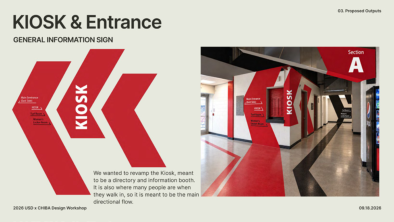
Figure 1: Proposed Dakota Dome entrance kiosk and general-information sign, converting the former ticket-booth area into a prominent orientation point.
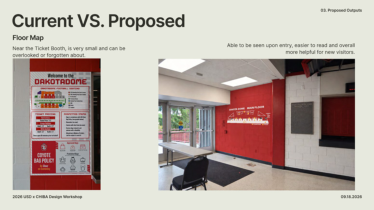
The team’s Victory concept translated the forward motion and energy of athletics into a family of chevron forms. Red, black, and green distinguished fans, athletes, and staff, while additional colors supported maps and event-access credentials. The system applied this language to the entrance kiosk, floor map, directional floor graphics, seating-section walls, stairs and elevators, lower-level destinations, exterior approaches, restrooms, room plates, and field passes. The entrance proposal in Figure 1 turns an underused ticket booth into a visible orientation point, while the comparison
1136 Kim and Chang in Figure 2 demonstrates how a small, easily overlooked map could become a prominent arrival cue. Together, these interventions address confidence through hierarchy, role clarity, advance information, and continuity between successive decisions.
Figure 2: Current and proposed Dakota Dome floor-map conditions, showing a shift from a small posted map to a highly visible arrival display.
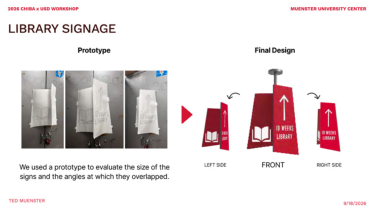
The Muenster University Center team identified four related problems: insufficient directional guidance, low visibility and contrast, difficult-to- find destinations, and inconsistency across the building. Its USD in Motion concept used layered red planes to represent people, spaces, and ideas coming together. The system extended that visual logic across an entrance directory, floor and ceiling guidance, library identification, faculty-office and room signs, restroom signs, elevator information, and exterior building identification. Physical prototyping was used to examine scale, overlap, and visibility from multiple approach angles before the team developed the final library-signage proposal shown in Figure 3.
Figure 3: Physical prototype and final multi-angle library-signage concept for the Muenster University Center. Student team: Isa Jai, Kemper Bowden, Emily Kurtz, Enzo Trometer, Sho Agata, and Miyui Watanabe.
Teams also used advance notice and confirmation more intentionally. Proposed systems identified the number of floors, clarified facility functions, distinguished entrances, and placed directional information before route choices. Confirmation cues were repeated after major transitions so users would not need to infer that silence meant they were still correct. Recovery was addressed through maps, recognizable landmarks, and information that allowed users to reorient without returning to the beginning of a journey.
From Uncertainty to Confidence: Emotional UX and Cross-Cultural Co-Design 1137 The preliminary findings suggest that emotional reassurance is produced through an accumulation of small design decisions. No single color, icon, or phrase creates confidence or belonging. For users with limited familiarity with the campus, confidence develops when the environment repeatedly answers the questions that arise throughout a journey: Which building am I approaching? Is this the correct entrance? Which building am I in? Where am I within it? Which route should I choose? Is this route accessible? Am I still moving in the right direction? What should I do if I make a wrong turn? How will I recognize when I have arrived?
To support this awareness, interior wayfinding can carry recognizable aspects of each building’s exterior identity—such as its form, facade, materials, color, or architectural character—into interior signs, maps, and environmental graphics. These cues can reinforce a sense of place without requiring users to consciously interpret the connection.
COLLABORATIVE LEARNING ACROSS CULTURAL PERSPECTIVES Cross-cultural discussion influenced how teams interpreted courtesy and density. Some students initially equated helpfulness with providing more information. Comparison with Japanese examples encouraged closer atten tion to sequencing: a system may contain extensive information while revealing only what is needed at each moment. Conversely, the lower-density campus setting required stronger building recognition and longer-range exterior cues than a compact transit setting. The collaboration therefore moved the design question from how much information to provide toward when, where, and in what form information becomes supportive.
Workshop artifacts and critiques indicated that collaboration influenced both problem identification and design development. USD students contributed knowledge of campus terminology, routines, and operational conditions, while Chiba University students more readily recognized assumptions hidden by familiarity. Their prior research and cultural experiences also introduced alternative approaches to information density, advance notice, repetition, and considerate guidance. Learning occurred through comparison and negotiation rather than one-directional cultural transfer. Differences in language, campus familiarity, academic level, and design experience required students to explain assumptions, evaluate alternatives, and develop shared decisions supported by site research and stakeholder needs.
A FRAMEWORK FOR EMOTIONAL WAYFINDING The study supports a six-stage framework for connecting wayfinding interventions with cognitive and emotional needs. The stages are not strictly linear. Users may return to orientation after an error, enter a journey at an interior location, or move between physical and digital information. Nevertheless, the sequence provides a practical structure for auditing a route and for teaching students to design beyond isolated sign objects.
Stage User Need Design Response Intended Outcome Welcome Arrival Identify building and entrance
Building identity, visible entrance, overview Awareness
Orientation Understand building, floor, and location
Floor plans, you-are-here maps, identity cues Decision Select an appropriate route Advance directions, Control hierarchy, accessible options
Reassurance
Confirmation Verify route and progress Repeated cues, identifiers, landmarks Reduce anxiety Recovery Correct a wrong turn Reorientation maps and alternate routes
Confidence
Destination Confirm arrival and next action
Clear identification and service information
At arrival, the system should establish building identity and indi cate public and accessible entrances before the user commits to a path. This is particularly important on the USD campus, where historic buildings, contemporary structures, and newer additions create varied facades, entrances, and circulation patterns. Although this architectural diversity can complicate navigation, distinctive building forms, materials, and facades can also become memorable orientation cues.
Orientation connects the user’s present location with a destination through you-are-here maps, floor plans, landmarks, zones, and floor information. Interior signs and environmental graphics can also carry recognizable aspects of a building’s exterior identity, such as its form, materials, color, or architectural character, into the interior. This continuity can reinforce awareness of which building the user is navigating without requiring conscious interpretation of the connection.
At decision points, users need sufficient information before selecting a route. Advance directions, clear hierarchy, accessible route choices, and distance or time cues can support a sense of control. After movement begins, repeated route cues, building and floor identifiers, visual continuity, and milestone signs can confirm progress and maintain trust. Recovery information acknowledges that errors occur and provides reorientation maps, recognizable landmarks, and alternate routes that allow users to regain understanding independently. Destination recognition closes the journey by confirming arrival and explaining the next action, such as where to check in or which service is available.
The framework links cognitive and emotional objectives without suggesting that they are separable in practice. Clear orientation can reduce anxiety, confirmation can free attention for the next decision, and consistent building identity can strengthen awareness and a sense of place. A wayfinding system is not fully successful when it provides technically accurate directions but leaves users uncertain about their location, progress, or ability to recover from an error.
DISCUSSION
The workshop suggests that cross-cultural collaboration can function as a method of design inquiry by exposing assumptions created through familiarity. Experienced users can make an incomplete system appear usable because they fill gaps from memory, while participants less familiar with the campus more readily notice missing information and unclear conventions. Unfamiliar observers, however, need local collaborators to interpret institutional language, regulations, routines, and operational constraints. Co-design joined these forms of knowledge without treating either cultural group as the universal user. Comparing selected Japanese, New York City, and USD examples also encouraged students to translate communication principles rather than reproduce another setting’s visual conventions.
For design education, the workshop provided real-world practice in solving problems for users rather than relying only on a written brief. Site visits, documentation, and stakeholder interviews required students to listen before designing and connect visual decisions with the navigational difficulties, needs, goals, and operational realities of each space and its users. Emotional journey mapping created a bridge between research and form-making. Students could relate typography, color, symbols, placement, materials, and architectural cues to changing cognitive and emotional needs. Culturally diverse teamwork also encouraged students to consider different perspectives, recognize similarities and differences in environmental interpretation, learn from one another, and negotiate decisions with peers and client groups. This process made empathy specific and actionable within research, prototyping, and critique.
The framework reframes wayfinding quality. Conventional measures such as time, errors, and destination accuracy remain necessary, but they do not fully capture the experience of navigation. Two users may reach the same destination in the same amount of time while experiencing different levels of stress, confidence, or dependence. Emotional UX adds questions that can be investigated alongside performance: Did users understand their current location and which building they were moving through? Did the system confirm progress? Could they recover independently? Did accessibility information support equitable route planning? Did the journey communicate welcome?
This perspective also changes the designer’s unit of analysis. A sign is an artifact; a journey is a relationship among architecture, information, movement, memory, and institutional behavior. Designing the journey requires coordination across exterior and interior systems, permanent and temporary communication, physical and digital channels, and multiple administrative owners. It also requires continuity between a building’s recognizable exterior identity and its interior wayfinding. Translating building form, materials, color, and architectural character into interior cues can reinforce awareness of place. Inconsistency is therefore partly a governance issue. A coherent system can deteriorate if terminology, maintenance, temporary notices, accessibility information, and digital maps are not managed together.
1140 Kim and Chang The framework may be applicable to hospitals, museums, transportation hubs, government buildings, and other complex public environments, but it should not be treated as a universal checklist. The importance of safety, privacy, urgency, cultural convention, architectural identity, and staff assistance varies by setting. Its primary value is as a structure for asking situated questions and tracing how users’ needs change throughout a journey. Because the emotional and collaborative learning outcomes were inferred from workshop artifacts, observations, and critiques rather than an installed-system evaluation or formal learning assessment, the findings remain preliminary and require further empirical study.
CONCLUSION
Campus wayfinding is both an informational system and an emotional interface. Users do not experience navigation as a sequence of isolated signs; they experience arrival, orientation, decisions, confirmation, recovery, and destination as one continuous journey. When information is late, inconsistent, or disconnected, the resulting uncertainty can undermine autonomy and belonging even when a destination is eventually reached.
The USD x Chiba Design Workshop illustrated how cross-cultural co-design can make wayfinding problems visible while supporting learning across cultural, linguistic, institutional, and experiential differences. Through comparison and negotiation, students translated diverse perspectives into situated visual, spatial, and linguistic responses. The resulting six- stage framework represents both a wayfinding outcome and a product of collaborative design learning, connecting information hierarchy, advance notice, building awareness, repeated confirmation, accessible route planning, visual continuity, and considerate language with users’ changing cognitive and emotional needs.
The central argument is that reassurance is not an aesthetic supplement to wayfinding. It indicates that the system communicates at the appropriate time, supports recovery, and respects users’ independence. A system that provides accurate directions but leaves people uncertain, dependent, or excluded is only partially successful. Designing from uncertainty to confidence offers a more humane and complete measure of wayfinding quality.
ACKNOWLEDGMENT
The authors acknowledge the students from Chiba University and the University of South Dakota whose research, collaboration, observations, and design work informed this practice-based case study.
REFERENCES
Escobar, A. (2018). Designs for the Pluriverse: Radical Interdependence, Autonomy, and the Making of Worlds. Durham, NC: Duke University Press. Gibson, D. (2009). The Wayfinding Handbook: Information Design for Public Places.
New York: Princeton Architectural Press.
From Uncertainty to Confidence: Emotional UX and Cross-Cultural Co-Design 1141 Lynch, K. (1960). The Image of the City. Cambridge, MA: MIT Press. Norman, D.A. (2004). Emotional Design: Why We Love (or Hate) Everyday Things.
New York: Basic Books. O’Neill, M.J. (1991). Effects of signage and floor plan configuration on wayfinding accuracy. Environment and Behavior, 23(5), 553–574. https://doi. org/10.1177/0013916591235002 Passini, R. (1984). Wayfinding in Architecture. New York: Van Nostrand Reinhold. Passini, R. (1996). Wayfinding design: Logic, application and some thoughts on
universality. Design Studies, 17(3), 319–331. https://doi.org/10.1016/0142- 694X(96)00001-4 Qiu, J. (2025). Design for multi-sensory: How can visual design help communicate human sense. Applied Human Factors and Ergonomics, 199, 1883–1893. https:// doi.org/10.54941/ahfe1006999 Sanders, E.B.-N. and Stappers, P.J. (2008). Co-creation and the new landscapes of
design. CoDesign, 4(1), 5–18. https://doi.org/10.1080/15710880701875068 Srikanth, N. (2023). Design anthropology and the next evolution of the design process. Human Dynamics and Design for the Development of Contemporary Societies, 81, 84–94. https://doi.org/10.54941/ahfe1003536
SEARCH THE AHFE DIGITAL BOOKSTORE BY ISBN
Explore the complete digital volume
Human Factors in Design, Engineering, and Computing
Read this individual research paper free through the original publisher, or explore the full digital proceedings book.