Weger Kristin, Vineetha Menon, Jennifer Bail (2026). Designing Integrated Human-AI Systems: A Socio-Technical Approach to Knowledge Management in Healthcare. In: Human Factors in Design, Engineering, and Computing. AHFE Open Access, vol. 238, pp. 1899–1909. https://doi.org/10.54941/ahfe1008418
The integration of artificial intelligence (AI) into healthcare knowledge management (KM) offers opportunities to improve knowledge flows, decision-making, and clinical workflows. However, current AI applications remain fragmented and often address isolated tasks rather than supporting system-wide integration. This conceptual paper examines AI-enabled KM through a socio-technical systems perspective and proposes a collective adaptive socio-technical framework comprising four interdependent dimensions: the KM process, social, technological, and relationship contexts. The framework emphasizes interactions among healthcare professionals, AI systems, organizational infrastructure, and regulatory environments, supported by continuous learning and feedback. The conceptual analysis suggests that effective AI integration requires more than technological capability; it also depends on usability, trust, human-AI collaboration, interdisciplinary cooperation, a knowledge-driven culture, and strategic leadership. By positioning AI as an embedded component of an interconnected healthcare system, the framework advances a human-centered approach intended to support collaborative intelligence and continuous adaptation.
Human-AI collaboration combines computational capabilities with human expertise in complex problem-solving and decision-making environments (Wilson & Daugherty, 2018). Healthcare organizations are increasingly adopting AI-driven capabilities to support healthcare processes, creating new challenges that highlight the importance of interactions among healthcare professionals and between healthcare professionals and intelligent systems (Bednar & Welch, 2020). AI can assist in problem-solving and strategic decision-making (Jarrahi et al., 2023). With the abundance of available data, analytics, and computational power, advances in AI provide new foundations for driving Knowledge Management (KM) in healthcare organizations.
AI and KM are intrinsically linked through the concepts of knowledge and learning. However, successful performance on a specific task does not establish effective integration across healthcare contexts (Kelly et al., 2019).
Knowledge applied for strategic-level thinking and decision-making requires elements of general intelligence, including curiosity, imagination, foresight, self-development, and social and emotional intelligence (Jarrahi et al., 2023). AI performance on a defined task does not remove the need for professional interpretation and judgment in healthcare decision-making (Brynjolfsson & Mitchell, 2017; Jarrahi et al., 2023; von Krogh, 2018). These limitations highlight the need for approaches that support collaborative intelligence rather than automation in isolation. Given the inherent relationship between AI and KM, a socio-technical perspective is needed to understand how AI can be effectively integrated into healthcare KM systems.
RQ: How can AI be effectively integrated into healthcare knowledge management systems through a socio-technical perspective?
To address this question, we examine the role of AI across KM processes and introduce a collective adaptive socio-technical framework for the integration of AI into healthcare KM systems.
CONCEPTUAL APPROACH This paper develops a conceptual framework through an interpretive synthesis of selected literature on KM processes, socio-technical systems, and human-AI collaboration: 1) KM process concepts organize the analysis, 2) social and technological elements inform the organizational contexts, 3) and human-AI interaction informs the relationship context (Alavi & Leidner, 2001; Šajeva, 2010; Makarius et al., 2020; Jarrahi et al., 2023). Healthcare applications illustrate these connections. Evidence from other sectors informs design considerations rather than demonstrating healthcare outcomes. The framework is therefore a theoretical integration, not a systematic review or an empirically validated model. Its proposed relationships and anticipated benefits require subsequent evaluation.
AI ACROSS HEALTHCARE KNOWLEDGE MANAGEMENT PROCESSES While healthcare organizations are already using big data inputs, the integration of AI such as artificial neural networks, deep learning, attention and self-learning transformer models offers new approaches to how healthcare institutions create, acquire, and apply new knowledge (Bangani et al., 2021; Puckett et al., 2023; Schwalb et al., 2022). KM, within healthcare organizations, facilitates the delivery of medical goods and services by creating, identifying, acquiring, storing and retrieving, sharing, and applying knowledge (Alavi & Denford, 2011; Alavi & Tiwana, 2003). These processes are crucial for an organization to learn, reflect, and develop skills necessary to maintain its distinctive advantage (Davenport & Prusak, 1998). The effectiveness of AI within healthcare KM depends on how knowledge is acquired, shared, assimilated, and reinforced through the interaction between KM systems and healthcare professionals (Makarius et al., 2020).
Knowledge Creation The process of knowledge creation frequently involves the reconfiguration and recombination of existing knowledge while occasionally generating new
Designing Integrated Human-AI Systems 1901 solutions (Bhatt, 2001). The potential of deep-learning AI lies in its predictive power and ability to uncover previously undisclosed patterns within healthcare data (Agrawal et al., 2017; Hilton et al., 2020). Through analytical functions and pattern recognition, AI may help healthcare organizations to identify patterns in large datasets (Faraj et al., 2018). For example, Hilton et al. (2020) developed interpretable models of readmission and length of stay using retrospective data from one health system. Their study illustrates predictive support, while its need for external validation limits claims about broader clinical benefit.
Knowledge Identification Knowledge identification determines critical knowledge possessed by healthcare professionals and organizations (Šajeva, 2010). AI can efficiently analyze large volumes of healthcare and pharmaceutical data to identify patterns and relevant to drug discovery, including binding protein conformations (Akondi et al., 2019, 2022; Gupta et al., 2022, 2023). As a result, these computational approaches may help to prioritize candidates for further investigation (Acharya et al., 2020; Amaro et al., 2018).
Knowledge Acquisition Knowledge acquisition involves obtaining new information from external sources to renew organizational knowledge (Šajeva, 2010). AI may support this process by integrating and analyzing large datasets from sources such as EHRs, wearable devices, medical imaging, and genomic data, potentially providing a more comprehensive view of patient health (Bangani et al., 2021; Benke & Benke, 2018; Bragazzi et al., 2020; Puckett et al., 2023).
Storage and Retrieval Another function of KM is to develop and sustain an organizational memory that can track knowledge resources. Strategies for storage, retrieval, and access control are primary mechanisms for preserving organizational memory (Alavi & Leidner, 2001). This process involves extracting healthcare-related knowledge, transforming it into explicit information, and documenting it for future use through healthcare knowledge repositories.
AI in KM can support the storage and retrieval of explicit knowledge. Machine-learning algorithms provide opportunities for gathering, categorizing, structuring, storing, and retrieving vast datasets generated within organizations (Jarrahi et al., 2023). Practice-oriented accounts describe how AI can analyze content sources and communication channels, generate summaries, identify emerging topics, distinguish confidential information, and provide reusable insights applicable to new scenarios (O’Dell & Davenport, 2019). With appropriate design and evaluation, AI may use KM practices and user interactions to deliver personalized recommendations, highlight relevant documents and communications, and identify the patient information most relevant to a specific healthcare task or decision.
Knowledge Sharing Knowledge sharing is essential for effective problem-solving and decision- making but is often hindered by organizational and functional barriers. AI may facilitate collaboration among healthcare professionals across disciplines and geographic boundaries while creating more interconnected coordination systems (Faraj et al., 2018). By identifying patterns and reinforcing weak connections across networks, AI can support collaborative learning, shared memory, feedback exchange, and peer review. These capabilities suggest a role for AI in collaborative intelligence beyond information storage (Jarrahi, 2019).
Knowledge Application Knowledge application involves the practical use of knowledge to address healthcare challenges and support decision-making (Faraj et al., 2018). AI-enabled assistants can improve the retrieval and representation of knowledge by providing timely access to relevant information through automated categorization, tagging, and content refinement (Davenport, 2019; Maedche et al., 2019). Situated knowledge can be particularly valuable in patient care, where healthcare professionals require immediate access to prior cases and relevant health information (Jarrahi et al., 2023; Zhang et al., 2020).
AI also provides more interactive interfaces through technologies such as chatbots and digital assistants that leverage natural language processing to facilitate access to healthcare knowledge (O’Dell & Davenport, 2019). These capabilities can reduce barriers to information access and support clinical decision-making. However, knowledge creation and management remain fundamentally human-centered (Davenport & Prusak, 1998; Sanzogni et al., 2017). Consequently, AI is more likely to augment healthcare professionals than replace them, fostering collaborative intelligence and human-AI collaboration that can inform professional learning and supervised system improvement (Paschen et al., 2020; Wilson & Daugherty, 2018; Hemmer et al., 2022). For instance, Hemmer et al. (2022), drawing on interviews with healthcare experts, identified adoption factors and tensions in clinical human-AI collaboration. This supports examining adoption conditions alongside technical capability rather than assuming that potential benefits ensure use.
A Socio-Technical Framework to Integrate AI in KM Prior research has highlighted that the success of KM within an organization depends on interactions among people, processes, and technology (Bhatt, 2001). Even with the introduction of intricate AI applications, people remain the driving force behind successful AI-enabled KM initiatives (Amin & Mohamad, 2017). Consequently, integrating AI into healthcare KM requires consideration of both individuals and organizational culture. Current models of socio-technical systems highlight the significance of the interaction between KM processes and the organizational environment (Šajeva, 2010; Dalkir, 2011). According to Šajeva (2010), a socio-technical knowledge management system comprises
Designing Integrated Human-AI Systems 1903 technological and social elements that support KM processes and appropriate organizational conditions. These models provide a basis for examining AI-enabled KM in Healthcare. Sittig and Singh (2010), for example, connect healthcare technology with people, workflow, organizational policies, and monitoring. Our framework brings these concerns into a KM-focused representation. Applying a socio-technical perspective, we introduce a conceptual framework that represents the interwoven connections of AI within the socio-technical KM system. The framework is grounded in human factors principles from design, engineering, and computing, emphasizing the alignment of AI capabilities with human cognition, workflows, and organizational structures.
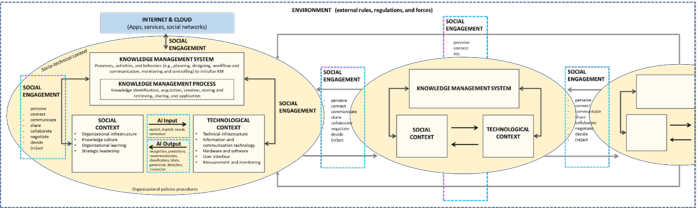
The conceptual model includes four independent elements: (1) the KM process context, (2) the social context, (3) the technological context, and (4) the relationship context.
(1) The KM process in healthcare revolves around transforming individual knowledge into organizational knowledge (Šajeva, 2010). This process includes knowledge identification, acquisition, creation, storage, retrieval, sharing, and application. Integrating AI within these processes must align with the organization’s strategy and culture. (2) The social context includes organizational infrastructure, knowledge
culture, organizational learning, and strategic leadership.
Organizational infrastructure encompasses structures that support social networks and AI augmentation through data management, automated processes, communication, and collaborative platforms (Šajeva, 2010).
Knowledge culture can be supported by knowledge discovery, collaborative learning, and recognition of knowledge-sharing contributions (Kaadoud et al., 2021; Lee et al., 2019; Raj & Renumol, 2022; Brun & Dugas, 2008).
Organizational learning encompasses individual and collective learning to create new knowledge and drive continuous improvement and innovation, with AI supporting personalized learning, continuous feedback, content recommendations, and skill mapping (Dasgupta & Gupta, 2009; Ashok et al., 2016; Raj & Renumol, 2022; Wong, 2021).
Strategic leadership involves leaders’ active interest in KM and organizational support, with AI providing data-driven insights, resource optimization, risk assessment, and market analysis (Bratasanu, 2018; Metz, 2020).
(3) The technological context includes AI systems, software, hardware, databases, and information and communication technologies used to facilitate KM processes. A robust technological infrastructure must address scalability, performance, security, privacy, compliance, ethics, and bias mitigation while supporting the development, deployment, monitoring, maintenance, skill development, and knowledge sharing of AI systems (Sittig & Singh, 2010; WHO, 2021). The longer-term resource demands of AI infrastructure also warrant consideration (Robbins & van Wynsberghe, 2022).
AI input refers to the data, information, or stimuli received for processing and decision-making, including explicit records and contextual information relevant to the task. Proactive systems also require attention to what users expect from their use of such information (Meurisch et al., 2020).
AI output refers to the results, responses, or actions generated by AI systems, including recognition, predictions, recommendations, classifications, labels, generative content, detection, and translation (Bandi et al., 2023; Enholm et al., 2022). Related work on trust in drone-based AI offers a nonclinical example of human-AI interaction research (Schwalb et al., 2022).
(4) The relationship context involves social engagement and interaction between humans and AI systems. These interactions may occur through chatbots, personal intelligent assistants, social robots, human-AI collaboration, personalization, and recommendations across co-worker, team, organizational, and societal levels (Brandtzaeg et al., 2022; Moore et al., 2023; Pham, Nabizadeh, & Selek, 2022; Possati, 2023). Social engagement with AI is context-sensitive and must adhere to security and regulatory considerations (Cabrera et al., 2023; Riener & Ferscha, 2013).
In addition, internal and external regulations play a critical role in shaping the ethical, legal, and operational landscape of AI systems in healthcare. Organizations must align procedures and policies with relevant regulations (Cabrera et al., 2023; Panigutti et al., 2023). Ethical guidance complements legal requirements; WHO (2021), for example, emphasizes human rights and accountability in healthcare AI.
Figure 1 illustrates the framework, including feedback loops supporting perception, reasoning and decision-making, interaction and communication, and responses or feedback. For example, AI algorithms may analyze medical data to support diagnosis, drawing on organizational knowledge repositories while influencing healthcare professionals’ roles and operating within regulatory constraints. Overall, the framework provides an organizing view of how AI can be integrated into healthcare KM systems by considering KM processes, social systems, technological infrastructure, relationship dynamics, and regulatory requirements.
Figure 1: A collective adaptive socio-technical system for AI in KM and possible channels of information exchange.
Designing Integrated Human-AI Systems 1905 DISCUSSION, IMPLICATIONS AND FUTURE RESEARCH AGENDA
Translating AI capabilities into healthcare workflows requires attention to implementation conditions as well as technical performance (Kelley et al., 2019). The proposed approach emphasizes collaborative intelligence, in which AI and human expertise complement each other, and where AI capabilities are aligned with human cognition, workflows, and organizational structures, with the aim of supporting patient care and organizational learning. While AI can identify patterns, generate predictive insights, and facilitate access to distributed knowledge sources, these outputs still require contextual interpretation and professional judgment in complex healthcare decisions. Healthcare professionals therefore need opportunities to question outputs, provide feedback, and participate in evaluating system changes.
The framework links these four contexts through feedback and organizational learning. Successful integration therefore requires not only technological robustness but also usability, trust, interdisciplinary collaboration, a knowledge-driven culture, and strong strategic leadership.
Future research should validate the framework in organizations through targeted case studies or surveys that assess its alignment with actual AI implementations and its impact on KM processes and outcomes. Application beyond healthcare organizations remains a proposition to be tested, considering industry-specific challenges and opportunities.
Future research should address patient autonomy, nurse-patient relationships, and standards of care in AI-assisted scenarios. The evolving regulatory landscape also warrants continuous investigation into how regulations influence implementation, governance, and monitoring. Standardized methos should measure AI performance, effectiveness, and ethical compliance in KM systems, considering both expected outcomes and unintended consequences of AI integration. The selective conceptual evidence base and absence of empirical validation limit the conclusions. Future evaluation should examine knowledge quality, retrieval accuracy, review workload, and unintended effects alongside clinical outcomes, as neither improved performance nor cross-sector generalizability is established by the framework alone.
CONCLUSION
The conceptual analysis suggests that effective AI integration in healthcare KM requires deliberate socio-technical system design that enables collective intelligence and continuous adaptation. By positioning AI as an embedded component within an interconnected system, healthcare organizations may enhance cognitive support, reduce information overload, improve knowledge-driven decision-making, and better integrate AI into clinical workflows. This human-centered approach offers a basis for organizational learning and continuous adaptation. Empirical evaluation is needed to determine whether it improves knowledge use and healthcare outcomes.
REFERENCES
Acharya, A., Agarwal, R., Baker, M. B., Baudry, J., Bhowmik, D., Boehm, S., ... & Zanetti-Polzi, L. (2020). Supercomputer-based ensemble docking drug discovery pipeline with application to COVID-19. Journal of Chemical Information and Modeling, 60(12). Agrawal, A., Gans, J., and Goldfarb, A. (2017). What to expect from artificial
intelligence. Akondi, V. S., Menon, V., Baudry, J., and Whittle, J. (2019). Novel K-means clusteringbased undersampling and feature selection for drug discovery applications. In 2019 IEEE International Conference on Bioinformatics and Biomedicine (BIBM) pp. 2771–2778. IEEE. Akondi, V. S., Menon, V., Baudry, J., and Whittle, J. (2022). Novel big data-driven
machine learning models for drug discovery application. Molecules, 27(3), pp. 594. Alavi, M., and Denford, J. (2011). Knowledge management: Process, practice and Web 2.0. Handbook of Organizational Learning and Knowledge Management. Alavi, M., and Leidner, D. (2001). Review: Knowledge management and knowledge
management systems: Conceptual foundations and research issues. MIS Quarterly, 25(1), pp. 107–136. Alavi, M., and Tiwana, A. (2003). Knowledge management: The information technology dimension. The Blackwell Handbook of Organizational Learning and Knowledge Management, 104–121. Amaro, R. E., Baudry, J., Chodera, J., Demir, Ö., McCammon, J. A., Miao, Y., and
Smith, J. C. (2018). Ensemble docking in drug discovery. Biophysical Journal, 114(10), pp. 2271–2278. Amin, Y., and Mohamad, R. (2017). Knowledge management system model for learning organisations. International Journal of Learning and Change, 9(4), pp. 290–305. Ashok, M., Narula, R., and Martinez-Noya, A. (2016). How do collaboration and
investments in knowledge management affect process innovation in services? Journal of Knowledge Management, 20(5), pp. 1004–1024. Bandi, A., Adapa, P. V. S. R., and Kuchi, Y. E. V. P. K. (2023). The power of generative AI: A review of requirements, models, input–output formats, evaluation metrics, and challenges. Future Internet, 15(8), pp. 260. Bangani, R. G., Menon, V., and Jovanov, E. (2021, December). Personalized stress
monitoring AI system for healthcare workers. In 2021 IEEE International Conference on Bioinformatics and Biomedicine (BIBM) pp. 2992–2997. IEEE. Bednar, P. M., and Welch, C. (2020). Socio-technical perspectives on smart working: Creating meaningful and sustainable systems. Information Systems Frontiers, 22(2), pp. 281–298. Benke, K., and Benke, G. (2018). Artificial intelligence and big data in public health.
International Journal of Environmental Research and Public Health, 15(12), pp. 2796. Bhatt, G. D. (2001). Knowledge management in organizations: Examining the interaction between technologies, techniques, and people. Journal of Knowledge Management, 5(1), pp. 68–75. Bragazzi, N. L., Dai, H., Damiani, G., Behzadifar, M., Martini, M., and Wu, J. (2020).
How big data and artificial intelligence can help better manage the COVID-19 pandemic. International Journal of Environmental Research and Public Health, 17(9), pp. 3176. Brandtzaeg, P. B., Skjuve, M., and Følstad, A. (2022). My AI friend: How users of a social chatbot understand their human–AI friendship. Human Communication Research, 48(3), pp. 404–429.
Designing Integrated Human-AI Systems 1907 Bratasanu, V. (2018). Leadership decision-making processes in the context of data
driven tools. Quality Access to Success, 19. Brun, J. P., and Dugas, N. (2008). An analysis of employee recognition: Perspectives on human resources practices. The International Journal of Human Resource Management, 19(4), pp. 716–730. Brynjolfsson, E., and Mitchell, T. (2017). What can machine learning do? Workforce
implications. Science, 358(6370), pp. 1530–1534. Cabrera, J., Loyola, M. S., Magaña, I., and Rojas, R. (2023, June). Ethical dilemmas, mental health, artificial intelligence, and LLM-based chatbots. In International Work-Conference on Bioinformatics and Biomedical Engineering pp. 313–326. Springer Nature Switzerland. Dalkir, K. (2011). Knowledge management in theory and practice (2nd edn). MIT
Press. Dasgupta, M., and Gupta, R. K. (2009). Innovation in organizations: A review of the role of organizational learning and knowledge management. Global Business Review, 10(2), pp. 203–224. Davenport, T. (2019). Managing support knowledge with AI: Talla helps Toast. Forbes.
https://www.forbes.com/sites/tomdavenport/2019/10/10/managing-support- knowledge-with-ai-talla-helps-toast/ Davenport, T., and Prusak, L. (1998). Working knowledge: How organizations manage what they know. Harvard Business Press. Enholm, I. M., Papagiannidis, E., Mikalef, P., and Krogstie, J. (2022). Artificial
intelligence and business value: A literature review. Information Systems Frontiers, 24(5), pp. 1709–1734. Faraj, S., Pachidi, S., and Sayegh, K., (2018). Working and organizing in the age of the learning algorithm. Information and Organization, 28(1), pp. 62–70. Gupta, S., Baudry, J., and Menon, V. (2022). Using big data analytics to “back engineer”
protein conformational selection mechanisms. Molecules, 27(8), pp. 2509. Gupta, S., Baudry, J., and Menon, V. (2023). Big data analytics for improved prediction of ligand binding and conformational selection. Frontiers in Molecular Biosciences, Volume 9, 953984. Hemmer, P., Schemmer, M., Riefle, L., Rosellen, N., Vössing, M., and Kühl, N.
(2022). Factors that influence the adoption of human-AI collaboration in clinical decision-making. ECIS 2022 Research Papers, 139. Hilton, C. B., Milinovich, A., Felix, C., Vakharia, N., Crone, T., Donovan, C., ... & Nazha, A. (2020). Personalized predictions of patient outcomes during and after hospitalization using artificial intelligence. NPJ Digital Medicine, 3(1), 51. Jarrahi, M. H. (2019). In the age of the smart artificial intelligence: AI’s dual capacities for
automating and informating work. Business Information Review, 36(4), pp. 178–187. Jarrahi, M. H., Askay, D., Eshraghi, A., and Smith, P. (2023). Artificial intelligence and knowledge management: A partnership between human and AI. Business Horizons, 66(1), pp. 87–99. Kaadoud, I. C., Fahed, L., and Lenca, P. (2021, August). Explainable AI: A narrative
review at the crossroad of knowledge discovery, knowledge representation and representation learning. In MRC 2021: Twelfth International Workshop Modelling and Reasoning in Context (Vol. 2995, pp. 28–40). CEUR-WS. Kelly, C. J., Karthikesalingam, A., Suleyman, M., Corrado, G., and King, D. (2019).
Key challenges for delivering clinical impact with artificial intelligence. BMC Medicine, 17, 195. https://doi.org/10.1186/s12916-019-1426-2 Lee, J., Suh, T., Roy, D., and Baucus, M. (2019). Emerging technology and business model innovation: The case of artificial intelligence. Journal of Open Innovation: Technology, Market, and Complexity, 5(3), p. 44.
Maedche, A., Legner, C., Benlian, A., Berger, B., Gimpel, H., Hess, T., ... & Söllner, M. (2019). AI-based digital assistants: Opportunities, threats, and research perspectives. Business & Information Systems Engineering, Volume 61, 535–544. Makarius, E. E., Mukherjee, D., Fox, J. D., and Fox, A. K. (2020). Rising with the
machines: A sociotechnical framework for bringing artificial intelligence into the organization. Journal of Business Research, Volume 120, 262–273. Metz, S. (2020). The future of strategic leadership. The US Army War College Quarterly: Parameters, 50(2), pp. 9. Meurisch, C., Mihale-Wilson, C. A., Hawlitschek, A., Giger, F., Müller, F., Hinz, O.,
and Mühlhäuser, M. (2020). Exploring user expectations of proactive AI systems. Proceedings of the ACM on Interactive, Mobile, Wearable and Ubiquitous Technologies, 4(4), pp. 1–22. Moore, N., Weger, K., Yeazitzis, T., and Mesmer, B. (2023). Stakeholder elicitation for autonomous robotic systems design for mission-critical environments. ASEM Conference 2023. O’Dell, C., and Davenport, T. (2019). Application of AI for knowledge management.
CIOReview. Panigutti, C., Hamon, R., Hupont, I., Fernandez Llorca, D., Fano Yela, D., Junklewitz, H., ... & Gomez, E. (2023). The role of explainable AI in the context of the AI Act. In Proceedings of the 2023 ACM Conference on Fairness, Accountability, and Transparency pp. 1139–1150. Paschen, J., Wilson, M., and Ferreira, J. J. (2020). Collaborative intelligence: How
human and artificial intelligence create value along the B2B sales funnel. Business Horizons, 63(3), pp. 403–414. Pham, K. T., Nabizadeh, A., and Selek, S. (2022). Artificial intelligence and chatbots in psychiatry. Psychiatric Quarterly, 93(1), pp. 249–253. Possati, L. M. (2023). Psychoanalyzing artificial intelligence: The case of Replika. AI
& Society, 38(4), pp. 1725–1738. Puckett, S., Menon, V., and Jovanov, E. (2023). Embedding artificial intelligence into wearable IoMT systems. In Proceedings of the Second Serbian International Conference on Applied Artificial Intelligence (SICAAI). Raj, N. S., and Renumol, V. G. (2022). A systematic literature review on adaptive
content recommenders in personalized learning environments from 2015 to 2020. Journal of Computers in Education, 9(1), pp. 113–148. Riener, A., and Ferscha, A. (2013). Enhancing future mass ICT with social capabilities. In Co-evolution of Intelligent Socio-technical Systems: Modelling and Applications in Large Scale Emergency and Transport Domains pp. 141–184. Springer. Robbins, S., and van Wynsberghe, A. (2022). Our new artificial intelligence
infrastructure: Becoming locked into an unsustainable future. Sustainability, 14(8), pp. 4829. Sanzogni, L., Guzman, G., and Busch, P. (2017). Artificial intelligence and knowledge management: Questioning the tacit dimension. Prometheus, 35(1), pp. 37–56. Šajeva, S. (2010). The analysis of key elements of socio-technical knowledge
management system. Economics and Management, 15, pp. 765–774. Schwalb, J., Menon, V., Tenhundfeld, N., Weger, K., Mesmer, B., and Gholston, S.
(2022, November). A study of drone-based AI for enhanced human-AI trust and informed decision making in human-AI interactive virtual environments. In 2022 IEEE 3rd International Conference on Human-Machine Systems (ICHMS) pp. 1–6. IEEE.
Designing Integrated Human-AI Systems 1909 Sittig, D. F., and Singh, H. (2010). A new sociotechnical model for studying health
information technology in complex adaptive healthcare systems. Quality and Safety in Health Care, 19(Suppl. 3), pp. i68–i74. https://doi.org/10.1136/ qshc.2010.042085 von Krogh, G. (2018). Artificial intelligence in organizations: New opportunities for phenomenon-based theorizing. Academy of Management Discoveries, 4(4), pp. 404–409. Wilson, H. J., and Daugherty, P. R. (2018). Collaborative intelligence: Humans and
AI are joining forces. Harvard Business Review, 96(4), pp. 114–123. Wong, Y. K. (2021). Skills mapping and career development analysis using artificial intelligence. In Proceedings of Computer Science & Information Technology (CS & IT) Computer Science Conference Proceedings (CSCP) 2021 pp. 185–192. World Health Organization (WHO). (2021). Ethics and governance of artificial
intelligence for health: WHO guidance. https://www.who.int/publications/i/ item/9789240029200 Zhang, P. I., Hsu, C. C., Kao, Y., Chen, C. J., Kuo, Y. W., Hsu, S. L., ... & Huang, C. C.
(2020). Real-time AI prediction for major adverse cardiac events in emergency department patients with chest pain. Scandinavian Journal of Trauma, Resuscitation and Emergency Medicine, 28(1), pp. 1–7.
SEARCH THE AHFE DIGITAL BOOKSTORE BY ISBN
Explore the complete digital volume
Human Factors in Design, Engineering, and Computing
Read this individual research paper free through the original publisher, or explore the full digital proceedings book.