Amey Gohil, David Bissig, Hao-Chuan Wang, Priyanka Koppolu, Tejas Patil, Preyash Yadav, Shreyas Aswar, Shijia Pan, Michelle Cohn, Chen-Nee Chuah, Sarah Tomaszewski Farias, Alyssa Weakley (2026). Embedding Self-Administered Dementia Monitoring Into a Remote Caregiving Platform: A Pilot Usability and Data- Sharing Preferences Study. In: Human Factors in Design, Engineering, and Computing. AHFE Open Access, vol. 238, pp. 2270–2280. https://doi.org/10.54941/ahfe1008453
Older adults living alone with cognitive impairment desire tools that support aging-in-place, while remote family caregivers desire awareness of their loved one's cognitive health to inform care. To meet these needs, we embedded Self-Administered Tasks Uncovering Risk of Neurodegeneration (SATURN), a validated self-administered cognitive screener, into Interactive-Care (I-Care), a remote caregiving web-application, to enable monthly cognitive check-ins. A pilot study (Phase 1, n=4) with two care receiver-caregiver dyads evaluated the usability, acceptability, and data-sharing preferences arising from this integration. Care receivers (ages 84-88, mild dementia, MoCA 19-20) completed the assessment with no observed confusion, and both reported high usability and usefulness of monthly check-ins. Both wanted to see results in multiple formats and be informed of score changes. Caregivers reported high usefulness and identified the importance of dynamic consent and shared decision-making for result-sharing, as well as data security concerns including encryption and role-based access. These findings directly informed the design and development of a caregiver-facing SATURN Results Dashboard within I-Care, enabling score visualization, longitudinal trend tracking, per-session contextual notes, selective release of results to care receivers, and PDF/JPEG export. A follow-up dashboard evaluation (Phase 2, n=4 caregivers, n=2 care receivers) revealed high usability, strong support for contextual notes and trend visualization, and nuanced views on result disclosure across caregiver and care-receiver perspectives. Cumulatively, findings demonstrate the feasibility of integrating longitudinal cognitive screening into a remote caregiving platform and surface important human factors design considerations around result display, consent management, and data access control.
More than 57 million people worldwide were living with dementia in 2021, with nearly 10 million new cases occurring each year (World Health
Embedding Self-Administered Dementia Monitoring Into a Remote Caregiving Platform 2271 Organization, 2026). Studies of community-dwelling people with dementia have reported that approximately 18-51% live alone (Clare et al., 2020; Eichler et al., 2016). A significant concern for people living alone with dementia is increased vulnerability to self-neglect and other safety risks as cognitive difficulties progress (Charles et al., 2015; Clare et al., 2025). Informal family caregivers who provide infrequent in-person care have fewer opportunities for direct day-to-day observation and may therefore rely on accumulated “red flags,” such as changes in personal hygiene, clutter, failure to return phone calls, or suspected financial exploitation, to recognize changes in cognition (Clare et al., 2025). Limited awareness of changing difficulties can further complicate conversations about safety and care needs. Longitudinal cognitive monitoring could provide more objective information before problems escalate; however, frequent in-clinic assessment is burdensome for both care systems and families. Remote cognitive assessment offers an alternative, although older adults with cognitive impairment may experience technology-related barriers to independent completion (Yi et al., 2021).
In this paper, we attempt to address this issue by integrating the validated Self-Administered Tasks Uncovering Risk of Neurodegeneration (SATURN; Bissig et al., 2020; Pasao et al., 2026), which has also demonstrated feasibility for remote unsupervised administration (Tagliabue et al., 2023) into our Interactive-Care (I-Care; Aswar et al., 2026; Pimento et al., 2024; Weakley et al., 2025) caregiving platform specifically designed for remote care of older adults living alone with ADRD. I-Care is a web-based remote caregiving platform used by care receivers through a simplified kiosk interface and by caregivers through their own devices. Prior evaluations demonstrated that older adults with cognitive impairment could independently complete key tasks and reported high technology acceptance (Weakley et al., 2025).
Embedding cognitive screening within I-Care addresses a critical gap at the intersection of self-administration and system interoperability. Most existing digital cognitive assessments are delivered as standalone tools, requiring users to navigate to a separate website, manage separate credentials, and manually transfer results to caregiving or clinical workflows. For older adults with cognitive impairment, such fragmentation poses meaningful barriers. Self- administered, unsupervised computerized cognitive tools have demonstrated good diagnostic performance for MCI and dementia (pooled sensitivity 0.84, specificity 0.86; Li et al., 2025), while prior reviews highlight their potential for scalable clinical implementation (Tsoy et al., 2021). However, integrating such tools directly within an existing caregiving platform that individuals with ADRD can use independently remains unexplored.
Results display, privacy, and consent are also important considerations. Perceived usefulness and ease of use influence digital-health adoption, while privacy concerns can reduce use intentions among older adults (Davis, 1989; Jokisch et al., 2022; Zhang et al., 2025). Dementia-disclosure research further suggests that caregivers value written and visual information but may have difficulty retaining complex information (Li et al., 2026). Patients and care partners also prefer multiple result-delivery formats and are generally comfortable sharing results with family and healthcare providers (Kim et al., 2025). Delivering cognitive results outside a clinical encounter therefore requires attention to comprehension, emotional response, and accessible explanation (Bolton et al., 2025).
In this paper, we describe the integration of SATURN into I-Care, report findings from a pilot human factors study evaluating usability, perceived usefulness, result disclosure preferences, and data-sharing and consent attitudes from both care receivers and their caregivers. We further describe how these findings informed the design of a SATURN Results Dashboard within I-Care, and report on follow-up evaluation of the dashboard. Together, these contributions advance our understanding of how validated cognitive assessment tools can be made accessible, acceptable, and actionable within remote caregiving technology.
METHODS
I-Care Platform and SATURN Integration I-Care is implemented as a web-based single-page application built with React and TypeScript, and supported by Firebase cloud infrastructure including Cloud Firestore for real-time data synchronization, Firebase Authentication for secure role-based access, and Firebase Hosting for deployment. The platform supports dual-role access: care receivers interact through a simplified interface displayed on a dedicated desktop computer in kiosk mode, while caregivers access a feature-rich web interface from any device.
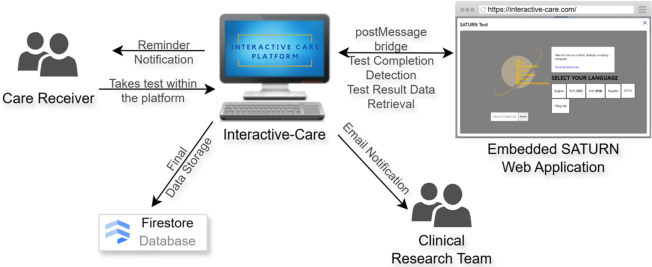
SATURN (www.saturn-test.com) was integrated into I-Care as an iframe embedded within the platform’s settings interface, enabling care receivers to complete the cognitive assessment without leaving I-Care or navigating to a separate website. A postMessage bridge between I-Care and the embedded SATURN web application enables automatic detection of test completion and retrieval of the raw test result data. I-Care normalizes this data and writes it to Cloud Firestore. Following successful result storage, I-Care sends an automated email notification containing the result data to the clinical research team. To prevent retesting before a meaningful interval has elapsed, the integration enforces a 30-day minimum period between completed assessments, after which the platform automatically sends a reminder notification to the care receiver prompting them to complete the next assessment. Users have the option of taking the test immediately or scheduling it for a later time. This architecture delivers the usability benefits of an embedded, single-platform experience while preserving SATURN’s validated assessment delivery.
Figure 1: I-Care - SATURN integration.
Embedding Self-Administered Dementia Monitoring Into a Remote Caregiving Platform 2273 SATURN Results Dashboard
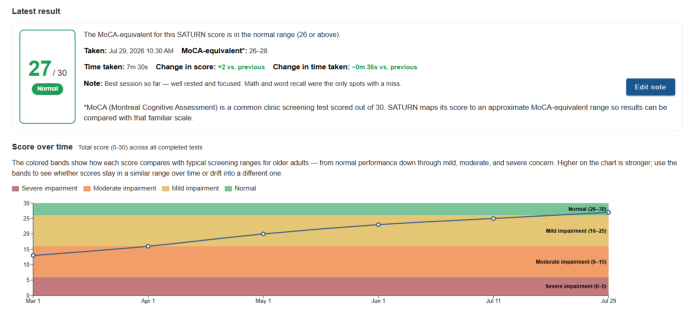
A caregiver-facing SATURN Results Dashboard was accessible through a dedicated navigation tab. The dashboard displayed the latest SATURN score with a color-coded performance band, MoCA-equivalent range, and plain- language interpretation; longitudinal score trends; cognitive-domain scores and changes from the previous assessment; caregiver-added contextual notes; PDF/JPEG export; and test history. During iterative development, caregiver notifications were also added after a completed SATURN assessment and after two postponed assessments, allowing caregivers to view results, add contextual notes, message the care receiver, or schedule a reminder.
Figure 2: Results dashboard showing the Latest Result and Score over time.
Phase 1 was conducted with two care receiver-caregiver dyads (n = 4). Care receivers were two community-dwelling older adults (ages 84-88) with clinical diagnoses of mild dementia (MoCA 19-20; Nasreddine et al., 2005) who were active I-Care users with low-to-moderate digital technology comfort. They were supported by their adult children (ages 61-63) who provided remote care and used I-Care. Phase 2 evaluation included four caregivers (n = 4) and two care receivers (n = 2) across three care-receiver families. All participants provided written informed consent under University of California, Davis IRB approval.
Phase 1: SATURN Integration Study - Procedure and Measures Following SATURN completion, 2 care receiver-caregiver dyads (n = 4) completed semi-structured interviews separately. Care receiver questions were grouped into four domains: Usability, Usefulness, Result Sharing and Access, and Privacy and Consent. Usability questions assessed whether participants understood the SATURN reminder, liked taking the test within I-Care, could complete the test without help, and whether they experienced any confusing steps. Usefulness questions addressed checking cognition over time, repeated testing within I-Care, and monthly cognitive check-ins. Result Sharing and Access questions addressed whether participants wanted to view their results, their preferred test result formats, notification of decline, and
who should have access. Privacy and Consent questions addressed result storage, understanding of the test purpose, and recurring reminders about that purpose.
Caregiver questions used the same domain labels and similar questions where applicable: Usefulness, Result Sharing and Access, and Privacy and Consent, with an additional Clinical Response domain addressing how results could inform caregiving and responses to possible cognitive decline. Responses followed a 1-5 Likert scale (5 = Strongly Agree). Structured Phase 1 interview items are summarized in Table 1.
Phase 2: SATURN Results Dashboard Evaluation - Procedure and Measures Following development of the SATURN Results Dashboard informed by Phase 1 findings, Phase 2 evaluation visits were conducted with 4 caregivers and 2 care receivers (n = 6). Prior to interviews, participants explored the dashboard with a walkthrough. Caregivers were interviewed using a structured protocol covering eight blocks: First Impressions and Navigation; Latest Score Comprehension (with a talk-aloud approach in which caregivers described what they saw before any structured questions); Score Trend and Screening Ranges; Cognitive Areas and Change by Domain; Caregiver Notes; Downloadable/Printable Report; Caregiver Notifications and Missed-Test Escalation; and Overall Usefulness and Actionability. The two participating care receivers subsequently completed a follow-up interview, providing longitudinal design improvement evidence. Care receiver questions focused on access to their own results, caregiver review before disclosure, decision- making authority, and transparency about who viewed their results.
RESULTS
Phase 1: SATURN Integration Both care receivers successfully completed SATURN within I-Care. One completed the assessment independently, while the other required minor clarification on multi-select question mechanics. Both returned to I-Care following test completion without reported confusion. Usability and usefulness ratings were high (see Table 1). Both care receivers wanted access to their results, preferred multiple result formats including numeric scores, longitudinal comparisons, and explanatory information, and wanted to be informed if their score declined. One participant preferred a reminder of SATURN’s purpose at each assessment, while the other did not. Further, one participant also raised a concern about whether results would be publicly accessible.
Caregivers likewise rated SATURN highly for usefulness and result access (see Table 1). Both wanted care receivers to have access to their results and preferred detailed result displays, audit trails of result access, contextual notes (e.g., care receiver reported poor sleep), and an additional delivery channel such as email or printout. Both supported asking permission before each new result was shared. In separate questions, both prioritized
Embedding Self-Administered Dementia Monitoring Into a Remote Caregiving Platform 2275 care-receiver preferences while the care receiver remained able to decide and selected caregiver surrogate consent if meaningful consent was no longer possible. One caregiver noted it would be useful to share with care receiver’s clinician. One caregiver raised concerns about encryption and role-based access. Responses to possible cognitive decline differed, with one favoring notification of family and the primary care provider and the other favoring additional I-Care alerts.
Table 1: Selected structured Phase 1 interview items and responses.
Table available in the original PDF paper.
Domain Item Responses Care Receiver Responses
4.5 (4-5)
Usability I understood what the I-Care SATURN reminder was asking me to do.
I liked taking SATURN within I-Care. 4.5 (4 -5) I could complete the test without help. 4 (3-5)
Usefulness It would be useful to check memory/thinking over time. 4.5 (4-5)
5 (5-5)
Having SATURN within I-Care would make regular cognitive testing easier.
Monthly SATURN testing would be useful. 5 (5-5) Access Would you want to see your result? Yes-Yes
Would you want your caregiver to see your result? Yes-Yes Caregiver Responses
5 (5-5)
Usefulness Having SATURN within I-Care would be useful for remote caregiving.
5 (5-5)
Monthly SATURN testing would help understand changes over time.
4.5 (4-5)
SATURN results would help me decide when to contact a clinician.
Overall usefulness of monthly SATURN results (1-10). 9.5 (9-10) Access I would want to know if my care receiver score declined Yes-Yes
I would like to receive my care receiver’s results. 5 (5-5) Note. Likert items were rated from 1 = strongly disagree to 5 = strongly agree unless otherwise specified. Average score is displayed with the range in parentheses.
Phase 2: SATURN Results Dashboard Evaluation All four caregivers rated dashboard navigation 5/5 and reported no information overload. Iterative revisions improved comprehension: one evaluator’s rating of the MoCA-equivalent comparison increased from 1/5 to 5/5 after explanatory text was added, and initially unfamiliar cognitive- domain labels were revised with clearer terminology and hover explanations. The score trend, contextual notes, and PDF export features were rated 5/5 across evaluators, while overall dashboard usefulness ranged from 8-10/10. Caregivers identified sleep, stress, illness, hunger, distraction, medical-device use, and other day-of-testing circumstances as useful contextual notes. One evaluator requested JPEG export to accommodate a healthcare provider’s
messaging system. Caregivers viewed the dashboard primarily as supporting evidence for clinical conversations rather than as a direct trigger for contacting a provider.
Both care receivers wanted access to their results whether scores were stable or declining, did not support caregivers permanently withholding results, and wanted transparency about who had viewed them. Preferences differed regarding how disclosure should occur: one preferred immediate independent access and individual decision authority, whereas the other preferred explanation at the time of disclosure, was comfortable with caregiver review first, and favored joint decision-making. Caregivers raised concerns about potential confusion or negative emotional responses to some results. Three caregivers ultimately supported care-receiver access to the score display, while one preferred not to share it at present because favorable scores could create false reassurance and poorer scores could cause frustration.
DISCUSSION
This pilot study demonstrates the feasibility of embedding a self-administered cognitive screener within a remote caregiving platform for older adults with mild dementia. Both care receivers completed SATURN independently or with minimal clarification, consistent with evidence supporting remote unsupervised cognitive assessment (Zhao et al., 2026) and prior SATURN usability findings (Bissig et al., 2020). Embedding the assessment within I-Care may reduce barriers associated with navigating separate tools and accounts.
One care receiver did not understand what SATURN was checking before taking it, revealing a consent-comprehension gap with direct design implications. Bolton et al. (2025) highlight that cognitive result disclosure without specialist support requires plain-language scaffolding to maximize comprehension and safety. Thorogood et al. (2018) note that consent in dementia populations should support ongoing decision-making rather than rely on a single enrollment- stage agreement. Together, these findings support adding a plain-language explanation of the test’s purpose at each assessment initiation, a change also supported by the care receiver’s own expressed preference.
Beyond format and delivery, our results highlight a fundamental tension between protecting the care receiver from potentially confusing or distressing information and respecting their autonomy over their cognitive health information. Prior work has similarly described caregivers assuming a gatekeeping role following cognitive screening results that indicate possible impairment, including gathering information and sometimes shielding the care receiver from distressing news (Lee et al., 2018). At the same time, being informed about health-data sharing strongly influences willingness to share personal information (Viberg Johansson et al., 2021), and dementia-consent recommendations emphasize ongoing supported decision-making, with surrogate consent serving as a fallback rather than a default (Thorogood et al., 2018). Consistent with this tension, Phase 1 caregivers supported repeated permission checks before results were shared and prioritized care- receiver preferences while the care receiver remained able to decide, while endorsing surrogate consent if meaningful consent was no longer possible. In Phase 2, caregiver concerns included confusion, distress, and false reassurance
Embedding Self-Administered Dementia Monitoring Into a Remote Caregiving Platform 2277 from apparently favorable scores, whereas both care receivers still wanted access to results even when scores declined. Three caregivers ultimately supported care-receiver access to the score display, while one preferred not to share it at present. The two care receivers also differed in their preferred disclosure process: one preferred immediate, ungated access, while the other was comfortable with caregiver review first and joint decision-making. These findings support flexible, individualized disclosure controls rather than a single platform-wide access model.
Dashboard evaluation produced concrete design improvements grounded in the disclosure literature. The improvement in MoCA-equivalent understanding and domain comprehension after explanatory text and revised labels were added directly illustrates Li et al.’s (2026) finding that structured written summaries and visual aids substantially improve caregiver comprehension and recall of cognitive health information. The JPEG export request highlights a practical clinical integration constraint. Caregivers rated healthcare provider communication highly and viewed the dashboard as providing supporting evidence for clinical conversations, consistent with Galvin et al.’s (2020) finding that clinical follow-up remains inconsistent even when screening results are available, suggesting I-Care’s automated clinician email notification may serve as a more reliable clinical pipeline than caregiver-mediated communication alone.
The contextual notes feature received uniformly strong support, with caregivers identifying a wide range of factors they would document including sleep quality, use of medical devices, illness, stress, distraction, hunger, and significant life events. This directly addresses Li et al.’s (2026) finding that caregivers face persistent challenges retaining and contextualizing diagnostic information, and represents a novel capability not documented in any existing cognitive screening or remote monitoring platform literature.
LIMITATIONS Phase 1 was conducted with two care receiver-caregiver dyads (n = 4), and Phase 2 dashboard evaluation with four caregivers and two care receivers across three care-receiver families (n = 6), limiting generalizability. The sample comprised existing I-Care users with prior co-design experience, potentially resulting in higher baseline platform comfort than a novel user population would demonstrate. Data on longitudinal use across multiple monthly assessments is not yet available. Future work will expand the sample across diverse populations, evaluate repeated monthly testing longitudinally, and explore integration with other I-Care behavioral data for a more comprehensive cognitive health monitoring ecosystem.
CONCLUSION
This study demonstrates that embedding a validated self-administered cognitive screener within a remote caregiving platform is feasible and well-received by older adults with mild dementia and their caregivers. A key contribution is demonstrating that cognitively impaired older adults can complete a validated cognitive assessment independently within a
caregiving platform, without caregiver or clinician assistance, through an interoperability-based design approach that embeds the assessment directly within the user’s familiar caregiving environment. The subsequent design and evaluation of a caregiver-facing SATURN Results Dashboard further shows that caregivers can effectively interpret and act on cognitive screening data when supported by accessible, iteratively refined visualizations and plain- language explanations. Findings highlight several important human factors design considerations: (1) consent scaffolding should be provided at each assessment initiation rather than relying on a one-time enrollment agreement; (2) result sharing should support repeated permission checks and care-receiver involvement, with surrogate decision-making when meaningful consent is no longer possible; (3) platforms should support role-based access control with audit trails; (4) caregivers value the ability to annotate scores with day-of- testing contextual factors; and (5) export formats must accommodate real- world clinical workflow constraints. This work contributes both a replicable system integration model and an empirically grounded set of design principles for the growing field of remote cognitive health monitoring within caregiving platforms.
ACKNOWLEDGMENT
The authors thank the study participants and their families for their time and generous contributions to this research. This project was supported by the NIH funding NIA 1K23AG080152-01 and NIBIB 1R01EB041352-01. The content is solely the authors’ responsibility and does not necessarily represent official NIH views.
REFERENCES
Aswar, S., Weakley, A., Koppolu, P., Farias, S., & Weakley, A. (2026). A Plug-and- Play Desktop System for Remote Care of Older Adults with Alzheimer’s Disease. In: Jay Kalra (eds) Human Factors in Aging and Special Needs. AHFE (2026) International Conference. AHFE Open Access, vol 214. AHFE International, USA. Bissig, D., Kaye, J., & Erten-Lyons, D. (2020). Validation of SATURN, a free,
electronic, self-administered cognitive screening test. Alzheimer’s & Dementia: Translational Research & Clinical Interventions, 6. Bolton, C. J., Rostamzadeh, A., Chin, N., Fowler, N. R., Heidebrink, J., Rahman-Fillipiak, A., Romano, R. R., & Clark, L. R. (2025). Disclosure of Alzheimer’s disease blood-based biomarker results in a primary care setting: Opportunities and challenges. The Journal of Prevention of Alzheimer’s Disease, 12(9), 100310. Charles, J., Naglie, G., Lee, J., Moineddin, R., Jaglal, S., & Tierney, M. C. (2015). Self-
report measures of well-being predict incident harm due to self-neglect in cognitively impaired seniors who live alone. Journal of Alzheimer’s Disease, 44(2), 425–430. Clare, L., Martyr, A., Caulfield, M., Gamble, L. D., Charlwood, C., Ward, J., ...
& Oyebode, J. R. (2025). Living alone with dementia is a neglected source of inequality: Findings from a scoping review of research evidence. Systematic Reviews, 15(1), 16. Clare, L., Martyr, A., Henderson, C., Gamble, L., Matthews, F. E., Quinn, C., ... & Victor, C. (2020). Living alone with mild-to-moderate dementia: Findings from the IDEAL cohort. Journal of Alzheimer’s Disease, 78(3), 1207–1216.
Embedding Self-Administered Dementia Monitoring Into a Remote Caregiving Platform 2279 Davis, F. D. (1989). Perceived usefulness, perceived ease of use, and user acceptance
of information technology. MIS Quarterly, 13(3), 319–340. Eichler, T., Hoffmann, W., Hertel, J., Richter, S., Wucherer, D., Michalowsky, B., ...
& Thyrian, J. R. (2016). Living alone with dementia: prevalence, correlates and the utilization of health and nursing care services. Journal of Alzheimer’s Disease, 52(2), 619–629. Galvin, J. E., Tolea, M. I., & Chrisphonte, S. (2020). What older adults do with the results of dementia screening programs. PLOS ONE, 15(7), e0235534. Jokisch, M. R., Schmidt, L. I., & Doh, M. (2022). Acceptance of digital health
services among older adults: Findings on perceived usefulness, self-efficacy, privacy concerns, ICT knowledge, and support seeking. Frontiers in Public Health, 10, 1073756. Kim, J. E., de Rosa, C., Grill, J. D., & Lingler, J. H. (2025). Preferences for receiving and sharing ADRD related health information following biomarker testing among cognitively symptomatic individuals and their care partners. Alzheimer’s & Dementia, 21(Suppl 4), e099100. Lee, J. J. Y., Barlas, J., Thompson, C. L., & Dong, Y. H. (2018). Caregivers’ experience
of decision-making regarding diagnostic assessment following cognitive screening of older adults. Journal of Aging Research, 2018(1), 8352816. Li, H. H., Tang, W. W. C., Leung, H. L. H., Gao, Z., Chan, K., & Lou, V. W.
(2026). Tools for dementia disclosure: A systematic review of family caregivers’ perspectives and experiences. The Gerontologist, 66(4), gnaf301. Li, L., Zhang, B., Yang, Y., Zhang, S., An, R., & Wan, Q. (2025). Diagnostic performance of self-administered unsupervised computerized cognitive tests for the identification of mild cognitive impairment (MCI) and dementia: A systematic review and meta-analysis. Aging & Mental Health, 29(8), 1439–1455. Nasreddine, Z. S., Phillips, N. A., Bédirian, V., Charbonneau, S., Whitehead, V.,
Collin, I., Cummings, J. L., & Chertkow, H. (2005). The Montreal Cognitive Assessment, MoCA: A brief screening tool for mild cognitive impairment. Journal of the American Geriatrics Society, 53(4), 695–699. Pasao, K. A., Florendo, M. N., & Bissig, D. (2026). Retrospective validation of SATURN, a public domain self-administered cognitive screening test. Frontiers in Psychology, 17, 1801901. Pimento, S. N., Agarwal, H., Minor, B., Karia, S., Cook, D., Schmitter-Edgecombe, M.,
Farias, S., Lorabi, R., & Weakley, A. (2024). Interactive-Wear: An intelligent watch application to aid memory for intentions and everyday functioning in older adults with cognitive impairments. In 2024 IEEE International Conference on AI for Medicine, Health, and Care (AIMHC), 145–152. Tagliabue, C. F., Bissig, D., Kaye, J., Mazza, V., & Assecondi, S. (2023). Feasibility of remote unsupervised cognitive screening with SATURN in older adults. Journal of Applied Gerontology, 42(9), 1903–1910. Thorogood, A., Mäki-Petäjä-Leinonen, A., Brodaty, H., Dalpé, G., Gastmans, C.,
Gauthier, S., Gove, D., Harding, R., Knoppers, B. M., Rossor, M., Bobrow, M., & Global Alliance for Genomics and Health, Ageing and Dementia Task Team. (2018). Consent recommendations for research and international data sharing involving persons with dementia. Alzheimer’s & Dementia, 14(10), 1334–1343. Tsoy, E., Zygouris, S., & Possin, K. L. (2021). Current state of self-administered brief computerized cognitive assessments for detection of cognitive disorders in older adults: A systematic review. The Journal of Prevention of Alzheimer’s Disease, 8(3), 267–276. Viberg Johansson, J., Bentzen, H. B., Shah, N., Haraldsdóttir, E., Jónsdóttir, G. A.,
Kaye, J., Mascalzoni, D., & Veldwijk, J. (2021). Preferences of the public for sharing health data: Discrete choice experiment. JMIR Medical Informatics, 9(7), e29614.
Weakley, A., Pimento, S., Gohil, A., Hegde, P., Kaur, A., Koppolu, P., Agarwal, H., Yadav, P., Patil, T., Weakley, A., & Farias, S. (2025). Promoting autonomy in older adults with cognitive impairment: Co-designing an interactive calendar for memory support. In T. Ahram, W. Karwowski, & J. Kalra (Eds.), Human factors in design, engineering, and computing (Vol. 199). AHFE International. World Health Organization. (July 3, 2026). Dementia. World Health Organization
Website: https://www.who.int/news-room/fact-sheets/detail/dementia Yi, J. S., Pittman, C. A., Price, C. L., Nieman, C. L., & Oh, E. S. (2021). Telemedicine and dementia care: A systematic review of barriers and facilitators. Journal of the American Medical Directors Association, 22(7), 1396–1402. Zhang, J., Ma, Y., Zhang, H., Chen, Y., & Yu, J. (2025). Predicting older adults smart
healthcare adoption using an extended TAM. Scientific Reports, 15(1), 37486. Zhao, S., Toniolo, S., Tang, Q.-Y., Scholcz, A., Ganse-Dumrath, A., Gendarini, C., Broulidakis, M. J., Thompson, S., Manohar, S. G., & Husain, M. (2026). Remote digital cognitive assessment for aging and dementia using the Oxford Cognitive Testing Portal OCTAL. npj Digital Medicine, 9(1), 162.
SEARCH THE AHFE DIGITAL BOOKSTORE BY ISBN
Explore the complete digital volume
Human Factors in Design, Engineering, and Computing
Read this individual research paper free through the original publisher, or explore the full digital proceedings book.